Blog

  • 5-Point Guide to Earning Revenue With EV Charging

    5-Point Guide to Earning Revenue With EV Charging

    India is in the midst of an electric vehicle revolution, and with it comes a gold rush for accessible, reliable EV charging infrastructure.
    Annual EV sales in India, FY 2015.jpg

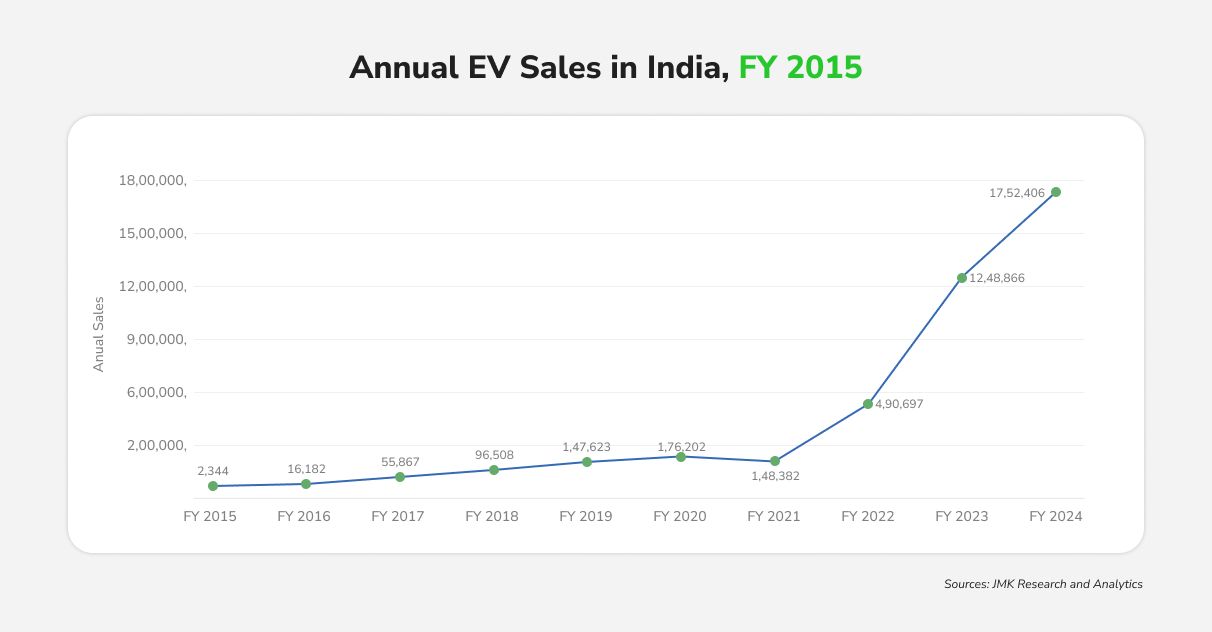
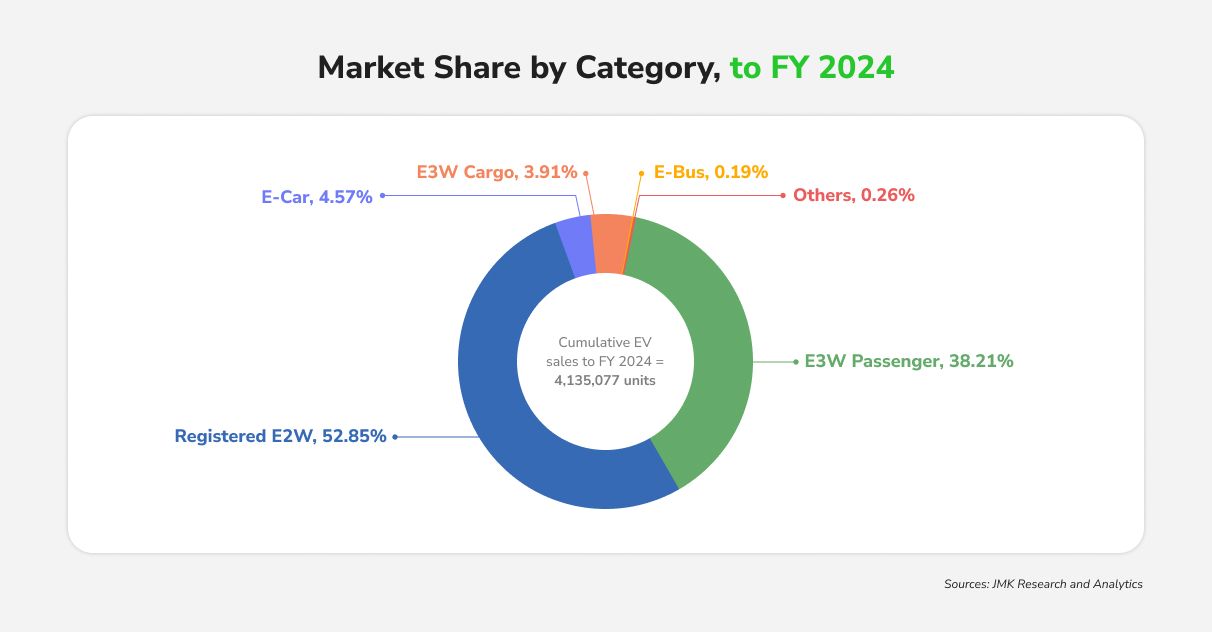
    Over 5.91 million EVs are already on Indian roads as of April 2025, with electric two-wheelers accounting for approx. 59% of sales. Yet charging stations remain relatively scarce roughly 26,000 public chargers serving those millions of EVs, about 1 charger per 235 EVs. By comparison, China has about 1 per 7 vehicles.
    Annual EV sales in India, FY 2016 (1).jpg

    A Confederation of Indian Industry report estimates India will need around 1.32 million charging stations by 2030 to support the expected EV growth. Analysts project India’s EV market could generate over $100 billion in revenue by 2030, and robust charging infrastructure is key to unlocking this opportunity.

    For entrepreneurs and businesses, this gap between EV adoption and charging infrastructure is an invitation. But how to make money with EV charging isn’t as simple as installing a charger and waiting for EV owners to show up. Much like petrol station owners learned to diversify beyond selling fuel, EV charging entrepreneurs must employ smart strategies to maximize revenue.

    In this 5-point guide, we’ll explore how you can earn revenue with EV charging in India, from choosing the right location and pricing model to offering value-added services and leveraging government incentives.

    1. Strategic Location and High Utilization Are Key

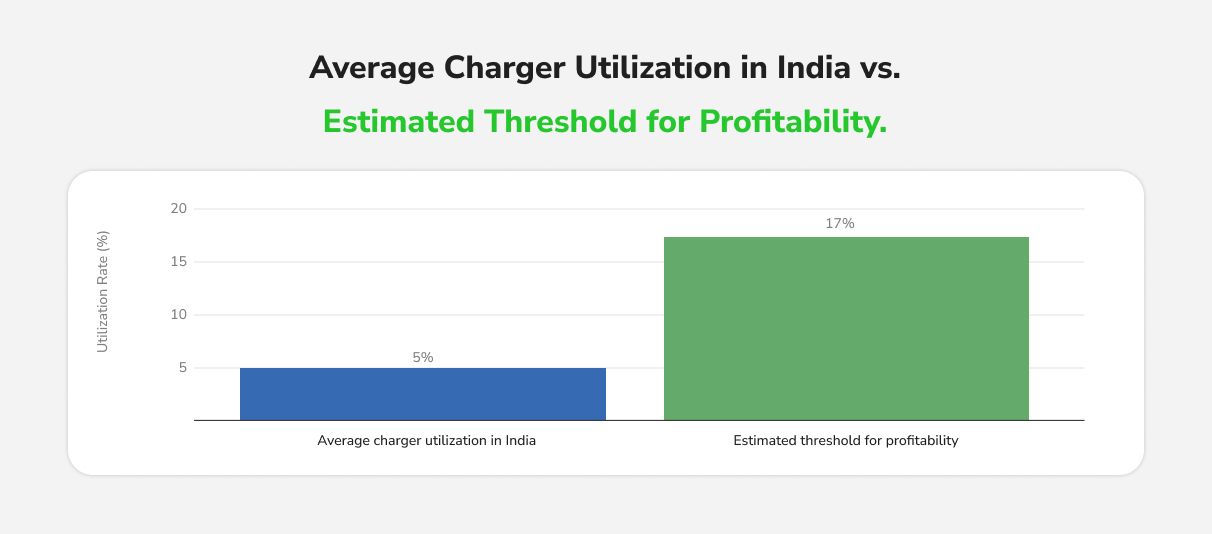
    Just as in real estate, location is the mantra for EV charging stations. A charger’s earning potential is tied to how often it’s used, i.e., its utilization rate. Many charging stations in India today suffer from low utilization, often only approx. 5%, meaning they’re used just a few hours a day.
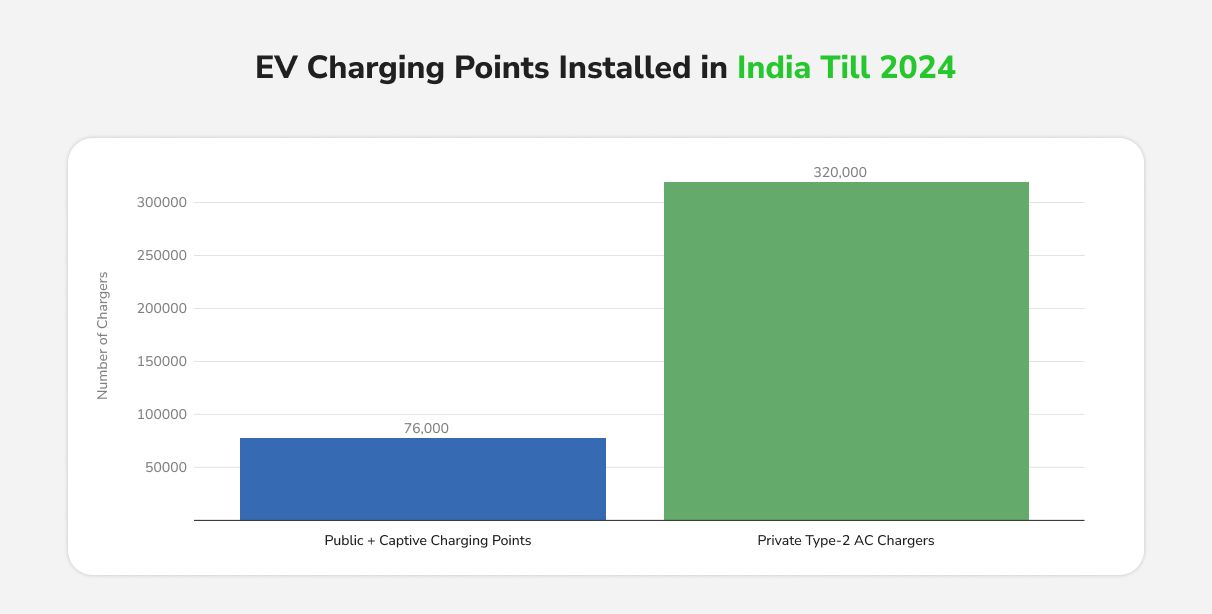
    EV Charging Points Installed in India Till 2024.jpg

    At 5% utilization, a charger sits idle 95% of the time, a recipe for delayed returns. The lesson? Place your chargers where the demand is. High footfall areas bring steady traffic, increasing your revenue potential. A station on a busy highway or in a popular mall is akin to a shop in a crowded bazaar.

    Think about where EV owners spend time. Ideal spots include shopping centers, office complexes, parking lots in dense residential areas, highway rest stops, and petrol pumps adding EV charging. Situating chargers at supermarkets or cinemas means drivers can top up while they shop or catch a movie, turning waiting time into useful time.

    Location also impacts costs and partnerships. If procuring real estate is a challenge, consider creative partnerships. In dense urban neighborhoods, collaborate with local shops or housing complexes. A great example is tying up with small neighborhood stores (kirana shops) for installing charging points. Under a revenue-sharing model, the shop provides space and oversight, while you provide the charger; both parties then share the revenue. This can be a win-win: you secure a prime location with built-in community trust, and the shop benefits from additional foot traffic. The Indian government’s think tanks have even recommended such models, e.g., DISCOMs (electric utilities) partnering with kirana stores in crowded areas to host two-wheeler/three-wheeler chargers.

    Moreover, scale matters. A lone charger might struggle, but a cluster or a network effect can draw more EV users. Many major players are rapidly expanding networks in strategic locations. The goal is to place chargers where EVs are concentrated: urban centers like Bengaluru, Delhi, and Mumbai and along key travel corridors. States like Karnataka and Maharashtra lead in charging point count, reflecting higher EV adoption.

    Finally, uptime and reliability are part of “utilization.” Choose locations with a stable electricity supply (or invest in a good backup). Nothing chases away repeat customers like a charger that’s often “Out of Order”. Treat your charging station like a retail business: a great location, easy accessibility, and reliability will drive higher usage, directly boosting revenue.

    2. Optimize Pricing and Charging Fees

    The most straightforward revenue stream for an EV charging operator is the charging fee, selling electricity as a service. But setting the right pricing strategy can make or break your business. Price too high, and drivers will detour to a competitor; price too low, and you might not cover costs. The key is to optimize pricing and find the sweet spot that attracts customers while ensuring a healthy margin.
    More DISCOMs are rolling out separate TOU slabs for EVs. Typically_.jpg

    In India, public EV charging rates typically range around ₹10–14 per kWh for AC chargers (slow/medium speed) and ₹18–22 per kWh for DC fast chargers. These prices are significantly higher than residential electricity rates (often 2–3× the home charging cost), effectively a “convenience premium”. Many are willing to pay more for the convenience of a fast charge. After all, using a 60 kW fast charger might refill a battery in 40 minutes versus 8 hours at home.

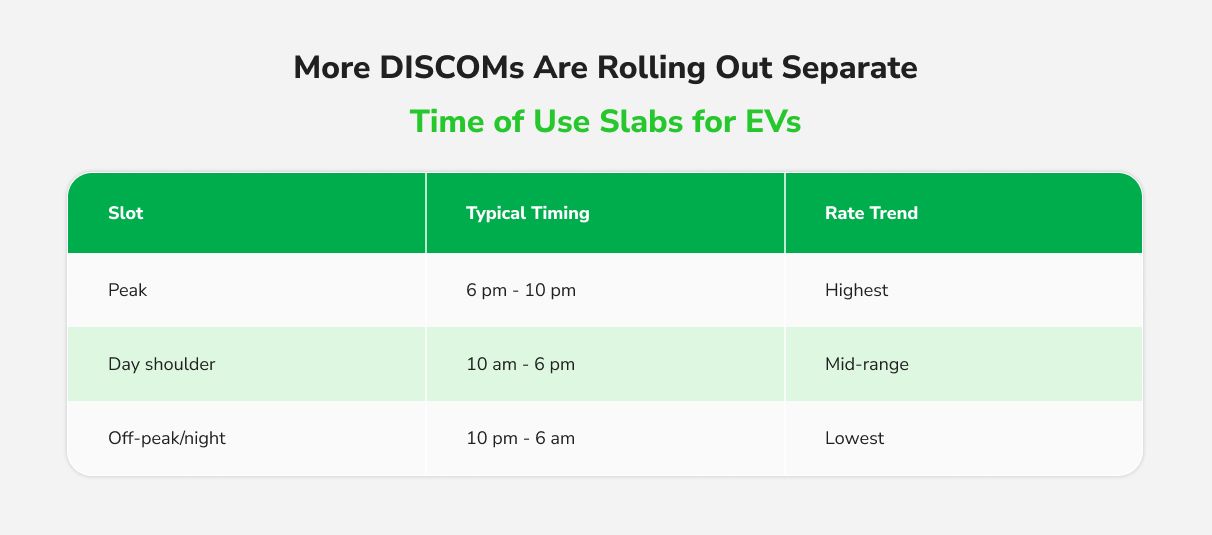
    One smart approach is dynamic pricing, or time-of-use pricing. You can vary charging tariffs based on demand and time of day. Charging during off-peak night hours (e.g., 10pm–6am) might cost 30–50% less than peak hours. Encourage EV charging for fleets or drivers to charge overnight or midday by offering discounted rates, and apply slightly higher rates during the evening peak. This boosts utilization in off-peak times but reduces grid strain.

    Transparency and fairness in pricing are crucial. EV drivers are highly cost-conscious (a difference of ₹1 per kWh adds up over a full battery). Ensure your fee structure is clear, whether you charge per kWh, per minute, or a combination. In India, most public chargers charge per kWh consumed, which is generally seen as fair. You might also consider session fees (a flat start fee) or tiered pricing (the first 15 minutes at one rate and then a different rate) to encourage efficient use.

    Policy trends are nudging prices downward: the central government has recommended guideline tariffs as low as ₹4/kWh for slow charging and ₹7/kWh for fast charging (far below what many operators charge today). While not enforced uniformly, this signals a push to keep EV charging affordable. Also, electricity is often the biggest operational cost. Tapping into special EV tariff plans or sourcing renewable energy can lower your input cost, allowing you to maintain margin even at competitive prices.

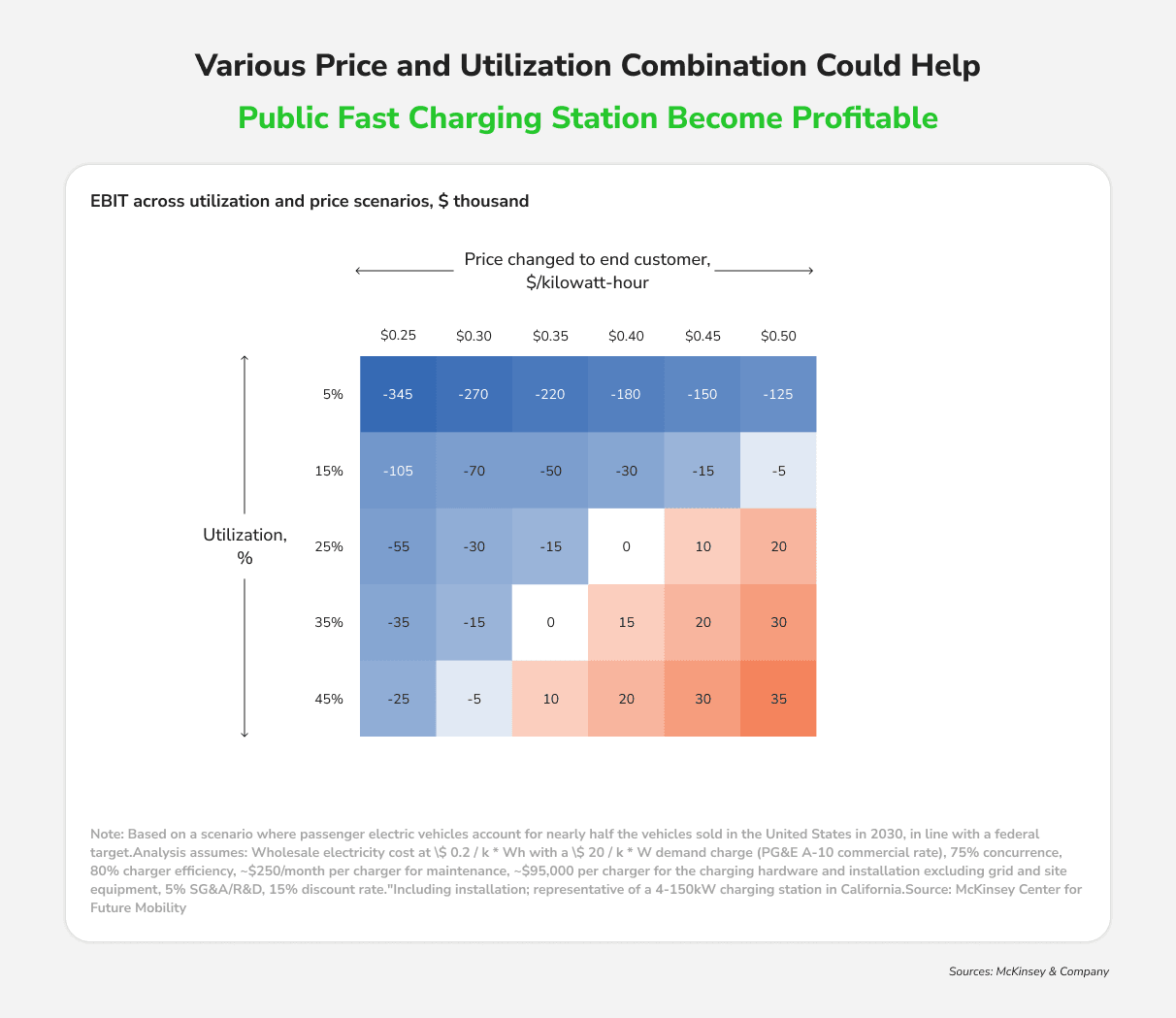
    To illustrate why smart pricing matters, consider an analysis by McKinsey in the US, which showed that public fast-charging stations face challenging economics because utilization is still ramping up. They found that at around 15% utilization (about 7 fast-charge sessions a day), a typical station barely breaks even on operating costs at current prices. The only way to improve this is to increase utilization and optimize pricing, exactly what we’ve discussed.
    utilization.png

    In India’s context, where utilization might be even lower initially, you simply must get more EVs in and charge what the market can bear.

    Bottom line: treat pricing as a strategic tool. Monitor what others charge, stay updated on tariffs, and be ready to adjust. When pricing is done right, you’ll maximize revenue per unit and keep the chargers busy.

    3. Offer Subscriptions and Loyalty Plans for Steady Income

    Would you rather have a customer who uses your charger once in a blue moon or one who uses it regularly? The latter is obviously better for stable revenue. That’s where subscriptions and membership programs come in, a growing trend that can lock in customer loyalty and provide predictable income.

    Many EV charging networks worldwide and in India are introducing subscription plans. For a monthly fee, a member could get discounted rates, some “free” charging credit, priority access to chargers, or the ability to reserve a slot during busy hours. For high-mileage users like fleet drivers or daily commuters, this offers convenience and savings. For the operator, it means predictable revenue and a higher likelihood of repeat usage. As one industry source puts it, offering subscription packages provides predictable revenue streams; customers enjoy cost savings and convenience, while operators enjoy steady income.

    For an EV charging station business, loyalty pays off in multiple ways. Subscriptions can also be tiered (e.g., Silver, Gold, and Platinum plans) for different segments: perhaps a two-wheeler rider might opt for a lower-cost plan, whereas a taxi fleet might pay for a premium plan.

    Don’t forget B2B and fleet partnerships. Strike deals with corporate fleets, cab aggregators, e-commerce delivery companies, or housing societies. If you sign an agreement with an electric taxi company, they might pay you a fixed monthly fee or guarantee a minimum number of charging sessions. This is huge in India, where commercial EV fleets (electric rickshaws, ride-share cabs, delivery vans, etc.) are growing fast. McKinsey has noted that globally, services to support EV charging for fleets are an emerging revenue pool, estimated to be $15 billion annually by 2030 in the US. The same trend will come to India. Fleet operators would rather outsource charging infrastructure. By providing tailored plans, you secure a consistent customer base that keeps your chargers busy day in and day out.

    4. Diversify Revenue Streams: Beyond Just Electricity

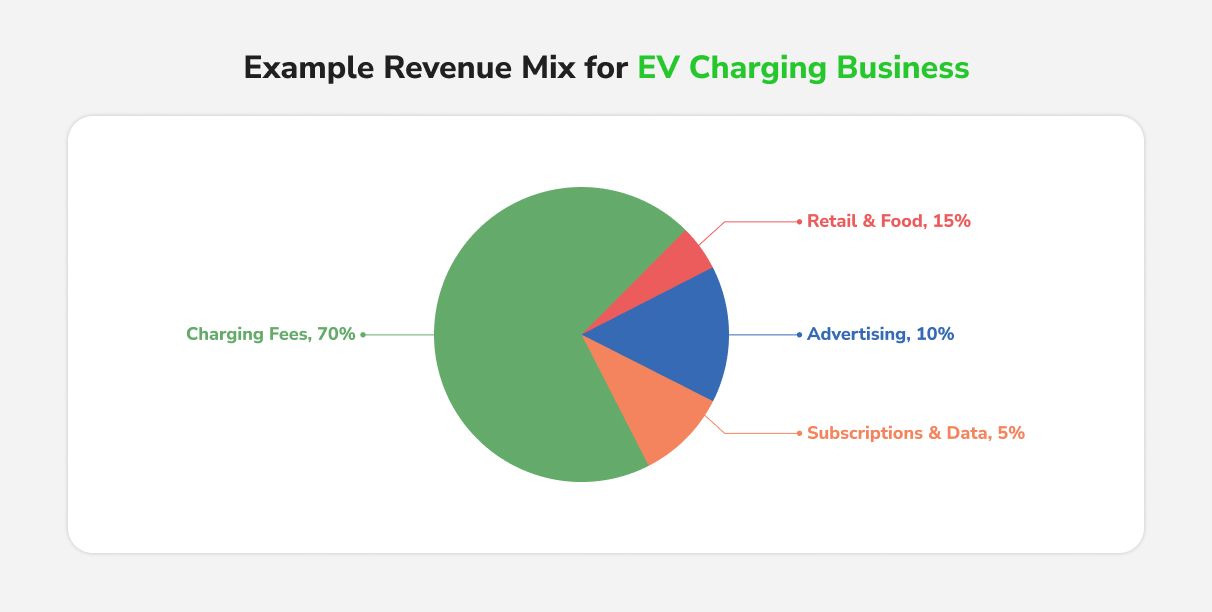
    Charging fees is the core of your business but shouldn’t be the only revenue source. Smart entrepreneurs are turning their stations into multi-faceted hubs. Think of how petrol pumps evolved over the years. They added convenience stores, coffee shops, ATMs, car washes, and even QSR franchises – because selling snacks or offering services can be far more profitable than fuel alone. An EV charging station can be more than a plug; it can be an experience.
    Annual EV sales in India, FY 2018.jpg

    Here are some lucrative side hustles for your EV charging station business opportunities:

    • On-site Retail and Food: A fast charger means 20-40 minutes of dwell time. If you have space, set up a small café or tie up with a food truck. Even a vending machine or a tie-in can entice customers. Remember, at gas stations “snacks, drinks, and everyday essentials have much higher profit margins than fuel”. Make your charging stop a pleasant place to take a break. Some highway charging plazas in India are already doing this, essentially becoming the new-age “charging dhaba” where both car and driver recharge.
    • Advertising and Sponsorship: If your station is in a high-visibility location, monetize that visibility. Digital screens or a big billboard can host ads. Brands that associate with green mobility want visibility; you could host ads for them. This can create an additional revenue stream at very low incremental cost.
    • Value-Added Vehicle Services: Consider offering services like car wash/detailing, tire check, or minor maintenance at your station. An EV may not need oil changes, but basics like tire pressure top-up or windshield cleaning could be offered. If a driver can get their car cleaned while charging, that’s added value (and you can charge for it). These services can be outsourced; perhaps a car detailing company pays you rent or commission to operate at your site on weekends. It’s another way to utilize the time the vehicle is parked and make the station a one-stop shop.
    • Retailing EV Accessories or Products: With EVs, there’s a whole new ecosystem of products – portable chargers, charging cables, adapters, EV-themed merchandise, and even snacks for the road. A small retail kiosk or an automated locker could sell these to drivers. For example, an EV driver might realize they need a better charging cable lock or an extra adapter for a specific socket; if you sell those on-site, that’s instant extra revenue.
    • Partnering with Host Businesses: Earlier we discussed partnering for location (like kirana shops). Such partnerships can also involve revenue sharing on other services. For example, if your charger is at a supermarket parking lot, arrange discounts for users and share revenue. Co-location with retail can drive foot traffic to both the charging station and the store.

    Providing free Wi-Fi or seating might not directly earn revenue but can increase dwell time and customer satisfaction. Some stations internationally are even considering co-working spaces or playgrounds. While those might be big investments, the core idea is to maximize the earning potential of every minute that a vehicle is at your station.

    One more angle: data and technology. Your chargers generate data on usage data. Aggregated and anonymized, this could be valuable for research or utilities. Down the line, there may be opportunities to monetize insights. Even now, some charging providers might partner with map services or EV manufacturers to share station usage stats in exchange for something (not necessarily direct revenue, but increased visibility).

    5. Leverage Government Incentives and Plan for Future Opportunities

    The Indian government is an active enabler, offering incentives, subsidies, and policy support. Take full advantage of these schemes and position yourself for future trends like renewable energy integration.

    Tap into Subsidies and Grants

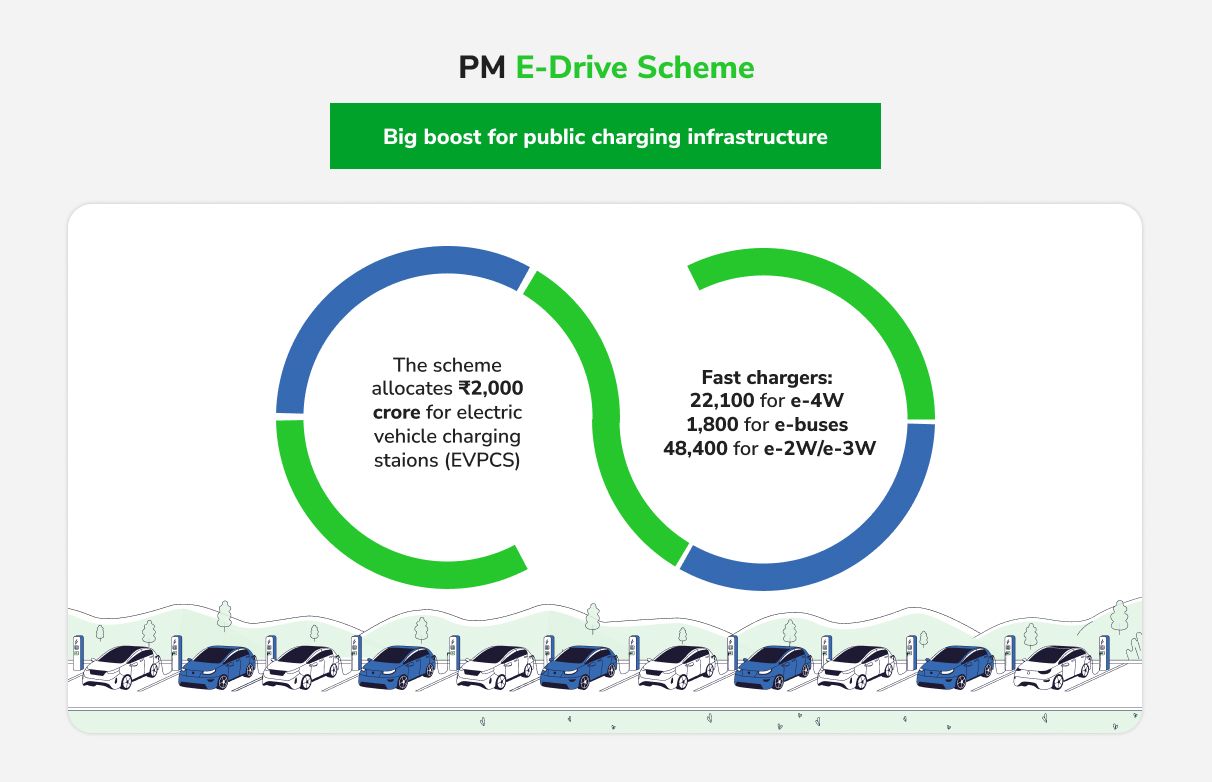
    The FAME-II scheme (Faster Adoption and Manufacturing of Electric Vehicles) allocated subsidies for public charging stations. It earmarked ₹1,000 crore toward installing about 7,000 chargers by 2024. In 2024 the government launched PM E-DRIVE with a ₹10,900 crore (~$1.3 billion) outlay, including ₹2,000 crore for public chargers (22,000+ stations by 2026). These funds are being disbursed as capital subsidies or in public-private partnership models to encourage private players like you to set up stations.

    Translation: there’s potentially money on the table to cover a portion of your charger purchase or installation costs. Keep an eye on EV policies from the Ministry of Heavy Industries and state nodal agencies; they often invite proposals for subsidized projects. If you can get, say, 30-50% of your equipment cost reimbursed by a scheme, your path to profitability becomes much quicker.

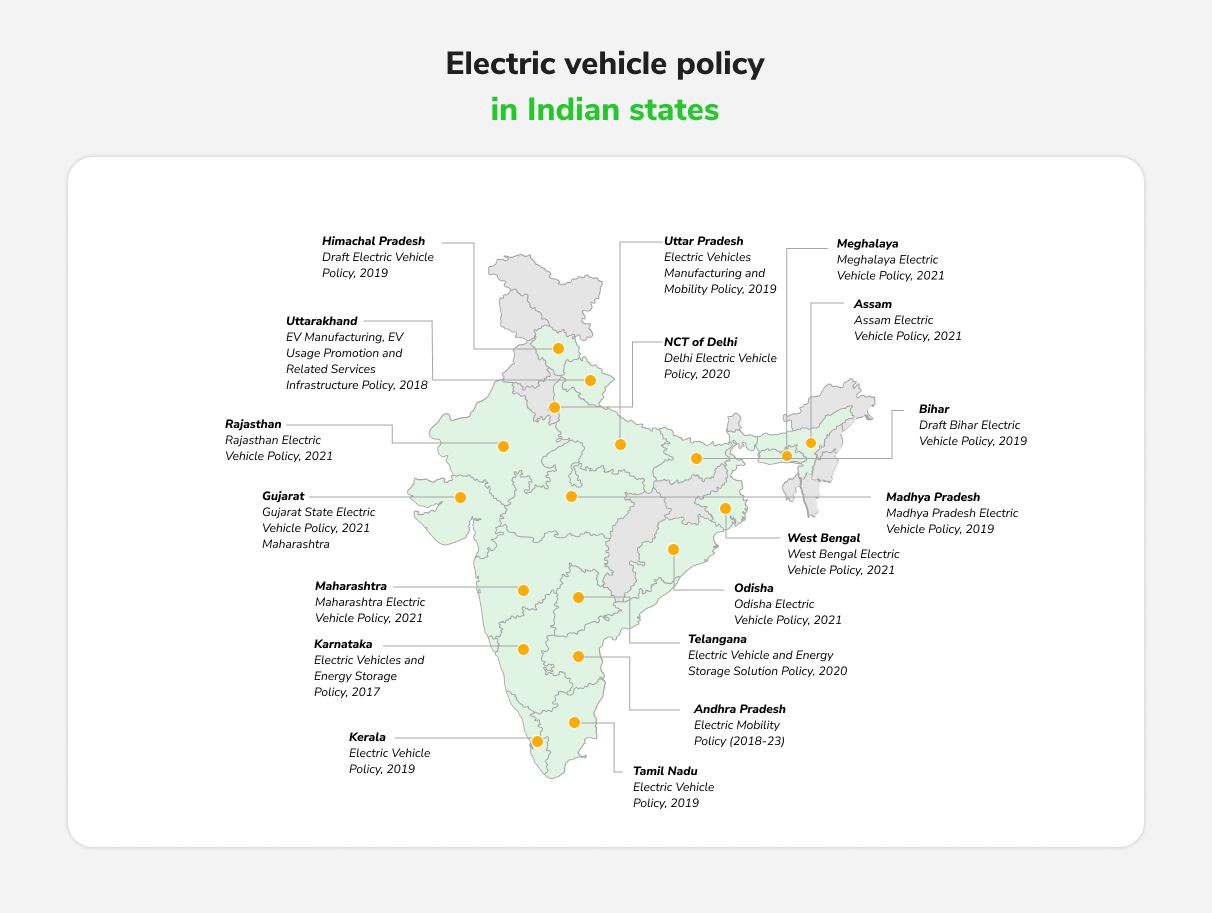
    In addition to central schemes, state governments have their own incentives. Many states, like Maharashtra, Gujarat, Delhi, Telangana, and Tamil Nadu, to name a few, offer perks such as capital subsidies, electricity tariff concessions, discounted land rent, or tax exemptions for charging infrastructure.

    Tax Benefits and Credits

    The government also provides indirect boosts. Tax benefits include lower GST, only 5% GST vs. 18% on petrol/diesel, depreciation benefits, and carbon credit programs. India is developing a carbon credit market; if you power your station with renewable energy or help offset emissions, you might earn tradable carbon credits or Renewable Energy Certificates (RECs). Major corporations in India are also interested in sponsoring green infrastructure as part of CSR or carbon-offset initiatives, meaning you could find corporate funding or partnerships if you position your charging station as 100% solar-powered, for example.

    Speaking of solar, energy management is the future. As your operation grows, consider integrating renewable energy or battery storage at your charging site. For instance, installing a solar PV canopy above the charging bays not only provides shade but also generates power that can cut your electricity bills. Over a year, solar can significantly offset grid consumption, improving your profit margins (after the payback period of panels). Additionally, if your station has battery storage, you can store cheap off-peak power (or solar power) and use it during peak hours, shaving those nasty demand charges and reducing your draw from the grid when electricity is expensive.

    Another government-driven opportunity: participating in grid services or load management programs. Utilities may offer incentives if you help them manage load, e.g., by curtailing charging during peak demand or providing battery backup to support the grid. In the US, some operators earn via energy credits for using renewable power or by enrolling in demand response programs. In India, similar mechanisms will evolve as EV load grows. Keep an ear out for pilot programs by bodies like SECI or state DISCOMs that seek to integrate charging stations into smart grid projects.

    Final Thoughts

    Earning revenue from EV charging in India is a multifaceted game, one that blends infrastructure, customer-centric services, and policy alignment.

    To recap our journey:

    • Choose your locations wisely and drive utilization through the roof; an idle charger is a money pit, while a busy charger is a cash register that keeps ringing.
    • Get your pricing right. Not just right in terms of covering costs, but strategically right to attract and retain customers. Don’t shy away from innovative pricing models that reward off-peak use or loyal users.
    • Cultivate loyalty and lock in recurring revenue with subscriptions or fleet contracts; this provides stability in a growing yet volatile market.
    • Don’t just sell electricity, sell convenience, sell comfort, sell services, and sell eyeballs (to advertisers)! Diversifying your revenue streams can often be the difference between a barely-breaking-even station and a thriving, profitable enterprise.
    • Lastly, ride the tailwinds provided by government and technology. Take every incentive you can and be ready for the next wave (be it a new subsidy, a new battery tech, or a new way to monetize energy).

    In conclusion, by following this five-point guide and keeping a keen eye on market trends, you can do more than just keep the lights on; you can charge up substantial profits while playing a pivotal role in India’s clean mobility revolution. Your EV charging business can fuel (or shall we say, electrify) not only vehicles but also your entrepreneurial success.

    After all, the vehicles of the future are electric, and they all need a charge. Both you and the nation stand to gain by making that charge as accessible, efficient, and rewarding as possible.

  • Universal EV Chargers Explained:Solving the Fragmented Charging Ecosystem

    Universal EV Chargers Explained:Solving the Fragmented Charging Ecosystem

    Electric vehicles (EVs) are becoming mainstream worldwide, yet EV owners still face the issue of a fragmented charging ecosystem. The reason? Multiple unstandardized connectors.

    Unlike gasoline cars that accept the same fuel nozzle, EVs lack a single “universal EV charger” that works with every EV model.

    Let’s understand this with an example: India’s EV market is dominated by two- and three-wheelers, but there are over 10 different charging connectors used across EV brands.

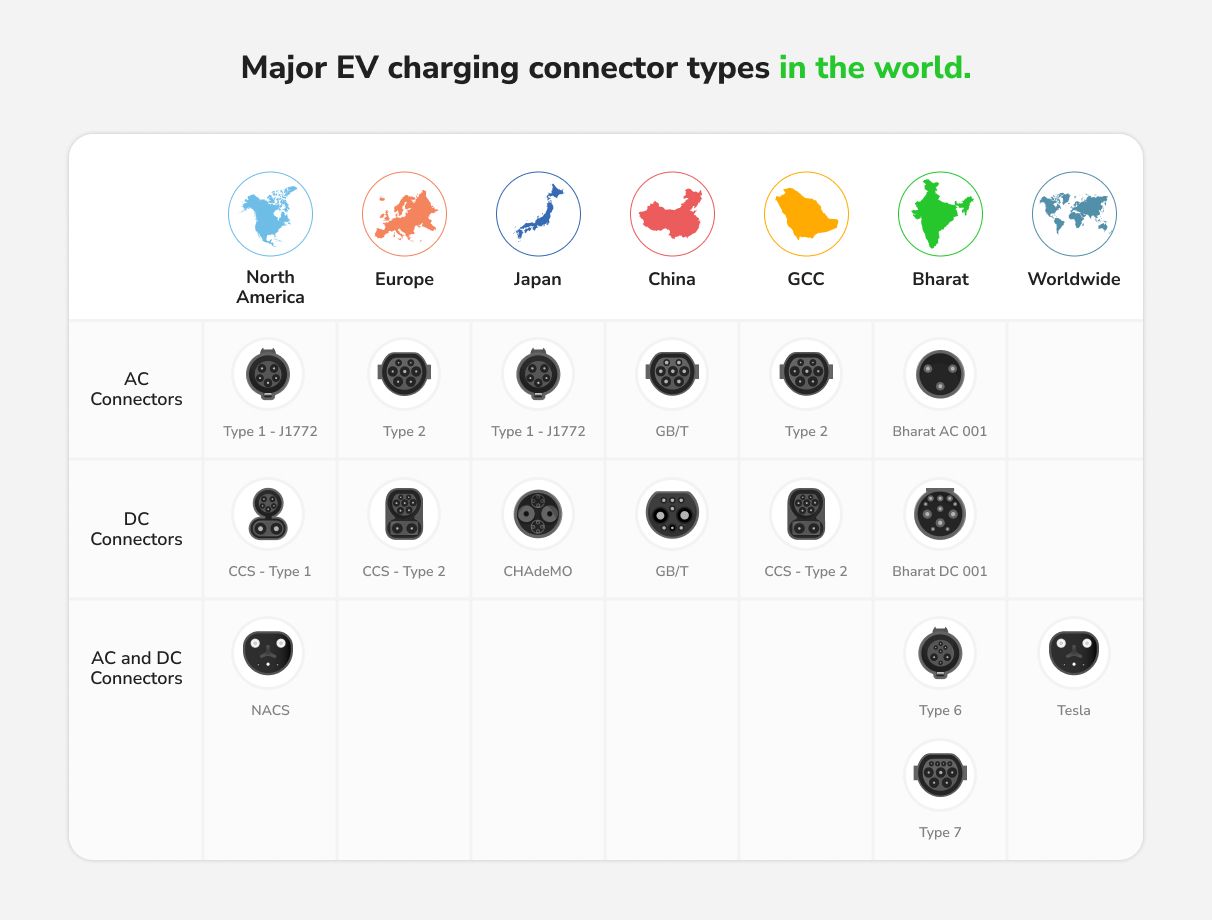
    Globally, EV charging solutions employ a patchwork of connector standards. From CCS and CHAdeMO to Tesla’s NACS and China’s GB/T, these connectors make EV charging interoperability a serious challenge.

    Read this blog to get answers for three key questions:

    • What are the major EV charging connector standards, and why isn’t there a universal plug?
    • How do compatibility and interoperability challenges arise from this fragmented landscape, globally and in India?
    • What efforts are underway to standardize EV charging and move toward a more universal, interoperable ecosystem?

    What Are the Major EV Charging Connector Standards, and Why Isn’t There a Universal Plug?

    EV charging standards evolved regionally, leading to a patchwork of connector types rather than one universal EV charger design.

    Different countries and vehicle segments adopted their own plugs for historical, technical, or policy reasons. This resulted in the issue that there is no “one-size-fits-all” EV connector today. Thus, it’s essential to understand the key standards in use around the world. Figure 1 illustrates this regional diversity of EV charging connectors.
    Creative 3.jpg

    Now, let’s briefly understand the major EV charger connector standards and who uses them:

    Type 1 (SAE J1772)

    Creative 1.jpg
    Type 1 charger is a five-pin AC charging plug standard in North America and Japan. It supports single-phase AC at up to approx. 19 kW. Virtually every American and Japanese EV (except Tesla) has a Type 1 inlet for Level 1 and 2 AC charging. Its limitation is single-phase only and no automatic lock. Older European and Indian cars sometimes had Type 1, but Europe moved to Type 2. Tesla provides adapters so its cars can use type 1 chargers.

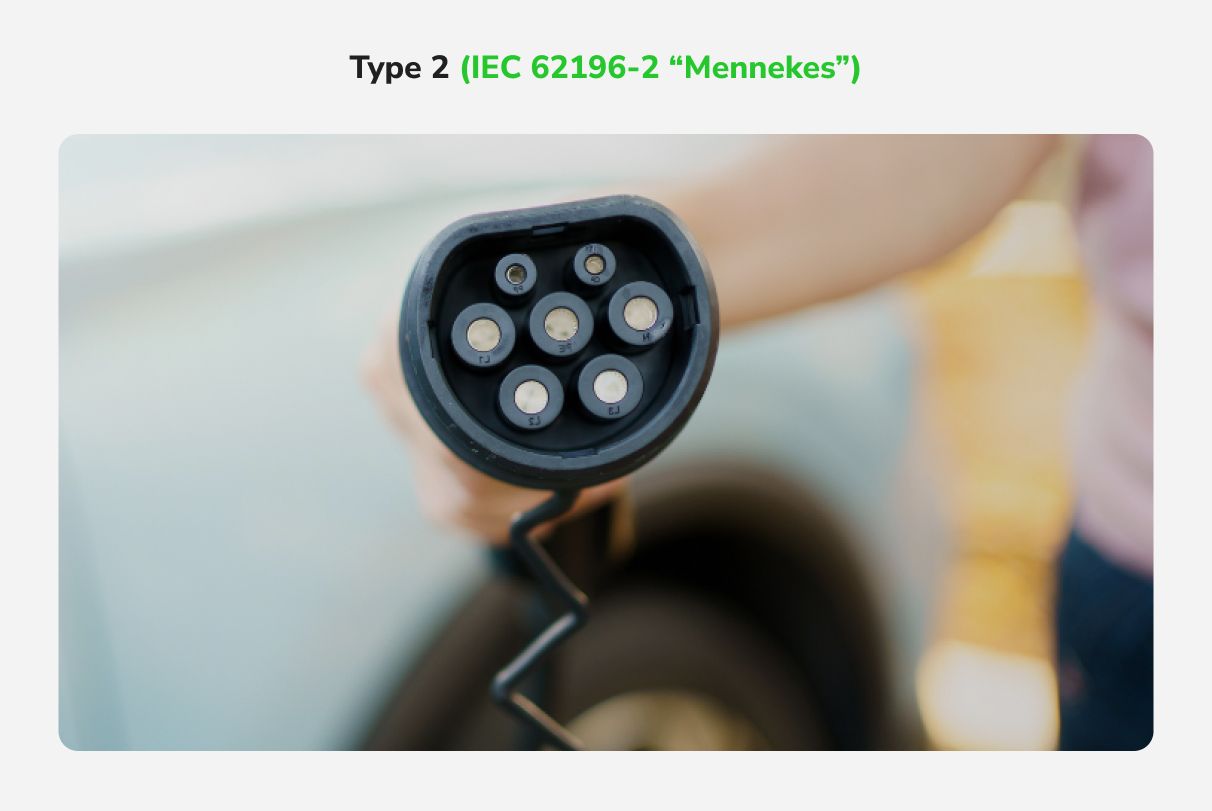
    Type 2 (IEC 62196-2 “Mennekes”)

    Creative 4.jpg
    Type 2 is a seven-pin AC plug standard in Europe (and adopted in many other regions, including India, for AC charging).

    Type 2 handles single- or three-phase AC (up to 22 kW on 3-phase) and features an automatic locking latch. Since 2018, all new European public chargers use Type 2 for AC, and even Tesla in Europe switched to the Type 2 design for compatibility. Likewise, India too uses Type 2 for AC charging.

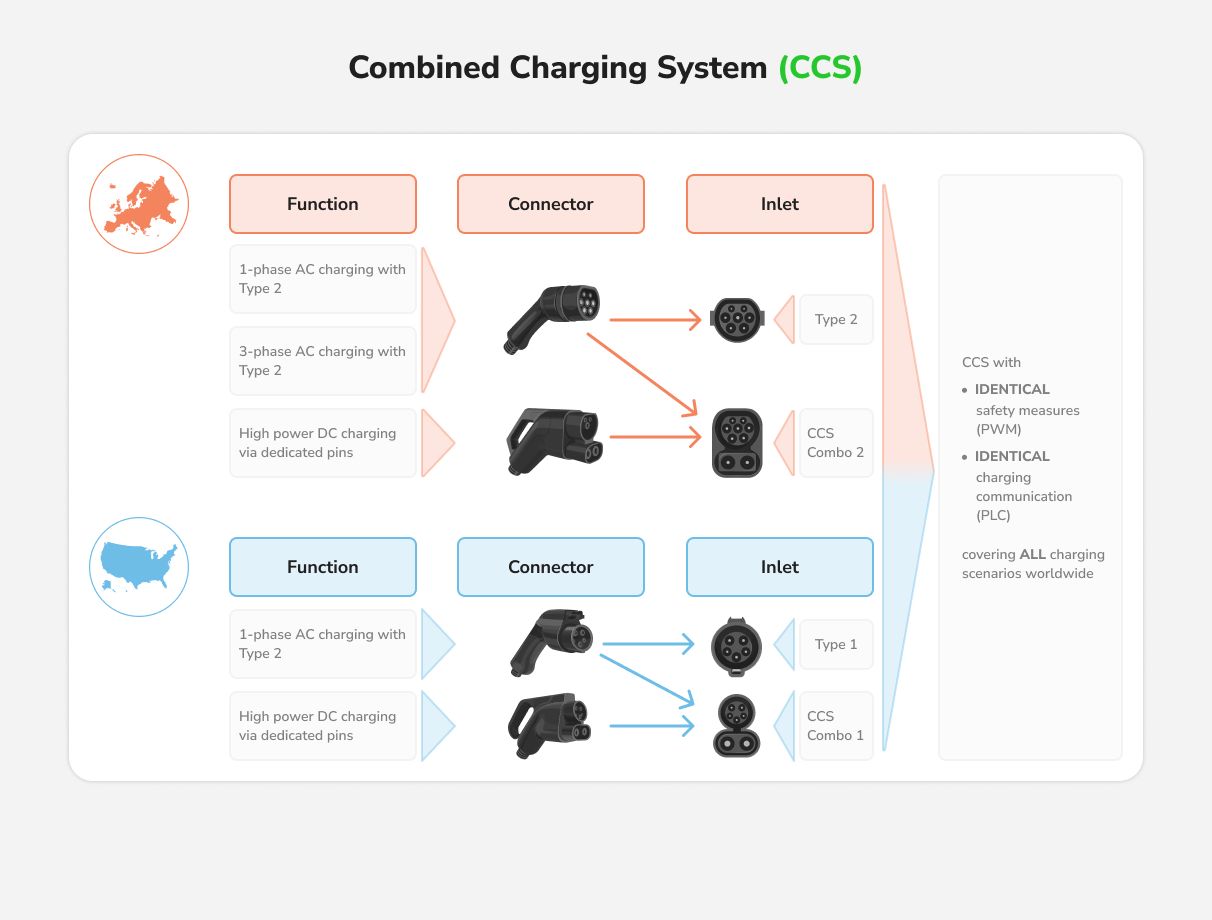
    Combined Charging System (CCS)

    Creative 2.jpg
    CCS is a “combo” connector that combines AC and DC pins into one port, allowing both slow AC and fast DC charging through the same inlet. It exists in two variants:

    • CCS1 (Type 1 combo), popular in North America (the upper half comes with Type 1 with two DC pins added below)

    CCS has become the most popular DC fast-charging standard globally for cars. The advantage is it requires only one vehicle socket for all charging, unlike older systems that need a separate port for DC. Europe mandates that every new public fast charger must include at least one CCS connector, and automakers are abandoning incompatible formats in favor of CCS.

    India has also mandated CCS2 as the standard for DC fast charging on four-wheelers, aligning with the global trend.

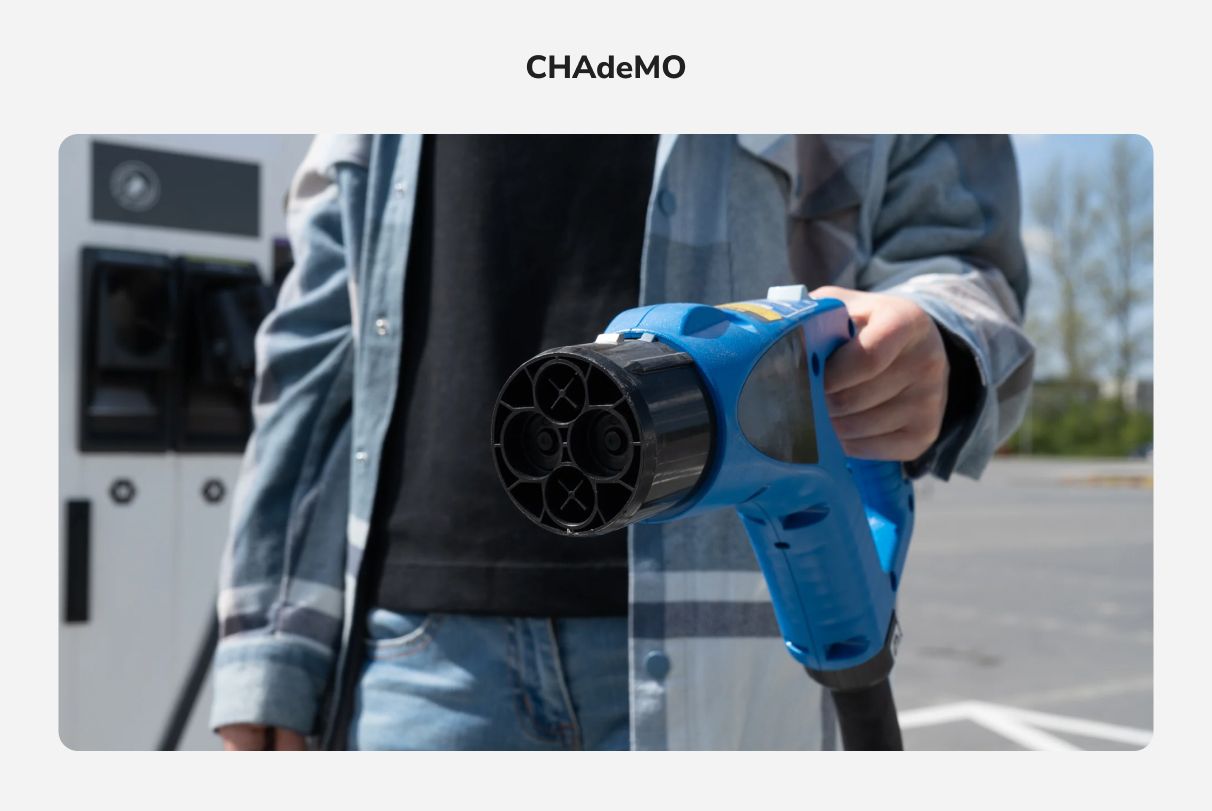
    CHAdeMO

    Creative 5.jpg
    CHAdeMo is a dedicated DC fast-charging connector developed in Japan (the name stands for “CHArge de MOve”). It was an early DC standard (released 2010) and can support high power (up to 400 kW in the latest specs). Japan uses CHAdeMO widely for DC charging, but globally CHAdeMO is declining. Only a couple of current car models still use CHAdeMO, and notably Nissan has switched its new EVs from CHAdeMO to CCS in North America.

    In Europe, CHAdeMO stations are dwindling as EU policy and automakers move toward CCS. In India, it is only supported by a few older Japanese models and is rarely used today.

    Notably, CHAdeMO requires a separate AC port on the car, whereas CCS unifies AC/DC into one port. The CHAdeMO consortium is now working with China on a next-gen ultra-fast connector called “ChaoJi” to support up to 900 kW, which could become a future standard in Asia.

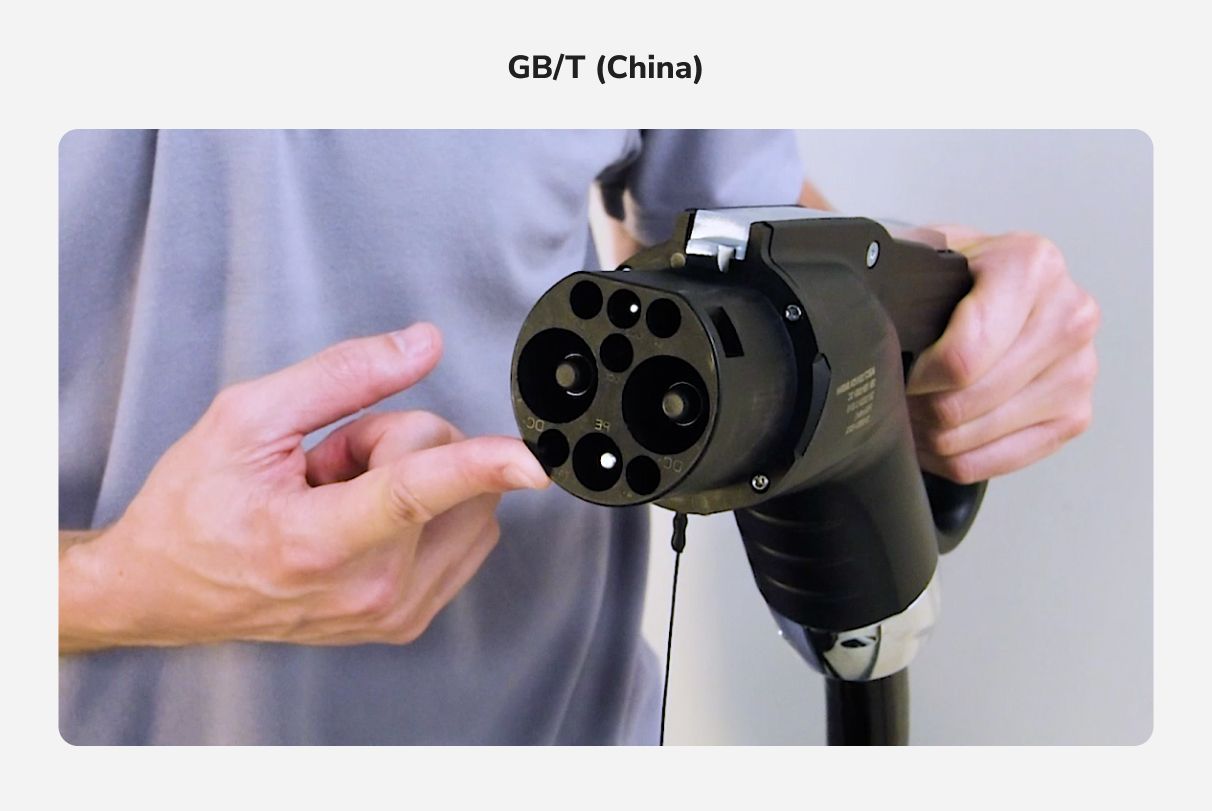
    GB/T (China)

    Creative 6.jpg
    China chose its own national standards (Guobiao/T, “GB/T”) for EV charging. China’s GB/T AC connector looks similar to Type 2, but is wired differently (not cross-compatible), supporting up to approx. 7 kW AC single-phase. The GB/T DC connector is entirely separate and supports high power, up to approx. 237 kW in its current form, with a future 900 kW via ChaoJi.

    Having a single standard helped China build the world’s densest charging network and 60% of the global EV stock. However, GB/T is essentially unique to China, so EVs exported from China must adapt to CCS or other plugs, and foreign vehicles in China need adapters.

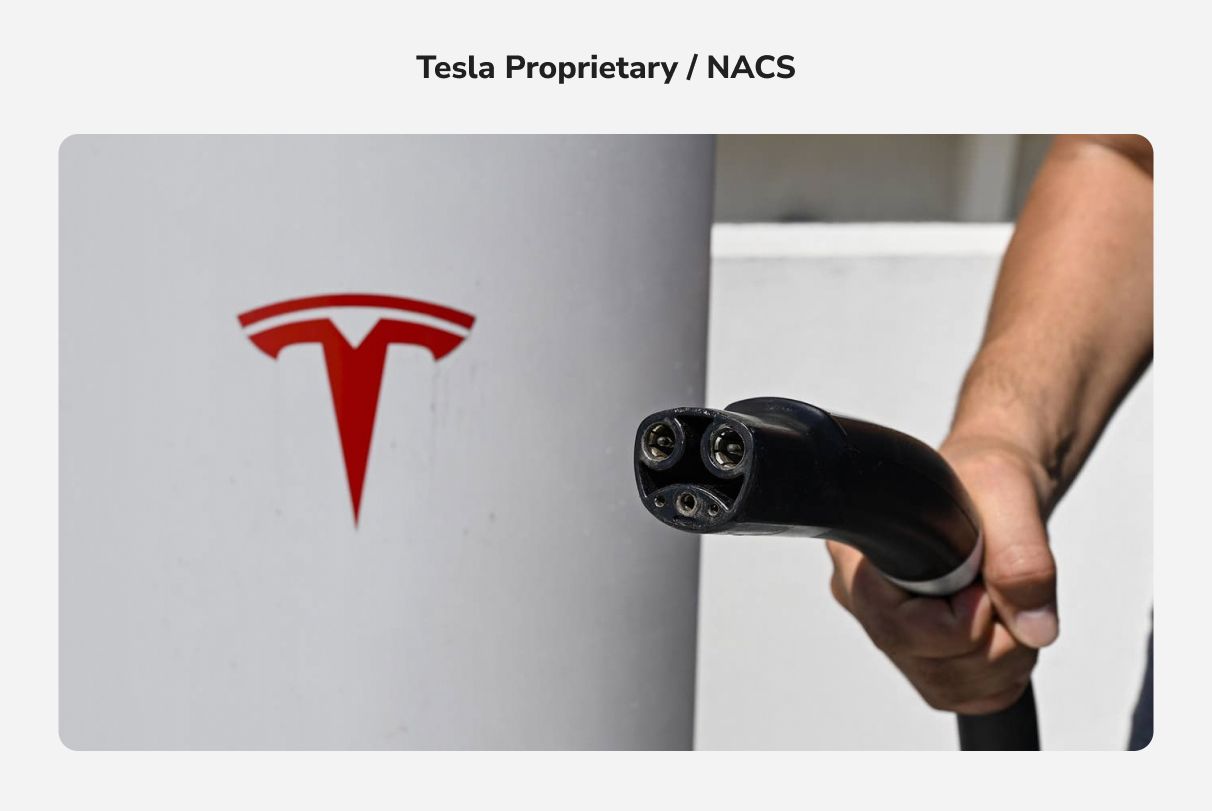
    Tesla Proprietary / NACS

    Creative 7.jpg
    Tesla historically used proprietary connectors. In North America, its slim connector supported both AC and DC charging (up to 250+ kW). In 2022, Tesla opened this design as NACS (North American Charging Standard), and by late 2023, major US automakers like Ford and GM announced plans to adopt NACS ports on future EVs.

    This marks a significant convergence; the US market may coalesce around NACS alongside legacy CCS1. In Europe, Tesla conforms to local standards (using Type 2 / CCS2), as required by EU regulations. In China and Japan, Tesla provides adapters or modified ports (e.g., for China’s GB/T). So while Tesla’s connector unified its own network, only recently has it begun shaping a broader industry standard, at least in North America.

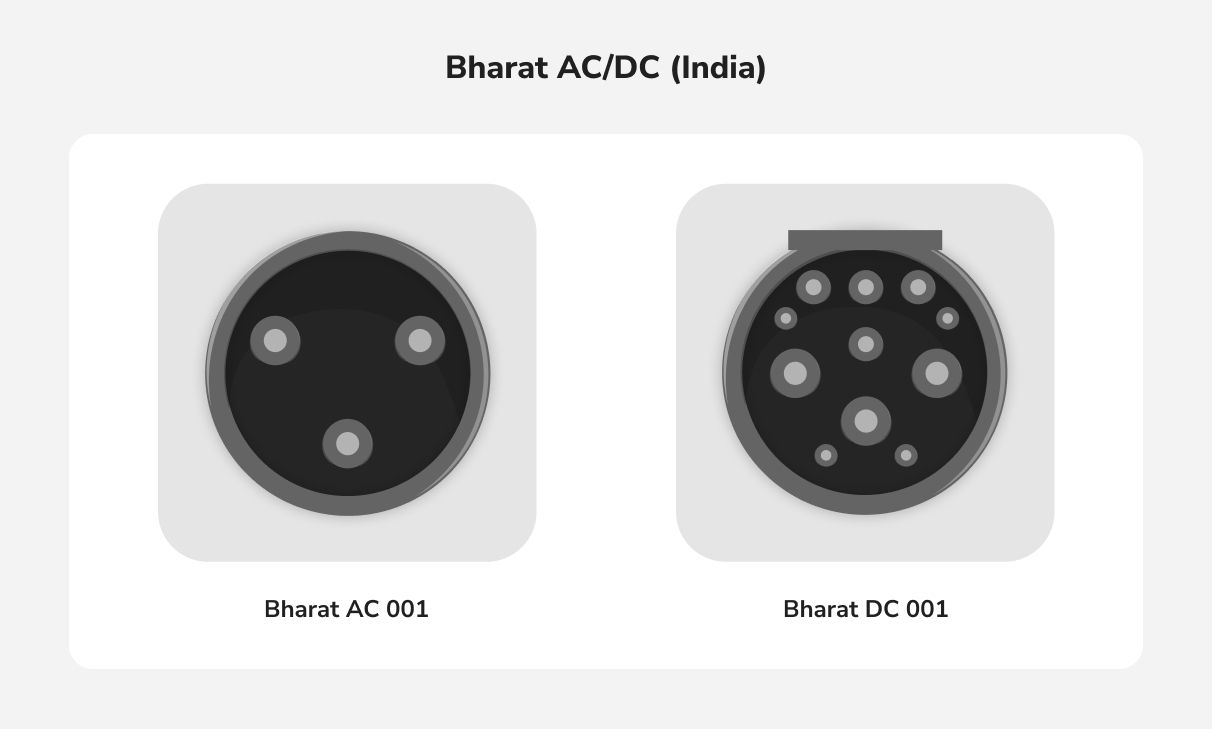
    Bharat AC/DC (India)

    Creative 8.jpg
    India initially developed the Bharat EV Charger standards (AC001 and DC001) for affordable charging of light vehicles. AC001 is a 3.3 kW AC charger with three 15A sockets, aimed at two-wheelers and auto-rickshaws.

    DC001 is a modest DC fast charger up to 15 kW (72–200 V, 120A) for e-rickshaws, three-wheelers, and small cars. It uses a simple India-specific connector.

    These standards were a pragmatic early solution but limited in power. As the market matured, India pivoted to global standards like CCS2 for cars while continuing to support Bharat DC001 for smaller vehicles. Many public chargers now offer CCS2 for cars plus Bharat DC001 outlets.

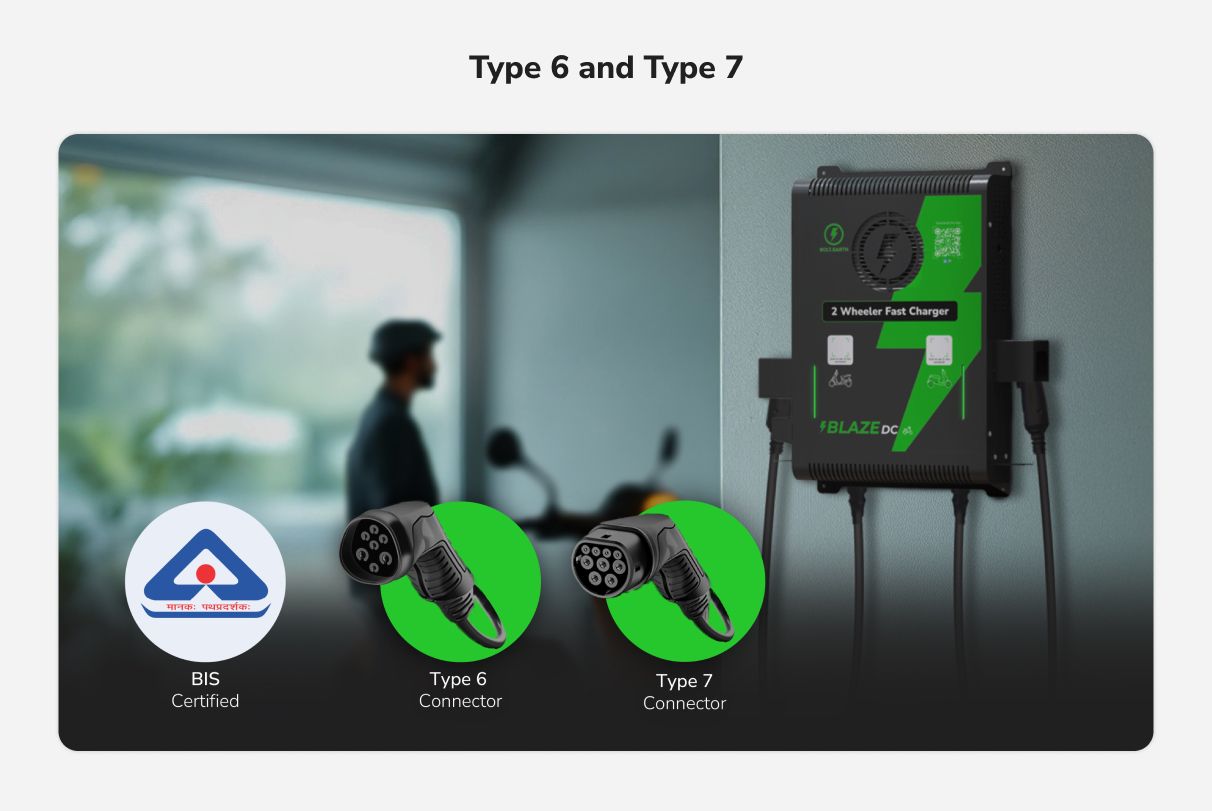
    Type 6 and Type 7

    Creative 9.jpg
    India’s 2W and 3W charging ecosystem has been highly fragmented, but change is underway. In 2023, BIS introduces Type 6 and Type 7 connectors (IS17017 series) as national standards.

    Hero MotoCorp’s Vida V1 scooters have adopted the Type 7 connector so far.

    How Do Compatibility and Interoperability Challenges Arise From This Fragmented Landscape, Globally and in India?

    The patchwork of charging standards creates significant compatibility challenges for EV owners, charging providers, and manufacturers. Key problems include physical incompatibility, communication issues, and a more complex infrastructure. Here are some of the major challenges:

    Inconvenience for EV Owners

    If you drive an EV, the charger must match your vehicle’s inlet, and with multiple plug types, that’s not always the case. In the US, Tesla and CCS1 vehicles need adapters to use each other’s chargers.

    In Europe, CHAdeMO-equipped cars like Nissan Leafs struggle with CCS-only stations, forcing drivers to carry bulky adapters or hunt for the right charger. As one expert put it, “When you go up to your gas pump, you know it’s going to work with your car. But you don’t have the same experience with your charger.” This uncertainty fuels range anxiety and user frustration.

    In India, the problem is especially acute for two-wheelers: an Ola scooter (Type 6) cannot use an Ather charger (Type 7), and vice versa. Most 2W/3W OEMs still rely on proprietary plugs, leaving public fast-charging networks closed to competitors. Riders are often left stranded despite available infrastructure.

    Infrastructure Complexity and Cost

    Charging service providers (CPOs) must accommodate multiple standards, increasing hardware cost and maintenance. Many public fast-charging stations end up offering multiple cables: e.g., a US station might have CCS1, CHAdeMO, and NACS, and an Indian station might need CCS2 for cars plus separate outlets for Bharat DC001 and Type 6/7 for two-wheelers.

    Interoperability and Communication Issues

    Physical plugs are one aspect; EV charging interoperability also requires communication standards between the car and charger. Different fast-charge systems use different communication protocols. CCS uses PLC digital comms via the cable, CHAdeMO uses CAN bus, and GB/T has its own protocol. These are not inherently compatible, making it difficult for chargers to serve all vehicles without supporting multiple communication stacks.

    Creative 14.jpg

    Software and Payment Fragmentation: Proprietary networks often require specific apps or RFID cards. In India, efforts like the Unified Energy Interface (UEI) aim to enable roaming and unified payments, but until such systems mature, fragmentation remains a barrier.

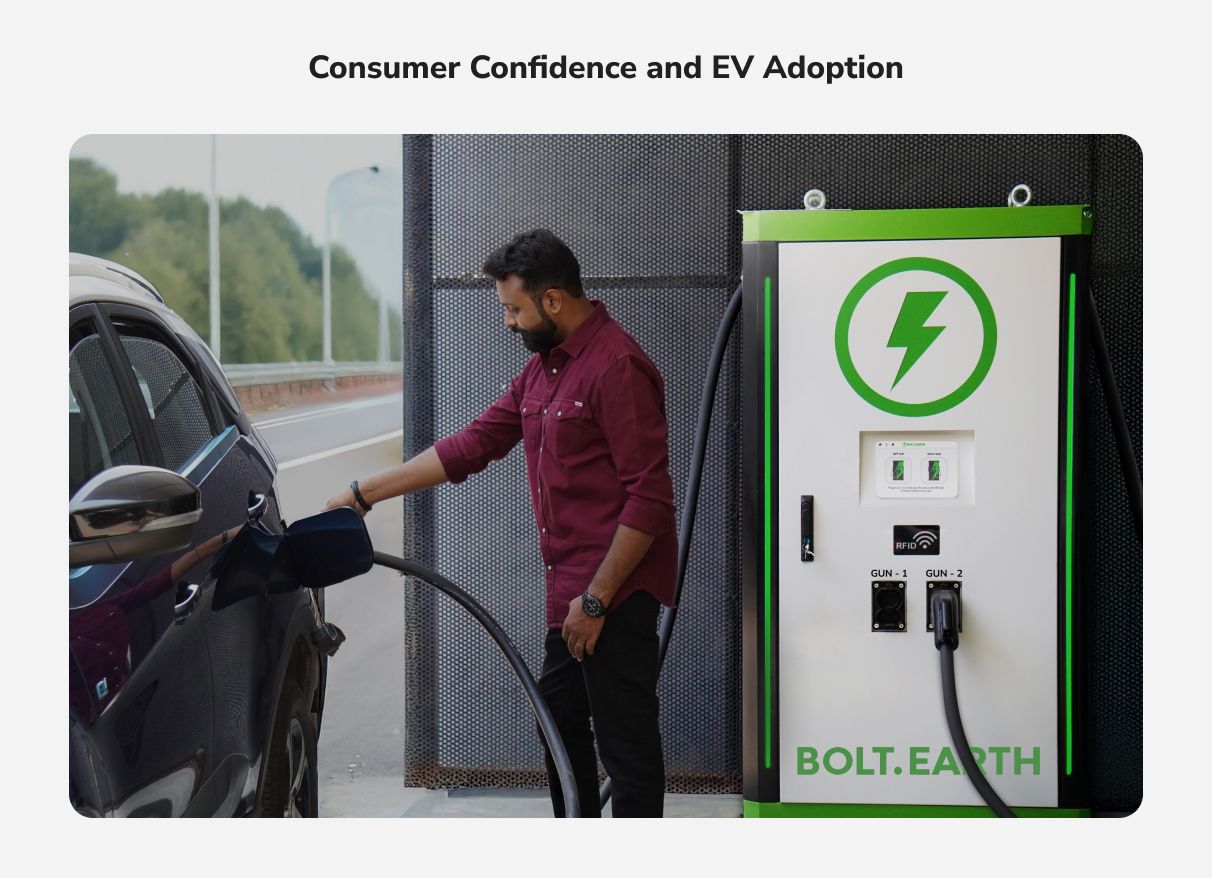
    Consumer Confidence and EV Adoption

    Creative 12.jpg
    Charger incompatibility continues to slow EV adoption. Surveys show that charging logistics and reliability are top concerns for consumers considering EVs. If potential buyers hear that “you might not find a compatible charger on a trip” or encounter broken, brand-specific infrastructure, they hesitate. A fragmented ecosystem forces EV owners to plan more carefully, checking connector types and station compatibility, which adds friction to the experience.

    In India, this challenge is especially common in the two-wheeler segment. The lack of a standard connector initially forced many users to rely only on home charging. While public fast chargers existed, they were often exclusive to specific brands due to proprietary plugs and protocols. This siloed approach has hindered the development of shared, inclusive charging infrastructure.

    What Efforts Are Underway to Standardize EV Charging and Move Toward a More Universal, Interoperable Ecosystem?

    With the downsides of fragmentation now evident, global efforts are underway to standardize EV charging and improve interoperability. While a single “USB-C moment” for EVs may still be elusive, consolidation around dominant standards and supportive policy frameworks is encouraging progress.

    Consolidation Around Dominant Standards

    The industry is gradually converging on fewer connector systems.

    • In the US, a major shift in 2023 saw Tesla’s NACS gain broad support. Ford, GM, Mercedes, Honda, and others are committed to NACS ports, while networks like Electrify America and ChargePoint agreed to add NACS cables. The US is now simplifying to two systems – CCS1 and NACS, with NACS likely becoming the default.
    • China remains unified under GB/T, with the ChaoJi project aiming to merge CHAdeMO and GB/T into a single ultra-fast standard for the region. Japan continues to support. CHAdeMO domestically but export CCS-equipped models.

    Policy and Mandates for Interoperability

    Governments are pushing standards to fix charger compatibility. In Europe, CCS is mandated for all new fast chargers. India has aligned with global norms by requiring CCS2 for DC and Type 2 for AC, while CHAdeMO is permitted only for legacy use. Policies also encourage multi-standard chargers to ensure no vehicle is stranded. The PM e-drive incentives and the draft battery swapping policy emphasize interoperable solutions across brands.

    In the US, federal NEVI funding initially required CCS1 on subsidized chargers, but with NACS gaining traction, regulators are revising rules to mandate open access, likely requiring both CCS and NACS. Some states have even proposed making NACS mandatory to further reduce fragmentation.

    Standardization in India’s Light EV Segment

    India’s 2W/3W charging ecosystem has been among the most fragmented, but meaningful progress is underway. In 2023, the BIS introduced Type 6 and Type 7 connectors (IS:17017 series) as national standards.

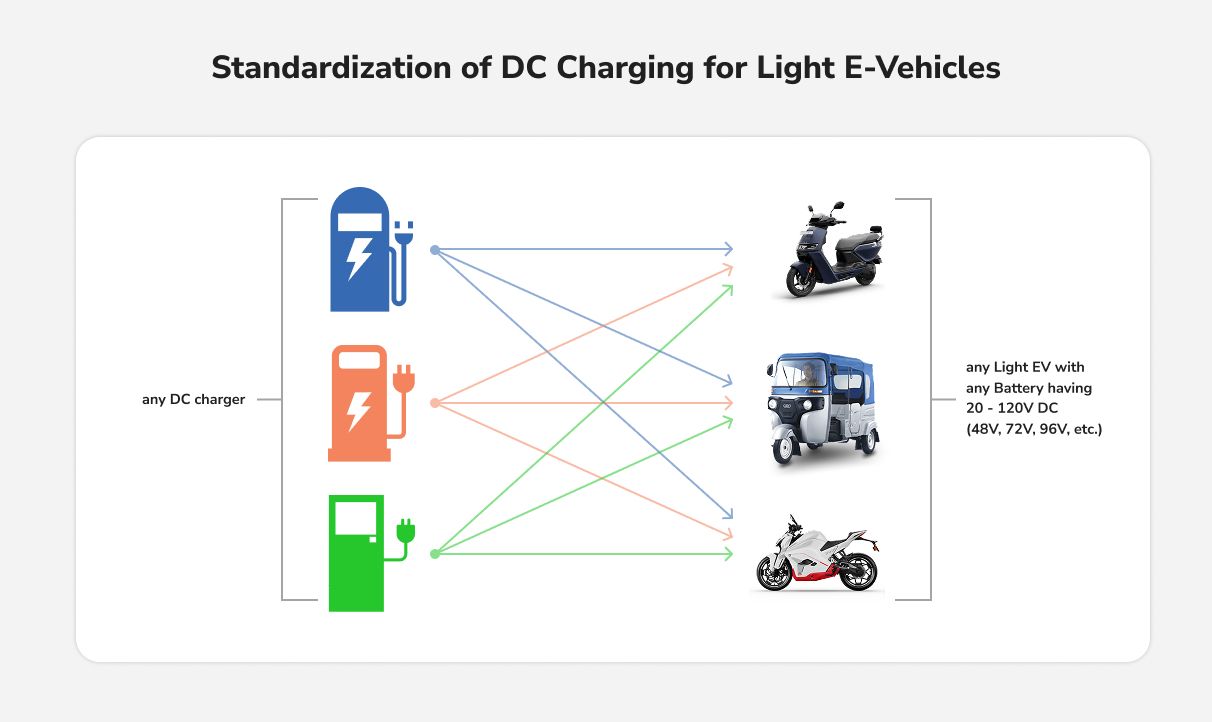
    The Bharat Charge Alliance is backing Type 6 as the common DC fast-charge interface for scooters, bikes, and rickshaws, with Ola, Tork, and others already onboard. This would allow a vehicle from one brand to charge on another’s fast charger seamlessly.

    Meanwhile, Ather’s Type 7 combined AC/DC port is also standardized, with adoption by Hero MotoCorp’s Vida scooters proving interoperability on Ather’s public chargers. Over time, the 10+ proprietary connectors used by 2W OEMs are expected to consolidate into just these one or two, simplifying public charging deployment.

    India’s approach highlights the power of industry collaboration: competitors aligning on open standards that benefit the entire sector, much like the mobile industry’s convergence on USB charging.

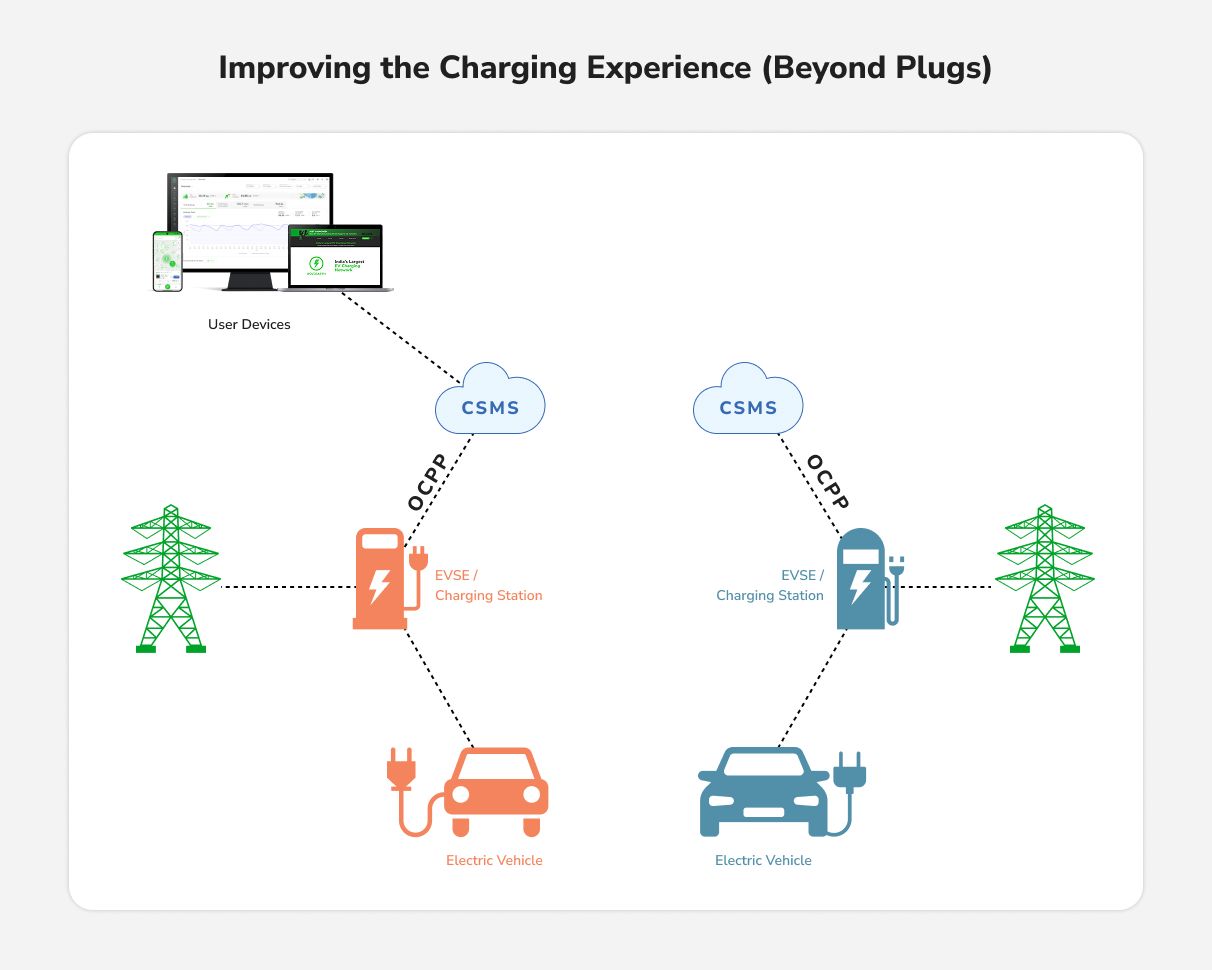
    Improving the Charging Experience (Beyond Plugs)

    Plug and Charge: Achieving a “universal EV charger” goes beyond hardware; it requires a seamless user experience. A key step is ISO 15118 / Plug & Charge, which lets EVs and chargers authenticate and initiate charging automatically, without apps or cards. Supported by many new EVs and CCS/Tesla chargers, it works across connector types using cryptographic certificates.

    Creative 13.jpg

    OCPP and UEI: On the network side, Open Charge Point Protocol (OCPP) enables chargers and backends from different vendors to communicate. In India, a Unified Energy Interface (UEI) is being rolled out to let drivers locate and pay for any charger through a single interface. Together, these advances tackle the software side of EV charging interoperability, making today’s patchwork of networks feel more universal to users.

    Final Thoughts

    The world may never settle on a single EV connector, but the clutter is giving way to clarity. Within a few years, two or three standards will dominate: CCS, China’s GB/T/ChaoJi, and NACS in North America, supported by adapters and harmonized protocols. Initiatives like the Megawatt Charging System show that global cooperation is possible from the start.

    The lesson is simple: EV charging interoperability unlocks adoption. As automakers, governments, and networks align, EV charging solutions will shed their complexity and become as effortless as refueling, only cleaner, smarter, and more universal.

  • EV Charger Certifications in India: Ultimate Guide to 3 Major Types, Uses, and How to Get Them

    EV Charger Certifications in India: Ultimate Guide to 3 Major Types, Uses, and How to Get Them

    Electric vehicle (EV) adoption in India is growing by the day, and with it, the number of public charging stations has jumped fivefold from about 5,151 in 2022 to over 25,000 by early 2025. While the rapid growth is good news for EV owners, it raises critical questions about safety, reliability, and regulatory clarity, issues that are increasingly being addressed through EV policy in India.

    In recent years, there have been incidents of fires and safety scares involving EVs and charging stations. For example, an EV caught fire while charging in Surat in 2022. Such events underscore why certification of EV chargers is non-negotiable to ensure every charger is safe, reliable, and interoperable, as EV charging infrastructure in India scales rapidly by the day.

    Consider this real scenario: In 2023, an Indian startup developed a DC fast charger that could recharge a car in under 45 minutes. Yet, they couldn’t bring it to market because the product lacked mandatory certification. Whether you’re a manufacturer, a charge point operator (CPO), or an installer, missing a required certificate can halt your entire operation. For EV charging station manufacturers, this can mean delayed launches, missed tenders, and lost credibility.

    In this comprehensive guide, we answer three key questions about EV charger certifications in India:

    • What certifications are required for EV chargers in India, and how can you obtain them?
    • Why are these certifications important, and who needs them (manufacturers, importers, CPOs, installers)?
    • What certifications apply to different types of EV chargers (from slow AC to high-power DC setups)?

    By the end of the blog, you’ll have a clear roadmap of the certification landscape for navigating EV charger approvals in India.

    1. BIS Certification – Mandatory Approval for EV Chargers

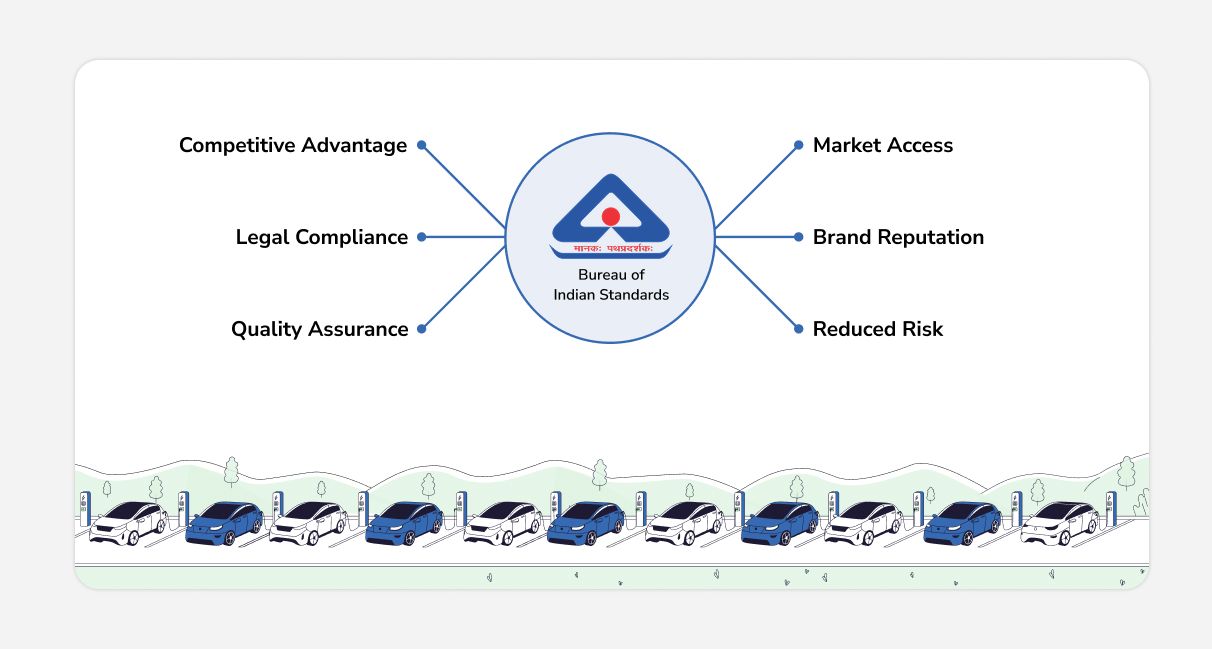
    The Bureau of Indian Standards (BIS) certification is mandatory for all EV chargers sold or imported in India. It sets the IS 17017 standards covering AC/DC chargers, connectors, communication, and safety, aligning them with global norms like IEC 61851 and 62196. For consumers, it guarantees safety against shocks, fire hazards, and overcharging, while ensuring chargers from different manufacturers work seamlessly. For businesses, BIS compliance is non-negotiable: manufacturers, importers, and charge point operators must only deal in BIS-certified equipment to avoid penalties, meet subsidy requirements, and assure reliability.
    1 (9).jpg

    Standards covered: The cornerstone is IS 17017, which has multiple parts:

    • IS 17017-1: General requirements for conductive charging (based on IEC 61851-1).
    • IS 17017-2 series: Covers specifics for AC and DC charging equipment.
    • IS 17017-21 & 22: Electromagnetic compatibility (EMC) requirements for chargers.
    • IS 17017-25: Special requirements for light EV DC chargers (low-power DC).
    • Bharat EV Standards: Early Indian standards Bharat AC-001 (AC charger up to 10 kW) and DC-001 (15–30 kW DC charger) are referenced in IS 17017. These were interim standards for EVSE in India and are largely superseded by newer IS/IEC standards, but are still seen in some legacy installations.

    How to Get BIS Certification

    2 (4).jpg
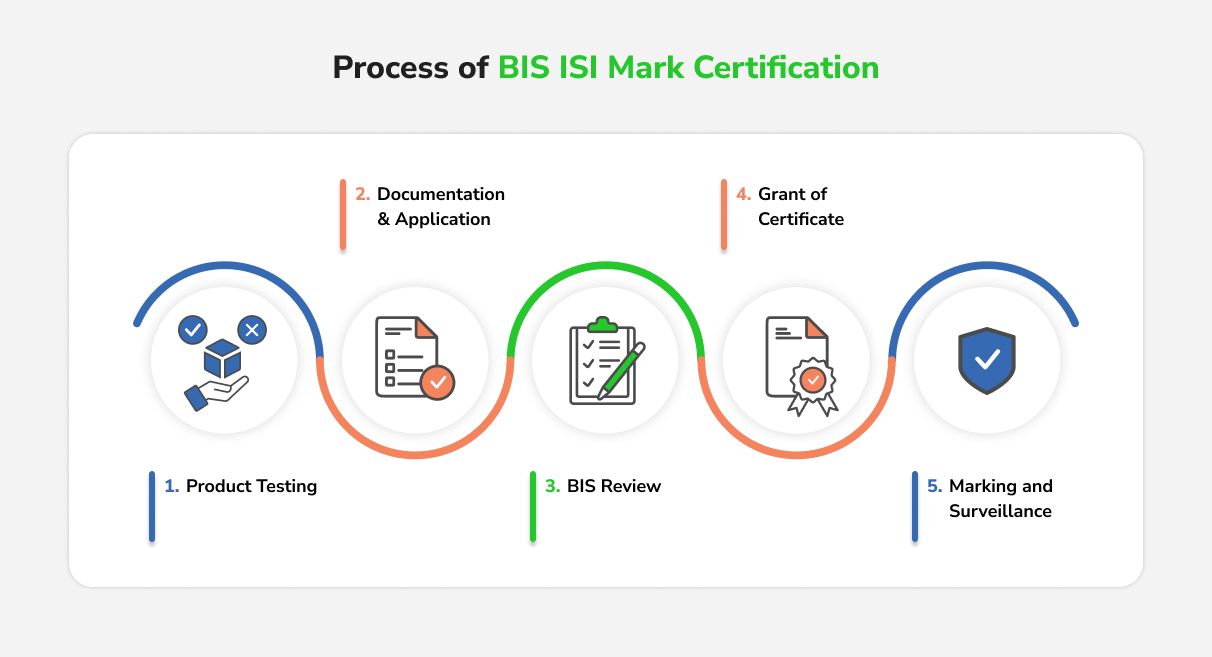
    The process follows the Compulsory Registration Scheme (CRS) of BIS.

    Getting a BIS certification for EV chargers involves product testing in a BIS-recognized NABL-accredited lab or the Foreign Manufacturers Certification Scheme (FMCS) for overseas players. BIS then reviews the reports, raises clarifications if needed, and grants a registration number once satisfied. Certified chargers must display the BIS mark, and manufacturers remain subject to periodic surveillance audits or random testing to ensure compliance. The registration is valid for two years initially and can be renewed for up to five years, provided the product remains unchanged and updated test results are submitted.

    2. ARAI and AIS Standards – Testing for Automotive-Grade Safety

    3 (10).jpg

    The Automotive Research Association of India (ARAI) and the International Centre for Automotive Technology (ICAT) introduced the first technical standards for EV chargers in India: AIS-138 Part 1 (for AC chargers) and Part 2 (for DC chargers). These laid the foundation for today’s BIS standards (IS 17017 series).

    An ARAI certification shows that a charger has passed stringent safety and performance tests. While not legally mandatory like BIS certification, it plays a critical role in establishing credibility with OEMs, CPOs, and consumers. For any EV charging solutions company aiming to work with enterprise clients or government sectors, this certification can be considered a key differentiator.

    Standards covered: AIS-138 is comprehensive and divided into two parts:

    • AIS-138 Part 1: Covers AC charging stations – general and safety requirements for charging an EV from a standard AC supply. This includes protection against electric shock, metering (if any), connector standards, etc., for AC modes (similar in scope to IEC 61851-1 for AC and Mode 1/2/3 charging).
    • AIS-138 Part 2: Covers DC charging stations – requirements for off-board DC fast chargers, including the communication between charger and vehicle, connector standards (CCS2, GB/T as applicable), and safety features.

    AIS-138 has been harmonized with the BIS IS 17017 series, ensuring consistency across certifications. Think of BIS as the driving license to operate in India, and ARAI approval as an advanced skill certificate for your chargers.

    Additionally, Indian regulators have notified that new vehicles in certain categories must use interoperable charging inlets per standards, making sure vehicle inlets match standards like CCS2 or Bharat specs. This ensures that what the vehicle expects and what chargers provide (as tested by AIS/BIS) are in sync.

    How to Get ARAI/ICAT Certification

    To obtain ARAI certification, manufacturers must submit their charger to ARAI, ICAT, or an NABL-accredited lab with technical specs, where it undergoes safety, performance, environmental, and interoperability tests as per AIS-138 (or relevant IS/IEC). Once approved, the agency issues a compliance certificate or test report that can be used as official proof, often publicized by companies, that the charger meets required standards.

    Tip: If you plan to supply to government projects or want an extra badge of credibility, budget for an ARAI/ICAT test. Their certification is widely respected in the industry, as it essentially vouches that “this charger meets all safety and performance criteria under Indian conditions.” While for many stakeholders, ARAI certification isn’t mandatory, it can open doors. Think of BIS as the driving license to operate in India, and ARAI approval as an advanced skill certificate that further validates your product.

    NABL Accreditation (for Test Labs)

    4 (5).jpg
    One common point of confusion when it comes to certifications is the role of NABL (National Accreditation Board for Testing and Calibration Laboratories). NABL doesn’t certify chargers; it accredits the labs that conduct BIS and ARAI testing. This means that any product testing for certification must be done in an NABL-accredited lab.

    From a manufacturer’s perspective, you must ensure that the lab you choose has NABL accreditation for the relevant IS/IEC standards to avoid delays or invalid results.

    3. Other Indian Compliance Requirements

    Beyond product certifications like BIS and ARAI, there are a few additional requirements and best practices to be aware of when deploying EV chargers in India. These may not always come in the form of a certificate, but they are important for legal and safe operations:

    Central Electricity Authority (CEA) Guidelines

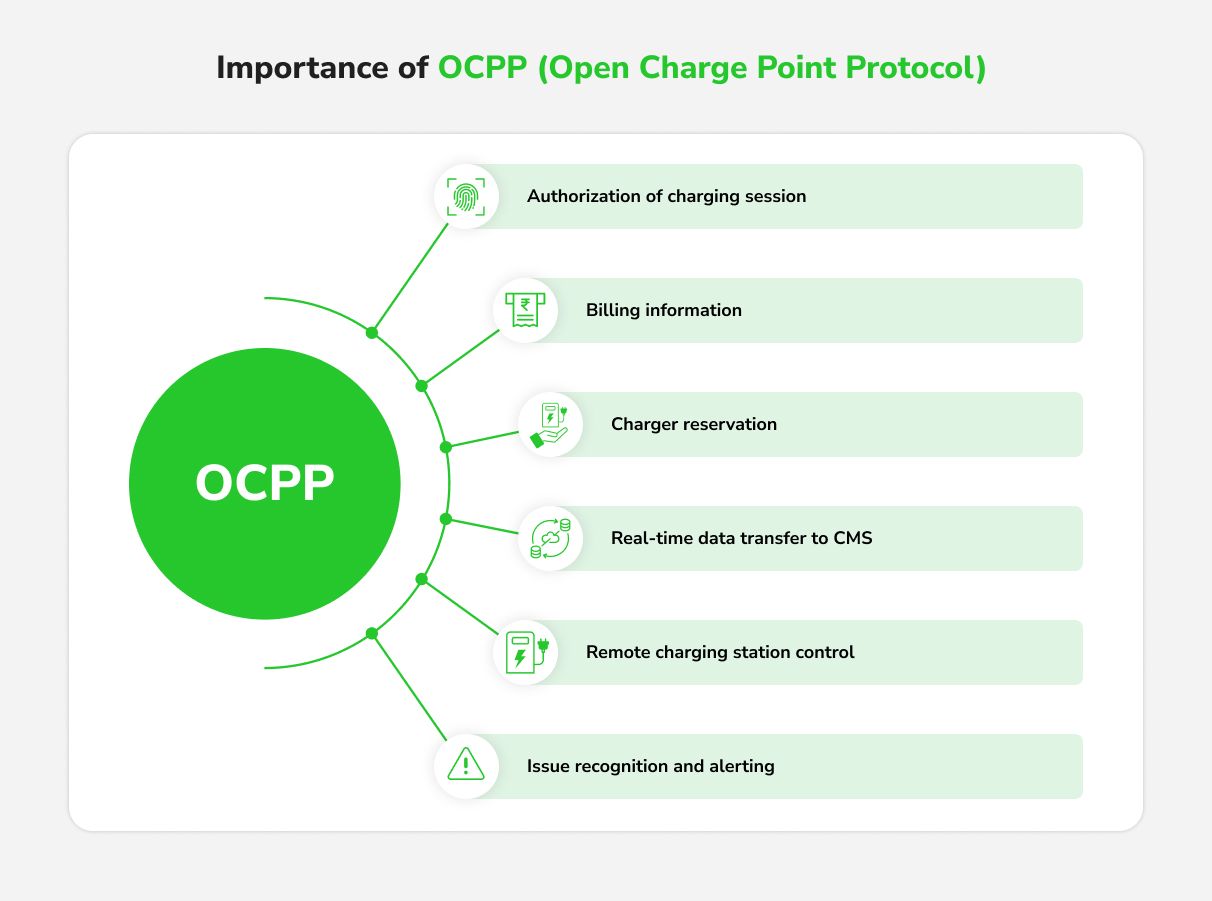
    The CEA and Ministry of Power have issued guidelines for EV charging infrastructure in India to ensure a robust and interoperable network. These guidelines mandate open communication protocols like OCPP/OCPI for networked chargers.
    5 (4).jpg
    As an operator or installer, you should ensure the chargers you install can support these protocols if they are to be networked. Many modern chargers in India come with OCPP compliance out of the box, and some even seek OCPP certification from the Open Charge Alliance to guarantee compatibility.

    Electrical Safety and Installation Approval

    Installing high-power charging stations may require inspection and approval by local electrical authorities. In many Indian states, any electrical installation above a certain load (often 10 kW) needs a sign-off from the Chief Electrical Inspector to the Government (CEIG) or equivalent authority. This is to ensure the wiring, earthing, and protection systems at the site are safe and meet the Electrical Safety Standards. So, if you’re an installer setting up, say, a 50 kW DC fast charger, you might need to submit the installation drawings and charger specifications to the Electrical Inspectorate and obtain an approval or No Objection Certificate (NOC) before commissioning. Always check the local state regulations – some states have made this process straightforward for EV charging, given it’s a de-licensed activity, but compliance with electrical norms is still required.

    Metering and Energy Billing Compliance

    For public charging stations that bill users per kWh, the accuracy of the energy meter is critical. While India doesn’t yet have a specialized “EV charger metering law” like Europe’s Eichrecht, it’s good practice to use energy meters that are certified under the Indian Legal Metrology Act (for accuracy class) if you charge customers. Some chargers integrate approved meters; otherwise, a separate utility-grade meter might be used. This ensures transparency and avoids disputes over billing accuracy.

    Environmental and Fire Safety Norms

    If chargers are installed in enclosed or sensitive locations (e.g., indoor parking, basements), local fire department NOCs might be needed. Ensure that installations have proper ventilation, fire extinguishers or suppression systems as recommended, and follow any guidelines in the National Building Code for EV charging areas. While not a product certification, following these norms can be life-saving and is increasingly being written into local bylaws.

    Your charging station as a whole might include various certified components. Equipment like cables, connectors, and surge protectors must conform to IS/IEC standards and carry ISI marks to ensure reliability and safety.

    Real-World Examples: What Certification Looks Like in Practice

    To understand how these certifications apply in real scenarios, let’s compare two cases – a 3.3 kW home charger vs a 120 kW public fast charger:

    Example 1: 3.3 kW AC Home Charger (Bharat AC001 or similar)

    6 (2).jpg
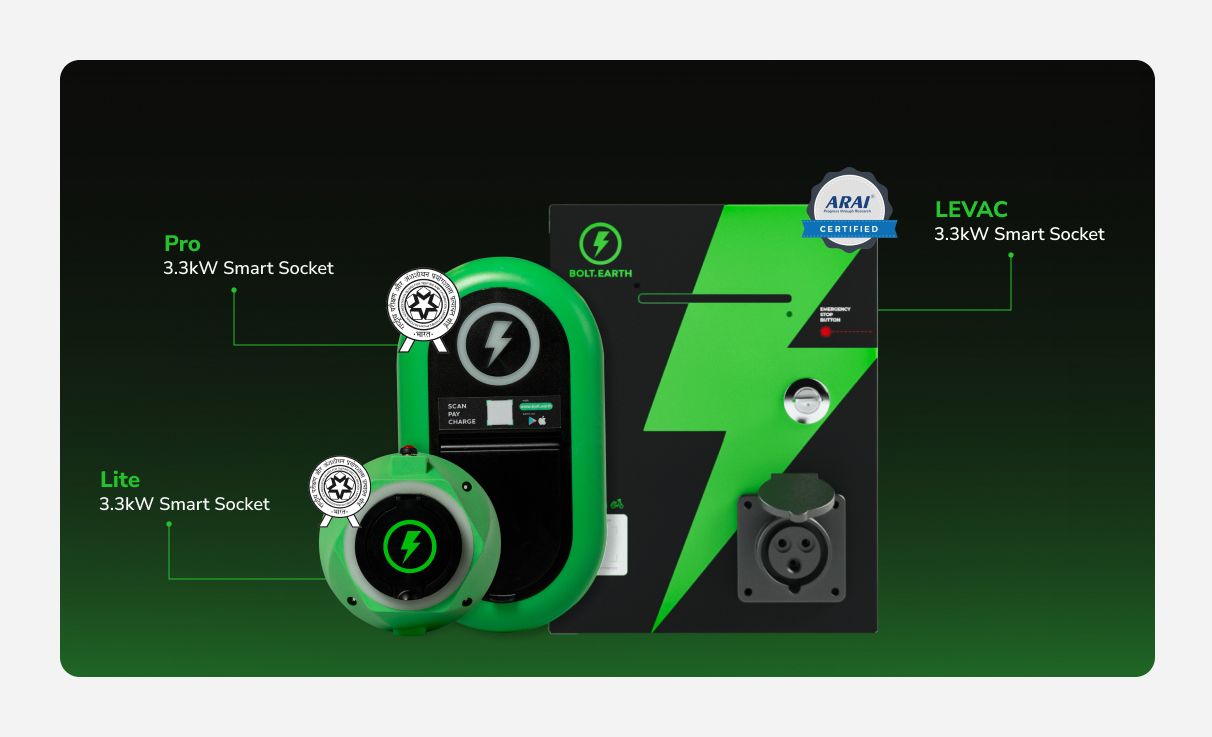
    A 3.3 kW AC home charger requires BIS certification under IS 17017-1 (general requirements) and IS 17017-22 (AC charging specifics).

    For installation at home, no additional “license” is required. A homeowner can install a charger with the help of a licensed electrician, who should ensure proper earthing and residual current devices (RCD) are in order. Ingress protection is important if the charger is outdoors; most home units are IP54 or IP65, which meets recommended practice.

    There is typically no ARAI involvement needed for a low-power AC charger for private use. The charger’s built-in safety (per BIS standards), like over-current cut-off, ground fault trip, etc., suffices.

    Metering is typically handled via a home electricity meter, and approvals are required unless the charger is part of a larger commercial setup.

    Example 2: 120 kW DC Fast Charger (Public Highway Station)
    7 (2).jpg
    This is a complex system combining power electronics, cooling, and communication. The BIS certification is mandatory under IS 17017-1 and –23, and -24, and ARAI certification is often needed for credibility and tender bids.

    The installation needs a dedicated grid connection, a 150 kVA transformer (or higher), and utility approvals. CEIG inspection and fire safety compliance are mandatory, and the charger must meet IP55-IP65 protection standards, IK10 enclosure ratings, and fail-safe cooling system requirements. From a standards perspective, the charger might also implement ISO 15118 for communication, given that many new cars would use it to ensure global interoperability.

    Summing up: a 120 kW charger needs BIS certification plus de-facto ARAI approval; compliance with Central Electricity Authority’s (CEA) grid connectivity (voltage limits, harmonics filters), and adherence to all site regulations (electrical and fire). It’s a larger compliance burden, but necessary to safely run such high-power equipment. Neglecting any aspect, say skipping a proper earthing or not having the charger type-approved, could result in serious hazards or regulators shutting down the station.

    Final Thoughts

    EV charger certifications in India are about safety, compliance, and trust. The BIS certification under IS 17017 is mandatory and foundational. ARAI/AIS approvals add credibility, open doors to partnerships and tenders. Installers and operators must follow electrical and fire safety norms to ensure a secure charging experience.

    As the EV ecosystem grows. Understanding and investing in proper certification will future-proof your business and build customer confidence and trust.

    Blog CTA Banner

  • How Fleet Electrification Can Help India Achieve Its 2030 EV Goals

    How Fleet Electrification Can Help India Achieve Its 2030 EV Goals

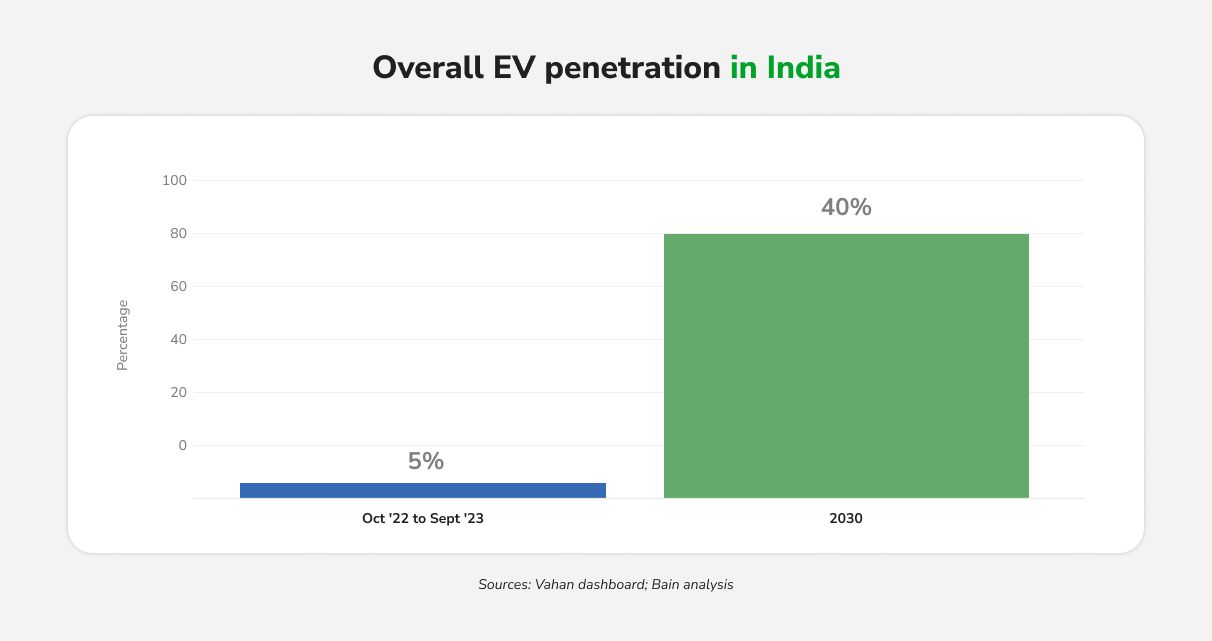
    India’s transition to electric vehicles (EVs) has gained remarkable momentum, yet EVs still comprise only a small fraction of the nation’s overall vehicle fleet. EV adoption in India rose to 6.3% by 2024, totaling over 5.5 million EVs on Indian roads in early 2025.

    Private and captive charging growth (2).jpg

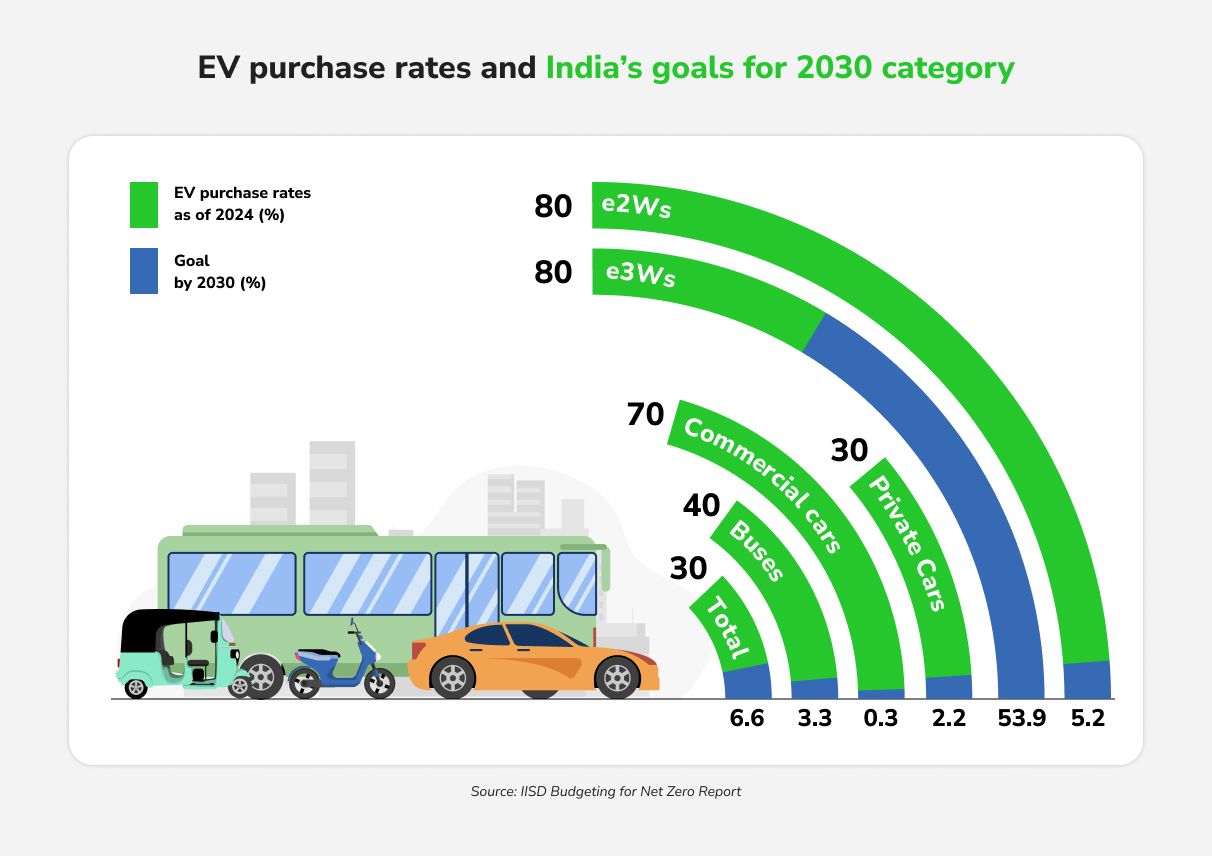
    The Indian government has set ambitious targets for 2030, including 30% of private cars, 70% of commercial vehicles, 40% of buses, and 80% of two- and three-wheelers to be electric by 2030. Achieving these goals will require bold action across all mobility sectors. Increasingly, experts and policymakers recognize that enterprise and commercial vehicle fleets, ranging from delivery vans and ride-hailing cars to government vehicles and buses, will be the linchpin of India’s EV revolution.

    This blog answers three key questions:

    • Why are enterprise fleets crucial for India’s EV transition?
    • What is the current state of fleet electrification in India, and how are companies and governments driving it?
    • What immediate actions should CEOs and fleet leaders take to future-proof their organizations through EV adoption?

    Why Enterprise Fleets Are Crucial for India’s EV Transition

    Several factors make enterprise and commercial fleets key catalysts for India’s shift to electric mobility:

    Scale and Speed of Adoption

    Unlike individual consumers who adopt vehicles one by one, enterprises can convert dozens or hundreds of vehicles at once. Fleet operators, from delivery companies to taxi aggregators, can deploy EVs in bulk, rapidly boosting EV numbers on the road. By 2030, commercial EVs are expected to account for approx. 70% of all EVs in India, underscoring the outsized role of fleets in the transition and the importance of scalable EV fleet solutions.

    United States of America (3).jpg

    Total Cost of Ownership (TCO) Advantage

    Fleets typically log high daily mileage, making fuel savings and maintenance benefits of EVs accrue faster. According to industry analysis, most EV categories in India are already TCO-positive for high-use scenarios, making them attractive as fleet and B2B vehicles.

    In other words, while an individual car buyer might worry about the higher upfront cost of an EV, a business calculating lifecycle costs may find an EV cheaper overall than a gasoline or diesel vehicle due to lower electricity vs. fuel costs and reduced maintenance. This economic rationale is a powerful driver; fleets can justify EV investments to their CFOs by projecting fuel cost reductions and lower total operating costs over time, strengthening the case for EV fleet solutions.

    Infrastructure and Operational Control

    Fleet operators benefit from controlled use cases and depots, simplifying charging solutions. For instance, e-commerce companies can install private charging stations at warehouses to recharge electric vans overnight. Public transport agencies can set up charging at bus depots, contributing to the growth of EV charging infrastructure in India.

    This depot-charging model sidesteps one of the main consumer concerns, public charging availability, because fleets can ensure dedicated access.

    Enterprises can also experiment with solutions like battery swapping for two- and three-wheeler fleets, minimizing downtime. By investing in their own charging infrastructure, fleets effectively expand the nation’s charging network.

    Market Signaling and Ecosystem Boost

    When large companies electrify their fleets, it sends a strong market signal to automakers and investors that EV demand is real. Corporate fleets committing to EVs give confidence to the ecosystem (manufacturers, charging providers, and financiers) to scale up. Moreover, fleet vehicles typically have defined turnover cycles; after a few years of service, they are resold into the second-hand market. Thus, today’s fleet EVs become tomorrow’s affordable used EVs, broadening access. Fleets, therefore, can jump-start a robust used-EV market, allowing middle-class consumers to buy pre-owned EVs at lower price points in a few years, further accelerating mass EV adoption in India.

    Environmental and Social Impact

    Commercial vehicles contribute disproportionately to urban pollution and carbon emissions due to their intensive use. Electrifying these yields outsized gains in emissions reduction and air quality.

    For example, the government estimated that electrifying all government-owned vehicles could save ₹1.63 lakh crore (₹1.63 trillion) in fuel and avoid 12.13 lakh tonnes (1.21 million tons) of CO₂ emissions over their lifetimes, an outcome aligned with progressive EV policy in India.

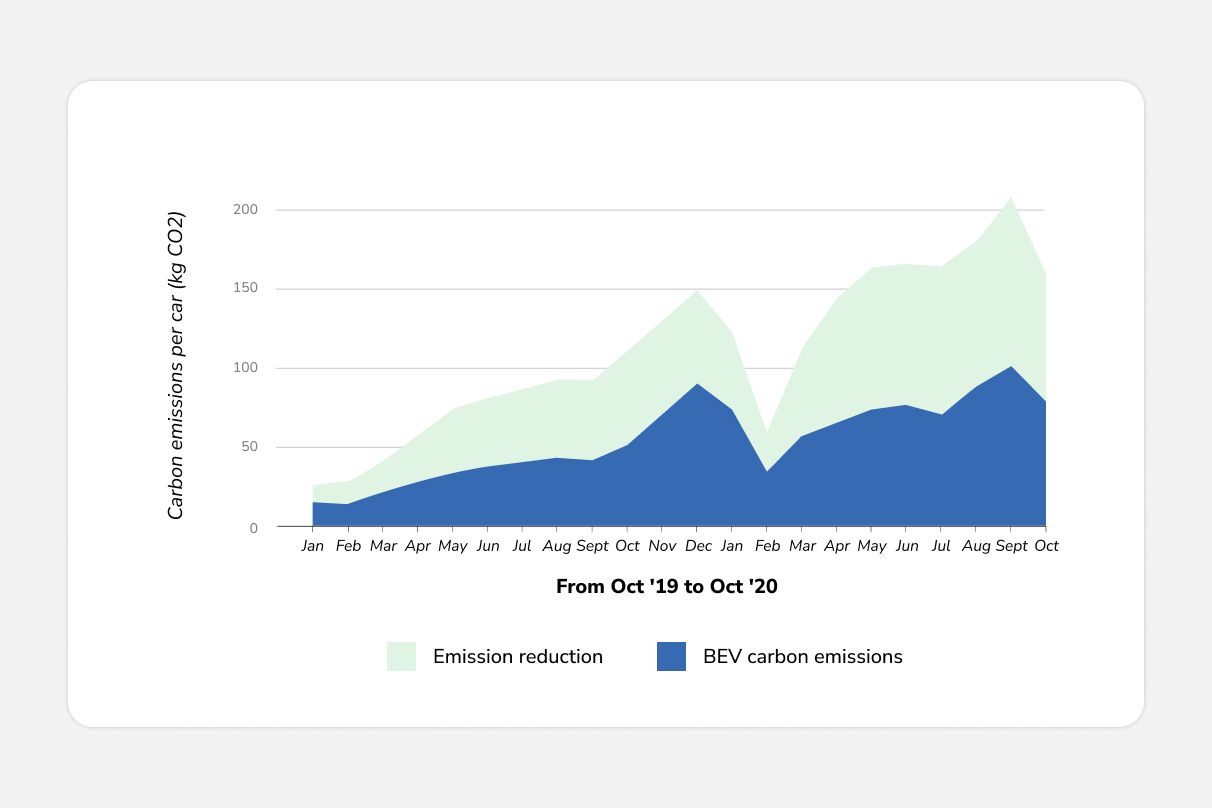
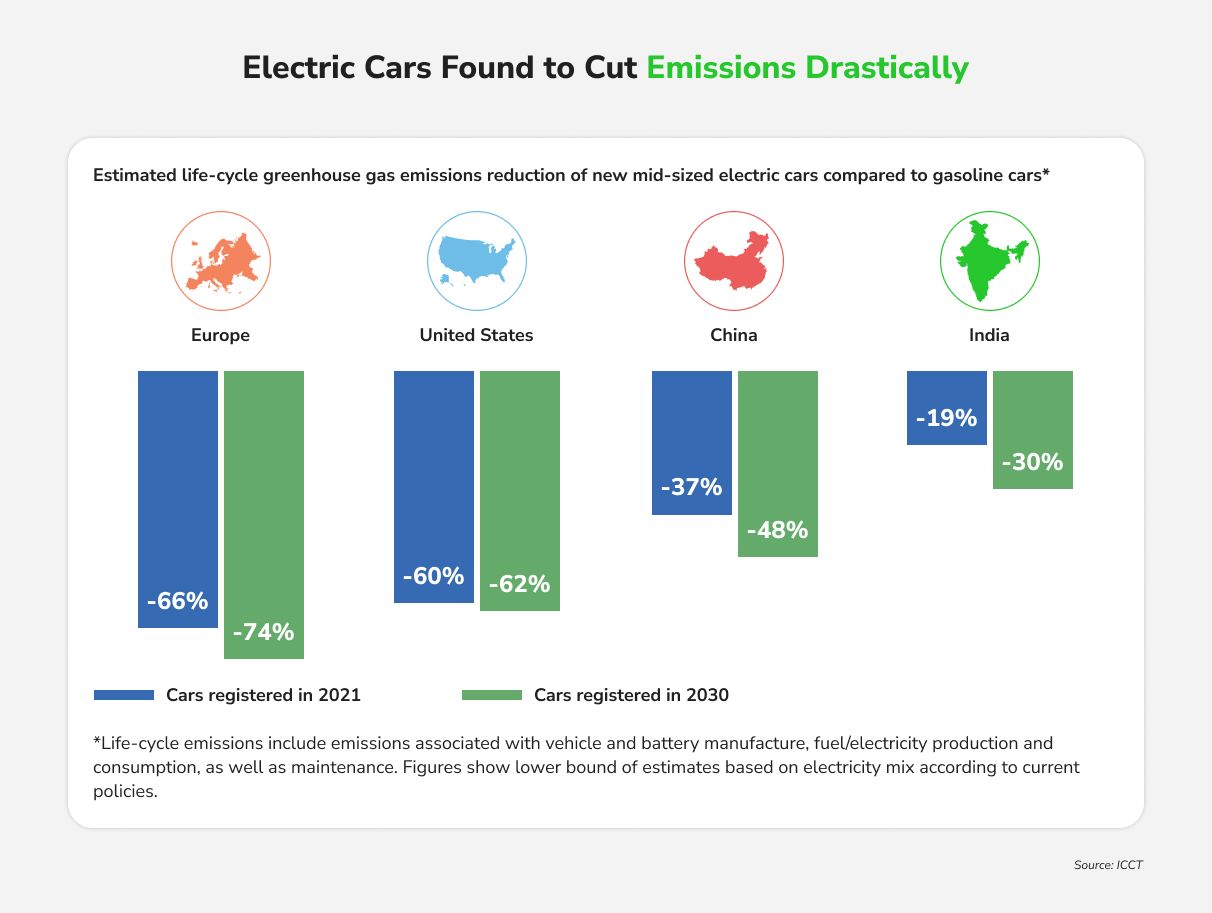
    Another real-life example could be China’s. Using real-world driving data, a study shows a significant drop in carbon emissions when Battery Electric Vehicles (BEVs) replace fuel-powered vehicles over the same driving distances. Emission reductions displayed a steady upward trajectory throughout the study period, rising from about 8.72 kg of CO₂ per BEV in January 2019 to roughly 63.83 kg of CO₂ by October 2020. This represents an average monthly increase of 9.47%.

    United States of America (4).jpg

    Now extend that impact to the vast commercial sector, delivery trucks, ride-share cars, and company-owned buses, and the benefits to India’s energy security (cutting oil imports), climate goals, and public health (cleaner air in cities) are enormous. Fleet operators, often being large companies, are also under pressure to meet sustainability and ESG (Environmental, Social, Governance) goals. By switching to EVs, enterprises can dramatically shrink their carbon footprint and showcase climate leadership, aligning with India’s net-zero vision for 2070.

      Enterprise fleets offer a fast-track pathway to scale EV adoption. They have the:

    • Means – capital and scale to invest in new technology
    • Motive – cost savings and ESG commitments
    • Opportunity – structured operations that can accommodate charging logistics

    The Current State of Fleet Electrification in India

    While private EV ownership (particularly electric cars) is in its early stages, electrification is racing ahead in certain vehicle segments and use cases, many of them enterprise-driven. Let’s examine the landscape segment by segment and through key examples:

    Two- and Three-Wheelers (2W & 3W)

    Global Lessons_ What India Can Learn from the US, China, Norway, and Germany (1).jpg
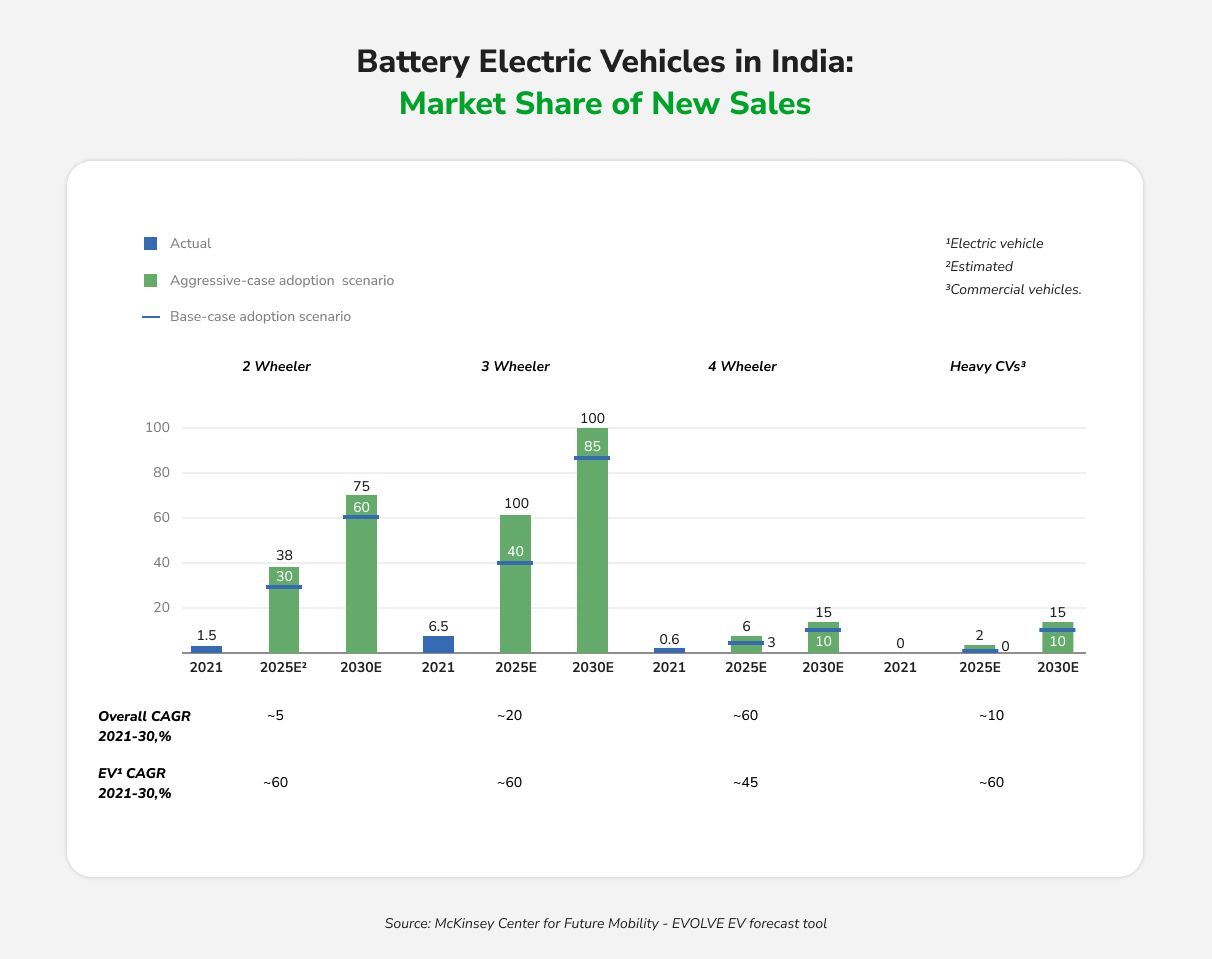
    India’s largest EV volumes today come from two-wheelers and three-wheelers, which account for over 85-90% of all EVs sold. A significant portion of these are used in commercial operations: from gig delivery workers to electric auto-rickshaws. By 2030, electric two-wheelers could reach 50% of new sales and electric three-wheelers 70%, driven by their lower operating costs and suitability for short-range urban duty.

    For instance, food delivery companies and courier services are rapidly onboarding e-bikes: Zomato and Swiggy have pledged 100% electrification of their delivery fleets by 2030. These companies are already deploying thousands of electric two-wheelers in major cities, often through partnerships or incentives for their delivery partners. The cumulative effect is significant; millions of daily delivery miles are now electric, cutting fuel use and emissions.

    Four-Wheeler Fleets (Cars and Vans)

    Adoption of electric passenger cars by individual consumers remains modest, but enterprise momentum is building. EVs were approx. 25% of new car sales in 2022, per industry reports. Taxi and ride-hailing fleets are a prime example. Uber India announced plans to deploy 25,000 electric cars by 2025-26 as part of its “Uber Green” initiative, partnering with fleet operators and automakers.

    Its domestic competitor Ola (which also launched its own EV manufacturing arm, Ola Electric) had similar bold plans to electrify its ride-share fleet.

    Corporate fleets for employee transportation are also switching to EVs in tech hubs like Bengaluru and Hyderabad, supported by leasing companies offering EV fleet solutions.

    On the logistics front, Amazon India is adding 10,000 electric delivery vans to its fleet by 2025. Flipkart has deployed over 10,000 EVs in its delivery fleet as of 2024 and is steadily increasing that number. Flipkart’s EV fleet, comprising electric vans and two-wheelers, already contributes to over 55% of its grocery delivery orders in major cities being completed by EVs. The company has committed to 100% electrification of its last-mile fleet by 2030 as a member of the global EV100 initiative.

    Buses and Public Transport Fleets

    Electrifying buses is a priority for cleaner public transit. Here, fleets are largely government or public-private entities, but they behave like enterprise fleets in adoption decisions. Under the FAME II scheme and PM e-Bus Sewa program, thousands of electric buses have been ordered for city fleets, reflecting the impact of evolving EV policy in India.

    In FY 2024 alone, over 3,700 electric buses were sold across India and the market is growing quickly. The goal is to replace 800,000 diesel buses by 2030. Cities now run e-buses for urban routes, and state transport units are partnering with OEMs via leasing models to reduce upfront costs. India’s focus on early electrification of bus fleets is positioning the country as a leader among emerging markets, setting a valuable example.

    Government Fleets

    Progress in electrifying government-owned vehicles has been slower; as of early 2022, only about 0.6% of government vehicles in India were electric, but efforts are underway.

    Agencies like EESL (Energy Efficiency Services Ltd) initiated procurement of 10,000 EVs for government use.

    A few states have even set targets. States like Delhi have mandated EVs for all government hires, and Haryana and Uttar Pradesh have announced 100% electrification goals for their official fleets by the mid-2020s, though implementation remains weak.

    Converting government fleets boosts public confidence in EV and sets an example for private EV buyers and businesses.

    Corporate Commitments and Coalitions

    Indian businesses are joining coalitions to promote fleet electrification. The Climate Group’s EV100 initiative has attracted at least 12 Indian companies, such as Flipkart and BSES, which have committed to 100% electric fleets by 2030.

    Under the “Moving India” platform by the World Economic Forum, over 30 businesses and government bodies are collaborating on electrifying corporate fleets, logistics, and financing.

    There are also public-private partnerships targeting specific segments. For example, several companies (Amazon, JSW Steel, IKEA, etc.) launched EV pilots for trucking through EV100+ to kickstart electric truck deployment in India. Such collective efforts are addressing common challenges (like lack of suitable vehicle models or financing hurdles) and sending a unified message to suppliers and policymakers that the demand for fleet EVs is robust.

    Automaker and Industry Response

    Automakers are tailoring products for the Indian fleet market. Tata Motors launched the XPRES-T EV, a version of its electric sedan designed for fleet use.

    However, industry analysts note that the market still lacks an economical, entry-level electric car designed for fleet operators; existing electric car models are mostly higher-end, and even the XPRES-T is priced significantly above equivalent gasoline/CNG models.

    Partnerships like Tata Motors supplying EVs to Uber and Mahindra Electric focusing on e-3Ws for deliveries show that the automotive value chain is adapting.

    Battery leasing models, fleet energy management software, and dedicated B2B sales teams are becoming central to India’s auto industry strategy.

    Key Actions for Executives: Seizing the EV Fleet Opportunity Now

    For a CEO or senior executive convinced by the arguments above, the logical next question is, “What should we do to get started on our EV journey?”

    Here is a checklist of concrete actions and best practices to initiate today, ensuring your organization stays ahead in the EV transition:

    • Develop a Clear EV Fleet Vision and Policy: Articulate a top-level commitment (e.g., “50% of our delivery fleet will be electric by 2025, and 100% by 2030”). Make EV adoption part of your sustainability strategy and public ESG goals.
    • Conduct a Fleet Audit & Segmentation: Map out all vehicles in use and segment them by use case, mileage, and replacement timeline. Identify “low-hanging fruit” vehicles or routes that can be electrified immediately. Also note upcoming procurement cycles: if certain diesel vehicles are due for replacement in 2024–25, plan for EV options now rather than locking into another ICE for 5+ years.
    • Run Pilot Projects and Training: Select a city or business unit and launch a pilot with a handful of EVs. Training programs for drivers and fleet managers on EV basics (charging protocols, driving techniques to maximize range, and safety procedures) can help address any anxiety or resistance to new technology.
    • Engage Finance Early: Involve your CFO or finance team to explore leasing, hire-purchase, or the “EVs-as-a-service” model. Consider total cost over vehicle life, and tap into green finance or CSR budgets for pilot funding.
    • Plan Your Charging Infrastructure and Strategy: Conduct a site survey to install chargers. Decide whether you need fast DC chargers or slower AC chargers. Consider integrating solar energy and setting up software to monitor charging data such as sessions, costs, and energy consumption from day one.
    • Leverage Government Incentives and Partnerships: Track central and state incentives. Ensure timely application for subsidies on each vehicle purchase. Networking with government agencies can also present opportunities to collaborate on pilot programs (like electric bus or freight corridor pilots), which often come with support. Being visible in the public sustainability space can open doors. For instance, if a city is creating an EV task force, have your company represented.
    • Communicate and Celebrate Milestones: Publicize your progress through press releases and social media. It not only boosts your brand but also holds the organization accountable to keep the momentum. Internally, celebrate the first 100,000 electric kilometers driven, or the first 100 tons of CO₂ emissions avoided. This reinforces the positive feedback loop and builds pride among employees that they are part of a forward-thinking, purpose-driven organization.
    • Monitor, Measure, Improve: Set up a dashboard for the leadership team to track key fleet metrics such as utilization, costs, downtime, driver feedback, and emissions saved. Encourage continuous improvement and plan for scale beyond the pilot stage.
    • Build Ecosystem Partnerships: Partner with OEMs, charging providers, tech startups, and fellow corporations to share knowledge and resources. Join consortiums like the Climate Group’s EV100 or NITI Aayog’s stakeholder committees to facilitate peer learning and collective action.

    The EV transition is a “sooner is better than later” scenario. Early movers gain cumulative benefits, while late adopters risk falling behind. With prudent planning and bold leadership, enterprise fleets can transform from carbon-intensive cost centers into efficient, innovative, and green assets for the organization.

  • Government Incentives for EV Charging Infrastructure in India

    Government Incentives for EV Charging Infrastructure in India

    Electric vehicles (EVs) are gaining momentum in India’s transition to sustainable transport. However, widespread adoption hinges on a robust charging network across the country. Recognizing this, the Indian government, at both central and state levels, has rolled out an array of incentives to accelerate EV charging infrastructure development.

    From capital subsidies and tax breaks to land allotments and utility support, these measures aim to alleviate “range anxiety” and encourage investments in charging stations. This push supports ambitious goals: India is targeting 30% EV penetration by 2030 in new vehicle sales, a goal that requires a nationwide charging network.

    Whether you’re a charge point operator, fleet operator, startup founder, or EV investor, this blog breaks down the evolving policy landscape and shows you how to make the most of government support.

      Because in this guide, we answer three critical questions:

    • What are the central government incentives for EV charging infrastructure in India?
    • Which Indian states offer the best subsidies and benefits for setting up EV charging stations?
    • How can charge point operators, investors, and developers benefit from these incentives today?

    Central Government Initiatives for EV Charging Infrastructure

    From FAME to E-DRIVE: Laying the Groundwork

    India’s EV push began with the National Electric Mobility Mission Plan 2020, under which the FAME India (Faster Adoption and Manufacturing of (Hybrid &) Electric Vehicles) schemes were launched. FAME I ran from 2015 to 2019, supported 2.55 lakh EVs, and sanctioned 520 EV charging stations with an outlay of ₹43 crore. Though a pilot,it set the stage for a larger intervention under FAME II.

    Target number of vehicles to be incentivized under the FAME II scheme and target achievement (1).jpg

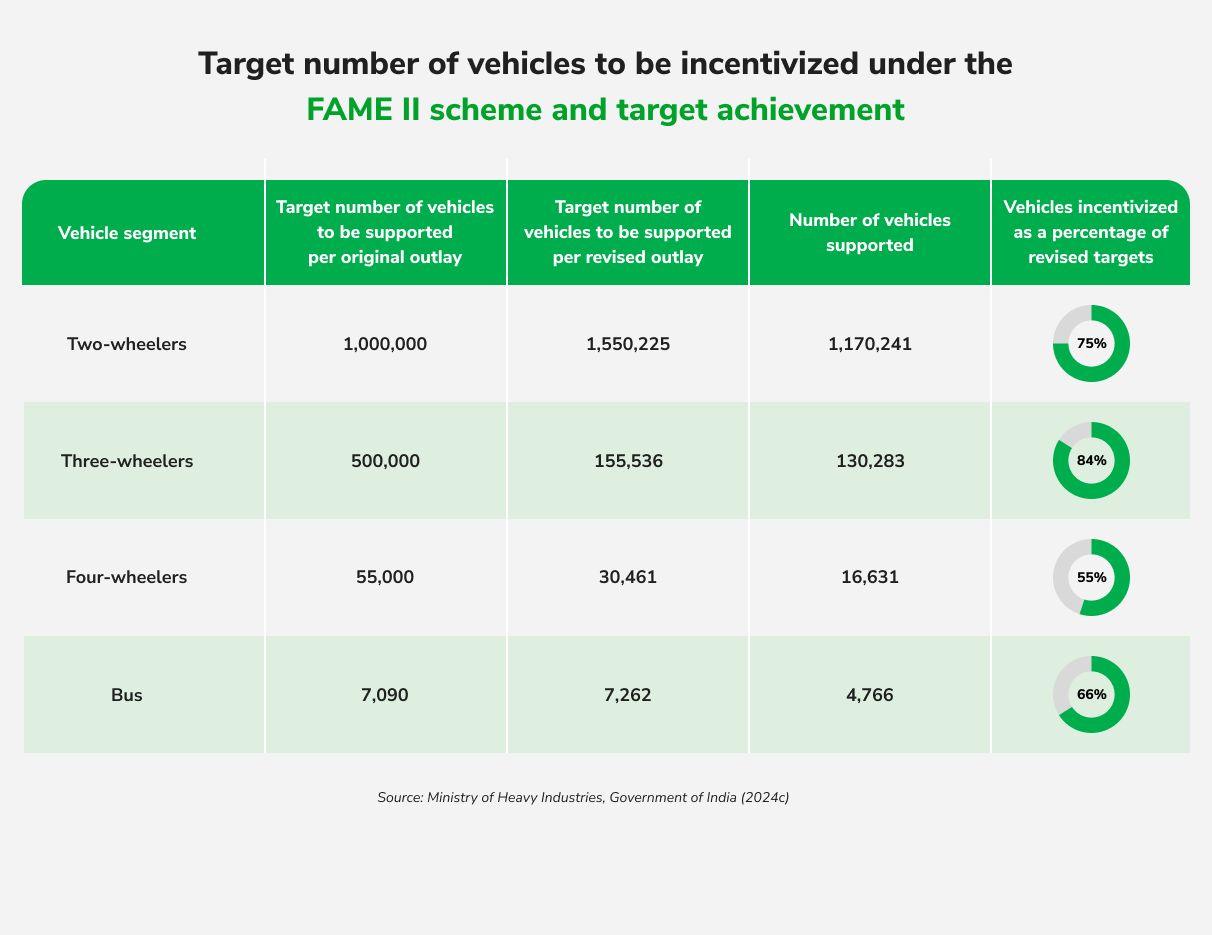
    FAME II (2019–2024) significantly expanded support. With a budget of ₹10,000 crore, it offered upfront subsidies on EV purchases and allocated ₹1,000 crore for EV charging infrastructure in India. By June 2025, FAME II had supported 16.29 lakh EVs and sanctioned 9,332 public EV charging stations (EVPCS) with 8,885 already installed.

    These chargers weren’t limited to big cities; the scheme extended to Tier-2 and Tier-3 cities as well. FAME II’s nationwide incentives helped accelerate the EV charging network in India, which reached over 25,000 public charging points by end-2024. However, FAME II was a time-bound scheme and concluded in 2024.

    A short bridging program in 2024 was later subsumed under PM E-DRIVE. In the words of the Heavy Industries Minister, “Today is a landmark day, as we transition from the FAME scheme … to the PM E-DRIVE Scheme,” signaling continued commitment with a refreshed approach. Let’s explore what PM E-DRIVE brings to the table.
    PM E-DRIVE: The New Catalyst for EV Charging

    United States of America (2).jpg
    PM Electric Drive Revolution in Innovative Vehicle Enhancement (PM E-DRIVE) is India’s flagship EV incentive program, running from October 1, 2024 to March 31, 2026, with a ₹10,900 crore outlay. The scheme has two key objectives: accelerate EV adoption through buyer subsidies and establish essential EV charging infrastructure in India. In practice, PM E-DRIVE has multiple components:

    • Demand incentives for EVs: A ₹3,679 crore is allocated for subsidies on electric two-wheelers, three-wheelers, buses, ambulances, and trucks, targeting nearly 25 lakh new EVs. Notably, privately owned e-2Ws are also eligible, unlike the earlier focus on commercial/public vehicles. E-vouchers linked to Aadhaar are used, enabling seamless incentive claims at purchase.
    • Grants for charging infrastructure: A ₹2,000 crore is earmarked to expand public EV charging stations nationwide. This funding will support installing approximately 72,000 new chargers by FY 2025-26. The plan includes around 22,100 fast chargers for cars, 1,800 charging stations for e-buses, and 48,400 chargers for e-two & three-wheelers, focused on high-demand cities and key highway corridors. For context, FAME II supported approx. 9,300 chargers in five years, while PM E-DRIVE targets over 70,000 in just two years. Chargers will be strategically placed on 50 national highway corridors and high-footfall public locations such as metro stations, airports, bus depots and fuel stations to curb range anxiety.

    Other components of PM E-DRIVE include support for electric buses, ambulances, and testing labs, but the scheme’s most transformative impact lies in its EV charging infrastructure in India push.

    In May 2025, an inter-ministerial meeting chaired by MHI decided to appoint BHEL as the nodal agency to aggregate charger demand and develop a unified “EV super app” for users. This app will allow real-time charger discovery, slot booking, digital payments, and track rollout progress,enhancing the user experience and transparency.

    Such coordination reflects a “whole-of-government” approach: “Ministries, public sector enterprises, and states are all aligned to deliver results on the ground… PM E-DRIVE will catalyse new industries, generate green jobs, and offer seamless electric mobility to every Indian,” said the Heavy Industries Minister.

    Overall, PM E-DRIVE is set to be a transformative initiative. It consolidates India’s EV momentum into a focused two-year rollout, backed by substantial funding. By making EV charging stations widely accessible, the scheme aims to eliminate one of the biggest hurdles to EV adoption.

    Union Budget 2025: Supercharging the EV Ecosystem

    The Union Budget 2025-26, delivered in February 2025, reinforced India’s commitment to electrified transport, particularly via funding and tax reforms. Finance Minister Nirmala Sitharaman almost doubled the overall automotive sector budget, from ₹4,307 crore in FY24 to ₹7,485 crore in FY25, driven largely by increased EV spending. A major highlight was the boost to charging infrastructure:

    • Higher Allocation for PM E-DRIVE: The budget allocation for the PM E-DRIVE scheme jumped by 114% to ₹4,000 crore for FY2025, specifically to accelerate the rollout of charging stations. The government is front-loading funds to ensure the targeted 72,000 chargers under PM E-DRIVE are deployed on schedule. This infusion also signals to private players. Complementing this, a dedicated PM e-Bus program was allotted ₹510 crore to help electrify public transport in cities.
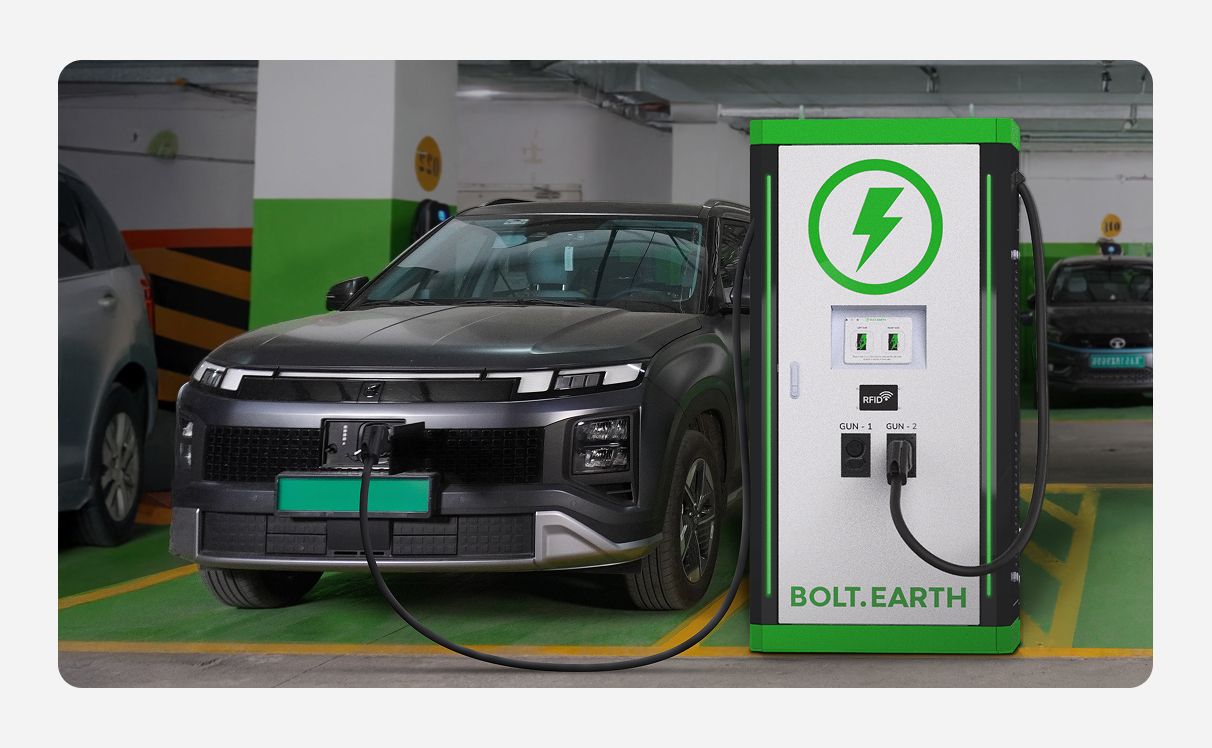
    • The budget also continued the policy of offering income tax rebates on loans for EV purchases (Section 80EEB) and announced improved access to credit. Additionally, it expanded the Fund of Funds for Startups, which EV charging startups can access for capital. While these are not direct charging infrastructure subsidies, they improve the overall environment for EV adoption, innovation, and growth of the EV charging network in India.

    State EV Policies: Incentives Driving Infrastructure on the Ground

    State EV Policies_ (1).jpg
    India’s states are playing a pivotal role in India’s EV revolution. Over 25 states and Union Territories have notified dedicated EV policies, offering a mix of capital subsidies, land support, and electricity concessions.

    Capital Subsidies for Charging Stations

  • Uttar Pradesh: In June 2025, UP became the first state to subsidize upstream electrical infrastructure (like transformers and grid connections) as part of EV charging station cost. Under the amended UP EV Policy 2022, stations are eligible for a 20% subsidy on fixed capital investment, up to ₹10 lakh per station, including grid equipment. This helps CPOs meet ₹25 lakh investment threshold and makes more projects viable.
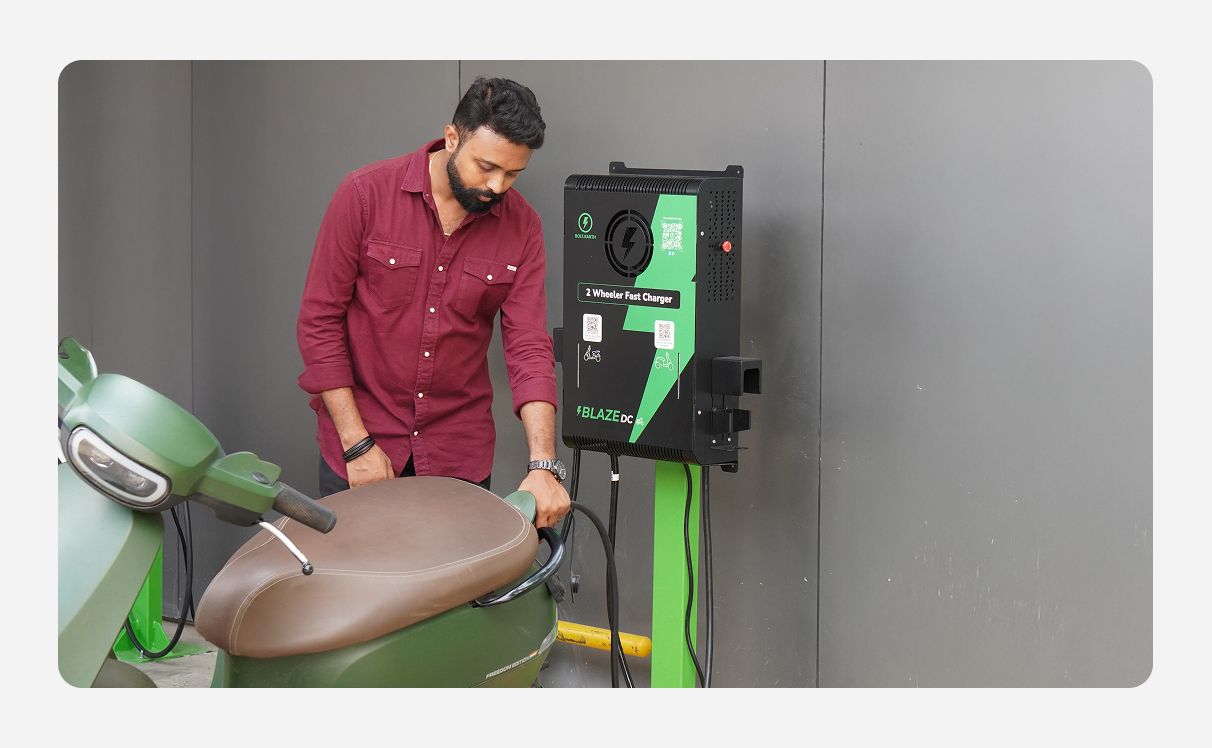
    • Maharashtra: The new Maharashtra EV Policy 2025 has introduced a Viability Gap Funding (VGF) scheme for public chargers. CPOs can get 15% of the charger cost reimbursed (up to ₹10 lakh per DC fast charger), especially along highways and in cities like Mumbai and Pune.
    • Other states such as Gujarat, Kerala, Punjab, Tamil Nadu, and several Northeastern regions offer similar capital subsidies, typically ranging from 20–25%, with caps per charger or station. Land Allotment and Infrastructure Support

    Securing suitable land remains a key challenge for harging infrastructure. States are addressing this through:

    • Land at Concessional Rates: States with EV manufacturing ambitions are developing EV parks or clusters where land is offered at subsidized rates for related infrastructure. Tamil Nadu’s 2023 EV policy gives 50% discounted land in EV supplier parks for companies setting up EV or charging equipment plants. While that mainly targets factories, it indirectly helps charging by bringing down charger hardware costs. Telangana’s updated policy (Nov 2024) similarly offers land in upcoming EV parks on long-term lease at concessional rates to attract charging station operators and battery swapping providers.
    • Public Land for Charging Stations: Several states and city authorities are identifying government-owned spaces (bus depots, parking lots, highways rest areas) to install charging stations. Delhi has been aggressive here – through its single-window portal, applicants can request installation at municipal parking lots and Delhi Transco Ltd helps provide locations and connections. Maharashtra is opening up MSRTC bus depots for private players to install fast chargers (with revenue-sharing models). Karnataka is clustering chargers at metro stations and BMTC bus depots in Bengaluru, often offering space at nominal rent. This addresses both location and footfall challenges, while the state bodies often facilitate the electrical connection as well.
    • Ease of Land Conversion & Approvals: States are simplifying the red tape for charging stations. Many have declared charging setups as a permissible activity in commercial or non-agricultural land use, avoiding lengthy land-use change processes. Some (e.g., Rajasthan and Madhya Pradesh) have single-window clearance systems to approve new charging stations within weeks, coordinating utilities and urban bodies.
    • EV Parks & Hubs: A few large states are creating integrated EV zones. Uttar Pradesh is setting up a 500-acre EV park near Kanpur, primarily for manufacturing, but with provisions for battery swapping and charging infrastructure on-site. The idea is to provide ready-made infrastructure (power supply, land, permissions) so investors can plug-and-play.

    Affordable Electricity: Tariff Concessions and Duty Waivers

    Electricity cost is the single largest ongoing expense for a charging station operator. To make EV charging profitable and accessible, states:

    • Dedicated EV Tariffs: Most states offer dedicated EV tarrifs with lower per-unit rates and reduced demand charges compared to commercial tariffs. For example, Delhi’s EV tariff is ₹4.5 per kWh (plus nominal fixed charges), which is significantly cheaper than regular commercial rates. Maharashtra too has a concessional EV tariff (around ₹5–5.5/kWh) approved by MERC, and waived demand charges for the initial years, enabling CPOs to pay only for energy consumed. Karnataka and Telangana have tariffs in the ₹5–6 range, which their policies advertise to investors as a major incentive.
    • Electricity Duty Exemption: States like Gujarat and Maharashtra have waived electricity duty for EV charging operations for a period (often 5 to 10 years). Gujarat, for instance, offers a 100% electricity duty exemption for EV charging services, effectively reducing the energy cost by approx. 15%. Odisha, Bihar, Tamil Nadu, Punjab, and several others include similar duty holidays in their EV policies. This directly lowers the cost per unit of electricity for CPOs.

    Together, these concessions keep EV charging cheaper than petrol, often ₹1–2 per km, and encourage adoption.

    Other Incentives and Mandates

    State policies also include various innovative measures to boost charging infrastructure:

    Mandating Charging Facilities: States like Andhra Pradesh, Telangana, and Haryana, require new real estate projects to include EV charging provisions

    Fuel Station mandates: Maharashtra, Kerala and Tamil Nadu mandate require petrol pumps to install at least one charging station.

    • Highway mandates: NHAI (central) is working with states to ensure charging points every 40-60 km on national highways – many states piggyback on this to also cover state highways.
    • Battery Swapping and Grid Support: Delhi, Telangana and Tamil Nadu offer incentives for battery swapping stations
    • Open Access for Renewables: Some states allow open access to solar energy for large charging parks, reducing carbon footprint.
    • Public Awareness and Outreach: Campaigns like Switch Delhi educates users about EVs and the available charging infrastructure.

    The result of all this multi-level push is evident: India’s EV charging infrastructure is growing rapidly. By Dec 2024, we saw 25,000+ public charging stations operational across the country, up from just a few hundred five years prior.

    Conclusion: A Unified Charge Toward an Electric Future

    The policy landscape in 2025 clearly shows that India is fully commited to an electric mobility revolution. With central government’s initiatives like PM E-DRIVE and state-level incentives offering capital grants, land, and low-cost power, charging infrastructure is expanding rapidly.

    For CPOs, fleet operators, and investors, this is the ideal time to enter the market.

    Of course, challenges remain, but today the direction is clear. Executing the installation of tens of thousands of charging stations in a short span will test coordination between ministries, state agencies, and private players. There is also a need for standardized guidelines and robust maintenance to ensure these stations remain functional and don’t “rust,” as some experts caution.

    Every ₹1 saved in subsidies or gained in revenue by a charging operator, every parcel of land allotted, and every reduced electricity bill is locking in “green miles” on India’s roads for decades to come. The government incentives, central and state, are not just monetary boosts; they are confidence builders, telling the ecosystem that “we are in this together.”

    As a result, India’s EV charging infrastructure is no longer a chicken-and-egg dilemma; it’s racing ahead, powering the country’s transition to sustainable transportation.

    The journey from a handful of chargers to a nationwide network in a few years is truly remarkable. And with the current policies in place, the remainder of this decade promises an electric ride, one charging station at a time, lighting up a cleaner future for all.

  • Part 2: Scaling Workplace EV Charging in India: Global Case Studies, Business Models, and Investment Opportunities

    Part 2: Scaling Workplace EV Charging in India: Global Case Studies, Business Models, and Investment Opportunities

    A few days ago, we published Part 1: The Future of Workplace EV Charging in India, a deep dive into why workplace charging matters, the current state of deployment, and what the future could look like as EV adoption accelerates, especially as EV charging infrastructure in India continues to grow.

    In part 2, we go a level deeper, focusing on how India can translate that potential into real, scalable outcomes.

      This article answers three questions:

    • What can India as an evolving market learn from other countries about building effective workplace EV charging networks?
    • What EV charging business models and ROI structures are working—and what should Indian enterprises consider?
    • Where do the real investment opportunities lie for businesses, utilities, and infrastructure players?

    Let’s dive in.

    Global Lessons: What India Can Learn from the US, China, Norway, and Germany

    While India’s EV charging journey has its own unique story, there are valuable lessons we can embrace from countries that are ahead in the EV adoption curve, particularly regarding workplace EV charging infrastructure.

    In this blog, we highlight insights from the United States, China, Norway, and Germany, four markets with advanced EV ecosystems, and how India can adapt their best practices.

    United States of America

    A key lesson from the US is the role of public-private partnerships and employer initiatives in expanding workplace EV charging. Early on, the US Department of Energy launched the Workplace Charging Challenge (2013–2018), which rallied employers to voluntarily install EV chargers for their staff, significantly raising the profile of at-work charging.

    United States of America.jpg

    Major American companies (tech firms, automakers, and universities) responded by installing charging bays as an employee amenity, normalizing the idea of charging at work. Additionally, federal incentives such as tax credits for installing charging stations helped encourage more people to adopt EVs. Strategically, the US is now investing heavily in charging infrastructure nationwide (through the Bipartisan Infrastructure Law). Under earlier federal initiatives (Biden–Harris administration), the US set a clear goal of deploying 500,000 publicly available EV chargers by 2030. While not exclusively intended for workplace use, a substantial portion is expected to be installed in locations such as office parks, retail centers, and multi-unit dwellings, including DC fast charging stations for higher throughput.

    India can learn from the US by creating similar corporate challenge programs (to encourage Fortune 500 companies in India to pledge chargers at all their sites) and by providing financial incentives (tax breaks or subsidies) for workplace charger installation. The US experience also underlines the importance of reliable maintenance; many American firms partnered with charging network providers to ensure uptime, something Indian companies will need to emulate as they scale up internal charging facilities.

    China

    China’s approach to EV infrastructure is characterized by strong government mandates and rapid scale, offering a blueprint for India in policy enforcement. Notably, since 2022, China has had a national policy that all new residential communities and workplaces must have EV charging infrastructure built in. This kind of mandate, coupled with strict local implementation, ensured that new office buildings in China’s megacities come pre-equipped with a substantial number of charging points (or at least the electrical capacity and conduits to add them).

    Moreover, China has deployed massive numbers of chargers. The country is expected to reach a total of 17.47 million EV charging points by the end of 2025, with around 4.66 million of those installed during that year alone. This expansion is intended to meet the rising demand for charging infrastructure as the country’s electric vehicle fleet approaches an estimated 40 million units. Many of these are in commercial and workplace parking lots, often installed with government subsidies or utility company support.

    What can India adapt?

    Firstly, a similar mandate in building codes nationwide. While India has guidelines for 20% EV-ready parking, making this a legally binding requirement with enforcement (as China did) would be impactful.

    Secondly, China’s practice of empowering state-owned utilities to invest in charging has yielded results; India’s utilities could take a more proactive role in setting up workplace charging parks, possibly offering it as a service to large employers.

    Finally, China’s tech infrastructure, common payment platforms (QR code payments via apps like Alipay/WeChat for any charger), and real-time status apps make using public/workplace chargers very convenient. Indian startups and DISCOMs can collaborate to ensure interoperability and user-friendliness, learning from Chinese platforms to strengthen EV charging infrastructure in India.

    Norway

    Norway continues to lead the world in electric vehicle adoption. In June 2025, EVs accounted for 96.9% of all new passenger car registrations, a milestone that signifies the country’s near-total transition to electric mobility. This record was surpassed in July, when EVs made up 97.2% of new car sales, reinforcing Norway’s position at the forefront of the global EV movement.

    Norway.jpg

    One key lesson from Norway is how comprehensive incentives and cultural support drive infrastructure naturally.

    The Norwegian government made EV ownership extremely attractive (no purchase tax, no VAT, free tolls, etc.), which created consumer demand that in turn spurred workplaces to add chargers to accommodate employees. Many Norwegian companies provide free or very low-cost charging for staff as a perk, and thanks to government policy, this is often cost-neutral for both parties (for example, providing free workplace EV charging is not considered a taxable benefit in Norway up to a certain limit, similar to how India treats subsidized canteen meals). Norway also heavily invested public funds in charging infrastructure, ensuring even smaller towns and rural areas have good coverage.

    The takeaway for India:

    • Incentivize both end-users (employees) and providers (employers):
    • If India continues to increase demand-side incentives for EVs while simultaneously offering benefits to companies such as recognition, ESG score improvements, or financial perks for installing chargers, the market will organically drive much of the rollout.

    • Invest in education and awareness campaigns:
    • Norway’s example shows that awareness matters. Government authorities and the Norwegian EV Association actively educated employers about the benefits of providing workplace charging, including environmental branding and improved employee satisfaction. Indian industry bodies can run similar campaigns to promote workplace charging as a smart business investment.

    • Plan ahead for grid capacity in high-EV zones:
    • Norway’s grid foresight included upgrading transformers in areas with high EV density. Indian utilities should take note, especially in business districts likely to experience a surge in daytime charging demand.

    Germany (and EU)

    Germany provides a case of integrating EV charging into policy and corporate practice through a mix of regulations and incentives. On one hand, the EU’s building directives now require new and renovated non-residential buildings to have a minimum number of charging points (e.g., at least one charger for every 20 parking spaces, under the updated Energy Performance of Buildings Directive). This means German workplaces are increasingly pre-wired for EV charging from the construction phase.

    On the other hand, Germany introduced a novel incentive: the tax exemption for employees for free charging at the workplace. Since 2017 (extended through 2030), if an employer offers free or discounted electricity for EV charging on-site, the employee does not incur it as a taxable fringe benefit.

    This policy led many companies to offer free charging as part of their corporate sustainability programs without tax paperwork hassle. Additionally, Germany rolled out grants for companies to install chargers, especially for small and mid-sized enterprises.

    For India, adopting a similar tax treatment could be a game-changer. Currently, if an Indian company provides free charging, there’s no specific tax guidance, but making it explicitly tax-free (or offering tax credits to employers) would remove any hesitation.

    Germany also underscores standardization and safety. The government enacted a Charging Station Ordinance (2016) to ensure all public chargers have common connectors and safety standards.

    As India’s network grows, focusing on common standards (Type-6/Type-7/Bharat/DC001/Type-2/CCS2 as default standards) will be vital to ensure any EV can plug in at any workplace or public station.

    Moreover, Germany’s push for “roaming” between charging networks (so one subscription works everywhere) is a practice Indian networks can emulate via unified payment interfaces. In short, the EU/German experience teaches that a combination of regulatory requirements, smart incentives, and emphasis on interoperability can accelerate workplace EV charging deployment and support various EV charging business models.

    In all these international cases, a recurring theme is that workplace EV charging is not just about technology; it’s about policy support and stakeholder buy-in. India stands to gain by adopting a hybrid of these approaches: encourage companies with incentives, mandate readiness in new buildings, and make it part of a broader cultural shift to EVs. By learning from these pioneers, India can leapfrog some challenges (such as charger underutilization or grid strain) and create a robust, future-proof workplace charging ecosystem.

    Investment Potential and Market Size of Workplace EV Charging in India

    The acceleration of charging infrastructure is a significant investment opportunity. The CEEW-CEF report (2020) estimated $2.9 billion for deploying public chargers by 2030 in the base scenario, covering hardware, installation, and grid upgrades. With scale projected to reach 2 million chargers, this number may rise.

    Beyond chargers themselves, investments in grid infrastructure (distribution upgrades, transformers) and charging software will be important. India’s deployment has grown at approx. 120% CAGR, and industry analysts predict robust growth through 2030.

    Moreover, strategic localization is underway. The CII-Edelman report noted that India has the potential to become a global manufacturing hub for EV charging stations and components.

    Domestic companies are ramping up production of everything from charging kiosks to power electronics. For investors, this means opportunities across manufacturing, CPO services, and even renewable energy integration.

    It’s worth noting that operational models are evolving rapidly. By 2030, many workplaces are expected to offer charging-as-a-service, specialized firms will install and operate chargers at offices, and employees or visitors will pay per use. This model is already taking hold, and it attracts investment into CPO startups that see revenue in kilowatt-hours dispensed rather than just hardware sales.

    For investors and stakeholders in the EV charging industry, the coming years represent a period of rapid boom, like telecom towers in the 2000s or solar farms in the 2010s.

    With over a million chargers forecasted and billions in investments required, opportunities span hardware manufacturing, software platforms, CPO services, and infrastructure financing. Importantly, the ecosystem is likely to remain data-driven with metrics like utilization rates, energy management, and ROI shaping strategies. We can expect innovative business models, such as energy companies partnering with real estate developers to integrate charging in commercial leases, or startups delivering end-to-end EV charging solutions for office parks (installation, software, and even renewable energy integration).

    Strategic investors should actively evaluate supply chain partnerships, from smart EV switchgear makers to aggregators enabling grid services.

    Business Models and ROI for Workplace Charging

    Norway-2.jpg

    Installing EV chargers is one thing; making them financially and operationally viable is another. Here we explore business models, monetization strategies, and return on investment (ROI) for employers and building managers:

    Monetization & Pricing Models

    Many companies face the question: should we offer charging for free or charge a fee? Globally, around 80% of workplaces that provide EV charging have offered it free to employees, treating it as an employee amenity like free parking. Free charging can significantly incentivize EV adoption, but it also incurs electricity costs. Some Indian companies initially offer free or heavily subsidized charging as a pilot, then move to a paid model once usage grows.

    Common pricing models include:

    • Pay-per-use: Charging the employee or fleet driver per kWh consumed or per hour. In India, typical rates are ₹10–20 per kWh for paid charging. Employers might charge at cost or include a small margin to cover maintenance.
    • Subscription or Membership: Employees pay a monthly fee for unlimited or discounted charging at work. This provides cost certainty and encourages regular use.
    • Stipend or Reimbursement: Conversely, some companies give EV-driving employees a monthly charging stipend (especially if charging is done on personal electricity at home). This can be an incentive baked into salary/benefits.
    • Public Use Revenue: An emerging model is to open workplace chargers to the public or visitors for a fee during off-hours. For example, a company may allow its chargers to be used by the public on weekends and bill them via a mobile app. This can generate a small revenue stream and improve overall utilization.

    Ownership vs. Service Models

    Organizations can either invest in owning the charging infrastructure or leverage third-party services:

    • Direct Ownership: The company purchases and installs chargers and either provides electricity free or handles billing internally. This gives maximum control and allows the company to capitalize on any government incentives like depreciation benefits or subsidies on chargers. Capital costs for a basic setup, say 5–10 AC chargers, might range from ₹5–10 lakhs, including installation and electrical upgrades.
    • Leasing/Charging-as-a-Service: EV charging providers offer turnkey solutions where they install and operate chargers at your site at little or no upfront cost in return for a service fee or revenue share. For instance, a provider might install chargers in an office parking lot and charge users per kWh, sharing a percentage with the site owner. This Public-Private Partnership (PPP) approach reduces risk to the employer. Several Indian startups and energy companies are active in this space, often proposing revenue-sharing models or fixed-service fees to workplaces.
    • Employee-Owned Charging for Two-Wheelers: In Bengaluru’s IT parks, a simple and cost-effective model is gaining traction: employers provide basic 3-pin, 3.3 kW charging sockets in parking areas, and employees use their own portable chargers, typically bundled with their electric two-wheelers. This approach requires minimal infrastructure, avoids the complexity of smart chargers, and allows companies to recover costs through a nominal usage fee. It’s a practical way to support EV adoption without heavy investment, especially for large campuses with high two-wheeler traffic.

    Return on Investment (ROI)

    Workplace charging can be measured in both direct financial terms and indirect benefits:

    • Direct ROI: Charging stations can generate revenue when offered as a paid service. For example, at ₹15/kWh and an average of 4 kWh dispensed per workday, one Level-2 charger could earn approx. ₹1,200 per month. With higher utilization, revenue scales up. One analysis projected a ₹2.95 million public charging investment yielding ₹1.7 million net profit over 5 years, with utilization rising from 15% to 65%. While office chargers operate at a smaller scale, employers can still break even within a few years.
    • Intangible ROI: Many companies adopt workplace charging for its indirect returns. Better ESG and sustainability scores improve brand image and stakeholder relations. It also supports employee retention; eco-conscious professionals value green workplace initiatives. Additionally, reduction in commute-related CO₂ emissions can contribute towards ESG reporting. Some firms even include avoided emissions from employee EV usage in sustainability reports.
    • Tax and Incentives: The Indian government has begun offering incentives for charging infrastructure. For example, some states provide capital subsidies (up to 50–100% of charger cost) for installations in workplaces or public spaces. There are also tax benefits: under income tax rules, businesses can claim accelerated depreciation on EV charging equipment, lowering taxable income. Any GST reduction on EV chargers (currently 5% GST) and schemes like the Fame-II subsidies for charging stations also improve ROI. Employers can thus take advantage of these policies to reduce upfront costs, shortening the payback period.

    Public-Private Partnerships & Service Models

    In India, new partnership models are emerging to fund and operate charging networks:

    • Energy companies have inked Memorandums of Understanding (MoUs) with large firms and real estate developers to deploy charging points at offices, malls, and highways. For example, bp (British Petroleum) and Infosys announced a collaboration to provide Energy-as-a-Service on Infosys campuses, integrating solar power, EV charging, and battery storage on a digital platform. Such partnerships bring expertise and capital from energy companies to create smarter charging ecosystems on campuses.
    • Fleet operators and logistics companies often work with charging providers to set up depot infrastructure. A notable trend is companies like Amazon and Flipkart partnering with charging specialists (Flipkart with Adani, Amazon India with Gentari) to roll out charging hubs for their delivery fleets. These hubs may serve multiple fleet owners in the area, effectively acting as multi-client charging depots.

    Pricing Strategies and Cost Management

    To ensure a sustainable operation, building managers consider:

    • Time-of-Day Pricing: Incentivizing employees to charge at certain times, like encouraging daytime charging when solar power is abundant and rates are low. If an office has solar panels, midday charging might even be free or discounted to utilize surplus generation.
    • Demand Charge Management: For commercial electricity tariffs, high peak demand (kW) can incur hefty charges. Smart charging systems can stagger charging to avoid spiking the building’s load (discussed more under Technology Trends). This protects the facility’s electricity bills and improves ROI by minimizing demand charges.
    • Maintenance and Reliability: A charger that is frequently down for maintenance loses revenue and frustrates users. Many opt for annual maintenance contracts (AMC) or choose units with remote monitoring to ensure high uptime. Some providers include maintenance in a service model, which can be cost-effective.
    • Scaling vs. Stranding: There is a fine balance in how many chargers to install. Installing too few leads to queuing and unhappy users; too many can mean underutilized assets. Companies often start with a pilot (a handful of chargers) and expand as EV adoption among employees rises. The modular nature of charging, like adding ports as needed, helps manage capital efficiently. Additionally, installing conduit and panel capacity for future chargers during initial setup (when civil work is done) significantly lowers cost for expansion, a practice recommended in building guidelines.

    Final Thoughts

    Global markets have shown that workplace EV charging succeeds when policy, private enterprise, and user behavior align. From China’s mandates to Norway’s cultural momentum and the US’s corporate-led adoption, the path is clear: create incentives, build trust, and ensure ease of use. But the real opportunity lies in India’s ability to leapfrog, to design scalable, smart, and sustainable models that are rooted in its unique economic and infrastructural context. With the right blend of mandates, partnerships, and business innovation, India can unlock a trillion-rupee opportunity in workplace EV charging and take a decisive step toward its electric future.

  • Part 1: The Future of Workplace EV Charging in India

    Part 1: The Future of Workplace EV Charging in India

    Is home charging really accessible for India’s EV owners?

    According to McKinsey’s Global Automotive Consumer Survey: India, 55% of EV owners in India have access to home charging, while the remaining 45% rely on alternatives like public, shared, or workplace EV charging India to charge their vehicles.

    However, access to public charging in India is still evolving. Today, the country has approximately 1 public charger for every 135 EVs, compared to a global average of 1 charger per 6 to 20 EVs, highlighting the need for more destination-based EV charging infrastructure.

    This charging gap opens up a clear opportunity, especially as millions of Indians return to offices post-pandemic. For most commuters, the workplace is where their vehicle sits idle for 8–10 hours a day, an ideal window for charging.

    Globally, studies show that combining home and workplace charging can cover over 90% of daily driving needs. And in India, where public charging remains limited and home charging isn’t universal, the workplace EV charging in India is emerging as the next high-impact node in the EV ecosystem.

    Yet, most Indian offices and depots are not EV-ready. While corporate fleets still account for less than 20% of EV adoption in India, demand is rising fast, driven by ESG targets, cost savings, employee expectations, and the promise of smarter, solar-integrated, grid-aware EV charging infrastructure.

      In this article, we focus on the following three questions:

    • What are the benefits of workplace EV charging in India?
    • What is the current state of workplace EV charging in India?
    • What is the future of workplace charging in India, and how will it scale by 2030?

    3 Benefits of Workplace EV Charging in India

    Providing EV charging at corporate campuses presents a win-win opportunity. For employees, they get a convenient “top-up” charging, and for employers, this amenity enhances the company’s sustainability profile and employee satisfaction.

    According to a 2022 KPMG analysis, the majority of charging for private EVs in India, particularly two- and four-wheelers, is likely to be conducted at home or at work using AC slow/medium chargers. By installing EV charging stations, companies demonstrate ESG commitment and help overcome one of the biggest perceived barriers to EV adoption in India: lack of charging infrastructure.

    Encouraging EV adoption

    Encouraging EV adoption.jpg
    A recent survey in Bengaluru found that ~25% of people commute on two-wheelers, but many hesitate to switch to electric due to charging access. Workplace charging can directly address this: IT office parking lots host approx. 500,000 two-wheelers daily in Bengaluru alone. Simply providing basic 3-pin sockets or AC charging points in these lots (even at a modest fee) would let employees charge over 6–8 hours of work, ensuring they have enough range to get home and back the next day. Such initiatives could create a massive incentive for millions of commuters to opt for EVs nationally.

    Employee benefits and retention

    Employee benefits and retention.jpg
    Free or low-cost charging is seen as a valuable perk. Companies offering workplace charging have reported improved employee satisfaction and retention. Globally, employees have indicated that workplace charging access influences their choice of employer; one survey found 82% of EV drivers consider on-site charging an important benefit. In India, forward-thinking firms like Vedanta and MakeMyTrip are subsidizing employee EV purchases and installing campus charge points as part of “green perks” packages.

    Reducing emissions and costs

    Reducing Emissions and Costs.jpg

    Workplace charging aligns with corporate sustainability goals. Every kWh delivered at work (especially if coupled with solar power) displaces fossil fuel usage in employees’ commutes. EVs also cost far less per km to run, around ₹1.2–1.5 per km versus ₹5–7 for petrol cars, translating to savings for employees. Workplace charging thus directly supports staff in cutting their fuel bills and carbon footprint.

    Current State of Workplace EV Charging

    As of 2025, India’s EV charging infrastructure has grown rapidly, supported by both government initiatives and private sector participation. Workplace charging, is gaining traction as businesses incorporate EV facilities for employees and fleet vehicles. Corporate leaders are now treating EV charging stations as an essential amenity for offices, comparable to Wi-Fi or parking security, to future-proof their facilities and align with sustainability goals.

    Key aspects of the current state include:

    Surge in charging points

    According to the Ministry of Power, India had 12,146 operational public EV charging stations as of February 2, 2024, nearly double the count from 10 months prior. Major business hubs lead in charger deployment, for example, Maharashtra and Delhi had approx. 3,079 and 1,886 public chargers respectively by early 2024. By mid-2025, the total number of public chargers is expected to be well beyond this figure (likely in the 15,000–20,000 range) as new stations come online monthly. Notably, oil marketing companies (IOCL, BPCL, HPCL) aggressively added stations at their fuel outlets – around 8,000 fast chargers were installed by these firms during 2023–24 alone, under FAME II funding support. This expanded network directly benefits workplaces located near highways or urban fuel stations, improving charging access for commuting employees.

    Private and captive charging growth

    Private and captive charging growth (1).jpg
    Alongside public chargers, there’s been a boom in private (captive) charging at workplaces, apartment complexes, and fleet depots. A recent industry report noted that by 2024 India had about 76,000 charging points in total (public + captive) and over 320,000 private chargers (mostly home chargers) installed. Many large companies, especially in IT parks, logistics, and hospitality, have set up dedicated employee charging stations. These are typically AC slow/medium chargers (3.3 to 7 kW) that can top up vehicles over the workday. The majority of charging for private EV owners in India is expected to happen at home or at work using AC chargers, a trend now visible in corporate sustainability plans. For example, tech campuses in Bengaluru and Gurugram have started offering free or subsidized EV charging, paralleling practices in Silicon Valley.

    Scalability for decarbonization

    Public-private partnerships is emerging to build large charging hubs for commercial use. For instance, Flipkart partnered with a utility to set up 38 dedicated charging sites (190 fast chargers) across cities to support its delivery of EV fleet. These hubs not only serve company vehicles but can often be opened to other fleets or even the public, maximizing utilization. The opportunity is huge: India’s logistics and service sectors operate millions of vehicles, and electrifying even a fraction by 2030 will require thousands of depot charging stations.

    How India’s Charge Point Operators (CPOs) are powering the workplace charging ecosystem

    The charging infrastructure market now hosts 40+ active CPOs offering various hardware and software solutions. Many national and global players are now partnering with corporates and real estate developers to install chargers at workplaces, shopping centers, and parking lots. The private sector’s role is evident in the growing diversity of charger types, from 15A charging sockets to Type 6 and Type 7 connectors (primarily for two- and three-wheelers), Type-2 AC connectors for cars, and 60 kW CCS2 DC fast chargers for commercial fleets. The ecosystem has matured to the point where workplace charging solutions — such as load-managed smart charging for office parking garages and charger management systems (CMS)— are now offered as turnkey services by emerging energy startups.

    Government initiatives and policies

    The policy environment in 2022–2025 has significantly favored faster charging rollout:

    In 2022, the government issued revised Guidelines and Standards for EV Charging Infrastructure. These allowed individuals to use existing electrical connections at homes/offices for charging EVs, mandated that distribution companies provide connections for public chargers expeditiously, and capped tariffs for EV charging (with a special EV tariff not exceeding the average cost of supply. Such measures directly encourage workplaces to install chargers, since offices can now easily add charging points on their premises without regulatory hurdles.

    Several state EV policies (e.g., Maharashtra 2021, Karnataka 2022) include provisions for charging infrastructure in commercial buildings. Delhi’s subsidy for 30,000 private chargers was fully subscribed, boosting installations in office complexes and apartments. States like Telangana, Tamil Nadu, and Gujarat have also provided capital subsidies or tariff concessions for charging stations, spurring private investors to set up charging hubs that often cater to nearby office clusters.

    In late 2024, the government approved the PM e-Drive (Electric Drive Revolution) scheme, essentially FAME II’s successor. With an outlay of ₹10,900 crore for 2024–26, it earmarks ₹2,000 crore specifically for charging infrastructure. This injection of investment is accelerating installations in cities with high EV adoption and along key highways. We are already seeing the impact in 2025: tenders and grants for workplace charging clusters (in government office complexes and tech parks) have been rolled out under this program.

    More ease of access for users

    With more chargers around, using an EV for commuting is far more practical in 2025. Payment and access have been streamlined. Most public and workplace chargers support digital payments and interoperable RFID/mobile app access, often integrated via aggregators or the government’s One Nation One Card for EVs initiative. Tariffs for workplace charging are often subsidized by employers or offered at cost (and remember, in India charging at the workplace using an employer’s electricity is allowed on the company’s connection). This ease of access is encouraging more employees to consider electric company cars or to switch to electric two-wheelers for their daily commute. Backing this shift, several companies now offer reimbursement programs that make buying an EV not just sustainable, but financially rewarding.

    Outlook 2025–2030: Forecasts and Future Trajectory

    The next decade will be transformative for EVs in India, and workplace charging infrastructure is expected to grow exponentially to keep up with rising demand. Key forecasts and data-backed estimates include:

    EV adoption rates

    Government targets and industry projections indicate that EVs could form 30% of new private car sales, 70% of commercial vehicle sales, 40% of buses, and 80% of two- and three-wheeler sales by 2030. In absolute numbers, one analysis projects around 50 million EVs on Indian roads by 2030, up from only ~2 million in 2023. This surge will be driven largely by two/three-wheelers and commercial fleets, segments that heavily rely on workplace or depot charging.

    Charger deployment needs

    To support these EVs, India will need a massive build-out of charging infrastructure. Estimates vary, but a 2024 report by Forvis/Mazars suggests about 1.3 million charging stations will be required by 2030 (roughly a 1:40 charger-to-EV ratio). This implies installing approx. 400,000 chargers per year through 2030. For context, as of early 2024, India had only approx. 16,000 public charging stations. A significant share of the new chargers will be semi-public (at workplaces, malls, fleet depots, etc.) rather than purely public ones. Workplaces are expected to become a major venue for EV charging, second only to home charging, as EV adoption expands.

    Workplace charger demand & utilization

    As more employees drive EVs, the demand for office charging points will rise. Today, the availability is limited; only about half of EV drivers in one 2025 survey had access to workplace charging, but employee interest is extremely high. In the US, 98% of surveyed commuters without workplace charging said they want it available, and Indian employees echo similar sentiments anecdotally. We can expect utilization of workplace chargers to start modestly perhaps a few uses per charger per day when EV penetration is low) and climb steadily through 2030. Global data shows that when offered, many EV owners plug in at work 1–3 times per week, mostly to replenish the daily commute. One US Department of Energy program found that employees at companies with charging were six times more likely to drive an EV than the average worker.

    Typical charger utilization

    A single Level 2 charger can often fully charge 2–3 cars during an 8-hour workday if drivers rotate, but in practice, cars often remain plugged in for the entire workday. This means that current utilization (charging time vs. connected time) is relatively low. However, as EV numbers grow, we can expect smarter usage policies to increase throughput. By 2030, it’s plausible that workplace chargers will operate near capacity during daylight hours, especially in large campuses. Fleet depot chargers will also see intensive use. For example, ride-hailing and delivery fleets might cycle vehicles such that each charger is used for multiple sessions per day. Overall, industry planners anticipate average charger utilization rates rising from <15% in early years to 40%+ by the late 2020s for public/commercial chargers, as EV adoption reaches critical mass. High utilization is key to making the economics of charging stations viable.

    EV charging cost trends

    The cost of EV charging equipment and installation is expected to gradually decrease, making workplace chargers more affordable. Today, a basic 3.3–7 kW AC charger unit in India costs on the order of ₹10,000–₹100,000 (plus installation), while a 60 kW DC fast charger costs over ₹5 lakh. These costs have already fallen from a few years ago, thanks to local manufacturing and economies of scale.

    By 2030, continued innovation and volume production could further reduce hardware costs per charger by 20–30%. Additionally, battery improvements might allow smaller chargers to deliver more service, improving cost-effectiveness. On the electricity side, tariffs may evolve with more time-of-use pricing, potentially lowering off-peak charging costs. Overall, the total cost of providing workplace charging (per vehicle served) is expected to trend downwards, improving the business case for employers.

    Energy demand and grid impact

    If tens of millions of EVs charge at homes and workplaces, what does it mean for energy demand? According to a 2019 Brookings India study, even under a scenario where all vehicle sales shift to electric, EV electricity demand would remain under 100 TWh by 2030, but still make up between 1.3% and 4.8% of India’s total electricity use that year. Daytime/work charging is actually advantageous for the grid if it aligns with solar generation. India’s policy think tanks note that unmanaged evening charging (everyone charging after 6pm) would stress the grid, but shifting more charging to daytime (at workplaces during solar peak hours) can reduce loads and cut emissions. Thus, forecasts to 2030 increasingly favor “solar-friendly” charging patterns, with workplaces playing a crucial role in absorbing midday solar surplus by charging cars while the sun shines. By 2030, we may also see vehicle-to-grid pilots where workplace EVs can discharge power back to the grid or building during peaks (this remains experimental but could become part of beyond-2030 forecasts for office campuses).

    Policy trends and government roadmap

    Policy will continue to be a key driver. We can expect:

    Continued incentives

    The upcoming years might see an extension or evolution of subsidy schemes. With FAME II concluded, the PM e-Drive scheme (2024–26) provides fresh capital for chargers. If the EV sales trajectory remains steep, policymakers could extend such incentives beyond 2026. We might also see state-level mandates, for instance, requiring office complexes above a certain size to install EV chargers (some cities globally have done this). In India, several state governments already require new commercial buildings to allocate 20–25% parking for EVs with charging facilities; enforcement of these rules will tighten by 2030.

    In short, through 2030 and beyond, workplace charging infrastructure in India will expand from a niche offering to a mainstream feature of corporate campuses and logistics hubs. We will likely go from only a few thousand workplace chargers today to tens of thousands (if not more) by 2030. This growth will mirror and support the rapid rise in EV ownership, helping India stay on track to meet its electrification and climate goals.

    In the next part of this series, we’ll explore what India, as an evolving market, can learn from other countries about building effective workplace EV charging networks. We’ll also break down the business models and ROI structures that are working globally. And finally, we’ll highlight where the real investment opportunities lie for Indian enterprises, utilities, and infrastructure players.

  • Fast Charging vs. Battery Swapping: Evaluating ROI for Indian EV Fleets

    Fast Charging vs. Battery Swapping: Evaluating ROI for Indian EV Fleets

    In India, the number of public commercial EV charging stations has surged to over 26,367 by early FY25 (early 2025), dwarfing the roughly 2,600 battery swapping stations currently in operation. This sharp difference in infrastructure adoption raises a key question for fleet operators and policymakers: which model offers better long-term value? Both fast charging and battery swapping promise to minimize downtime and operational costs for electric vehicle (EV) fleets, yet their economic and practical viability differ across vehicle segments, especially when considering the right fleet charging solution.

    In this blog, we address the following key questions:

    • What is the difference between fast charging and battery swapping?
    • Which model, fast charging or battery swapping, offers better ROI for different fleet types in India?
    • What is the infrastructure, cost, and operational implications of each approach?

    What Is the Difference Between Fast Charging and Battery Swapping?

    2 Wheeler Fast Charger.jpg
    Fast charging refers to high-powered charging stations that can replenish an EV’s battery in a fraction of the time of standard home charging. Modern DC fast charging solutions operate at power levels of 50 to 24 kW (and even higher in the newest versions), enabling much quicker top-ups. For example, by 2023, some EVs were able to add over 160 km of range in just 15 minutes using the latest ultra-fast chargers.

    Continued innovation, such as 800-volt battery systems and upcoming megawatt charging standards, is pushing charging times closer to gas station refueling, making it ideal for EV charging for fleets.

    Battery Swapping.jpg
    Battery swapping takes a different approach: instead of waiting for the battery to charge, the EV’s depleted battery is physically replaced with a fully charged one at a swap station. This typically takes only a few minutes, after which the vehicle drives off with a full “tank” of energy. The used battery is left behind to be charged off-board and later reused. Swap stations are usually automated facilities where robots handle heavy battery packs, making the process seamless for the driver. Better Place, a pioneering startup in the 2010s, could swap a car’s battery in about five minutes and built 37 swap stations across Israel. Today’s advanced swap systems (like those by NIO in China) complete the process in as little as 3 minutes without the driver even stepping out.

    Both fast charging and swapping aim to minimize downtime, but their infrastructure and business models differ. Next, we compare these approaches across key dimensions: speed, convenience, infrastructure costs, battery lifecycle, operational use cases, and the specific context of India’s EV market, especially for those evaluating a scalable fleet charging solution.

    ROI Across Fleet Types: Fast Charging vs. Battery Swapping

    Understanding ROI for fast charging and battery swapping requires looking at how each model performs across different vehicle categories. Fleet operators in India manage a spectrum of vehicles ranging from two-wheeler delivery bikes and three-wheeler e-rickshaws to four-wheeler taxis and electric buses. Each segment has unique energy needs and duty cycles that influence which charging model makes more financial sense. Below, we compare fast charging and battery swapping side-by-side for key vehicle categories, focusing on metrics like TCO, uptime (vehicle availability), battery life, and overall operational cost.

    Table 1.jpg

    table 2.jpg

    table 3.jpg

    table 4.jpg

    Key Takeaways:

    For two-wheelers and three-wheelers, battery swapping can offer superior ROI in high-utilization scenarios like delivery fleets or passenger rickshaws. Studies show that a ride-hailing e-scooter using swaps can achieve 15% lower TCO than one using charging, thanks to zero downtime and no battery replacement cost over the vehicle’s life.

    Likewise, a typical e-rickshaw driver might increase earnings by approx. 30% with swapping due to more service hours and paying only per use of the battery. However, these benefits depend on intensive use; for private owners or low-mileage commercial use, the extra per-swap fees mean point charging can be more economical.

    For four-wheelers, fast charging clearly dominates the ROI equation in India today. The lack of a universal battery format for swapping means fleets have no choice but to use fast chargers. Fortunately, they are becoming more ubiquitous and standardized with universal electric vehicle charger protocols like CCS2. Consumers have also shown a preference for the convenience of fast charging; a McKinsey survey found most Indian EV buyers are willing to pay 10 to20% more for faster charge speeds. Thus, investment in fast charging has a larger immediate user base and also avoids the interoperability pitfalls of car battery swaps.

    For buses, the jury is still out. Swapping holds theoretical appeal to eliminate long charging downtimes and reduce bus acquisition costs, and the government’s push for standardized swappable bus batteries signals interest. Yet, given the enormous scale of infrastructure needed, fast charging is a more straightforward path for the foreseeable future.

    In summary, fast charging infrastructure tends to yield better ROI across most vehicle categories due to its broader applicability and lower systemic costs, while battery swapping shows targeted ROI advantages in certain niches, notably 2W/3W fleet operations, but faces significant constraints scaling beyond those.

    Infrastructure, cost, and operational implications

    The choice between fast charging and battery swapping is not just a financial calculus but also an infrastructural and operational one. Each model demands a different kind of ecosystem, with distinct cost structures and practical considerations:

    Space and location
    Fast charging stations require parking bays where vehicles remain plugged in for anywhere from 30 minutes up to several hours. This means higher space requirements, especially for large fleets needing many simultaneous charges. Battery swapping stations, on the other hand, can be more compact; they store charged batteries in racks and only need space for vehicles to briefly dock for a swap.

    As NITI Aayog noted in its draft policy, swapping stations can mitigate urban space constraints by stacking batteries and not occupying parking spots for a long period of time. In dense cities like Bengaluru or Delhi, this space efficiency is a clear point in favor of swapping. However, swapping stations might need to be more expansion to cover a wide area of service, whereas fast chargers can be installed more flexibly.

    Capital expenditure (Capex)

    Fast charging infrastructure cost is driven by the charging hardware and electrical grid connection. High-power DC fast chargers (50 kW and above) are expensive and often require grid upgrades or transformers, but one charger can service many vehicles per day in sequence.

    Battery swapping demands a different kind of Capex: the station mechanism (automated robotics or manual racks) plus an inventory of extra batteries. For every EV in a swapping network, operators might need 1.5 to 2 batteries available (to ensure a charged battery is ready when needed). This means a significant upfront investment in batteries themselves, essentially duplicating battery assets.

    For instance, a swapping network serving 100 e-rickshaws may need approx. 150 battery packs in circulation. These spare batteries tie up capital, although they are the core “fuel” inventory for the operator’s business model. The initial expenditure to establish a wide network of swap stations is substantial, often cited as a major barrier. In contrast, installing an equivalent coverage of fast chargers could be less capital-intensive since the fleet vehicles carry their own batteries (no extra inventory needed). A Council on Energy, Environment and Water (CEEW) analysis highlighted that while swapping stations have high upfront costs, they can lower vehicle purchase prices and potentially spread battery costs over multiple users, an investment model attractive only if high utilization can be achieved (idle batteries earn nothing). Thus, fast charging may have a lower breakeven threshold in many cases, unless supported by innovative financing for swapping.

    Operational complexity

    Operating a fleet on fast charging is straightforward. It ensures vehicles have access to chargers and manages charging schedules to match operations. The operational challenges are mitigating queue times at charging stations and maintaining these chargers. With battery swapping, operations become more complex logistically. The swap operator must manage charging hundreds of batteries off-board, keep track of battery health, and position charged batteries at the right stations to meet demand. Interoperability issues add to the complexity. Batteries must be compatible with multiple vehicle models. Without industry-standard batteries, swap providers like Battery Smart have had to form partnerships with specific OEMs or retrofit vehicles to accept their batteries, essentially creating “walled gardens” of compatibility. This lack of universal interoperability means an e-scooter using one network’s batteries cannot simply swap at a different provider’s station. By contrast, fast-charging standards like Bharat DC-001 and CCS2 make it easy. Any electric vehicle that supports these can charge at any compatible station, no matter the brand. This interoperability of chargers greatly simplifies operations and consumer experience akin to how any petrol car can refuel at any petrol pump. In effect, fast charging benefits from being a more open ecosystem, whereas battery swapping is currently a more closed, network-specific operation in India.

    Maintenance and battery lifecycle

    Battery health is a crucial factor in fleet economics. Fast charging, especially high-speed DC charging, can induce stress on batteries (heat and high C-rate currents), possibly shortening their lifespan if done very frequently. Modern battery management systems and liquid cooling in vehicles are mitigating this, and many fleet managers optimize charging to occur at moderate speeds when possible and reserve ultra-fast charging only for occasional use. Battery swapping introduces a different dynamic. The batteries are actively managed by the swap operator, who can charge them in optimal conditions. However, frequent swapping itself can lead to wear and tear on connectors and the battery housing.

    Moreover, batteries in a swap system cycle more times per day , meaning they accumulate charge/discharge cycles faster than a battery dedicated to one vehicle. Providers must invest in high-quality, long-cycle-life batteries to make the economics work. If poorly managed, accelerated battery degradation can eat into the ROI of a swapping model. This is why compatibility and quality control across various manufacturers’ batteries are vital. In sum, fast charging externalizes battery care to each vehicle owner (or fleet operator), whereas swapping centralizes battery maintenance with the service provider. The latter can be an advantage or a risk .

    Energy costs and utilization

    Fast charging draws power from the grid whenever needed, and since tariffs often change by time of day, this can significantly affect operating costs. Fleet operators can take advantage of lower tariffs during solar hours or nighttime for charging, as guided by revised tariff policies (e.g., India’s tariffs allow 0.7× cost during solar hours to encourage daytime charging).

    Battery swapping stations keep charged batteries in stock by continuously recharging them. By timing this recharging during off-peak grid hours, operators can manage loads and reduce electricity costs. But swap operators also incur overhead costs for station operation and battery cooling, etc., so they typically charge a premium above the raw electricity cost. Essentially, swapping monetizes convenience and saves time. For high-utilization vehicles, paying this premium makes financial sense but for lower usage, the premium might not be worth it. Simply using a public charger or a depot charger yields better ROI.

    Final Thoughts

    From an infrastructure planning perspective, fast charging appears more scalable and flexible in the Indian context. Public agencies and private companies are rapidly expanding charging networks, and oil companies are installing thousands of fast chargers at fuel stations. These chargers cater to all vehicle types, effectively making them a universal solution.

    By contrast, battery swapping infrastructure is growing but in a more limited scope, primarily serving e2W and e3W segments. Battery Smart’s 1,400+ swapping stations (as of late 2024) are impressive growth, yet those stations serve approx. 60,000 drivers, a fraction of India’s EV user base. To match the scale of charging infrastructure, swap networks would require enormous capital infusion.

    Furthermore, each new vehicle model with a different battery size presents a challenge unless standardization is enforced. The Ministry of Power’s 2025 battery swapping guidelines and the draft policy by NITI Aayog are attempts to bring some order, proposing uniform battery pack standards, safety and performance requirements, and interoperability protocols. If these succeed, some infrastructure duplication can be avoided, improving the economics of swapping. Until then, fast charging holds an edge in simplicity. A fast EV charger installed today can serve a wide range of current and future EVs with minimal adjustments, ensuring the investment continues to generate returns as the EV market grows.

  • Why Blaze DC Is the Right Choice for Apartments and Enterprises

    Why Blaze DC Is the Right Choice for Apartments and Enterprises

    India’s electric vehicle (EV) revolution is no longer confined to highways and dealerships; it’s coming home to high-rises and heading to corporate campuses.

    With over 1.75 million EVs sold in FY24 and projections targeting 5 million electric two-wheelers annually by 2027, the demand for fast, reliable, and interoperable charging infrastructure is on the rise across residential EV charging stations and commercial EV charging stations.

    As India’s urban landscapes evolve, residential and commercial spaces are taking the driver’s seat in steering the transition toward sustainable mobility. Today, residents look for the convenience of EV charging for apartments at home, and employees expect their workplaces to support their climate-first choices. Moreover, facility managers and developers are under pressure to meet their sustainability (ESG) goals without compromising daily operations.

    So what’s the real challenge? As we’ve explored in earlier blogs, most existing charging solutions are slow, brand-specific, or simply not built for India’s unique and evolving EV landscape.

    But that gap ends here. With Blaze DC in the market, built for speed, interoperability, and scalability, it’s a strategic asset for future-ready properties.

    In this blog, we explore five reasons why Blaze DC is the right choice for apartments and enterprises. This will help you enhance property value, future-proof infrastructure, and elevate the resident experience through EV charging for apartments and enterprises.

    1. Universal fast charging built for India’s EVs

    Picture2.jpg

    Blaze DC is India’s first universally compatible fast charger engineered to cater to two- and three-wheelers. It supports both Type 6 and LECCS Type 7 connectors, making it compatible with over 80% of fast-charging-enabled EVs in India. This includes Ola, Ather, Hero MotoCorp, Ultraviolette, and Simple Energy.

    The best part is there are three variants, 3kW, 6kW, or 12kW, to choose from to match your infrastructure needs or according to the footfall demand in your properties. Whether it’s gated community parking or a sprawling enterprise campus, Blaze DC is engineered to cut queues and keep up with charging uptime.

    • For apartments: Residents get shared QR access, faster sessions, and no brand limitations.
    • For enterprises looking for workplace EV charger installation: Fleet and employee vehicles charge on demand, even during peak hours, reducing idle time and increasing utilization of chargers.

    Given that Blaze DC is brand-neutral and interoperable, you don’t need separate chargers for different EVs.

    The speed we are talking about isn’t just convenience; it’s a necessity. It’s about turnover and trust, especially for apartments, where your residents can charge quickly, and for enterprises, your employees and fleet vehicles are always ready to charge and go.

    • The 6kW and 3kW variants offer 80 km and 40 km range, respectively, in just 15 minutes.
    • The 12kW variant delivers up to 120 km range in 15 minutes; that’s 1% charge in 1 minute.

    Read more: Blaze DC: India’s First-Ever Universally Compatible Fast Charger

    2. Integrates seamlessly with apartment and office infrastructure

    Point 2b.jpg

    Blaze DC is designed for India’s urban density. It’s compact, modular, and grid-friendly, which fits into every property’s needs. If space is a constraint, like in an IT park, you can easily wall-mount the Blaze DC, and if you’re looking to install these chargers in a gated community, you can choose the pedestal-style installation with minimal disruption.

    For EV charging for apartments, you get:

    • Shared access with QR authentication
    • Smart billing system
    • Minimal crowding at basement or open parking within residential EV charging stations

    For EV charging solutions for enterprises, Blaze DC can have:

    • Centralized monitoring via Bolt.Earth’s CMS
    • Integration with employee ID systems

    Here is a quick case study for you to see how we helped streamline an overcrowded charging station at one of Bengaluru’s top gated communities and supported the RWA to optimize charger utilization among residents.

    Case study: Optimized an overcrowded charging point at Purva Westend, Bengaluru, with Blaze DC

    Challenge:

    With more residents adopting electric vehicles, Purva Westend in Bengaluru needed a solution that would streamline the EV charging infrastructure, make it less crowded, and provide smart, future-ready charging that aligned with their commitment to sustainability and resident convenience.

    What changed?

    We installed three chargers with varied capacities and formats. Namely, Blaze DC fast charger (deployed in April 2025), Blaze AC fast charger (in June 2023), and Lite, an EV charging socket (in February 2025).

    With seamless integration into the property’s electrical setup and smart monitoring through the Bolt.Earth platform, residents and guests now enjoy accessible, hassle-free charging that reflects the community’s sustainable values.

    Tech highlights:

    • Smart access and monitoring via Bolt.Earth platform
    • Seamless integration with existing electrical setup
    • Built to serve both residents and guests

    Timeline snapshot:

    • Site Assessment: 1 week
    • Electrical Prep & Cabling: 3 weeks
    • Installation & Integration: 1 week
    • Final Testing: 1 week

    The result (as of July 2025):

    • Over one metric ton of CO₂ emissions avoided, contributing meaningfully to ESG benchmarks.
    • On-site chargers eliminate range anxiety and support hassle-free daily EV commutes.
    • Establishes Purva Westend as an eco-conscious, forward-looking residential community in Bengaluru’s evolving EV landscape.

    3. Turn charging into a revenue stream

    Point 3.jpg

    For decades, EV charging has been perceived as a sunk cost, an amenity offered out of necessity, not profitability. Blaze DC challenges that assumption head-on.

    With Bolt.Earth’s Charger Management System (CMS), at its core, Blaze DC transforms charging infrastructure into a revenue-generating machine.

    As an operator, you can:

    • Set custom per-kWh pricing
    • Monitor usage in real time via the CMS
    • Open chargers to the public during off-peak hours to maximize utilization.

    Here’s a simple ROI calculation: Imagine a 6kW Blaze DC charger deployed in a residential EV charging station or commercial hub. With eight sessions per day, averaging 12 kWh each, the charger dispenses 96 kWh daily.

    If you set a rate of ₹22 per kWh, you can earn ₹2,112 in daily revenue. With margins ranging between ₹8 and ₹10 per kWh, you can expect gross earnings of ₹768 to ₹960 per day, totaling ₹23,000 to ₹29,000 per month.

    These figures aren’t hypothetical. They align with Ecogears’ financial projections, which show that fast chargers in India can yield a 30% to 40% margin per session, even before utilization scales.

    What’s more, you ask? Well, Blaze DC’s pricing and access controls allow you to experiment with monetization models. For example, subscription-based charging for residents, pay-per-use for visitors, and bundled packages for delivery fleets.

    This flexibility makes Blaze DC not just a charger but a business model in itself. For apartments, RWAs, and enterprises, the shift from cost center to profit center is finally achievable, don’t you agree?

    4. Safety meets smart monitoring

    4.jpg
    When it comes to shared environments like gated communities, office parks, or retail zones, we all agree that safety is non-negotiable.

    Thus, Blaze DC is designed to meet that need for safety with enterprise-grade protections that activate automatically, without requiring manual intervention, making it one of the most reliable EV charging solutions for enterprises. Blaze DC chargers come with:

    • Short-circuit and over-voltage protection
    • Earth fault and current leakage detection
    • An emergency stop button and IP54 weatherproofing

    These features ensure that your chargers remain resilient in any weather and withstand the unpredictability of India’s grid and density.

    But that’s not all. Blaze DC isn’t just about safety; it’s also designed to be smart. The integration with Bolt.Earth’s CMS enables you to monitor charger status across multiple locations. Predictive maintenance alerts flag potential issues before they escalate, and you also get remote diagnostics and over-the-air (OTA) updates. This reduces service calls, minimizes downtime, and enhances user experience, whether it’s your resident or an employee topping up between shifts.

    5. Futureproof for a greener tomorrow

    India’s EV market is projected to grow by 40% in 2025, with the country needing over 3.9 million charging stations by 2030. Yet, cities like Nagpur still have just one public charger for every 515 EVs, a ratio that underscores the infrastructure gap.

    The urgency to scale up to match the momentum is real. Government mandates, ESG goals, and shifting consumer expectations are attempts to make EV infrastructure not just desirable but indispensable.

    Blaze DC is engineered to make fast charging inclusive and easier. Its universal and interoperable personality supports both BIS-approved Type 6 and Type 7 connectors, meaning it’s compatible with over 90% of fast-charging-enabled two- and three-wheelers in India. Moreover, its modular design allows for easy upgrades. Compliance with Bharat Charge Alliance standards further guarantees interoperability across OEMs and platforms, making Blaze DC a future-ready investment.

    As Raghav Bharadwaj, CEO of Bolt.Earth, aptly puts it, _“Blaze DC is built by Indian engineers, for Indian infrastructure. It’s not just a charger; it’s a catalyst for everyday EV adoption.”_

    Did you know? Average Blaze DC charger uptime exceeds 99.5%, based on internal benchmarks. And properties report a 60% reduction in EV complaints post-deployment.

    Final Thoughts

    Apartments and enterprises are at the forefront of India’s EV transition. And you, as residential developers, facility managers, or enterprise leads, can self-drive the sustainability wagon with ease.

    Blaze DC helps you take the lead, future-proof your property with effortless installation, align with ESG goals, boost asset value, and unlock new revenue streams, all through a single, smart charging solution.

    Want to integrate smart EV solutions into your real estate or commercial projects? Get a free site assessment done today, and we will take care of the rest.

    Email: [email protected]

    Phone: +91 80456 88455

  • Why Blaze DC Is the Right Choice for EV Charging Hosts

    Why Blaze DC Is the Right Choice for EV Charging Hosts

    Historically, many businesses and residential complexes in India hesitated to host EV chargers due to perceived high costs and unclear benefits. But as EV demands surge and public charging remains scarce, a new reality is setting in: businesses that offer on-site charging stand to attract a growing wave of EV customers and gain a competitive edge over those that don’t.

    International trends echo this. Major retail brands like Starbucks and Walmart have invested heavily in EV charging, expecting it to increase customer dwell time and same-store sales. In the US, a comprehensive study across 800+ counties found that retailers located near public chargers saw a 4% increase in monthly visits and a 5% rise in spending on average. In other words, EV drivers actively seek out and patronize charger-equipped locations. Offering fast charging is no longer just a green gesture; it’s becoming a proven way to boost foot traffic, customer loyalty, and revenue.

    Blaze DC was built for exactly this opportunity. It’s a fast, intelligent charging solution tailored to businesses, property owners, and any EV charging hosts looking to turn the charging gap into a growth avenue.

    In this blog, we explore 5 reasons why Blaze DC is the right choice for EV charging hosts, helping you draw in EV customers, create new revenue streams, and deliver a seamless charging experience that sets your location apart.

    5 Ways Blaze DC is the Profitable Solution for EV Charging Hosts

    1. Increase footfall and customer dwell time

    Installing Blaze DC can transform your location into a magnet for the growing EV customer base. With convenient charging available on-site, EV drivers are more likely to choose your business over others, even going out of their way for a top-up in a safe, comfortable environment. Early-adopting retailers have already seen the impact: businesses within approx. 150 m of a charging station enjoy higher visit counts and spending from customers who charge while they shop.

    The logic is simple: if patrons can plug in their scooter or rickshaw and then grab a meal or do some shopping, they’ll linger longer and likely purchase more. This increased dwell time directly boosts sales.

    In fact, a US survey found EV drivers are willing to pay a premium for public charging convenience, and they overwhelmingly prefer venues that offer amenities during charging stops. By hosting Blaze DC fast chargers, you’re offering an experience that draws people in and keeps them coming back.

    2. Optimize space & serve more EVs with fast charging

    In many businesses, parking space comes at a premium. Blaze DC’s compact, wall-mountable design allows it to fit neatly onto a wall or a single parking spot, delivering fast charging without disrupting your layout or operations.

    Despite the small size, Blaze DC packs a punch: its DC fast charging capability drastically reduces charge times, so each parking spot with a charger can serve many more vehicles in a day compared to a slow charger.

    In fact, fast chargers service roughly 3× more vehicles per connector than typical AC units, according to a study done on 27,800 charging stations in Germany.

    For an EV host, this means you can accommodate more charging sessions without needing many dedicated bays. Customers get a meaningful charge in just 15 to 30 minutes, freeing the spot for the next EV drive; no one is stuck waiting hours.

    And faster turnaround keeps your parking area flowing smoothly, even as traffic grows. Blaze DC comes in 3 variants of 3 kW, 6 kW, and 12 kW you can choose from according to your use case, balancing speed and grid load to fit your space and capacity. Bottom line: Blaze DC lets you offer efficient charging, maximize utilization of each charger and parking spots.

    3. Tap into a high-margin revenue stream

    EV charging can be a lucrative new income source for host businesses. Public fast charging typically carries a hefty convenience fee. In India, DC fast charging rates hover around ₹18–₹22 per kWh, which is 2 to 3× higher than residential electricity rates. EV owners willingly pay this for a quick top-up, even though charging at home is much cheaper, because time is money on the road. This price difference translates into solid profits for the charger operator.

    One analysis found drivers are happy to pay ₹250–₹330 per hour for DC charging, despite it costing only about ₹60 in electricity for that time at home—a markup that goes into the host’s pocket. Even at modest utilization, a single Blaze DC can generate significant revenue. Industry data from early deployments in India shows that a busy public charger can earn ₹10–14 lakh per year from charging fees.

    With typical fast-charge margins of around 30–40% after electricity costs, that means ₹3–5 lakh in annual gross profit per charger. Moreover, government initiatives like the PM E-DRIVE scheme now offer subsidies (up to 80% of infrastructure costs) for installing public fast chargers, dramatically lowering your upfront investment.

    In short, Blaze DC doesn’t just pay for itself; it quickly becomes a profit center for your location, helping offset declining revenues in other areas and future-proofing your business model.

    4. Safety and smart reliability; built for worry-free operation

    When you provide EV charging to customers, you need it to work flawlessly every time; a malfunctioning charger could mean lost trust and business. Blaze DC is engineered with enterprise-grade safety and intelligence to ensure every charge is both safe and smooth. Each unit comes with a multi-layer protection system that operates autonomously in real time. This includes safeguards against:

    • Short-circuits
    • Over-voltage
    • Under-voltage
    • Earth faults
    • Reverse polarity
    • Current leakage

    Along with an emergency stop button for immediate cutoff. These protections are always-on and require no manual intervention, so even if a customer is charging unsupervised, you can be confident there’s no risk to them, their vehicle, or your premises.

    On the reliability front, Blaze DC’s built-in smart features minimize downtime. The charger is natively connected to the cloud via the Bolt.Earth CMS, enables live status monitoring, instant fault diagnostics, and predictive maintenance alerts.

    If an issue does arise, many fixes can be done remotely or with simple component swaps, thanks to its modular design (critical parts are field-replaceable in minutes). For a host operator, this means 99%+ uptime without needing on-site technical expertise.

    By choosing Blaze DC, you’re providing a safe, dependable service to your customers, backed by intelligent systems that keep it running smoothly in the background.

    5. Universal compatibility & future-proof flexibility

    One of the biggest headaches for charging hosts is dealing with multiple vehicle brands and charging standards. Nobody wants a charger that’s limited to one make or stuck with an outdated connector.

    Blaze DC eliminates that worry. It’s India’s first universally compatible DC fast charger for 2- and 3-wheelers and supports both the major connector standards, Type 6 (Bharat Charge Alliance’s DC standard) and Type 7 (the new LECCS fast-charge standard approved by the BIS), in a single unit.
    In practice, this covers over 90% of fast-chargeable EV models on Indian roads. Whether your customer drives an Ather or Ola e-scooter, a Hero MotoCorp, a Mahindra e-rickshaw, or any other popular model, Blaze DC can charge it seamlessly.

    As the market evolves toward these common standards, your infrastructure will remain compatible with upcoming vehicles, keeping you future-proof.

    The charger’s over-the-air update capability also ensures it stays current with the latest protocols and features. And with its robust design (IP54 weather protection, industrial-grade components), Blaze DC is built to last in India’s conditions, from high-traffic urban storefronts to outdoor parking lots. Choosing Blaze DC is a long-term investment in charging flexibility, ensuring that your site can serve the widest range of EV customers both now and in the years to come.

    Final Thoughts

    In a landscape where EV adoption is outpacing infrastructure, forward-thinking businesses have a golden chance to stand out by becoming EV charging hosts. Blaze DC makes that transition not only feasible but also highly rewarding. It enables you to offer a premium fast-charging experience that delights customers by letting them see their vehicle gain tens of kilometers of range over a quick cup of coffee or charge up while running errands without missing a beat. By doing so, you’re signaling that your business values convenience, innovation, and sustainability, which in turn builds goodwill and customer loyalty.

    At the same time, Blaze DC addresses the practical needs behind the scenes: keeping your operations smooth and profitable. From reducing parking bottlenecks with quick-charge turnover to generating new income with each charging session to minimizing maintenance headaches through smart monitoring, it’s a solution designed from the ground up for commercial viability.

    If you’re looking to deploy Blaze DC at your retail outlet, office complex, hotel, or any other site, our team at Bolt.Earth is here to help make it happen. You can purchase Blaze DC fast chargers directly through the Bolt.Earth website, or reach out to us for a tailored consultation and free site assessment.

    Email: [email protected]

    Phone: +91 80456 88455