Blog

  • EV Charging Cybersecurity in India: Threats, Risks, and Policy Landscape

    EV Charging Cybersecurity in India: Threats, Risks, and Policy Landscape

    India’s electric mobility network is growing at lightning speed, with thousands of public EV charging networks powering millions of EVs daily. As chargers become smarter and more connected, they also become prime targets for EV charging cyber threats. From data breaches to remote tampering, a single compromised EV charging station in India can disrupt networks or expose sensitive information. Securing the charging ecosystem is now as essential as maintaining grid stability or fire safety. 

    In this blog, we explore: 

    • Why cybersecurity matters for EV charging in India, and how attacks on connected chargers could compromise charging networks and infrastructure. 
    • India’s evolving policy and standards landscape and secure communication protocols.

    Why Cybersecurity Matters for EV Charging in India
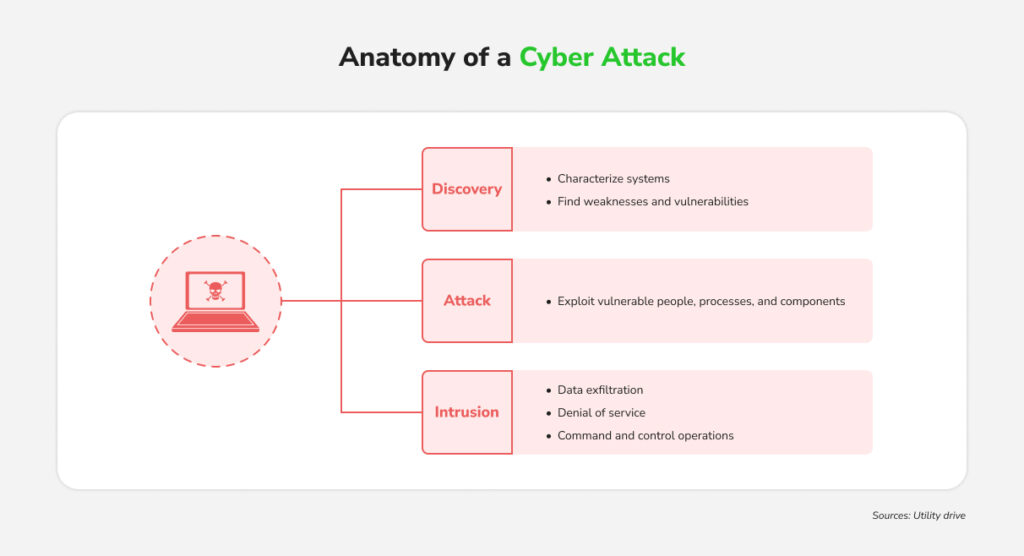
    Infographic explaining the three stages of a cyber attack, Discovery, Attack, and Intrusion, highlighting how hackers find vulnerabilities, exploit systems, and extract data.

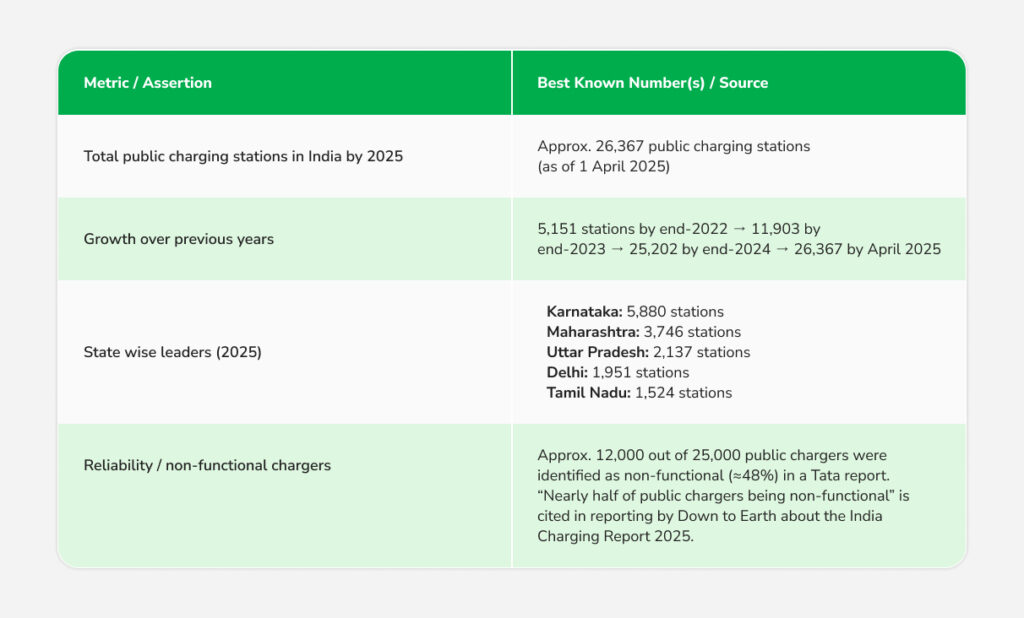
    India’s EV ecosystem is growing fast, with nearly 2 million EVs sold in FY2024-25 and over 29,000 public charging stations operational by late 2025. The government’s PM E-Drive program aims to install 72,000+ public chargers by 2026.  
     
    Each charging point is an IoT-enabled device that connects with vehicles, payment systems, and the power grid. This connectivity brings convenience but also makes chargers enticing targets for cybercriminals. A single compromised charger could lead to stolen user data, disrupted charging services, or even grid instability. In short, cybersecurity has become as important as electrical safety in the EV charging network.

    Government and industry stakeholders recognize the stakes. In 2023, Transport Minister Nitin Gadkari cautioned Parliament that EV charging stations are “susceptible to cyberattacks and security incidents, just like any other technological application.” He noted that India’s Computer Emergency Response Team (CERT-In) has already observed vulnerabilities in charging station software/hardware and issued multiple security alerts with countermeasures. Reporting cyber incidents is now mandatory, and the government is “actively taking steps to combat the issue of hacking”, emphasizing that securing EV infrastructure is a national priority. 

    Major Cyber Risks Facing EV Charging Networks 

    What kind of cyber threats do EV charging networks face? Broadly, the risks mirror those in other IoT and critical infrastructure systems. Key threat vectors include: 

    1. Denial-of-Service (DoS) Attacks
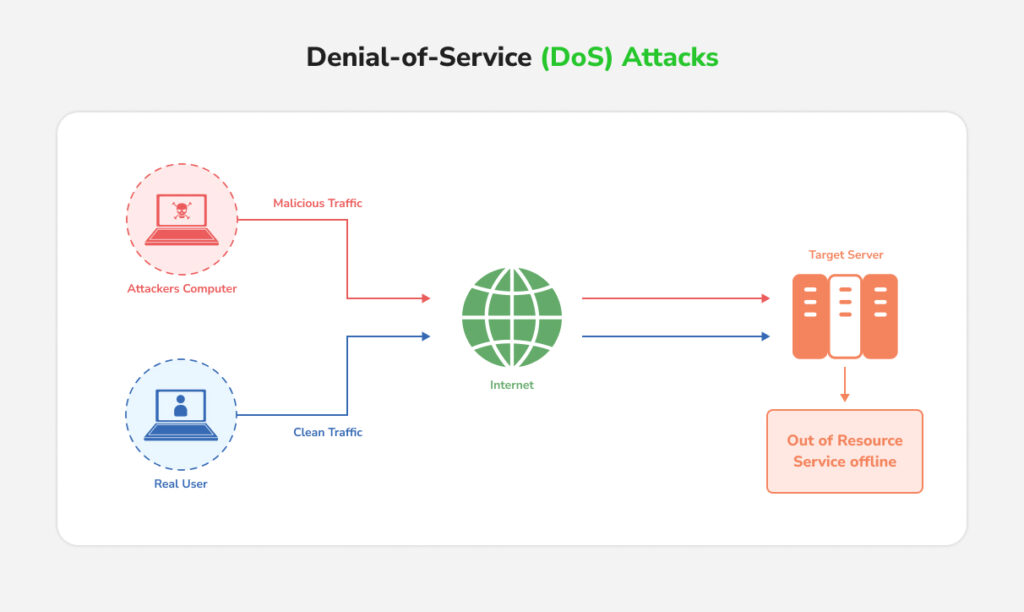
    Infographic showing how a DoS attack floods a target server with malicious traffic from an attacker, disrupting real users and taking the service offline.

    Overloading servers or communication channels to knock chargers offline. For instance, in a 2023 incident, ransomware attackers temporarily shut down a major charging network across the US and Europe. In a coordinated attack, widespread charger outages could even strain the grid by suddenly dropping or spiking demand.

    2. Man-in-the-Middle (MitM) Attacks
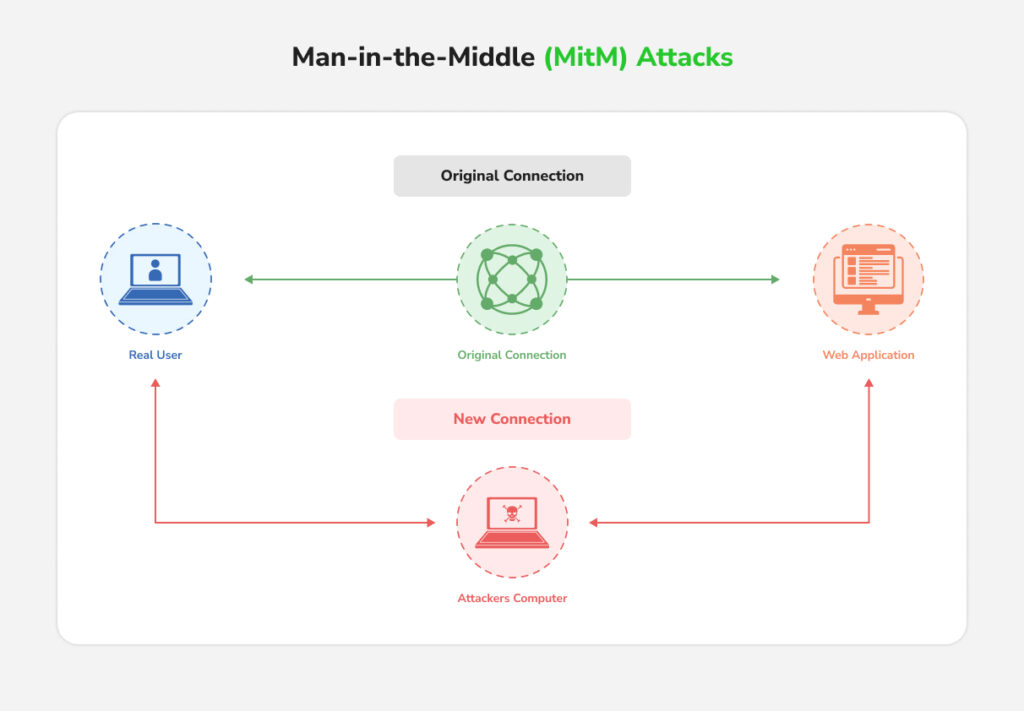
    Infographic showing a Man-in-the-Middle (MitM) attack, with an attacker’s computer intercepting and altering data between a user and a web application.

    Hackers intercept communication between EV chargers and backend systems to steal sensitive data (like payment information or user credentials) or send fraudulent commands. For instance, an attacker relaying or altering messages could manipulate charging session data, leading to incorrect billing or unauthorized free charging. 

    3. Malware and Ransomware
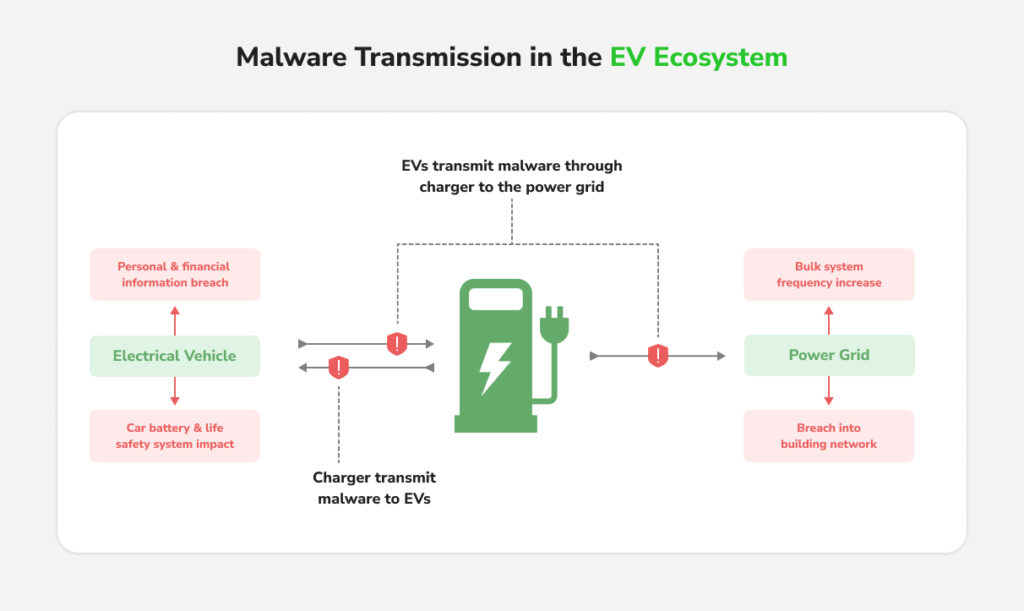
    Infographic explaining how malware spreads in the EV ecosystem, showing infected EVs transmitting malware through chargers to the power grid, leading to data breaches and system disruptions.

    Chargers run software that can be infected just like any computer.  Ransomware can lock down operations until a ransom is paid. A notable real-world example occurred in 2023 when a charging network provider was hit with ransomware that turned off chargers across multiple countries and demanded cryptocurrency to restore service. The company recovered without paying, but the incident was a wake-up call.

    4. Data Breaches 

    Public chargers often handle user identities, credit card payments, and vehicle data. Poorly secured systems can expose user identities, payment details, or charging patterns. In one case, Shell’s charging network had a vulnerability that could have exposed millions of charging session logs, including potentially sensitive driver data, before it was patched. 

    5. Unauthorized Remote Control

    If attackers exploit software vulnerabilities in a charger or the connected vehicle, they might gain remote control of charging equipment or even the vehicle. This scenario is more complex but was demonstrated when researchers at a 2025 cybersecurity contest compromised Tesla home chargers, highlighting that even widely used EVSE systems had exploitable flaws. In extreme cases, such exploits could be used to manipulate the charging rate or harm vehicle batteries (like overcharging) or as a bridge to infiltrate the car’s internal network. 

    6. Supply Chain Backdoors

    Another risk specific to India’s context is the heavy reliance on imported charger components. About 80–85% of EV charger parts in India are sourced from abroad (mainly China), raising concerns about hidden malware or backdoors. Industry experts warn that malicious code implanted in a charger’s components could be activated later to compromise the charger or any network it connects to. 

    7. Physical Tampering

    Not all attacks are purely digital; exposed chargers can be physically tampered with. For example, installing skimmers (to steal card data) or malware devices. Proper locks, tamper alarms, and surveillance can mitigate these risks, but they remain a consideration, especially for private chargers in unguarded locations. 

    Real-world incidents highlight these threats. In 2022, EV chargers in Russia and the UK were hacked to display rogue political messages. While these were pranks, the attackers essentially took control of the stations’ interfaces remotely, a capability that could be misused for more damaging ends.
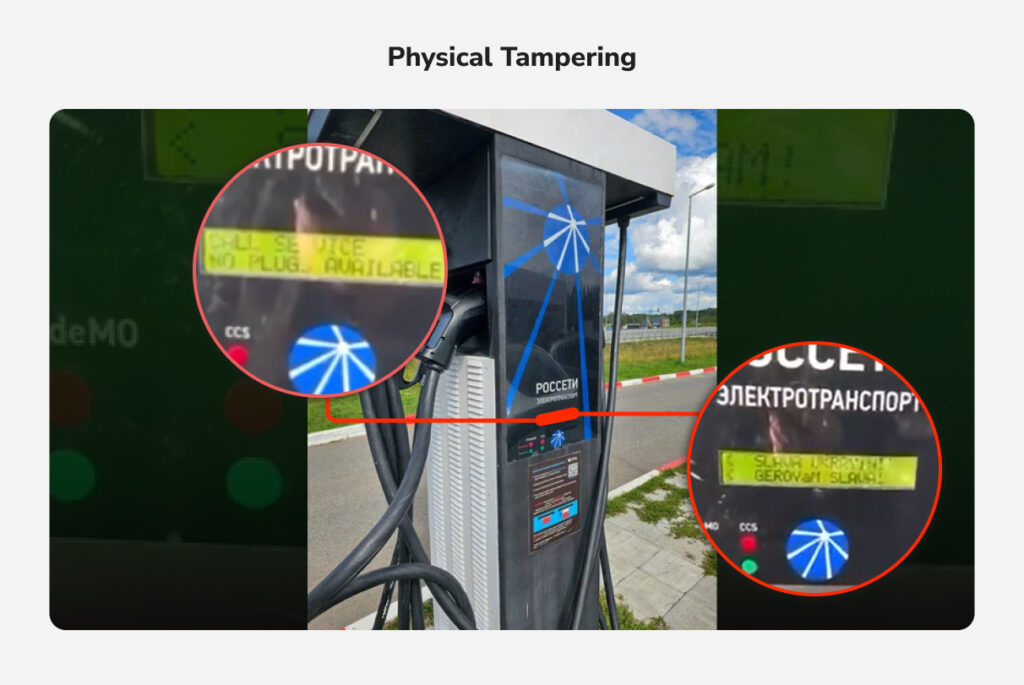
    Image showing a tampered EV charging station display with hacked text, illustrating physical tampering risks in EV chargers.

    More recently, Electrify America (a major US charging network) faced shutdowns due to operating system weaknesses, and in 2025, researchers at Pwn2Own (Tokyo) successfully breached Tesla’s Wall Connector chargers twice. Although India has not yet seen large-scale charger hacks, these examples highlight the urgent need for robust cyber protections.

    India’s Policy and Standards Landscape for EV Charging Security 

    Ensuring cybersecurity in EV infrastructure is a shared responsibility, and the Indian government has laid the groundwork through policies and standards: 

    Ministry of Power (MoP) Guidelines

    Issued in 2018 and revised in 2022 and 2024, these guidelines standardize charger deployment across India. While the MoP guidelines do not explicitly focus on cybersecurity, they enforce quality and uniformity, creating a reliable foundation on which software security can be built. Notably, under these guidelines, no license is required to operate public chargers, making it even more important that operators voluntarily adhere to best practices.

    Bureau of Indian Standards (BIS) Certifications

    The BIS has developed an entire set of standards (IS 17017 series, mirroring IEC 61851 and others) that cover performance, safety, and connector requirements for EV chargers. Adherence to these standards is now mandatory for manufacturers. Although these are largely electrical and mechanical standards, compliance ensures that chargers have proper protections against electrical surges, faults, and basic tampering. Robust hardware reduces risks of unsafe behavior during cyberattacks. BIS is also exploring standards for communication protocols and data security in automotive electronics.

    CERT-In Directives and Cyber Guidelines

    India’s CERT-In (Computer Emergency Response Team) under the IT Ministry plays a key role in cybersecurity policy, including for EV infrastructure. CERT-In continuously issues alerts and advisories about the latest cyber threats to EV charging systems and recommended countermeasures. Importantly, in 2022 the government empowered CERT-In to mandate that all cybersecurity incidents must be reported within hours and to prescribe emergency measures.  
     
    Gadkari highlighted that CERT-In has “formulated a Cyber Crisis Management Plan for critical sectors and empaneled 150 security auditors to help organizations tighten their defenses. For charging network operators, this means any breach or malware outbreak in their network must be disclosed to CERT-In, and they should follow CERT-In’s best practice guidelines. In 2024, the Ministry of Road Transport and Highways (MoRTH) explicitly acknowledged the cyber threat to EV chargers and stated that charging networks are expected to comply with CERT-In’s advisories, such as implementing encrypted communication, strong authentication, and regular security patches. While there isn’t a dedicated “EV charging cybersecurity law” yet, these directives effectively compel CPOs to adopt standard cyber hygiene or risk regulatory action. 

    Emerging EV Communication Standards

    India is encouraging secure communication standards like OCPP security and ISO 15118. Open Charge Point Protocol (OCPP) is the common language between chargers and their EV charging management systems. The latest version, OCPP 2.0.1/2.1 (released in 2025), adds substantial security features. It supports secure boot, encrypted messaging (TLS), digital certificates for charger authentication, and even secure firmware update mechanisms.  
     
    Many Indian networks today still use OCPP 1.6, but new installations are increasingly expected to use OCPP with security profiles enabled. Likewise, ISO 15118, the global standard for vehicle-to-charger communication, uses a robust PKI-based encryption and authentication system for EVs and charging points. The Bureau of Energy Efficiency (BEE) and other bodies have run pilots on ISO 15118 features in India, given its potential to make public charging both seamless and secure. Though ISO 15118 is not yet universally deployed, its secure handshake and cryptographic authentication offer a blueprint for the future of EV charging in India. We can expect upcoming guidelines to formally recommend these protocols for any smart public charging infrastructure.

    No Dedicated EV Charger Cyber Law – Yet

    It’s worth noting that as of late 2025, there is no separate cybersecurity certification or regulation specifically for EV chargers. General IT security rules apply, and power sector regulations cover grid-safety aspects. Industry executives have pointed out this gap, suggesting that specific guidelines could emerge as the network expands. In the meantime, much of the responsibility lies with charger manufacturers and operators to proactively secure their infrastructure.

    Final Thoughts 

    The cyber risks are real and evolving, from ransomware attacks and data breaches to potential grid disruptions. But so are the solutions. With proactive implementation of secure communication standards like ISO 15118 and OCPP security, adherence to CERT-In directives, and consistent alignment with BIS and MoP frameworks, India has the tools to stay ahead of emerging threats. 

    Ultimately, cybersecurity in EV charging is not a one-time compliance exercise; it’s a continuous process of vigilance, collaboration, and innovation. As stakeholders across government, utilities, OEMs, and CPOs work together, India can build a charging network that’s not just widespread and reliable but also cyber-resilient. Protecting every EV charging station in India today will ensure tomorrow’s electric highways remain open, safe, and secure for all. 

    Frequently Asked Questions

    Why can’t imported components just be “checked” for malware before use?

    Because backdoors are often embedded deep in firmware or chipsets —invisible without advanced testing. India is working toward local manufacturing and stronger supply chain audits to close this gap.

    If India doesn’t have a dedicated EV cybersecurity law yet, who enforces compliance right now?

    Currently, CERT-In acts as the de facto authority. It mandates that all cyber incidents must be reported and issues security advisories that operators are expected to follow. Enforcement is indirect, through policy pressure, public procurement standards, and utility-level compliance.

    What happens if a public charger is hacked? Who’s liable?

    Right now, liability is murky. Without a dedicated law, responsibility could fall on the CPO (Charge Point Operator) or hardware vendor, depending on the cause, whether it’s poor software maintenance or a faulty device. Future EV-specific regulation is expected to clarify this.

  • EV Charging Connectors in India: A Masterclass on Standards 

    EV Charging Connectors in India: A Masterclass on Standards 

    Electric vehicle charging connectors are like the “fuel nozzles” of EVs – the plugs and sockets that let you charge your vehicle. Unlike petrol nozzles, which are standardized, EV connectors come in different shapes and standards. If you’ve ever struggled with multiple phone chargers, you know the feeling. EV owners face a similar challenge with charging connectors.  
     
    In this blog, we break down the key EV connector standards in India, why they matter, and who uses what. We’ll focus on the main players with an Indian lens for EV users, fleet operators, and charging providers. By the end, you’ll know exactly which plug fits which vehicle and why India is standardizing connectors. 

    Why Do EV Connector Standards Matter? 

    In the early days of EVs, automakers used different charging plugs, leading to a “format war” much like VHS vs. Betamax or old phone chargers. Some countries rolled out confusing charging networks with multiple plug types, frustrating drivers when plugs didn’t fit their EVs.  

    Standards ensure any EV can charge at any station safely and efficiently. They define plug shape, power levels, and communication between car and charger, so both speak the same “language”. For drivers and fleet operators, standard connectors reduce range anxiety. For charging providers, it means serving more vehicles with fewer cable types. In short, connectors are the bridge between EVs and the power grid, and standardization is key to a seamless charging experience. 

    This is why the idea of a universal EV charging station is gaining traction in India, one setup that can serve multiple connector types and ensure compatibility across brands.

    Type 2 (AC): The Standard AC Charging Plug 

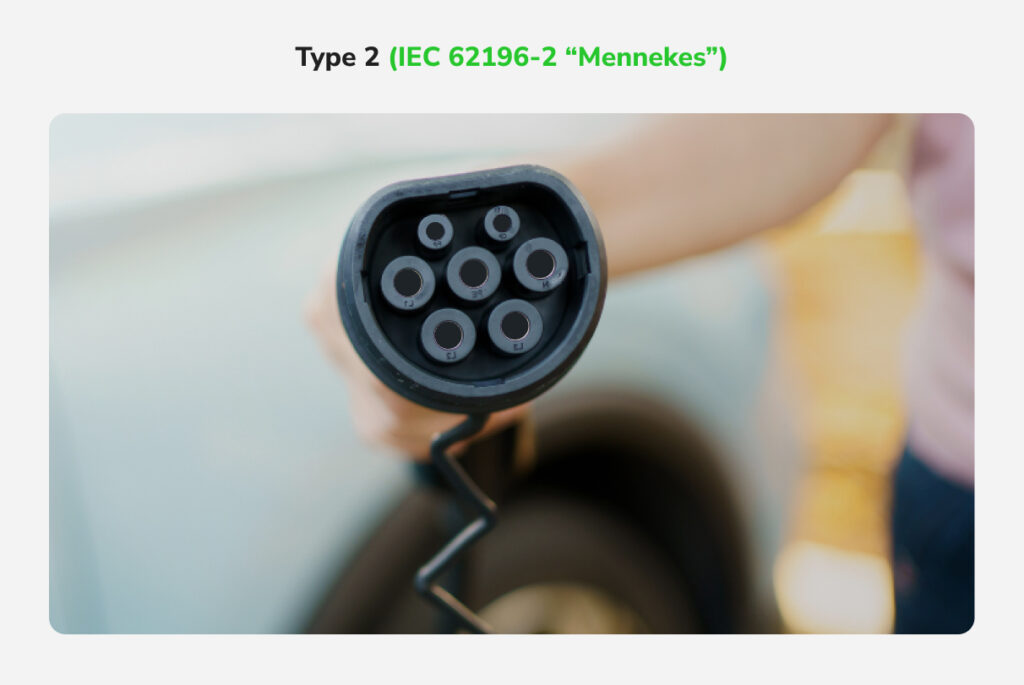
    Type 2, also known as the Mennekes or IEC 62196 Type 2 connector, is the global standard for AC charging and the default in India. Its round 7-pin design supports both single-phase and three-phase AC, allowing up to 32A and 22 kW output. 

    Most EVs in India, from the Tata Nexon EV and MG ZS EV to the Audi e-tron and Mercedes EQC, use a Type 2 port, often as part of the CCS2 combo inlet. Public chargers (7–22 kW) at malls and offices typically provide Type 2 sockets or tethered cables, letting you plug in directly or use your own cable. 

    Type 2’s success comes from its universal compatibility, built-in safety features, and smart communication pins that let the charger and car “handshake” before charging. It’s officially recognized by the Bureau of Indian Standards (BIS) as India’s AC charging norm, ensuring interoperability across vehicles and networks. 

    Think of it as the USB-C of EVs: one connector for almost everything. 

    CCS2 (Combined Charging System Combo 2)

    For fast charging, the CCS2 charging standard (Combined Charging System Type 2) is now the benchmark across India and much of Europe. It combines AC and DC charging within a single connector, creating a unified solution for every scenario. 

    A CCS2 inlet looks like a Type 2 socket with two larger DC pins added below. This simple but clever design allows one port to handle both slow AC and high-speed DC charging. For drivers, that means one port for all charging needs; for manufacturers, it simplifies design and ensures global compatibility. 

    Technically, CCS2 is built for high-voltage, high-current charging, up to 1000 V DC and around 500 A with liquid-cooled cables, enabling ultra-fast charging. In practice, most DC fast chargers in India deliver 60–120 kW, while premium networks are rolling out 150–350 kW stations. 

    Recognizing this scalability, BIS adopted CCS2 for DC and Type 2 for AC as unified national charging standards. Today, nearly all public DC chargers in India feature CCS2 guns. Older systems like CHAdeMO, once common for Japanese EVs, have largely disappeared as the market converged on CCS2. 

    As a result, virtually every modern EV, from the Tata Nexon EV and MG ZS EV to the Kia EV6, BMW i4, BYD Seal, and Mercedes EQE, supports CCS2 fast charging, cementing CCS2 as the backbone of India’s fast-charging ecosystem. 

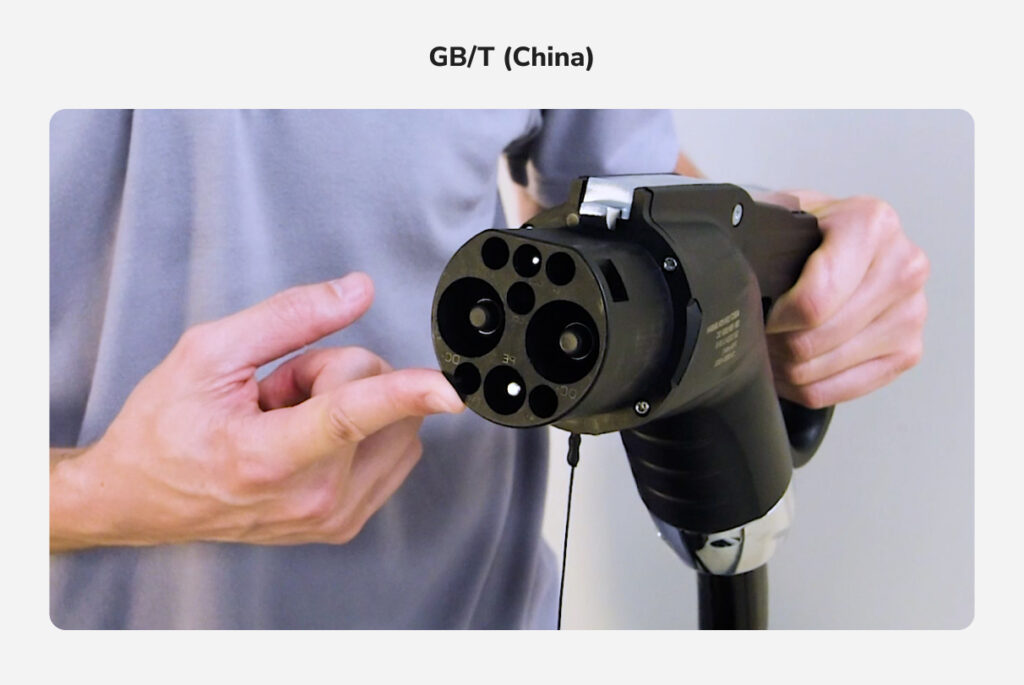
    GB/T: The Chinese Standard and Its Indian Journey

    GB/T refers to China’s national charging standards (GB stands for “Guobiao,” meaning national standard). Unlike CCS, GB/T has separate plugs for AC and DC.  
     
    The AC connector is oval-shaped with seven pins,  while the DC connector uses two thick pins in a rectangular housing. Many early Indian charging stations installed under government schemes had GB/T outlets, especially for serving vehicles from Indian manufacturers who adopted the “Bharat DC-001” standard. 

    GB/T entered India through early Chinese-designed EVs and the Bharat Charger standards (2017–2019). Bharat DC-001 used a modified GB/T connector with CAN communication, delivering up to 200 V, 120 A (≈15 kW) for early EVs like the Mahindra e-Verito, e2o, and Tata Tigor EV fleet models. Bharat AC-001 offered up to 3×3.3 kW via IEC 60309 sockets. 

    As EVs grew in range and battery size, India adopted the CCS2 for new cars. GB/T remains relevant mainly for electric buses (e.g., BYD-based Olectra fleets) and older public chargers, but  CCS2 dominates new installations. 

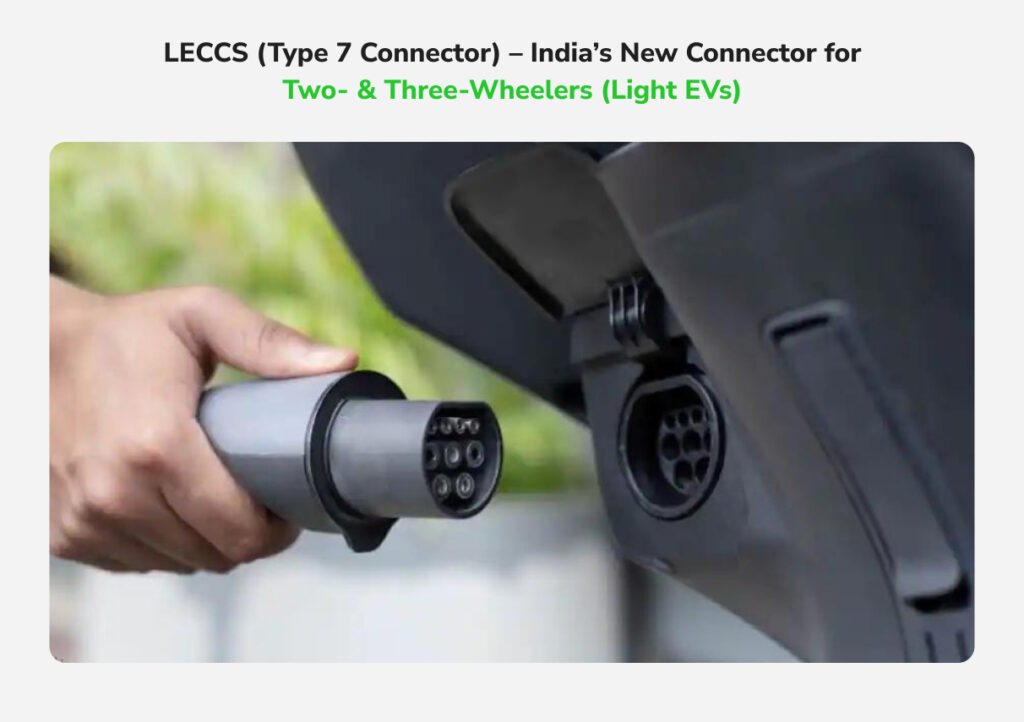
    LECCS (Type 7 Connector): India’s Standard for Two- & Three-Wheelers 

    LECCS (Light Electric Combined Charging System) is India’s first homegrown charging standard for light EVs, covering electric 2-wheelers, 3-wheelers, and small 4-wheelers. Approved by BIS in late 2023, it’s the world’s first combined AC/DC connector designed for light vehicles. 

    CCS2 is too large and costly for scooters or e-rickshaws. Since over 75% of Indian vehicles fall into this category, LECCS offers a compact, affordable solution by merging AC and DC pins into one small, lightweight plug, essentially a “mini CCS” for light EVs. 

    LECCS (Type 7 in BIS documents) supports up to 7 kW AC (240 V, 32 A) and ~10–12 kW DC (120 V, 100 A), enabling both slow home charging and DC fast charging. A typical scooter can charge to 80% in under an hour using an LECCS DC charger; no separate charger or proprietary connector is needed. 

    Developed by NITI Aayog, ARAI, DST, and industry players like Ather Energy, LECCS builds on Ather’s open-sourced connector design. Manufacturers, including Ather, Hero MotoCorp, and Jitendra EV, are already integrating it. With adoption, over 90% of India’s light EVs could share a common connector. 

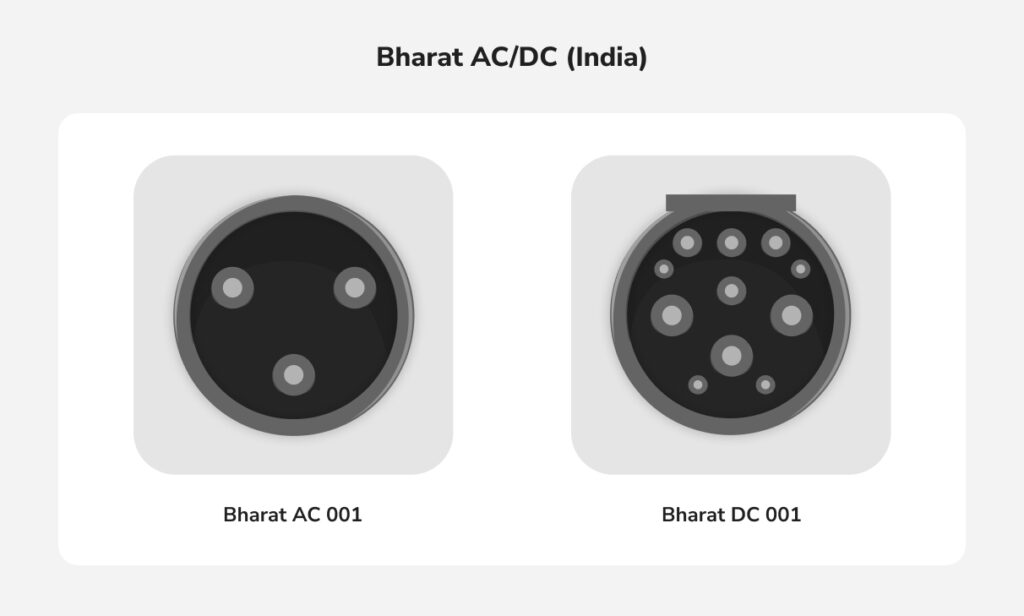
    Bharat DC-001: India’s First DC Fast-Charging Standard

    Introduced under the FAME program in 2017, Bharat DC-001 (or Bharat DC) is India’s first national DC charging standard. Based on China’s GB/T protocol, it uses the same gun-style connector with two large DC pins and smaller communication pins. Bharat DC-001 delivers up to 15 kW DC output (200 A, approx. 72 V max). It covers voltage levels from 48V to 72V using CAN communication and supports OCPP for charger-network integration, making it advanced for its time. Though slower than CCS2, it’s 4–5× faster than basic AC charging; for example, a 5 kWh e-rickshaw battery could recharge in about 20–30 minutes. 

    Initially, Bharat DC chargers were installed nationwide under FAME and by public agencies like EESL, anticipating their use by low-voltage cars and fleets. However, as mainstream EVs adopted higher-voltage systems and CCS2 connectors, Bharat DC became limited to light EVs. Today, it remains relevant mainly for e-autos, e-carts, and small 3-wheelers like the Mahindra Treo or similar fleet vehicles. 

    Early policies required one Bharat DC charger per EV charging station in India, but this mandate was dropped in 2019 as carmakers shifted to CCS2. The BIS standard IS:17017 still includes Bharat DC for low-voltage use, but new deployments now favor modern connectors such as Type 6 and Type 7 (LECCS)

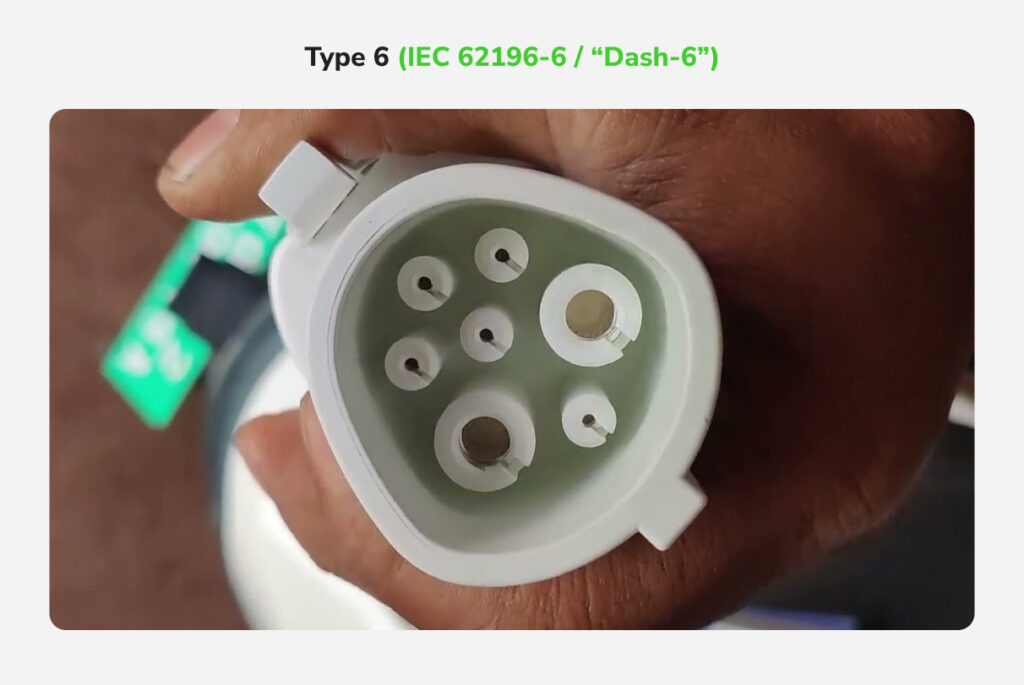
    Type 6 (IEC 62196-6 / “Dash-6”) 

    Type 6, also called Dash-6 or LEV DC connector, is a DC-only charging standard for light EVs such as scooters, e-rickshaws, and bikes. Defined in India’s IS:17017 Part 2 Section 6, it supports up to 120 V DC and delivers 3–12 kW. It uses a simple CAN-bus protocol with a control pilot signal for safety and has two main pins (DC + and –) plus smaller ones for communication. It does not support AC charging or advanced features like Plug-and-Charge or V2G. The focus is simplicity, reliability, and low cost. 

    At 10 kW, a 10-minute charge adds about 1.6 kWh, roughly 40–50 km of range for a scooter. Most chargers operate at 3 kW or 6 kW to balance cost and speed, while higher-power versions (10–12 kW) are used for rapid fleet top-ups. 

    Between 2022 and 2024, Type 6 became popular for quick, low-cost network deployment. A typical charger costs around ₹1.5 lakh (~$1,800), making it ideal for small businesses and fleet depots. It’s widely used in pilot projects and compact charging points across cities. 

    However, Type 6 is seen as an interim standard. BIS and government agencies now back Type 7 (LECCS) as the long-term solution. By 2024, both Type 6 and Type 7 were officially standardized, and dual-standard chargers (e.g., Bolt.Earth Blaze DC) began supporting both to ensure compatibility. 

    Final Thoughts 

    India’s EV connector landscape is becoming unified and user-friendly. For four-wheeler EV users, it’s straightforward: cars use Type 2/CCS2 ports, so any standard charger will fit. Carry your Type 2 EV connector cable for AC charging and use CCS2 cables at DC stations.  
    For two- and three-wheeler users, the government and industry heard your pain (of carrying chargers or finding brand-specific stations) and introduced LECCS, which promises “one plug to charge them all,” whether it’s a slow top-up or a quick fast-charge. As this gets adopted, expect a much denser and more accessible network for light EVs; charging an e-scooter on the go could become as easy as charging your phone at any cafe. 

    A key takeaway is that standardization breeds confidence. When connectors are widely supported, EV ownership feels seamless. India’s policies aim to remove refueling anxiety, ensuring customers can charge their vehicles easily, no matter where they are or which brand they ride. This is akin to how all petrol vehicles share the same fuel dispensers, or how a universal EV charging station ensures compatibility across multiple EVs.

    Frequently Asked Questions

    Which connectors are approved by BIS? 

    Type 2 (AC) and CCS2 (DC) for four-wheelers and LECCS (Type 7) for two- and three-wheelers are officially approved by BIS. 

    Is CHAdeMO still used in India?

    No. CHAdeMO is being phased out in favor of CCS2, which has become the global and Indian standard for DC charging.

    Do all EV cars have the same charging port in India? 

    No. Four-wheelers mostly use Type 2 (AC) and CCS2 (DC) connectors, while two- and three-wheelers are adopting LECCS (Type 7) and LEV DC (Type 6), but India’s national standards are converging on Type 2 and CCS2 for cars, and LECCS for light EVs.

    Why did India choose Type 2 and CCS2 as its national standards?

    India adopted Type 2 for AC and CCS2 for DC because they are globally established, interoperable, and future-proof. They support both single-phase and three-phase AC and high-power DC fast charging (up to 1000 V, 500 A), covering the entire range from home to highway charging. This ensures imported EVs, local models, and future vehicles all use a common ecosystem

  • Implementing DC Fast Charging: A Fleet Manager’s Guide

    Implementing DC Fast Charging: A Fleet Manager’s Guide

    For fleet managers electrifying (or expanding) their EV fleets, designing the right fast charging setup is just as important as selecting the right vehicles. This blog provides a step-by-step framework and tips to help you choose a DC fast charging solution that maximizes uptime and return on investment (ROI).  

    1. Assess Your Fleet’s Duty Cycles and Energy Needs

    Start by analyzing your fleet’s daily operations. What is the average distance per vehicle? What are the peak operating hours vs. idle periods? What are the typical range requirements and downtime windows?  
     
    For example, if delivery vans cover 120 km daily and return to the warehouse twice for loading, those loading periods might be ideal for quick charging. A van consuming 1 kWh per 5 km would need approximately 24 kWh per day. Multiply this by your fleet size to estimate total daily energy demand.  
     
    A useful rule: Segment vehicles based on charging needs. For example, vehicles with around-the-clock availability or very high daily mileage will likely require DC fast chargers, not just overnight slow charging. Identify which vehicles absolutely need fast charging to meet the schedule (e.g., those with <4-5 hours idle time in 24 hours) and which can suffice with slower charging.

    2. Choose the Right Charger Power Levels

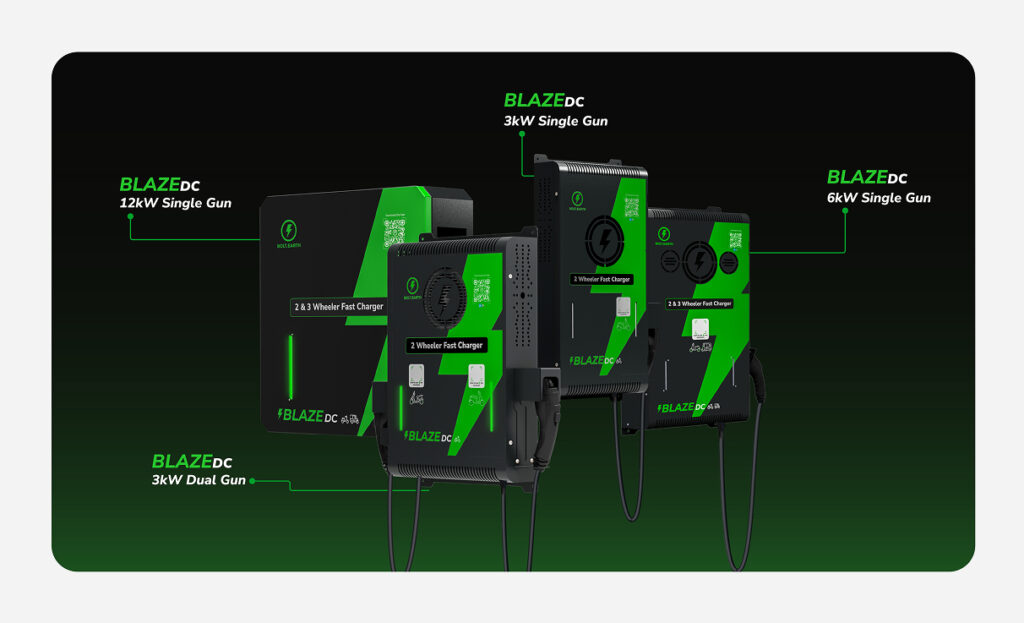
    Bolt.Earth BLAZE DC Fast Chargers lineup showcasing 3kW, 6kW, and 12kW models with single and dual gun options designed for two- and three-wheeler electric vehicles.

    Small EVs like 2- and 3-wheelers (2–10 kWh batteries) need only 3–12 kW chargers—enough for a full charge in under an hour. Most two-wheelers can’t handle high currents.

    Three-wheelers and small cargo EVs (10–20 kWh) charge efficiently at 15–30 kW, reaching full capacity in 30–60 minutes.  

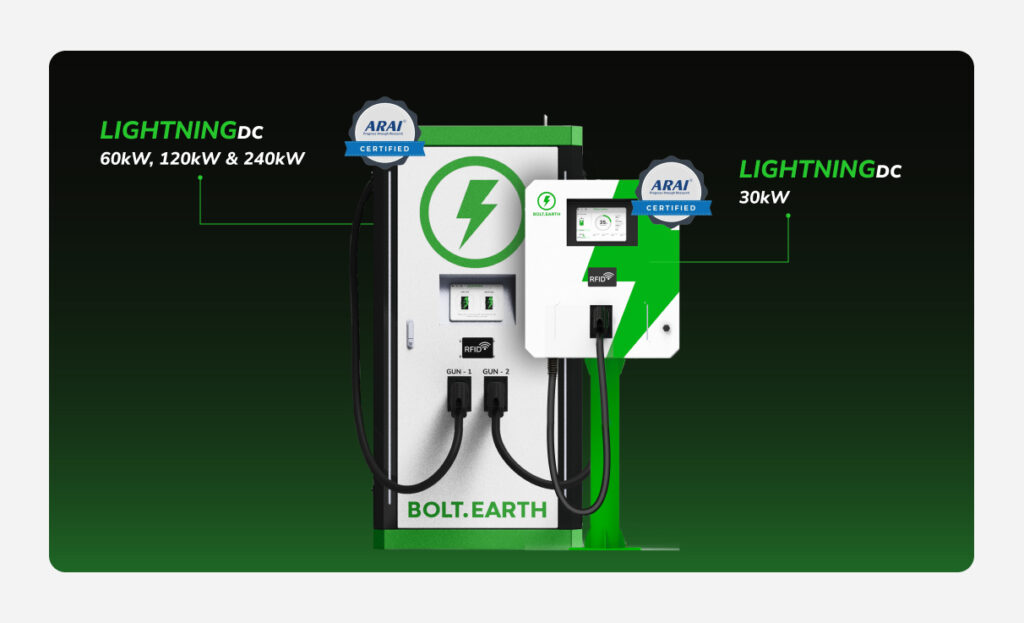
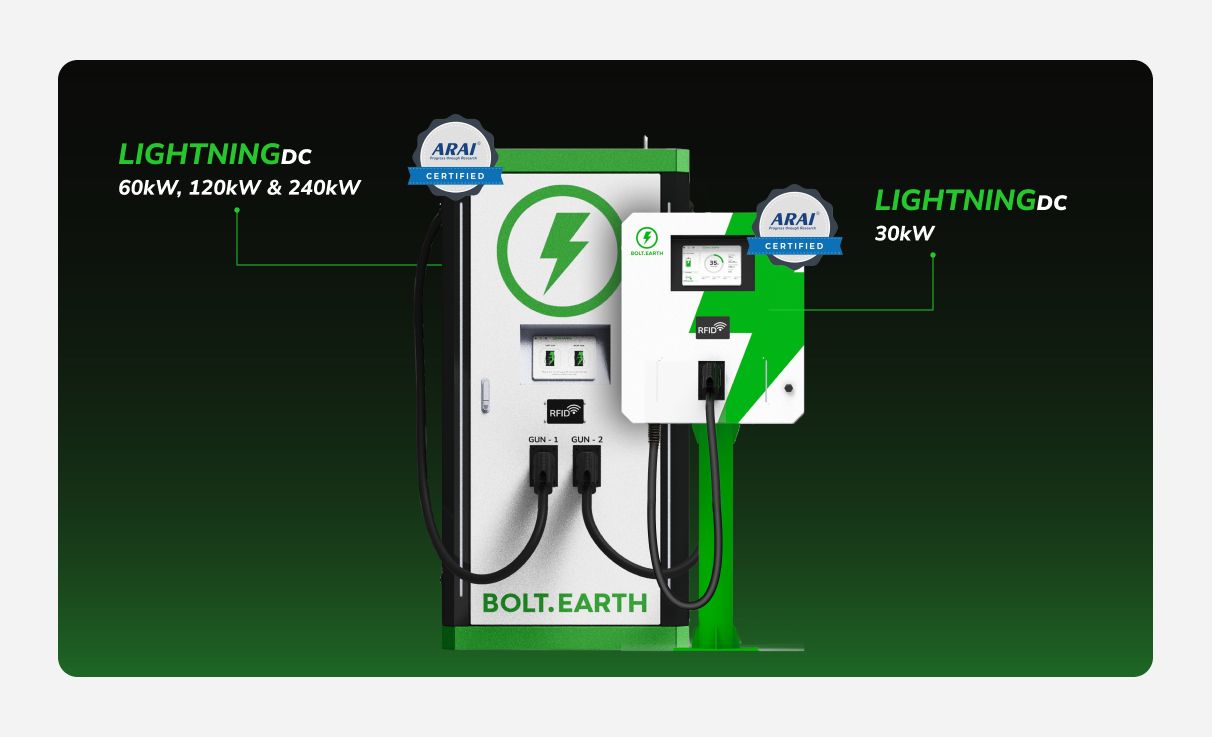
    Bolt.Earth LIGHTNING DC fast chargers with 30kW, 60kW, 120kW, and 240kW power outputs, ARAI-certified charging units designed for electric cars and commercial EV fleets.

    Fleet cars and vans (20–40 kWh) typically support 30–60 kW DC fast chargers, adding approximately 100 km of range in an hour, or up to 80% in less than one.  

    Larger trucks and buses (100 kWh+) need at least 60 kW, ideally 90–210 kW for faster turnarounds. 

    City e-buses in India typically use 120 kW chargers, while intercity buses and heavy trucks are adopting 360 kW CCS2 and upcoming megawatt charging systems. Since higher power means higher cost and grid demand, a mix works best: a few 100 kW units for large vehicles and multiple 30 kW units for routine fast charging. 

    Ensure compatibility with connector standards. To future-proof your setup. 

    3. Determine Number of Chargers and Charging Ports

    Estimate how many vehicles need to be charged simultaneously. Fleet EVs often share chargers due to staggered charging schedules. One fast charger can typically serve 5-10 vehicles with managed scheduling

    For example, if 10 taxis each need a 30-minute top-up across an 8-hour shift, two 50 kW chargers could handle all 10. But if 20 delivery vans return at 7 PM and must leave by 8 PM, more chargers will be required. 

    As a rule of thumb, start conservatively (3:1 or 4:1) and adjust using real-world usage data, though high-utilization fleets may need ratios closer to 1:1 or 2:1. Consider dual-gun chargers that can charge two vehicles at once or split power dynamically (e.g., two 30 kW outputs from a 60 kW unit).

    Plan your layout for easy cable access and charger reach.  Finally, always use at least one extra charger for redundancy in your fleet charging solution. 

    4. Plan Infrastructure and Power Supply 

    Collaborate early with your electricity provider and engineers to confirm your site can handle the required load. For example, three 60 kW chargers running together require 180 kW; your connection and transformer must support this load alongside other facility needs. Use load management systems to stay within capacity. If you have four 60 kW chargers (240 kW total) but only a 180 kW connection, smart software can dynamically distribute power to avoid overload. 

    Consider on-site solar and battery energy storage (BESS) to reduce grid demand and costs. Storage can charge during off-peak hours or from solar, then deliver high power during peak use, easing grid pressure and providing backup during outages.

    In the EV charging infrastructure in India, solar + storage systems can make daytime fast charging cleaner and cheaper. 

    If mission-critical uptime is essential, include backup power, such as a diesel genset or battery pack, for emergency charging. While diesel backup isn’t ideal for the long term, it ensures operational continuity when the grid fails. 

    5. Ensure Charger Uptime and Maintenance

    Fast charging only adds value when chargers are reliable. Invest in robust, well-supported equipment with remote monitoring and strong service contracts.  

    Best practices include:  

    • Preventive maintenance, regular inspections, calibration, and timely replacement of wear parts.  
    • Keep essential spares like cables, connectors, and fuses handy to minimize downtime. 
    • Train in-house staff or contract an on-call technician for quick fixes, and consider an O&M contract with guaranteed uptime (e.g., SLA to resolve faults within 24 hours).  
    • Always plan for redundancy; if one charger can meet your fleet’s needs, install at least two to prevent total disruption. 

    As your fleet grows, distribute chargers across sites to avoid single-point failures. With proper monitoring, predictive maintenance, and real-time monitoring, 95–98% uptime is achievable. Treat chargers like critical IT infrastructure, actively managed and maintained. 

    6. Use Software to Optimize Charging and Costs

    A centralized charging management platform can automate scheduling, prioritize vehicles, and notify drivers when charging is complete.  

    For larger fleets, integration with EV fleet management solutions helps align charging with vehicle deployment. 

    Smart scheduling also reduces electricity costs by shifting non-urgent charging to off-peak tariff hours (like 6–10 PM). Advanced systems can reallocate power from nearly full vehicles to those needing faster charging, maximizing utilization. 

    In India, many fleets already use these strategies; charging more vehicles simultaneously at moderate power often beats waiting for high-speed slots. Smart software ensures every kilowatt is used efficiently. 

    7. Analyze Costs and Track ROI

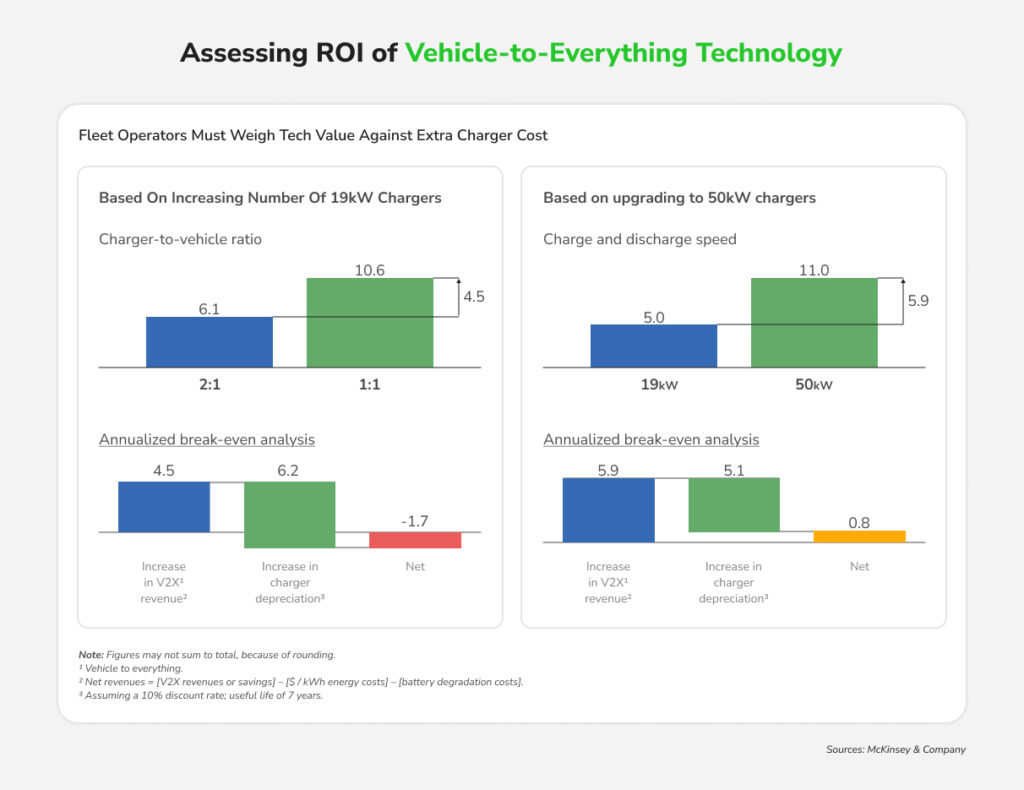
    Comparison chart showing ROI analysis for Vehicle-to-Everything (V2X) technology, highlighting charger-to-vehicle ratios, break-even analysis, and net revenue impact when upgrading from 19kW to 50kW chargers based on McKinsey & Company data.

    Before installation, conduct a full total cost of ownership (TCO) and EV charging ROI analysis covering equipment, installation, grid upgrades, maintenance, and electricity costs. Balance these against savings, lower fuel and vehicle maintenance costs, operational uptime gains, and any carbon credits or incentives. This helps estimate your payback period. 

    Many fleet charging projects in India recover costs within a few years; high-utilization public stations can even break even in under two days. For private fleets, the “return” often comes from fuel savings and improved productivity. 

    If ROI looks tight, adjust your plan; fewer chargers, more overnight AC charging, or smarter utilization can improve payback. Aim for 30–50% charger utilization during working hours to strike the right balance between capacity and efficiency. 

    Also, explore financing or leasing models, now offered by several banks and charge-point operators. Spreading costs over time through “charging-as-a-service” makes infrastructure investment easier and ROI more attractive. 

    8. Future-Proof and Scale Your Setup

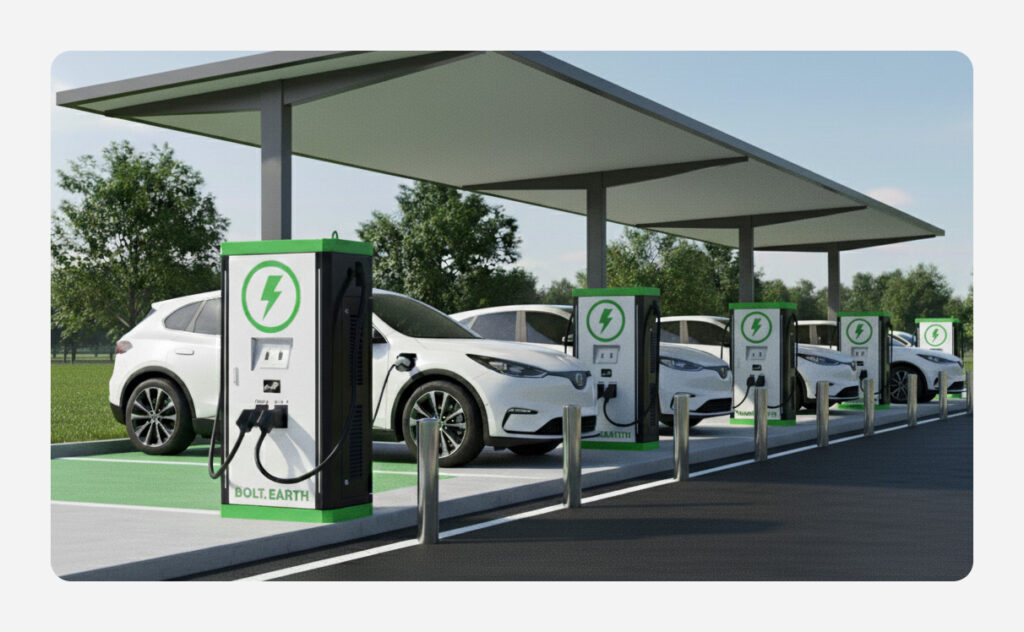
    Row of electric cars charging at Bolt.Earth DC fast charging stations under a covered solar canopy, showcasing modern EV fleet charging infrastructure in an outdoor setting.

    Plan your charging setup with growth from the start. As EV adoption rises, expanding your fleet and charging needs will be inevitable. It’s far cheaper to prepare now than retrofit later. 

    When installing electrical infrastructure, lay conduits for future chargers and install a slightly larger transformer in case the fleet size may double in a few years.  

    Choose modular chargers that scale easily. Reserve space and electrical capacity upfront to avoid expensive overhauls later. 

    Stay informed on emerging technologies like 500 kW+ chargers and vehicle-to-grid (V2G) systems. If relevant, invest in V2G-ready chargers to unlock future revenue opportunities. 

    Finally, ensure all chargers support open standards like OCPP to maintain software flexibility and avoid vendor lock-in. The goal: build a system that grows and evolves seamlessly as your fleet and technology advance. 

    Final Thoughts

    By understanding your fleet’s needs, right-sizing your charger mix, building a resilient infrastructure, and using smart management software, fleet managers like you can deploy DC fast chargers in a cost-effective way that delivers real uptime and ROI. Indian pioneers, from e-commerce giants to electric taxi startups and state transport fleets, have proven it’s possible. Their success came not just from adopting EVs but from building the charging muscle behind them. 

    Frequently Asked Questions

    How do I decide which vehicles in my fleet actually need DC fast charging?

    Not all EVs need DC fast charging. Analyze duty cycles and downtime windows. If a vehicle operates almost continuously (e.g., <4–5 hours idle per day), it needs DC charging to sustain uptime. Vehicles with predictable overnight rest can rely on slower AC charging. A good strategy is to segment your fleet by usage intensity. High-mileage or high-availability vehicles get fast chargers; the rest use slower, cheaper options. 

    How do I calculate how many chargers my fleet actually needs? 

    Estimate total energy demand (kWh/day) and overlapping idle times. A 3:1 or 4:1 vehicle-to-charger ratio works for most medium-utilization fleets, but for 24×7 operations, go closer to 1:1 or 2:1. Also, always install at least one redundant charger for continuity. 

    What kind of maintenance plan ensures 95%+ uptime? 

    Follow preventive maintenance every quarter, cable inspection, firmware updates, and part replacements (connectors, relays, fans). Keep critical spares on-site, train one technician, and use remote diagnostics for quick fault resolution. Aim for an Operation and Maintenance Service Level Agreement (O&M SLA) guaranteeing 24-hour resolution; treat chargers like IT servers, not just equipment. 

  • Top 5 EV Charging Innovations of 2026 Set to Solve Range Anxiety 

    Top 5 EV Charging Innovations of 2026 Set to Solve Range Anxiety 

    Below are five global innovations in EV charging poised to meaningfully impact EV charging infrastructure in India by 2026. Each innovation redefines the charging experience in terms of speed, efficiency, and cost-effectiveness, helping India leapfrog infrastructure challenges and accelerate EV adoption. 

    5. Megawatt EV Platforms: 1,000V Architecture Brings 1 MW Charging to the Masses

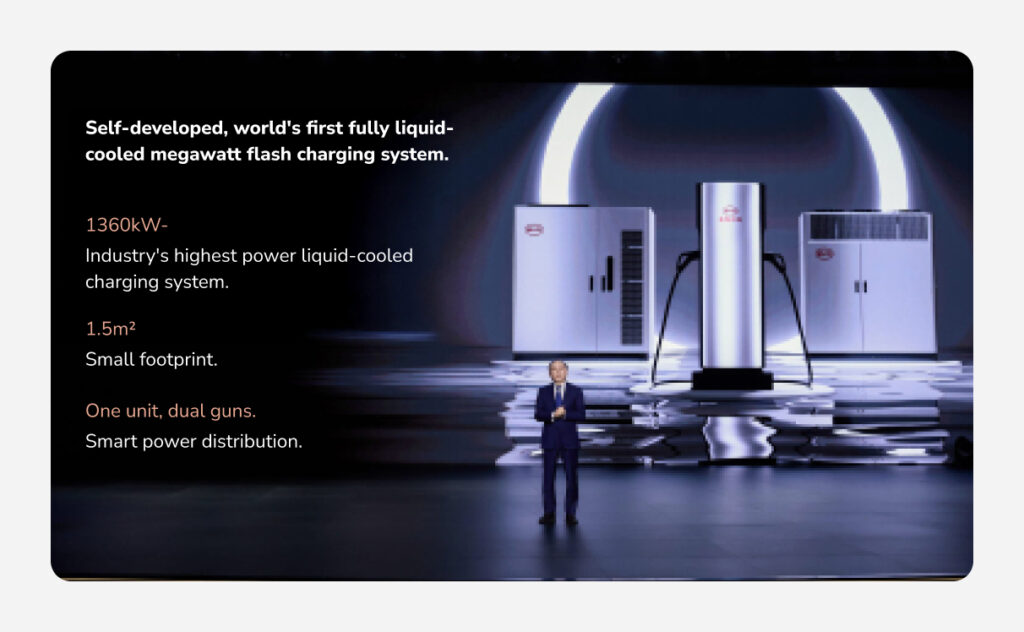
    Chinese automaker BYD has “flipped the switch” on charging times with its new Super e-Platform, unveiled in March 2025. This is the world’s first mass-produced “full-domain” 1000-volt EV architecture, delivering megawatt-level charging power. BYD demonstrated that an EV using this platform can gain approximately 400 km of range in just 5 minutes, equivalent to two kilometers of driving range per second.  

    With a 1 MW peak, using 1000 V and 1000 A, charging an EV can rival the convenience of refueling a petrol car. Importantly, BYD is rolling out this capability in mainstream models like the Han L and Tang L sedans/SUVs, democratizing ultra-fast charging for everyday drivers.  

    To support this surge, BYD plans to build 4,000 new “Flash Charging” stations across China. Each station features liquid-cooled 1 MW DC chargers, smart energy management, and often onsite solar power. These hubs can serve dozens of vehicles per hour, minimizing wait times even during peak demand. As more automakers adopt 800V+ architectures and megawatt charging standards, pit stops will shrink from hours to minutes, erasing one of the last barriers to practical electric road trips for commuters and commercial fleets alike. 

    4. Megawatt Charging: New Benchmarks for Passenger EVs

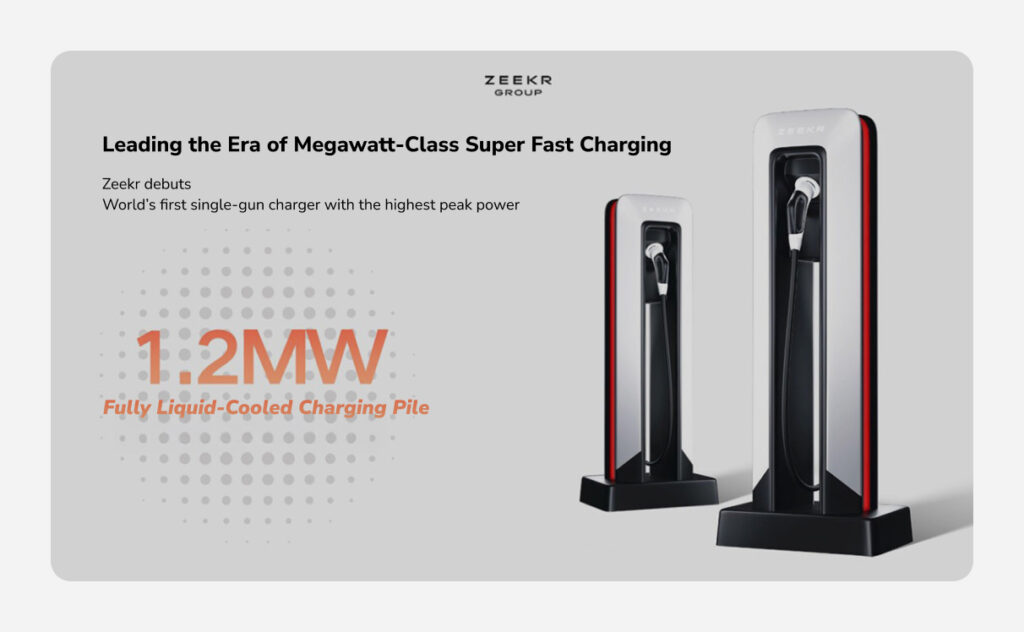
    Once reserved for heavy-duty electric trucks and buses, megawatt-class charging is now entering the passenger EV segment. Thanks to rapid advances by companies like Zeekr, BYD, and Huawei, charging speeds are reaching unprecedented levels. At 1.3 MW (roughly 1,300 kW), an EV could gain 500 km of range in about 5 minutes of charging. China is leading this ultrafast charge; premium EV brand Zeekr (part of Geely) recently unveiled a 1.2 MW fully liquid-cooled charger for passenger vehicles, the highest-powered car charger to date. It leapfrogs BYD’s 1 MW system, although current EV models need to catch up to fully utilize this capability.  
     
    Huawei has also announced a 1.5 MW charging system for electric trucks, delivering 2,400 A of current and up to 20 kWh per minute of energy transfer. All this means that in China, hundreds of 1 MW+ public charge points are already live, and thousands more are planned by 2030. These ultrafast stations use innovations like liquid-cooled cables and AI-powered load balancing to safely manage high power flow during peak hours.  
     
    Europe and the US are following suit. The EU’s new regulations support megawatt-class chargers along core highways, and companies in both regions are testing the technology for future networks.  

    The result? EV drivers will soon “fill up” as quickly as stopping at a petrol pump, making long-distance electric travel effortless and range anxiety a thing of the past. 

    3. Wireless EV Charging Will Redefine Convenience

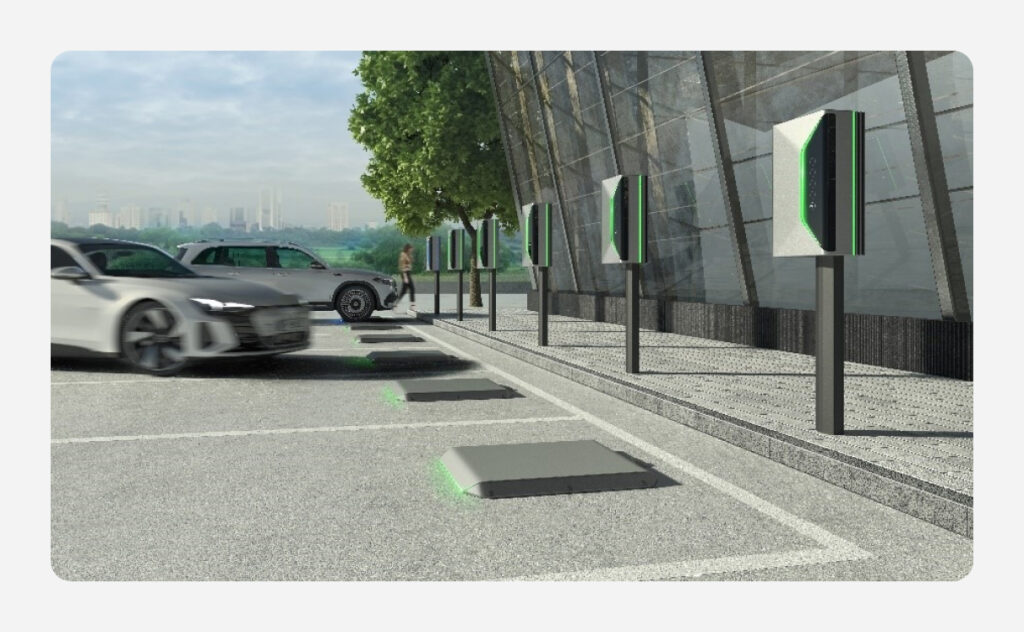
    Wireless charging uses electromagnetic induction to transfer energy without a physical cable. A charging pad embedded in the ground transmits energy to a receiver coil on the underside of the car, even with an air gap of up to 25 cm.  
     
    Massachusetts-based WiTricity is rolling out its Halo wireless charging system for real-world use. After successful demos retrofitting a Ford Mustang Mach-E and a Tesla Model 3, WiTricity is deploying Halo on E-Z-GO and ICON electric golf carts and light vehicles as part of a commercial pilot. The system delivers about 11 kW, translating to roughly 35 miles of range per hour of charging.  
     
    Major players are backing the tech. WiTricity’s investors include Mitsubishi and Siemens, and it’s partnering with South Korea’s KG Mobility (formerly SsangYong) to integrate wireless charging in future models. Another startup, HEVO from Brooklyn, is testing a 50 kW wireless charging pad on a Chrysler Pacifica minivan and developing a 300 kW version for the next leap in power.  

    Tesla has also confirmed it’s developing an inductive charging solution. As Tesla’s design chief noted, “You don’t even need to plug in… just pull into your garage, drive over a pad, and it’s charging.”  
     
    With industry standardization efforts underway, wireless charging pads could soon appear in garages, shopping centers, and taxi stands. This technology makes charging as easy as parking, rendering the entire charging process invisible and eliminating day-to-day range anxiety. 

    2. Electrified Roads: Charging Vehicles in Motion

    If wireless charging pads seem futuristic, how about roads that charge your car while driving?  
     
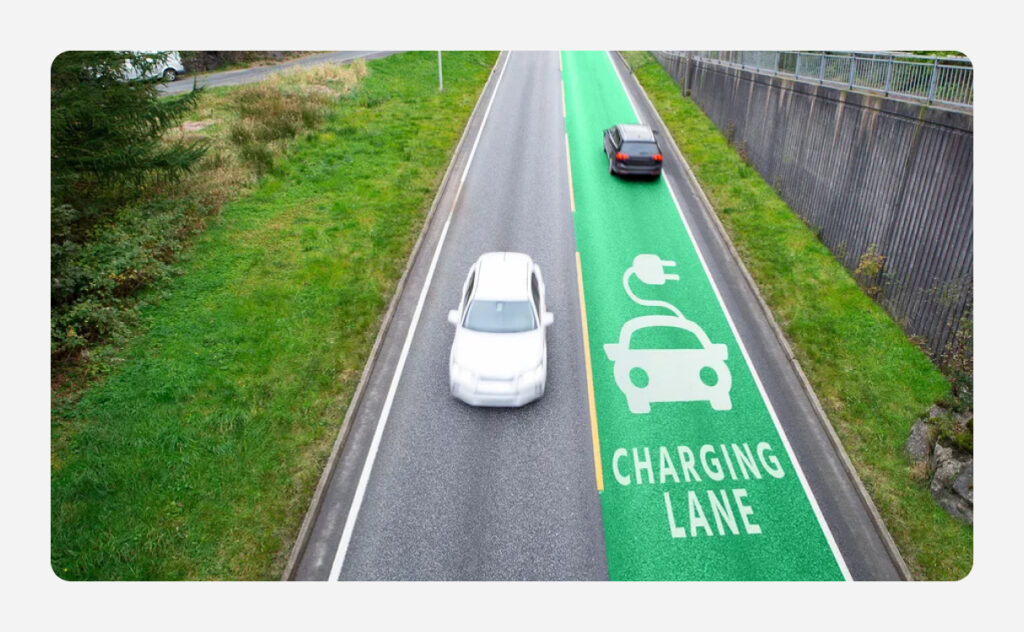
    Sweden is building the world’s first permanent electrified highway, a stretch of the E20 motorway, where EVs, especially heavy trucks and buses, will charge on the move. The system can use either embedded conductive rails or inductive coils under the asphalt to transfer power dynamically.  
     
    In one tested design, a conductive rail connects to a pickup arm under the vehicle, delivering up to 200 kW of power in real-time. That’s enough to keep a typical bus or truck moving indefinitely without exhausting its battery. Sweden’s pilot projects have validated both approaches, including a 2.5-mile inductive trial on Gotland Island. The first 21 km (13 miles) permanent e-motorway is slated to open by 2025, with plans for 3,000 km of electric roads by 2035.  
     
    Similar trials are underway in Germany, France, Israel, China, and South Korea. These innovations blend EV charging solutions into daily life, charging city buses at stoplights or EVs while cruising the highways. For commercial fleets, electrified roads mean higher uptime and smaller batteries. For everyday drives, it promises a future where finding a charging station is no longer a concern, the road itself becomes the charger.  

    1. 5-Minute Charging Batteries: Recharging 500 km Range in Minutes

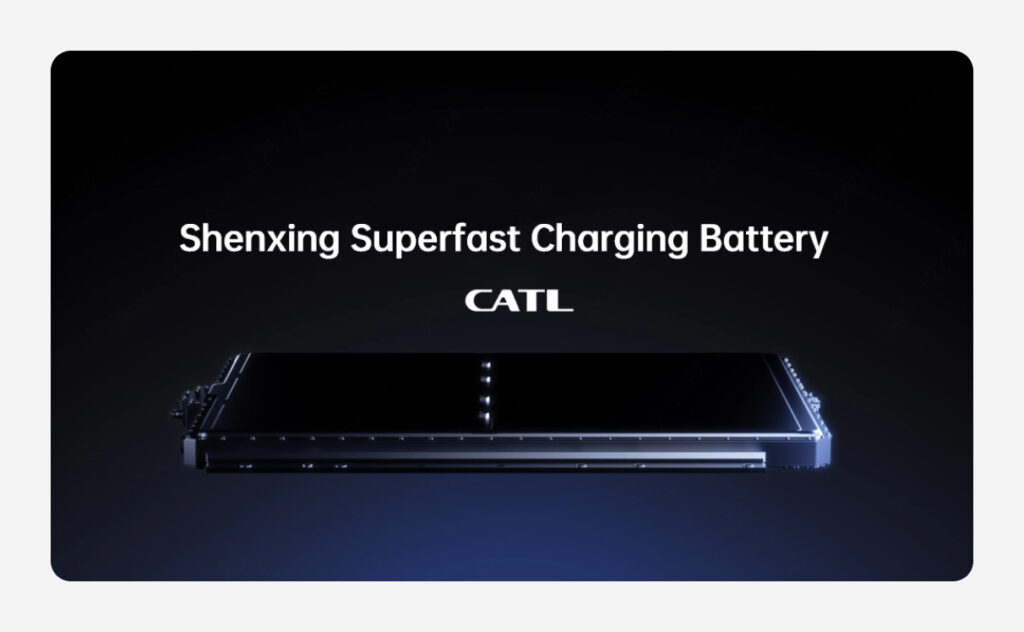
    The holy grail of fast charging, adding hundreds of kilometers of range in minutes, is becoming a reality with new battery technology. CATL’s latest Shenxing ultra-fast battery, unveiled in 2025, is a second-generation lithium-iron-phosphate pack with a 12C charge rate and peak input of 1.3 MW.  It can add 520 km of range in only 5 minutes, jumping from 5% to 70-80% charge in the time it takes to stretch your legs. This beats even the impressive 400 km in 5 minutes claim of BYD’s recent 1 MW battery platform. With Shenxing, a full 800 km (approx. 500 miles) pack can recharge from 5% to 80% in just 15 minutes under optimal conditions, twice as fast as the best chargers of 2024. Crucially, these new batteries maintain high charging power even in cold weather, delivering approximately 830 kW at -10 °C. This addresses a major drawback of earlier fast-charge cells and makes ultra-fast charging viable year-round.

    Final Thoughts

    By 2026, EV charging technology will leap to new heights: 5-minute charges, 1,000 km batteries, 1+ MW chargers, cable-free charging, and even charging highways. What felt cutting-edge in 2023 will be routine. Range anxiety and downtime will fade into history, much like dial-up internet or analog cellphones.  

    India’s EV industry, already among the most dynamic globally, stands to benefit immensely. With the right investments and forward-thinking policy support, EV charging infrastructure in India can not only adopt but also lead in deploying these solutions. The road to 2026 is electrifying, and these five charging innovations are lighting the way towards the future of electric mobility, which is ultra-fast, ubiquitous, and unimaginably convenient.

    Blog Banner

    Frequently Asked Questions

    When will Indian EV drivers actually experience 5-minute charging?

    India is closer than it seems. With Tata and Mahindra adopting 800V systems and startups piloting megawatt-level chargers, metro-city corridors could see 5-minute charging stations by 2026–27. Early rollout will likely focus on highways and commercial hubs before expanding into city centers.

    Will new megawatt chargers work with existing EVs?

    Not immediately. Most current EVs use 400V systems, while megawatt chargers are designed for 800V–1000V vehicles. However, automakers are introducing bidirectional adapters and flexible charge modules, so newer EVs may not require major upgrades right away.

    Are ultrafast and wireless EV chargers environmentally friendly? 

    Yes, these technologies reduce grid stress by shortening charge times and often run on renewable energy. New LFP batteries also use fewer rare-earth metals and offer longer lifespans, making the entire ecosystem more sustainable.

  • DC Fast Charging for Fleets: How to Maximize Uptime and ROI 

    DC Fast Charging for Fleets: How to Maximize Uptime and ROI 

    India’s electric fleet revolution is gaining momentum, from nimble two-wheelers delivering groceries to electric buses running intercity routes. For fleet operators, EVs promise lower operating costs and higher productivity, provided vehicles spend more time on the road than at the charger. That’s where EV fleet charging infrastructure with DC fast chargers becomes a game-changer, enabling quick turnarounds, multi-shift operations, and seamless logistics through robust EV fleet charging infrastructure. 

    In this blog, we explore: 

    1. How fast charging maximizes fleet uptime and operational flexibility 
    1. Depot vs. public charging strategies, and how each model impacts cost, control, and reliability. 
    1. The ROI equation for fast charging, with real-world examples from Indian fleets.  

    Why Fast Charging Maximizes Fleet Uptime

    Vehicle downtime directly translates to lost revenue. A delivery van stuck at a charger for hours, or a taxi offline mid-day, is time lost. DC fast charging dramatically reduces charging time, thereby maximizing vehicle availability. In the context of fleets: 

    1. Minimized Downtime = More Trips

    DC fast chargers (typically ranging from 50 kW up to 150+ kW) can recharge a vehicle’s battery to 80% in 30-40 minutes, as compared to 6 hours on a home outlet. Simply put, a vehicle that charges faster can complete more trips per day, directly boosting productivity and strengthening any fleet charging solution.

    2. Operational Flexibility

    Fleets can top up batteries during short downtimes. For example, a bus charging at a terminal or a van during warehouse stops. Strategic scheduling during breaks or shift changes makes charging nearly invisible in terms of lost time.  

    3. Extended Service Hours

    Fast charging enables multi-shift usage of EVs. For instance, a ride-hailing car can run morning and evening shifts with a quick afternoon charge. Delivery vans can do double runs, effectively doubling daily output.

    Flipkart’s finding of 20% faster delivery turnaround with EVs is in part due to leveraging quick charging and quick swaps to keep bikes and vans constantly moving. 

    4. Reduced Range Anxiety

    While private EV owners might plan their day around a full charge, fleet vehicles often push the limits of range. Knowing that a fast charger is available provides confidence to dispatch EVs on longer routes or more trips. Amazon India’s highway trials with electric trucks show that uptime is achievable even for long-haul routes with adequate fast charging.

    5. High Utilization Segments

    Some fleet segments operate almost continuously. Segments like intercity buses or 24×7 delivery fleets rely on fast charging to maintain schedules. Charging 15 minutes every 300 km allows electric buses to mirror diesel pit stops, proving fast charging can eliminate EV downtime disadvantages.

    Depot vs. Public Charging: Choosing the Right Strategy for Fleet Charging

    Fleet EVs can be charged at private depots (or hubs) controlled by the fleet operator or at commercial EV charging stations. Many fleets use a hybrid model, but optimizing the strategy is vital for cost and uptime. Let’s compare: 

    Depot (Private) Charging

    This involves installing charging stations at fleet-owned or leased facilities, such as bus depots, delivery warehouses, taxi parking lots, etc. Depot charging can be further split into overnight slow charging and on-demand fast charging at the depot. 

    Advantages:  

    • Depot charging gives fleets full control and guaranteed access. Vehicles can charge on a set schedule, say, all vans overnight, without competing for spots.  
    • Smart charging with off-peak power and on-site renewables like rooftop solar with battery storage to cut energy costs.  
    • Customizable infrastructure (AC chargers for overnight use and DC fast chargers for quick top-ups).  
    • Lower electricity rates and high charger utilization.  
    • Avoids dependence on public infrastructure, letting fleets maintain their own high-uptime systems with built-in redundancy. 

    Challenges:  

    • High upfront costs for hardware and electrical upgrades.  
    • Depot space constraints and lead time for getting permits and utility approvals for large installations.  
    • Impractical for small fleet operators or those with distributed vehicles, e.g., gig workers who take vehicles home, may find it impractical to have their own depot for charging.  
    • Requires planning and investment but amortizes over time.  

    Public DC Fast Charging  

    This refers to using third-party or government-run commercial EV charging stations, available in cities and on highways. Fleet vehicles can visit these stations and pay per use (usually per kWh or per minute). 

    Advantages:  

    • Public charging eliminates upfront infrastructure costs for fleets—the station operator handles setup and maintenance, while fleets simply pay per use.  
    • Ideal for small fleets or pilot programs with limited EV numbers. 
    • Enables en-route top-ups and emergency charging.  
    • Pay-per-use model offers flexibility and scalability as fleets grow. It acts as an operating expense rather than a capital investment.  

    Challenges:  

    • Unpredictable availability and potential queuing.  

    Due to these issues, fleet operators often prefer controlled environments. As one EV fleet operator put it, dedicated fast-charging hubs are preferred for high-reliability requirements or 24×7 operations– public chargers serve as a backup or overflow option. 

    In practice, many fleets adopt a hybrid strategy.  

    Most fleets adopt a depot-first approach with selective public charger use. Some even open depot chargers to the public during off-hours to generate revenue and maximize utilization.  

    Ultimately, the choice comes down to scale and control. Large, mission-critical fleets (buses, large e-commerce delivery operations, taxi fleets) lean towards building their own fast-charge facilities to guarantee uptime. Smaller fleets or those in early stages might lean more on public chargers until their usage justifies dedicated installations. In either case, fast charging – whether at a depot or public – is a cornerstone of fleet electrification economics. Next, let’s look at how fast charging translates into ROI for fleet operators, with some real-world data from Indian deployments. 

    Fast Charging and Maximizing Fleet ROI

    Fuel Cost Savings

    Electricity is much cheaper per kilometer than diesel or petrol. This is the fundamental source of EV cost advantage. For high-mileage fleet vehicles, the fuel savings accrue quickly, and fast charging enables more electric kilometers per day.  

    According to industry analysis, most EV categories in India are already TCO-positive in high-use scenarios, meaning over the vehicle’s life, they turn out cheaper than ICE vehicles when driven a lot. By allowing vehicles to stay in service longer each day, fast charging effectively increases the daily kilometers driven on electricity, thereby accelerating fuel cost payback.  

    For example, an electric delivery van running 150 km/day (vs. 75 km/day with slow overnight charging) doubles diesel displacement. Over a year, this translates to tens of thousands of rupees saved, offsetting charger investment.

    Higher Productivity and Revenue

    Flipkart’s 20% improvement in delivery speed and reduction in cost per order show how fast charging boosts operational metrics. In ride-hailing, quick charges between rides enable trips and higher fare revenue.

    Competitive and Sustainability Edge 

    Fast charging supports sustainability goals and brand positioning. Companies like Flipkart use their EV fleets and charging infrastructure to gain goodwill and attract eco-conscious clients. This strategic edge enhances ROI beyond direct cost savings. 

    Battery Swapping vs Fast Charging  

    For two- and three-wheelers, battery swapping has emerged as an alternative to fast charging to maximize uptime. Studies show 15% lower TCO and 30% higher earnings for e-rickshaw drivers using swaps.

    Companies like Zomato, Blinkit, and Zepto leverage this for nonstop delivery. However, swapping is limited to light EVs. For cars, vans, and buses, fast charging remains the dominant solution. Standards like CCS2 and GB/T are mature, and government policy also favors fast charging for heavy vehicles.

    Maintenance and Lifespan Benefits

    Fast charging, when managed well, contributes to lower maintenance costs and longer vehicle life, indirectly boosting ROI. Modern EVs are built for rapid charging, with warranties covering high cycle counts. Some fast-charging hubs use battery storage to buffer the grid, reducing stress on vehicle batteries.  

    Longer service life means the initial purchase cost is spread over more kilometers and years, improving the overall ROI. It’s worth noting that excessive fast charging can degrade older batteries, but today’s tech and thermal management mitigate the impact. Many fleet operators factor this into the TCO model and still find fast charging worthwhile.

    Final Thoughts

    As technology evolves and scale drives costs down, DC fast charging will only become more accessible and even faster. Fleet managers who embrace it today will position their operations to ride the wave of electrification efficiently.

    Maximizing uptime is no longer just about better scheduling; it’s about electrifying smartly. DC fast chargers unlock the true potential of electric fleets, ensuring that going green doesn’t mean slowing down. With the right charging strategy, supported by electric fleet management solutions, your EV fleet can outpace diesel vehicles in both performance and profitability.  

    Blog Banner

    Frequently Asked Questions

    Is fast charging financially viable for small fleet operators?

    Yes, fast charging is financially viable for small fleet operators, especially with shared or pay-per-use charging networks. Smaller fleets can start with public fast chargers to avoid upfront infrastructure costs. As vehicle count and mileage grow, investing in a private depot charger becomes cost-effective due to lower per-kWh rates and higher uptime. Hybrid models often offer the best ROI balance.

    How do I know if my fleet needs DC fast charging?

    If your vehicles run multiple shifts or over 150 km daily, fast charging helps keep them running instead of idle. 

    How soon does DC fast charging pay off? 

    For high-mileage fleets, ROI usually comes within 1.5–2 years through higher uptime and lower fuel costs. 

  • How Tamil Nadu’s EV Policy Is Accelerating DC Fast Charging in India 

    How Tamil Nadu’s EV Policy Is Accelerating DC Fast Charging in India 

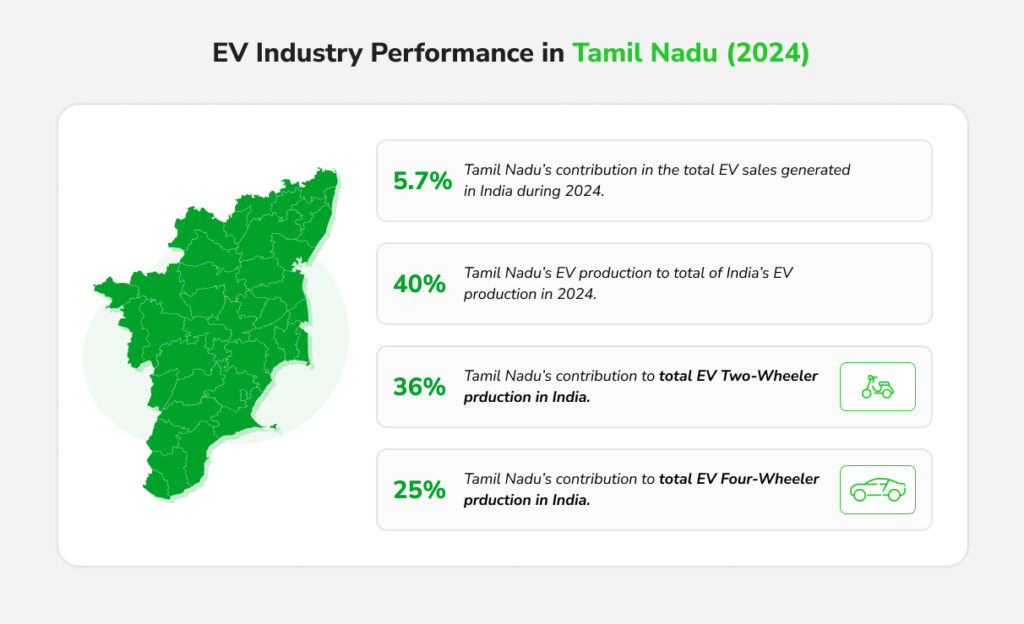
    Tamil Nadu is rapidly positioning itself at the forefront of India’s EV revolution, driving the expansion of DC fast chargers and broader EV charging infrastructure in India through bold, clear-sighted policy measures. Its latest Tamil Nadu EV policy 2025 blends financial incentives with smart governance, lowering costs, streamlining approvals, and inviting private participation to build a dense, reliable charging network. In doing so, the state is powering its own mobility transition while setting a national benchmark for DC fast charging solutions and EV infrastructure growth. 

    This blog explores: 

    1. The financial and operational measures that make dc fast-charging solutions more viable for investors. 
    1. The collaborative models and institutional mechanisms driving large-scale rollout. 
    1. The results on the ground and how Tamil Nadu EV policy 2025 is influencing state EV policies in India. 

    Incentives Fueling Fast Charger Deployment 

    Tamil Nadu’s policy introduces significant financial and operational incentives to spur DC fast charging station deployment: 

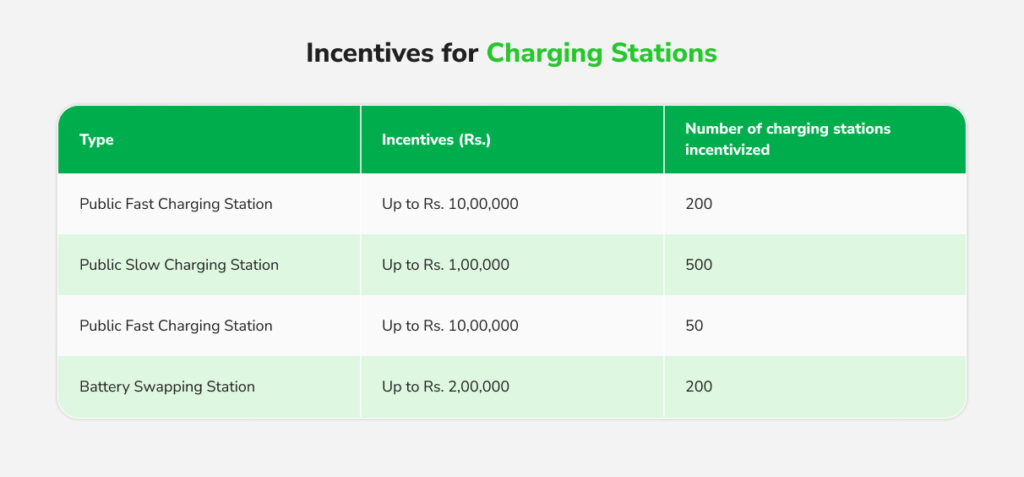
    • Capital Subsidies: The state offers a 25% capital subsidy on equipment and machinery costs for companies setting up public charging stations that meet national guidelines. Additionally, the first 50 private charging stations qualify for a 25% subsidy, up to ₹10 lakh each, on charger hardware, encouraging early private investment. These grants substantially reduce the high capital expenditure of DC fast chargers, which often exceed ₹20–30 lakh for 50 kW+ units. 
    • Land and Infrastructure Support: Access to affordable land is critical for charger installation. Tamil Nadu offers land at concessional rates in dedicated EV parks, with a 50% discounted land price for companies building EV or charging equipment factories. While this primarily targets manufacturing, it indirectly benefits the dc fast charging solutions ecosystem by lowering hardware costs. For charging station siting, the state is leveraging public land – highway rest areas, bus depots, and municipal parking lots – to host chargers in high-demand locations. Tamil Nadu Generation & Distribution Corporation (TANGEDCO), the nodal agency for charging infrastructure, and the Tamil Nadu Green Energy Corporation Ltd. (TNGECL) are working with local bodies to earmark government-owned sites for rollout.  
       

    Public-Private Partnerships and Policy Enablement 

    Tamil Nadu’s EV policy actively promotes public-private partnership (PPP) models to accelerate charging network growth. Rather than relying solely on government installations, the state is inviting private capital and expertise to co-develop infrastructure: 

    Fast Charging Rollout Targets and Progress 

    Tamil Nadu has set ambitious targets for expanding its EV charging infrastructure in India. From just151 public charging stations in 2022, the number jumped to roughly 3,000 public charging stations by mid-2025, thanks to the policy push and FAME India Scheme. However, charger density remains low, approximately one public charger per 316 EVs in 2025, compared to a healthy ratio of 1 per 6–30 EVs.  

    To address this, Tamil Nadu EV policy 2025 aims to install about 24,715 charging stations by 2030. This nearly ten-fold increase within the next five years would elevate Tamil Nadu into a leading position for EV charging infrastructure in India. 

    A large portion of these will be DC fast chargers, especially along highways, fleet hubs, and urban grids. The roadmap calls for coverage of all major highways with fast chargers every 25–50 km, and at least one fast charging station per 3×3 km grid in dense cities. The first 200 public commercial EV charging stations have already been incentivized with capital subsidies up to ₹10 lakh each.  

    This scale-up contributes meaningfully to India’s overall EV charging outlook. Nationwide, about 29,277 public charging stations were installed as of August 2025. Tamil Nadu’s 2030 goal would account for roughly 5% of the country’s public chargers, assuming India meets its target of 4–5 lakh chargers by 2030. With nearly 4.5 lakh EVs already on road by 2025), Tamil Nadu’s rollout, is both necessary and influential. Success here could bolster confidence and inspire similar projects across other state EV policies in India. 

    Streamlined Implementation and National Ripple Effects 

    Tamil Nadu is not only crafting incentives but also focusing on execution mechanisms. In July 2025, the state released the Tamil Nadu Public Charging Infrastructure Guidelines, India’s first comprehensive state-level framework for EV charging rollout. These guidelines clarify agency roles, technical standards, and processes like obtaining connections and approvals. They encourage smart charging, and processes like obtaining connections and approvals. They encourage smart charging and renewable integration to minimize grid impact and outline a single-window system for permits.  

    This move is nationally significant. Few states have published such detailed guidance, so Tamil Nadu’s document is poised to become a reference for other state EV policies in India

    More broadly, the state’s policy approach is shaping best practices across India: 

    • PPP models: Tamil Nadu’s emphasis on private sector participation provides a working model for sharing costs and responsibilities. Offering upfront subsidies for a limited number of private stations and reserving government support for corridor charging can be replicated with local tweaks. 
    • Integrated ecosystem planning: Tamil Nadu links EV manufacturing incentives with charging infrastructure goals. Subsidizing charger deployment while attracting equipment manufacturers creates synergy; many chargers installed in the state may be locally produced, lowering costs and ensuring supply. Other states may follow suit by aligning their industrial policy (attracting EV/charger production) with infrastructure deployment, creating regional EV hubs. Indeed, Tamil Nadu aims to attract ₹50,000 crore (approx. $6B) of EV investment by 2030, and its success in drawing major EV and battery makers is partly due to such comprehensive planning. If this strategy continues to pay off, it will set a benchmark for treating the EV ecosystem as an end-to-end value chain in policy design. 
    • Regulatory best practices: Publishing detailed guidelines and establishing an EV cell demonstrates proactive governance. These efforts address interoperability and safety norms, which, if adopted widely, could lead to more uniform charger installations across India. Tamil Nadu’s framework tackles multi-agency coordination, consumer awareness, and grid readiness, common challenges in fast charger deployment. 

    Final Thoughts 

    Tamil Nadu EV policy 2025 has become a strong accelerant for DC fast charging infrastructure, within the state and as a national trend-setter. For B2B stakeholders, charging infrastructure providers, automakers, utilities, and policymakers, the key takeaway is the power of a comprehensive policy framework in unlocking the EV charging infrastructure in India.  

    By coupling financial incentives with enabling measures like PPP models, nodal agency support, and clear guidelines, Tamil Nadu has rapidly expanded its DC fast charging network and attracted significant private investment. Its trajectory over the next five years could very well shape the confidence and strategies of players across India’s EV sector. If the state meets its 2030 targets, it’ll be a proof-of-concept that robust state policy can drive the EV transition at a pace and scale needed to meet India’s electrification goals. Tamil Nadu has effectively thrown down the gauntlet, demonstrating how to supercharge the drive toward an electric mobility future. 

  • Why DC Fast Chargers Are Critical for India’s Highway EV Push 

    Why DC Fast Chargers Are Critical for India’s Highway EV Push 

    EV highway charging in India is rapidly becoming a priority as more drivers demand the ability to travel long distances without extended stops. Although the charging infrastructure in India has grown fivefold since 2021, gaps persist, especially on intercity routes.  

    This blog analyzes why DC fast chargers are now essential for India’s highway electrification, reviews current infrastructure and policies, and outlines what’s needed by 2030. It offers data-driven insights for EV stakeholders, infrastructure planners, and mobility professionals. 

    Additionally, we also explore three key dimensions shaping that shift: 

    1. Why DC fast chargers are indispensable for enabling long-distance EV travel and supporting heavy-duty electric vehicles on highways. 
    1. The current state of highway EV charging infrastructure in India 
    1. Government initiatives and policy frameworks driving large-scale fast-charger rollout, alongside the challenges 

    The Role of DC Fast Charging for Highway Travel 

    Highway travel demands quick, reliable charging, something only DC fast chargers can deliver at scale. Unlike slower AC chargers (ideal for home or overnight use), DC fast chargers supply 30–240 kW or more, replenishing an EV’s battery to approx. 80% in under an hour. On a 300 km intercity trip, stopping for 6–8 hours to charge via AC charger is impractical; dc fast charging solutions reduce dwell time to 30–60 minutes, making EVs viable highway cruising. 

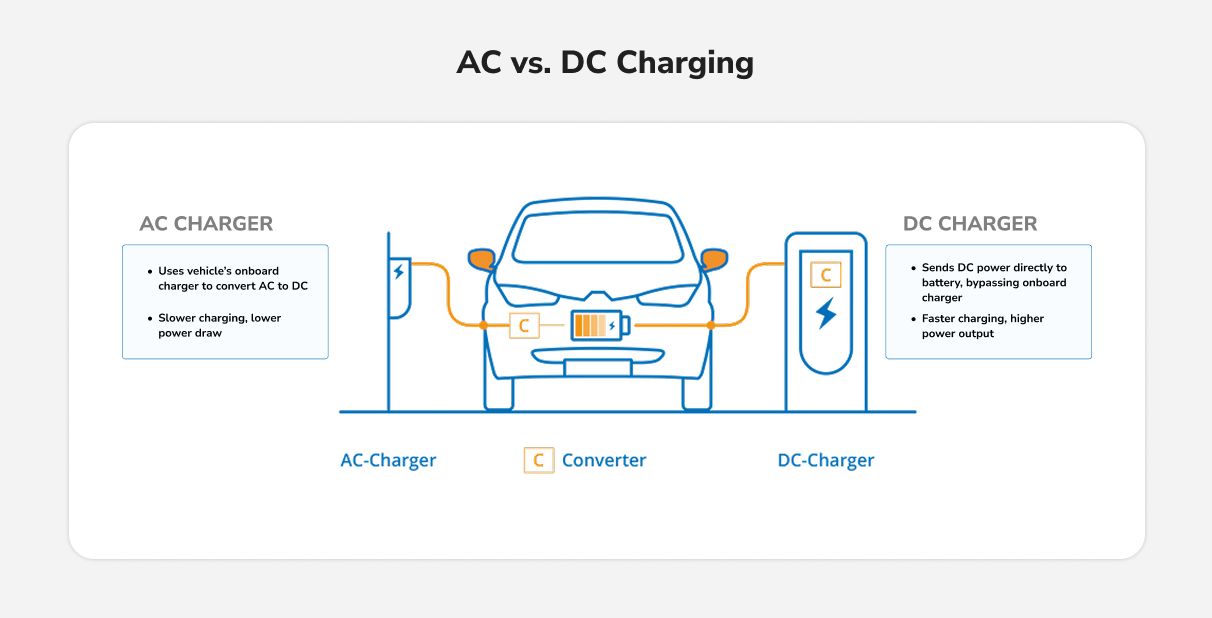
    Most modern EVs have onboard AC chargers limited to approx. 7 kW (in mass-market Indian models) or up to 11–22 kW in premium variants. Even if a higher-power AC station is available, the vehicle itself restricts charging speed.  
     
    DC fast charging bypasses the onboard converter, feeding power directly to the battery at its maximum intake rate. For long-range EVs with 40-60 kWh big battery packs, relying on 7 kW AC would require 8-10 hours for a full charge — untenable on highway EV charging stations. 
     
    Government guidelines now mandate at least one fast charging station every 100 km on highway corridors for long-range EVs and heavy-duty vehicles. DC fast chargers are necessary to match refueling times of petrol stops, ensuring both private and commercial EV drivers can get back on the road quickly. 

    Additional factors make AC chargers unsuitable for highways: 

    • Travel patterns: Highway drivers cover hundreds of kilometers daily and won’t wait hours to charge. DC fast charging solutions add significant range during short breaks, unlike AC charging, which suits overnight or workplace use. 
    • User expectations: To encourage EV adoption, highway EV charging stations must match the convenience of petrol pumps. Long queues or hours-long waits discourage intercity EV travel. In 2025, 35% of EV users used fast chargers monthly, up from 21% in 2023, a sign of growing reliance. AC points can supplement, but cannot meet core demand for rapid highway charging

    India’s push to electrify logistics and public transport further highlights the need for dc fast charging solutions. High-utilization vehicles like buses and trucks can’t afford multi-hour stops; they need high-power DC hubs that enable rapid turnaround. In 2024, the government recognized this by funding the installation of high-capacity DC chargers (up to 360 kW) at bus depots, metro stations, and highway EV charging stations. Without widespread DC fast charging, India’s EV ambitions risk stalling due to “range anxiety” and lost productivity. 

    Current State of EV Highway Charging in India (2025) 

    India has roughly 29,000 public charging points as of mid-2025, up from approx. 6,500 two years ago. This explosive growth has been urban-centric —Karnataka leads with approx. 5,765 chargers, followed by Maharashtra, Uttar Pradesh, Delhi, and Tamil Nadu. Highways and smaller towns still lag in charger density, reflecting an urban skew. Nationally only about 35% of public chargers are DC fast chargers; the rest are slower AC outlets.  

    Highway corridors show patchy progress. Routes like Delhi–Jaipur (NH48) have fast chargers roughly every 80–100 km, while the Mumbai–Pune Expressway offers dense coverage (~50–70 km). However, many highway chargers non-functional or offline, eroding user confidence. Frequent outages stem from grid stress and poor maintenance. On average, public chargers operate only 60–70% of the time due to grid fluctuations and connectivity problems. While the numbers of stations are rising, reliability and fast-charger availability remain bottlenecks. 

    Government Policies and Infrastructure Initiatives 

    Policy support has driven charging rollout, with national and state-level efforts accelerating infrastructure: 

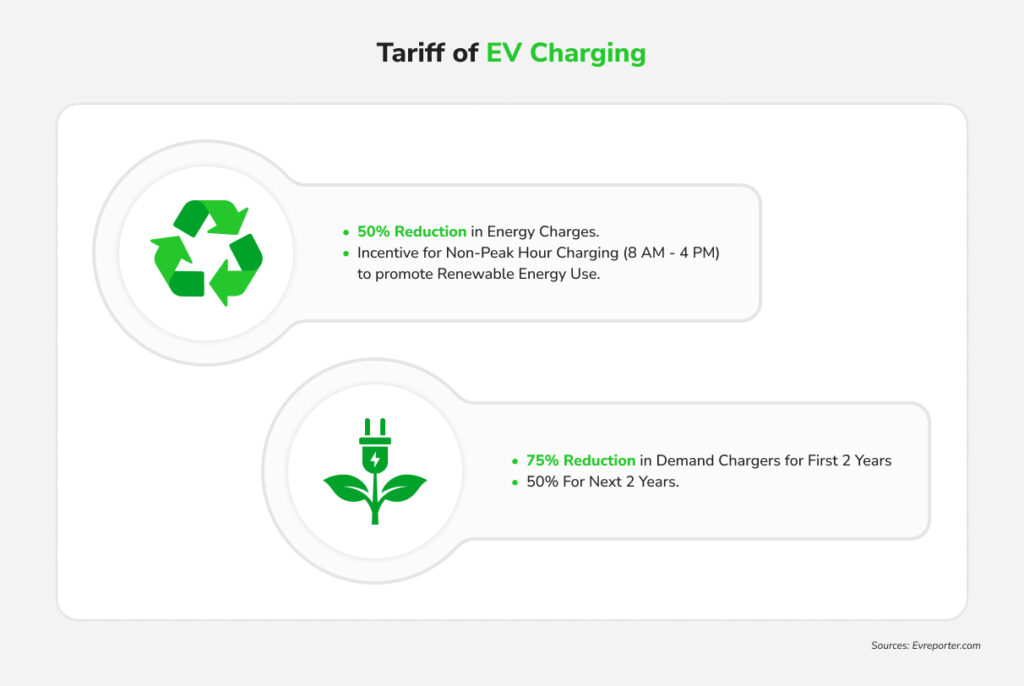
    • State EV Policies: States offer incentives like Maharashtra waiving tolls and mandating chargers in new real estate projects. Delhi provides capital subsidies and plans a fast charger every 5 km; Uttar Pradesh aims to set up 300 new stations with tax breaks. Southern states like Karnataka and Tamil Nadu offer concessional tariffs and public-private partnerships (PPP model) to attract charger investments, helping Karnataka lead in charger count. 
    • Regulatory Facilitation: The Ministry of Power’s 2025 guidelines introduced safety and interoperability standards. EV charging now has “infrastructure” status and a 5% GST rate. A unified “super app” is being piloted to map real-time charger status across networks. 

    While policies have catalyzed investment, uneven implementation and execution challenges limit full impact. The focus now is translating targets into reliable, on ground DC fast chargers, especially in highway EV charging stations. 

    Emerging EV Traffic Patterns and Electrified Corridors 

    EV usage in India is extending beyond city limits. Early patterns show highway routes are leading the electrification push and how different user groups are behaving: 

    • Fleet Operators and Commercial Use: Electric taxis, delivery fleets, and buses increasingly use highways. Electric bus routes are being tested between cities as part of the e-Bus program. These commercial players value reliability and speed above all. As a result, fleet operators often coordinate with specific Charge Point Operators (CPOs) to ensure reserved or well-maintained chargers on their routes.  
    • Personal EV Travel Long-distance EV travel is growing. Drivers plan meticulously: using multi-operator apps to locate chargers and check real-time status. Online EV forums share road trip experiences and reliable dhabas or rest stops. A common behavior is dual-app usage, keeping two different charging network apps to cross-verify if a station is actually online. This indicates that personal EV drivers are adapting to the current unreliability by being extra prepared. 
    • Regional Differences: EV traffic is highest on highways near EV hubs. The Delhi-NCR region sends many EVs toward Jaipur/Chandigarh; Mumbai-Pune has daily electric commuters; Bengaluru-Chennai and Hyderabad-Vijayawada corridors are picking up as South India leads in EV two-wheeler adoption. In contrast, eastern and central India see fewer EVs on highways due to lower adoption and fewer highway EV charging stations. 

    Challenges in Fast Charger Rollout 

    Despite momentum, several challenges hinder DC fast chargers deployment: 

    • High Upfront Costs and ROI Concerns: 60 kW DC charger costs ₹3–7 lakh for equipment alone; full setups run into crores. Utilization is low, often just 5% usage, making ROI difficult for CPOs. Low EV volumes and range anxiety create a Catch-22: idle chargers discourage adoption, but adoption won’t grow without chargers.  
    • Grid Capacity and Reliability: Remote highways lack robust grids. Voltage fluctuations and weak feeders cause outages. Some sites have only 60 kW connections, insufficient for multiple 150 kW chargers. Utilities (DISCOMs) must reinforce substations along new EV corridors. Pilots on the Mumbai–Pune corridor use solar PV and battery banks to buffer grid strain. 
    • Operational Reliability and Maintenance: Many chargers suffer from poor maintenance, software faults and interoperability issues. Payment and app fragmentation add friction. The government’s push for a unified payments interface (UEI) and new uptime standards aims to improve reliability. 
    • Land and Permitting Hurdles: Prime highway locations are scarce. The best spots are existing highway services or petrol pumps – hence oil companies have an advantage by leveraging their network. Private CPOs often partner with these petrol pump or highway restaurants for space. Even so, the process of getting approvals from multiple agencies (highway authorities, local bodies, utilities) can be slow. Bureaucratic delays in permits and right-of-way have been cited as reasons some announced stations haven’t materialized. The government is exploring measures like “land pooling” or co-locating chargers with existing infrastructure to simplify this. For highways specifically, NHAI (National Highways Authority) is carving out EV charging spaces in new amenity projects to streamline deployment. 
    • Power Tariffs and Viability: High-capacity chargers face punitive tariffs. Demand charges inflate operating costs. Some states offer concessional EV tariffs and waive demand chargers, critical until utilization improves. Without it, the cost of running an ultra-fast charger would be very high, deterring usage and slowing rollout.
  • Choosing the Right DC Fast Charger for Hotels, Malls, and Office Spaces

    Choosing the Right DC Fast Charger for Hotels, Malls, and Office Spaces

    EVs are becoming increasingly common on Indian roads, and businesses in the hospitality, retail, and corporate sectors are taking note. Installing EV charging infrastructure, especially DC fast chargers, can be a smart move for hotels, shopping malls, and office complexes looking to attract customers, enhance their green image, and future-proof their facilities. This blog provides a data-backed overview of how to choose the best EV charger for a mall or an office in India.

    We’ll cover the following:

    • Business value of EV charging
    • Advantages of DC fast charging
    • How to select and implement the right charger for your property type

    Why EV Charging Is Good Business for Hotels, Malls, and Offices

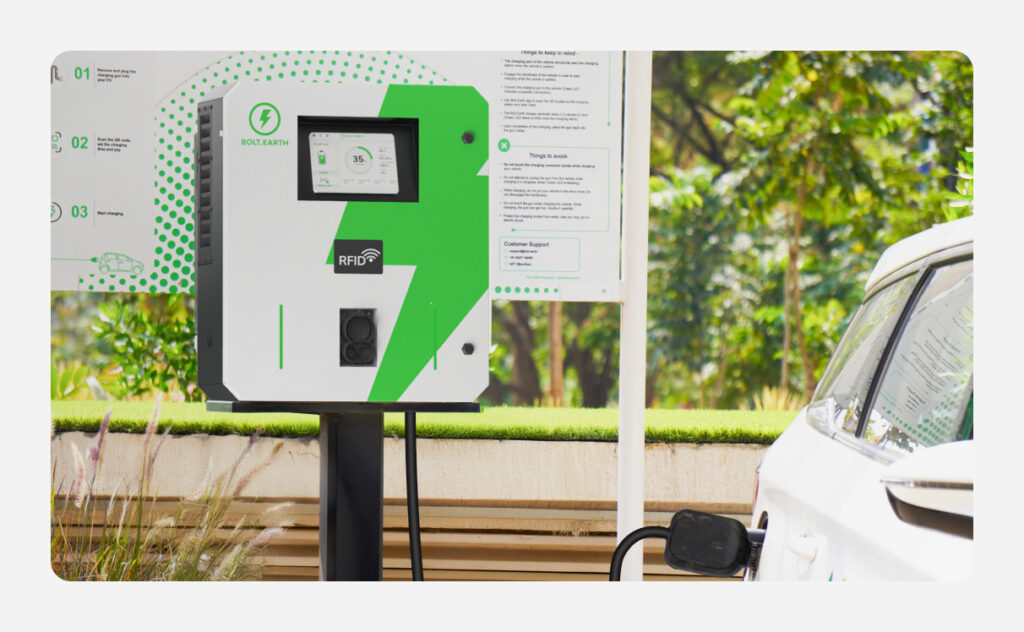
    DC_charging Station_2 (1).jpg

    Offering EV charging for office buildings, malls, and hotels yields multiple benefits and can be a win-win proposition.

    • Longer Dwell Time and Higher Spending: Charging takes time, which means customers spend more time (and money) on-site. In Delhi, the average mall visit is about 90 minutes, aligning well with EV charging durations. A DC fast charger can encourage extended shopping or dining time. EV charging for hotels can expect guests to stay for meals or additional services while waiting for a charge.
    • New Revenue Streams: EV charging can be monetized. Businesses often set a fee for public charging usage (either per kWh or per hour). For example, a well-utilized EV charger for mall can potentially earn a few thousand rupees per day in charging fees. Even if offered free or at cost, indirect revenue from increased patronage can be significant. Some commercial charging models involve partnerships or revenue sharing with charging network operators.
    • Regulatory Compliance and Future-Proofing: Installing EV chargers now keeps you ahead of evolving regulations. Building codes and city policies increasingly mandate EV readiness. For example, Delhi requires a percentage of parking to be EV-ready. Acting early allows businesses to benefit from government subsidies and avoid retrofitting costs later.

    In summary, EV charging for hotels, EV charger for a mall, or EV charging for office buildings is more likely to attract EV-driving customers, keep them longer, and earn their goodwill, all while tapping into emerging revenue opportunities. It’s an investment in both customer experience and sustainability leadership.

    Blog Banner

    Why prioritize DC fast charging for commercial locations?

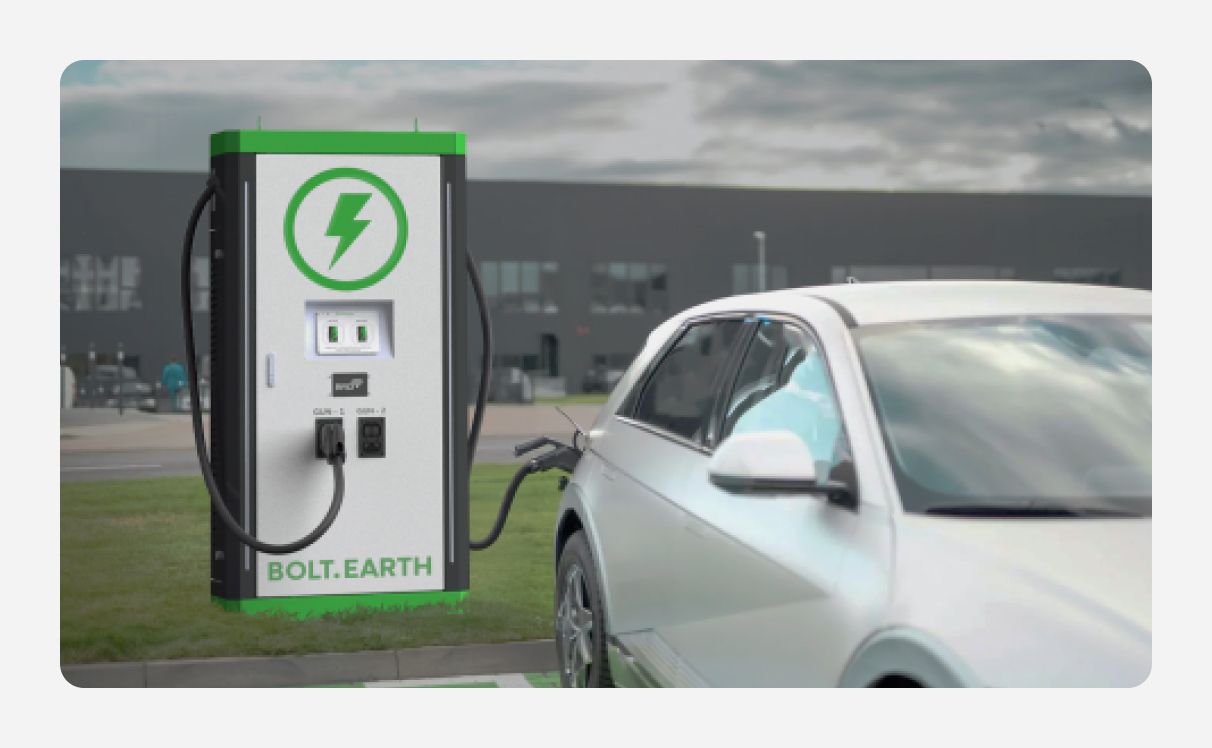
    Why prioritize DC fast charging for commercial locations_.jpg
    While use case matters, DC chargers offer distinct advantages for EV charging at shopping malls, EV charging for hotels, and EV charging for office buildings, despite higher costs:

    • Faster Turnover: DC fast chargers serve more vehicles in a day than AC ports. For example, a 50 kW DC station can substantially charge several cars in 8 hours, while a 7 kW AC socket might fully charge only one. Malls in particular benefit from giving shoppers meaningful top-ups during their 60–90 minutes.
    • Customer Convenience: Fast charging is a premium convenience. Hotel guests checking in late or stopping briefly for lunch might appreciate the ability to top up 100+ km of range quickly. Office employees might mostly slow-charge during the day, but a fast charger supports urgent needs or fleet vehicles.
    • Vehicle Compatibility and Future Trends: Most new EV models support DC fast charging, typically using the CCS2 port in India. Installing a DC fast charger ensures compatibility with most vehicles, including Tata Nexon EV, MG ZS EV, Hyundai Kona, and others.

    Note: AC vs. DC is not an either/or choice. Many businesses deploy a mix: low-cost AC points for long-term parking and DC fast chargers for quick service. If installing only one charger, choose based on typical customer needs. If installing multiple, offer both.

    How to Select the Best DC Fast Charger for Your Business

    DC_Range2.jpg

    Power Rating and Charging Speed

    DC fast chargers come in various power capacities. The “right” level depends on visitor dwell time, expected traffic, and budget.

    • 15 kW (Bharat DC-001): Entry-level units for low-voltage vehicles (like e-rickshaws and some older cars). Slightly faster than a high-end AC charger, but not ideal for modern EVs. Suitable only if your site expects two-wheelers or older models.
    • 30–60 kW: Popular for commercial destinations. A 60 kW charger can deliver approximately. 80% charge in under an hour. A 30 kW unit is slower, but still much faster than AC. These strike a good cost-benefit balance for many businesses. Equipment typically costs ₹7–12 lakh and requires a 3-phase 415V supply. Most hotels, malls, and offices can support one or two units without grid strain.
    • 90 kW and above: High-power chargers (often 90, 120, 150 kW, up to 360 kW) are suited for highway corridors, EV charging hubs, or fleet depots. They’re expensive (often double or more the cost of a 60 kW unit) and require special grid connections. Few Indian EVs currently support >60 kW, but installing one can be a future-proofing move. Consider only if your location expects high EV traffic or you want to brand as an ultra-fast destination.

    Tip: Align the charger power with visitor duration. For approx. 1-hour visits (e.g., mall shoppers), a 60 kW unit is ideal. For 8-hour stays (e.g., office employees, hotel overnight guests), lower-power DC or AC might suffice. Many DC chargers are “modular”; some allow two cars to share power or can be upgraded later.

    Segment-Specific Considerations: Hotels vs. Malls vs. Offices

    Person_using charger (2).jpg
    Let’s briefly understand special considerations for each type of location, beyond the general points discussed above:

    Hotels and Resorts

    Hospitality spaces cater to two types of guests: overnight guests and short-term visitors.

    • Urban hotels: Chargers act more as amenities and can influence booking decisions.
    • Highway or destination properties: A (30–60 kW) DC fast charger is valuable for travelers needing quick top-ups.

    Recommendation: Install at least one DC fast charger and one AC unit. Offer complimentary charging (cost can be absorbed in room rates), integrate it into valet or concierge services, and partner with an EV network for visibility and maintenance.

    Shopping Malls and Retail Centers

    Malls benefit from high footfall and long dwell times, especially on weekends and holidays.

    Recommendation: Install at least two chargers, such as a dual-gun 60 kW DC fast charger. Clearly mark charging bays, implement alerts (via app or parking staff) when charging is complete, and dedicate 5–10% of parking to EVs. Promote your “EV charging at shopping mall” facility in marketing and ensure safety with cable management and CCTV.

    Offices and Corporate Campuses

    Employees typically park for 8–9 hours, making slower AC charging practical and cost-effective.

    Recommendation: Install several 7 kW AC chargers for employees and one 60 kW DC fast charger for fleet or visitor use. Provide access via internal apps or RFID, encourage midday rotation, and integrate charging into ESG or green-building initiatives. Consider solar rooftops or parking canopies for sustainable power.

    No matter the segment, a common theme emerges: integrate the EV charging experience into your customer or employee journey. Make it easy, visible, and reliable. A hotel could mention EV charger availability during booking and have staff ensure the car is charged overnight. A mall could display “EV Charging Available” at the entrance. An office could include EV charging guidelines in the employee handbook. These touches ensure the infrastructure actually gets utilized to its full potential.

    Blog Banner

  • DC Fast Chargers and Their Growing Role Across Highways Corridors and City Centers

    DC Fast Chargers and Their Growing Role Across Highways Corridors and City Centers

    EVs have sparked a revolution in mobility, and DC fast chargers are a critical part of making that revolution practical. Unlike common AC chargers found in homes or standard public EV charging stations, DC fast chargers deliver power directly to an EV’s battery without using the car’s onboard converter. This allows them to supply very high power (often 30 kW up to 360 kW) by performing the AC-to-DC conversion inside the station itself.

    The result is dramatically faster charging, typically reaching 80% in just 15–45 minutes for many EVs. Such rapid top-ups significantly reduce “range anxiety”, reassuring drivers that they can quickly recharge and continue their journey. This article explores what DC fast chargers are and examines their growing role along highway EV charging corridors and in city centers.

    What Are DC Fast Chargers?

    DC_2-1 (1).jpg
    DC fast chargers (often called Level 3 chargers) are high-powered charging stations designed to deliver direct current (DC) straight into an EV’s battery. With AC charging (Level 1 or 2), the EV’s onboard charger must convert alternating current from the grid into DC, a process limited by the vehicle’s relatively small converter.

    DC fast chargers bypass this bottleneck. They contain heavy-duty power electronics that convert AC to DC internally and feed electricity to the car at the battery’s native voltage. Because the station’s converters are much larger and more powerful than a car’s onboard unit, DC chargers can deliver energy at a far higher rate. For example, a home AC charger might provide 7–11 kW, whereas a commercial DC fast charger can deliver tens or even hundreds of kilowatts.

    Read more: DC Charging vs AC Charging for EVs: What Businesses Need to Know

    Typical DC fast charging systems take a high-voltage AC supply (often three-phase 400–480 V) and output anywhere from approx. 200 V up to 800–1000 V DC, accommodating a wide range of EV battery packs. They use specialized connector standards, such as the CCS2 charging standard, which communicate with the vehicle to manage charging safely and efficiently. Once the heavy-duty connector is plugged in, and the car and charger “handshake” via a protocol, the station ramps up power delivery automatically.

    Modern DC fast chargers typically provide at least 30 kW, with many newer stations offering 150 kW, 240 kW, or even 300+ kW per vehicle. At such power levels, an EV can gain hundreds of kilometers of range in the time it takes to have a coffee break, making them ideal for ultra-fast EV charging.

    It’s important to note that DC fast charging is intended for commercial and public use, not home installations. These units require substantial EV charging infrastructure, high-power grid connections, heavy cabling, cooling systems, and proper siting and safety measures. They are also far more expensive than home chargers. However, their ability to recharge an EV in a fraction of the time makes them indispensable for long-distance travel, fleet operations, and quick “fuel ups” when time is critical. In the sections below, we look at how DC fast chargers are being rolled out along highway EV charging corridors and in urban centers, and why both deployments are vital for the EV ecosystem.

    DC Fast Chargers on Highways: Enabling Long-Distance EV Travel

    DC_2 (1).jpg
    One of the most impactful roles of DC fast chargers is supporting EV drivers on long highway trips. Before fast charging, taking an electric car on a road trip meant planning for extended stops or not going at all. DC fast chargers change that by slashing refuel times to well under an hour, making cross-country EV travel feasible. This convenience mirrors the experience of refueling a gasoline car and gives EV drivers “range confidence”.

    Governments and private networks worldwide are rapidly building DC fast chargers on major routes to create “EV charging corridors.” In the United States, initiatives like the West Coast Electric Highway have installed stations every 25–60 miles (approx. 40–95 km) along long stretches of interstate, ensuring an EV is never out of range. According to Washington State’s transportation department, this network gives drivers confidence on road trips, with stations placed near highway exits where amenities like restrooms, restaurants, and shops are available for the 20–30 minutes it takes to recharge.

    On a larger scale, the US federal government’s NEVI program (National Electric Vehicle Infrastructure) is funding a nationwide highway EV charging network. Every state is participating, with plans to install fast chargers along 122,000 kilometers of key roadways over the next few years. These efforts aim to ensure that EV drivers can find a high-speed charging station at least every 50 miles on interstate highways, virtually eliminating coverage gaps.

    Interstate Highway.jpg

    Europe has similarly ambitious targets. The EU’s new Alternative Fuels Infrastructure Regulation (AFIR) mandates that by 2025, fast-charging stations (at least one 150 kW charger) must exist every 60 km (approx. 37 miles) along the Trans-European Transport Network highways. This policy requires a dense blanket of DC fast chargers across all major European corridors to support seamless EV travel. The buildout is well underway; Europe had over 70,000 fast chargers by the end of 2022 (a 55% increase from the year prior), and further funding is being directed to increase coverage and ensure interoperability across EV models.

    India’s government has also set guidelines for at least one charging station every 25 km on highways. Its national policy aims to make DC fast charging a “growth linchpin”, increasing the share of fast chargers on city and highway EV charging routes to 35–60% of all chargers by 2030.

    Globally, the number of public EV charging stations is climbing steeply. About 330,000 new fast charging points were added in 2022 alone, bringing the total to roughly 860,000 (with China leading in deployment). In the United States, over 6,000 DC fast chargers were installed in 2022, raising the nationwide total to around 28,000 by year’s end. These expansions mean more drivers can undertake long-distance electric travel without undue worry. Fast chargers at highway rest stops typically offer multiple ports and high power levels, minimizing wait times and serving many EVs concurrently. A widely available and reliable network of public EV charging stations is essential to alleviate range anxiety and make long-distance EV travel practical.

    DC Fast Chargers in City Centers: Fueling the Urban EV Revolution

    DC_charging Station.jpg
    Fast charging isn’t just for highways, it’s increasingly important in cities and urban centers. While many EV owners charge primarily at home or work using slower AC chargers, a significant number don’t have access to private charging. City dwellers in apartments or condos often can’t install a home charger. For these drivers, EV charging infrastructure becomes a lifeline, and DC fast chargers offer the convenience of a quick recharge during a busy day.

    Rather than waiting 6–8 hours at a Level 2 station, an urban EV driver can stop at a DC fast charging station and add substantial range in 15–30 minutes, especially useful for those on tight schedules.

    City governments and businesses are responding by deploying DC fast chargers at strategic locations. Urban fast-charging hubs are appearing in parking garages, shopping centers, and busy downtown areas, providing high-power charging where people tend to park briefly. Some cities have introduced centrally located “charging plazas” with multiple 60 kW or 150 kW stations, allowing drivers to top up quickly while running errands. These installations are crucial for electric taxi fleets, rideshare drivers, and delivery vehicles operating continuously in city traffic.

    Commercial drivers benefit enormously from the ability to gain, say, 100 km of range during a short lunch break. Research shows rideshare EV drivers often use public EV charging stations for brief sessions (often under an hour), suggesting that more DC fast chargers would better serve their needs for quick, partial charges throughout the day.

    Expanding access to public EV charging stations in cities can accelerate EV adoption among people who lack home charging, including lower-income households in multifamily housing. Simply put, if apartment dwellers know they can reliably charge their car nearby (even if it costs a bit more per kWh), they’re more likely to consider an EV.

    Policymakers are setting ambitious targets to integrate fast charging into the urban landscapes. Delhi aims for a fast charger every 5 km to ensure no neighborhood is left without convenient charging access. Some European cities, as part of broader climate goals, are partnering with private charging providers to build high-speed chargers in public parking lots and curbside locations. Even oil companies and gas stations in metro areas are adding DC fast charging stalls to attract EV-driving customers.

    Fast charging in cities complements, rather than replaces, slower “destination” charging. Many urban EV users still charge overnight at home or for longer periods at work or public garages. Fast chargers fill the gap when immediate range is needed or when home charging isn’t available.

    However, convenience comes at a price. DC fast charging tends to be significantly more expensive than residential power on a per-kWh basis. Operators must cover high installation and electricity demand costs, so drivers pay a premium for speed. In some regions, a full charge on a public DC station might cost 3–4 times more than charging the same amount at home. As a result, urban fast chargers are often used sparingly or for “top-ups” rather than as a primary energy source. Despite the cost, their availability is crucial for those without other options, and for relieving congestion at slower charging sites.

    The growing presence of DC fast chargers in city centers signals that cities are adapting to electric mobility by providing infrastructure akin to fuel stations. In the near future, we can expect even more urban fast-charging hubs, some possibly equipped with amenities like cafes or lounges, to serve the ever-increasing number of EVs on city streets. Urban fast charging supports not only individual drivers but also electrified public transportation and commercial fleets (e.g. electric buses). Combined with home and workplace charging, a robust network of city fast chargers ensures that driving an EV in a dense city is practical and convenient.
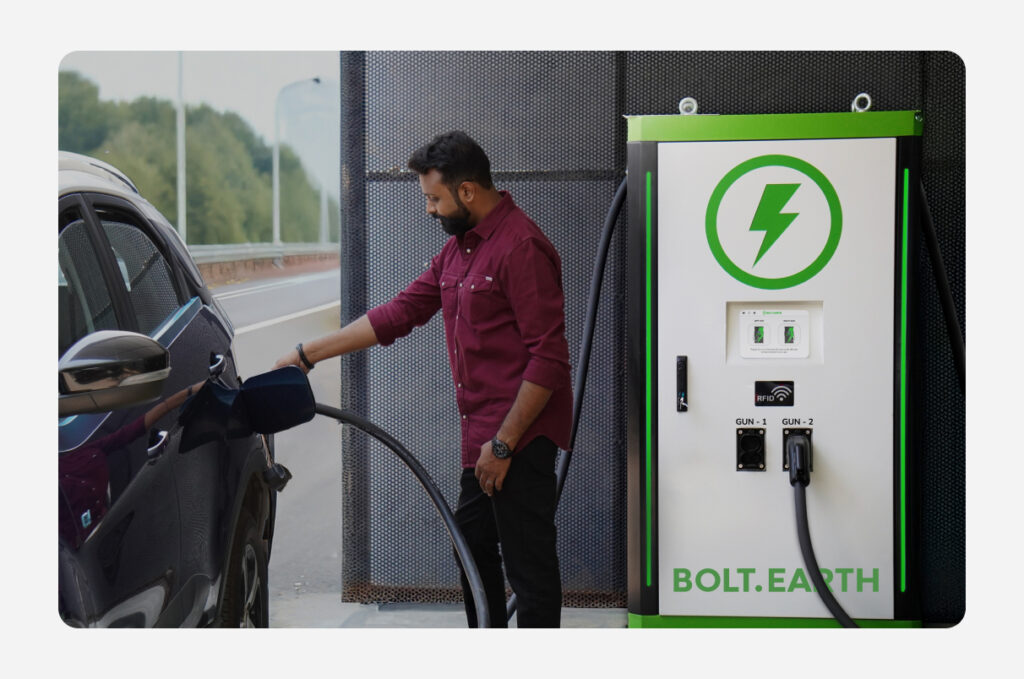
    Top Safety Features to Look for in a Commercial DC Fast Charger

    AC (2).jpg

    Ground Fault Detection: A quality DC fast charger includes residual current monitoring (GFCI/RCD) to immediately cut power if any current leakage to ground is detected, preventing electric shocks. This is vital for user safety given the high voltages involved.

    Overcurrent and Surge Protection: Commercial chargers should have built-in circuit protection (fuses or breakers) to disconnect power in case of an overcurrent (short circuit or overload) or dangerous overvoltage spike from the grid. This helps avoid electrical fires or damage to vehicles when current or voltage exceeds safe limits.

    Thermal Management: High-powered charging generates heat, so chargers must include robust temperature monitoring and cooling systems. Sensors should track internal temperatures (cables, connectors, power electronics) and trigger cooling fans or a shutdown if components begin to overheat, thus preventing fire hazards and ensuring safe operation.

    Emergency Stop Button: Any public DC fast charger should feature a clearly labeled EMERGENCY STOP switch. In case of malfunction, smoke, or other danger, this allows users or attendants to immediately cut all power output with a single press, providing an instant manual safety override.

    Insulation Monitoring: Advanced chargers include insulation monitoring devices that continuously check the isolation between the high-voltage circuits and the chassis/ground. If the insulation degrades or a fault is detected, the system halts charging to protect users from shock and prevent equipment damage.

    Standards Compliance: Reputable DC fast chargers carry safety certifications such as ARAI, UL, CE, or IEC 61851 compliance. These indicate the charger has met stringent safety requirements, including ground fault protection, overcurrent protection, and electromagnetic compatibility testing, ensuring essential safety features are built in and verified.

    The Growing Impact of DC Fast Charging

    From cross-country road trips to daily city commutes, DC fast chargers are increasingly the backbone of public EV charging infrastructure. Their ability to deliver rapid energy refills is unlocking new possibilities for electric mobility. In recent years, the expansion of public fast charging has already contributed greatly to EV adoption and will continue to be pivotal in the coming decade.

    Drivers seek out fast charging for the convenience it offers, and studies show many are willing to pay a premium for quicker charge sessions. Businesses and governments have noticed this demand, fueling a virtuous cycle where more fast chargers attract more EV drivers, which in turn encourages further investment in infrastructure.

    Looking ahead, DC fast chargers are poised to play an even bigger role across highways and city centers worldwide. Governments are backing ambitious plans to blanket highways with ultra-fast stations; for instance, the EU’s goal of 1 million public chargers by 2025 and fast hubs every 60 km on main roads. In cities, continued buildout of convenient fast-charge locations will support drivers who cannot charge at home, ensuring EV ownership is feasible for a broad population.

    Technological advancements are making next-generation fast chargers more powerful and more grid-friendly. Some stations now even exceed 350 kW, and future models may push charging times closer to the single-digit minutes.

    In summary, DC fast chargers have evolved from a niche convenience to a cornerstone of the EV charging ecosystem. By drastically cutting charging time, they reduce range anxiety and make electric cars a practical option for long-distance travelers, commercial fleets, and urban residents alike. The growing network of DC fast chargers on highway corridors connects cities and countries for electric travel, while those within city centers integrate EVs seamlessly into daily life.

    Together, these developments are accelerating the transition to electric mobility. With robust safety features and supportive policies in place, DC fast chargers are set to empower the next wave of EV growth, bringing us ever closer to a future where charging an electric vehicle is as quick and ubiquitous as filling a gas tank, if not more so.

    Blog Banner

  • DC Charging vs AC Charging for EVs: What Businesses Need to Know

    DC Charging vs AC Charging for EVs: What Businesses Need to Know

    Choosing between DC vs AC EV charging is a critical decision. These two charging methods differ in terms of speed, cost, and use cases, and understanding the differences is key to developing a smart EV charging strategy for companies.

    India’s EV charging infrastructure has expanded rapidly in recent years. Public and semi-public charging points grew from about 6,600 in early 2023 to nearly 29,300 by mid-2025. However, not all chargers are created equal: only about 35% are DC fast units, while the majority are slower AC chargers. Offering convenient charging can attract EV-driving customers, support employees with EVs, and future-proof your business for the electric mobility wave, especially if you’re planning a commercial EV charging station.

      This article will explore:
    • The fundamental difference between AC and DC fast charging
    • Pros and cons of AC vs. DC charging for businesses
    • Which charging type suits different business scenarios in the Indian EV context

    AC vs. DC Charging: The Basics

    AC vs. DC Charging.jpg

    Fundamentally, the difference between AC and DC charging lies in where the AC power from the grid is converted into DC power that an EV’s battery can accept. In AC charging, the conversion occurs onboard the vehicle: the charger utilizes the car’s built-in converter to convert AC from the outlet into DC for the battery.

    In DC fast charging, the conversion is handled by the high-powered charging station itself, which feeds DC electricity directly to the battery, bypassing the vehicle’s onboard charger. A helpful analogy is your laptop or phone charger brick. It converts AC from your wall socket to DC for your device’s battery. With AC charging, the EV essentially uses a “small brick” inside the car, whereas DC fast charging is like using an external supercharger that delivers battery-ready power instantly.

    Understanding Electricity.jpg

    Practically, this means AC charging is slower and lower power, while DC charging is much faster but requires more powerful equipment. AC chargers typically provide 3 to 22 kW of power, translating to roughly 4–10 hours to fully charge a mid-size EV. DC fast chargers range from around 15 kW up to 160–360+ kW, allowing an EV to reach about 80% charge in just 20–60 minutes.

    The car’s onboard charger capacity limits AC charging. Even if you plug into a high-rated AC charger, the vehicle may only draw what it can handle (often 3.3 kW or 7.2 kW for many models).

    DC chargers bypass this limitation by feeding the battery directly, enabling much faster range addition. However, the intense power of DC fast charging generates more heat. Frequent use can strain the battery. Occasional fast charging is fine (modern EVs have thermal management systems), but over-reliance on DC charging may lead to slightly faster battery degradation. AC charging is gentler; lower currents are generally easier on the battery over time. This is a key consideration in AC vs DC charging for EVs.

    AC Charging: Pros and Cons

    AC_2-1.jpg

    For businesses, AC charging offers several advantages along with some limitations:

    Pros of AC Charging:

    • Low equipment and installation cost: AC charging stations are relatively inexpensive and simple to install. A basic AC charger (wall-mounted unit or pedestal) typically costs much less than a DC fast charger. Small 3–7 kW units can even be modified into heavy-duty sockets or smart plugs. Installation usually requires standard electrical wiring, keeping capital costs low, ideal for a commercial EV charging station setup.
    • Simpler electrical load management: AC chargers draw modest power (similar to an appliance or AC unit), making it easier to obtain utility/DISCOM approval and often avoiding expensive grid upgrades. Many businesses can integrate AC chargers without major changes to their existing electrical setup.
    • Universal compatibility: Every EV on the market supports AC charging, as all have onboard AC chargers. This includes electric two-wheelers, three-wheelers, and high-end electric cars. With the appropriate connector, AC charging works across types, even models that lack fast-charging options.

    Cons of AC Charging:

    • Slower charging speeds: AC charging is significantly slower than a DC fast charger. A typical AC charger adds around 10–20 km of range per hour, which is suitable for overnight or all-day charging, but not for quick turnarounds. For high-turnover businesses like highway pit stops or taxi fleets, AC alone may not suffice.
    • Limited by the vehicle’s onboard charger: The actual charging speed with AC is capped by the EV’s onboard charger. For instance, if a car’s onboard charger is 7.2 kW, even plugging into a 22 kW AC station won’t increase the speed; it will still charge at 7.2 kW. Upgrading the AC station beyond a certain point yields no benefit unless the vehicles can utilize it. This limitation can be a bottleneck, especially as battery sizes grow.

    Despite the slower speed, AC chargers are ideal for scenarios where vehicles are parked for extended periods and cost is a major consideration. AC fast chargers can be a tactical part of an EV charging strategy for companies focused on long dwell times.,

    DC Fast Charging: Pros and Cons

    DC_2-1.jpg

    For businesses aiming to offer rapid charging or support vehicles needing quick turnarounds, DC chargers can be game changers, but they come with higher costs and infrastructure requirements.

    Pros of DC fast Charging:

    • Rapid charging for quick turnaround: The key advantage of DC charging is speed. High-power DC stations can deliver up to 80% charge in 30-40 minutes for compatible vehicles. This enables businesses to serve more EV drivers daily, boosting throughput and potentially increasing revenue or supporting time-sensitive operations.
    • Support long-distance travel and larger vehicles: DC fast chargers are essential for intercity EV travel and are commonly installed at highway rest stops. They are also the only practical solution for charging large battery packs in electric buses, trucks, or long-range cars. With appropriate connectors, DC stations can accommodate heavy EVs, making them vital for fleet operators and public transport electrification.
    • Not limited by onboard charger constraints: Since the conversion happens off-board, DC chargers aren’t restricted by the vehicle’s onboard AC charger. If an EV supports 100 kW DC, a compatible fast charger can deliver that. This makes DC infrastructure more “future-proof” for newer EVs with ultra-fast charging capabilities.

    Cons of DC Fast Charging:

    • High equipment and installation cost: DC fast chargers are significantly more expensive than AC units. They include powerful rectifiers, cooling systems, and advanced control electronics. A single DC fast charger can cost anywhere between ₹8–10 lakhs for a 15–30 kW unit and tens of lakhs for 50+ kW models. Ultra-fast stations (150 kW, 200 kW, etc.) can reach ₹50–80 lakh per unit. Installation is complex and often requires high-capacity grid connections, transformers, and heavy cabling.
    • Greater power and infrastructure needs: While AC chargers can plug into standard supplies, DC fast charger requires large power feeds. For example, a 60 kW DC charger may need a dedicated 400 V, 3-phase line with a high sanctioned load. Not all sites have this readily available. Upgrading infrastructure (new transformers, substations, etc.) can be a major project. Adequate space and a cooling system are also necessary, which can extend the installation timeline and require coordination with electricity providers.
    • Higher maintenance complexity: DC chargers involve advanced electronics and cooling systems, making them more maintenance-intensive. They are industrial-grade electrical devices that may require remote monitoring, regular servicing, and higher repair costs. Businesses must factor in operational expenses and possibly service contracts to ensure uptime.

    Choosing the Right Charger for Different Scenarios

    AC (1).jpg
    Now that we’ve outlined the strengths and limitations of AC and DC charging, the next question is: which should your business choose? The answer depends largely on how and where the charging will be used. In many cases, a combination of both may be ideal. Let’s look at typical scenarios and the most suitable charging solutions:

    AC charging is well-suited for:

    • Locations with long parking durations: If EVs are parked for extended periods, such as at offices where employees stay for 8 hours or malls where customers spend an afternoon, AC chargers are an excellent fit. In these cases, a slower charge is not a problem; the vehicle will have ample time to recharge.
    • Overnight or residential charging: Apartment complexes, housing societies, or hotel parking areas often rely on AC charging because vehicles remain parked overnight. Installing AC points allows residents to charge their cars or two-wheelers each night at an affordable cost. Slow charging overnight is usually sufficient to replenish the daily driving range.
    • Workplaces and destinations with long dwell times: Many offices and workplaces are adding AC chargers in their parking areas. Employees can plug in at the start of the workday and come back to a charged vehicle by evening. Similarly, places like multiplexes, supermarkets, hotels, and resorts, where visitors spend a few hours, can offer AC charging as a value-added amenity. These encourage EV drivers to visit and stay longer, benefiting the business.
    • Cost-sensitive deployments: For businesses or institutions with limited budgets, AC chargers offer a cost-effective starting point. A small restaurant or shop might install an AC unit to attract EV owners without significant investment. Public projects also tend to deploy more AC units initially to maximize coverage. AC infrastructure enables affordable charging, albeit at slower speeds.

    In these scenarios, the lower cost and simpler installation of AC chargers often outweigh the speed disadvantage. Many businesses find that a few hours of AC charging while customers or employees are on-site is enough to significantly top up or fully charge most EVs.

    DC fast charging is better suited for:

    • Highway stops and transit hubs: Highway charging stations or rest stops require DC fast chargers. EV drivers on long trips prefer spending 20-40 minutes charging, not hours. Fast chargers at petrol pumps or dedicated EV stations enable quick top-ups for long-distance travel. Similarly, transit hubs like intercity bus terminals or rail station parking lots benefit from DC fast chargers that allow travelers to recharge quickly before continuing their journey.
    • Fleet operators with tight schedules: Commercial EV fleets, such as electric taxis, delivery vans, and buses, operate on strict timelines. DC charging helps vehicles return to service quickly. For example, an electric taxi can queue for a 30-minute fast charge between rides instead of being idle for hours. Bus depots also use fast chargers during layovers. Faster turnaround directly improves fleet utilization.
    • Public charging hubs and commercial EV stations: If you are setting up a commercial EV charging station to serve multiple users, DC chargers are essential. They increase the number of vehicles charged per day, maximizing revenue. In today’s landscape, “fast charging = higher customer turnover”. A hub with multiple DC fast chargers can become a preferred refueling point. Offering DC charging also provides a competitive advantage by attracting drivers who need a quick top-up.
    • “Future-proof” installations: Sites aiming to support the next generation of EVs should consider installing DC fast chargers. Newer EV models feature larger batteries and higher charging acceptance rates. Including DC infrastructure (or provisions for it) ensures readiness for future needs. For example, a tech campus might install one or two DC stations to support upcoming EV models or company fleet cars, even if current employee vehicles rely on AC. This signals a forward-looking approach and accommodates faster EVs.

    For many businesses, a mix of AC and DC offers the best of both worlds. A large mall might install several AC chargers for shoppers staying a few hours, along with a couple of DC fast chargers for quick top-ups. Similarly, a fleet depot could use AC charging overnight to reduce energy costs and battery stress, while relying on DC chargers during the day for rapid turnarounds. Combining both types allows you to serve diverse needs efficiently.

    The Indian Context: AC vs. DC on the Ground

    DC_1.jpg

    While the general principles of AC and DC charging apply globally, understanding the Indian EV market is crucial when making decisions:

    • Vehicle charging capabilities: Unlike markets with widespread ultra-fast charging, many popular EV models in India have modest fast-charging capabilities. For example, mainstream electric cars like the Tata Nexon EV typically accept only 25–30 kW on DC fast charge. Even when plugged into a 60 kW or 120 kW DC charger, they charge at around 30 kW due to battery and thermal limits. A 30 kW DC charger can serve these vehicles just as effectively as higher-powered stations. Businesses should assess the vehicles likely to use their chargers; if most patrons drive such models, a 150 kW charger may not deliver its full benefit today. However, higher-end EVs and future EVs support faster rates (50 kW, 100 kW or more), and the market is gradually moving in that direction.
    • Prevalence of two-wheelers and three-wheelers: India’s EV growth includes a significant share of two-wheelers and three-wheelers (scooters, bikes, rickshaws). These vehicles primarily use AC charging, often via a simple 3.3 kW or 15A plug, or battery swapping in the case of e-rickshaws. They lack DC fast-charge ports. If your business is located in an area frequented by two-wheelers (for example, a campus or shopping zone popular with e-scooters), installing multiple affordable AC charging points (or standard plug points with metering) may offer more value than a costly DC charger that these vehicles can’t use. For instance, an EV scooter might recharge in 1-2 hours on a 3 kW point, making DC charging unnecessary. Catering to this segment means focusing on accessible AC sockets and charging models like hourly or per-kWh fees.
    • Standards and connectors in India: The Indian government has promoted standard connectors for interoperability. On the AC side, Type 2 (IEC 62196) is the standard for four-wheelers, while Bharat AC-001 (using 3-pin/IEC 60309 sockets) is used for light EVs at 3.3 kW. On the DC side, most cars use the CCS2 connector, which supports 25-350 kW. Bharat DC-001(with a proprietary GB/T connector) supports low-cost DC charging up to 15–30 kW, mainly for smaller cars and fleets. Why does this matter? If you’re installing fast chargers, CCS2 is the preferred standard for modern cars. Bharat DC-001 units(15 kW) are cheaper but limited to specific models like the Mahindra eVerito or the fleet variant of the Tata Tigor EV. Most commercial deployments now favor CCS2 for future-proofing. For AC chargers, Type-2 sockets or tethered cables will cover all cars, with adapter cables available for two-wheelers if needed.
    • Current infrastructure mix: As of end-2024, most public chargers in India are still AC. This reflects cost considerations and the early phase of market growth. AC points are quicker and cheaper to deploy, helping build confidence among EV owners. Fast chargers are being rolled out along strategic corridors (e.g., every 25–50 km on highways) with government support. Only about one-third of public chargers are DC fast units, though this share is increasing. For a business, this means there may be gaps in fast-charging coverage you can help fill, potentially attracting customers. At the same time, many EV users expect destination charging to be AC-based.
    • Government incentives and policies: The government is actively expanding charging infrastructure through initiatives like PM E-Drive, state EV policies, and zoning regulations. In some cities, commercial and residential buildings must allocate a percentage of parking for EV charging. Capital subsidies are also available in certain states, often with higher incentives for fast chargers. When planning your investment, check for subsidies, tax breaks, or public-private partnership opportunities, can significantly offset the cost of a DC charger or make AC installation nearly free. Also, electricity tariffs for EV charging vary by state. Some offer special EV tariffs lower than commercial rates. Navigating these policies can influence your decision (for instance, a subsidy on a 50 kW DC might make it as affordable as a 22 kW AC setup).

    Overall, the Indian context calls for a pragmatic approach: start with the basics by deploying AC charging where it suffices, but plan for the future with DC fast charging as the EV ecosystem matures.

    For many businesses, this means installing AC chargers now to meet current customer needs, while closely monitoring usage patterns and trends in EV adoption. As more EVs, particularly newer models, hit the road, you can scale up with DC fast chargers at strategic locations. The EV landscape in India is evolving rapidly, and adaptability is just as important as the initial choice of charger type.

    Blog Banner


    Frequently Asked Questions

    What is the difference between AC and DC charging for EVs?

    AC charging uses the vehicle’s onboard charger to convert power from the grid, making it slower. DC charging converts power within the station and delivers it directly to the battery, enabling much faster charging.

    Which type of charger is better for long trips or highway travel?

    DC fast chargers are ideal for long trips or highway travel. They can recharge approximately 80% of the battery in 20-60 minutes. AC chargers are better suited for overnight stops or longer stays.

    Do all electric vehicles support DC fast charging?

    No. All EVs support AC charging, but only some, mainly modern four-wheelers, support DC fast charging. Two-wheelers and older models typically rely on AC or battery swapping. How much does it cost to install AC vs. DC EV chargers?

    AC chargers cost ₹20,000–₹1,50,000 (but may vary depending on the power level and smart features). DC fast chargers range from ₹15–80 lakh, depending on power level and installation needs. Government subsidies may help offset these costs.

    Should businesses install both AC and DC chargers?

    It depends on your needs, but a mix of AC and DC chargers is ideal if your budget allows. AC chargers serve longer parking times and offer a low-cost option, while DC chargers provide quick charging for drivers on tight schedules. Many businesses start with AC chargers and add DC as demand grows. If you must choose one, pick AC chargers for longer stays and cost savings, or DC for fast turnaround and high traffic. Combining both offers flexibility and future readiness.