Blog

  • EV Charging in Apartments and RWAs: Simplifying Installation in India

    EV Charging in Apartments and RWAs: Simplifying Installation in India

    As India marches toward its EV30@30 goals, several public and private players can play a role in boosting EV adoption. RWAs also have a unique opportunity: by installing residential EV charging stations, they can generate a steady revenue stream while boosting the country’s EV adoption.

    But installing residential EV charging points is not an easy feat for RWAs, with issues like space constraints, lack of awareness and support, high upfront costs, and installation complexity. To ease these challenges and promote the setting up of EV charging stations, many state governments are introducing a single window process for EV charger installation. In part 2 of our series on residential EV charging, we dive deep into India’s single window process. More specifically, we answer three questions:

    • What challenges can the single window process for EV charging point installation address?
    • How can RWAs fully benefit from the single window process?
    • What can RWAs and state governments learn from other single window process implementations?

    The Need for a Single Window Process In The Indian Market

    Despite the government incentives, setting up residential EV charging stations remains a challenging task for RWAs. For example, the Ministry of Housing and Urban Affairs (MOHUA).pdf) has set a long list of items for RWAs to follow to be eligible to set up charging stations. These requirements range from gaining a No Objection Certificate from the local municipal body all the way to sharing collected data from EV charging stations with the appropriate State Nodal Agency (SNA).

    Given these stringent requirements, the EV charging installation process becomes a hassle for RWAs, thereby hindering their charging ecosystem initiatives. To further add to the hassle, the different charging requirements for different residents makes selecting charging equipment nearly impossible. Combined, these factors suffocate RWAs efforts to help their communities turn to green mobility.

    However, helping RWAs install EV chargers on their premises is an important step in achieving a full EV charging ecosystem. The table below outlines the roadmap RWAs can follow to gauge how far along they are in electrifying their society.
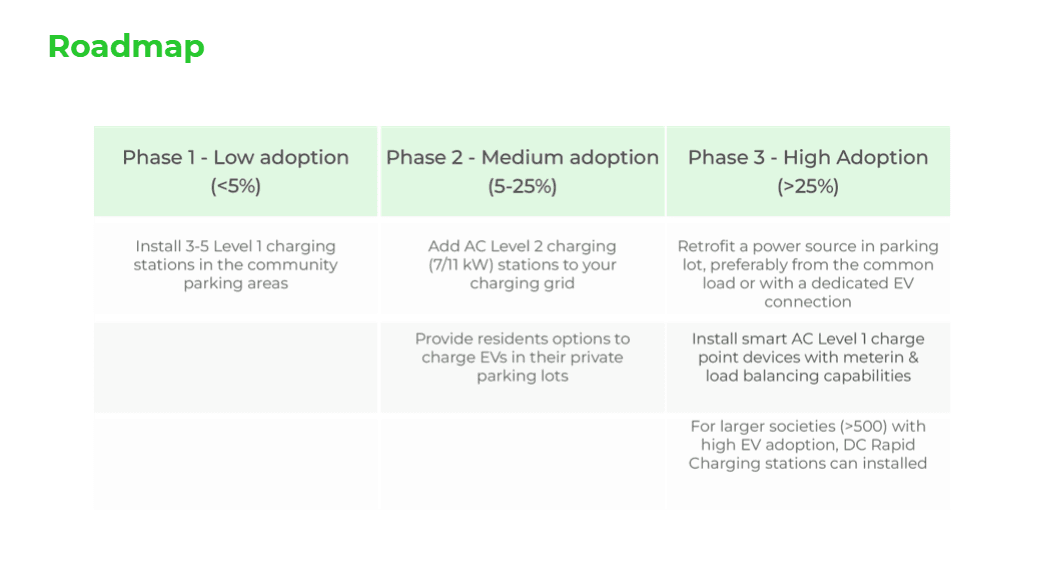
    Table of the Roadmap RWAs should follow.

    How the Single Window Process for EV Charger Installation Helps RWAs

    The single window process for EV charger installation was set up in various states in an attempt to mitigate RWAs’ challenges. Below is a step-by-step overview of this process:

    • DISCOMs enlist vendors to offer their charging equipment on the single window portal (SWP)
    • One single authority handles obtaining all the permits and clearances
    • The authority may provide end-to-end EV installation through its employees or chosen vendors
    • RWAs can access this portal to get information on the different types of chargers, costs, vendors, etc.
    • RWAs can review the available incentives and rebates on installation costs
    • Office bearers simply apply and pay for the charger installation

    By combining all the need-to-know information for RWAs in one single portal, the installation process is no longer a hassle. The single window process also makes EV installation more affordable, both in terms of money and time, enabling RWAs to gain more support from residents, thereby boosting EV adoption in the community.

    4 Components of a Single Window Process

    The single window process, with its centralized portal, standardized set of guidelines, streamlined approval process, and automatic subsidy, is expected to help RWAs install EV charging points quickly and with little effort. Below we examine how four key components in the single window process can help RWAs in India overcome installation obstacles.

    1. Centralized Portal

    A key component of the single window process for EV charger installation is the centralized portal that brings together different DISCOMs. In this portal, a list of trustworthy EV charging vendors vetted and approved by the state-designated authority is listed along with the cost of different chargers.

    Such a credible list of vendors reduces the vetting time and effort for RWAs. It also helps ensure the chosen charging equipment will be safe and reliable. Finally, by seeing the different charger types in one place, RWAs can compare offerings to select the ones that fit their community’s needs.

    2. Standardized Set of Guidelines

    The single window process for EV charger installation is transparent. It also follows a standardized set of guidelines that anyone can check through the DISCOMs’ portals. These guidelines focus on safety, and ensure the EV chargers offered as well as the installation expertise of vendors meet the requirements laid down by the Bureau of Indian Standards (BIS).

    Having a standard set of guidelines can help RWAs gain support from their residents, as any solution they choose will be safe for the community. In addition, these guidelines can help RWAs to better choose the types of chargers to install based on their residents’ needs.

    3. Streamlined Approval Process

    The single window process for EV charger installation streamlines the approval process. Once the RWA applies, the DISCOMs do a site inspection and handle all the necessary approvals and permits. RWAs simply have to apply and pay for the chargers.

    By using this process, RWAs don’t have to worry about meeting the guidelines of MOHUA, the power ministry, and the local laws and regulations on their own. This, in turn, makes the installation process more efficient.

    4. Subsidized Costs

    Most state governments offer a subsidy for setting up EV charging stations. With a single window process, the subsidies are automatically deducted from the installation cost, and RWAs only have to pay the remaining fee. Again, this saves time and money because RWAs don’t have to pay upfront and apply for a subsidy or follow up on it. This inclusion of subsidies also helps with budgeting and planning.

    Given the many benefits RWAs reap from the single window process for EV charger installation, it’s important to know how office bearers can get started with it.

    How RWAs Can Use the Single Window Process In India

    The single window process for EV charger installation allows RWAs to easily apply for the installation of EV chargers through a centralized portal. The five steps detailed below describe the broad process, but the exact steps may vary across states.

    1. Access the Single Window Portal

    The launch point of the single window process is the portals of state-authorized power distribution companies (DISCOMs). These portals have information about the application process. They also contain information about the required documents, and the price list of different chargers from approved EV charger vendors.

    RWAs can follow these steps to get started:

    • Visit the DISCOM’s portal to browse the list of vendors and chargers
    • Decide on charger type and numbers
    • Prepare the required documents in digital format
    • Log in using the society’s existing customer number. To create a new customer number, the RWA should input its email ID and phone number.

    2. Apply for a New EV Connection

    The first part of the application is to apply for a new commercial EV connection, if required. RWAs can generally find out whether they need one through the DISCOM portal. The sample table below can help an RWA evaluate if it needs to apply for one.

    RWAs can apply for a new connection with the below steps:

    • Click New Connection
    • Fill in the required details, like the number of charging units required
    • Sign an online declaration form summarizing the entered information
    • Check the details before agreeing to the terms and conditions
    • Upload relevant documents, like the RWA registration certificate, address proof, the last two
    • power utility bills, proof of consumer information, and other identification documents as required by the DISCOM
    • Check the information for accuracy before submitting. Any errors or inconsistencies can delay the processing of the application or result in a rejection

    On successful submission, an acknowledgement of the request for a new EV connection with a unique tracking number is displayed. The same information is also sent to the registered email ID and mobile number.

    3. Submit and Review the Application

    After applying for a new EV connection, RWAs can apply for an EV charging point installation in parallel. Based on the state’s EV policy, RWAs may have the option to pay for the installation using the CAPEX model or the Subscription model.

    Below are the application steps for EV charging installation:

    • Log into the single window portal
    • Navigate to the the application form
    • Provide the RWA consumer number, the housing society’s address, the type and number of chargers, and the cost model

    From there, the online portal automatically checks details and applies any available subsidies the RWA qualifies for. The RWA will then receive the net price to pay, along with application confirmation.

    If the submitted information is incorrect, the RWA receives a notification by email, or phone call. In such cases, they will have to apply again. After that, the two remaining steps are for the DISCOM to handle.

    4. Monitoring the Inspection and Installation

    Based on the submitted information, a vendor representative will schedule a visit to the housing community. The vendor will then assess the site and provide the detailed cost split-up for any additional electrical infrastructure required.

    Once the RWA gives the go-ahead, the vendor will install the charger and present the final bill for payment. Some states require the RWA to sign an agreement with the vendor for the monthly subscription model.

    It’s also a good idea for one or more RWA office bearers to be present during the inspection and installation to ensure the agreed chargers are installed, as it can be difficult to change later. Office bearers should also double-check the details on the receipt or the monthly agreement before signing.

    5. Completing the Process

    After the installation is complete, the vendor uploads the agreement documents or bills to the portal. The DISCOM will then provide the vendor a completion certificate and approve the subsidy. The Nodal officer will also verify the details and will initiate the subsidy to the vendor.

    Though the RWAs do not receive any certificates, they may log into the DISCOM portal to check their EV charger installation. They can also follow the same process for adding more installations.

    Through this single window process, RWAs only need to access the portal and provide information. The DISCOMs and vendors then take care of the process, with little to no intervention from the RWA. As a result, this reduces the workload for RWAs. But housing societies can gain more from the single window process by following some best practices.

    3 Best Practices for RWAs to Implement the Single Window Process

    Many state governments are easing the process of EV installation in housing communities. In the first part of this series, we emphasized the approach RWAs should take when installing charging stations on their premises, as outlined in the illustration below.
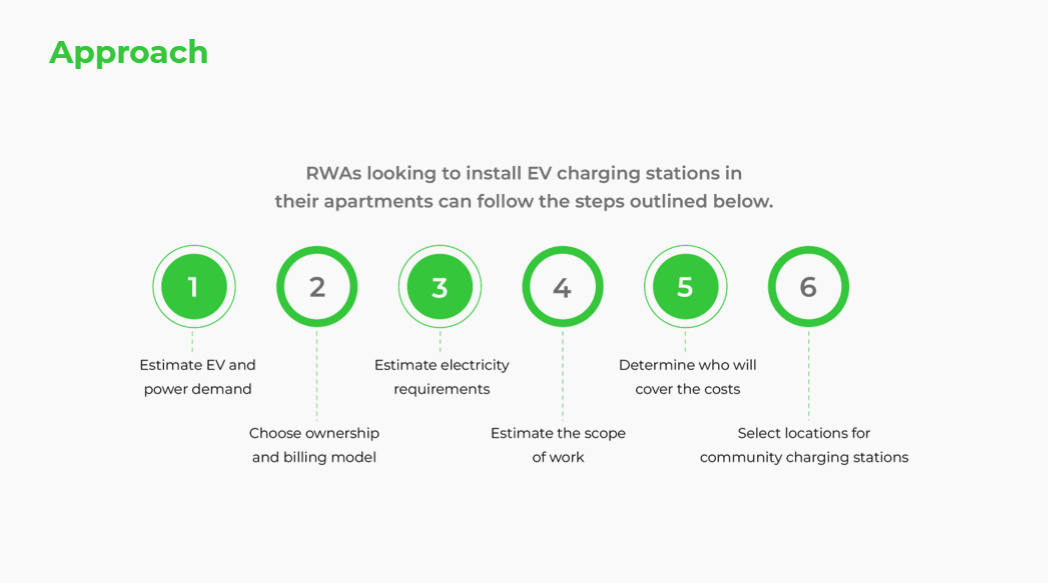
    Illustration of the approach RWAs should follow when installing charging stations.

    However, to maximize the benefits of this process, RWAs can implement certain best practices to make the single window process more efficient and cost-effective.

    1. Sign Annual Maintenance Contracts

    RWAs can discuss the long-term maintenance for the installed chargers. Some vendors listed in the DISCOM portal offer annual maintenance contracts at a fixed fee that the RWAs can renew for each year. This, in turn, will help avoid expensive repairs and get technicians to attend to problems quickly.

    2. Collaborate with Neighboring RWAs

    An RWA with limited space can collaborate with neighboring RWAs to share EV charging points. In such cases, both RWAs can apply together through the single window portal. It’s also best for the RWAs to sign a formal agreement with the terms of use that specify the number of hours of usage for each RWA, the cost per hour, and other pertinent details. Through this collaboration, RWAs can save resources and improve the efficiency of the installation process.

    3. Gauge Future EV Adoption Rates

    RWAs can conduct a survey across the community to better understand how many residents are planning to buy EVs in the near future, and the type of chargers they would need. Accordingly, the RWA can select the number and type of chargers on the single window process portal. Doing so will help RWAs avoid repeating the installation process every time residents purchase new EVs.

    However, the success of the single window process depends on state governments’ efforts to implement it. By analyzing how other governments have succeeded — or failed — in their efforts to implement the process, RWAs and governments can better understand how to collaborate together to ensure a successful implementation.

    Case Studies: How Two Indian States Have Implemented the Single Window Process for EV Charger Installation

    The case studies presented below provide a thorough understanding of the implementation of the single window processes across two different states. Through these case studies, RWAs and state governments alike can identify the factors that can lead to the success or failure of the single window process implementation.

    1. Delhi

    The Delhi government has launched its “EV Policy 2020”, providing a single window clearance process for installation of EV charging infrastructure. Through this plan, the Delhi government plans to install at least 30,000 charging points across the city.

    To implement this single window process, the Delhi government empowered all its DISCOMs: BSES Rajdhani Power Limited (BRPL), BSES Yamuna Power Limited (BYPL), and Tata Power Delhi Distribution Limited (TPDDL). They were empaneled to shortlist EV vendors and estimate the costs for RWAs. DISCOMs then updated their websites to include the single window process and application forms.

    Delhi’s single window process for EV charger installation is simple to use. RWAs can go online and complete the process or call the office, and the operator will provide detailed instructions on where to find the physical form and how to submit it. This multichannel support is handy for people with varying technical skills and backgrounds.

    Because the Delhi state government has tailored this process to fit different RWAs’ needs, it has successfully installed 1,000 EV charging points since the policy was introduced.

    2. Karnataka

    The Karnataka government’s “Electric Vehicle and Energy Storage Policy 2017” provides a single window clearance process for setting up EV charging stations. Under this policy, Bangalore Electric Supply Company Limited (BESCOM) is responsible for setting up EV charging stations.

    BESCOM follows the guidelines and regulations of the Central Electrical Authority and the safety parameters provided by the Karnataka State Electrical Inspectorate while installing EV charging points. To apply, RWAs have to reach out to BESCOM and may even have to go in person to complete the application form.

    However, note that EV charging installations are being opposed by some apartment owners. The Karnataka EV policy does not have provisions to resolve these disputes, so this may delay or make it impossible to install an EV charger in the community, especially with opposition from even a few owners.

    As a result, it’s crucial for state governments to ensure they are always on the same page with all RWAs, and address any concerns they may have, to guarantee the success of their single window initiatives and avoid facing Karnataka’s scenario.

    Based on the above, state governments need to ensure their single window process implementation actually addresses RWAs’ needs.Looking ahead, successful single window processes across India will be key to promote further adoption of EVs.

    The Future of Residential EV Infrastructure

    With RWAs being a key player in the creation of a country-wide EV charging ecosystem, the government is making significant efforts to ease the installation process for EV charging stations in housing societies.

    The single window process for EV charger installation can significantly simplify the approval process. As a result, it can reduce the time and costs associated with installation and facilitate private investment in EV charging infrastructure. This streamlined process can also encourage more RWAs to invest in EV charging infrastructure, leading to wider EV adoption.

    However, achieving a seamless and accessible process for EV installation requires continued collaboration and innovation. Gathering information about the effectiveness of this implementation will be key to addressing any issues along the way, thereby making the process more beneficial for everyone involved.

    RWAs, on the other hand, should stay informed and engaged in the process of creating a conducive environment for the growth of EV charging infrastructure. By collaborating with industry stakeholders, the government, and even other RWAs, they can ensure the EV charger installation process remains profitable for them, and safe and accessible for all residents.

    For this reason, the next part of this series will discuss the importance of navigating government requirements to create a conducive regulatory environment for the growth of EV charging infrastructure.

    For more information about the single window process for EV charger installation, please see the FAQ and Resources below.

    FAQ

    How does the single window process simplify the EV installation process?

    The single window process simplifies EV installation by providing a centralized and streamlined approval process through a single portal. As soon as an RWA applies for an EV installation, a single authority or organization handles all the necessary approvals and permits. This cuts bureaucratic delays and saves time and effort for RWAs and small business owners.

    What are the benefits of the single window process for EV charger installation?

    The single window process for EV charger installation facilitates private investment and provides faster approvals, reduced time and costs, and increased transparency. It simplifies the approval process by consolidating multiple agencies into a single window, thereby encouraging more RWAs to invest in it. Additionally, it provides clear guidelines and reduces barriers to entry for private players, leading to competition and innovation in the market.

    Who can use the single window process for EV charger installation?

    The single window process for EV charger installation in India can be used by any small business owner, individual EV owners, and RWAs interested in installing EV charging infrastructure. The process aims to simplify the approval process and promote the adoption of EVs, making it accessible to a wide range of users.

    How long does the approval process take under the single window process for EV charger installation?

    The approval process under the single window process for EV charger installation varies from state to state, depending on the number of pending applications. In Delhi, however, the government has instructed that the installation process has to be completed within seven days of submitting a request.

    What permits and approvals are required for EV installation?

    Housing societies and RWAs need approvals from authorities like the State Electricity Board, local bodies like Municipal Corporations, and the Fire Department for EV installation in India. The single window process simplifies this by consolidating all approvals into a single point of contact.

    What building codes or regulations to consider when installing an EV charging station?

    In India, the MOHUA.pdf) lays down guidelines and regulations to consider when installing an EV charging station. When RWAs opt for the single window process for EV charger installation, all the building codes and regulations are clearly laid out. The DISCOM will also ensure the housing society is in compliance with these requirements.
  • The Importance of Affordable Slow Chargers in Building a Robust Countrywide EV Network

    The Importance of Affordable Slow Chargers in Building a Robust Countrywide EV Network

    During the 2015 COP21 Summit held in Paris, the Indian government pledged to reduce greenhouse gas emissions by 2030, minimizing its carbon footprint by 35% compared to levels in 2005. To meet this commitment, the Indian government aims to transition 30% of vehicles on the road to electric vehicles (EVs) by 2030.

    Policymakers, infrastructure developers, investors, and private companies all play a vital role in achieving this EV milestone. Thus, their key focus should be on incentivizing businesses and users to improve access to a country-wide EV charging network.

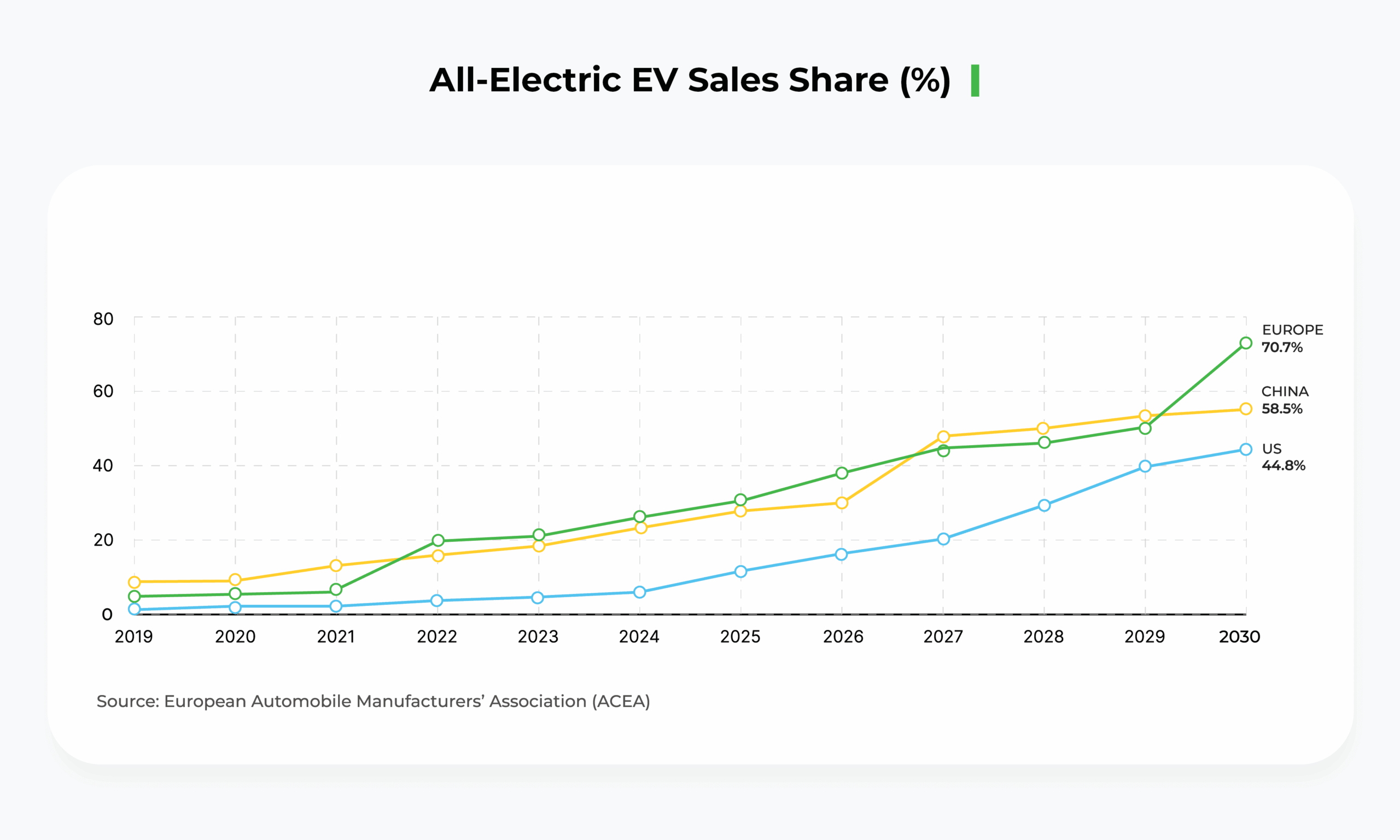
    The image below shows the percentage of EV market share across regions in Q4 2022.

    This article analyzes the key role of affordable slow chargers in creating this comprehensive EV charging network and answers these three questions:

    • Why does India need a country-wide EV charging network?
    • What are the challenges of building a charging network across India?
    • How can a slow-charging EV network resolve these challenges?

    Need for a Comprehensive Country-Wide EV Charging Network

    Road transportation in India constitutes most of the country’s fossil fuel demand and is a major source of carbon emissions. The shift from ICE (internal combustion engines) to EVs can help India make significant strides toward achieving carbon neutrality.

    The aim is to reduce dependence on fossil fuels and replace them with electric energy, which is much more efficient to produce and consume. The transition to EVs will be beneficial for the environment and will also reduce India’s oil import dependency. However, this transition will only be possible through the creation of a comprehensive charging infrastructure.

    Policy Focus on EV Charging Infrastructure

    Most people considering an EV are concerned about the availability of charging stations. The availability of adequate charging infrastructure is, therefore, a critical requirement for widespread EV adoption in India.

    To achieve India’s vision for 2030, the Bureau of Energy Efficiency (BEE) has been nominated as the Central Nodal Agency for EV Public Charging Infrastructure by the Ministry of Power, Government of India. As a result, every state government has appointed its State Nodal Agency to roll out EV Public Charging Infrastructure as government policy works to make a charging station accessible every 25 km along highways and roads. But this initiative alone may not be sufficient to meet India’s charging needs.

    Complex Challenge of Building a Nationwide EV Charging Network

    Despite the push from the government, public EV charging stations are not available across the country yet. It takes significant capital to set up and maintain charging infrastructure, and the country’s infrastructure may not be able to handle the load.

    These challenges standing in the way of rolling out a nationwide network are discussed in more detail below.

    1. Public EV Charging Stations Are Costly

    Public charging station setups have fast charging capabilities, meaning they use DC power, and are costly to set up, run, and maintain. The charger cost, however, is not the only issue to consider. Charge point operators also need to consider the cost of land, power transformers, power substations, and metering equipment.

    Since fast chargers are designed for public use, customers drive in, charge their EVs, pay, and drive out. This means the land requirement is substantial as operators try to manage peak capacity by charging multiple EVs simultaneously. The power and infrastructure required to manage multiple charging and metering units further add to the setup cost.

    2. Setting up Public EV Charging Stations in Rural Areas Is Fraught with Challenges

    Creating a country-wide EV charging network includes rolling out stations in rural areas. This presents a challenge, as the population density in these areas is low. Rural areas generally have lower demand for EV charging, meaning setting up charging stations is not financially viable. Given that the per capita income for rural areas is low, residents in these areas may not be able to afford to use charging stations for their EVs.

    Additionally, power supply is a challenge in many rural areas. Many regions do not have round-the-clock access to power from the grid. Augmenting the power supply in these regions may not be possible due to the additional costs and long gestation periods for these projects. This, in turn, makes setting up fast charging stations in these areas a challenging task.

    3. The Power Grid May Not Support the Load of Charging Stations

    As the EV transition picks up pace, the charging stations’ demand for electric power will also increase. Meeting this demand will require efficient power grid management and a reliable power supply to support India’s increasing demand for EV charging infrastructure in the years ahead. Because fast chargers can require up to 750V, they add a lot of pressure to the existing power grid.

    Additionally, the increased load on the grid can result in issues like network congestion, voltage issues, an increase in peak load, and phase imbalance issues. To manage these challenges, DISCOMs (power distribution companies) will need to regulate the power supply to fast chargers through measures such as location planning and smart charging capabilities.

    But until then, fast chargers cannot be the mainstay of the charging network in India. A more viable solution would be to rely on affordable slow chargers as the centerpiece of the EV charging network.

    Building a Nationwide EV Charging Network with Affordable Slow Chargers

    Given that fast chargers cannot be rolled out nationwide due to their high cost and the pressure they place on the grid, attention shifts to more affordable slow chargers. The three areas below highlight how slow chargers may help address the challenges in creating a country-wide EV charging network.

    1. Slow Chargers Are Affordable

    Government policy can encourage charging companies to primarily focus on rolling out a country-wide network of affordable slow chargers because it is the most cost-effective, convenient, and efficient way to recharge an EV. Setting up slow chargers requires little investment compared to fast chargers.

    With current government policies, slow chargers can play a dominant role (≥ 60%) in delivering the demand for EV charging infrastructure in India. The Indian scenario is not much different from the worldwide trend, as slow chargers are slated to be the dominant choice due to the advantages of slow charging technology.

    For instance, slow chargers offer the added benefit of maximizing battery life and safety compared to fast charging. Slow charging is the best way to charge an EV because it uses low voltage and allows ample time for ion stabilization. In contrast, fast charging generates more heat, which is detrimental to the battery’s health. This makes slow chargers more economical in the long run.

    2. Rural Regions Can Support Slow Chargers

    Slow chargers are viable in rural areas because they have low setup costs and infrastructure requirements. They only need an AC power supply and can easily be powered through renewable energy sources such as solar power in the absence of a round-the-clock, reliable power supply.
    Most rural regions in India have an abundant supply of renewable energy sources, such as solar energy. They could, therefore, leverage this supply to power slow charging stations at a fraction of the cost required for a fast charging station.

    Renewable energy-powered slow charging stations with facilities like net metering could help mitigate the power supply challenge and improve the financial viability compared to a fast charging station. With net metering, charging point operators can supply surplus power that they generate back to the grid and reduce their power costs significantly.

    3. Slow Chargers Are Better for the Power Grid

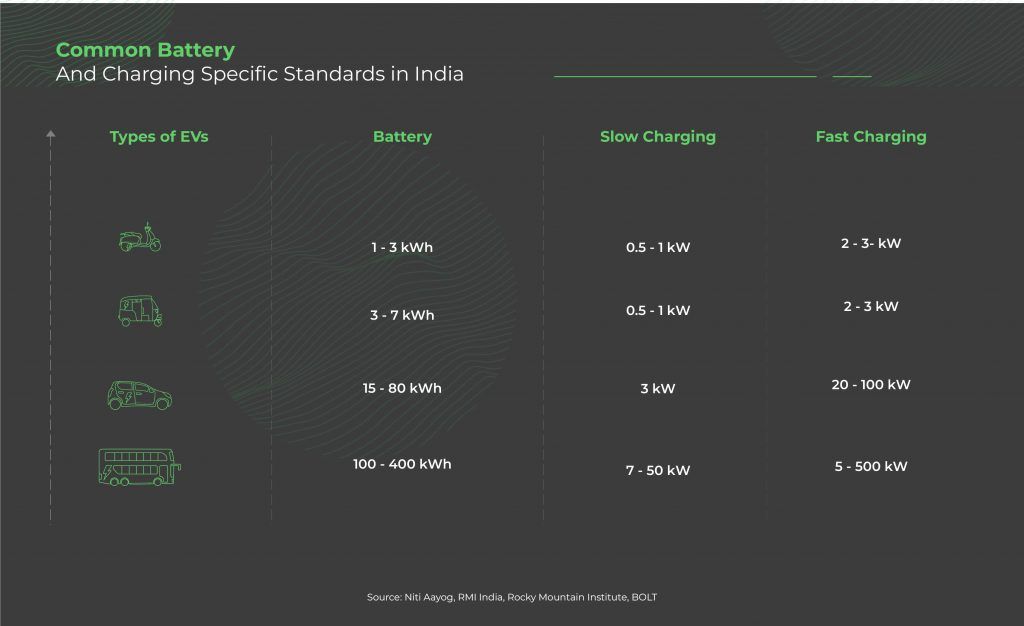
    Slow chargers use an AC electric supply to charge the EV in a few hours while it is parked. For reference, a 2-wheeler with a 2kWh battery can charge in an hour, while larger vehicles will charge in five to six hours. Slow charging stations can also be optimized for energy management through smart load management for grid balancing.

    By providing information access to users and providers across the network, smart chargers can help users save money. They can also drive the adoption of slow charging among price-conscious consumers, who would form the majority of users in India.

    DISCOMs will be able to manage the increased load of a slow charger-dominated EV charging network rollout much more efficiently than a faster charger-dominated network. This is because slow chargers deliver up to about 2.5 KW-3.3kW of power with a 230V/15A single-phase plug.

    The power requirement of a fast charger is manifold: 10 KW-50 KW or higher capacity and voltage rating 48V/72V, up to 750V or even higher depending on the battery capacity. A smart network of slow chargers will also improve grid stability, as DISCOMs will be able to manage the peak load of charging demand more efficiently.

    That being said, will rolling out a network of affordable slow chargers be beneficial for the country’s overall goals? Can slow charging meet India’s increasing EV charging needs?

    Slow Chargers Can Cater to the Majority of EV Charging Demand in India

    Government policy encourages people to set up chargers across the country, even going as far as delicensing the activity. Anyone can set up EV charging points according to the technical performance standards provided in the government policy.

    The setting up of slow charging stations has also been incentivized through early bird incentives and tax exemptions, such as a reduction in GST on chargers and a lower tariff on the power supply. However, will this promotion of affordable slow chargers be successful in India? How can slow chargers meet the EV charging demand?

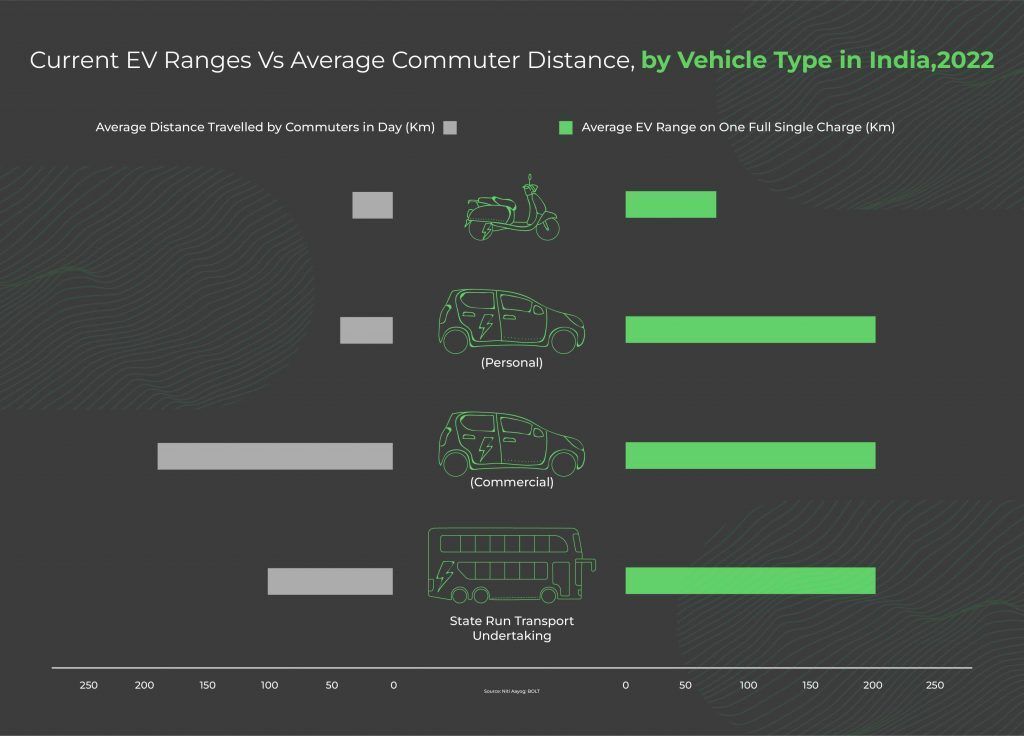
    The numbers below can give an idea of how much charging EVs require for their daily function:

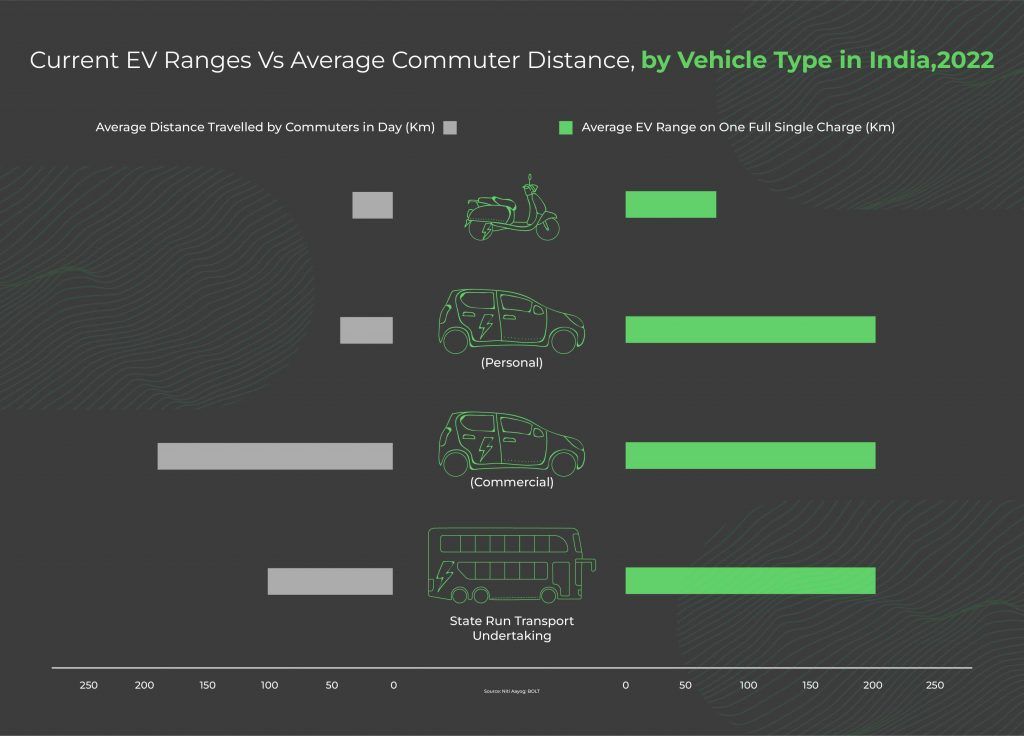
    • 2-wheelers in India run for 17 km per day on average
    • Private 4-wheelers in India have an average daily run of 32 km
    • Commercial 4-wheelers run for 192 km per day on average
    • Intra-city public transport (buses or light commercial vehicles) run for approximately 100 km a day on average

    The graph below shows that the average run for each of these EV types is well below the average range gained from a single full charge. This means charging these vehicles overnight using slow chargers is a viable option.

    Current EV Range vs Average Distance traveled in a Day for India, 2022

    For 2-wheelers, private 4-wheelers, and most commercial 4-wheelers, a large-scale public fast-charging infrastructure is unnecessary. Installing slow charging points within residential complexes, housing societies, shopping malls, parking lots, and offices could cater to the majority of the charging demand for EVs. It is pertinent to note that most EVs in India are 2- and 3-wheelers. Therefore, affordable slow chargers can cater to the majority of the country’s charging demand quite comfortably.

    Government policy has already mandated the provision of sufficient EV charging points in housing colonies/building apartments), which is a step in the right direction for building charging infrastructure within the residential infrastructure. Parking lots could also adopt slow chargers and create a feasible revenue model for EV charging services.

    The image below provides an overview of the sales share of electric vehicles by mode and scenario in India 2030.


    Role of Software in Creating a Network of Affordable Slow Chargers

    Policymakers, infrastructure providers, investors, and charging companies need to put concerted efforts into promoting slow charging in India and connecting all the charging points into a single network through software. This is crucial to accelerate the rollout of a country-wide charging network and to achieve the EV30@30 target. This will pave the way for a host of economic and environmental benefits for stakeholders in the EV ecosystem, Indians, and people across the globe.

    To promote the development of charging infrastructure, the Indian government has made it mandatory for public charging stations to tie up with at least one Network Service Provider (NSP) to enable advanced remote/online booking and specify service charges. Such interconnectivity will encourage large-scale private participation in the setting up of charging stations. For instance, private slow chargers can generate passive income, e.g., through a simple app-based scan-pay-charge. This will also help strengthen the community of EV owners in the region as more consumers can access charging services conveniently.

    Software will play a critical role in connecting slow chargers across the country, especially with advancements like Open EV Charging Platforms, allowing different entities to add their charging points to a single network. This software can benefit users, providers, investors, and policymakers by providing information such as the nearest available charging point and the supply-demand gap in charging in a given region.

    Accelerating the Transition to a Sustainable Future

    As India marches toward full EV adoption by 2030, the country needs to support its initiatives with a robust charging network. Fast chargers, however, are only a small part of the solution here. They are expensive to set up and substantially increase the load on the power grid. Fast chargers are also unsuitable for rural areas without enough grid support and capital to implement them.

    On the other hand, the potential environmental and economic impact of affordable slow chargers and a countrywide EV network on the future of transportation and energy is immense. The mainstay of the EV charging network will be slow chargers, supplemented with other technologies, such as fast chargers and battery swapping systems.

    With India’s strides towards its COP21 goals, many niche innovations in EV charging are starting to arise, such as wireless charging and vehicle-to-grid (V2G) technology. V2G, for instance, has the potential to make about 5% of the total EV battery capacity available to manage the grid’s peak demand.

    These innovations will surely drive EV adoption in time, especially if they become more affordable and available. But until then, investing in affordable slow chargers can solve India’s growing need for a country-wide EV charging network.

    To learn more about affordable chargers and their impact on the EV space in India, please see the FAQ and Resources sections below.

    FAQ

    What is a slow charger, and why is it important for EV charging networks?

    Slow chargers use an AC power supply to charge the EV. Most private-use EVs will provide a slow charger to install at home, but EV owners can also get a compatible slow charger from the market through independent providers. A slow charger is the most popular and affordable way to charge an EV. Although slow chargers take longer to charge the battery, they are safe and prolong the EV battery’s life.

    What is the difference between a slow and fast charger for EVs?

    A slow charger uses an AC power supply to charge the EV battery, whereas a fast charger uses DC power as input. Slow chargers charge slowly but are low-cost and good for the battery’s long-term health. In contrast, fast chargers are helpful when you need to charge the EV quickly and are willing to pay a premium for the quick service.

    How do slow chargers fit into the infrastructure requirements for a country-wide EV network?

    Slow chargers are an important part of the country-wide EV network infrastructure as they provide a reliable, convenient, and economical mode of charging EVs. Users can plug in the EV for charging overnight while they rest or during the day at their convenience. Slow chargers require very low setup costs compared to fast chargers and are expected to fulfill most of the EV charge requirements for private-use EVs.

    What challenges does India face in building a country-wide EV network, and how can affordable slow chargers help address those challenges?

    India faces multiple challenges in building a country-wide EV network, such as vast geography, erratic power supply, and price-sensitive consumers, particularly those in rural areas. These factors inhibit the rollout of a public charging station network based on fast charger technology as it is capital-intensive. Slow chargers are touted as the perfect solution for the Indian market because they are economical and can be easily set up at home.

    What role do government policies and incentives play in encouraging the adoption of affordable slow chargers and building a country-wide EV network?

    Government policies and incentives enable the adoption of slow chargers and the building of a country-wide EV network. The government offers different types of financial incentives through national-level policies, such as FAME II, and state-level policies. The financial incentives make it economically a smarter option to choose EVs and install a slow charger at home.

  • Best Practices for Achieving a Sustainable Residential EV Charging Ecosystem

    Best Practices for Achieving a Sustainable Residential EV Charging Ecosystem

    Studies show 80-90% of EV owners prefer charging at home, making residential charging ecosystems critical for India’s EV adoption. With India targeting 30% EV penetration by 2030, Resident Welfare Associations (RWAs) and housing societies play a pivotal role in enabling accessible, safe, and profitable charging infrastructure.

    However, setting up a residential EV charging point can come with barriers such as space constraints, lack of awareness and support, and grid compatibility. And even though governments provide incentives for RWAs, like tax credits for setting up EV charging stations and subsidies on power tariffs, they often aren’t sufficient to help RWAs overcome these barriers.

    In part 1 of our series on residential EV charging, we look at the best practices for implementing residential EV charging ecosystems. These practices will help RWAs and residential community members progress in the transition to EV charging. Specifically, we answer three questions:

    • What are the existing barriers to implementing residential EV charging ecosystems?
    • How can RWAs adopt best practices for implementing residential EV charging?
    • What are the best practices for installing residential EV charging stations?

    Understanding the Barriers RWAs Face in Implementing Residential EV Charging Ecosystems

    India’s growing adoption of EVs poses an opportunity for RWAs in setting up EV charging infrastructure. But this won’t be without its set of challenges. In addition to India’s growing power demands, bureaucratic limitations, and limited funding, RWAs need to navigate installation complexity, lack of standardization in charging, and the challenge of finding suitable charging locations. As the demand for EV charging infrastructure grows, understanding these barriers is crucial in finding solutions to overcome them.

    1. Grid Limitations

    India’s electricity demand is projected to cross 2,000 billion units by 2030, nearly double 2023 levels. RWAs must apply for additional sanctioned loads (1.25x planned EV capacity per MOHUA guidelines), making grid readiness a major challenge. Given the bureaucratic limitations, this likely won’t be straightforward.

    The mismatch between supply and demand can impact the regular supply of power to charging stations. Fluctuations may even damage the underlying charging components. Additionally, if a large amount of power is directed toward an apartment complex’s EV charging stations, residents will have less power available for use. This makes residents more resistant to setting up residential EV charging stations.

    2. Installation Costs

    Residential EV chargers cost between ₹80,000–₹5,00,000 depending on the type. Installation costs associated with charging infrastructure may be a barrier for RWAs. RWAs are bound by the Societies Registration Act of 1860, which lays down guidelines for their operations.

    Typically, RWAs need majority support to undertake major expenses, which means they can’t get approval to install EV charging stations unless a majority of residents are EV owners. While government subsidies and state EV policies offset costs, RWAs often struggle with upfront funding.

    3. Complexity and Standardization

    Residential EV charging is about managing a complex ecosystem where technical, operational, andn community challenges intersect. RWAs often struggle with: 

    • Power Load Management: Frequent outages due to limited sanctioned loads are a common issue in many housing societies. Adding EV chargers without proper planning can stress the grid further, leading to resident dissatisfaction. RWAs must assess and upgrade sanctioned loads to avoid this. 
    • Choosing appropriate EV hardware: Selecting chargers that align with residents’ diverse needs, ranging from slow AC chargers for overnight use to fast DC chargers for quick top-ups, needs attention.
    • Finding professional electricians: To ensure safe and reliable installation demands, hiring a certified electrician who is familiar with EV standards is essential. Having said that, the availability of such skilled technicians remains a roadblock, making it challenging for RWAs to guarantee compliance and long-term reliability.
    • Connectors and Compatibility Challenges: Different EVs use different connectors (Type 2 AC, CCS2 DC). Lack of standardization increases costs and resident resistance, forcing RWAs to invest in multiple types of chargers, increasing costs and creating confusion among residents expecting seamless compatibility.  

    4. Lack of Suitable Locations

    Government mandates require RWAs to allocate at least 20% of their total parking space for EV charging. Charging areas must also be visible and accessible to drivers. In addition, the space must be close to the electrical room to avoid wires running through parking lots. The parking bays must also have 4G/5G connectivity to help EV drivers connect to their mobile apps.

    But not all housing societies have the mandated parking space availability, making it difficult to set up specific areas for EV charging. And because EV OSs are a critical part of electric mobility, it’s becoming difficult to forsake connectivity requirements in residential parking spots.

    To overcome barriers in the residential EV charging ecosystem, stakeholders can follow the practices below to promote collaboration and awareness.

    3 Best Practices for RWAs to Follow in Residential EV Charging Ecosystems

    Despite the barriers RWAs face in their endeavor to implement residential charging ecosystems, they can leverage a few best practices that will help them get their ecosystems up and running. These practices involve creating awareness campaigns, leveraging policies and incentives, and collaborating with key stakeholders.

    1. Create Awareness Campaigns

    As EV charging stations are a relatively new technology, misconceptions impede RWAs and residents from fully embracing them. RWAs can utilize campaigns set up by governments and private companies that debunk misinformation about EVs.

    RWAs should also inform residents about the benefits of green mobility and EV charging through workshops, interactions, and awareness campaigns in housing societies. This will help garner greater support for installing EV charging stations within their communities.

    2. Leverage Government Policies and Incentives

    Besides the impetus from the Indian government, many state and local administrations, like the Delhi government, have developed specific EV policies to boost residential EV charging ecosystems. RWAs will need to stay on top of these changing guidelines to know how best to use the incentives to set up EV charging stations. Doing so will help them reduce some of the cost-associated burdens and get residents on board faster.

    Government websites like NITI Aayog and Power Ministry have updated information on power tariffs. Some state governments also have specific EV policies that provide this information. RWAs can also check with the local Electricity Board superintendent for updated rates.

    3. Enter into Collaborative Partnerships

    Partnering with EV manufacturers, charging infrastructure providers, and utilities can make residential EV charging infrastructure more reliable. For example, RWAs can work with companies like NTPC and Power Grid to ensure they have sufficient electric capacity to support charging stations.

    Likewise, housing societies can work with EV charging providers. Together, they can develop smart charging solutions that optimize charging times and reduce strain on the electrical grid. OEMs can also offer RWAs customized features that help manage power consumption and profitability. These collaborations can help reduce the load of setting up residential EV charging infrastructure.

    To put the strategies above into action, we’ll examine some installation best practices for residential EV charging stations. These practices will improve the accessibility and efficiency of the residential EV charging infrastructure.

    5 Best Practices for Installing Residential EV Charging Stations

    Considering the installation best practices for residential EV charging stations is key to avoiding obstacles in the process. Following these best practices will also make the residential EV charging stations safe for residents, accessible for EV drivers, and profitable for housing societies.


    Step 1: Assess the Community’s Power Needs

    Understanding power needs is a critical first step for RWAs to avoid overspending on charging infrastructure. To determine charging potential, RWAs should first evaluate the following key elements:

    • Current electricity load
    • Total sanctioned load for the housing society
    • Local transformer capacity
    • Peak demand during summer

    With this information, RWAs can decide how many EV chargers the community can support. If less than 5% of the community has EVs, a universal 3.3kW charger should do. On the other hand, if 5-25% of the community has EVs, it will need 7kW chargers. And if the community has over 25%, it would need a smart charger in every parking space. Figuring out this number will ensure RWAs opt for the most profitable solutions for their needs.

    Step 2: Determine the Scope of Work

    Based on the assessment in step 1, RWAs may need to apply to the local power station and request greater electrical capacity. RWAs should also consider the EV charging providers and their costs. Below are some additional steps RWAs can take:

    • Contact the local DISCOM to come under the government’s single window process for selecting residential EV providers
    • Reach out to CPOs directly to handle the process from installation to maintenance
    • Research which CPOs will offer the most suitable charging points at the lowest cost, without compromising safety

    Determining this action plan early on in the process will help ensure the installation process remains hassle-free. Doing so will also help RWAs ensure their residential EV charging ecosystem is safe and accessible for all residents and EV drivers in their community.

    Step 3: Select a Suitable Location

    Next, RWAs should consider the available space and assess if their community can meet the requirements outlined by the MOHUA guidelines. If it doesn’t, RWAs can opt for the following workarounds:

    • Hold meetings with residents to evaluate the possibility of converting unused space into EV charging spots
    • Search for space-friendly charging stations and smart residential EV charging points that don’t take up too much space

    Selecting a location for charging points is key to ensuring everyone has equitable access to charge their EVs. This will also yield the most profit and ensure all residents are satisfied with the parking arrangements.

    Step 4: Estimate the Costs

    RWAs should evaluate the installation costs for a single residential EV charger. Doing so will allow them to determine how many charging points are within their budget. They should also consider any additional costs, like:

    • Electrical rewiring in common areas
    • Maintenance to preserve the infrastructure’s integrity
    • Additional safety features needed

    Understanding all the costs associated with setting up residential EV charging points will be key to successful budgeting. It will also help ensure residential charging points are profitable, while being accessible to all EV drivers in a complex.

    Step 5: Train Users and Offer Support

    Finally, RWAs should offer user training and support for new EV owners in their area. Below are some ideas to include in any training sessions:

    • Instructions on how to use the charging stations
    • Overview of the different types of charging connectors and charging speeds
    • Rundown of the costs involved in EV charging
    • Troubleshooting resources to address common issues

    Ensuring everyone in the complex is fully aware of how to use the newly set residential EV charging stations will reduce the chance of accidents. When the charging experience is safer, usage will likely increase, thereby encouraging further EV adoption.

    Below, we take a look at how two companies have helped RWAs implement the above suggestions and break down the barriers to residential EV charging.

    Case Studies: Solutions that Help RWAs Implement Residential EV Charging

    The case studies of residential EV charging implementation show how EV OS developers and charging providers have created offerings with RWAs in mind. This is all in an effort to help RWAs make residential EV charging a reality within their societies.

    1. EZ Charge: Enhancing Residents’ Support

    Tata Power noticed how much installation costs impede RWAs from setting up residential EV charging stations. So they built their EZ Charge solution with that in mind. The EZ Charge is compatible with different EVs available in India today, reducing installation costs for RWAs.

    Tata Power also included other features on its app, like remote charging and seamless payments. These features help RWAs gain greater resident support and explore funding options on an individual-community level. With this initiative by Tata Power, RWAs can now increase their revenue potential from their residential EV charging ecosystem.

    2. BOLT LITE: Making Residential EV Charging Safe and Affordable for RWAs

    Bolt.Earth is on a path to help boost India’s EV adoption through its smart, connected ecosystem. One way to make this ecosystem widely available is to help RWAs overcome the obstacles that prevent them from implementing charging stations for their residents. Most notably, Bolt.Earth’s BOLT Lite charging point focuses on safety and affordability.

    RWAs can boost charging point safety with BOLT Lite’s built-in protection against power surges, high temperatures, and voltage fluctuations. These charging points also include an automatic power cut-off feature, which can reduce pressure on the electricity grid. Finally, the BOLT Lite charging point can reduce installation costs for RWAs because it’s universally compatible with all EVs.

    Companies that continue to prioritize safety, affordability, and availability will certainly help RWAs overcome the challenges that keep them from installing residential EV charging infrastructure. They will be key players in helping RWAs adopt the best practices for residential EV charging installation.

    How Residential EV Charging Ecosystems Will Shape the Future of EVs

    The need for residential EV charging infrastructure is becoming more pressing as India prepares for a significant increase in EVs on the roads.

    While challenges like space constraints and lack of awareness remain an issue, RWAs and residential community members can leverage several best practices to successfully achieve EV charging ecosystems in their communities.

    By creating awareness campaigns, leveraging government policies and incentives, and collaborating with key stakeholders, RWAs can provide convenient EV charging ecosystems for their residents while also creating an alternative revenue stream.

    Adopting these best practices can contribute to a more sustainable future and help India meet its charging station targets for 2030.

    Installing residential EV charging stations isn’t just an opportunity to benefit EV owners and add value to the housing society — it can also help encourage more people to adopt EVs as the more convenient choice. Over time, the effects can ripple throughout the country, leading to the wide-scale adoption of green mobility.

    In part 2 of this series, we explain how RWAs, small business owners, and individual EV drivers can use the single window process to overcome some of the challenges of setting up EV charging stations.

    Blog Banner

    Frequently Asked Questions

    What are the benefits of residential EV charging, and how can they help me save money while reducing my carbon footprint?

    Charging at home is convenient as it helps you avoid public charging stations and lets you take advantage of off-peak electricity rates. Using clean energy sources like solar or wind to power residential chargers can significantly lower your emissions, while charging at night can reduce the strain on the electrical grid.

    What EV chargers are available for residential installation in India?

    You can currently opt for one of two residential charging points in India: slow trickle chargers and residential fast chargers. Slow chargers use a standard 120V outlet and take up to 20 hours to fully charge an EV. On the other hand, residential fast chargers can use a 240V outlet and can charge an EV in 4 to 8 hours.

    How much does installing a residential EV charging station typically cost, and can any rebates or incentives offset the cost?

    In India, installing a residential EV charging station can cost anywhere from Rs 100,000 to Rs 5,000,000. However, the government’s FAME scheme offers a subsidy of up to 15% of the cost of the charging station or a maximum of Rs 6,000. Some state governments and private companies also offer additional incentives like reduced electricity tariffs.

    Can I install a residential EV charging station myself, or do I need to hire a professional electrician?

    In India, hiring a professional electrician to install a residential EV charging station is mandatory in some states and highly recommended in others due to the electrical expertise required. Additionally, residential EV charger manufacturers prefer their in-house licensed electricians to install charging stations for greater safety.

  • Exploring the Role of Software in Advancing EV Adoption

    Exploring the Role of Software in Advancing EV Adoption

    India today has the potential to revolutionize sustainable mobility in a way that hasn’t been seen since the early 1900s, providing transformational opportunities for players in the auto industry to reinvent themselves.

    However, to succeed in this mobility transformation, the auto industry can’t rely solely on EV manufacturing and production but must also look into the technology and software that will enable the new “computers on wheels” to become ubiquitous.

    In particular, automakers require the DNA, or the operating system (OS), to power the new EVs and build the ecosystem that will drive EV adoption. That said, automakers are expert car manufacturers but usually don’t have the technical know-how and experience to successfully build EV operating systems.

    This is where collaborative partnerships with EV OS makers can help develop and implement advanced EV software solutions that will support the safe, efficient, and reliable operations of these vehicles.

    At the heart of every software-enabled system is an operating system. Take the case of your smartphone, for example. Though you have many apps for doing different things, it’s the underlying Android or iOS operating system that enables you to use these apps and provides a seamless user experience. Similarly, an OS will enable communication among the different EV components while providing a safe and reliable driving experience.

    In this article, we focus on three key questions:

    • What are the current challenges in EV software?
    • Why does the EV industry need to upgrade its software?
    • How can EV software solutions optimize EVs?

    Challenges for The Indian EV Market

    Though EV OS is already playing a critical role in the EV industry, several challenges in software development and hardware mapping continue to impede the sustainable development and adoption of EVs in India. This is a common challenge faced by many countries, including China, one of the most dominant and comparable global EV markets today.

    According to Miao Wei, the former Minister of Industry and IT in China, two prominent issues continue to plague the Chinese EV industry: 1) semiconductor shortages and 2) lack of comprehensive and advanced operating systems.

    Conversely, India has a rich talent pool of software engineers and supportive government policies, so the country may not face the same issues as China. That said, obstacles persist in the EV software industry.

    Below, we take a detailed look at four primary challenges and explore what needs to be done.

    1. Integration with Hardware

    The Challenge

    EV software is multilayered and interacts with different pieces of hardware through its tech stack. For example, the surface layer of EV software connects cars to phones, while the layer below it is the infotainment layer that handles GPS, touchscreens, air conditioning, etc. The base layer is the mission-critical layer that connects with different sensors and chips to ensure the car is functioning as it should.

    From a maintenance standpoint, EV software must be able to send accurate analytics and diagnostics data in real-time to help technicians troubleshoot problems efficiently. But this extensive and complex software stack can’t function properly without a well-developed OS that can integrate different types of hardware from multiple vendors.

    The Solution

    Industry bodies can create standards for software makers to follow, ensuring compatibility with all different hardware layers. Properly developed communication protocols will also ease this problem, improving communication speeds and the vehicle’s efficiency. Furthermore, universal adoption of an EV OS can create an ecosystem for powering different applications.

    2. User Experience (UX)

    The Challenge

    Good UX allows every individual to customize their EVs to match their preferences. Ideally, a vehicle’s UX should enable users to interact with all the different controls in their car. But creating great UX requires an ecosystem that scales well to support the vehicle’s operations and the user’s preferences.

    The Solution

    UX designers can leverage the power of AI and machine learning to customize the user experience. They can also tap into the power of an OS to offer incremental updates to the UI, which in turn will help meet different customers’ needs and accelerate the shift to EVs. When built and scaled properly with an advanced operating system, UX can also help EVs become more secure and reliable, improving EV drivers’ overall experience.

    3. Security

    The Challenge

    A recent report by Upstream Automotive shows the frequency of cyberattacks on cars has increased by 225% from 2018 to 2021. This exponential rise was most likely due to EVs becoming more advanced and therefore requiring additional technology, resulting in a larger attack surface.

    The Solution

    Every EV software maker must make cybersecurity an essential component of the development process. To do that, they must use up-to-date cloud services to manage charging stations. Software makers should also secure chargers’ personal information, using chargers with role-based access to prevent misuse. Furthermore, an OS can provide greater control and visibility, leading to early detection and remediation of threats. Although these measures won’t completely eradicate security threats, EV software powered by a state-of-the-art OS will surely improve EV safety.

    4. Interoperability

    The Challenge

    EV drivers currently rely on mobile applications and access cards to use charging stations operated by different providers. However, each provider’s access card only works at their station, which is highly inconvenient for drivers. This also increases range anxiety as drivers may struggle to find a charging station compatible with their cards.

    The Solution

    Unified access will improve the charging process, increasing EV adoption rates. Additionally, the CEEW Center for Energy Finance in India is encouraging charging point operators, EV platforms, and mobility service providers to create compatible systems.

    To address the above challenges and deliver the best possible driving experience to EV consumers, the auto industry must continue to partner with EV OS makers who offer a single, cohesive tech stack for all EV software applications.

    The Need for Upgraded Software in Today’s Market

    Change is permanent, as old technologies give way to new ones. Rewind to Nokia and BlackBerry, which dominated the cellphone market until Apple, Samsung, and Google emerged with new technologies. Similarly, the EV industry is likely to replace traditional ICE vehicles soon due to the rapid innovation occurring in the EV software space. EV OS makes it easy to send Over-The-Air (OTA) updates and open up opportunities to create EV software with new features that reflect changing consumer expectations and the market as a whole.

    Below, we examine four key drivers behind upgraded EV software.

    1. Competitive Landscape

    Competition is heating up in the Indian EV market, thanks to a substantial push from the Indian government. For instance, India’s Faster Adoption and Manufacturing of (hybrid and) Electric Vehicles (FAME) is creating more charging stations and providing incentives for consumers to purchase EVs. Consequently, we see many private players entering the Indian EV space.

    To stay ahead of the competition, more OEMs are incorporating AI and self-healing algorithms that can reduce operational issues by 80%. At the same time, OEMs must also partner with EV OS providers to bring down the total cost of ownership and boost EV adoption. To keep up with the competition, EV operating system developers need to upgrade to an OS that powers AI.

    2. Cybersecurity

    Governments worldwide are coming up with stringent standards for EV software, like the TR 25 2022 in Singapore, to battle the increase in cyberattacks. Every EV software maker today has to acknowledge these requirements and tailor their platform to comply with them.

    This increased focus on cybersecurity will, therefore, likely push EV manufacturers to embrace an advanced EV OS that supports built-in security mechanisms.

    A lock on a background of zeros and ones.

    3. Scaling Infrastructure

    According to current estimates, high capital costs, incompatibility among charging providers, and numerous other issues represent a major gap between the currently available charging infrastructure and the anticipated growth. Unfortunately, this gap negatively impacts the country’s ability to scale and impedes adoption.

    But this discrepancy could push EV software tools and applications to evolve and bridge the gap. For instance, some advanced tools built on a cohesive OS can suggest the best place for EV infrastructure providers to set up new stations. Software apps may also help drivers plan their trips. Additionally, next-generation EV software tools can leverage machine learning-powered systems to forecast the future EV requirements of a community or city.

    4. Fleet Management

    As fleet operators shift to EVs, they are seeking streamlined solutions to consolidate and manage their EVs. Doing so should help them improve the overall user experience and gain a higher ROI.

    An EV OS can integrate hardware, software, and data solutions from multiple vendors, helping operators generate more accurate data about their fleet’s charging status. More advanced versions of EV software will also have the potential to provide all data analytics in real-time through a single pane. This will help fleet operators make more informed decisions quickly.

    Changing business dynamics and the adoption of a comprehensive EV OS will thus play a crucial role in the development of the EV software ecosystem. In the next section, we examine what EV software makers can do to address the current challenges and leverage future opportunities.

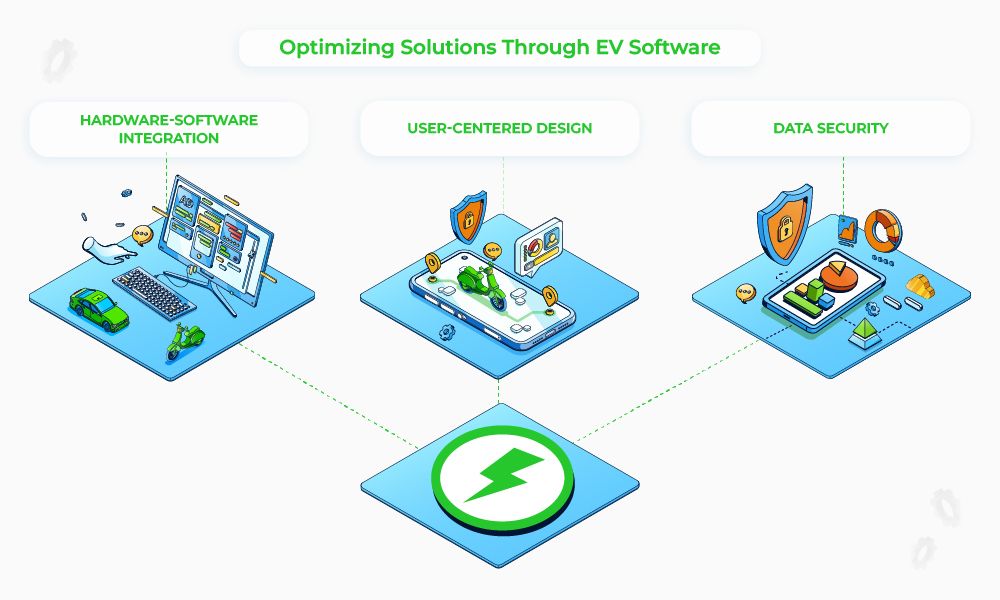
    Optimizing Solutions Through EV Software

    Optimizing EV software is essential to maximizing the benefits of electric mobility and overcoming the greatest challenges that the EV software industry is facing. Doing so can also help encourage greater adoption in the coming years.

    Below, we look at three ways EV software makers and OEMs can optimize EV software for the future.

    Infographic of 3 ways to optimize solutions through software: hardware-software integration, user-centered design, and data security.

    1. Hardware-Software Integration

    Trends like Vehicle-to-Anything (V2X) connectivity and energy-efficient powertrain solutions are fueling the demand for centralized control of vehicle functions. This, in turn, is driving up the need for highly efficient and heterogeneous multicore processors and a forward-looking OS that can handle this increasing load.

    To meet these changing needs, software experts are designing a flexible software architecture. Doing so will help meet the demand for seamless communication among different hardware components. As a result, the software will support faster processing, improved efficiency, and scalability to add new applications and mapping.

    2. User-Centered Design

    EVs present a unique opportunity for many innovative designs and interior spaces that can be customized to meet customers’ specific needs. As the EV market develops with new features and technologies, a user-centered design is emerging as a viable option.

    In this model, OEMs can take the different blocks of software, customize them to meet their vehicle model’s specific requirements, and build their own products on top of an OS that supports this modular approach. A user-centered design also brings together user experience and software development processes for quick scalability.

    3. Data Security

    Connected vehicles can currently transfer information from charging stations to a whole network of vehicles. But this creates a major data security threat. Even a small misstep along this communication pipeline can have a disastrous security impact.

    To address the growing cybersecurity challenges, many governments and industry bodies are developing standards and frameworks like UL 4600, SOTIF, and ISO 26262. These standards govern data handling, AI and ML use of data, operational feedback, and the data pipeline.

    As a result, EV software must be optimized to meet these emerging requirements. Software makers will also have to leverage the capability of a mature OS to integrate cybersecurity processes like penetration and fuzz testing at every stage of the development lifecycle. Doing so will reduce rework rates and make EVs more secure.
    Colossal Impact for The Future

    As the EV market continues to expand and evolve, industry stakeholders need to focus on adopting an advanced OS for building comprehensive and seamless software solutions to ensure a secure, efficient, and reliable transition to electric mobility.

    EV software has the potential to provide a wide range of benefits, including increased efficiency, sustainability, and cost savings for EV owners. Additionally, the optimization through EV software can lead to longer battery life, faster charging times, and better overall performance of EVs. EV software can also enhance operations and streamline maintenance, reducing costs for manufacturers and consumers alike.

    Overall, leveraging the power of an EV OS to build an EV software ecosystem is critical for unlocking the full potential of electric mobility. When done properly, EV software can also address many of the obstacles currently facing the industry. If companies focus on the three solutions above, they can improve the efficiency, safety, and user experience of their EV software solutions. This, in turn, can have a significant, positive impact on the future of EV adoption in India.

    To learn more about EV software, please see the FAQ and Resources sections below.

    FAQ

    How does EV software impact the ecosystem of India?

    The impact of EV software on the ecosystem of India is multi-faceted, ranging from environmental benefits to economic opportunities. India can use software to optimize electric mobility, which will help it build a sustainable, low-carbon future. Developing EV software will also help provide jobs to India’s young and tech-savvy workforce.

    How does EV software impact the Indian automotive industry?

    EV software has the potential to disrupt the Indian automotive industry and create new growth opportunities. The Indian government’s EV push has created a new market for EV software providers to develop and sell their solutions to automakers, charging infrastructure providers, and fleet operators. Additionally, EV software can make the Indian automotive industry more sustainable and environmentally friendly.

    How does EV software impact the Indian government’s EV initiatives?

    The adoption of EV software can help address critical EV adoption blockers like range anxiety, charging infrastructure, and battery performance. EV software solutions can also optimize charging patterns and grid integration. This makes EVs more cost-effective and reduces the burden on the power grid. With these varied impacts, EV software can help the Indian Government achieve its ambitious target of 30% electric vehicle penetration by 2030.

    How does EV software impact the Indian consumer market?

    EV software has the potential to enhance the performance and efficiency of EVs, making them more attractive to consumers. EV software has also led to the creation of new services that help address consumers’ key concerns. Moreover, the increased adoption of EVs is expected to lead to lower operating costs, which could incentivize consumers to switch to EVs.

    What challenges does the Indian EV software industry face?

    The Indian EV software industry faces challenges like limited standardization, low R&D investment, and cybersecurity risks. Addressing these challenges is vital for the long-term success of the industry. Though many initiatives are starting to develop seamless EV software, the results are not yet tangible enough to impact the EV industry.

  • The Future of Electric Vehicles in India: Opportunities and Challenges

    The Future of Electric Vehicles in India: Opportunities and Challenges

    As one of the world’s largest automobile markets, India’s country-wide electrification will be a turning point for the entire world and the country itself. Driven by the Indian government’s push towards sustainable mobility, growing consumer demand for new technologies, and the emergence of private players with an interest in EV technology, the future of electric vehicles in India looks promising.

    However, the country continues to grapple with several challenges in its pursuit of full EV adoption, namely with the low number of charging stations and high upfront costs of EVs.

    In this article, we focus on the following three questions:

    • What is the state of the Indian EV ecosystem?
    • What challenges and opportunities lie ahead?
    • What can India learn from other countries?

    India’s EV Market Is on a Rapid Growth Trajectory

    India is one of the world’s largest markets for two- and three-wheeled vehicles, ranking among the global top five for private cars and commercial vehicles.

    According to JMK Research, a staggering 455,733 EV units were sold in FY2022. India’s Ministry of Road Transport and Highways also claimed that 1,334,385 electric vehicles in India were on the road as of July 2022.

    These numbers are sure to increase, with central and state governments, as well as private sector players, actively pushing for greater electrification on Indian roads.

    India Sets Ambitious Targets

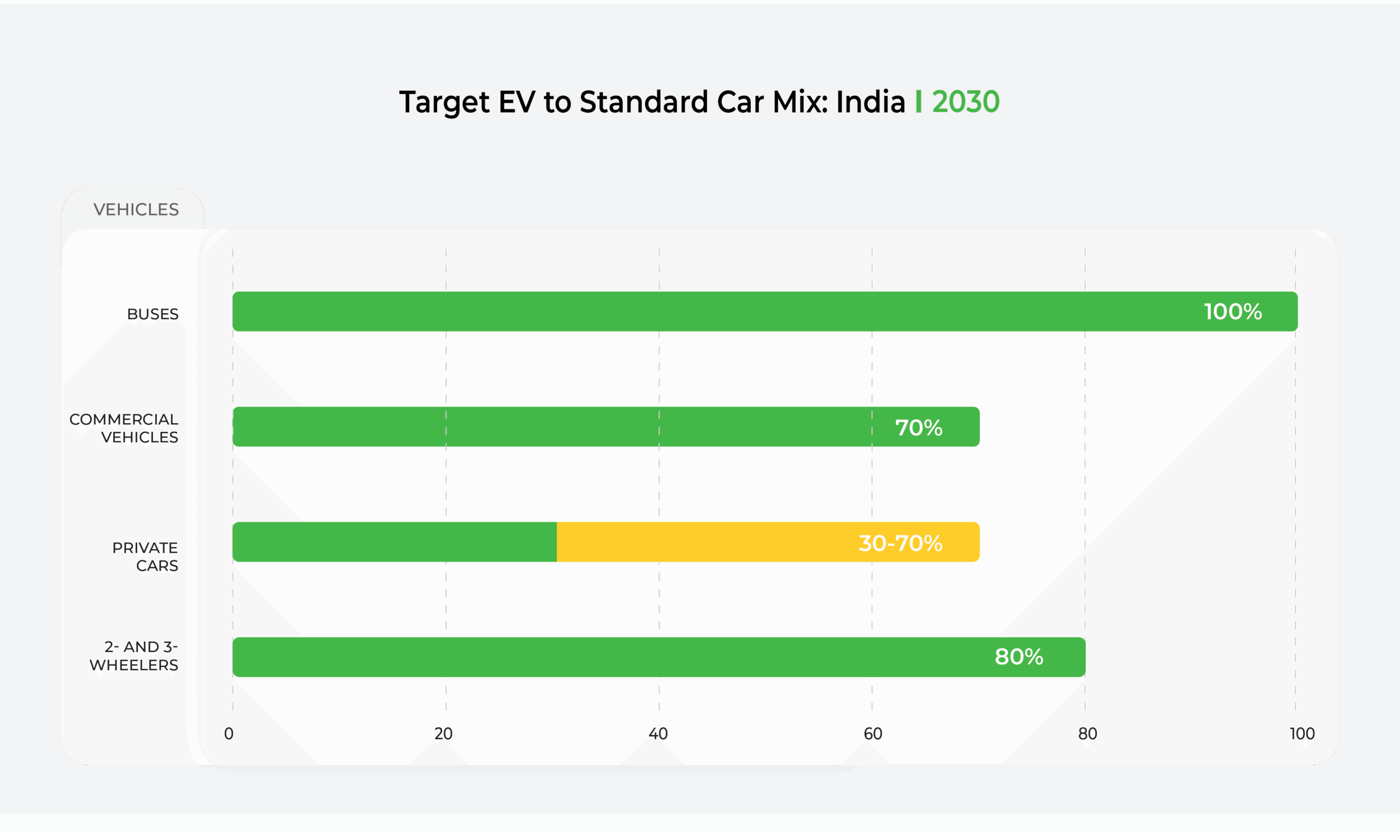
    According to Union Minister Nitin Gadkari, the Indian government intends to achieve the following EV mix in India by 2030:


    India sets ambitious targets for its EV ecosystem by 2030.

    To reach these ambitious targets, the Indian government has created policies and programs like the National Electric Mobility Mission Plan (NEMMP), a broad plan to encourage the adoption of electric vehicles in India. The aim is to reduce India’s dependence on crude oil.

    The Indian government has also formulated the Faster Adoption and Manufacturing of (Hybrid &) Electric Vehicles (FAME) scheme. This plan should facilitate greater adoption rates in the coming years. The Finance Minister of India has also announced a reduction in customs duty and taxes for the 2023 budget. This will help boost the domestic production of lithium-ion batteries that power electric vehicles.

    Many state governments like Assam, Telangana, Tamil Nadu, and Gujarat have also created attractive policies and programs to incentivize EV manufacturing in their respective territories.

    As a result of these strategies, private players have begun entering the EV market, setting the stage for the further adoption of electric vehicles in India. India’s success will also have a significant, positive impact on the rest of the world.

    India’s EV Adoption Will Be a Global Win

    According to the International Energy Agency (IEA), global EV sales in 2021 doubled from the previous year to 16.5 million EV units sold worldwide. India also announced that EVs will represent at least 30% of all road traffic by 2023. Though a modest target, a 30% adoption rate will have global ripple effects, both environmentally and economically.

    For starters, India is the world’s third-largest oil importer, but the transition to EVs will significantly reduce its oil dependency, disrupting global oil markets. If India can meet its ambitious adoption targets, the country will create a model that other emerging economies can replicate. This, in turn, will have further impacts on oil markets as the dependency on this fossil fuel decreases.

    Additionally, with India’s population of 1.4 billion and its rapidly growing economy, the country is certain to be an influential player in the global EV market today. The full adoption of electric vehicles in India will represent a major step in the right direction toward sustainable development in worldwide mobility.

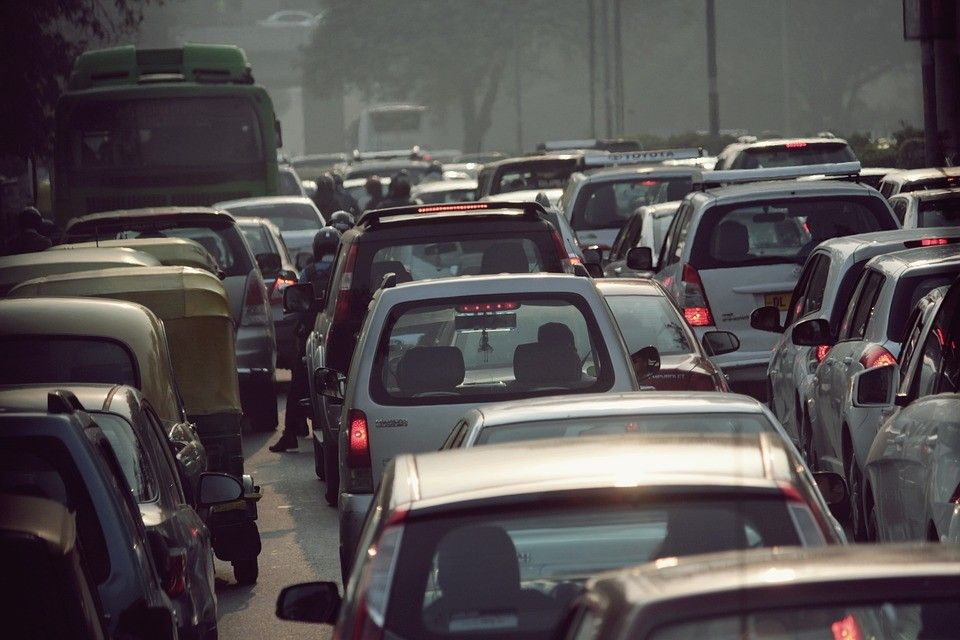
    The increasing adoption of EVs in India will have significant environmental impacts. Source: Pixabay, carlovenson

    Environmental Opportunities for India

    The shift towards electric vehicles in India will have a significant impact on the environment. Currently, the transportation sector in India is a major contributor to pollution. Take the capital, New Delhi, for example, where two- and three-wheelers contribute 50% to the surface PM 2.5 levels.

    India’s transportation sector also accounts for about one-fifth of the country’s total energy use. In light of these numbers, EVs can have a huge impact on India’s environment in the following areas.

    1. Reducing Air Pollution

    Within India alone, vehicular traffic contributes to 27% of total air pollution and claims 1.2 million deaths00090-0/fulltext) annually. EV adoption in India will therefore significantly reduce the negative global environmental impacts originating from Internal Combustion Engine (ICE) vehicles.

    2. Reducing Noise Pollution

    Noise pollution is also a major challenge in India due to the rapid urbanization increasing the need for vehicles. According to the 2022 UNEP report, five Indian cities feature in the world’s noisiest cities. Though vehicles are not the only source mentioned in the report, EVs are likely to bring down the noise levels because they don’t have the mechanical valves, gears, or fans common to ICE vehicles.

    3. Improving Operational Efficiency

    From a fuel efficiency standpoint, petrol or diesel cars convert only 17 to 21% of stored energy while EVs can convert 60% of electrical energy from the grid. Clearly, this shift to electric vehicles in India can improve the efficiency of fuel production and optimization. It will bring down the operational costs for end-users, thereby increasing demand for EVs.

    Besides the above environmental impacts, the adoption of EVs in India will also present many economic opportunities for the country.

    Economic Opportunities for India

    In addition to representing significant progress towards a cleaner and greener future, locally, the full electrification of India will benefit businesses, investors, and consumers alike. Below, we highlight several of the most compelling opportunities.

    1. Fleet Operators

    Fleet operators like Amazon, DoorDash, and BigBasket can reduce their operating costs by switching to EVs. According to Weforum.org, the Total Cost of Ownership (TCO) for a two-wheeler in New Delhi is Rs 2/km when it’s run on petrol. This cost comes down to Rs 0.52/km when switched to EVs. Undoubtedly, the operating costs go down by more than half for fleet operators. Maintenance costs will go down as well.

    However, shifting to EVs is happening at a much slower pace when compared to Brazil or the US. Electric vehicles in India are still unfavored because of the high upfront costs, unestablished reseller value, and lack of trust in the new technology.

    To address these concerns, the government is providing tax incentives to reduce upfront costs. Meanwhile, first mover companies are providing robust and reliable charging solutions that will boost confidence in this new technology.

    2. OEMs

    The EV industry provides enormous opportunities for OEMs to build cost-competitive auto products for India and the rest of the world. Research shows that OEMs can produce a 5.7% higher value addition to every EV by 2030. As a result, the Indian government is pushing for indigenization of the supply chain under the Atma Nirbhar plan to support OEMs to develop the EV ecosystem.

    Furthermore, efforts from companies in India are underway to help OEMs build a charging app using SDK development tools, and provide access to features like navigation, vehicle diagnostics, and keyless control. All these measures help OEMs offer on-the-go charging for their drivers and accelerate the shift to EVs.

    3. The Real Estate Sector

    EVs create multiple opportunities for real estate investors, realtors, and property developers, as this industry requires the construction of EV manufacturing units, industrial areas, and charging stations. Another key aspect is the development of retail infrastructure around EV charging stations, as it takes an average of 15 to 20 minutes to charge an EV.

    report by Colliers shows that the EV industry will require 1,300 acres to set up 110 GWh battery manufacturing capacity by 2030. The country will also need 13.5 million square feet for charging stations by 2025. These numbers reflect the ample opportunities available for every player in the real estate space.

    4. Consumers

    India’s young and dynamic population is looking forward to embracing new technologies as the country is experiencing a growing trend in upward mobility. As individuals become more affluent, their socioeconomic status continues to improve, and they are better positioned to purchase EVs.

    To meet the growing demand, the government and other innovative players in India’s EV space are spearheading efforts to add more charging points to EV charging networks. This includes offering software solutions that make daily charging accessible.

    Multiple players are also partnering with businesses and government agencies to build innovative solutions that positively impact the EV industry, leveraging India’s qualified talent pool. According to Nitin Gadkari, the Union Minister of Road Transport and Highways, the EV industry is likely to create five crore new jobs, and India’s young talent pool is well-poised to ride this job growth.

    Despite these many opportunities, the country still has to address significant challenges before reaching full adoption of electric vehicles.


    India’s electrification will be beneficial for many different sectors, but the country’s path won’t be very smooth. Source: Weforum.org

    The Challenges for India

    Realizing India’s EV potential is not without its challenges. The journey towards widespread EV adoption in India is slow and plagued with hurdles to overcome. In the following sections, we examine the key challenges hindering EV adoption in India. We also explore possible solutions that can help the country overcome these obstacles to enable a faster, more efficient country-wide adoption of EVs.

    1. Lack of Clean Energy

    Much of India’s electricity is generated from burning coal. That said, relying on coal to generate power for all the EVs would defeat the purpose of reducing carbon emissions through EV adoption. That’s why India is exploring other energy generation sources, like solar, wind, and nuclear energy, as mentioned in Nitin Gadkari’s speech in the 7th edition of the ETAuto EV Conclave. The government is also actively pursuing research and development in the areas of biofuel to power EV manufacturing units.

    These measures from the Indian government provide trust and opportunities for private players to leverage innovation and technology to build EVs faster and at a lower cost. In turn, this will bring down upfront costs for end-users, thereby leading to greater adoption of electric vehicles in India.

    2. Underdeveloped Charging Infrastructure

    Infrastructural issues stand against India’s quest for full EV adoption. EVs require different charging and maintenance infrastructure than traditional ICE vehicles because of the differences in engine and other working parts. But India’s current charging infrastructure may not be enough to handle the increased demand for EVs.

    At the time of writing this piece, India has 934 charging stations, most of which are located in urban areas. In comparison, China had 1.8 million electric charging stations as of 2022. Building bigger batteries and fast-charging stations will mean investing in high-speed, commercial-grade chargers. This, however, requires significant capital investment.

    The government is working with private players to boost the presence of charging stations. The Ministry of Power is providing a slew of financial and non-financial incentives to build EV charging stations. For example, the ministry is adopting a revenue-sharing model for land use and setting affordable charging rates for both operators and users.

    In addition, private entities in the sector are working with municipal, state, and central entities to help install EV stations and charging points. They are also collaborating with operators to create a Charger Management System (CMS) to monitor the operations of these stations and streamlining the entire charging process.

    3. Suboptimal Battery Technology

    An EV’s driving range is limited, making it difficult for drivers to travel long distances without recharging. Besides limited charging stations, battery capacity, aerodynamic drag, and vehicle weight also compound the problem. This is because current batteries are small, and have low voltage capacities, so they aren’t enough to increase EV propulsion and travel longer distances.

    To address this problem, private players must innovate to create batteries made of lightweight materials, with higher energy density, and that use renewable sources for charging. The government is providing the necessary impetus in the form of tax credits.

    The national government is also promoting the manufacturing of batteries in India with the National Mission for Transformative Mobility and Battery Storage, 2019. It is also providing companies with the technical know-how and business environment to improve the battery technology for EVs.

    4. Persistent Resistance to Change

    Indian consumers are still resisting the adoption of EVs, despite their long-term economical and environmental benefits. This stems from a lack of awareness of EVs and a general reluctance to embrace new technologies, especially in rural areas.

    But players in the Indian market must come together to address consumers’ concerns. They should also build a supportive ecosystem to promote the widespread adoption of EVs in India. This can be done through the development of more affordable EVs, the expansion of charging infrastructure, and the creation of awareness and education programs to educate consumers about the benefits of switching to EVs.

    What Can India Learn from Other Countries’ Success?

    Power, infrastructure, and financing all are primary antagonists in India’s EV adoption story. But the country can take cues from others already making inroads towards full EV adoption. The countries leading global EV adoption paint an interesting picture.

    India can learn from other countries’ successes and mistakes. Source: acea.auto

    The top countries in the graph above are all wealthy countries in northern Europe. Combined, they don’t even represent 3% of India’s population. This may lead us to believe that their success will be impossible to replicate in a much more diverse and densely-populated country, like India.

    However, China comes in second and turns that argument on its head. Let’s delve into what different regions have done for EV adoption and what India can learn from these efforts.

    The EU, EFTA, & UK

    In 2021, electric car registrations in the EU-27 region was 1,729,000, up from 1,061,000 in 2020, representing a 17.8% increase. All EU countries, including Norway, which has the highest number of registrations in a year, offered financial incentives like tax reductions and exemptions.

    India is also offering tax incentives along the same lines. And with favorable government policies and the presence of first-mover companies, the country will be able to improve the adoption of EVs in the next three to five years.

    China

    According to the China Association of Automobile Manufacturers (CAAM), China sold 6.89 million EVs in 2022 alone. It also boasts the largest electric car fleet in the world: 4.6 million + electric cars on roads in China. This success story is attributed to generous government support as well as intense domestic competition, both of which fueled innovation and reduced car prices.

    In comparison, India is also offering support, but the domestic market is not robust and competitive yet. But that is expected to change in the coming years as the impact of the current policies becomes more widespread. In the meantime, the government must continue to encourage innovation and investments.

    The USA

    EV car sales in the US represent 5.8% of all vehicles sold, up from 3.2% a year ago. However, the overall sales fell by 8% in 2022 when compared to 2021. Experts believe that stricter requirements for claiming federal incentives, high car prices, and concerns about raw materials for batteries were the cause of the decline. That said, the EV car industry is still huge in the US, and it grew due to government investments and policies. Innovation by leading players like GM and Tesla also added to the appeal.

    In comparison, the Indian government is significantly pushing towards greater adoption of EVs, with incentives and investments. However, it must enhance the pace of innovation and technical expertise. To do that, the government should create more educational centers of excellence. It must also stop federal funding in a phased manner after considering the macroeconomic factors.

    With the right mix of policies, awareness, investments, infrastructure, and technology, India will certainly take key lessons from these countries to drive full EV adoption.

    Smart Digital Solutions Will Be A Key Driver for India’s EV Ecosystem

    The future of electric vehicles in India holds great promise and is poised for significant growth in the coming years. With supportive government policies, increasing consumer awareness, and advancements in EV technology, the country is well-positioned to embrace this shift toward sustainable transportation.

    The increasing demand for EVs is also leading to an expansion of charging infrastructure and the development of locally produced battery technologies. The automotive industry in India is also poised to play a major role in the global shift towards EVs, with the country having the potential to become a leader in this space.

    Private companies play a critical role in offering smart digital solutions that will contribute to infrastructure development while acting as a bridge between government agencies and end-users. Initiatives from these companies will help fleet operators make the shift to EVs and OEMs to provide seamless driving experiences to their customers.

    Collaboration with local governments will also help expedite the construction of charging stations, along with creating greater awareness among Indian customers. This will contribute to the rapid growth of the EV industry.

    It is therefore up to both the public and private sectors to continue working together to make India’s ambitious goals a reality. The right combination of innovation and investment has the potential to accelerate the adoption of electric vehicles in India, transforming the country’s transportation landscape and contributing to a cleaner, greener future.

    For more information about the future of electric vehicles in India, please see the FAQ and Resources sections below.

    FAQ


    What challenges is India facing on the road to electric mobility?

    India’s concerns along the road to electric mobility relate to a lack of infrastructure, energy, and domestic innovation and production. But innovative players are offering solutions and helping pave the way to mass adoption.


    What will contribute to India’s EV goals?

    The Indian government has set ambitious targets for EV adoption in India by 2030. The important contributing factor in meeting these targets is the infrastructure needed to charge EVs in India. EV drivers, however, could install simple and cost-effective solutions. This will help them build on this adoption and accelerate the adoption of electric vehicles in India.


    Is the future of electric vehicles in India cost-effective?

    Many people only see an EV’s higher upfront cost, so they assume an electric future is expensive. That said, EVs offer significant savings in maintenance and power over their lifetime. Some companies even enable EV drivers to charge at home while generating passive income from letting others use their device.


    What are the benefits of electric vehicles?

    EVs help reduce carbon emissions. They’re also significantly cheaper to run and maintain than traditional petrol-engine vehicles. EVs are even quicker to accelerate and smoother to drive because they don’t have changing gears. Finally, EVs can be conveniently charged without expensive petrol stations.


    What is the economic potential of the Electric Vehicle market in India?

    India sells many vehicles every year combined, and the government has ambitious targets for 2030. As a result, the total addressable market for new vehicles in 2030 encompasses almost 15 million vehicles. This bright future of electric vehicles in India offers a huge chance for vehicle manufacturers. It’s also an opportunity for anyone looking to participate in this booming market.

    Resources

    Bureau of Energy Efficiency: E-Mobility

    Learn more about the general E-Mobility space from the Ministry of Power.

    E-Amrit: Accelerated E-Mobility Revolution for India’s Transportation

    See what the government is doing to support the transition to electric vehicles in India.

    SECTION 80EEB: Tax Deductions

    Find out which tax deductions are available for electric cars in India.

    Bolt.Earth: Official Website

    Get to know Bolt.Earth’s products and services on our official website.

  • Part 3: EV Charging Infrastructure in India – Strategic Recommendations

    Part 3: EV Charging Infrastructure in India – Strategic Recommendations

    Read BOLT’s recommendations to Indian officials to support India’s EV charging growth.

    *This is the third part of BOLT’s three-part analysis of India’s EV charging infrastructure.*

    At BOLT, we conducted a three-part market analysis on the electric vehicle (EV) charging infrastructure in India. The first article established the current state of EV and EV charging in India. In the second, we discussed the opportunities and risks of increased EV adoption in India. From these two articles, it’s clear that EV charging infrastructure is set to grow in India.

    Now, we’ll highlight some key strategic recommendations. We also hope this helps officials to make better decisions around the EV charging infrastructure.

    Maximizing the Economic Impact of the EV Transition in India: Possible Scenarios

    India is a key market to represent the transition to electric mobility in the coming decade. More specifically, it can lead the way on how emerging economies should reach this goal.

    We can somewhat compare the EV and EV charging infrastructure worldwide to the smartphone market. Developed and emerging economies have starkly different mobility and charging needs. For instance, the share of 2-wheelers is much larger in emerging economies. This mirrors the dominance of the two largest smartphone operating systems–iOS and Android.

    In the long run, we believe the same will happen to the operating systems that power EVs and EV charging infrastructure. Clear leaders will likely emerge for the two distinct markets. Although market shares among different geographies may overlap, the difference will be clear. While some EV and Charger Operating Systems will offer an open-source, peer-to-peer charging experience, others may create a closed ecosystem of charging services,  depending on the local EV user base.

    Given the advent of EVs, we can also project a few main transitions that could happen to the mobility sector in India. Namely, we’ll list these 3 scenarios and what they could mean to the EV charging infrastructure in India:

    1. EVs on the Road Outstrip the Needed EV Charging Infrastructure

    While this scenario is unlikely, this would be the worst possible outcome. India will have to deploy an efficient EV charging infrastructure on time. Otherwise, EV charging will snowball into a costly endeavor. A big chunk of public charging infrastructure investment could also become a sunk cost. This will all slow down EV adoption even further. Ultimately, the country could miss the EV30@30 pledge it has made in this scenario.

    2. Unplanned Deployment of EV Charging Infrastructure Creates Inefficient Public Charging Networks 

    Deploying an efficient nationwide charging network needs several considerations. Additionally, infrastructure deployment requires a massive collaboration. Specifically, the government, utilities, private/ public companies, startups, and the media should all work together.

    End-users use public EV charging infrastructure far less than gas/petrol stations. The country needs a highly optimized strategy for deployments. Otherwise, some chargers on the network could get isolated. This will certainly lead to a sunk cost. Additionally, for EV charging infrastructure to be efficient, the positioning of fast and slow chargers needs to be optimal. An inefficient approach would limit EV adoption rates around hyper-localized regions.

    3. India Leads the Way for Emerging Economies

    Deploying a nationwide charging network is challenging. However, India should look at this as a necessary task. This is also an opportunity to market a successful EV business model. Other emerging economies can then use this model.

    Consumers’ EV charging needs vary vastly across different countries. This means India can’t deploy an inexpensive version of a Western business model. Rather, the country should encourage a “leading” kind of EV ecosystem. The rest of the world should want to reference India’s business model.

    Before planning a nationwide EV charging network, decision-makers have a few things to consider. Let’s take a deeper look at some of the key considerations.

    3 Factors to Consider When Planning India’s EV Charging Infrastructure

    1. Business Model: Creating an EV Charging Marketplace 

    Current Scenario

    The Centre for Climate and Energy Solutions states that charging stations can’t possibly rely on direct revenue from EV charging services. Most EV charging happens privately at home, so it isn’t financially feasible.

    To ensure mass rollouts globally, governments have favored EV charging businesses. In some cases, these businesses are exempt from regulations on utilities. In others, they operate as pure commercial service businesses.

    What does this mean? EV charging infrastructure providers give electricity to consumers. However, they aren’t tied to the regulations that utilities need to follow. As a result, this creates a lower entry barrier in the charging infrastructure market

    Many new business models around charging have also started to emerge across the globe. Below, we take a look at some of the most common of these business models. We’ll also see how applicable they are to India.

    6 Business Model Examples

    Below are the 6 most common EV charging business models found across the globe.

    Graph-Option-2-1024x736.jpg

    6 different models for EV charging infrastructure.

    Slow chargers aren’t highly cost-intensive per unit. However, the volumes of slow chargers needed in India are extremely high since India has a large share of 2- and 3-wheeled EVs. Additionally, fast chargers can require a much higher initial capital cost to deploy, almost 10 to 100 times that of slow chargers. This means that making charging stations profitable would require a strategic approach. That’s especially true in emerging economies where consumers are also highly cost-conscious.

    The involved cost structures are also high. Distribution companies (DISCOMs) in India aren’t currently ready for the EV transition yet. That means the ideal solution for India is to adopt Germany and Finland’s business models. India should promote a marketplace model where CPOs and EV users make direct transactions.

    2. Quantifying Charging Needs for a City 

    Next, India will have to consider the actual execution of charger deployment. Historically speaking, EV charging infrastructure around the world is expanding outward from Tier 1 cities. Thus, to plan EV charging infrastructure deployment, a necessary step is to define and quantify the following key criteria:

    Charging Loads to the Existing Electricity Infrastructure

    As the number of EVs on the road grows, the load on the electrical grid will also increase. Planning authorities need to understand this data, then execute grid balancing operations accordingly.

    EV End-User Battery Charging Patterns and Behaviors 

    EV charging patterns will vary drastically from petrol/gas stations. Most EV users will charge their vehicles at home or at work. This means the charging behavior of users is also critical to understand. Utilities should know when they’ll face higher loads from EV charging depending on the time of day, geographical location, and so on. India needs to identify the peak EV load demands at each time of the day. Then, this will help offset any grid failures.

    Slow and Fast Chargers in Different Locations

    India specifically requires fast charging along highway routes. The country also needs a dense network of slow chargers in more populated areas. Fast chargers placed strategically within city limits will be a valuable add-on. However, this wouldn’t restrict EV adoption largely if unavailable immediately. India needs to identify the most optimized charger placement. To do this, the country should consider charger types, numbers needed, and user behavior. This will also be critical to meeting charging demand.

    The Need for EV Chargers Will Increase Soon

    City-level planning authorities need to consider the fact that the ‘ubiquity of chargers’ can solve many issues. That includes charger availability, charger malfunctions, and so on. One good metric to understand these needs is the predicted total number of chargers needed in a year. Similarly, the country will need to consider the year-on-year increase in peak EV loads. This will help predict the number of chargers needed as the EV market in India grows.

    Updates to the Electricity Grid To Handle Future Loads

    The EV market is fairly new to India. Yet, by 2030, the peak loads could be far larger than what the current electricity grid infrastructure can support. Additionally, any investment into renewable energy-based charging solutions might also warrant a similar infrastructure upgrade. Thus, the country needs city-level grid planning. Investments should also be based on EV adoption throughout the year. This will all be critical to understanding the costs involved now and in the future.

    City-level planning will aid in the efficient execution of charging infrastructure deployment. However, decision-makers need to look into some additional considerations, specifically around Indian consumer behaviors. Many aspects of the Indian EV ecosystem need to be carefully crafted around these consumer patterns. In the next section, we take a more detailed look at these behaviors. We’ll also see how they impact charging infrastructure deployment.

    3. The Indian EV Consumer

    Many Indian consumers are interested in and willing to buy EVs. Namely, their motivation is to battle climate change. Likewise, the same consumers have technological adoption concerns. As a result, they’re reluctant to transition to EVs. Below are some key considerations that help potential EV customers in India adopt this technology:

    Indian Automobile Consumers Care About Initial/Running Costs

    Indian automobile consumers are extremely conscious of the initial cost of entry. They also care about running costs. OEMs manufacturing EVs locally can gain subsidies, which can help lower the customer’s total ownership costs. On the charging side, consumers are likely to prefer slow chargers. They’re also incentivized to opt-in for any subsidies available on electricity tariffs.

    2- And 3-Wheeled EVs Are Well-suited for Indian Roads

    EVs are generally well-suited to Indian driving conditions. Within the 2- and 3-wheeled EV segments, the switch to EVs is growing. These vehicle types have smaller battery capacities and they’re suited for slow charging standards. As a result, 2- and 3-wheelers are likely to demand charging infrastructure first.

    Lacking Awareness of Consumers

    Potential EV customers in India still lack a certain level of awareness. They don’t know about range anxiety, battery life, and charging availability. Customers won’t face these issues with value-added services. They could get route planning options and real-time information on charge point locations and charging costs. However, this will require a comprehensive educational initiative across government and media to help ease the transition to new technology.

    Simple Payment Management Systems

    EV Charging also needs a simple and easy-to-use payment system integrated with a charger management system. These should also track and document all direct transactions between charging point owners and EV users. Additionally, with several EV charger plug types currently in use), charging point operators should also focus on compatibility. This will help cater to a wider variety of vehicle types.

    Now that we’ve seen the 3 factors to consider before rolling out an EV charging infrastructure in India, let’s dive into our recommendations.

    Recommendations

    After discussing these strategic considerations, we at BOLT also have some further recommendations for EV charging infrastructure. We’ve separated them into 4 categories:

    1. The Government Needs To:

    • Develop a comprehensive strategy for nationwide public EV Charging infrastructure deployment
    • Refine regulations around electricity distribution for EV charging 
    • Align private and public EV ecosystem players towards India’s unique needs arising from the higher population density and relatively smaller average distances traveled by commuters daily
    • Clarify the long-term role of state-owned utilities and DISCOMs in setting up EV charging infrastructure
    • Specify regulations around grid services and vehicle-grid integration
    • Address citizens’ concerns about range anxiety and EV charging infrastructure issues
    • Inform citizens about the environmental and cost benefits of transitioning to EVs

    2. The EV Industry and Ecosystem Needs To:

    • Address the immediate need for 2- and 3-Wheeler EVs and the consequently required charging infrastructure, with a safe and connected experience 
    • Deploy and maintain large charging point networks and cater to the demand for chargers up to 2030 and beyond (for CPOs)
    • Educate citizens about range anxiety and EV charging infrastructure issues and about the benefits of transitioning to EVs

    3. The DISCOMs Need To:

    • Develop programs with CPOs/MSPs that encourage customers to notify DISCOMs when they register a new EV or buy an automated charging point for public use
    • Offer incentives for charging systems with some automated control capabilities to gain network visibility into EV charging demands
    • Offer the right signals to the user, enabling them to choose the best charging option that includes time-of-use or location-based price signals to manage grid loads effectively
    • Educate citizens on incentives and subsidies for EVs and EV charging 

    4. The Media Needs To:

    • Highlight the right educational stories around alleviating concerns among EV users about range anxiety, charger availability, cost of ownership, and so on
    • Assist in democratizing information about the technology transition to EVs, the new charging paradigm, and the benefits of making this switch

    When the citizens are well-informed, it’ll be easy to convince them to transition to EVs. In turn, the market will also benefit from the booming EV charging infrastructure. Then, India will be at the forefront of the ongoing global transition to clean transport.

    To Summarize

    In this final part of our 3-part EV charging infrastructure series, we’ve discussed our recommendations for EV charging infrastructure deployment. We’ve also showcased the necessary factors the city supervisory body should consider in implementing the EV charging infrastructure. This third installation has also outlined BOLT’s recommendations to bolster EV charging infrastructure growth. We hope the government, industry, DISCOMs, and other related parties consider our findings. Adhering to an optimized plan will surely help India reach its EV30@30 pledge.

    In all, we’ve been able to address all the risks and summarize all the opportunities that will come from the EV transition. Our mission at BOLT is to ensure the proper growth of India’s EV charging infrastructure. To that end, we hope our market analysis has brought enough awareness to India’s EV users and governmental officials.

    FAQ

    What should the Indian government do to support the EV charging infrastructure?

    The government should inform citizens about the potential issues in the country’s EV infrastructure. It should also showcase the health and cost benefits of adopting EVs. That’ll enable citizens to head towards EVs, which also creates EV charging infrastructure opportunities.

    What are some business models in the EV charging marketplace?

    Some stores may offer free charging, and it increases attraction to their business. Other companies may also adopt a subscription fee model where the owners and end-users pay the provider a fee. In all, these business models can support a country’s EV charging infrastructure growth.

    What are some opportunities for the EV charging infrastructure?

    As India’s EV charging infrastructure grows, it’ll create many opportunities in the market. For example, data analytic businesses can emerge to assist CPOs and DISCOMs. Solar energy-powered stations can also pop up to support the EV charging infrastructure. Contact BOLT to learn more about the best EV charging infrastructure solutions.

    What are some risks in the EV sector?

    The EV charging infrastructure in India may face many risks. For example, there may be reduced revenue from the fossil fuel tax. 25% of the central government’s revenue comes from this tax. The EV charging infrastructure also lacks regulations and clarity. This makes cross-platform usage hard to achieve.

    What EV type is prominent in the Indian market as of 2022?

    2- and 3-wheeler EVs lead the Indian market in sales volumes (34% for 2-wheelers and 33% for 3-wheelers). These EVs need smaller battery capacity and can use standard AC outlets to charge. These EVs also help lower carbon emissions, so they’re better for the environment. Finally, 2 and 3-wheeler EVs have lower running costs.

    Resources

    BOLT: Part 1: EV Charging Infrastructure 

    Discover our assessment of India’s EV charging infrastructure.

    BOLT: Part 2: EV Charging Infrastructure

    Learn about the business opportunities and risks for India’s EV charging infrastructure.

    BOLT: Our Partners

    Find out who’s supporting BOLT in developing India’s EV charging infrastructure.

    BOLT: BOLT OS

    Get the best EV charging network app.

    BOLT: Guide to Install a Home EV Charger

    Learn how you can install a home EV charger from BOLT.

  • Part 2: Developing Electric Vehicle Charging Infrastructure in India–Business Opportunities and Risks

    Part 2: Developing Electric Vehicle Charging Infrastructure in India–Business Opportunities and Risks

    Recently, the Indian government has focused on following a uniform strategy for its EV charging infrastructure. They also aim to bolster EV adoption in the country. Bolt.Earth operates the world’s largest EV charging network and marketplace. We also currently occupy a 50% market share of India’s EV charging network with the chargers we deployed. As such, we want to become the default EV charging solution for EV users across India.

    The first part of this series was a market analysis of the current Indian EV charging infrastructure. This part will focus on the EV transition in India. First, we’ll show the opportunities it creates for the country’s industry and society. Then, we’ll also discuss some risks associated with this surge.

    Let’s delve into India’s 3 prime opportunities with its growing EV charging infrastructure.

    3 Opportunities for India in Deploying EV Charging Infrastructure

    1. Tier 1 and Tier 2 Indian Cities May Not Need Large Scale Public Charging Infrastructure

    According to the International Energy Agency (IEA), almost 90% of the existing EV charging points are private slow chargers. This isn’t surprising, considering EV user charging patterns. In fact, 80% of all EV charging is done at homes and workplaces. There, vehicles spend most of their time parked.

    The NITI Aayog vice-chairman also states that the current EV battery capacity is much higher than the average distance traveled in a day within the city.

    Graph-11-1024x736.jpg

    Current EV Vehicle ranges in India are comfortably larger than the average distances traveled by commuters across the board.

    This all means most EV owners won’t use public EV charging points much. That said, private and commercial EVs may need them periodically. That’s especially if they travel longer ranges. India also won’t need large government investment in EV charging infrastructure. Most EV charging stations would be privately owned. That means India only needs enough public charging sites to manage the demand for long-range EV transportation.

    unified approach to charging infrastructure needs to occur. Otherwise, the infrastructure won’t be adopted and utilized by commercial enterprises. It wouldn’t make sense to roll out EV charging for commercial vehicles by district. That’s because long-range vehicles would need nationwide coverage. Instead, a nationwide approach should expand infrastructure with a focus on motorways. Then, the infrastructure should propagate to lesser-used commercial routes.

    Key Take-Aways

    • Indian cities can become EV-ready. They simply need a few thousand strategically-placed universal EV charging stations.
    • Public EV charging infrastructure will still have low usage until EVs reach a tipping point because most EV charging happens at home.

    2. India is a 2- and 3-wheeler-led market by volume, possibly catered by slow charging standards

    Graph-22-1024x626.jpg
    Two and Three-Wheelers are taking over the Indian EV market.

    >Today, the upfront initial capital costs for EVs are generally larger than Internal combustion engine-based vehicles. However, 2- and 3-wheeler EVs have already reached price parity in India.

    As of July 2021, 2-wheel (2W) and 3-wheel (3W) EVs accounted for 98% of the current Indian EV sales. These segments require only smaller battery capacities. That means most EVs in this sector can use a standard AC outlet to charge.

    CPOs especially have a significant opportunity here. They could develop a holistic network of smart and connected slow charging points. This segment can also use IoT-enabled EV charging! This advancement won’t need expensive EV charging infrastructure upgrades. It also doesn’t require significant regulatory or market reforms.

    Electricity distribution companies (DISCOMs) need help with demand planning. To achieve that, we need a foundational smart charging point-based layer. It’ll then grant extreme network visibility into EV charging trends.

    Key Take-Aways

    • In India, the electrification case particularly suits the 2- and 3-wheeler segments, and it’s very robust. That means it’ll see rapid growth.
    • The first EV charging network generation can happen in India without new charging technology. It’s possible through a peer-to-peer free-market and a consumer-driven charging marketplace setup.

    3. Improved Grid Management Requires New Data and Analytics Businesses

    Graph-33-1024x728.jpg

    Grid-powered stations, Solar charging stations, and energy management systems are all emerging businesses.

    Today, most EV charging infrastructure players focus on powering EV charging stations with the existing electricity infrastructure. However, we might see a shift towards renewable energy-powered charging stations soon. Eventually, the EV charging infrastructure will also move towards end-to-end energy distribution and management solutions for EV charging.

    In this eventuality, CPOs that operate large public EV charging infrastructures will want to make charging patterns more visible. They’ll also need to visualize the long-term peak demand trends.

    DISCOMs will also need to suggest the right pricing signals to EV customers. That way, they can optimize grid balancing efforts. EV charging, as a commodity, should operate on a decentralized free-market model. In turn, it’ll facilitate load management and grid balancing through pricing economics. DISCOMs will also gain visibility from CPOs. This means DISCOMs can ensure that supply-demand economics will act as checks and balances for peak load challenges in the long run.

    Key Take-Aways

    • EV charging points will evolve, moving away from simple grid-connected charging points. Instead, they’ll become smart, connected charging networks optimized for energy management.
    • A robust EV charging infrastructure market in India will provide many opportunities. For example, it’ll enable revenue augmentation for DISCOMS and distribution network upgrades. It’ll also encourage private companies and start-ups to set up a reliable charging point network.

    Since we’ve discussed the opportunities, we can now move on to see the risks. Most notably, we can count 3 risks in the EV charging infrastructure in India.

    3 Risks for India in Deploying EV Charging Infrastructure

    1. 2 and 3-Wheeler Segments Are Growing, Charge Management Lacks Network Visibility

    In this section, we’ll take a look at 3 risks that may impact the nationwide growth of EV charging infrastructure in India. As we’ve discussed above, most risks will not fall on the majority of EV users. Rather, they will impact commercial usage. For many companies, their success depends on range, reach, and fast charging. To assess the risks involved, we’ve split up EVs by vehicle type. In turn, this will reflect their use case.

    Graph-44-1024x626.jpg

    Learn the consumer trends, dominate the market.

    By 2030, India’s 2-wheeler segment electrification is expected to grow rapidly. It’ll also be a leading market segment.

    EV drivers can charge their new EVs using a standard Indian AC outlet. That means DISCOMs may not know where EV demand rises from. The lack of smart and connected IoT-based charging points will also pose a risk for DISCOMs. They’ll operate without consumer trend visibility.

    The additional electric load on the nation’s grid won’t cause any challenges. In fact, electricity shortage isn’t an issue for mass EV adoption. This is only a myth. According to BloombergNEF, electrifying all road transport will only add 25% to global electricity demand by 2050. Electricity generation in India as of March 2022 is 448.11 GW. Yet, the country uses only 180 GW at present. Assuming constant population growth and demand, India can already support a nationwide EV charging network.

    Key Take-Aways

    • Standard outlets are found anywhere in India, which can facilitate charging. Yet, a huge segment of the EV population could be adding battery charging loads. DISCOMs won’t be aware of these patterns. As a result, they may fail to implement proper demand planning.
    • The lack of a connected charging network could lead to serious grid stability issues as EV usage grows. Vehicle-Grid Integration solutions will also be a critical risk if left unresolved. For example, we can mention the EV charging management solutions that mitigate the negative impacts of uncontrolled EV charging on the power system.
    • India already generates enough electrical energy to support a nationwide EV charging network and cater for future population requirements.
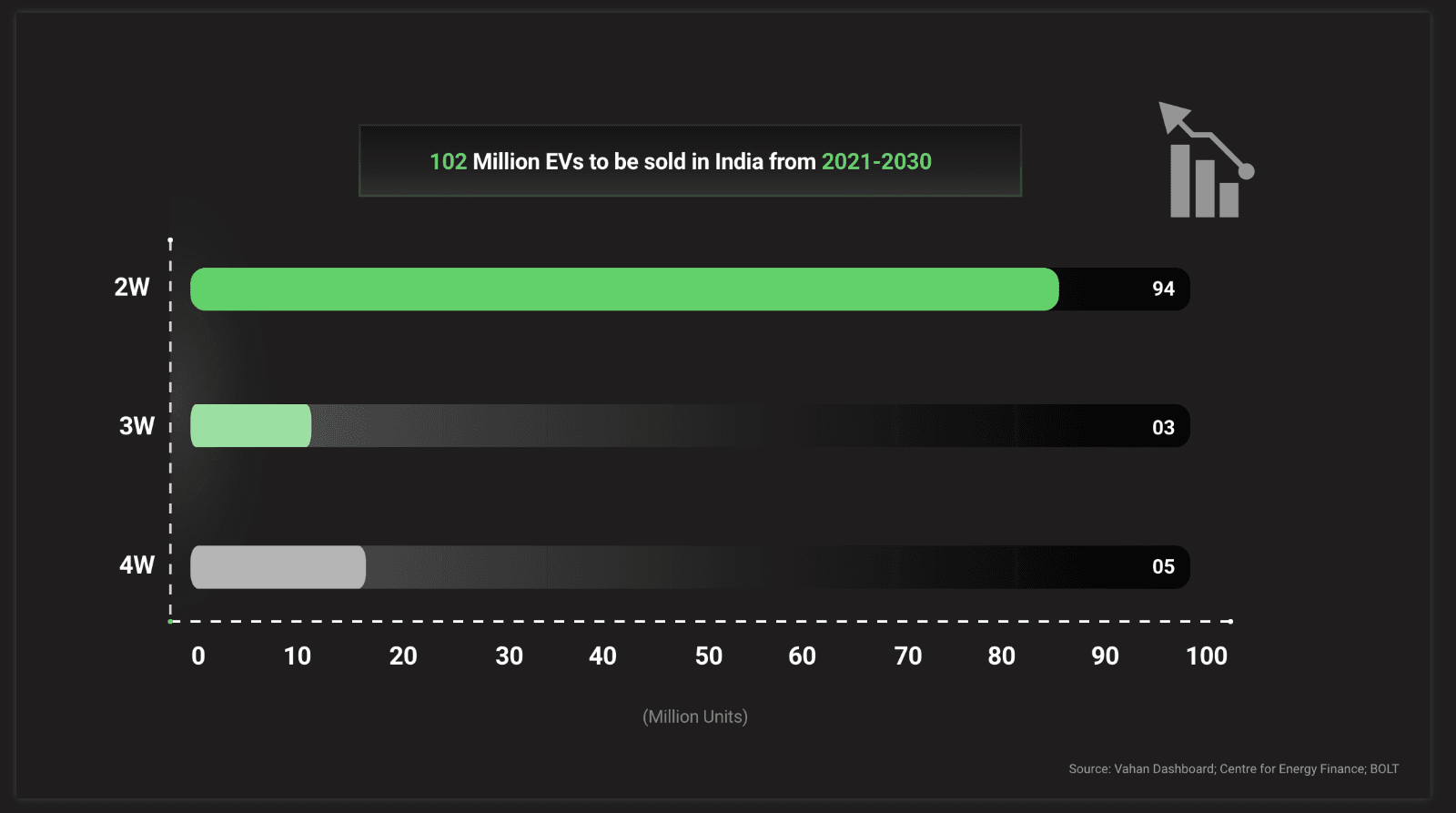
    2. EV Ecosystem Management Lack Regulatory Clarity

    India’s regulations lack provisions for EVs, specifically the principles or implementation models for resource utilization. In turn, companies that want to provide grid services and vehicle grid integration are facing a major barrier to implementation.

    India also doesn’t clarify the long-term role of state-owned utilities that are working to deploy EV charging stations. This lack of clarity poses an issue.

    Key Take-Aways

    • Policymakers haven’t clearly defined the long-term role of state-owned utilities. They also didn’t address the evolution of EV charging tariffs.
    • Policy provisions are lacking for ethical user data handling and privacy.
    • Cross-platform usage is hard to achieve with the unclear strategy of registration for charging usage.

    3. Revenue for Governments from Fuel Taxes Will Likely  Reduce

    In the long run, EV adoption will replace oil products with electricity. This will impact government taxation. In turn, it may impact EV incentives. This may also elevate the road tax to compensate. In addition, the revenue from EV charging and usage may not fully offset the revenues from the fossil fuel tax. The net tax loss is also due to EVs being more energy-efficient than traditional vehicles.

    Not all crude oil is fractionally distilled or used as automotive fuel. Even though EV growth will reduce dependency on crude oil, it won’t end it. This means the Indian government will still receive revenue from taxing trade on crude oil.

    Key Take-Aways

    • The EV market is evolving rapidly, but India isn’t suffering significantly from the net tax loss just yet.
    • Net fuel tax losses might also become extremely significant as EV uptake increases.
    • Governments will anticipate taxation changes while designing mechanisms that support EV deployment.

    Final Thoughts

    The Indian EV charging infrastructure is still developing. As a result, many opportunities can arise for the Indian commercial sector. First, India’s EV market won’t need extensive charging point installations. Second, the EV charging infrastructure won’t need further development to be fully functional. Finally, this evolution will create many business opportunities for DISCOMS.  

    That said, the EV charging infrastructure deployment isn’t without risk. Regulatory clarity is one of the largest challenges faced by India at present. In addition, the Indian government may lose revenue from future fossil fuel taxes. This may make EV adoption unappealing. That said, this loss may be balanced by an increase in road tax.

    Bolt.Earth supports India’s government in implementing a nationwide infrastructure. That way, we support EV adoption. Here at BOLT, we’re keen to see how state officials implement public EV charging infrastructure. As the largest market share (50%) EV charging network supplier, our offering goes beyond charging hardware. We provide a whole charging solution. In future activities, we hope to work hand-in-hand to roll out a total charging solution. We will help private and commercial transport users get where they need to go.

    Blog CTA Banner

    FAQs

    What are the challenges to owning an EV in India?

    EV owners face many challenges. For example, you may lack mechanical service options. You may also notice a lack of standardization in connector types and parking spots. Finally, you may even worry about a lack of EV charging infrastructure for long-range travel. Here at Bolt.Earth, we aim to support the EV surge in the country.

    What are the EV benefits in India?

    EVs reduce noise pollution and carbon emissions. EV maintenance and running costs are also lower than ICE vehicle costs. Lastly, with a proper EV charging infrastructure, EVs are very convenient to charge. Contact Bolt.Earth to learn more about the best EV charging solutions in India.

    What are some business opportunities in the EV sector?

    The EV boom can pave the way for many innovative, useful businesses. For example, it can promote a battery swapping and recycling industry. We can also see a rise in EV parts manufacturing. It’s also possible to see solar EV charging mechanisms. The EV charging infrastructure is bright, and Bolt.Earth is growing these opportunities.

    Why should India use electric cars?

    To achieve Net Zero Emissions, India needs a revolution in the transportation system. One way to achieve that is through EV adoption. EVs play a very important role in reducing emissions and saving on fossil fuels. That’s why India needs to improve the EV charging infrastructure to facilitate EV adoption in the long run.

    Does India have EV charging stations?

    Yes! Currently, India has 1,640+ operational public charging points for EVs. That’s not counting the private ones installed in homes. Overall, India’s EV charging infrastructure will grow as EV adoption increases. As a result, EV users will have less range anxiety.

  • Part 1: Assessment of India’s Current Electric Vehicle (EV) Charging Infrastructure

    Part 1: Assessment of India’s Current Electric Vehicle (EV) Charging Infrastructure

    Explore the rapidly growing EV charging market in India

    Since the beginning of 2020, the electric and connected car market has drawn more than $100 billion in investment globally. Over the past two years, India has also witnessed a rapid increase in the market penetration of Electric Vehicles (EVs) and EV charging points.

    In the past four months alone, electric charging stations in India have increased by more than two-and-half times. The Council on Energy, Environment, and Water (CEEW) claims that the Indian EV industry will be worth $206 billion by 2030 if India meets its Clean Energy Ministerial (CEM) EV30@30 pledge. The CEM is a global forum that is currently trying to get all governments to help facilitate at least 30% of all automotive sales to be EV by 2030. This pledge isn’t legally binding, but provides a useful target for governments to align with. That said, it appears to be more than achievable in India based on current infrastructural growth rates, as seen in the figure below, led by 2 Wheeler and 3 Wheeler EV sales.

    prva-slika.jpg
    EV sales in India are looking good even throughout the pandemic.

    The Indian government is currently focusing on developing a long-term strategic plan for electric vehicle adoption in India. In general, it’s planning to set up a vast array of charging points throughout India by investing in infrastructure improvements. If you didn’t know already, BOLT is already the largest EV infrastructure solution provider in India. This means we’re very excited by India’s EV adoption plans. To this end, we at BOLT decided to conduct our own market analysis and report findings here. We hope that this information will help illuminate what key requirements the Indian Government, startups, and the EV community need to consider, to set up a nationwide EV charging infrastructure.

    What To Expect in This Article

    In this article, we present what the current EV charging infrastructure looks like in India.

    In addition, we also present you with the growth potential of India’s EV transition up until 2030. Our analysis here will clarify the opportunities the EV transition presents to the Indian industrial sector and society, and we can also give strategic recommendations to the Indian government and community leaders.

    This article is the first in a three-part series where we analyze the market and specifically focus on EV charging infrastructure in India. Let’s initially take a look at BOLT and why we’re a leading authority in the EV infrastructure marketplace.

    Why Choose Bolt.Earth?

    Bolt.Earth is a venture-backed Electric Vehicle (EV) Ecosystem hardware and software business. We also operate the world’s largest peer-to-peer EV charging network and marketplace. Powered by the expansive Bolt.Earth Charging Network, we’re focused on creating a safe, smart, and connected ecosystem for EV users worldwide. In doing so, we aim to make range anxiety a thing of the past.

    Bolt.Earth’s clients and partners include EV OEMs like Hero Electric, TVS, Bosch, Okinawa, BattRE, Zypp, and Sun Mobility. We also work with infrastructure management players, like MyGate, Park+, and more. BOLT has already installed 10,000+ EV charging points worldwide, and we’re on track to deploy 100,000+ more in the next 6 months. We’re also hoping to install 250,000 charging points across India within the next year.

    >As an ecosystem player with B2B clients on the EV OEM side and B2C clients on the charging infrastructure side, Bolt.Earth is perfectly positioned to leverage a network of information nodes that represent the state of the market today.

    Read on as we give you an overview of India’s EV ecosystem in the following section.

    Blog CTA Banner

    An Overview of India’s EV Ecosystem

    In 2021, India’s EV growth was 168% up on its previous year, with 122607 EV units. Leading analysts expect this growth to continue throughout 2022 and also continue at an accelerated pace. In this section, we’ll take a look at infrastructure and future growth predictions.

    EV and EV Charging Infrastructure in India: Future Adoption Predictions

    Take a look at these: 

    3 predictions for the growth of the EV market in India:

    • The Society of Manufacturers of Electric Vehicles (SMEV) predicts India will hit the 1 million sales mark for EVs by the end of 2022 (based on current sales trends).
    • The India Energy Storage Alliance (IESA) expects the EV market to hit 6.34 million annual unit sales by 2027.
    • The Council on Energy, Environment, and Water (CEEW) and Center for Energy Finance report that the cumulative EV sales in India from 2021 to 2030 will be around 102 million units.

    2.png

    Estimated EV sales in India between 2021-2030.

    Our Assessment

    The above projections all have an underlying theme: India is seeing a strong push toward transitioning to EV-based mobility. That, in effect, will bring a host of radical changes in the way India’s citizens move around.

    Many factors are driving this growth in EV sales, indicating the Indian EV market is nearing an inflection point. EVs are expected to penetrate the different vehicle categories with varying adoption rates. Overall, the 2W EV and 3W EV markets will see rapid electrification in the near future. Rapid growth in 4W EV markets will likely begin between 2026 and 2027.

    Key Findings

    Given the new EV influx in the Indian automobile market, we’ll need an adequate EV charging infrastructure network. It isn’t hard to see how these two events are closely linked. Currently, the infrastructure may be the biggest barrier to EV transition in India.

    India’s EV Charging Infrastructure Market

    The EV charging infrastructure network in India is evolving. Several private, startups, and government entities are currently engaged in developing deployment strategies. Take a look at these examples.

    • In January 2020, the DHI approved setting up 2,636 EV charging stations across 62 cities in 24 states and union territories (UTs) of India. These include 1,633 fast-charging stations and 1,003 slow-charging stations. The Ministry of Heavy Industries (MHI) also sanctioned 241 additional charging stations in September 2020.
    • By 2030, the Bureau of Energy Efficiency (BEE) predicts that 2.26 Million charging points will be required in Delhi, 0.62 Million charging points in Lucknow, and 0.26 Million charging points in Nagpur.

    The key market players are a good mix of government-backed entities and private companies. They’re also looking to grow their installed base capacities to make several Indian cities ‘EV-Ready’ in terms of charging infrastructure deployments next year.

    Total number of current public charging points in India by vendor.

    Our Assessment

    Private home EV charging is also expected to dominate the market by 2030 in both numbers and capacity, given the sheer volume of 2-wheeled and 3-wheeled vehicles in India. The Private EV charging at-work segment will also need chargers. Until 2030, slow chargers will dominate the public charging infrastructure, but public fast chargers will also see a significant uptick.

    We’re already moving towards a trend of total disruption in India, which will see Charge Point Operators (CPOs) adapt to the evolving market changes. CPOs’ hesitancy to invest in new ideas and technologies or engage in major collaborations or acquisitions will also fail to capture key market positions.

    Key Finding

    The EV sector in India will expect access to an efficient charging infrastructure. CPOs need to prepare for a disruptive change in mobility. The Indian EV market is still in the development stage, but the market is heading toward making charging a commodity, just like oil or gas. In other words, the phrase: ‘electricity is the new fuel’ is gaining more merit.

    Additional Opportunities in Charging

    • Network Visibility in Charging: IoT-enabled platforms can make EV charging electricity lines smart by offering information on the infrastructure, location, availability, and real-time status.
    • Ease of use of charging infrastructure: Payment methods and charging initialization is crucial in allowing EV users to transition.
    • Data and Analytics: Geospatial data, network visibility, traffic density, and charging demand are also necessary to support a strategic deployment of a charging infrastructure across a city.
    • Smart Charging Points: Smart, connected, IoT-enabled charging points that allow for monitoring of EV charging will develop as the surviving business model grows. The idea of creating separate electricity lines for EVs in India at all locations might not be feasible, given the costs and complexity involved.
    • Alternative charging technologies: Alternative charging methods, like inductive charging, might find a market in India to solve space availability and cabling issues.

    The Value Chain of the Indian EV Ecosystem

    In terms of a public EV charging infrastructure, the value chain has had a few specific roles. Let’s take a look at 6 of these:

    cetri.jpg

    EV ecosystems provide an integrated approach to EV charging.

    • Energy Suppliers and Distribution Companies (DISCOMs): Responsible for the supply of electricity at regulated tariffs for consumption by electric vehicles. DISCOMs need to understand where and when they’re facing peak demands to operate efficiently.
    • EVSE and EV Charging Point Manufacturer: The charging equipment manufacturers who design, develop, and sell their own charging points or EVSE.
    • Installation and Maintenance Providers: Responsible for the installation of chargers at locations desired by charging point real estate providers and ensuring device maintenance over time.
    • Charge Point Operators (CPOs): Responsible for setting up, managing, and operating an EV charging station network for semi-public or public use. CPOs may directly own the charging points or operate the chargers on behalf of the charging point owners.
    • Mobility Service Providers (MSPs): Responsible for helping EV users locate and provide the user interfaces to conduct transactions at EV charging points. They also enable “roaming” for EV users subscribed to one CPO, and to use another CPO’s charging networks. CPOs may also sometimes act as MSPs.
    • EV End Users and Charging Point Real Estate Providers: Include both EV and EV charging station buyers.

    The Path Forward: Future EV Charging Trends in 2022

    The future evolution of the previously mentioned points will mean that value chain integration will force some segment absorption. Ultimately, only a few players across the chain will survive in the market. Who will it be? The ones that undergo continuous upgrades in their business models. On the end-user side, charging point real-estate providers will have to cope with increased peak loads. For example, we can think of providers like shopping centers, food courts, parking spaces, and apartment complexes. In this section, we define key EV charging trends that will influence the way India adopts EV technology.

    CPO and MSP Roles

    In BOLT’s opinion, the CPOs and MSPs form the more crucial part of this value chain. We also think they’re perfectly placed to expand across the entire value chain. What’s more, these entities are currently the most active players in the market, with a huge first-mover advantage. When CPOs reach a certain critical size and scale, MSPs will have a high incentive to collaborate with them.

    Conversely, CPOs will feel as if they’re battling to expand their charging networks. Smaller players will most likely become aggregated, even at this growing stage. That way, CPOs secure the more strategically attractive charging locations for their slow/fast-charging services.

    A small number of MSPs in India currently take up a significant chunk of the market share. Still, this trend will likely change rapidly as more players emerge over the next two years.

    EV Market: Future Trajectory and Advantages

    We expect the market to follow global trends and move towards ‘plug and charge’ standards. We also see these in the U.S., Europe, and Asia, where the standard automatically identifies what type of EV you’re plugging in and bills you accordingly. In market dynamics, this gives CPOs and MSPs closely tied to EV OEMs an added advantage. That’s because they’ll be able to choose to create a closed ecosystem of EV charging customers.

    >For CPOs, the EV Ecosystem is all about scaling up – it’s a winner-takes-all market dynamic. For MSPs, the key to success will depend on how well they expand their network and diversify their operations in collaboration with the largest CPOs.

    Final Thoughts

    As the world adopts EVs more and more, it’s important to develop a proper EV charging infrastructure. That’s also the case in India, where EV adoption is increasing. To us, it’s important to analyze the current infrastructure state. Otherwise, we can’t know where it’s headed in the future. Here at BOLT, we encourage the Indian government to take action. We also encourage it to benefit from the many potential advantages of improving the infrastructure. Indian citizens and the environment alike will benefit from a robust EV charging infrastructure.

    Blog CTA Banner

    FAQs

    How big is the Indian EV charging market in 2022?

    The Council on Energy, Environment, and Water (CEEW) and Center for Energy Finance (CEF) estimate around 1 million EVs will be sold in India before the end of 2022. In addition, sales are expected to increase and total around 102 million units sold before the end of 2030.


    Who are the top 5 market shareholders for EV charging networks in India?

    Based on recent data, around 18,274 public EV charging points have been deployed in India as of June 2022. These are currently in cities like Delhi, Mumbai, Hyderabad, and Pune. The top 5 EV charging providers operating these (by market cap) are Bolt.Earth, Energy Efficiency Services Limited (EESL), Rajasthan Electronics and Instruments Limited (REIL), Tata Power, and EVI Technologies.


    Who are the critical stakeholders in the EV charging value chain who will determine the future of EV charging in India?

    Charge Point Operators who operate vast charging point networks can help determine the future of EV charging in India. Additionally, Mobility Service Providers, who provide aggregated charging services, will also be responsible for the nationwide rollout of EV charging infrastructure in India.


    What’s the difference between slow and fast charging stations?

    The main difference is the availability and usage of these stations. For starters, slow charging is usually meant for private settings. Conversely, fast charging stations might be best suited for public charging found on national highways. Secondly, fast chargers are more ideal for EVs with higher battery capacity. Finally, fast stations are more efficient per time spent charging.


    Can I set up an EV charging station in India?

    The Indian government has announced that anyone can establish EV charging stations throughout the country. That said, the station needs to comply with the Indian government’s specifications. This relative freedom presents an excellent opportunity for the EV value chain in India to establish and operate efficient EV charging stations. Contact Bolt.Earth for more information about EV charging stations.