Blog

  • Why Blaze DC Is the Right Choice for EV Dealerships

    Why Blaze DC Is the Right Choice for EV Dealerships

    EV sales in India are on a steep upward curve. With over 1.5 million EVs sold in FY24—a 50% year-on-year jump—India is fast becoming one of the world’s most dynamic electric mobility markets. Two- and three-wheelers continue to dominate the numbers, but passenger EV adoption is also accelerating, especially across metro and Tier-2 cities.

    As this growth takes hold, automakers are tightening expectations for dealership infrastructure. In the US, a recent audit revealed that over 80% of EV-certified dealerships in Delaware lacked even basic fast-charging capability, leading to customer dissatisfaction and delayed adoption. Learning from that, automakers in India are becoming more proactive, insisting that their dealership networks offer fast-charging solutions not just to meet compliance but also to deliver a seamless buyer experience.

    Having an EV on the lot is no longer enough. Today’s customers expect more; they want to see it charge, take it for a spin without long waits, and leave confident that the charging experience will be just as seamless as the drive. In a country where the EV-to-public-charger ratio still sits at 135:1, any friction in that experience can quickly turn into a lost sale. Charging, once an afterthought, is now directly tied to sales confidence, EV charging supplier reliability, and dealership credibility.

    Blaze DC was built for this exact need. In this blog, we’ll explore 5 reasons why Blaze DC is the right choice for EV dealerships, helping them reduce vehicle downtime, meet OEM requirements, and deliver a customer experience that’s as fast as the future they’re selling.

    5 Ways Blaze DC Gives EV Dealerships a Competitive Edge

    1. Enhance showroom experience & sales conversion

    A recent study on Indian EV buyer behavior found that customers are willing to pay ₹850–₹2,800 extra for every minute of reduced charging time. That means a dealership offering fast charging, like Blaze DC, isn’t just improving experience; it’s delivering real perceived value worth thousands in the eyes of the buyer.

    This matters on the showroom floor. When your sales team can plug in a two-wheeler, charge up to 120 km in 15 minutes, and let the customer watch it happen in real time, that’s not a pitch. It’s proof. It dissolves the two biggest questions to EV adoption: Will it charge fast enough? Will I always have to wait?

    According to Hypercharge, dealerships that integrate fast chargers see a significant lift in conversion rates because “a hands-on demonstration of charging removes theoretical doubt.” Internationally, US dealerships report up to 25% higher EV sales conversion with fast chargers on-site, especially during live demos.

    Blaze DC gives dealerships the power to turn charging into a live, real-time demo that directly boosts sales confidence. With its 1% charge per minute capability, Blaze DC delivers up to 120 km of range in just 15 minutes (on the 12 kW variant), allowing customers to witness fast charging firsthand, rather than hearing about it hypothetically.

    Unlike generic 4-wheeler chargers or OEM-locked units, it’s compact, interoperable with all major 2W and 3W brands, and capable of turning dealership parking lots into working, testable EV infrastructure.

    With EV adoption in India projected to cross 40% of all new vehicle sales by 2030, dealerships need more than just vehicles on display. They need the best EV chargers for business to back them.

    2. Optimize lot space & inventory readiness

    At any dealership, floor space is finite; every vehicle parked, especially one waiting hours to charge, is a vehicle not ready to be sold. As EV sales scale and test-drive volumes rise, the ability to keep vehicles charged, rotated, and visible becomes critical.

    With Blaze DC’s fast turnaround times, vehicles no longer occupy bays for extended periods, freeing up space for new deliveries, customer test drives, or immediate walk-in demos. Whether you’re preparing a vehicle for handover, a trial run, or post-service pickup, Blaze DC ensures it’s charged and ready without slowing down your lot.

    Faster charging cycles also reduce the need to dedicate specific bays to charging alone. This means dealerships can consolidate charging into fewer, smarter locations, freeing up room for service, display, or high-demand vehicle placements.

    Globally, dealers who’ve adopted fast charging have reported a notable reduction in bay occupancy times, allowing more efficient scheduling and smoother vehicle turnover.

    In the U.S., dealerships using fast chargers report gross margins of 75–100% per session, compared to just 3.9% on new car sales and 40–50% in traditional service margins. That means the charger itself is not just a utility; it’s a premium profit asset.

    A German study of 27,800 charging stations found DC fast chargers serve 3× more sessions per port than AC units—delivering significantly higher return on the same footprint.

    In high-traffic urban dealerships, where space is often at a premium, this optimization directly translates into leaner operations and better inventory visibility.

    For Indian EV charging dealerships juggling limited display areas and high vehicle flow, Blaze DC helps streamline operations, keeping inventory moving and the lot uncluttered.

    3. Unlock a high-margin revenue stream

    EVs are changing the math of dealership profitability. While internal combustion (ICE) vehicles require regular servicing, spare parts, and maintenance visits, EVs don’t. Studies show that EV maintenance costs are 20–50% lower than petrol or diesel vehicles. In India, routine service for a Tata Nexon EV averages just ₹2,817 per year, compared to ₹6,000–₹12,000 for similar ICE vehicles.

    For dealerships, this means their most profitable department (service and parts) is shrinking. Meanwhile, new car sales bring in a razor-thin 3.9% margin on average.

    This is where Blaze DC becomes a strategic asset.

    By installing a fast charger like Blaze DC on-site, dealerships can unlock a completely new, high-margin revenue stream. Fast chargers in India typically operate at tariffs between ₹20 and ₹24 per kWh, with DISCOM costs around ₹7–₹9, yielding margins upwards of 30–40% per session, even before utilization scales. And because Blaze DC is designed for high throughput, it starts generating value from day one.

    Let’s break that down:

    • A Blaze DC 6 kW or 12 kW charger serving 10 sessions per day (avg. 15 kWh/session) = 150 kWh/day.
    • At ₹24/kWh = ₹3,600/day revenue.
    • Even with conservative margins of ₹7–₹9/kWh = ₹1,050–₹1,350/day = ₹30,000–₹40,000/month gross margin.

    In high-demand zones or public-facing dealerships, this number can climb substantially. A Chevrolet dealership in Dallas reported earning $60K within six months of deploying fast chargers for public use.

    So while EVs may reduce service bay visits, Blaze DC replaces lost traffic with revenue-generating charging sessions right from your dealership lot. It’s not just a way to support EV buyers. It’s a way to future-proof dealership economics.

    4. Safety, smartness & reliability—built for dealerships

    When dealerships integrate fast charging into their operations, safety and uptime are non-negotiable. A charger that fails during a demo, a delivery handover, or a customer’s charging session not only disrupts sales but also damages trust. Blaze DC is engineered to slash that risk with enterprise-grade safety and intelligence.

    Blaze DC units are equipped with a multi-layer protection system that ensures fail-safe operation across all dealership scenarios:

    • Short-Circuit Protection
    • Input Over-Voltage & Under-Voltage Detection
    • Output Reverse Polarity Protection
    • Current Leakage Detection
    • Earth Fault Monitoring
    • Emergency Stop Button

    These protections are always active and fully automated, requiring zero manual input. The system continuously monitors charging health and performance in real-time, ensuring every demo, delivery, and top-up happens safely and predictably, whether it’s your sales team, service staff, or a walk-in customer using the charger.

    But safety is only one half of the equation. Blaze DC is also built to be smart, natively connected to the Bolt.Earth CMS, which powers:

    • Live charger status monitoring across all dealership locations
    • Instant diagnostics and error detection to flag issues early
    • Predictive maintenance alerts to prevent downtime before it happens
    • Remote servicing capabilities, minimizing onsite technician visits

    For dealerships managing dozens of vehicles across limited space, this means centralized visibility, streamlined operations, and reliable charger uptime, without adding operational complexity.

    Blaze DC ensures your chargers are as dependable as the vehicles you sell, making every session fast and flawless.

    5. One charger for every brand

    5.jpg
    Most EV dealerships in India today sell a wide variety of two- and three-wheeler brands. But the problem with many charging solutions is they’re built for exclusivity. Single-brand compatibility. Limited protocol support. OEM-specific lock-ins.

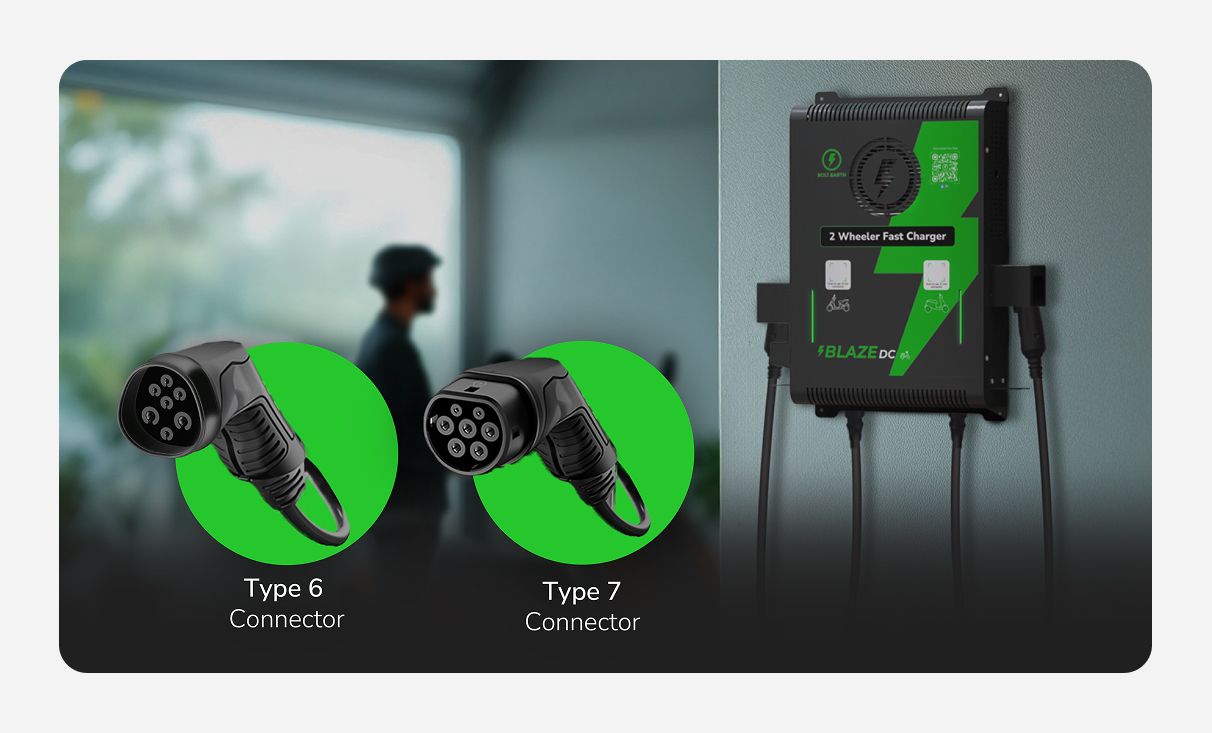
    Blaze DC is India’s first universally compatible DC fast charger for 2- and 3-wheelers, supporting both of the major standards in play:

    • Type 6: endorsed by the Bharat Charge Alliance (IEC 62196-6)
    • Type 7: officially approved by BIS under India’s LECCS standard

    This means it works out of the box with over 90% of fast-charging-enabled EVs on Indian roads, including models from Ather, Ola, Hero MotoCorp, Matter, Simple Energy, and Ultraviolette.

    For dealerships, it’s operational freedom. Whether you’re hosting test rides, prepping new vehicles for delivery, or supporting customer service visits, Blaze DC ensures every EV that rolls into your lot can charge without needing separate hardware or brand-specific bays.

    It also means you’re ready for the future. As Type 6 and LECCS-based EVs become the national standard, Blaze DC ensures your charging infrastructure won’t go obsolete; it evolves with the market.

    Final Thoughts

    In a dealership environment shaped by growing EV demand, shrinking service margins, and rising customer expectations, Blaze DC delivers where it matters. It helps dealerships do more than just sell EVs; it helps them demonstrate performance, optimize inventory flow, generate recurring revenue, and stay ahead of evolving OEM standards.

    From compact 3 kW units to high-performance 12 kW systems, Blaze DC offers the speed, compatibility, and intelligence that modern EV dealerships need to operate at full throttle.

    If you’re looking to deploy Blaze DC at your showroom, service center, or delivery hub, you can purchase directly from the Bolt.Earth website or reach out to our team.

    Email: [email protected]

    Phone: +91 80456 88455

  • Top 10 EV Charger Manufacturers in India [2025]

    Top 10 EV Charger Manufacturers in India [2025]

    In 2024, India’s EV charging market shipped around 179,000 units, up from just a few tens of thousands in previous years, with projections estimating 1.28 million units by year’s end. It reflects the rise of a domestic manufacturing ecosystem now backed by over 50+ certified EV charger manufacturers across the country. Production isn’t limited to volume—states like Tamil Nadu have become national hubs, where global players like Delta and Eaton are building export-ready fast chargers ranging from 60 kW to 350 kW. As the global EV charging station market grows from USD 22.46 billion in 2024 to a projected USD 257.33 billion by 2032 (Fortune Business Insights), India is no longer on the sidelines. With its domestic EV charger market expected to reach USD 3.7 billion by 2030, the country is building at scale, localizing innovation, and fast emerging as a core player in the global supply chain.

    In this blog, we profile the top 10 EV charger manufacturers in India, exploring their production capabilities, product portfolios, and their roles in shaping India’s electric future.

    List of Top 10 EV Charger Manufacturers in India 2025

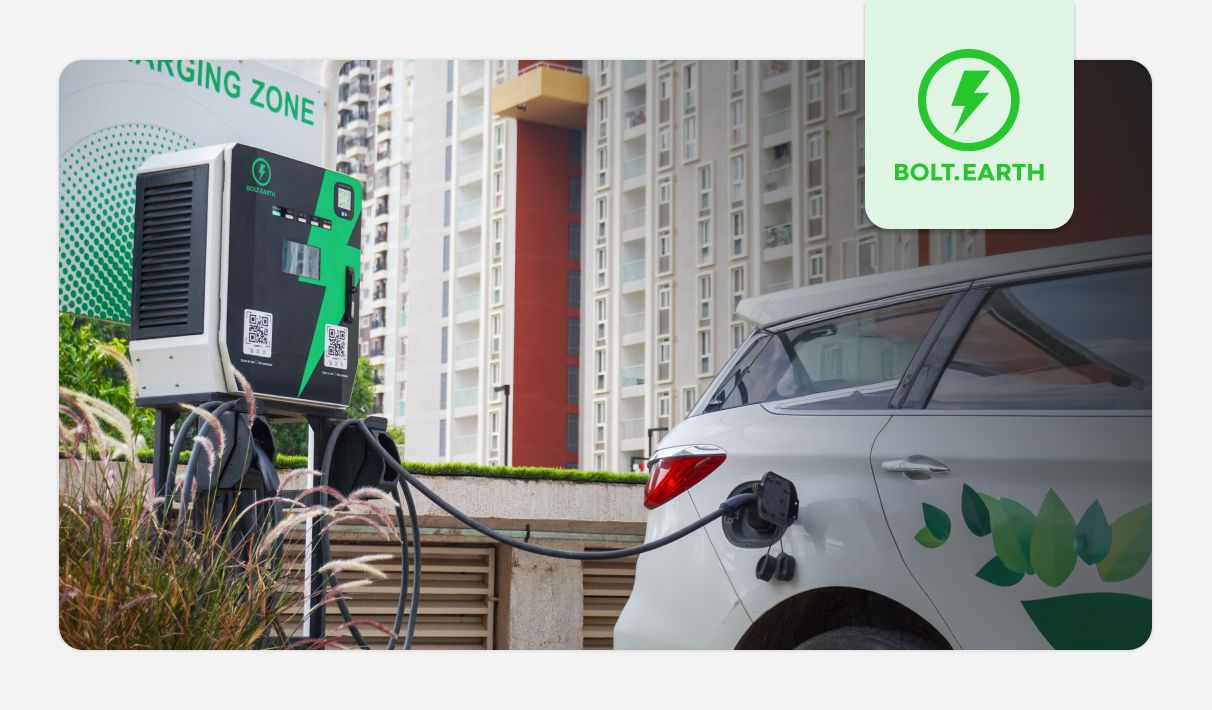
    1. Bolt.Earth
    1.jpg
    Company Overview
    Founded in 2017 and headquartered in Bengaluru, Bolt.Earth has grown into India’s largest EV charging network, with over 100,000+ chargers deployed across 2,000+ cities. The company caters to a broad spectrum of EV users: individual owners, residential complexes, commercial spaces, and fleet operators, with a focus on scalable, efficient, and user-centric charging solutions.

    Product Portfolio

    All Bolt.Earth hardware is designed in compliance with global standards such as CCS2, NABL, and ARAI.

    Strategic Partnerships

    Bolt.Earth has formed alliances with industry giants such as Amazon, Honeywell, Optum, Mahindra, Bajaj, Ultraviolette, TVS Motor, and Matter Motor, enabling charger deployment across dealerships, residential communities, and commercial zones.

    Flagship Innovation: Blaze DC

    In 2025, Bolt.Earth launched Blaze DC, India’s first universally compatible DC fast charger for 2- and 3-wheelers. Capable of delivering a 1% charge per minute, Blaze DC fills a long-standing gap in India’s EV infrastructure by offering brand-agnostic interoperability, rapid turnaround, and a future-ready design. It supports both the BCA-endorsed Type 6 connector and the BIS-approved Type 7 standard and is currently being rolled out nationwide.

    Manufacturing & Infrastructure

    Bolt.Earth operates multiple manufacturing and warehousing units across India. In 2024, it inaugurated a 13,000 sq. ft. Integrated Testing and Warehousing Facility in Bengaluru, built to accelerate hardware R&D and improve deployment timelines.

    Software Ecosystem

      Bolt.Earth complements its hardware with a proprietary charging software suite. This includes:

    • A user-facing mobile app, Bolt.Earth EV Charging App, for charger discovery, session tracking, and payments
    • A Charger Management System (CMS) for network operators and hosts to monitor performance, resolve faults, and analyze usage data

    This tech stack is a key differentiator, allowing Bolt.Earth to operate one of India’s few truly smart charging networks.

    Interoperability & Growth Model

    The company uses a host-sponsored model, allowing property owners and businesses to deploy and operate Bolt.Earth chargers on their premises. This reduces capital expenditure while accelerating network expansion across private and semi-public locations.

    Market Position

    According to JMK Research and the Bureau of Energy Efficiency (BEE), Bolt.Earth holds an estimated 63% share of India’s public charging infrastructure, by far the largest in the country. Its combination of scale, in-house tech, and product innovation has earned it a front-row seat in India’s clean mobility transition.

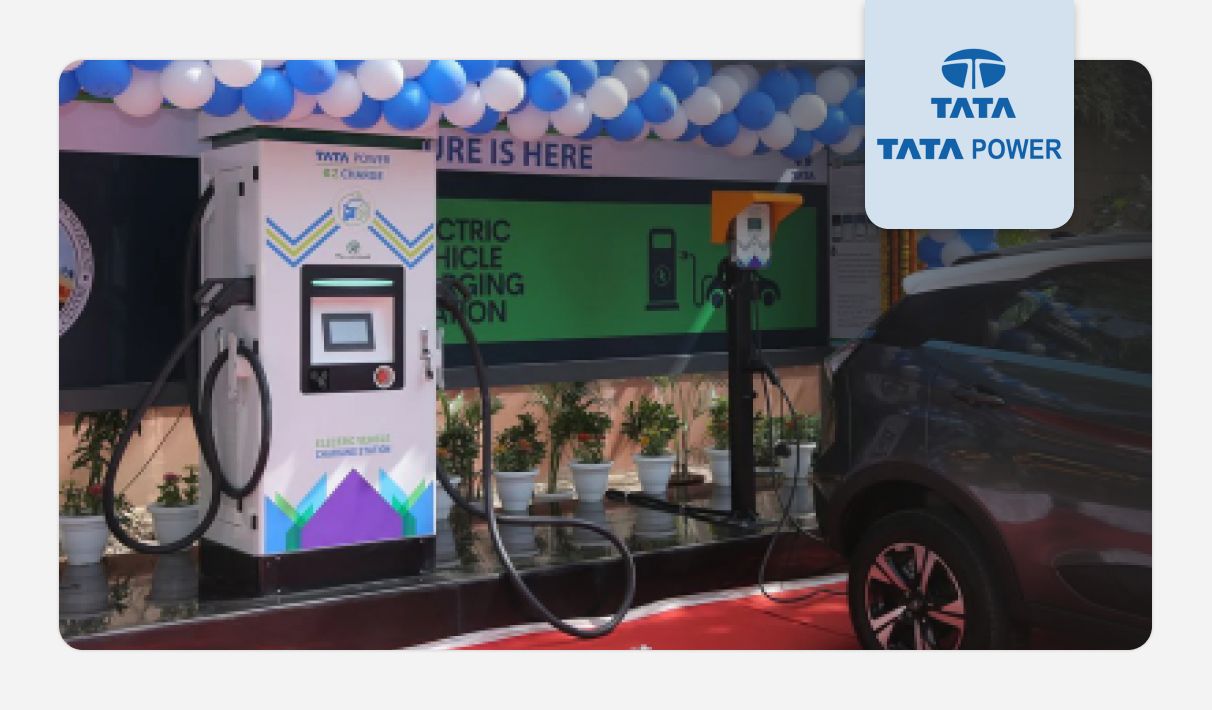
    2. Tata Power EZ Charge
    2.jpg

    Company Overview

    Tata Power EZ Charge is the EV charging division of Tata Power, one of India’s largest integrated power companies. Headquartered in Mumbai, the company has built a strong national footprint with EV charging solutions for residential users, public infrastructure, commercial fleets, and electric buses. As of 2024, Tata Power operates over 5,500 public and semi-public charging stations across 550+ cities and has installed more than 100,000 home chargers and 1,100+ bus charging points across India.

    Product Portfolio

    Tata Power EZ Charge offers a range of hardware options, including:

    • AC chargers ranging from 3 kW to 22 kW for home, workplace, and light commercial use.
    • DC fast chargers scaling up to 240 kW, ideal for highway corridors, fleet hubs, and public fast-charging stations.
    • All chargers are weatherproof, RFID-enabled, and compatible with global standards such as CCS, CHAdeMO, and GB/T.

    Strategic Partnerships

    Tata Power has formed alliances with leading OEMs such as Tata Motors, MG Motor, Jaguar Land Rover, and Zoomcar, enabling charger deployment at dealerships, residential communities, and commercial zones. The company also works with HPCL, real estate developers, and smart city projects to install chargers at key urban and highway locations.

    Manufacturing & Infrastructure

    While Tata Power doesn’t manufacture EV chargers in-house, it partners with certified vendors and integrates them into a cohesive national network. The company oversees deployment, quality control, and operations via its Network Operations Centre based in Mumbai.

    Software Ecosystem

    The Tata Power EZ Charge mobile app allows users to:

    • Locate nearby chargers
    • Track charging sessions in real time
    • Make digital payments via UPI, wallets, and cards
    • Access chargers with an RFID-enabled EZ Charge card for quick and seamless transactions

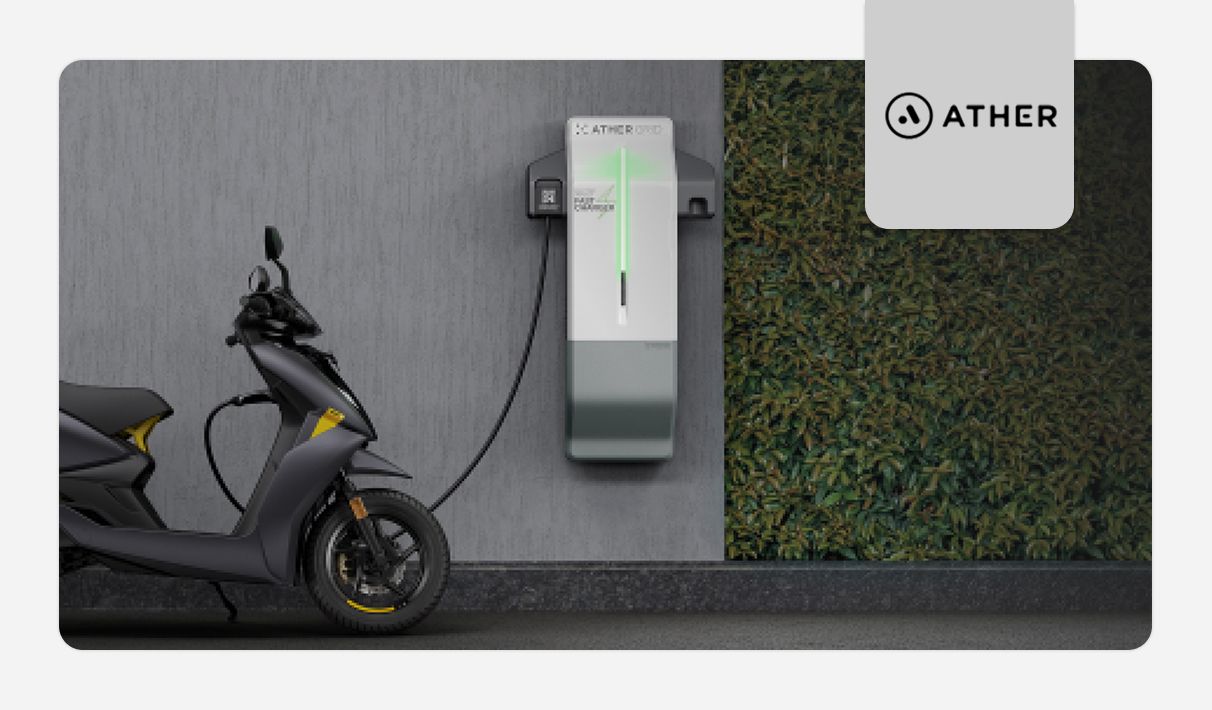
    3. Ather Energy
    3.jpg

    Company Overview

    Founded in 2013 and headquartered in Bengaluru, Ather Energy is a leading electric two-wheeler manufacturer in India and one of the earliest players to invest in dedicated EV charging infrastructure. Through its proprietary network, Ather Grid, the company has deployed over 2,700 fast-charging points across 230+ cities, focusing primarily on urban and semi-urban areas.

    What started as an ecosystem to support Ather’s own vehicles has now evolved into a more open, scalable network, especially with the company’s recent move toward interoperability through India’s upcoming LECCS standard.

    Product Portfolio

    Ather’s charging ecosystem includes both home and public fast-charging solutions:

    • Ather Dot / Ather Duo: A 700 W home charger for overnight or flexible residential use.
    • Ather Grid: A nationwide fast-charging network capable of delivering 15 km of range in 10 minutes.

    Flagship Infrastructure: Ather Grid

    Launched well ahead of its competitors, Ather Grid now spans over 2,700 active charging points, making it one of India’s largest fast-charging networks for two-wheelers. The grid is installed across cafes, malls, office campuses, and public parking spaces, offering riders convenient access in high-footfall locations.

    Software Ecosystem

    The Ather Grid mobile app is a key part of the charging experience. It allows users to:

    • Discover and navigate to nearby chargers
    • Monitor live charging sessions
    • Pay digitally using integrated UPI/wallet support
    • Access charging history and performance data

    Interoperability & Network Growth

    Ather has taken active steps to support open charging standards and interoperability. Its chargers are now being adapted to support LECCS, enabling access for non-Ather two- and three-wheelers. The company also partners with third-party networks such as Magenta ChargeGrid and ChargeMOD to extend coverage and ensure widespread compatibility.

    4. Reliance BP Mobility Ltd (Jio‑bp Pulse)
    4.jpg

    Company Overview

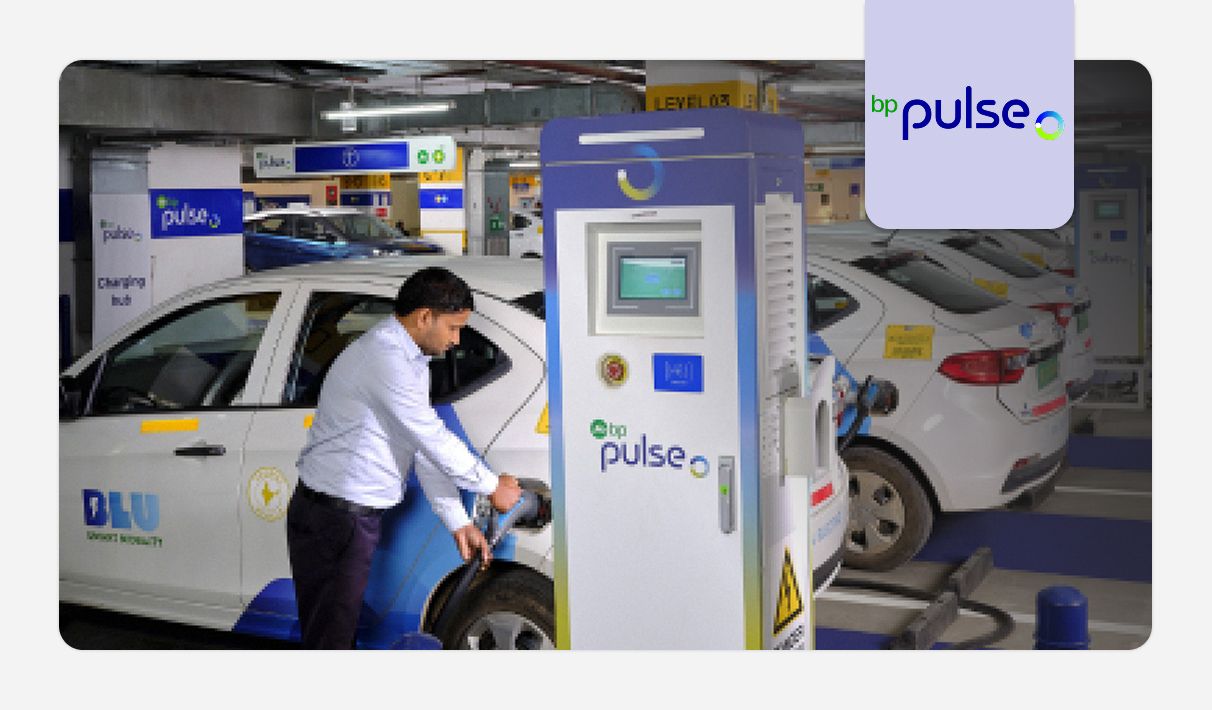
    Reliance BP Mobility Ltd., operating under the brand Jio-bp Pulse, is a joint venture between Reliance Industries and bp, focused on building one of India’s largest electric mobility networks. With a rapidly expanding footprint, the company currently operates over 5,000 EV charging points across 500+ locations, including highways, malls, corporate parks, airports, and fuel stations. Known for its aggressive rollout and emphasis on high-speed charging, Jio-bp Pulse is quickly becoming a key player in India’s evolving EV infrastructure landscape.

    Product Portfolio

    Jio‑bp Pulse offers a comprehensive suite of charging solutions designed for scalability and speed:

    • AC Chargers for residential and low-power commercial use
    • DC Fast Chargers ranging from 60 kW to ultra-fast 480 kW units for highway corridors, fleets, and high-traffic urban centers
    • Emerging battery-swapping infrastructure for two- and three-wheeler fleet operations

    With 95% of its deployed chargers being fast chargers, the brand is positioning itself as India’s most speed-centric EV charging network.

    Flagship Charging Infrastructure

    Jio-bp Pulse has rolled out significant high-speed charging hubs across India, including:

    • South India’s largest public EV charging station near Kempegowda International Airport, with 169 charging points.
    • Premium urban hubs like the Jio World Centre in Mumbai’s Bandra Kurla Complex.
    • Widespread installations at fuel stations, retail outlets, and food courts across highways.

    The network is known for its strong uptime, reportedly maintaining 96% availability across all stations.

    Software Ecosystem

    Jio-bp Pulse supports its hardware with a robust digital experience:

    • The Jio-bp Pulse mobile app enables users to locate nearby chargers, view real-time availability, start sessions, and pay via UPI, cards, or wallets.
    • Integrated with RFID-based access for seamless operation.
    • Select charging hubs also feature Wild Bean Café outlets for user convenience during charge cycles.

    Interoperability & Growth Model

    Jio-bp is expanding through partnerships with public and private stakeholders, including a landmark deal with the Bangalore Metropolitan Transport Corporation (BMTC) to deploy 225 charging stations across Bengaluru. The company is also piloting battery-swapping capabilities for commercial fleet segments, aiming to provide integrated energy services for urban mobility.

    5. Delta Electronics India
    5.jpg

    Company Overview

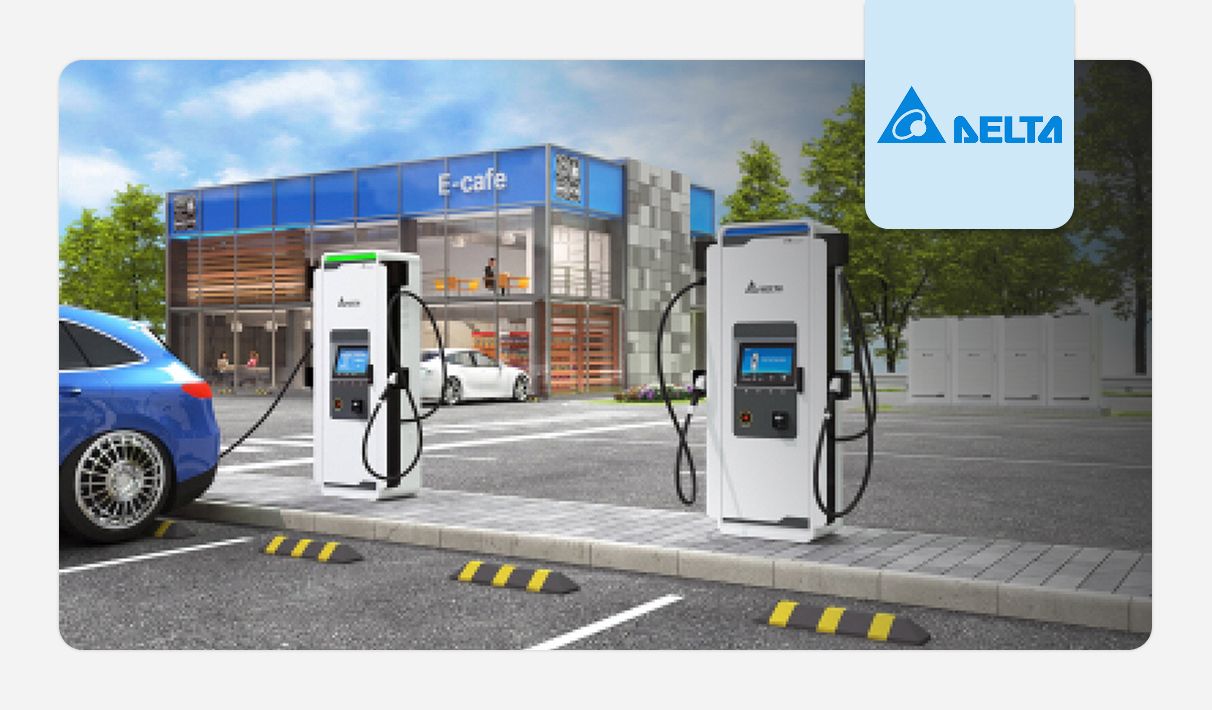
    Delta Electronics India is a subsidiary of the Taiwan-based Delta Electronics Group and a key player in India’s EV charging infrastructure space. With a strong presence in Tamil Nadu, Bengaluru, and Krishnagiri, the company has built a reputation for manufacturing high-efficiency power and energy management solutions, including a wide range of AC and DC chargers for public, commercial, and fleet applications. As of 2024, Delta has deployed over 6,000 EV chargers across India, supporting a wide range of electric mobility use cases.

    Product Portfolio

    Delta offers a full suite of EV charging solutions that cater to residential, commercial, and high-power public charging needs:

    • AC Chargers (7–22kW): Designed for homes, offices, and low-power commercial use.
    • DC Chargers (25–350kW): Including 25kW and 50kW wall-mounted units, 100 kW and 200 kW City Chargers, and the flagship Ultra-Fast Chargers (UFC 200 & UFC 350) for highway and fleet operations.
    • Energy Management Systems: DeltaGrid® EVM enables real-time monitoring, load optimization, and seamless integration with renewable energy sources and battery storage systems.

    Flagship Projects

    Delta has been involved in multiple high-impact deployments across the country:

    • Supplied 150kW DC fast chargers to Ahmedabad Municipal Transport Service (AMTS) to support its growing fleet of electric buses.
    • Partnered with BESCOM in Karnataka for the deployment of AC and DC chargers across public infrastructure and commercial sites.
    • Collaborated with ThunderPlus to develop India-made 4kW rectifier modules for onboard 2W/3W chargers, supporting domestic EV manufacturing.

    Manufacturing & Infrastructure

    Delta’s core manufacturing facility is in Krishnagiri, Tamil Nadu, where it produces chargers, rectifier modules, and other power components for domestic and export markets. The facility also supports ongoing R&D into next-gen EV chargers, including 60kW and 120kW units, which will complement its existing high-power lineup.

    Software Ecosystem

    Delta’s chargers are supported by smart backend systems and remote monitoring capabilities. The DeltaGrid® platform allows users and operators to:

    • Track real-time charger performance
    • Integrate with solar and battery systems
    • Perform diagnostics and firmware updates remotely

    This enables Delta to offer energy-smart charging solutions, especially suited for larger commercial or public deployments.

    Interoperability & Smart Infrastructure

    Delta has been a pioneer in showcasing green charging stations that combine solar PV, battery storage, and fast chargers, offering decentralized, sustainable EV infrastructure. These microgrid-enabled setups were first unveiled at Elecrama 2023, underlining Delta’s long-term vision for integrated energy mobility.

    6. Servotech EV Infra (Incharz)
    6.jpg

    Company Overview

    Servotech EV Infra, operating under the brand name Incharz, is the electric mobility subsidiary of Servotech Power Systems Ltd., a Delhi-based power electronics and renewable energy company. Launched in 2023, Incharz focuses on building AC and DC charging infrastructure across India, with deployments spanning residential societies, commercial hubs, and public locations. The company aims to build a nationwide network of 5,000 EV charging stations, with a clear emphasis on quality, strategic partnerships, and fleet-based applications.

    Product Portfolio

    Incharz provides a growing range of EV chargers for 2-, 3-, and 4-wheelers.

    • AC Chargers (7–22kW): Primarily installed in residential complexes and workplaces.
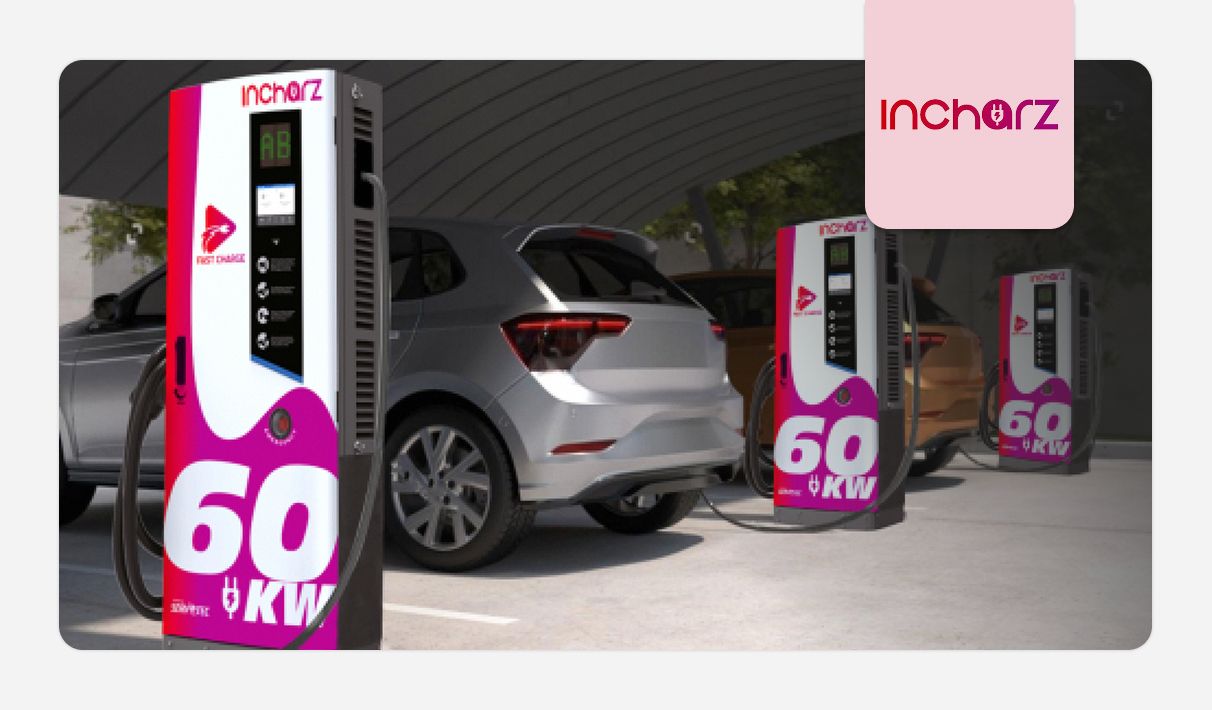
    • DC Fast Chargers (25–60kW): Suitable for commercial zones, cargo hubs, and fleet depots.
    • Future-ready support for mobile charging and battery-swapping infrastructure
    • All products are NABL- and ARAI-certified and designed for Indian road and climate conditions.

    Flagship Deployments

    • 3ECO Partnership: In May 2024, Incharz signed an MoU with 3ECO, a cargo EV OEM, to install 1,000 public charging points exclusively for light commercial EVs, supporting high-volume cargo operations.
    • Prateek Group Agreement: In July 2024, the company partnered with Prateek Group to deploy AC and DC chargers at multiple residential and commercial sites across Delhi-NCR, targeting both private and visitor EV users.

    Manufacturing & Infrastructure

    Servotech operates a large-scale manufacturing facility in Sonipat, Haryana, which produces EV chargers, solar inverters, and power electronics. The company has announced plans to expand with a new EV charger production unit by 2025, with a targeted capacity of 12,000 units per year dedicated to the Incharz brand.

    Software Ecosystem

    Incharz supports its chargers with a basic yet reliable software stack, including:

    • Real-time monitoring and diagnostics through a custom CMS.
    • Remote fault detection and uptime tracking.
    • Plans to integrate battery-swapping and mobile charging workflows in the near future.

    Interoperability & Growth Model

    Incharz follows a deployment-first strategy, focusing on high-utility, high-demand zones such as logistics hubs and gated communities. While the network is still in its early stages, the company’s expansion is underpinned by a future-ready design philosophy, allowing for easy integration of evolving charging standards and technologies.

    7. ABB India
    7.jpg

    Company Overview

    ABB India is the Indian arm of ABB Group, a global leader in electrification and automation technologies. With a strong foothold in energy infrastructure, ABB has brought its global EV charging expertise to India—offering a wide portfolio of AC and DC fast chargers for residential, commercial, and fleet applications. The company has supplied chargers for public highways, commercial complexes, and mass transit fleets and is known for its focus on high-performance, scalable charging infrastructure.

    Product Portfolio

    ABB India offers a comprehensive range of EV charging products:

      • AC Wallboxes (3–22kW): Ideal for homes and small businesses
      • DC Fast Chargers:

    – Compact DC units (11–50kW) for commercial and retail spaces
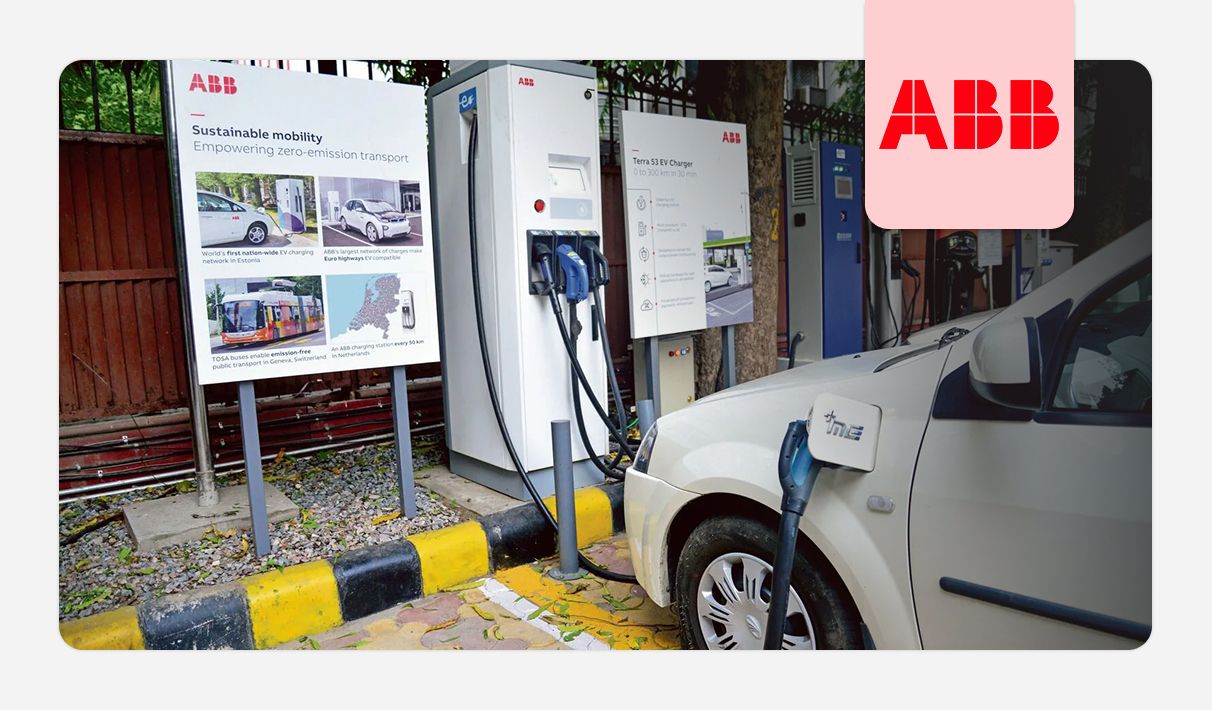
    – Terra Series ultra-fast chargers (100–360kW), suitable for highway corridors and public fast-charging stations
    – Heavy-Duty Chargers (up to 1.2 MW), tailored for buses, trucks, and fleet depots

    All ABB chargers are designed for modular scalability, cloud integration, and multi-vehicle compatibility.

    Flagship Innovation: Terra 360

    ABB’s Terra 360 is among the world’s fastest EV chargers and is available in the Indian market. It can charge up to four vehicles simultaneously, delivering up to 100 km of range in under 3 minutes. The charger features dynamic load distribution and is optimized for high-footfall, high-demand public charging environments.

    Manufacturing & Infrastructure

    ABB India produces several of its EV charging units locally, supporting India’s Make in India goals. Its chargers have been deployed at premium retail hubs, national highways, fleet depots, and OEM facilities. Globally, ABB has sold over 14,000 DC fast chargers across 80+ countries, including key deployments in India in collaboration with Audi, BHEL, and NITI Aayog.

    Software Ecosystem

    ABB’s hardware is supported by ABB Ability™, a cloud-based platform that allows:

    • Remote monitoring and diagnostics
    • Predictive maintenance
    • Real-time alerts and performance analytics
    • Integration with smart grid and energy management systems

    ABB’s 2022 acquisition of Numocity further enhances its ability to offer India-specific software features, including fleet monitoring and mobile-based payments.

    Interoperability & Growth Model

    ABB works closely with automakers, public agencies, and infrastructure providers to ensure that its chargers are OEM-agnostic, grid-compatible, and built for high-uptime usage. Its equipment is

    tailored for heavy-duty commercial EVs, long-distance travel, and high-volume public usage, making it a preferred supplier for high-throughput nodes like expressways, bus depots, and metro cities.

    8. Fortum GLIDA
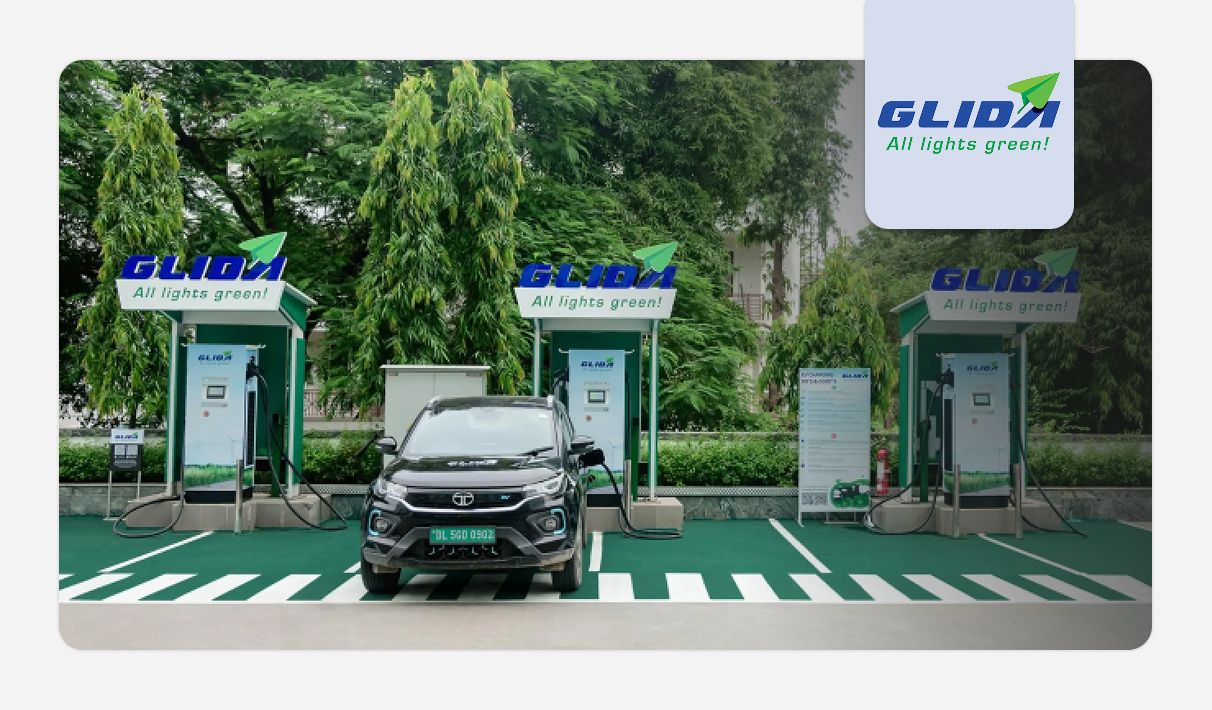
    8.jpg

    Company Overview

    Fortum GLIDA (formerly known as Fortum Charge & Drive India) is the EV charging subsidiary of Fortum India, part of the Finland-based Fortum Group. The company entered the Indian EV infrastructure space in 2017 and has since built a growing network of fast-charging stations across highways, cities, and commercial spaces. With over 740+ charging points across 30+ cities and 16 states, Fortum GLIDA has positioned itself as a premium provider of fast and ultra-fast charging solutions, with a focus on seamless user experience and long-distance travel compatibility.

    Product Portfolio

    GLIDA offers a range of AC and DC chargers catering to multiple segments:

      • AC Type 2 chargers (7.4–22kW): For residential, retail, and low-traffic urban areas
      • DC Fast Chargers (30–200kW): Designed for highway routes, fleet hubs, and high-footfall locations

    – Includes 30kW and 60kW CCS2 dual-gun models
    – 200kW ultra-fast chargers with modular satellite dispensers for high-speed multi-vehicle charging

    All chargers are designed to be operator-agnostic and compliant with Bharat EV standards.

    Flagship Infrastructure

    One of Fortum GLIDA’s standout installations is located near Hyderabad’s Shamshabad Airport, a one-acre site housing India’s first 200kW ultra-fast charger, equipped with six satellite dispensers. The company has also established over 180 charging stations nationwide, with a major presence in Hyderabad, Indore, Rajkot, and several National Highway corridors.

    Manufacturing & Infrastructure

    While Fortum imports high-power hardware through global OEM partnerships, it increasingly relies on local integration and modular design through partners like Kempower. The focus is on deploying scalable, fast-charging hubs that can handle growing demand without requiring massive physical footprints.

    Software Ecosystem

    Fortum GLIDA complements its hardware with a fully functional mobile and RFID-enabled platform:

    • The GLIDA app allows users to locate chargers, track sessions, view live availability, and pay via UPI, credit card, or wallets
    • RFID support includes both virtual and physical cards
    • Transparent pricing, session history, and usage logs are integrated into the app’s dashboard

    Interoperability & Growth Model

    GLIDA emphasizes network openness and strategic placement. It partners with hotels, malls, fuel stations, and highway operators to deploy chargers at high-dwell-time locations, enhancing convenience for users. The company’s rebranding to “GLIDA” (Swedish for “glide”) in 2023 reflects its vision of delivering a frictionless EV experience, summarized by its tagline: “All lights green.”

    9. Okaya EV Charging Solutions
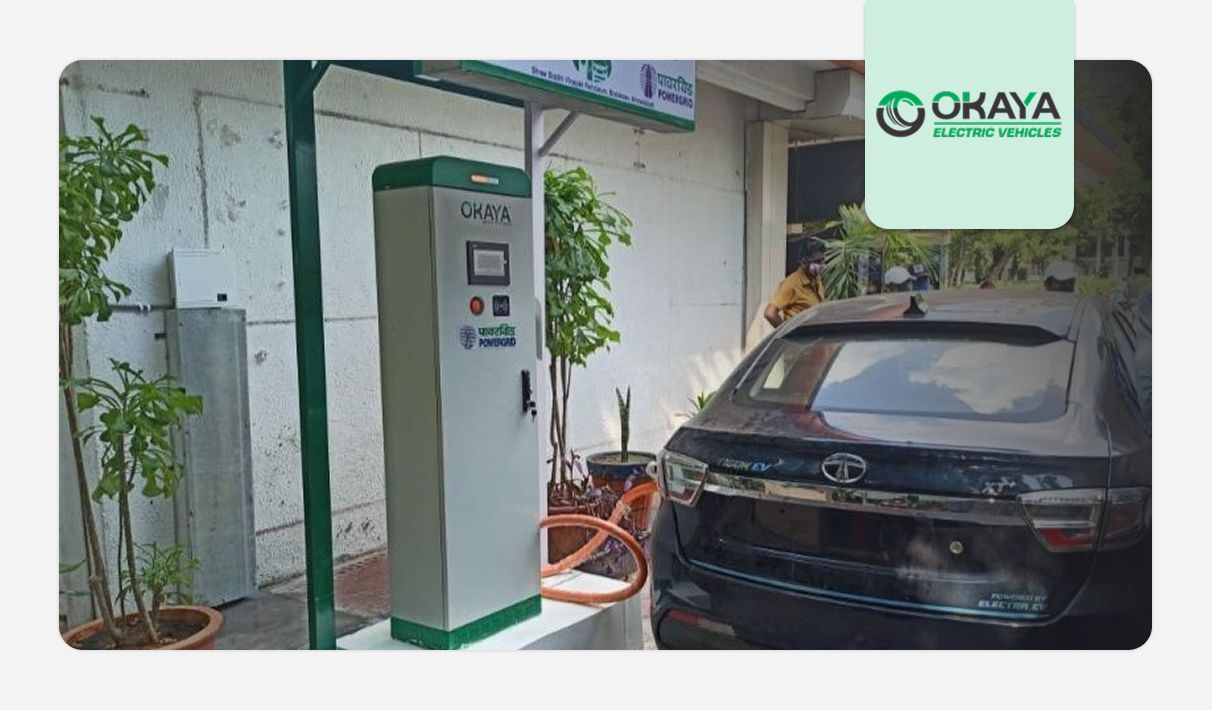
    9.jpg

    Company Overview

    Okaya EV Charging Solutions is a division of the Okaya Power Group, headquartered in New Delhi, and one of India’s fastest-growing EV charging infrastructure providers. Officially entering the EV segment in 2020, Okaya has quickly established itself as a key player across both AC and DC charging segments. The company supports 2-, 3-, and 4-wheeler EVs, with deployments across public charging stations, fuel retail networks, and fleet depots. As of 2024, Okaya claims to hold a 40% market share in India’s EV charger manufacturing landscape.

    Product Portfolio

    Okaya manufactures and supplies a wide range of EV charging products, including:

    • AC Chargers: 3.3kW, 7.4kW, and 22kW for residential, institutional, and commercial use
    • DC Fast Chargers: 30kW, 60kW, 120kW, and 360kW models, supporting CCS2, CHAdeMO, GB/T standards
    • Battery Swapping Solutions: For two- and three-wheeler fleets in the logistics and ride-share segments
    • Chargers are multi-standard compatible, including Bharat AC001, IEC Type 2, and ARAI/iCAT-certified

    Flagship Deployments

    Okaya has secured several high-impact charging infrastructure contracts:

    • HPCL Partnership: Contracted to deploy 600 DC fast chargers (60kW and 120kW) across HPCL fuel stations nationwide
    • Indian Oil Corporation (IOCL): Collaborated to install 2,550 chargers—both AC and DC—under a ₹125 crore program
    • Shell India: Partnered to deploy a mix of 3.3kW to 360kW chargers at Shell forecourts, with initial rollouts in Bengaluru

    Manufacturing & Infrastructure

    Okaya handles end-to-end manufacturing with a large workforce and OEM-scale production capacity. Although exact factory locations are not publicly disclosed, its execution of PSU-level contracts signals a robust supply chain and high-volume deployment capabilities.

    Software Ecosystem

    Okaya chargers come with smart features and integrated safety systems:

    • User Interface: 5-inch LCD touchscreens, RFID, and QR code-based authentication
    • Connectivity: App-based monitor
    • Safety: Multi-layer protection including surge protection, over-voltage cut-off, and emergency shutdown
    • Certifications: ISO 9001, 14001, 50001; ARAI and iCAT approvals

    Interoperability & Growth Model

    Okaya’s strategy revolves around multi-standard compatibility and PSU partnerships. By integrating its chargers into existing fuel station infrastructure (HPCL, IOCL, Shell), the company ensures high visibility and consistent utilization across high-footfall public spaces. It also supports battery-swapping readiness for commercial fleets.

    10. Volttic EV Charging Solutions
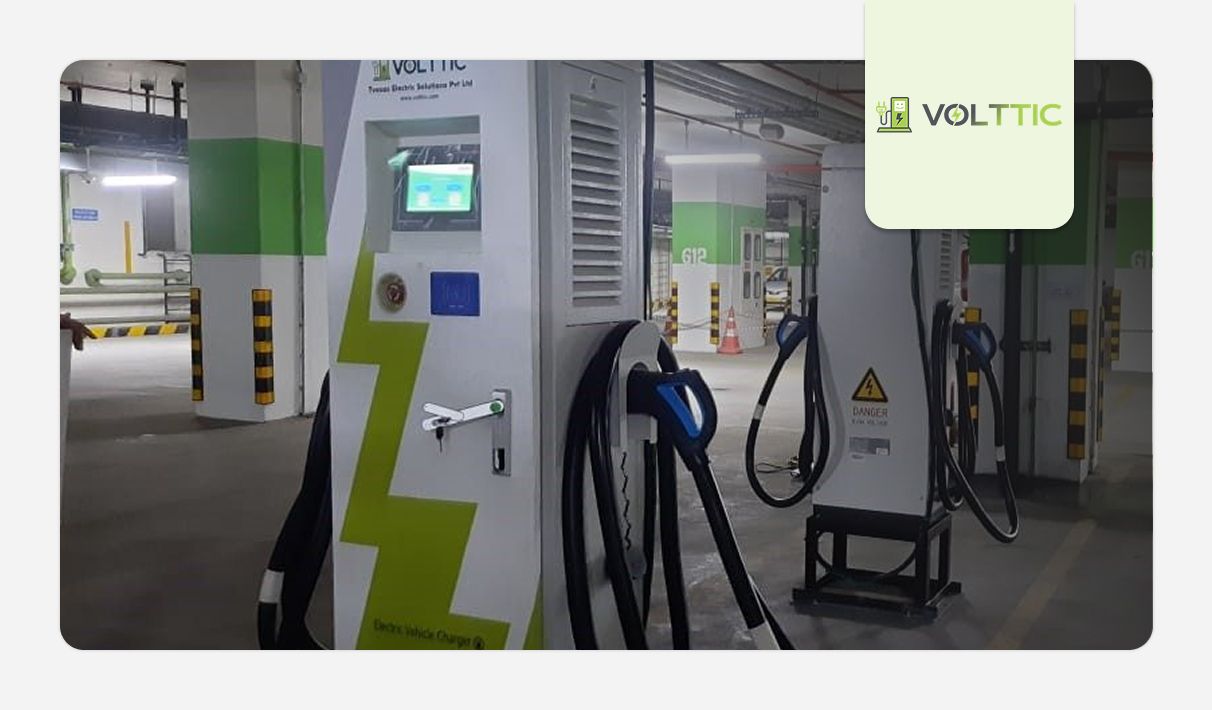
    10.jpg

    Company Overview

    Volttic EV Charging Solutions is the charging infrastructure division of Tvesas Electric Solutions Pvt. Ltd., founded in 2017 and headquartered in Lucknow, Uttar Pradesh. The company offers end-to-end EV charging solutions with a growing presence across 20+ Indian states. With over 1,400 operational charging points, Volttic caters to residential

    societies, corporate campuses, fleet operators, commercial hubs, and highway locations, positioning itself as a turnkey provider in India’s evolving EV landscape.

    Product Portfolio

    Volttic provides a wide range of charging solutions across multiple vehicle categories:

      • AC Chargers (3.3kW – 22kW): Wall- and pole-mounted Type 2 and Bharat AC001 units for residential and commercial use
      • DC Fast Chargers (15kW – 240kW):

    – Bharat DC001 chargers for light commercial use
    – CCS2 chargers at 60kW, 120kW, and 240kW levels, including models tailored for bus and truck applications

    All chargers are OCPP-compliant and support RFID, QR code, and app-based access.

    Flagship Deployments

    • Bengaluru Campus Project: Volttic deployed 5×60kW DC fast chargers and 40 AC slow chargers at a large corporate campus, enabling up to 150 charging sessions per day.
    • Highway Installations: The company has installed 60kW CCS2 fast chargers at premium hotel chains and workplace hubs across Hyderabad and Bengaluru.
    • Fleet Infrastructure: Customized high-power charging solutions for commercial EV fleets, including electric buses and trucks.

    Manufacturing & Infrastructure

    Volttic manages the full EPC lifecycle, from site feasibility and power upgrades to charger installation, civil works, and ongoing operations. While it sources components through certified vendors, the company’s strength lies in deployment speed, maintenance SLAs, and its ability to deliver across both greenfield and brownfield sites with minimal downtime.

    Software Ecosystem

    Volttic’s backend platform includes an IoT-enabled CMS and a user-friendly mobile app that enables:

    • Real-time charger status updates and diagnostics
    • Seamless payments through QR code, RFID, or in-app options
    • Session tracking, analytics, and backend alerts for maintenance and performance issues

    This ensures smooth operations for users and hosts alike across corporate and public environments

    Interoperability & Growth Model

    Volttic follows a turnkey EPC delivery model, allowing site owners to either own the infrastructure or partner via leasing and O&M contracts. The network is vehicle-agnostic, and chargers are compatible with multiple standards, including CCS2 and Bharat protocols, making them suitable for diverse vehicle fleets and real estate environments.

    Final Thoughts

    As India accelerates toward a cleaner and smarter mobility future, electric vehicles are quickly becoming a practical and rewarding choice for individuals and businesses alike. From significantly lower running costs and minimal maintenance to government-backed incentives like purchase subsidies and registration benefits, EVs offer compelling advantages beyond just environmental impact.

    However, choosing the right charging infrastructure is just as important as selecting the vehicle itself. The manufacturers featured in this list are not only building the backbone of India’s EV ecosystem but also shaping how easy, accessible, and reliable electric mobility becomes in the years ahead.

    Want to install EV chargers at your location? Book a FREE site assessment with Bolt.Earth.
    Visit bolt.earth or contact us at [email protected] / +91 80456 88455 to get started.
  • Why Blaze DC Is the Right Choice for Delivery Hubs

    Why Blaze DC Is the Right Choice for Delivery Hubs

    Delivery hubs are the nerve centers of India’s fast-moving urban economy, powering everything from food orders and grocery runs to last-mile logistics. At the center of this network are EV fleets, especially two- and three-wheelers, covering millions of kilometers every day.

    In this blog, we break down 9 key reasons why Blaze DC is the right choice for delivery hubs, from minimizing idle time and improving fleet turnaround to unlocking government incentives and enabling scalable, on-the-ground execution. Learn everything you need to know.

    Many platforms like Yulu, Zepto, Swiggy, and Zomato are committed to going electric in the coming years.

    But there’s one operational constraint that can bring even the best-run hub to a halt: charging downtime.

    Depot-based charging locks vehicles out of circulation for hours—an unscalable model for businesses built on speed. What delivery hubs need instead is fast, distributed, and intelligent charging, a solution that works around the pace of operations, not against it.

    That’s where Blaze DC comes in: a rugged, modular, and ultra-fast charging solution built to scale across dense urban networks and distributed delivery hubs.

    9 Reasons Why Blaze DC Is a Game Changer for Delivery Hubs

    1. Maximizes vehicle utilization

    Delivery hubs thrive on high throughput, fleets often run 10–12-hour shifts with tight delivery windows. Any vehicle offline for depot-only charging (3–4 hrs per cycle) drastically undermines productivity. Fast charging at the hub enables quick 15-minute top-ups, allowing vehicles to return to service swiftly and complete more daily trips.

    Blaze DC is built to match that pace, with charging variants that flex across use cases, from neighborhood dark stores to high-volume sorting centers.

    Each model is designed for a different level of operational intensity:

      • 3 kW (Single / Dual Gun): ~40 km of range in 15 minutes

    Perfect for 2W fleets handling short-haul food or grocery deliveries, especially in residential zones where single-phase power is the norm.

      • 6 kW: ~80 km in 15 minutes

    Suited for e-rickshaws and 3W cargo vehicles handling medium-distance logistics or shift-based models. Fits well at mid-size delivery hubs with moderate load cycles.

      • 12 kW: ~120 km in 15 minutes

    Made for high-density hubs with round-the-clock operations. Ideal for urban sorting centers, transit points, or highway-linked fulfillment sites with heavy 3W movement.

    Blaze DC’s ability to deliver quick top-ups between delivery cycles keeps vehicles moving without disruption.

    This enables:

    • More trips per shift
    • Reduced dead mileage to and from depot chargers
    • Lower per-delivery charging costs
    • Greater flexibility in hub layout and charger placement

    In short, Blaze DC gives delivery hubs the speed, scalability, and uptime required to keep India’s last-mile economy running.

    2. Strategically distributed charging cuts deadhead miles

    Centrally located chargers force vehicles to travel back and forth solely to recharge—creating deadhead miles and reducing daily last-mile efficiency. Blaze DC’s distributed model transforms this, enabling more flexible operations.

    Research supports distributed charging strategies:

    • BCG shows that strategic routing and charging points can reduce unnecessary cruising by up to 70%, enhancing fleet utilization by nearly 40%.
    • Academic research shows that doubling charger density can reduce detour miles by around 58%, thanks to smarter charging placements.
    • For high-frequency fleets, even a minor diversion adds up: adding 3 km extra per trip per 100 vehicles means 300 km of wasted distance daily—time that could have been spent delivering.

    By installing Blaze DC fast chargers at dark stores, micro-fulfillment centers, storefronts, and highway pit stops, hubs bring power where vehicles already operate.

    This “charge-where-you-serve” strategy:

    • Slashes deadhead mileage and idle time
    • Enhances delivery density by improving the trip-to-charge ratio
    • Reduces vehicles needed to maintain the same service level
    • Lowers operating costs from efficient battery use and fleet scheduling
    • Improves battery lifespan through frequent mid-shift top-ups

    Understanding distributed charging through an example:

    Imagine this: A mid-sized delivery hub operating 100 EVs, each making 20 trips a day.

    With traditional depot charging, vehicles return to a central location to recharge, wasting around 150 km per day in return trips alone.

    Switching to Blaze DC can reduce off-route charging by up to 50%. That’s a weekly savings of approximately 75 vehicle-hours, time that can now be spent on actual deliveries, not detours.

    3. Built for safety, intelligence, and reliability

    Picture1.jpg
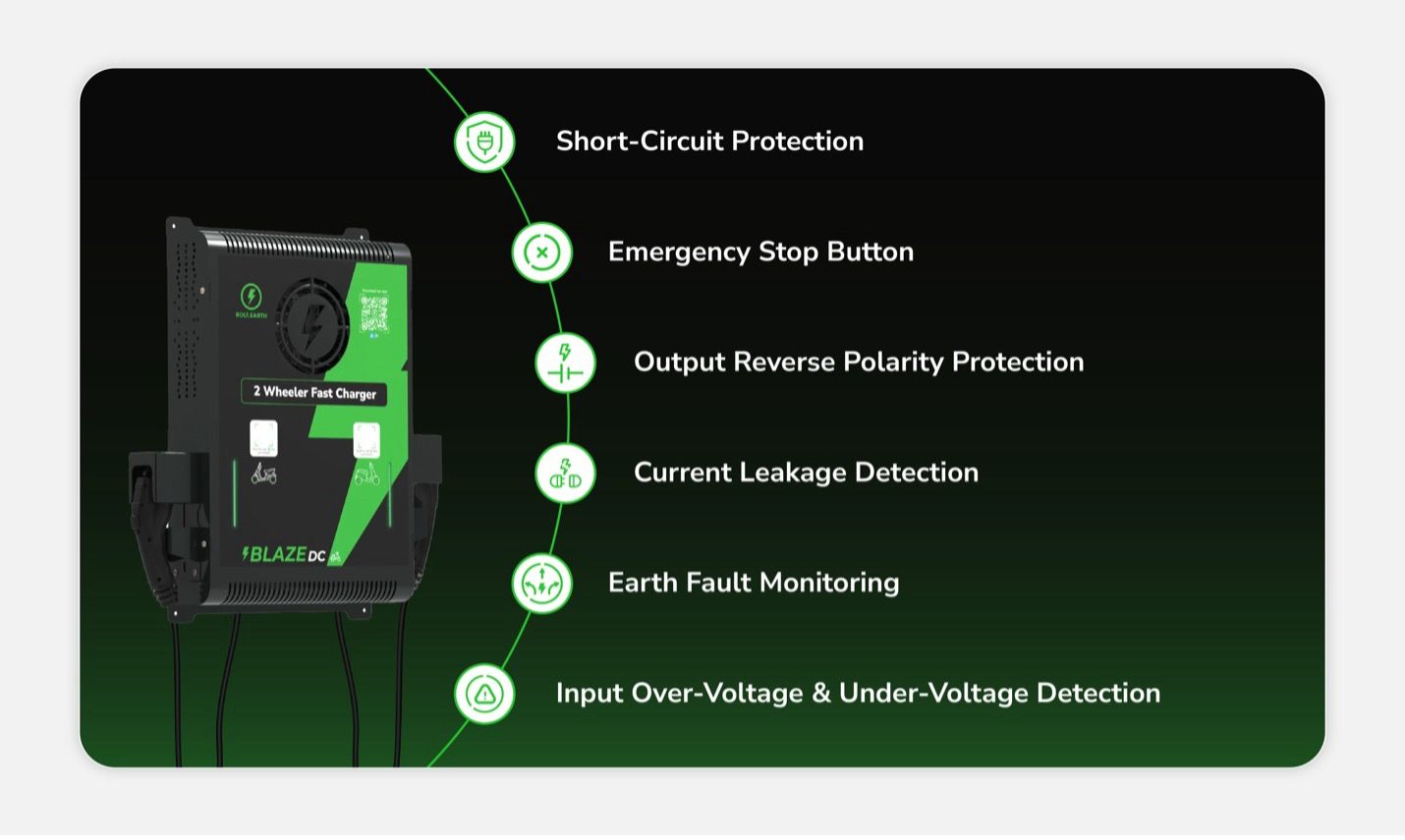
    Every Blaze DC unit is equipped with a multi-layer protection system engineered to handle the fast-paced, high-frequency charging demands of delivery hubs:

    • Short-Circuit Protection
    • Input Over-Voltage & Under-Voltage Detection
    • Output Reverse Polarity Protection
    • Current Leakage Detection
    • Earth Fault Monitoring
    • Emergency Stop Button

    These protections are fully automated; no technician or intervention is required mid-shift. Chargers self-monitor in real time, ensuring each session is safe for riders, ground staff, and the equipment itself.

    Beyond safety, Blaze DC is natively integrated with Bolt.Earth CMS, providing delivery hub managers with:

    • Live charger status across all hub locations
    • Instant fault diagnostics and performance alerts
    • Predictive maintenance triggers before downtime hits
    • Remote support and servicing to reduce on-site disruptions

    For delivery hubs running 24/7 with hundreds of daily charge cycles, Blaze DC offers what matters most: no surprises, no blind spots, and no missed deliveries due to charger issues.

    4. India’s first universal fast charger for 2- and 3-wheelers

    Picture3.jpg
    Current policy mandates a public charger every 3 km in cities and fast chargers every 25 km on highways. While CPOs have deployed thousands of chargers across the metro, many are still inaccessible or impractical for delivery hubs.

    Here’s what’s missing in most of today’s fast-charging networks:

    • Single-brand focus that limits use for mixed EV fleets
    • Consumer-first designs, not suited for high-traffic, round-the-clock logistics
    • Premium location bias, with most units in gated societies or malls—not near kirana stores, warehouses, or dark stores

    Blaze DC attempts to correct this imbalance.

    Its compact, wall-mountable form factor is ideal for space-constrained hub environments—parking bays, alleyways, loading zones, and even sidewalls at micro-fulfillment centers.

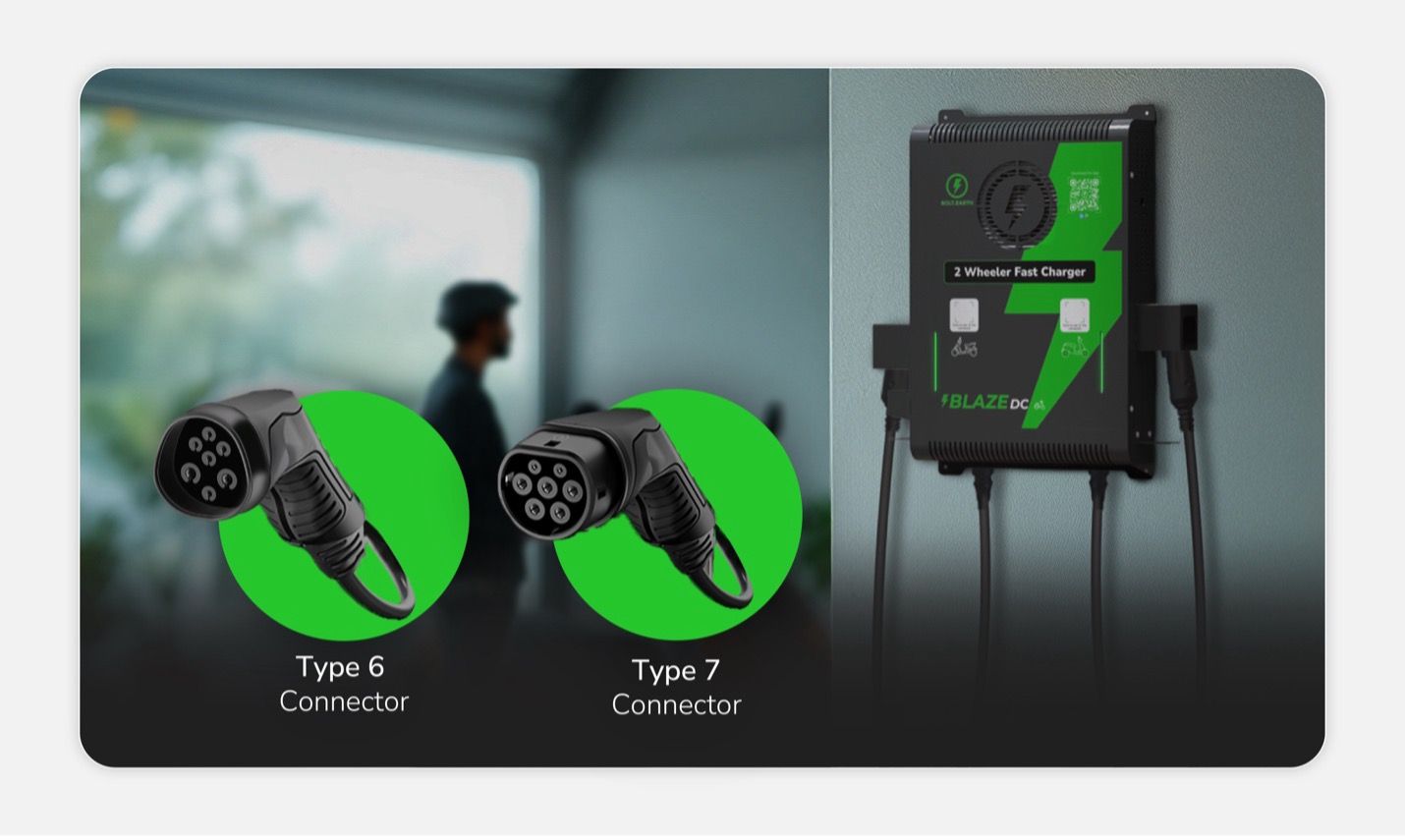
    Blaze DC is India’s first universal DC fast charger for 2- and 3-wheelers that supports both:

    • Type 6 (BCA-endorsed, IEC 62196-6)
    • Type 7 (formally BIS-approved under LECCS)

    This makes it compatible with over 90% of fast-charging EVs on Indian roads, including:

    • 2W delivery bikes: Ather, Ola, Hero, Simple Energy
    • 3W cargo vehicles: Bajaj, Mahindra, Euler, Altigreen, and more

    With Blaze DC, you can deploy a charger once, and charge any vehicle that shows up.

    5. Eligible for 80% government subsidies

    Under the Government of India’s PM E-DRIVE scheme, fleet operators, charging partners, and CPOs are now eligible for up to 80% subsidy on infrastructure costs for public fast-charging stations. That includes expenses like transformers, grid upgrades, and electrical cabling, the most capital-intensive components of any deployment. In exceptional cases, the scheme allows 100% subsidy coverage for critical power infrastructure.

    The only DC fast charger in India eligible under the scheme, Blaze DC’s 12 kW variant, meets all subsidy criteria. That means for every ₹1 crore invested, fleet operators and site partners can recover up to ₹80 lakh.

    Why it matters for fleet operators:

    • Cost barrier drops: Set up a fast-charging hub with just 20% of the usual upfront CAPEX. Meaning for every ₹1 crore invested, operators can recover up to ₹80 lakhs.
    • 2-scale-ready rollouts: With reduced costs, fleet operators can deploy multiple Blaze DC units across cities, creating a network of on-route fast chargers.
    • Subsidy-backed certainty: As fuel prices fluctuate, this scheme creates a reliable framework to invest in dependable charging infrastructure

    6. Built for measurable efficiency

    High-frequency delivery hubs operate where every second—and every rupee—counts. Blaze DC delivers not just faster charging but measurable business outcomes.

    • 4× less vehicle downtime

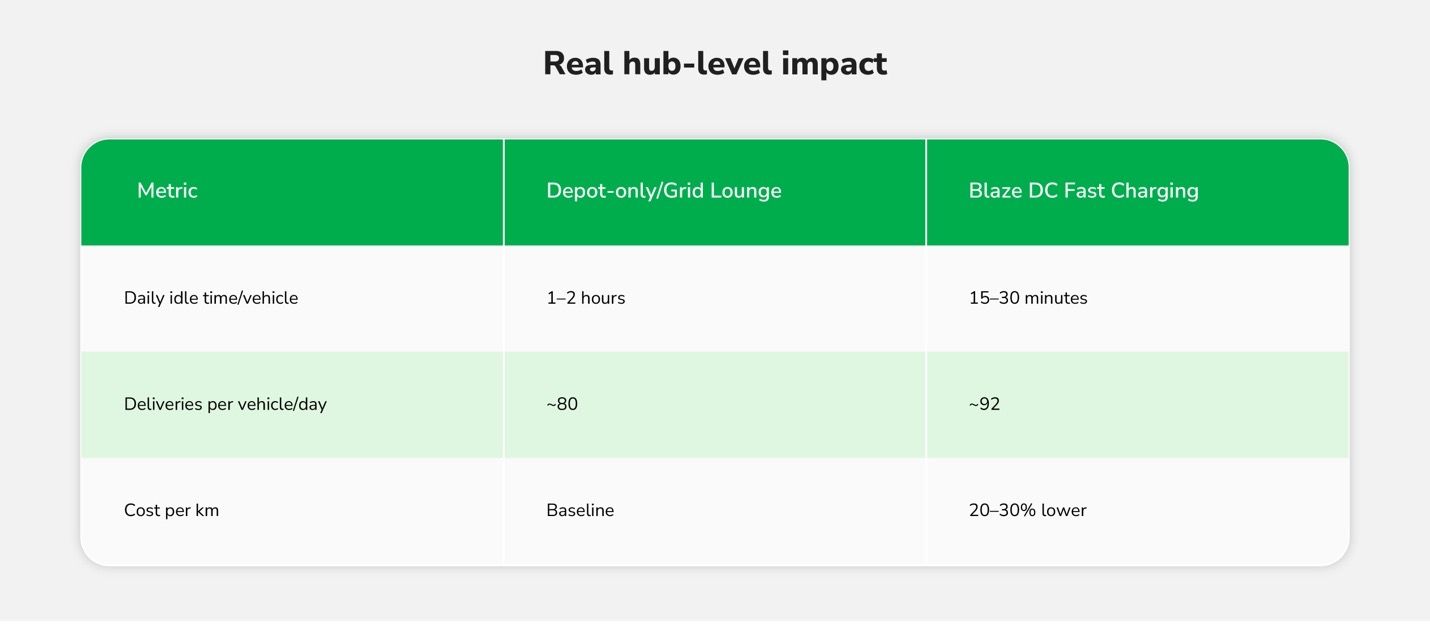
    A comparative study of 500 e-scooters in quick-commerce hubs found vehicle utilization increased dramatically with fast charging—enabling 92 deliveries/day versus 78/day with slower alternatives. Fast charging effectively slashed idle and charging downtime by up to 4×, making each vehicle significantly more active over its shift

    • 30–40% higher delivery density

    Fast chargers installed at dark stores deliver a 4–5 km coverage radius, with downtime averaging just 22 minutes/day—compared to 47 minutes with battery swap stations. This increase in availability boosted delivery density by roughly 30–40% per shift, meaning more earnings and fewer idle cycles.

    • 20–30% lower cost-per-km

    Fast charging’s operational efficiency also drives lower running costs:

    • Energy rates around ₹9–10/kWh and INR 400–600 monthly maintenance per vehicle.
    • Battery swap alternatives, by contrast, cost INR 11–13/kWh with higher infrastructure charges.
    • This efficiency delivered a 20–30% reduction in cost per kilometer, translating to real savings across high-volume hub operations.

    Picture4.jpg

    7. Minimizes costly downtime

    Delivery hubs operate under razor-thin timelines. When a fleet depends on 3–7 kW depot chargers, each full recharge can take 6–8 hours, making them practically unusable during busy shifts.

    A 30-minute delay per vehicle per session, for a hub of 100 EVs, adds up to 50 hours of lost productivity every day. That’s 50 hours not spent on deliveries but stuck in downtime.

    With Blaze DC, you can change this:

    • The 12 kW Blaze DC variant adds 120 km in just 15 minutes, reducing idle time by over . That means vehicles can remain in circulation instead of being sidelined.

    In essence, fast charging converts hours of downtime into effective vehicle time—directly boosting daily throughput, maximizing delivery potential, and helping hubs meet the demands of high-frequency, time-sensitive fleets.

    8. Supports policy-aligned charging

    India’s EV policy mandates a well-balanced mix of 3 kW, 7 kW, and high-power DC chargers across urban and highway corridors. But most installed chargers are slow-to mid-speed AC units, better suited to private vehicles—not the fast-paced, high-frequency demands of delivery hubs.

    For high-throughput operations handling thousands of orders a day, this gap is operationally unsustainable.

    Blaze DC bridges this policy-to-practice disconnect.

    With variants from 3 kW to 12 kW, Blaze DC delivers:

    • The speed needed to keep 2W and 3W fleets in constant motion
    • The scalability required to match hub density and rider volume
    • And full alignment with national fast-charging mandates

    This makes Blaze DC a practical choice not just for compliance but for performance.

    9. Designed for uptime

    When dozens—or even hundreds—of EVs are cycling through a hub daily, every minute a charger is offline impacts fulfillment rates, trip targets, and service SLAs.

    Blaze DC comes with Field Replaceable Units (FRUs)—a modular hardware system that allows key components such as the power module, charging gun, controller, communication board, 4G module, SMPS, and contactors to be swapped on-site within minutes by any certified technician.

    For hub operators, this removes one of the biggest operational hassles: waiting hours (or days) for technical support or specialized parts.

    Instead, Blaze DC enables:

    • Rapid fault resolution, even in peak load scenarios
    • Minimal disruption to vehicle charging queues
    • Lower maintenance costs with no dependency on OEM service calls
    • High charger uptime translates directly into more fulfilled deliveries

    Final Thoughts

    In a world where every second counts and every delivery window matters, Blaze DC gives delivery hubs exactly what they need to stay ahead—fast charging, minimal downtime, universal EV compatibility, and infrastructure that scales with demand.

    Whether you operate a network of dark stores, manage a centralized fulfillment center, or run hyperlocal delivery clusters, Blaze DC ensures your EV fleet stays charged, available, and efficient.

    For delivery hubs looking to electrify at speed—and at scale—this is the infrastructure built to keep up.

    To deploy Blaze DC at your hub, speak with our team today.

    Email: [email protected]

    Phone: +91 80456 88455
    Visit bolt.earth to explore Blaze DC in detail

  • Why Blaze DC Is the Right Choice for Urban Fleet Operators

    Why Blaze DC Is the Right Choice for Urban Fleet Operators

    Fleet vehicles are the bloodstream of India’s urban mobility, from food delivery bikes and app-based taxis to logistics vans and quick commerce two- and three-wheelers. While exact figures vary, fleet operators account for over 50% of commercial vehicle operations in major metros like Delhi, Bengaluru, and Mumbai.

    In this blog, we explore 5 key reasons why Blaze DC is the right charging solution for urban fleet operators in India. From meeting operational demands and reducing downtime to driving real business impact, we also highlight how Blaze DC helps you qualify for government incentives, making the shift to EVs more cost-effective and scalable.

    Read on to discover the key features and benefits that make this fast charger a strategic enabler for fleet efficiency, uptime, and business scalability.

    Platforms like Swiggy and Zomato employ over 590,000 delivery riders, most on EV two-wheelers. Both companies have announced plans to switch to a 100% electric fleet by 2030. Meanwhile, quick-commerce platforms like Zepto, Blinkit, and Instamart are driving hyper-local delivery demand, achieving $5–6 billion in annual Gross Merchandise Value (GMV) and expanding their EV fleet and dark stores aggressively.

    With large sections of rickshaw and scooter fleets now electric, these vehicles collectively cover hundreds of millions of kilometers daily, and downtime even for a couple of hours can quickly cascade into lost deliveries, missed rides, and escalated costs.

    And here lies the challenge.

    Most current fleet operations still rely on 3kW slow chargers or 7kW mid-speed alternatives—both incompatible with high-throughput commercial models. Fleet uptime demands faster turnarounds. Charging can’t be limited to central depots. It must be distributed and made available across every urban corner.

    Blaze DC was designed precisely for this.

    5 reasons why Blaze DC is a game changer for fleet operator

    1. Power options that match your fleet’s reality

    Fleet operations aren’t built around overnight charging—they’re built around uptime. Every idle minute affects delivery volumes, trip density, and revenue per rider. Blaze DC is engineered to match this pace, with performance tiers that scale from small local fleets to enterprise-grade deployment. Each variant is designed for a different level of operational demand:

    • 3kW (Single/Dual Gun): Adds ~40 km of range in just 15 minutes. Ideal for lightweight 2W fleets like food delivery and pharmacy riders operating on single-phase setups or for shared use in residential or retail environments.
    • 6kW: Delivers ~80 km in 15 minutes. Built for 3W logistics fleets, B2B mobility services, and high-frequency use cases where a single 3kW gun may fall short. Works perfectly for shift-based recharging at regional hubs.
    • 12kW: Enables ~120 km in 15 minutes. Tailored for high-volume fleets, public charging corridors, and last-mile operators needing quick turnaround. Its three-phase setup and high throughput make it ideal for highway pitstops, logistics parks, and central depots.

    What sets Blaze DC apart is repeatability; it lets riders get quick top-ups throughout their route without needing to take time off duty. This means,
    more deliveries per shift

    • Better trip-to-charge ratios
    • Lower cost per km compared to depot-only models
    • No over-reliance on a single location or power source

    2. Safety, smartness & reliability: Engineered into every unit

    For fleet operators, reliability is a requirement. One offline charger or an unscheduled trip to a depot can have a ripple effect across a fleet. That’s why Blaze DC is built not just for speed but for safety, uptime, and peace of mind on every route.

    Blaze DC units are equipped with an advanced multi-layer protection system that ensures fail-safe performance across any urban deployment condition:

    • Short-Circuit Protection
    • Input Over-Voltage & Under-Voltage Detection
    • Output Reverse Polarity Protection
    • Current Leakage Detection
    • Earth Fault Monitoring
    • Emergency Stop Button

    These protections are automated and always active, requiring no user intervention. The system continuously monitors charging parameters in real time, ensuring that every session begins and ends safely, whether it’s being used by a fleet rider, a ground staff member, or a third-party driver.

    But safety is only part of the equation. Blaze DC is also smart—natively connected to the Bolt.Earth CMS, which powers:

    • Live charger status monitoring across all locations
    • Instant diagnostics and error detection
    • Predictive maintenance alerts that flag potential issues before they cause downtime
    • Remote servicing capabilities to minimize manual intervention

    For large-scale operators managing 10, 100, or even 1,000+ vehicles, this means centralized visibility, zero guesswork, and significantly lower operational disruption.

    3. India’s first universal fast charger for 2- and 3-wheelers

    Under national policy, cities are mandated to have at least one public charger every 3 km and fast-charging stations every 25 km along major highways and arterial roads. And while India’s Charge Point Operators (CPOs) have made visible progress, installing thousands of chargers across major metro cities, most of them remain limited in scope and purpose.

    Today’s fast-charging landscape is still heavily skewed toward the following:

    • Single-brand compatibility limits accessibility for fleet operators using mixed EV models
    • Consumer-focused scooter networks, not optimized for rugged, high-utilization fleet environments
    • Installations in premium or gated zones, leaving most roadside and Tier 2–3 routes underserved

    Blaze DC closes this gap between policy ambition and real-world fleet requirements.

    • Compact & wall-mountable: Fits into India’s urban texture, parking lots, society gates, kirana storefronts, and fuel stations, with minimal space or civil work required.
    • Truly universal compatibility: Blaze DC is India’s first-ever universal DC fast charger for 2- and 3-wheelers. It supports both: Type 6 connector (BCA-endorsed, IEC 62196-6 standard) and Type 7 connector (formally BIS-approved under the Indian LECCS standard)
    • Compatible with 90%+ of EV models on the road: From Ather and Ola to Simple Energy, Matter, and Hero MotoCorp, Blaze DC is designed to serve mixed fleets, multi-brand deployments, and future-proof vehicle platforms

    For fleet operators relying on 2- and 3-wheelers to power last-mile deliveries, logistics routes, and ride-share networks, universality isn’t a feature; it’s a necessity. With Blaze DC, you’re not tied to a single brand, platform, or protocol.

    4. Eligible for 80% government subsidies

    Under the Government of India’s PM E-DRIVE scheme, fleet operators, charging partners, and CPOs are now eligible for up to 80% subsidy on infrastructure costs for public fast-charging stations. That includes expenses like transformers, grid upgrades, and electrical cabling—the most capital-intensive components of any deployment. In exceptional cases, the scheme allows 100% subsidy coverage for critical power infrastructure. The only DC fast charger in India eligible under the scheme, Blaze DC’s 12 kW variant, meets all subsidy criteria. That means for every ₹1 crore invested, fleet operators and site partners can recover up to ₹80 lakh.

    Why it matters for fleet operators:

    • Cost barrier drops: Set up a fast-charging hub with just 20% of the usual upfront CAPEX. Meaning for every ₹1 crore invested, operators can recover up to ₹80 lakhs.
    • Scale-ready rollouts: With reduced costs, fleet operators can deploy multiple Blaze DC units across cities—creating a network of on-route fast chargers.
    • Subsidy-backed certainty: As fuel prices fluctuate, this scheme creates a reliable framework to invest in dependable charging infrastructure.

    5. Complementary to India’s fast-charging mandate

    India’s EV policy mandates a structured mix of 3 kW, 7 kW, and high-power DC fast chargers for urban and highway networks. But in practice, most deployments have focused on slow- to mid-speed AC chargers, which don’t meet the needs of high-utilization commercial fleets.

    With Blaze DC’s fast-charging variants – 3 kW to 12 kW, you get the speed and flexibility needed for real-world fleet operations while staying aligned with policy expectations.

    This translates to:

    • A more practical deployment model for CPOs
    • A reliable uptime strategy for fleet operators
    • A direct contribution to India’s clean mobility goals—without compromise on scale or speed

    In high-velocity fleet operations, downtime is expensive. That’s why Blaze DC is engineered with Field Replaceable Units (FRUs), allowing critical components to be replaced on-site, within minutes, by any certified electrician, and without specialized tools.

    This includes the power module, controller, contactors, charging gun, 4G module, communication board, and SMPS.

    For fleet operators, this means

    • Rapid fault resolution across both high-traffic and remote locations
    • Minimal disruption during peak hours
    • Lower servicing overhead with no reliance on specialized technicians
    • Consistent charger uptime, keeping vehicles on the move and operations running smoothly

    Instead of losing hours (or days) to repair-related downtime, Blaze DC gets back online in minutes—delivering uptime that logistics and delivery fleets can count on.

    Final Thoughts

    In a market defined by high-utilization vehicles, tight delivery schedules, and rising electrification targets, Blaze DC meets the moment. It delivers what today’s urban fleet operators truly need: fast, distributed charging; universal compatibility; high uptime; and policy-aligned scale. Whether you manage a dozen EVs or a city-wide fleet, Blaze DC offers the performance, reliability, and flexibility your vehicle needs.

    If you’re looking to deploy Blaze DC at your home, commercial site, or fleet hub, you can purchase directly from Bolt.Earth website or get in touch with our team in case you have any questions.
    Email: [email protected]

    Phone: +91 80456 88455

  • Introducing Blaze DC: India’s First-Ever Universally Compatible Fast Charger for 2- and 3-Wheelers

    Introducing Blaze DC: India’s First-Ever Universally Compatible Fast Charger for 2- and 3-Wheelers

    Six years after deploying our first charger, we’ve now launched Blaze DC — a fast-charging solution shaped by everything we’ve learned from operating India’s largest EV charging network, with 1 lakh+ chargers across 2,000+ cities.

    It combines our latest advancements in hardware, software, and grid integration to deliver what we consider the ideal, universal fast charger for India’s two- and three-wheeler EVs.

    Refined through real-world insights and proudly built in India, Blaze DC is the most accessible and future-ready charging experience yet.

    Why India Needs a Fast Charger for 2- and 3-Wheelers


    India’s EV revolution is led by two- and three-wheelers. Together, they account for over 90% of all electric vehicles sold in the country. Two-wheelers alone made up 59% of EV sales in 2024, with three-wheelers close behind at 35%.

    But while adoption has surged, infrastructure hasn’t kept pace. Four-wheelers enjoy access to a growing DC fast-charging network, but for 2- and 3-wheelers, it’s still virtually nonexistent. It’s fragmented — slow sockets at home, brand-specific setups, or improvised, often unsafe, public workarounds.

    Governments are beginning to take notice. In cities like Delhi, local authorities have flagged safety and reliability concerns, particularly around unauthorized e-rickshaw charging hubs, and are calling for dedicated fast-charging stations.

    Industry projections show the two-wheeler fast-charging station market is expected to grow at over 30% CAGR, reaching nearly USD 1.85 billion by 2032.

    Blaze DC is our answer to this imbalance, a fast-charging solution engineered for India’s 2- and 3-wheeler segment.

    A Fast Charger Built for India’s 2Ws and 3Ws: Fast, Compatible, and Future-Ready

    While most fast-charging options for two- and three-wheelers in India today are either modified car chargers or locked behind OEM-specific networks, Blaze DC is engineered to meet the real-world demands of India’s most-used EVs. The result? It delivers 1% charge per minute, up to 3.5x faster than conventional setups, and is optimized for both the urban stop-and-go user and the long-distance fleet rider.

    Blaze DC supports both the BIS-approved Type 7 connector and the Type 6 connector endorsed by the Bharat Charge Alliance (BCA). Type 6, also formally recognized under the international IEC 62196-6 (Dash-6) standard, is rapidly becoming the preferred interface for fast-charging light electric vehicles in India.

    By supporting both standards, Blaze DC is nationally compliant and compatible with popular models from Ather, Ola, Hero MotoCorp, Matter Motors, Simple Energy, and more.

      Blaze DC’s connector architecture offers multiple cascading benefits:

    • Compatibility: Supports 90%+ of fast-charging enabled 2Ws and 3Ws in India
    • Scalability: Easy to deploy across residential, commercial, and fleet locations
    • Future-readiness: Designed to work with any future Type 6 and Type 7 EV models.

    Speed wasn’t the only priority. Blaze DC was designed to fit the everyday realities of India’s EV ecosystem, fast when the shift demands it, reliable when the route gets unpredictable.

    Echoing this, Raghav Bharadwaj, CEO of Bolt.Earth says, “Blaze DC is substantially faster than any two-wheeler charger in the country. The 12kW variant delivers up to 100 km of range in just 15 minutes. It cuts down charging time, on average, for 2-wheelers from 5 to 6 hours to 1 hour. Most riders who start around 10 am typically pause by noon to grab lunch and recharge, making that 30-minute window the perfect moment to power up. That’s the future we’re building: charging that fits into your day, not the other way around.”

    For urban commuters and delivery partners, charging anxiety remains one of the biggest barriers to adoption. Long queues, slow chargers, and unpredictable uptime all contribute to uncertainty. Blaze DC eliminates that with fast, dependable, and repeatable performance, helping users break free from downtime and experience seamless rides.

    4 Blaze DC Variants Built for Every EV Charging Use Case


    Blaze DC comes in four variants: 3kW (Single & Dual Gun), 6kW, and 12kW, each tailored to match India’s diverse power availability and EV use cases.

    Blaze DC 3kW Single Gun DC Fast Charger

    The 3kW Blaze DC is designed specifically for Indian homes and RWAs, where most properties operate on a single-phase, 230V connection, typically rated for up to 7.5kW or 40A. This unit draws less than half of that, making it safe, efficient, and plug-and-play for most residential settings.

    • No rewiring
    • No panel upgrades
    • No extra utility approvals

    For a typical 16A circuit, often used for air conditioners, water heaters, or microwave ovens, the 3kW variant operates well within limits. It upgrades users from slow wall sockets to a fully integrated fast-charging experience, up to 3x faster and far safer.

    It’s ideal for:

    • Apartment complexes
    • Gated communities
    • Small businesses
    • Homeowners with 2W EVs

    Power Input: 16A Single-phase, 220V AC ±10%
    Connector: Type 6 or Type 7 connector
    Output: 3kW DC | Single Gun
    Range Delivered: Up to 40 km in 15 minutes

    Need Blaze DC 3kW Single Gun? Click here to grab yours now!

    Blaze DC 3kW Dual Gun DC Fast Charger

    This variant is equipped with both Type 6 and Type 7 connectors, making Blaze DC the first DC fast charger in India to support both standards in a single unit. The dual-gun design improves access without overloading single-phase limits and is great for semi-public locations.

    It’s ideal for:

    • Small retail locations
    • Shared RWA/community chargers
    • Commercial two-wheeler charging

    Power Input: 16A Single-phase, 220V AC ±10%
    Connectors: Type 6 and Type 7 connectors
    Output: 3kW DC (1 gun active at a time)
    Range Delivered: Up to 40 km in 15 minutes

    Need Blaze DC 3kW Dual Gun? Click here to grab yours now!

    Blaze DC 6kW Single Gun DC Fast Charger

    The 6kW Blaze DC is best suited for high-performance two- and three-wheeler operators looking for a bit more speed without switching to three-phase power. It delivers double the output of the 3kW variant, while still working with a 32A single-phase connection common in many retail outlets and commercial complexes.

    It’s ideal for:

    • Light fleet hubs
    • Standalone EV charging kiosks
    • High-footfall RWA setups
    • Shared-use residential deployments

    Power Input: 32A Single-phase, 220V ±10%
    Connector: Type 6 or Type 7 connectors
    Output: 6kW DC | Single Gun
    Range Delivered: Up to 80 km in 15 minutes

    Need Blaze DC 6kW Single Gun? Click here to grab yours now!

    Blaze DC 12kW Single Gun DC Fast Charger

    This is the workhorse for public charging corridors and fleet-scale applications. Built for scale, the 12kW Blaze DC is India’s fastest DC charger for two- and three-wheelers, designed specifically for high-footfall environments.

    It’s ideal for:

    • Fleet depots
    • Highway charging stations
    • Commercial hubs and logistics parks
    • Public infrastructure rollouts

    Power Input: 16A Three-phase, 400V AC ±10%
    Connectors: Type 6 or Type 7 connector
    Output: 12kW DC
    Range Delivered: Up to 120 km in 15 minutes

    Need Blaze DC 12kW Single Gun? Click here to grab yours now!

    What Makes Blaze DC the Smartest Charger on the Market

    Blaze DC is the first fast charger built specifically for India’s 2- and 3-wheeler EVs that integrates connected software, real-time safety features, and a modular design—all in one unit. Its smart system enables seamless communication between the charger, the vehicle, and the user, with remote monitoring and over-the-air updates ensuring it stays reliable, secure, and future-ready.

    Every Blaze DC charger is:

    • 4G-enabled and cloud-connected
    • Paired with the Bolt.Earth app for real-time session control, secure payments, and live battery insights
    • Compatible with Bolt.Earth Charger Management System (CMS) for centralized monitoring, remote diagnostics, and predictive maintenance

    This software-driven foundation allows Blaze DC to evolve, with firmware updates that unlock compatibility with new EV models, connector protocols, and charging behaviors.

    Safety, smartness & reliability: Engineered into every unit

    Blaze DC is engineered with a full-stack protection system that activates automatically, with no manual input. Designed for India’s grid unpredictability and urban deployment density, these protections create a charging experience that’s reliable, safe, and hassle-free.

    Built-in protections include:

    • Short Circuit Protection
    • Input Over Voltage & Under Voltage
    • Earth Detection
    • Output Reverse Polarity
    • Output Short Circuit
    • Emergency Push Button
    • Current Leakage Detection

    Fault events are flagged instantly and can be viewed and tracked through the Bolt.Earth CMS gives operators total transparency.

    Modular by Design

    To minimize downtime and simplify servicing, Blaze DC features a modular hardware architecture. All core components, including power modules, communication boards, and controllers, are designed as Field Replaceable Units (FRUs).

      They can be:

    • Swapped on-site
    • Replaced without special tools
    • Serviced without waiting for factory intervention

    This reduces the average service time from days to minutes, keeping chargers live, revenue flowing, and user trust intact.

    Get additional visibility via Bolt.Earth CMS

    For operators and network managers, all safety events and charger health data can be viewed and monitored through the Bolt.Earth Charger Management System (CMS).

    From the CMS dashboard, you can:

    • Check live health status across locations
    • View triggered protection events and fault history
    • Run remote diagnostics and pre-emptive maintenance checks

    It’s an added layer of intelligence, giving you full visibility into charger performance, even before users notice an issue.

    Ready to Experience It?

    Blaze DC chargers are live and available on the Bolt.Earth EV Charging App. Download the app today on Android or iOS to locate a Blaze DC charger near you!

    If you’re looking to deploy Blaze DC at your home, commercial site, or fleet hub, you can purchase directly from Bolt.Earth or get in touch with our team in case you have any questions.

    Email: [email protected]

    Phone: +91 80456 88455

  • Is Charging Your Electric Vehicle From a Household Socket a Good Idea?

    Is Charging Your Electric Vehicle From a Household Socket a Good Idea?

    Charging your EV from a regular 16-amp wall socket may seem harmless. In fact, it’s what most early adopters do. After all, it works for your fridge, washing machine, and air conditioner. Then why not your EV? Well, it’s not that simple.

    In this article, we answer the three most important questions every EV owner should ask before charging at home:

    • Why isn’t a household socket suitable for EV charging?
    • What are the hidden risks, long-term costs, and performance issues of home socket charging?
    • What are the smarter, safer alternatives—and how do they compare?

    Why Isn’t a Household Socket Suitable for EV Charging?

    While using a home socket is a quick–fix, it’s quietly becoming a roadblock in India’s EV transition. The simple answer to the question: domestic sockets are ideally not made for your EVs.

    It’s easy to assume that your home’s 16-amp socket can handle EV charging. After all, every new electric vehicle comes with a portable cable that plugs directly into these outlets.

    But what most people don’t realize is that this cable is labeled for exactly what it is, an “emergency charger.”

    And that is critical.

    Regular household sockets are not designed to handle the sustained high-power draw needed to recharge an EV battery. These sockets are meant for short-duration appliance use, not for delivering several kilowatt-hours of power over 6 to 10 hours.

    Using them to charge your EV regularly puts strain on your home wiring, dramatically increases the risk of overheating, and, in worst cases, can trigger electrical fires.

    India has seen a steep rise in EV-related fire incidents in recent years, especially as adoption accelerates.

    In Karnataka alone, 83 EV-related fire incidents were reported between 2020 and late 2024 — with 36 alone in 2024, the highest so far. Nationally, a series of high-profile fires in early 2022 triggered batch recalls and government probes. While two-wheelers were the most affected, cars, auto-rickshaws, and buses weren’t spared either.

    A striking pattern emerged when these cases were analyzed: most EV fires happened during home charging, often from standard 15/16A household outlets. Global data supports this as well, showing roughly 18% of EV battery fires occur while the vehicle is plugged in. In India, officials frequently attribute these accidents to short-circuits or power leakage caused by overburdened home sockets and aging wiring.

    Recent Incidents

    Case 1: Vellore, Tamil Nadu (2022)
    An electric scooter was plugged into an old wall socket. The outlet overheated, shorted, and sparked a fire that engulfed the house, tragically killing the owner and his daughter in their sleep.

    Case 2: Odisha (2022)

    An electric scooter caught fire overnight. Investigations revealed the cause wasn’t a battery fault, but a faulty socket, underscoring the risks of unsafe charging setups.

    Case 3: Karnataka (Statewide Audit 2020 – 2024)

    A government review found that 65 out of 83 EV fire incidents were triggered by electrical faults, not battery explosions, highlighting how infrastructure failures remain a major safety concern.

    These are not outliers, they reflect a systemic misunderstanding of what’s “safe enough” when it comes to EV charging at home.

    Unlike an ideal EV charger, domestic sockets lack thermal cutoffs, surge protection, or monitoring systems.

    Without safeguards, sustained charging pushes your wiring beyond its limits, especially during summers, increasing the risk of overheating, sparking, and fires.

    This is why power agencies and fire departments have issued repeated advisories: avoid charging EVs using regular 16 A outlets.

    Safety Concerns with Regular 16A Home Sockets

    1. Risks of overheating and overvoltage

    Most homes across India are equipped with IS 1293:2019 wall outlets, also known as Type D or Type M sockets, rated for 250V and 16A. On paper, that seems sufficient.

    When you run high power continuously through these outlets, as you would while charging an EV overnight, the heat buildup is significant. Within 30 minutes, temperatures can climb to nearly 100°C. And here’s the problem: not all wall sockets are created equal. Their thermal tolerance varies by manufacturer, and unless you’re an electrician, you won’t know how much heat your outlet can safely handle.

    The result? A very real risk of overheating, thermal runaway, and even fire.

    2. Slow charging time, more energy loss

    A standard wall socket might technically support up to 16A, but in many regions, regulations limit practical usage to just 10A, translating to a charging speed of roughly 2.3 kW.

    To put that in context:

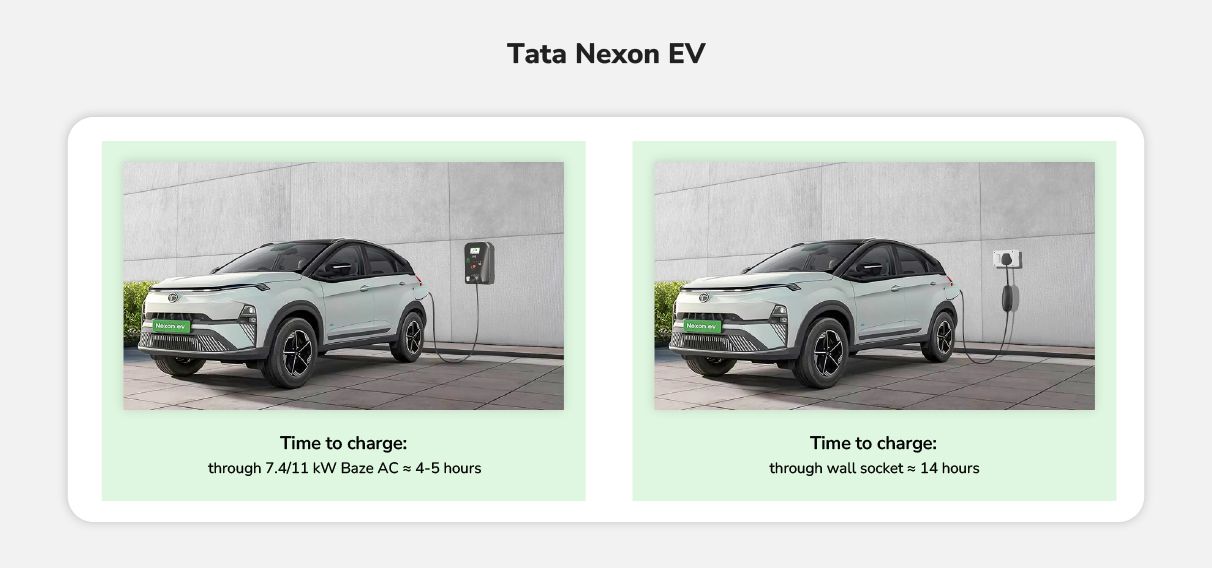
    • A Tata Nexon EV (30.2 kWh battery) would take over 13 hours to fully charge via a regular wall socket.
    • An MG ZS EV (50.3 kWh battery) would need more than 21 hours.
    • Even a compact EV like the Citroen eC3 (29.2 kWh) would still take 12–13 hours to reach full charge.

    Blog_creatives_Point- No.7-04 (2).jpg

    In contrast, a home EV charging point delivering 7.2 kW or 11 kW can reduce charging times dramatically:

    • The Nexon EV can be fully charged in around 4–5 hours.
    • The ZS EV can be ready to go in just 7–8 hours—perfect for overnight charging.

    3. High costs due to high energy loss

    Wall sockets not only charge slower, but they also waste more energy.

    The cables connecting your wall socket to the EV resist the flow of electricity. The thinner and longer the cable, the more energy is lost as heat. And since EV onboard chargers are calibrated to work efficiently at higher currents, lower power delivery (like that from wall sockets) pushes them into suboptimal territory, causing further losses.

    Take the Tata Nexon EV Prime as an example.

    When charged via a standard wall socket, real-world tests show it consumes around 17.1 kWh per 100 km. But when charged through a dedicated 7.2 kW AC wallbox charger, consumption drops to approximately 13.8 kWh per 100 km—a difference of 3.3 kWh for every 100 km driven.

    Over the course of 15,000 km in a year, that adds up to nearly 495 kWh of wasted electricity.

    At an average Indian electricity rate of ₹8 per unit, that’s an annual loss of ₹3,960, just because you used a wall socket.

    Now multiply that inefficiency across tens of thousands of EV owners in India still relying on basic outlets, and the financial and environmental losses become massive.

    4. No smart features, no futureproofing

    As EV adoption rises, energy demand will grow with it. If we don’t plan ahead, peak-hour charging could overload local grids and trigger widespread instability.

    That’s where smart charging comes in.

    Modern home charging stations can:

    • Dynamically balance power use within your home.
    • Schedule charging for off-peak hours (when electricity is cheaper and cleaner).
    • Communicate with the grid to support larger energy management systems (V2G).
    • Seamlessly integrate with solar panels and home batteries.

    None of these benefits is possible with a basic domestic outlet. In fact, plugging in during peak hours might become outright impossible in the future as utilities enforce stricter load controls.

    Considering the safety and efficiency limitations, household sockets should be treated as a fallback, not a primary charging solution. They’re best reserved for rare, low-power situations like topping up for a short drive or temporarily charging plug-in hybrids that have smaller battery demands.

    Which Home Charging Solutions Should You Choose for Your EV?

    There are significantly safer and more efficient alternatives designed specifically to handle the power demands of modern electric vehicles.

    But first, let’s compare a 16 A household socket and a dedicated EV charger:

    Once you’ve understood the limitations of household sockets—slow charging, energy losses, and safety concerns—the case for a dedicated home EV charger becomes obvious.

    Installing a home charging point is the most reliable, efficient, and future-ready solution for EV owners. Unlike basic sockets, these chargers are purpose-built to handle sustained high-power loads safely. Depending on the model, they typically deliver between 3.7 kW and 22 kW, enabling a full charge in just a few hours, perfect for overnight charging or daily top-ups.

    Blog_creatives_Point- No.7-03 (1).jpg

    This said, there’s an upfront investment. Installation costs vary depending on the power rating and wiring needs and can range from a few thousand to over ₹1 lakh. But for most EV users, it’s a one-time cost that delivers daily convenience, long-term energy savings, and peace of mind. Think of it like upgrading from a manual bicycle to an electric scooter: not just faster, but more comfortable and user-friendly.

    Beyond Home: Other Charging Options That Work

    While home charging is ideal, it’s not the only option available. India’s EV ecosystem is rapidly evolving, and alternative charging solutions are becoming more accessible.

    Public charging stations

    download.jpeg
    Public chargers are increasingly available in cities, on highways, in malls, office complexes, and parking lots. Many offer fast or even ultra-fast charging, with some capable of delivering up to 150 kW, enough to charge an EV to 80% in under 30 minutes. They’re ideal for long-distance travel or quick top-ups, but drivers should plan routes and verify charger availability to avoid delays, peak-hour queues, or high rates.

    Charging at work

    1745499255093_9610d93e83.jpeg
    Forward-looking companies across India are now installing EV chargers for employees. Supported by green incentives and growing EV adoption, workplace charging offers a practical daytime solution, especially for apartment dwellers or those without private parking. It’s a win-win: employees get hassle-free charging, and companies reinforce their commitment to sustainability.

    Final Thoughts

    Household sockets were never designed for EVs, and treating them as a long-term solution is not just inefficient; it’s unsafe. As India moves toward large-scale electrification, the conversation must shift from access to infrastructure. A plug is not a plan. True EV readiness means building charging ecosystems that are smart, safe, and scalable, starting at home. The future of mobility demands nothing less.

    Ready to Charge Smarter and Safer?

    Bolt.Earth’s EV chargers come with multiple layers of electrical protection—surge protection, short-circuit prevention, thermal cutoffs, and more. Everything your 16A wall socket was never designed for.

    Explore our range of reliable, NABL- and ARAI-certified chargers on our product page.
    Or talk to our sales team to find the right charging solution for your EV.

    Email: [email protected]

    Phone: +91 80456 88455

  • Exploring the UK’s Dynamic EV Market Landscape

    Exploring the UK’s Dynamic EV Market Landscape

    In 2019, the UK set a historic precedent: the government officially committed to achieving net zero greenhouse gas emissions by 2050. Despite some delays, the UK’s transport sector stands out positively in carbon emission reduction. In 2022, nearly one out of every five cars sold was fully electric, surpassing the government’s goals.
    Nevertheless, the UK’s ranking in the EV Country Readiness Index has dropped, from 4th place in 2021 to 5th in 2023, raising concerns about the country’s electric vehicle (EV) market.

    This article will provide insight into the UK’s EV situation by addressing the following questions:

    • What is the current state of the UK’s EV market; who are the major players, and what are the government’s goals?
    • What challenges does the UK’s EV market face?
    • How can the UK progress in the international EV industry in the upcoming years?

    The UK’s Current EV Market

    The UK’s EV market has seen rapid growth, registering over 260k new electric cars in 2022, a significant increase from 15k in 2018.

    According to the Society of Motor Manufacturers and Traders (SMMT), zero-emission vehicles accounted for an impressive 37.3% of new car registrations in September 2023. Growth is evident across battery electric vehicles (BEVs), plug-in hybrid electric vehicles (PHEVs), and hybrid electric vehicles (HEVs) alike.

    Meanwhile, fleet-driven growth increased by 40.8% in September 2023, reaching a 52.5% market share. This indicates a market adjustment following limited supply in 2022, which constrained deliveries to business and fleet customers. Private consumer demand rose by a less dramatic 5.8%, reaching 122,944 units.

    The increase in ultra-low emission vehicles began with plug-in hybrid electric vehicles from 2014. Specific BEV growth surged from early 2019, outstripping PHEVs from Q4 2020 onward. As of November 2023, BEVs remain in the lead, taking up 16.4% of the automotive market. PHEVs are also continuing to grow, but lag behind, at a 6.8% market share.

    The UK’s charging infrastructure is starting to catch up with the rising EV adoption rates. As of September 2023, the UK boasts 49,882 public electric vehicle charging points across 29,709 locations, marking a 43% growth since September 2022. Home and workplace charging installations bring the country’s total up to approximately 680k.

    Currently, rapid and ultra-rapid chargers make up around 20% of public charging devices; there are 9,209 rapid and ultra-rapid charging devices spread across 4,809 locations, with a growth rate of 68% YoY.
    A bar chart showing the UK's public EV charging infrastructure from 2019 to 2023, broken down by charger speed

    Greater London tops the list of charging points in 2023, with an estimated 17,380, accounting for an impressive 34.8% of the entire UK’s public charging infrastructure. Southeast England and Scotland follow, with 5,812 (11.7%) and 4,245 (8.5%), respectively.
    A pie chart showing the geographical distribution of public charging points in the UK

    Demand for affordable zero and low-emission cars is growing, as evidenced by rising second-hand sales figures; from March to June of 2023, second-hand EV sales surged by over 80%, reaching more than 30.5k units. Despite setting a record for the sector, however, these EV sales still constitute just 1.7% of the total second-hand market.

    Enhancing the second-hand market is crucial for broadening the accessibility of electric vehicles, which currently remain more expensive than ICE models.

    The UK’s electric 2-wheeler market is also growing, driven by increasingly affordable prices and rising traffic congestion. 2-wheelers up to 125cc currently dominate due to fuel and cost efficiency, and manufacturers are focusing their research and development efforts on premium high-capacity bikes to further amplify market growth. The strong leisure market, especially for adventure bikes, also contributes to market expansion. Anticipated growth in registered motorcycles over the next five years will further drive the UK’s two-wheeler market.
    A graphic listing important players in the British EV market, superimposed on an outline of the UK

    Major 4W Market Players

    Overall, the UK’s EV market is dominated by five foreign brands: Audi, BMW, Renault, Tesla, and Volkswagen.

    In 2022, the Kia e-Niro and Nissan Leaf were the 3rd and 5th best-selling EV models in the UK. 2023 has seen the arrival of a new Asian brand: China’s MG. During the first seven months of 2023, the MG4 was the UK’s #2 best-selling EV, beaten only by Tesla’s Model Y.

    Tesla

    Tesla’s Model Y and Model 3 were the UK’s best-selling EV models in 2022. The Model Y, a family SUV with a 319-mile range, is priced between £52k and £68k (USD 65,047 – 85,057), accelerating 0 – 60 mph in 3.5 seconds. The Model 3, priced between £48,490 and £61,490 (USD 60,653 – 76,914), charges from 10 to 80% in 23 minutes on a 200kW charger, making it a popular and affordable choice in the UK.

    Despite lacking a Gigafactory in the UK, Tesla offers another innovative approach: electricity generating. They recently applied for a license to generate electricity with the UK’s Gas and Electricity Markets Authority in Great Britain, showcasing their commitment to sustainability.

    German Legacy Brands

    BMW and Audi, legacy manufacturers of luxury cars, have recently grabbed the British EV market’s attention with the BMW i4 and Audi Q4 e-tron models.

    Audi has announced an ambitious goal: achieving full EV production by 2029. All existing production facilities will be retooled, new plants will be built where additional capacity is needed, and the range of models will grow.

    Volkswagen is planning a similar transition, but is targeting the mid-end market.

    Kia

    Many buyers view Korean brand Kia as comparable to Volkswagen. They provide similar range — around 260 miles — and safety features, at a near-identical price.

    However, Kia’s longer warranty and faster charging capability offer a better user experience, which is helping Kia make progress in the British market.

    MG

    China’s share of the European electric car market has more than doubled in less than two years. This is largely due to MG’s success.

    China’s dominance is further accentuated by its lead in battery production, leaving the European industry dependent on a geopolitical rival until it establishes its own “gigafactories.”

    In the case of MG, which is owned by SAIC, successful localization efforts include establishing a design studio in London and crafting cars that resonate with the preferences of the UK market, exemplified by the Cyberster series.

    Thanks to these efforts, in addition to competitive pricing (£26,995 to £32,495), the MG4 appears poised for a promising future in the British market.

    Major EV Fleets

    The UK has been making strong efforts to electrify its fleet and business vehicle sectors.

    Government Fleets

    In January 2023, the British government announced that it had successfully achieved its 2022 target: ultra-low emission vehicles now comprise 25.5% of government fleets.

    A notable instance is the integration of 3-wheeled electric motorbikes, the Yamaha Tricity 300, into the British police force. This initiative is endorsed by the Department for Transport and Innovate UK. The electric police bike incorporates a venturi duct traversing the center of the motorcycle, aiming to markedly minimize drag and improve efficiency.

    Taxis

    As of Q4 2021, there were 5,440 electric taxis registered in the UK, 3,621 of which were in London.

    London Electric Vehicle Company (LEVC), a prominent player in London’s taxi market, has been promoting the TX range-extended electric black cab since 2018. With over 6,000 vehicles now in operation, the LEVC TX comprises more than 40% of all black cabs in London. The LEVC TX, equipped with a 110-kilowatt electric motor, offers an impressive 78 miles of pure electric range and a flexible total range of 333 miles on the WLTP test cycle, driving in full-electric mode at all times.

    LEVC is contributing significantly to London’s transition to a cleaner, greener EV black cab fleet, positively impacting air quality.

    Buses

    Buses are responsible for 2.2% of the UK’s transport-related emissions. As of 2023, the Department for Transport has issued £320mn to obtain 4,000 zero-emission buses by 2025. The Transport Secretary has pledged £129 million to back local authorities in introducing zero-emission buses.

    Major operators like First Bus and National Express aim for zero-emission fleets by 2030 and 2035, respectively. With sufficient funding, it’s expected that over two-thirds of new bus purchases in England by 2025 will be zero-emission, aligning with the Confederation of Passenger Transport’s goal for full adoption by the same year.

    Freight

    In 2021, heavy goods vehicles (HGVs) contributed 19% to the UK’s domestic transport emissions. While electric HGVs have a higher upfront cost and an average shorter range of 220 km, their lifetime expenses are lower, including fuel and maintenance savings.

    Forward-thinking operators are adopting electric HGVs for a greener fleet. For example, Amazon UK has incorporated five heavy-duty electric trucks from DAF Trucks, capable of carrying up to 37 tons.

    Meanwhile, DHL Supply Chain has pioneered the use of four 40-tonne Volvo FM fully-electric HGVs in the UK. Featuring a substantial 540kWh battery, these zero-emissions trucks have a range of up to 180 miles and have received positive early feedback from DHL drivers, especially regarding acceleration and hill performance.

    Government Incentives & National EV Targets

    As far back as 2008, the UK had already started to explore green transportation. However, after many initiatives and campaigns, the results were not as expected.

    Until 2019, the Labor Party said it would aim to ban the sale of new non-electrified cars by 2030. Although the deadline shifted with each Prime Minister, the strict policy significantly boosted the UK’s market overall.

    EV Master Plan

    Shortly after announcing its goal of phasing out ICE vehicles by 2030, the British government issued the Ten Point Plan for a Green Industrial Revolution.

    To align with the 2030 goal, this plan suggested several funding schemes to support supply chain and charging infrastructure. The plan’s expected impact includes boosting the employment rate, unlocking private investments, and mitigating carbon emissions. In 2021, the government followed up with a more detailed transport decarbonization plan.

    Recently, like its neighbor Germany, the UK realized the importance of implementing charging infrastructure to sustain the EV ecosystem. As a result, in 2022, they published an electric vehicle infrastructure strategy to support EV adoption. Under this strategy, the UK will have an estimated minimum of 300k public charging points by 2030. However, this figure is highly uncertain.

    After the Plug-in Car Grant (PiCG) purchase incentive was dropped in 2022, the government shifted focus to EV infrastructure and to other vehicles.

    EV Supply-Side Incentives

    Grants for Charging Infrastructure

    The Ten Point Plan proposed issuing £1.3bn to accelerate charging infrastructure, and £582mn in extended grants. Major grants for charging points include the EV chargepoint grant and EV infrastructure grant. In addition, the Local Electric Vehicle Infrastructure (LEVI) funding program is specifically designed for residents without access to off-street parking. Meanwhile, the long-awaited Rapid Charging Fund has committed £950 million to install rapid chargers at key motorway service areas.

    Research and Development Funding

    The British government and private sector have continuously provided R&D funding to the EV industry. For example, in 2020, the government announced £12mn in funding for “groundbreaking research” into zero-emissions transport, including EV charging.
    As of January 2023, 17 projects aim to advance EV battery technologies in the UK. These are funded with £27.6mn from UK Research and Innovation (UKRI) through Innovate UK to bolster the UK’s competitiveness across the battery value chain.
    Furthermore, £89mn in funding has been granted to 20 pioneering projects in net-zero technology, solidifying the UK’s global leadership in zero-emission vehicle technology.

    Incentives for Manufacturers

    According to the Ten Point Plan, a £2.8bn support package was planned to boost EV manufacturing in the West Midlands, Wales and the North.

    EV Demand-Side Incentives

    Plug-In Car and Van Grants

    The plug-in car grant was dropped in June 2022, leaving Britain as the only major European market with no consumer EV incentives. Grants for vans remain in effect, deducting 35% of the purchase price for small vans up to £2,500 and large vans up to £5,000. EV grants are also available for wheelchair-accessible vehicles, motorcycles, mopeds, trucks, and taxis.

    Congestion Charge and Ultra Low Emission Zone (ULEZ) Benefits

    EV drivers are not subject to current city congestion charges or low emission zone charges, such as London’s Congestion Charge or ULEZ.

    Zero- or Reduced-Rate Benefit-in-Kind Taxation

    Although the direct purchase incentive for EVs has been canceled, there are still various tax advantages%20came%20into%20fruition,hybrids%20until%20around%202018%2C%20too.). EVs are exempt from road tax, including the “premium car” tax for those with a list price over £40k. Fleet operators and company car users benefit from a low Benefit-in-Kind (BIK) rate of 2% for EVs, frozen until 2025, when it will rise.

    Challenges to the UK’s Electric Vehicle Market

    The UK’s EV market faces several similar challenges to other countries’, as well as some unique issues.

    A graphic listing challenges to the British EV market

    Energy Supply and Grid Capacity Limitations

    In 2022, the UKs electricity demand reached a record low of 320.7 TWh due to the increased utility prices. Supporting electric vehicles would require an estimated 100 TWh in energy usage by 2030. This is not predicted to be a major problem, however, since almost 40% of electricity is expected to come from renewable resources by 2030.

    A more serious challenge involves grid stability at a street level, and domestic infrastructure. There are around 400k substations in the UK, each serving approximately 1,500 homes and businesses. This creates a serious risk of electricity overload from using typical 7 kW EV chargers, since substations have power output limits.

    Domestic wiring variations in the UK, such as TT, TNS, and TNCS, further complicate EV charging point installations; compatibility concerns with simultaneous household appliance usage must be addressed.

    Inconsistent Policies and Regulations

    The reduction in Plug-in Car Grant incentives led to an immediate decline in private EV sales in the UK, revealing the market’s dependence on policy support. Despite arguments that grants can kickstart ongoing EV demand, the cancellation raises concerns.

    The Prime Minister’s plan to delay the deadline for consumer EV purchases until 2035 conflicts with the unchanged mandate for manufacturers: over 20% of each manufacturer’s new cars in 2024 must be zero-emission, or they face fines.

    A lack of details and clarity causes further uncertainty for manufacturers, hindering investment and industry development. Furthermore, since the mandate now takes effect next year, manufacturers are already scrambling to adapt to the policy change.

    Overall, abrupt policy changes create ongoing chaos and challenges for the automotive sector; inconsistent regulations, implemented with insufficient prior notification, are hindering the industry’s development.

    Manufacturing and Supply Chain Issues

    This is the challenge faced by many traditional automotive giants worldwide, like Germany, Japan and South Korea.

    With half of its cars exported to the EU, the UK’s focus on limiting petrol and diesel sales faces a crucial shift, yet only 9.5% of 2022 car production comprises BEVs. This necessitates strategic moves to align with evolving global EV trends and secure export revenue. However, transforming the ICE supply chain into an EV-centric one requires substantial investment, new suppliers, and talent, all of which are difficult to find.

    Furthermore, post-Brexit, the UK’s EV supply chain is struggling to meet the rules of origin criteria outlined in the UK-EU Trade and Cooperation Agreement (TCA). To qualify for zero tariffs, EVs must meet specified content percentages originating from the UK or EU, starting with 40% by December 31, 2023. Brexit-induced trade barriers may impact material, component, and EV costs due to reduced market access.

    Charging Infrastructure Challenges

    EV adoption faces hurdles in the UK, with 70% of stakeholders highlighting on-street charging inadequacy as a key concern. A third of households lack driveways, creating a strong need for robust public charging infrastructure.

    Unclear public-private network relationships and requirements and a costly and time-consuming planning permit system also hinder EV infrastructure establishment. Furthermore, the UK is facing a critical shortage of skilled EV infrastructure technicians, with only 6% currently possessing the necessary skills, and a projected deficit of up to 35k by 2030.

    Opportunities for Future Growth in the UK

    A graphic listing opportunities for future growth in the British EV market

    Battery Technology Advancements

    As mentioned above, the British government is committed to providing financial and regulatory support to enable mass-scale EV battery production. Notably, Williams Advanced Engineering and Fortescue Metals Group are partnering to develop a bespoke battery system for a 240-tonne electric mining haul truck. The innovative battery electric powertrain, featuring regeneration capabilities, will be integrated into the prototype. The collaboration also involves creating a fast-charging unit, facilitating the broader adoption of a battery-electric haulage fleet. Meanwhile, Moixa’s
    solar battery integrates hardware and GridShare software for renewable energy management. It optimizes EV battery charging in real-time, considering factors like driver behavior, energy costs, and weather forecasts.

    Second-Hand EV Market Development

    Although the upfront cost of EV is not consumers’ top concern, it still needs to be addressed. With used cars representing 82% of all cars sold in the UK in 2021, it is critical to optimize the second-hand market as a catalyst for a nationwide adoption of EVs. To do this, the government could incentivize buyers with a new battery or financial refund, easing worries about battery health. Standardizing battery life and quality with a certification could further enhance consumer confidence. Finally, public awareness campaigns could dispel concerns about purchasing used EVs and educate consumers about charging costs and locations, enabling a smoother transition to electric vehicles.

    Domestic Manufacturing Support

    Britain’s new relationship to the EU has important implications for automakers, specifically for the whole value chain. As of 2023, the UK has already developed a foundational EV supply chain to produce almost every component of EVs.

    An SMMT report established plans for future direction anchor vehicle production in the UK via three strategies:

    1. Boost Government Support for EV Manufacturing

    To benefit from tariff-free trade, the UK needs investment in domestic minerals refining, battery manufacturing, and electric drive units. A competitive incentive package is crucial to attract global investors and position the UK as a top destination for green technology investment.

    2. Simplify Administrative Processes

    It is better for the UK to streamline regulatory frameworks for projects like battery production and renewable energy facilities. Faster access to funding and market reforms, such as decoupling electricity and renewable energy prices from gas, are essential for attracting investments.

    3. Forge Global Partnerships

    The UK can secure minerals processing capacity by expanding trade agreements and partnerships with resource-rich countries. Priorities include expanding free trade agreements, establishing partnerships, encouraging British investors in sustainable mining, and creating favorable conditions for remanufacturers.

    Charging Infrastructure Expansion

    Like Europe, the UK is actively working to expand its charging infrastructure. It has identified several areas for improvement.

    Home Charging

    Promoting residential EV charging is prudent, given unpredictable private-public charging proportions. Residents can charge their cars overnight, or establish a DER for extra income.

    The British public is open to home EV charging, as shown by a 2023 survey; nearly half of homeowners are willing to pave over their front gardens to accommodate charging devices, and 70% of EV owners have already modified homes for charging. The demand for home charging is expected to continue rising.

    Charger Technology Improvements

    According to British charger company Zap-Map, the latest ultra-rapid charging devices already enable some EVs to add more than 100 miles in as little as 10 minutes. To address the public charging network’s inadequacies, the UK could spread out more ultra-rapid chargers to low dense areas.
    Innovative companies such as Swarco, which provide expert-level 24/7 in-house customer support to optimize the user experience, could further support this transition.

    Grid Stability Optimization

    Since grid stability is the main concern when it comes to EV charging, the UK has proposed introducing the G99.pdf) grid connection standard to revolutionize the way power is generated, transmitted, and consumed.

    Accelerating Towards a Bright EV Future

    The UK’s electric vehicle market stands at the edge of a transformative era. With government commitment, strategic investments, and innovative solutions addressing challenges, the road ahead looks promising. The UK is poised for a future in which residential charging becomes ubiquitous, cutting-edge battery technologies redefine possibilities, and a robust domestic supply chain solidifies the nation’s position in the global EV arena. Substantial challenges exist, but they are stepping stones to a cleaner, sustainable tomorrow. The UK’s EV journey is not just about reducing emissions; it also promises to steer the nation towards a dynamic and electrifying future.

    FAQ

    What are the key factors shaping the growth of the UK’s EV market?

    The growth of the UK’s EV market is driven by government commitments to achieving net-zero emissions, rising consumer demand, advancements in technology, and supportive policies and incentives.

    How do advancements in battery technology affect the UK’s EV landscape?

    Cutting-edge battery technologies, including those developed by British companies like Williams Advanced Engineering and Moixa, are a major contributor to EV innovation in the UK, enhancing range, efficiency, and overall performance.

    What incentives exist for businesses to invest in EV manufacturing in the UK?

    Businesses receive substantial support, including a £2.8bn package, to boost EV manufacturing in regions like the West Midlands, Wales, and the North. Green finance initiatives and export support further incentivize investment.

    What role does charging infrastructure play in boosting EV adoption in the UK?

    Charging infrastructure is crucial for EV adoption in the UK. The government is investing in expanding charging points, and encouraging home charging. Challenges like on-street charging inadequacy and an overcomplicated planning permit system still need addressing.

    What is the timeline for the UK’s ban on new petrol and diesel car sales?

    The UK aims to ban the sale of new petrol and diesel cars by 2030. Hybrid vehicles will be permitted until 2035. As of September 2023, the Prime Minister was considering pushing the deadline back by 5 years, but no further details or plans have emerged.

    How are consumer preferences evolving in response to the UK’s changing EV landscape?

    Increased sales of second-hand EVs, growing demand for affordable zero-emission cars, and the popularity of EVs in various market segments all demonstrate a positive shift in consumers’ mindset toward electric vehicles.

    Resources

    SMMT: Society of Motor Manufacturers and Traders

    Explore updated data about the British EV market here.

    House of Commons: Electric vehicles and infrastructure

    Find more details about the UK’s EV industry and infrastructure here.

    Zap-Map: EV charging statistics 2023

    View a map of the UK’s EV infrastructure here.

    UK Gov: The ten point plan for a green industrial revolution

    Read the British government’s plan for the EV market here.

    UK Gov: UK electric vehicle infrastructure strategy

    Discover the British government’s strategy for EV infrastructure here.

  • Revolutionizing Commercial Mobility With OS in Electric Trucks & Vehicles

    Revolutionizing Commercial Mobility With OS in Electric Trucks & Vehicles

    Growing concerns over carbon emissions have led to a call for change in the commercial vehicle industry. Currently, commercial vehicles — most notably, commercial trucks with traditional internal combustion engines — are responsible for 80% of vehicular emissions. This emission level is unsustainable and poses a significant obstacle to countries reaching for Net Zero carbon commitments.

    The push for commercial electric vehicles (EVs) is driven largely by automotive technology advancements, with a particular focus on operating systems (OS) that are responsible for a smooth and seamless connection between EV components and performance.

    This article answers three key questions about the pivotal role of OS in transforming the commercial EV landscape:

    • What challenges impede the development of OS in commercial vehicles, and what opportunities lie in their implementation?
    • Which key OS features are best suited for electric commercial trucks and vehicles?
    • How can OS revolutionize commercial mobility for EVs?

    Challenges Impeding OS in Commercial Vehicles

    Despite the increasing adoption of commercial EVs, several challenges need to be addressed for widespread acceptance. Alongside general challenges like limited infrastructure and high costs, OS-related obstacles including software incompatibilities, cybersecurity issues, and the impact of over-the-air (OTA) updates in vehicle operations can be viewed as an inconvenience and dampen adoption efforts across the commercial industry.

    These challenges are even more profound in electric 3-wheelers due to their design. Because of this, their OS must support advanced safety features, support load management, and offer routing capabilities all while ensuring their stability when transporting heavy cargo.

     infographic listing the challenges impeding hindering OS development in commercial EVs

    Battery Technology Limitations

    Commercial vehicles are expected to operate efficiently over long distances, and sometimes, in demanding weather conditions. Existing battery technology offers only a limited range, meaning frequent stops are needed to charge commercial EVs. Also, the fear of running out of power during transit, especially along routes with limited charging infrastructure, can discourage commercial players from adopting EVs in their fleets.

    With these limitations, OS in commercial EVs must accurately estimate and communicate effective energy management. Battery management, space constraints, performance optimization, software updates, energy-efficient features, and user experience enhancements can also stand in the way of successfully implementing OS in commercial vehicles.

    To address this concern, researchers are exploring solid-state batteries with higher energy density that can extend the driving range of commercial EVs. Similarly, fast charging solutions and energy optimization systems are emerging to reduce charging times.

    Charging Infrastructure Constraints

    In 2022, the world had a mere 2.7 million charging stations, with Europe having just 375,000 stations despite EVs accounting for 20% of all its new-car sales. This shortfall can be particularly impactful for commercial EVs that need to cover long distances.

    Moreover, not all existing stations have fast charging capabilities. This can result in longer charging and waiting times, both of which can affect delivery schedules. Lastly, available public chargers may not be compatible with specific EV models, contributing to range anxiety concerns. The high cost of EV infrastructure development, coupled with trade-offs between range and payload capacity, can slow down OS development and adoption, particularly in the commercial industry.

    Improving the availability of interoperable EV charging infrastructure is key to overcoming these complications. Fast charging technologies are being developed to shorten the charging time and improve the efficiency of EV charging infrastructure. This, in turn, can shorten driver downtime and increase the Return on Investment (ROI) for charging point owners. Standardizations across EV charging points can also remove barriers to EV charging. Government incentives, private-public collaborations, and peer-to-peer sharing of charging points are filling this infrastructure gap for now.

    Motor Control and Power Delivery

    Managing power delivery, especially in 3-wheeler EVs, presents a unique challenge. These EVs require precise torque distribution to ensure optimal performance. The OS must allocate power to the wheels effectively to balance stability with acceleration, particularly during sudden turns. Also, the OS must control energy recovery during braking and convert it into stored power to extend the EV’s range.

    Bumps, potholes, and uneven terrain can suddenly affect vehicle stability. Given the variable road conditions, particularly for last-mile delivery 3-wheeler EVs, the OS must make real-time adjustments to ensure a smooth ride. OS in commercial vehicles must adjust power delivery to varying driving styles and driver preferences.

    Researchers are exploring torque vectoring algorithms that allow the vehicle to adjust the torque in each wheel to improve its traction and stability.

    While these challenges continue to exist, innovative solutions are being developed to refine the efficiency and adaptability of OS in commercial vehicles.

    Innovative Solutions for OS in Commercial Vehicles

    Over the years, EV OS has evolved significantly to optimize performance and enhance efficiency. Advancements in artificial intelligence (AI), machine learning (ML) technology, Internet of Things (IoT), and battery management systems have been instrumental in making commercial EVs a more viable option. Here’s a look at some of these technologies.

    Infographic listing solutions for OS in commercial EVs

    AI and Machine Learning Integration

    The integration of AI and machine learning into EV OS is driving energy efficiency and predictive maintenance, leading to more reliable operations. These algorithms can analyze data from sensors in real time to make immediate adjustments in driving and power distribution. They can also predict traffic conditions and help with route planning for the efficient use of available energy. Above all, these technologies continuously monitor the health of vehicle components to spot issues before they become critical. This allows for scheduled maintenance, eventually lowering operating costs and avoiding delays.

    Some examples of AI-based OS include:

    • Tesla’s Autopilot uses AI to provide features like adaptive cruise control, lane centering, and self-parking.
    • Waymo’s Self-Driving System provides an OS for autonomous driving, although it’s not available for commercial vehicles yet.
    • NIO’s NOMI leverages an AI assistant that manages vehicle functions and enhances navigation for a personalized driving experience.

    IoT Applications in OS

    Internet of Things (IoT) sensors collect large amounts of data from various vehicle components like temperature, battery health, and performance metrics. It analyzes this information to provide insights into the vehicle’s condition and efficiency. It also enables the remote monitoring of commercial EVs to help fleet managers optimize vehicle usage and plan maintenance. Other information like driver behavior, energy consumption, and route efficiency help fleet managers to plan routes. Lastly, it can enhance the safety of EVs in adverse driving conditions.

    Many companies are leveraging IoT to improve their operations, including:

    • UPS employs IoT to monitor the condition of batteries and other components to extend battery life, reduce maintenance costs, and increase overall reliability.
    • Geotab utilizes IoT connectivity to provide real-time data on vehicle location, speed, and diagnostics for fleet management. In turn, this allows companies to optimize routes and improve driver safety.
    • FedEx uses IoT in its commercial EVs for route optimization and energy management to reduce fuel consumption and emissions.

    Advancements in Battery Management Systems (BMS)

    Battery management systems (BMS) have evolved to offer comprehensive battery monitoring while providing real-time data on cell voltage, temperature, and health. In turn, this provides precise control and optimization of the battery’s performance. Advanced algorithms manage the charge and discharge, leading to the efficient use of the battery. Furthermore, the exact estimation of the battery’s State of Charge (SoC) helps with range prediction and optimal power management.

    The concept of swappable battery technology is also gaining popularity as it supports battery replacements. Though this technology is in the early stages, it holds the potential to minimize vehicle downtime and range anxiety concerns.

    Collectively, these innovations and technologies are shaping the development of OS conducive to powering commercial EVs and are influential in advancing the EV industry.

    The Current Landscape of Commercial EVs

    In 2022, 101,499 commercial electric trucks were sold, and these sales are projected to increase to 1,067,985 trucks by 2030, signaling a compound annual growth rate of 34.2%. This growth can be attributed to a combination of factors, including government policies and regulations on emissions, as well as technological advancements in batteries and EV OS. By 2030, it is estimated that EV commercial trucks will account for 27% of the total truck market while e-buses will make up 82% of commercial transportation. This substantial expansion will largely happen in the Asia-Pacific region powered by orders from China, India, and Japan. Canada and the United States are also expected to see robust growth, followed by Europe.

    Graph showcasing the increasing demand for commercial electric trucks by 2030

    The major players in commercial EVs, including BYD, Mercedes Benz, Volvo, Ford, and Rivian, are catering to diverse needs across numerous industries — the food and beverages industry, state services like the United States Postal Service (USPS), and e-commerce companies like Amazon and Walmart.

    Almost every major automaker in the world is investing heavily in innovative technologies that can improve the driving range of commercial EVs. Also, collaborations and partnerships pave the way for addressing the unique challenges of commercial EVs. With increasing demand for commercial EVs, OS in commercial vehicles will continue to play a bigger role in driving these vehicles.

    The Significance of OS in Commercial EVs

    Software-defined vehicles lie at the center of EV evolution, and commercial vehicles are no exception. Here, the OS is responsible for managing all aspects of the EV’s functionality. When an EV powers up, the OS takes charge of critical functions, integrating hardware, software, and data to ensure that every aspect of the vehicle is working as it should.

    The OS also plays a continuous role in monitoring the battery to maintain sufficient power levels. It controls the distribution of power from the battery to the wheels, enabling the vehicle to move. Furthermore, it oversees specialized functions like regenerative braking, a process that captures energy during deceleration and uses it to charge the battery for an extended driving range.

    In all, the OS is the driving force behind today’s commercial trucks and vehicles. Due to this overarching role, industry experts agree that developing and maintaining OS in commercial vehicles is necessary for evolving commercial transport. Consequently, several companies have taken the lead on this front.

    The Case for OS in Commercial EVs

    Some companies are ahead of the curve in implementing successful commercial EVs powered by sophisticated OS. One such company is Bollinger Motors, an American company that manufactures B4 and B5 commercial electric trucks. These vehicles are designed from the ground up, offering driver safety and fleet efficiency functionalities. They can also be custom-configured to meet the specific needs of their clients. Compatible with level 2 and level 3 chargers, they require approximately nine hours for level 2 and one and a half hours for level 3 to charge. These operations are supported by a patent-pending E-chassis.

    Another example is Tesla Semi, the class 8 semi-truck built by Tesla and powered by its OS. This fully-electric truck can accelerate from 0 to 60 miles per hour within 20 seconds to help drivers maintain the highway speed levels. It also comes with advanced motor and brake controls to improve safety. Its design, including the centered driver seat, ensures that drivers have comprehensive visibility on the roads. As for fleet operators, Tesla claims that they can save $200,000 in fuel costs within just the first three years of ownership.

    XOS Trucks is another notable company building electric trucks and their vehicles run on the proprietary Xosphere platform. They operate medium and heavy-duty trucks that can be customized for any use case including last-mile deliveries. Plus, its OTA updates make the upgrade process a breeze. It’s hard to find this battery modularity in similar trucks like Tesla or Bollinger Motors.

    This industry progress points to an electrified future, powered by robust operating system optimization.

    Impact of OS on the Future of Commercial EVs

    Advanced OS holds the potential to drive improvements in the cost-effectiveness and performance of commercial EVs. Through optimized power management, improved route planning, and predictive maintenance capabilities, these operating systems reduce operational costs and increase environmental sustainability. As a result, more businesses are likely to embrace EVs for their commercial operations.

    Bolt.Earth OS is a compelling example of an advanced OS that can reshape the commercial EV landscape. This innovative OS offers a seamless combination of AI, IoT, and data analytics to provide real-time insights into vehicles’ performance, energy consumption, and predictive maintenance. By enhancing efficiency and curtailing operational costs, Bolt.Earth OS can revolutionize commercial mobility.

    To know more about how to revolutionize commercial mobility with OS, read the FAQ and Resources below!

    FAQ

    How do operating systems impact the performance of electric trucks and commercial vehicles?

    Operating systems optimize power distribution and ensure that all components communicate and operate efficiently. They also ensure efficient energy utilization and extend battery life. Plus, they support OTA updates and protect data and systems from cyberattacks.

    What are the benefits of integrating AI and IoT in operating systems for EVs?

    AI optimizes energy usage, enhances predictive maintenance, and provides real-time insights into vehicle performance. IoT, on the other hand, enables remote monitoring, precise diagnostics, and safety enhancements. Together, AI and IoT make EVs more competitive, sustainable, and eco-friendly.

    Will optimized operating systems lead to the widespread adoption of electric commercial vehicles?

    An optimized EV OS can enhance efficiency, reduce operational costs, and improve overall reliability. They provide real-time insights for informed decision-making. When coupled with government incentives and stricter emissions regulations, operating systems are an obvious catalyst for commercial EV adoption.

    Are there any regulations promoting the use of electric trucks in the transportation industry?

    Governments worldwide are implementing policies, subsidies, and incentives to encourage the adoption of electric commercial vehicles. These regulations include tax incentives, emissions reduction targets, and stricter emissions standards. They aim to reduce greenhouse gas emissions, improve air quality, and transition to a more sustainable and eco-friendly transportation sector.

    How do 3-wheeler EVs differ from traditional electric commercial vehicles in terms of operating systems?

    3-wheeler EVs differ from traditional electric commercial vehicles in terms of operating systems due to their unique design and functionality. Operating systems for 3-wheelers require specialized algorithms for more efficient power management and real-time adjustments to varying road conditions. These systems optimize energy utilization, torque distribution, and braking, providing a different set of challenges and opportunities compared to larger commercial EVs.

    Resources

    IEA: Trends in electric heavy-duty vehicles

    Discover the major trends in commercial vehicles here.

    Diva: Modern Electrical/Electronic Infrastructure for Commercial Trucks

    Explore innovative insights here.

    Mecalux: Electric trucks and their impact on logistics

    Learn about the impact of electric Trucks on the future of logistics here.

    Driivz: Beyond Basics: What Growth-Oriented Providers Should Look for In EV Charging Management Software

    Know what to look for while choosing EV software here.

    McKinsey: The Economics of Fleet Electrification

    Read the economics of electrification here.

  • Exploring South Korea’s EV Success

    Exploring South Korea’s EV Success

    In Asia’s booming electric vehicle (EV) market, South Korea is demonstrating a much greater commitment to a cleaner environment than many other nearby countries.

    South Korea initially invested in hydrogen-powered EVs, much like Japan. However, it made a swift transition to pure EVs, thanks to determined policy support, advanced technology and innovation, a robust supply chain, and an export-oriented industry strategy. Since then, South Korea has emerged as a booming economy in the EV industry.

    This article will explore the factors behind South Korea’s leadership in the Asian electric vehicle market. In particular, it will address the following questions:

    • Who are the major players in the South Korean EV industry, and how do they shape the market?
    • How are the South Korean government and private sector promoting EV usage?
    • What are the current challenges associated with EV adoption in South Korea, and how can they be overcome?

    South Korea’s EV Market

    In South Korea, eco-friendly vehicles are usually called green cars or new energy vehicles (NEV). There are several types available, including battery electric vehicles (BEVs), hybrid electric vehicles (HEVs), plug-in hybrid electric vehicles (PHEVs), and fuel cell electric vehicles (FCEVs). FCEVs use a hydrogen-based fuel cell to power the motor, and are therefore sometimes categorized as HEVs.

    South Korea boasts a rich automotive history, particularly in the 1990s, when it became the world’s fifth largest automobile producer. When its market share declined in 2018, the government promptly responded by offering subsidies and incentives to boost the EV industry, and by investing in charging infrastructure. Leading OEMs like Kia and Hyundai began launching new EV models in 2004, and have been producing EV components domestically since 2009.

    This proactive approach resulted in significant growth in EV adoption. In 2022, the Ministry of Land, Infrastructure, and Transport (MOLIT) reported a remarkable surge in green vehicle registrations: electric vehicle registrations increased by 72.7% YoY, hydrogen vehicles by 54.3%, and hybrids by 29.6%. Total EV sales exceeded diesel vehicle sales for the first time, reaching 448,934 units. Among EV power sources, hybrids led with 274,282 units sold, followed by 164,324 BEVs, marking a 63.7% sales growth from 2021.

    A graph showing South Korea's annual EV sales from 2011 to 2020
    Nevertheless, there is still work to be done. In particular, stakeholders must find a way to meet the government’s extremely ambitious goals for the next few years.

    Meanwhile, South Korea’s adoption of electric 2-wheelers has slowed, due to limited range, inconvenient charging requirements, and extended charging times. These factors, coupled with reduced subsidies averaging ₩1.8 million (USD 1,365), down 13% from the previous year, have substantially dampened consumer demand.

    EV Charging Infrastructure Growth

    As a key initiative, in August 2016, the MOLIT, along with the Korea Electric Power Corporation (KEPCO) revealed plans to construct ₩200 billion of charging infrastructure. By November 2020, they had installed a total of 62,789 public chargers, including 9,661 rapid and 53,128 slow chargers. In 2021, they added 3k fast-charging stations, distributed as follows:

    • 2,280 charging stations at locations such as private supermarkets
    • 290 charging stations in parking garages
    • 300 fast-charging stations at pit stops
    • 123 high-powered charging stations by the automotive industry

    As of 2021, South Korea had the world’s best ratio of EVs to charging points: 2.6 vehicles per charging point.

    Major Players in South Korea’s EV Market

    South Korea’s thriving EV landscape is partly attributed to the efforts of leading automakers. They have rapidly adopted EVs, and have leveraged the country’s strong automotive industry and existing supply chains to compete globally.

    South Korea utilizes economies of scale to achieve competitive EV production. Its well-established network of suppliers and manufacturers, in addition to a substantial pool of engineers and technicians well-versed in cutting-edge production methods, supports efficient, cost-effective manufacturing of high-quality EVs.

    A graphic listing major players in the South Korean EV market
    Global OEMs in South Korea

    In 2022, the top three players in South Korea’s domestic passenger EV market were Hyundai Motor Group, Tesla, and Kia, which is a subsidiary of Hyundai. In the context of the global market, Hyundai was the fifth largest EV seller in 2022.

    Hyundai did not enter the EV market until 2015, but has achieved immense success, with a 75% domestic market share. The company initially emphasized hydrogen vehicles, and only shifted its focus to BEVs in 2018, in response to Tesla’s success.

    Hyundai’s vertically integrated supply chain network, modular EV platform, and export-oriented focus have all proven instrumental to the company’s success. The vertical integration spans various subsidiaries, streamlining EV production from batteries to software, and enabling strategic partnerships involving the whole EV supply chain. By adopting a dedicated EV platform early on, Hyundai set itself up for successful rapid model development; it plans to launch 31 EV models by 2030.

    In addition to supplying EVs to South Korean consumers, Hyundai has a strong focus on exporting to foreign markets. In fact, South Korea’s EV exports rose by 112.2% between 2019 and 2022, led by Hyundai and Kia.
    A bar chart showing South Korea's 2022 EV sales, broken down by model

    South Korea’s EV Component Manufacturers

    EVs contain many parts, including a speed reducer, a thermal management system, batteries, motors, inverters, and tires. As mentioned above, due to South Korea’s strong value chain, the country has many prominent suppliers of these components.

    Three major battery cell companies, LG Energy Solution, Samsung SDI and SK On, recently announced their plan to work with the government to jointly invest ₩20 trillion (USD 15.1bn) through 2030 to develop advanced battery technologies, including solid-state batteries.

    Hyundai Mobis, LG Electronics, and S&T Motiv produce motors, and are all core suppliers of Hyundai Motor Co., Ltd.

    Hanon Systems is the main contributor to the heating system segment, while Hwaseung R&A produces important components like air conditioner hoses and coolant hoses.

    Major EV Fleets

    South Korea’s government recognizes the importance of commercial vehicles and fleets in terms of EV industry development. In 2020, the country introduced 94,430 EVs and hydrogen cars, including 11k two-wheeled EVs, 7,500 electric delivery trucks and 650 electric buses.

    Electric Taxis

    Between January and November of 2022, the number of newly registered electric taxis surged to 15,038 units — roughly triple the previous year’s figure. These taxis have rapidly gained ground against their ICE counterparts, primarily thanks to their higher fuel efficiency and lower maintenance costs. Green taxis’ market share is expected to grow to 40% in the future.

    Car-Sharing Services

    South Korea’s car-sharing pioneer, SoCar, plans to transition its entire fleet to electric vehicles by 2030. In collaboration with leading charging service provider Everon, SoCar will expand the charging station network and enhance EV charging and car-sharing services. This partnership aims to leverage the two companies’ expertise and data on EV charging, including charging times and battery capacity.

    Car Rental Companies

    Local rental companies are rapidly adopting EVs; in fact, projections indicate that rental companies could account for 8% of green vehicle sales by 2025. This trend is particularly pronounced in large cities, where long-term lease packages for EVs are gaining popularity, driving the adoption of new energy vehicles.

    Postal Services

    Postal and logistics companies globally are piloting EV programs to explore their environmental benefits. Public procurement of EVs, exemplified by Korea Post’s plan to introduce 10k EVs by 2020, demonstrates these programs’ effectiveness, and, in turn, encourages wider adoption. Replacing conventional vehicles with EVs offers operational and non-market advantages, such as replacing gasoline-fueled delivery motorcycles with compact EVs in Korea Post’s fleet.

    Government Incentives & National EV Targets

    South Korea’s electric vehicle policy is overseen by three ministries: the Ministry of Trade, Industry and Energy (MOTIE) for vehicle and auto parts technology development; the Ministry of Environment (ME) for EV promotion and infrastructure; and the MOLIT for safety certifications.

    The South Korean government strongly supports the EV industry, with incentives like tax breaks, financial aid and R&D spending. These measures encourage investment and drive sector growth to achieve the government’s ambitious goals for EV adoption.

    EV Master Plan

    South Korea’s government has been continuously updating its EV policies since 2011. Currently, there are two main sources of guidance for EV goals: the 4th Master Plan for Eco-Friendly Cars, and the Korean New Deal.

    MOTIE and ME unveiled the 4th Master Plan in February of 2021. It aims to support 2.83mn eco-friendly cars by 2025, and 7.85mn by 2030.

    The Korean New Deal sets another ambitious goal: 1.3mn electric and 200k fuel cell vehicles by 2025. It also involves increasing renewable energy usage and expanding the smart grid.

    South Korea also has some additional EV-related goals:

    • Charging infrastructure goal: have 50% more chargers than EVs, including ultra-rapid chargers that take only 20 minutes to provide enough charge for a 300 km range.
    • Export plan: achieve a 12% share of the worldwide NEV market by 2030, in the interests of becoming a global automotive industry leader.
    • Commercial EV target: launch 20k hydrogen-powered buses and 10k hydrogen-powered trucks by 2030.

    To support all of these ambitious goals, the government has revised the incentive scheme every two years.

    EV Supply-Side Incentives

    Research and Development Support

    South Korea offers substantial R&D tax incentives, and is even allocating 70% of its yearly R&D budget to fund 40 projects in 11 key industrial areas, such as secondary batteries and future mobility. This includes investments of around $4.7bn from 2023 to 2027, with a long-term target of $10.2bn by 2030.

    Tax Incentives for Manufacturers

    The government offers tax credits for companies in key tech sectors, including EV-related ones. Large firms currently receive tax credits of up to 15% tax credit, while small- and medium-sized enterprises receive up to 25%. An additional 10% credit is available for 2023, based on increased average investments over the past three years.

    Sales Quota

    The South Korean government has implemented a sales quota whereby EVs must comprise at least 15% of each car manufacturer’s sales. The aim is to eventually make 20% of all South Korean-produced cars EVs, and then transition to all-EV production in the public sector.

    Export Support

    The government is using tax incentives to encourage car manufacturers to invest up to ₩95 trillion (USD 66.03bn) in EVs by 2026, in the interest of stimulating the production of EVs for export. The government is further supporting this goal by providing ₩7 trillion won (USD 5.3bn) in loans and guarantees to battery and material firms in North America.

    Investment Incentives

    The Foreign Investment Promotion Act aims to attract foreign investment primarily through tax support, cash grants, and industrial site support.

    Collaborations and Partnerships

    In response to various challenges, South Korea has adopted a trans-regional R&D strategy. This approach aims to reduce regional inequalities within the country and foster collaborative innovation in areas such as EV technology.

    EV Demand-Side Incentives

    Subsidies and Grants

    In 2023, South Korea will revise its EV subsidy policy to favor domestic producers based on performance, infrastructure, battery density, and price. This will particularly benefit Hyundai and Kia. Subsidies range from ₩2.5mn to ₩6.8mn (USD 1,867 – 5,078), excluding vehicles over ₩85mn (USD 63,481). Makers who have installed at least 100 chargers over the last three years get extra incentives, as do makers who have implemented vehicle-to-load (V2L) technology.

    Tax Benefits

    In 2019, South Korea’s government announced plans to extend tax breaks for purchases of electric vehicles. These tax breaks were originally set to expire, but were extended to incentivize more people to buy EVs.

    Discounted Parking and Tolls

    EV users in South Korea enjoy incentives including a 50% discount on public parking facility fees and highway tolls. Notably, hybrid vehicles no longer qualify for these discounts; only compact cars and fully electric vehicles are eligible.

    Residential Charging Support

    In keeping with the revised Environment-Friendly Automobile Act, new apartment complexes must install EV chargers in 5% of their parking spaces, while existing apartment complexes need chargers in 2% of theirs.

    Key Challenges in South Korea’s EV Market

    To generate ongoing momentum and keep making sustainable progress, South Korea will need a combination of proactive investments and supporting regulations. South Korea is certainly on the right track, but must still overcome a few challenges.

    Government Subsidy Dependence

    South Korea successfully achieved early EV adoption by heavily relying on government support. The downside of this strategy is that the market has been shaped by government policies rather than by consumer demand. In fact, according to a recent survey, price concerns persist despite biennial incentive revisions, significantly impacting purchase decisions. As South Korea’s EV industry advances, balancing government support with consumer demand will become increasingly important.

    Charging Infrastructure Issues

    The survey also indicated that charging infrastructure poses a significant challenge for prospective EV users in South Korea, particularly because multi-family housing with limited parking facilities is so common there. Unfortunately, economic issues discourage the establishment of new charging infrastructure. The government has capped charging fees, but does not directly subsidize the high initial costs of building a charging station, meaning that both public and private charging facilities have struggled to stay afloat. The government offers subsidies aimed at encouraging private investment in charger infrastructure, but this has led to market distortions, with companies prioritizing subsidies over charger optimization and demand considerations.
    A table showing results from a survey about South Korean consumers' EV-related concerns

    Talent Shortages and Organizational Inefficiencies

    The IMD World Competitiveness Ranking evaluates a nation’s capacity to foster a business-friendly environment. Between 2020 and 2023, South Korea’s ranking dropped from 20th to 28th out of 64. This decline has raised concerns about South Korean companies’ ability to sustain growth and contribute to their citizens’ well-being. Despite strong technological foundations, the country ranks low in workforce productivity growth and management practices.

    The service sector, including many small- and medium-sized enterprises, under-utilizes technology, and inadvertently hinders productivity by imposing excessive working hours and rigid hierarchical structures. Promotions are based on seniority rather than skill, compounding the problem. Senior leaders lack international exposure and skills, depriving them of hands-on knowledge about how to manage modern organizations. As a result of all these issues, even though South Korea’s government is encouraging EV-related research and development, the relevant companies may not be able to live up to their full potential.
    A graphic listing challenges in South Korea's EV market

    Opportunities for Future Growth

    South Korea has stepped into a prominent role in the global EV industry, even though its domestic market lags behind considerably. Looking ahead, the country has plenty of growth opportunities, both global and domestic.

    Collaborative R&D Initiatives

    South Korea actively engages in collaborative EV research and development with strong support from the EV value chain. Stakeholders including automakers, battery manufacturers, and technology companies have already formed R&D partnerships.

    To promote international researchers’ participation, the government is increasing the international R&D budget by 29.3%, focusing on outstanding joint projects led by overseas institutions. This shift responds to global tech challenges and intensifying competition. Ssangyong Motor’s partnership with BYD and Renault Korea’s planned collaboration with Geely reflect a growing trend of international cooperation within the EV industry. Such partnerships leverage strengths and resources from different countries to advance EV development and adoption. The collaboration also benefits the labor market, which will in turn boost the industry. Kia’s groundbreaking EV plant in South Korea offers employment opportunities, with a 31% increase in staff. This strategic move aims to secure a skilled workforce, providing stability amid the global trend of job reductions in the electric vehicle industry.

    Charging Infrastructure Investment

    The South Korean government has already stressed the need to significantly expand the number of charging stations. For example, upcoming laws require new buildings to be equipped with EV chargers.

    Seoul, South Korea’s capital city, will replace 400k ICE vehicles with EVs by 2026. They plan to install 220k chargers to ensure that residents can access them within a five-minute walk from anywhere in the city. To meet this goal, the city has come up with innovative solutions such as street lamp chargers: 50kW fast chargers resembling street lamps, which can fully charge an electric vehicle in just one hour.

    Meanwhile, back in 2013, the city of Gumi introduced two electric buses which utilize dynamic wireless charging technology. The buses receive electricity at 20 kHz and 100 kW, with an 85% maximum efficiency rate, by drawing power from cables under the road’s surface. The innovative charging method offers a solution to long charging times and bulky batteries. If other cities go on to implement this wireless charging technology, South Korea could significantly boost its EV adoption rates.

    Export-Oriented Manufacturing

    South Korea relies heavily on exports to grow its EV industry, and is therefore sensitive to global conditions. As a result, various geopolitical developments could benefit South Korean companies, especially in the US market. For example, the US Inflation Reduction Act signals commitment to boost EV adoption and production, giving Korean firms a competitive edge in the US and North American markets.

    Moreover, South Korea actively participates in international negotiations and agreements related to minerals and EVs. These include free trade agreements, negotiations with Indonesia, and discussions about leveraging Argentina’s lithium resources to produce lithium-ion batteries.

    To support its export strategy, South Korea plans to implement smart manufacturing practices, improve productivity, and reduce costs. This initiative will provide training for 40k workers, benefiting employment rates.

    A graphic listing future opportunities for South Korea's EV market

    South Korea’s Electric Future

    South Korea has emerged as a leader in the EV industry, propelled by strong policy support, advanced technology, and an export-oriented strategy. Major players like Hyundai, Kia, and Tesla have contributed to exponential growth in EV adoption, with green vehicle registrations surging significantly. The government’s ambitious goals include supporting millions of eco-friendly vehicles by 2030, and expanding charging infrastructure. Substantial incentives for manufacturers and demand-side subsidies for domestic EV producers further propel the nation’s EV industry. However, challenges such as government subsidy dependence and charging infrastructure economics must be addressed. Nevertheless, South Korea’s commitment to collaborative R&D initiatives and international partnerships, along with its export-oriented manufacturing approach, promises a bright future for the nation’s EV industry and economic development.

    FAQ

    Why is the South Korean EV market gaining attention?

    The South Korean EV market is gaining attention due to its rapid growth and its commitment to green transformation. Factors such as determined policy support, advanced technology, a robust supply chain, and an export-oriented industry strategy have propelled South Korea to a leadership position in the Asian electric vehicle market.

    How are government policies influencing EV growth in South Korea?

    Government policies in South Korea are playing a pivotal role in driving EV growth. These policies include tax breaks, financial aid, R&D spending, and subsidies for both manufacturers and consumers. They encourage investment, production, and adoption of electric vehicles, in line with the government’s ambitious goals.

    What opportunities exist for investors in the South Korean EV market?

    Investors in the South Korean EV market can capitalize on opportunities in various sectors, including EV manufacturing, battery technology, and charging infrastructure development. The government’s strong support and incentives for EV-related projects make South Korea attractive to investors with an interest in sustainable transportation.

    Who are the major players in South Korea’s electric vehicle sector?

    Major players in South Korea’s electric vehicle sector include Hyundai, Kia, and Tesla, with Hyundai leading the domestic market. These companies have rapidly adopted EV technology and are leveraging their strong automotive industry and supply chains to compete globally.

    What key factors are driving South Korea’s shift towards sustainable transportation?

    South Korea’s shift towards sustainable transportation is driven by factors such as government policies promoting eco-friendly vehicles, investments in charging infrastructure, and the rapid growth of EV adoption. Consumers are increasingly considering electric vehicles, due to governmental incentives and rising environmental awareness.

    What are the projections for EV market growth in the coming years?

    Projections for South Korea’s EV market growth are positive, with the government targeting support for millions of eco-friendly cars by 2030. The country aims to substantially boost EV production and exports, with ambitious goals for increasing market share and expanding charging infrastructure.

    Resources

    Journal of Technology Management & Innovation: Industrial Policy and the Development of the Electric Vehicles Industry: The Case of Korea

    Read about the current state of South Korea’s EV industry here.

    IOP Conference Series: Study on Electrical Vehicle Policy in South Korea as a Lesson Learning for Indonesia

    Learn about South Korea’s EV policies here.

    Storm4: Why South Korea Is Dominating The EV Sector In Asia

    Discover South Korea’s prominent role in the Asian EV market here.

    Invest Korea: The Rapidly Developing Electric Vehicle Industry in Korea

    Understand South Korea’s EV export landscape here.

    EVVAP: Electric Vehicle in South Korea

    Explore South Korea’s history of EV development here.

  • How to Leverage The Potential of All-Solid-State Batteries for Electric Vehicles

    How to Leverage The Potential of All-Solid-State Batteries for Electric Vehicles

    Electric vehicles (EVs) are quickly becoming the sustainable alternative to gasoline-powered vehicles. However, limited range and long charging times hinder many of today’s EVs. The all-solid-state battery presents a promising solution to these issues.

    Traditional lithium-ion batteries utilize a liquid electrolyte, which can be flammable and volatile. This raises safety concerns while restricting energy density and charging speed. Conversely, all-solid-state batteries use a solid electrolyte, making them safer, and allowing for higher energy density and faster charging times. All-solid-state batteries are cheaper to produce, utilizing inexpensive materials instead of rare earth metals, setting the stage for broader EV adoption.

    To know more about all-solid-state batteries and their potential for EVs, this article answers three questions.

    • Why are all-solid-state batteries crucial for EVs and the broader energy landscape?
    • What are the challenges to commercializing all-solid-state batteries, and how can we overcome them?
    • How will all-solid-state batteries change the future of EVs and energy storage?

    Understanding All-Solid-State Batteries

    All-solid-state batteries, as the name implies, contain only solid components. Lithium-ion batteries contain two electrodes (a cathode and an anode) separated by a liquid electrolyte. This liquid assists ion movement between electrodes, facilitating electricity generation. Solid-state batteries operate similarly but with a solid rather than liquid electrolyte.

    A diagram showing the difference between all-solid-state and lithium-ion batteries

    The shift from liquid to solid brings many benefits. Liquid electrolytes require a separator between the cathode and anode, which is redundant in a solid-state context. This compact nature means more energy and capacity, allowing EVs to travel longer distances between charges, reducing the stress of running out of power and searching for charging places.

    The lack of flammable liquids in all-solid-state batteries makes them safer and less prone to malfunction, translating to enhanced EV performance.

    All-Solid-State Batteries in Today’s EVs Landscape

    EV adoption is on a global upswing. By the end of 2023, EVs are projected to account for 18% of all cars sold worldwide. In 2022, over half of three-wheeler registrations in India were electric, and the two-wheeler sector experienced substantial growth in 2022 and 2023.

    Currently, EVs almost exclusively use lithium-ion batteries, as it’s the only available option. But, these batteries present many disadvantages:

    • Sensitive to temperature, so temperature extremes reduce efficiency or cause permanent damage
    • Difficult to recycle and often end up in landfills
    • Low energy density requires frequent charging
    • Overcharging causes battery damage
    • Average lifespan between five to eight years

    Most alarmingly, lithium-ion batteries can spontaneously combust when they enter a self-heating state called thermal runaway. These characteristics often increase EV costs and raise safety and range anxiety concerns. However, the emergence of all-solid-state batteries, with their superior safety, two to three times greater energy density, and cost-effectiveness, could revolutionize the EV landscape.

    Why Discuss All-Solid-State Batteries Now?

    The EV industry is currently navigating several challenges — heightened cost compared to traditional vehicles, safety concerns, and the limited driving range. All-solid-state batteries may be the solution.

    Recently, new developments in all-solid-state battery technology can help overcome the limitations of lithium-ion batteries. Toyota unveiled a breakthrough aiming for EVs that offer a 745-mile range with just a 10-minute charge by 2027. Chinese manufacturer Nio is gearing up to launch its solid-state battery with a 150kWh capacity, which is expected to be 40% denser than lithium-ion batteries.

    All-solid-state batteries are projected to yield environmental and economic benefits. Estimates suggest these batteries can store more energy with fewer materials, reducing an EV’s carbon footprint by 24%. Research highlights that solid ceramics in all-solid-state batteries can make them lighter, charge faster, and eventually cheaper.

     A bar chart showing the global warming potential of different batteries

    Furthermore, companies like Bolt.Earth are developing advanced operating systems designed to better monitor and manage the underlying Battery Management Systems (BMS) and extend the lifespan of batteries.

    However, fully realizing these benefits demands an understanding of inherent challenges.

    Challenges in Implementing All-Solid-State Batteries

    All-solid-state batteries offer numerous benefits, but their implementation isn’t straightforward. The technology is still emerging, with primary obstacles centered around manufacturing, material identification, and understanding conductivity.

    Manufacturing Scalability and Cost-Effectiveness

    Many engineering challenges make scalable manufacturing a distant reality. Some processes require external pressure exceeding 100 MPa for cell assembly. Moreover, several studies have used cathodes with less active loading than liquid electrolytes. Further research into the metal plating of anodes and cathodes is essential to understand their morphology and impact on energy density.

    Solid-State Electrolyte Conductivity

    Measuring the ionic conductivity of solid-state electrolytes is critical and complex. With the current technologies, conductivity is measured as bulk resistance, which can vary based on the electrolyte’s material, frequency, and temperature.

    Electrode Material Optimization

    The key component in all-solid-state batteries is the solid-state electrolyte, which can be ceramic, glass, polymer, or a mix. The choice of material brings varied electrical, electrochemical, and mechanical variations. Each material can react differently at different temperatures, making it challenging to select the most conducive material. Combining these materials with electrodes is still an obstacle and may need carbonaceous materials.

    Despite the difficulties, many companies are researching the potential of all-solid-state batteries for EVs.

    Solutions for Advancing All-Solid-State Batteries

    Researchers and companies are developing creative solutions to tackle challenges in all-solid-state battery adoption. Through collaborations, government policies, and safety certifications, the world can unlock the potential of cleaner energy storage.

    A list of solutions to help advance all-solid-state battery technology

    Collaborative Research Efforts

    In the last few years, several notable partnerships between research institutions, universities, and corporations have been underway. Some partnerships are:

    • Tsuyo Manufacturing and IIT Delhi aim to develop cost-effective solutions using low-cost materials to improve process efficiency and reduce EV prices.
    • Indian Oil Corporation and Phinergy, an Israeli battery developer, are manufacturing lightweight metal-air batteries.
    • MIT created a new method for stabilizing electrode interfaces, aiding Toyota’s efforts to build all-state-solid batteries.
    • A study at Stanford, sponsored by Samsung, alerted manufacturers of aspects to watch out for while using ceramic in all-solid-state batteries.
    • Volkswagen and Northvolt, having acquired a cell research company called Cuberg, target a 1000Wh/liter of energy density by 2025.

    Such partnerships combine knowledge and perspectives, pushing all-solid-state battery technology forward.

    Advancements in Manufacturing Techniques

    Innovative manufacturing techniques aim to resolve challenges in making all-solid-state batteries on a large scale. Some significant advancements are:

    • Thin-film deposition over solid-state electrolytes provides control over the thickness and uniformity of the electrolyte layer and can help optimize material usage.
    • Roll-to-roll processing, where batteries are assembled on a conveyor belt, can support scalable manufacturing.
    • Using graphite anodes instead of silicon anodes can increase energy retention and density.

    Embracing these methods could create a more extensive all-solid-state battery adoption.

    Government Support and Policy Initiatives

    Government support and policy initiatives are essential to boost the research and commercialization of all-state-solid batteries. Some policy initiatives are:

    • Government funding, in the form of research grants, creates more opportunities for innovation in advancing battery technologies.
    • Tax incentives for companies investing in the production of all-solid-state batteries can encourage others to move in this direction.
    • Regulations that prioritize the use of all-state-solid batteries can increase their demand and lead to wider EV adoption.

    With a mix of financial incentives and a favorable regulatory environment, governments can accelerate the transition to sustainable transportation.

    Safety and Certification Requirements

    All-solid-state batteries are safer and more efficient when compared to lithium-ion batteries. Still, safety certifications are essential to infuse confidence in the minds of EV owners. Some difficulties in implementing these certification requirements are:

    • Depending on the material used as the electrolyte, each kind of solid-state battery can have unique characteristics that may make certification a challenge.
    • Ensuring the safety of these batteries requires comprehensive testing across various operating conditions, which may need to be more practical to implement.
    • Establishing consistent safety standards across regions is challenging, similar to defining universal traffic rules for safe driving globally.

    Despite these challenges, international organizations and governments seek to establish safety standards and certifications.

    Safety Measures

    Some rigorous safety measures that must be integrated to mitigate the risks of these advanced battery systems are:

    • All-solid-state batteries must have fire-resistant casings designed to withstand and contain thermal events.
    • All batteries must have sophisticated thermal management systems that will maintain the battery’s temperature within safe limits, preventing potential hazards.
    • A battery management system (BMS) must continuously monitor the battery’s performance and initiate shutdown when irregularities arise.

    These measures are a starting point to infuse safety as an integral part of battery manufacturing.

    Certification Standards

    Certifications are essential to ensure the safety and reliability of all-solid-state batteries, especially for EVs. Some possible standards are:

    • The UN 38.3 regulation evaluates the safety of lithium batteries and involves electrical, mechanical, thermal, and environmental testing.
    • The IEC 62660-1 standard outlines the requirements for lithium-ion batteries and addresses factors like electrical performance, thermal management, and safety features.
    • The UL 2590 standard is specifically geared for the safety and performance of EV battery packs, as it assesses factors like thermal runaway prevention, electrical insulation, and protection against external hazards.

    These certification standards can also be extended to all-solid-state batteries, acting as benchmarks for their safety and reliability.

    Advancing Electric Mobility with All-Solid-State Batteries

    All-solid-state batteries are poised to redefine electric mobility. With enhanced energy density, they promise longer driving ranges and faster charging speeds, making EVs appealing to consumers. This boost in performance and reduction in greenhouse gas emissions presents a cleaner and more sustainable transportation future.

    Ongoing research and development are crucial to fully harness the potential of all-solid-state batteries. As the technology continues to improve and gain accessibility, it will play a pivotal role in shaping the EV market, driving sustainability efforts, and accelerating the global transition to cleaner energy sources. The future is bright, with all-solid-state batteries leading the way towards a greener and more efficient world of electric mobility.

    To learn more about all-solid-state batteries, please see the FAQ and Resources below!

    FAQ

    What are all-solid-state batteries, and how do they differ from conventional lithium-ion batteries?

    All-solid-state batteries use only solid materials as electrolytes, typically ceramics or polymers, unlike the liquid electrolytes found in lithium-ion batteries. This solid-state design offers several advantages, including higher energy density, faster charging capabilities, improved safety due to reduced risk of thermal runaway, and potentially a longer lifespan.

    What advantages do all-solid-state batteries offer for electric vehicles?

    All-solid-state batteries offer several advantages for EVs. They provide higher energy density, enabling longer driving ranges. They also allow faster charging is possible due to improved ion conductivity in solid-state electrolytes. Enhanced safety is a key benefit, as these batteries are less prone to thermal runaway. Additionally, they have the potential for a longer lifespan, reducing the need for frequent battery replacements, which is particularly important in the automotive industry.

    What are the main challenges in developing and commercializing all-solid-state batteries for electric vehicles?

    Developing and commercializing all-solid-state batteries presents significant challenges. Scaling manufacturing to meet the rising demand for EVs is difficult given the many variations in solid electrolytes. Additionally, finding electrode materials that maximize energy density and cycling stability is a technical challenge that requires innovative solutions.

    How are safety concerns of all-solid-state batteries in EVs addressed?

    Safety measures are being rigorously implemented to address concerns related to all-solid-state battery usage in EVs. These measures include using fire-resistant housing to contain thermal events and reduce external fire risks. Sophisticated thermal management systems are engineered to prevent overheating, ensuring safe battery operation within optimal temperature ranges. Furthermore, intricate battery management systems (BMS) continuously monitor battery performance. In the event of anomalies or irregularities, the BMS can promptly initiate shutdown procedures, significantly enhancing overall safety and reliability.

    How do all-solid-state batteries impact the performance and range of electric vehicles?

    All-solid-state batteries have higher energy density, allowing for increased energy storage capacity resulting in longer driving ranges on a single charge. Additionally, the enhanced efficiency of these batteries can lead to improved acceleration and sustained performance over time. These factors make all-solid-state batteries a promising technology for boosting EV performance and competitiveness.

    Resources

    MDPI: Recent Advances in All-Solid-State Lithium–Oxygen Batteries: Challenges, Strategies, Future

    Discover the future of all-solid-state batteries.

    LinkedIn: Unveiling the potential of all-solid-state batteries in shaping the future of electric vehicles

    Learn how all-solid-state batteries are paving the way for a bright future for EVs.

    Wiley Online Library: Challenges, interface engineering, and processing strategies toward practical sulfide-based all-solid-state lithium batteries

    Gain an in-depth understanding of all-solid-state lithium batteries.

    Association for Computing Machinery: The Holy Grail of Electric Vehicles: Solid-State Batteries

    Explore how all-solid-state batteries can impact EVs.

    OSTI.gov: High-Efficiency, Medium-Voltage-Input, Solid-State-Transformer-Based 400-kW/1000V/400A Extreme Fast Charger for Electric Vehicles

    Stay informed of key developments in solid-state batteries for EVs.