Category: EV Charging Infrastructure

  • EV Charger Certifications in India: Ultimate Guide to 3 Major Types, Uses, and How to Get Them

    EV Charger Certifications in India: Ultimate Guide to 3 Major Types, Uses, and How to Get Them

    Electric vehicle (EV) adoption in India is growing by the day, and with it, the number of public charging stations has jumped fivefold from about 5,151 in 2022 to over 25,000 by early 2025. While the rapid growth is good news for EV owners, it raises critical questions about safety, reliability, and regulatory clarity, issues that are increasingly being addressed through EV policy in India.

    In recent years, there have been incidents of fires and safety scares involving EVs and charging stations. For example, an EV caught fire while charging in Surat in 2022. Such events underscore why certification of EV chargers is non-negotiable to ensure every charger is safe, reliable, and interoperable, as EV charging infrastructure in India scales rapidly by the day.

    Consider this real scenario: In 2023, an Indian startup developed a DC fast charger that could recharge a car in under 45 minutes. Yet, they couldn’t bring it to market because the product lacked mandatory certification. Whether you’re a manufacturer, a charge point operator (CPO), or an installer, missing a required certificate can halt your entire operation. For EV charging station manufacturers, this can mean delayed launches, missed tenders, and lost credibility.

    In this comprehensive guide, we answer three key questions about EV charger certifications in India:

    • What certifications are required for EV chargers in India, and how can you obtain them?
    • Why are these certifications important, and who needs them (manufacturers, importers, CPOs, installers)?
    • What certifications apply to different types of EV chargers (from slow AC to high-power DC setups)?

    By the end of the blog, you’ll have a clear roadmap of the certification landscape for navigating EV charger approvals in India.

    1. BIS Certification – Mandatory Approval for EV Chargers

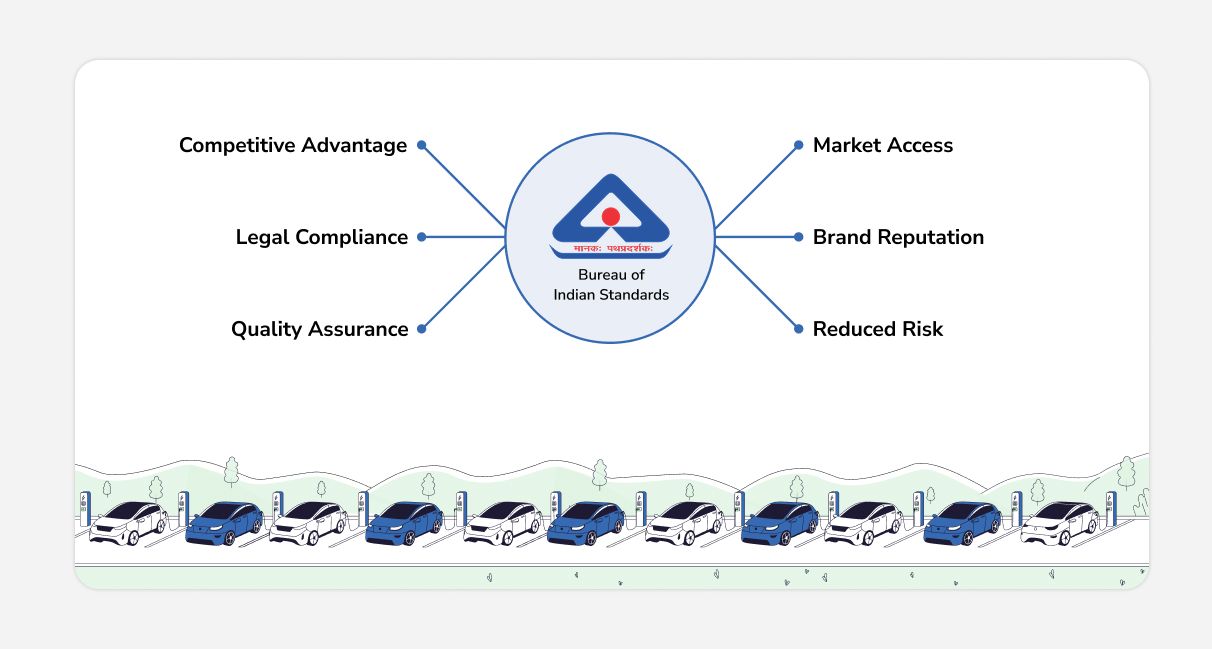
    The Bureau of Indian Standards (BIS) certification is mandatory for all EV chargers sold or imported in India. It sets the IS 17017 standards covering AC/DC chargers, connectors, communication, and safety, aligning them with global norms like IEC 61851 and 62196. For consumers, it guarantees safety against shocks, fire hazards, and overcharging, while ensuring chargers from different manufacturers work seamlessly. For businesses, BIS compliance is non-negotiable: manufacturers, importers, and charge point operators must only deal in BIS-certified equipment to avoid penalties, meet subsidy requirements, and assure reliability.
    1 (9).jpg

    Standards covered: The cornerstone is IS 17017, which has multiple parts:

    • IS 17017-1: General requirements for conductive charging (based on IEC 61851-1).
    • IS 17017-2 series: Covers specifics for AC and DC charging equipment.
    • IS 17017-21 & 22: Electromagnetic compatibility (EMC) requirements for chargers.
    • IS 17017-25: Special requirements for light EV DC chargers (low-power DC).
    • Bharat EV Standards: Early Indian standards Bharat AC-001 (AC charger up to 10 kW) and DC-001 (15–30 kW DC charger) are referenced in IS 17017. These were interim standards for EVSE in India and are largely superseded by newer IS/IEC standards, but are still seen in some legacy installations.

    How to Get BIS Certification
    2 (4).jpg
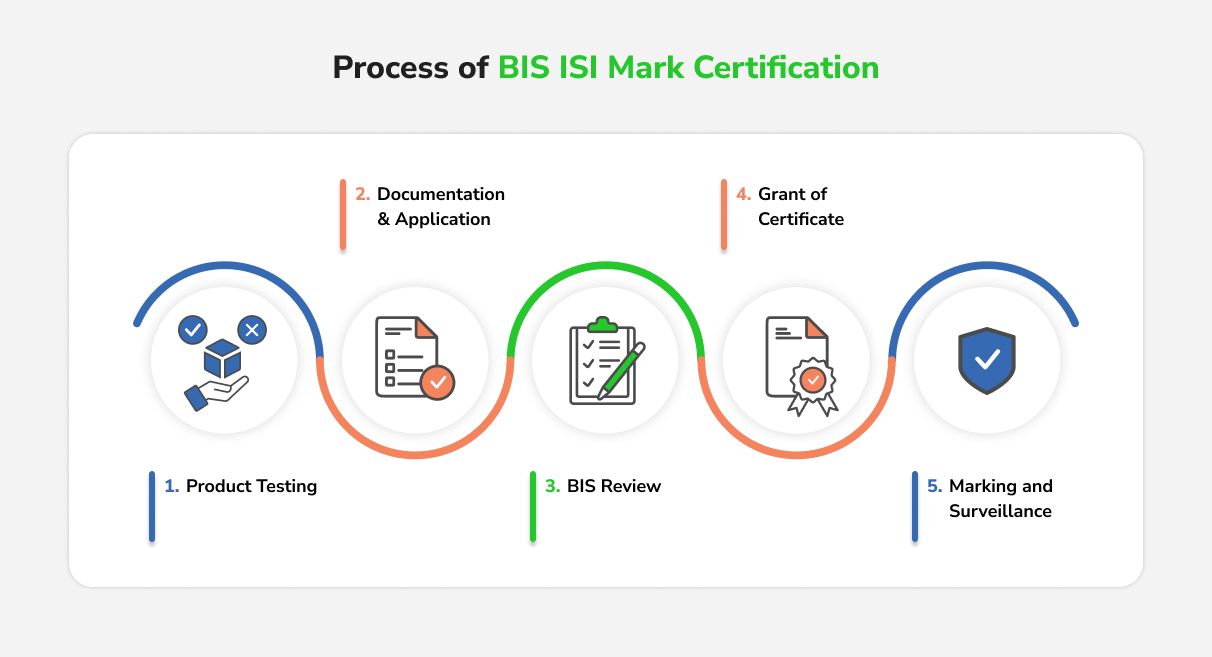
    The process follows the Compulsory Registration Scheme (CRS) of BIS.

    Getting a BIS certification for EV chargers involves product testing in a BIS-recognized NABL-accredited lab or the Foreign Manufacturers Certification Scheme (FMCS) for overseas players. BIS then reviews the reports, raises clarifications if needed, and grants a registration number once satisfied. Certified chargers must display the BIS mark, and manufacturers remain subject to periodic surveillance audits or random testing to ensure compliance. The registration is valid for two years initially and can be renewed for up to five years, provided the product remains unchanged and updated test results are submitted.

    2. ARAI and AIS Standards – Testing for Automotive-Grade Safety
    3 (10).jpg

    The Automotive Research Association of India (ARAI) and the International Centre for Automotive Technology (ICAT) introduced the first technical standards for EV chargers in India: AIS-138 Part 1 (for AC chargers) and Part 2 (for DC chargers). These laid the foundation for today’s BIS standards (IS 17017 series).

    An ARAI certification shows that a charger has passed stringent safety and performance tests. While not legally mandatory like BIS certification, it plays a critical role in establishing credibility with OEMs, CPOs, and consumers. For any EV charging solutions company aiming to work with enterprise clients or government sectors, this certification can be considered a key differentiator.

    Standards covered: AIS-138 is comprehensive and divided into two parts:

    • AIS-138 Part 1: Covers AC charging stations – general and safety requirements for charging an EV from a standard AC supply. This includes protection against electric shock, metering (if any), connector standards, etc., for AC modes (similar in scope to IEC 61851-1 for AC and Mode 1/2/3 charging).
    • AIS-138 Part 2: Covers DC charging stations – requirements for off-board DC fast chargers, including the communication between charger and vehicle, connector standards (CCS2, GB/T as applicable), and safety features.

    AIS-138 has been harmonized with the BIS IS 17017 series, ensuring consistency across certifications. Think of BIS as the driving license to operate in India, and ARAI approval as an advanced skill certificate for your chargers.

    Additionally, Indian regulators have notified that new vehicles in certain categories must use interoperable charging inlets per standards, making sure vehicle inlets match standards like CCS2 or Bharat specs. This ensures that what the vehicle expects and what chargers provide (as tested by AIS/BIS) are in sync.

    How to Get ARAI/ICAT Certification

    To obtain ARAI certification, manufacturers must submit their charger to ARAI, ICAT, or an NABL-accredited lab with technical specs, where it undergoes safety, performance, environmental, and interoperability tests as per AIS-138 (or relevant IS/IEC). Once approved, the agency issues a compliance certificate or test report that can be used as official proof, often publicized by companies, that the charger meets required standards.

    Tip: If you plan to supply to government projects or want an extra badge of credibility, budget for an ARAI/ICAT test. Their certification is widely respected in the industry, as it essentially vouches that “this charger meets all safety and performance criteria under Indian conditions.” While for many stakeholders, ARAI certification isn’t mandatory, it can open doors. Think of BIS as the driving license to operate in India, and ARAI approval as an advanced skill certificate that further validates your product.

    NABL Accreditation (for Test Labs)
    4 (5).jpg
    One common point of confusion when it comes to certifications is the role of NABL (National Accreditation Board for Testing and Calibration Laboratories). NABL doesn’t certify chargers; it accredits the labs that conduct BIS and ARAI testing. This means that any product testing for certification must be done in an NABL-accredited lab.

    From a manufacturer’s perspective, you must ensure that the lab you choose has NABL accreditation for the relevant IS/IEC standards to avoid delays or invalid results.

    3. Other Indian Compliance Requirements

    Beyond product certifications like BIS and ARAI, there are a few additional requirements and best practices to be aware of when deploying EV chargers in India. These may not always come in the form of a certificate, but they are important for legal and safe operations:

    Central Electricity Authority (CEA) Guidelines

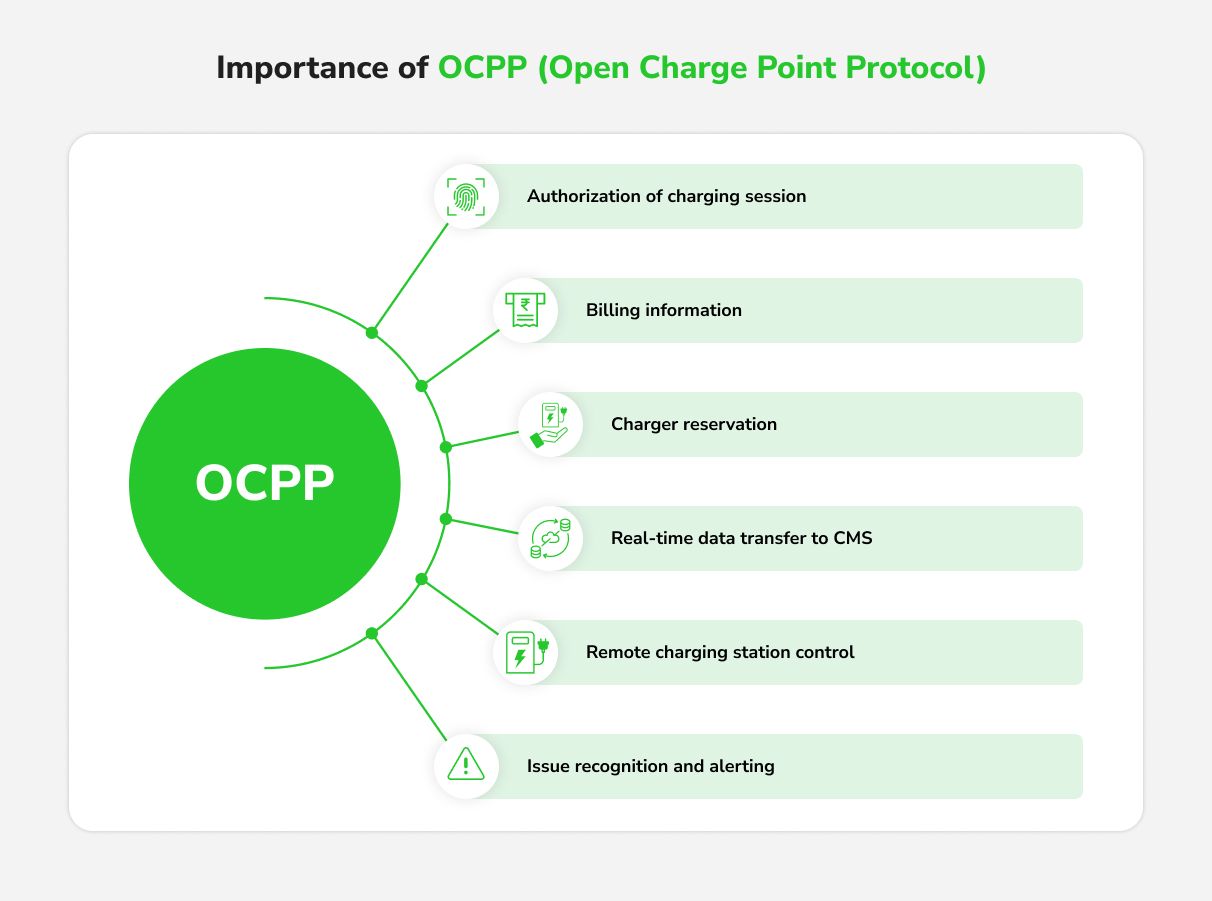
    The CEA and Ministry of Power have issued guidelines for EV charging infrastructure in India to ensure a robust and interoperable network. These guidelines mandate open communication protocols like OCPP/OCPI for networked chargers.
    5 (4).jpg
    As an operator or installer, you should ensure the chargers you install can support these protocols if they are to be networked. Many modern chargers in India come with OCPP compliance out of the box, and some even seek OCPP certification from the Open Charge Alliance to guarantee compatibility.

    Electrical Safety and Installation Approval

    Installing high-power charging stations may require inspection and approval by local electrical authorities. In many Indian states, any electrical installation above a certain load (often 10 kW) needs a sign-off from the Chief Electrical Inspector to the Government (CEIG) or equivalent authority. This is to ensure the wiring, earthing, and protection systems at the site are safe and meet the Electrical Safety Standards. So, if you’re an installer setting up, say, a 50 kW DC fast charger, you might need to submit the installation drawings and charger specifications to the Electrical Inspectorate and obtain an approval or No Objection Certificate (NOC) before commissioning. Always check the local state regulations – some states have made this process straightforward for EV charging, given it’s a de-licensed activity, but compliance with electrical norms is still required.

    Metering and Energy Billing Compliance

    For public charging stations that bill users per kWh, the accuracy of the energy meter is critical. While India doesn’t yet have a specialized “EV charger metering law” like Europe’s Eichrecht, it’s good practice to use energy meters that are certified under the Indian Legal Metrology Act (for accuracy class) if you charge customers. Some chargers integrate approved meters; otherwise, a separate utility-grade meter might be used. This ensures transparency and avoids disputes over billing accuracy.

    Environmental and Fire Safety Norms

    If chargers are installed in enclosed or sensitive locations (e.g., indoor parking, basements), local fire department NOCs might be needed. Ensure that installations have proper ventilation, fire extinguishers or suppression systems as recommended, and follow any guidelines in the National Building Code for EV charging areas. While not a product certification, following these norms can be life-saving and is increasingly being written into local bylaws.

    Your charging station as a whole might include various certified components. Equipment like cables, connectors, and surge protectors must conform to IS/IEC standards and carry ISI marks to ensure reliability and safety.

    Real-World Examples: What Certification Looks Like in Practice

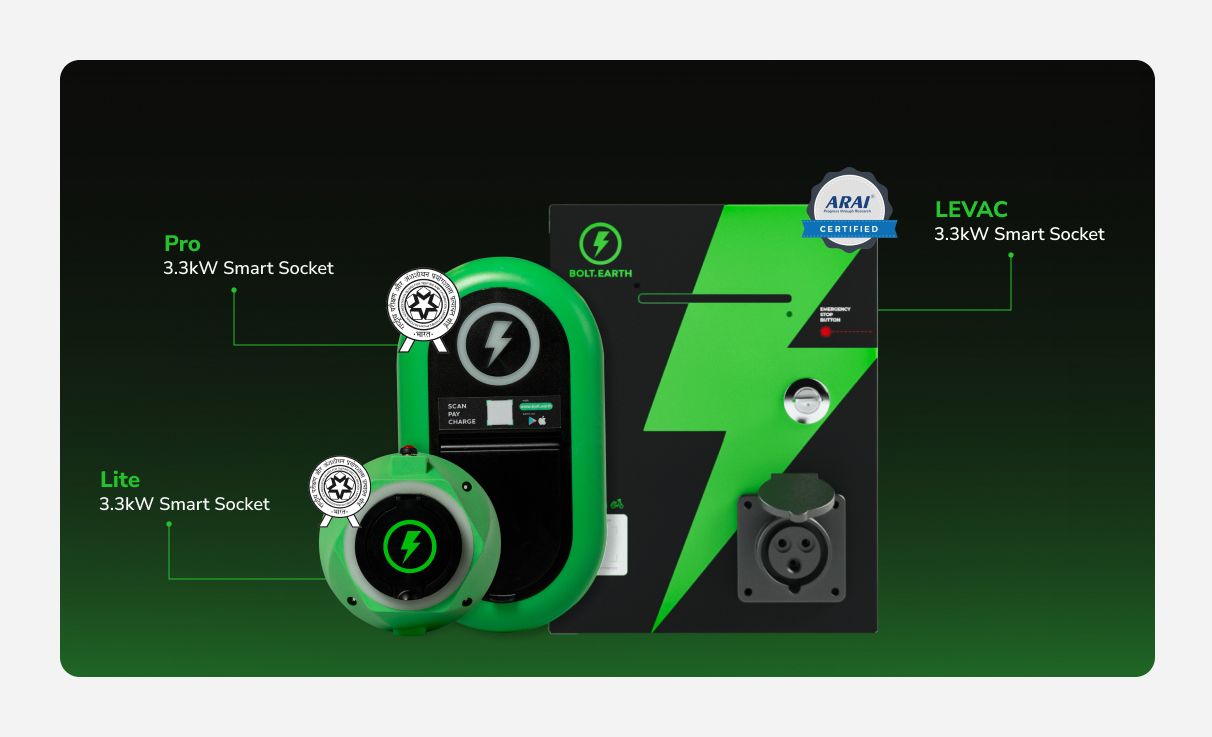
    To understand how these certifications apply in real scenarios, let’s compare two cases – a 3.3 kW home charger vs a 120 kW public fast charger:

    Example 1: 3.3 kW AC Home Charger (Bharat AC001 or similar)
    6 (2).jpg
    A 3.3 kW AC home charger requires BIS certification under IS 17017-1 (general requirements) and IS 17017-22 (AC charging specifics).

    For installation at home, no additional “license” is required. A homeowner can install a charger with the help of a licensed electrician, who should ensure proper earthing and residual current devices (RCD) are in order. Ingress protection is important if the charger is outdoors; most home units are IP54 or IP65, which meets recommended practice.

    There is typically no ARAI involvement needed for a low-power AC charger for private use. The charger’s built-in safety (per BIS standards), like over-current cut-off, ground fault trip, etc., suffices.

    Metering is typically handled via a home electricity meter, and approvals are required unless the charger is part of a larger commercial setup.

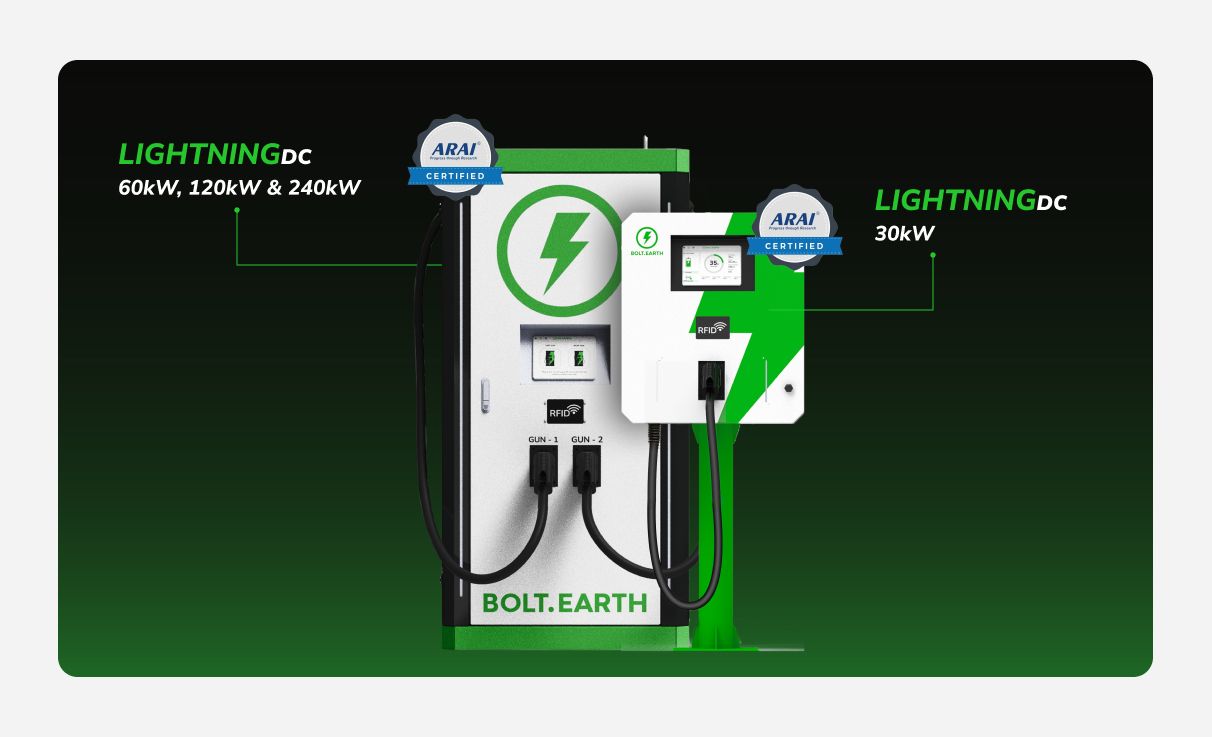
    Example 2: 120 kW DC Fast Charger (Public Highway Station)
    7 (2).jpg
    This is a complex system combining power electronics, cooling, and communication. The BIS certification is mandatory under IS 17017-1 and –23, and -24, and ARAI certification is often needed for credibility and tender bids.

    The installation needs a dedicated grid connection, a 150 kVA transformer (or higher), and utility approvals. CEIG inspection and fire safety compliance are mandatory, and the charger must meet IP55-IP65 protection standards, IK10 enclosure ratings, and fail-safe cooling system requirements. From a standards perspective, the charger might also implement ISO 15118 for communication, given that many new cars would use it to ensure global interoperability.

    Summing up: a 120 kW charger needs BIS certification plus de-facto ARAI approval; compliance with Central Electricity Authority’s (CEA) grid connectivity (voltage limits, harmonics filters), and adherence to all site regulations (electrical and fire). It’s a larger compliance burden, but necessary to safely run such high-power equipment. Neglecting any aspect, say skipping a proper earthing or not having the charger type-approved, could result in serious hazards or regulators shutting down the station.

    Final Thoughts

    EV charger certifications in India are about safety, compliance, and trust. The BIS certification under IS 17017 is mandatory and foundational. ARAI/AIS approvals add credibility, open doors to partnerships and tenders. Installers and operators must follow electrical and fire safety norms to ensure a secure charging experience.

    As the EV ecosystem grows. Understanding and investing in proper certification will future-proof your business and build customer confidence and trust.

    Blog CTA Banner

  • Government Incentives for EV Charging Infrastructure in India

    Government Incentives for EV Charging Infrastructure in India

    Electric vehicles (EVs) are gaining momentum in India’s transition to sustainable transport. However, widespread adoption hinges on a robust charging network across the country. Recognizing this, the Indian government, at both central and state levels, has rolled out an array of incentives to accelerate EV charging infrastructure development.

    From capital subsidies and tax breaks to land allotments and utility support, these measures aim to alleviate “range anxiety” and encourage investments in charging stations. This push supports ambitious goals: India is targeting 30% EV penetration by 2030 in new vehicle sales, a goal that requires a nationwide charging network.

    Whether you’re a charge point operator, fleet operator, startup founder, or EV investor, this blog breaks down the evolving policy landscape and shows you how to make the most of government support.

      Because in this guide, we answer three critical questions:

    • What are the central government incentives for EV charging infrastructure in India?
    • Which Indian states offer the best subsidies and benefits for setting up EV charging stations?
    • How can charge point operators, investors, and developers benefit from these incentives today?

    Central Government Initiatives for EV Charging Infrastructure

    From FAME to E-DRIVE: Laying the Groundwork

    India’s EV push began with the National Electric Mobility Mission Plan 2020, under which the FAME India (Faster Adoption and Manufacturing of (Hybrid &) Electric Vehicles) schemes were launched. FAME I ran from 2015 to 2019, supported 2.55 lakh EVs, and sanctioned 520 EV charging stations with an outlay of ₹43 crore. Though a pilot,it set the stage for a larger intervention under FAME II.

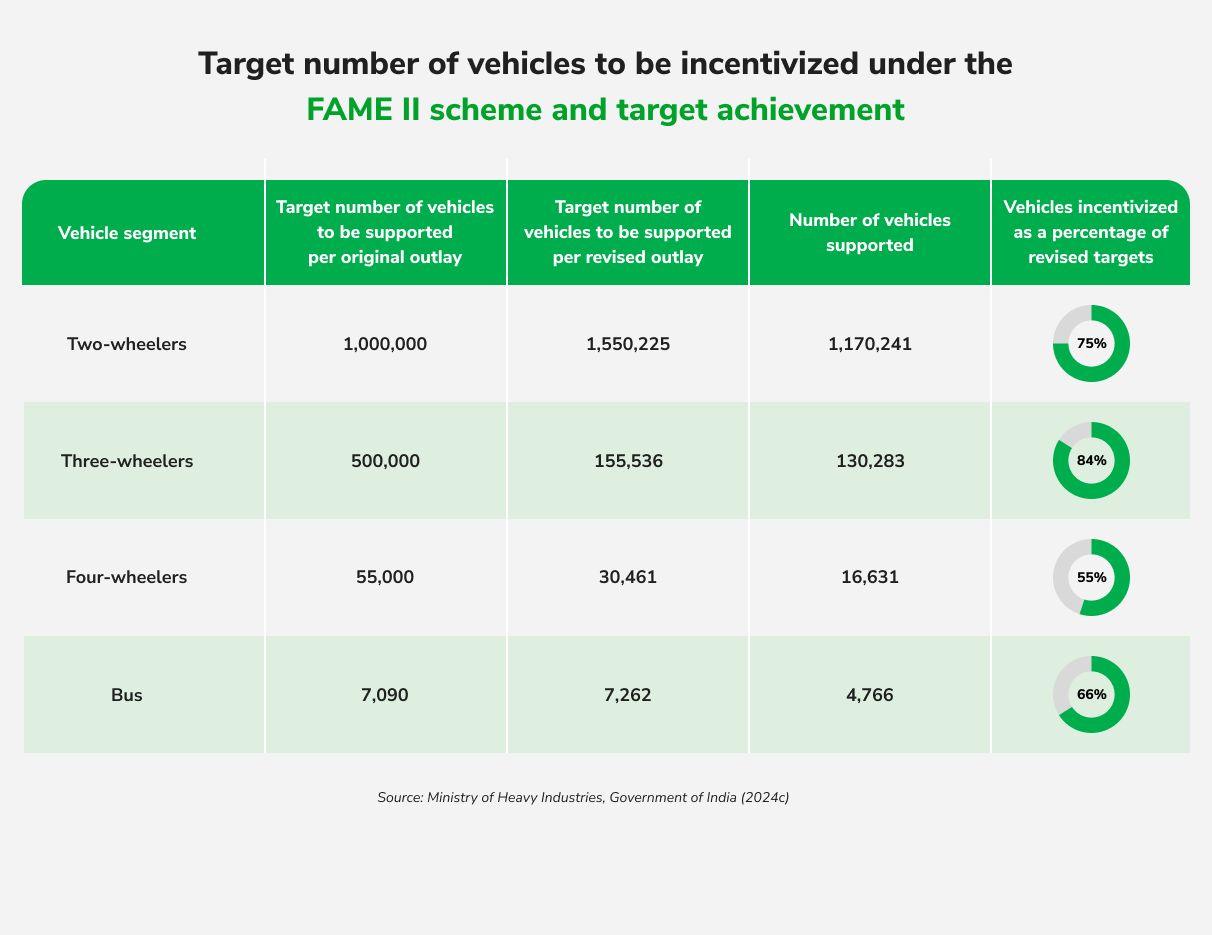
    Target number of vehicles to be incentivized under the FAME II scheme and target achievement (1).jpg

    FAME II (2019–2024) significantly expanded support. With a budget of ₹10,000 crore, it offered upfront subsidies on EV purchases and allocated ₹1,000 crore for EV charging infrastructure in India. By June 2025, FAME II had supported 16.29 lakh EVs and sanctioned 9,332 public EV charging stations (EVPCS) with 8,885 already installed.

    These chargers weren’t limited to big cities; the scheme extended to Tier-2 and Tier-3 cities as well. FAME II’s nationwide incentives helped accelerate the EV charging network in India, which reached over 25,000 public charging points by end-2024. However, FAME II was a time-bound scheme and concluded in 2024.

    A short bridging program in 2024 was later subsumed under PM E-DRIVE. In the words of the Heavy Industries Minister, “Today is a landmark day, as we transition from the FAME scheme … to the PM E-DRIVE Scheme,” signaling continued commitment with a refreshed approach. Let’s explore what PM E-DRIVE brings to the table.

    PM E-DRIVE: The New Catalyst for EV Charging

    United States of America (2).jpg
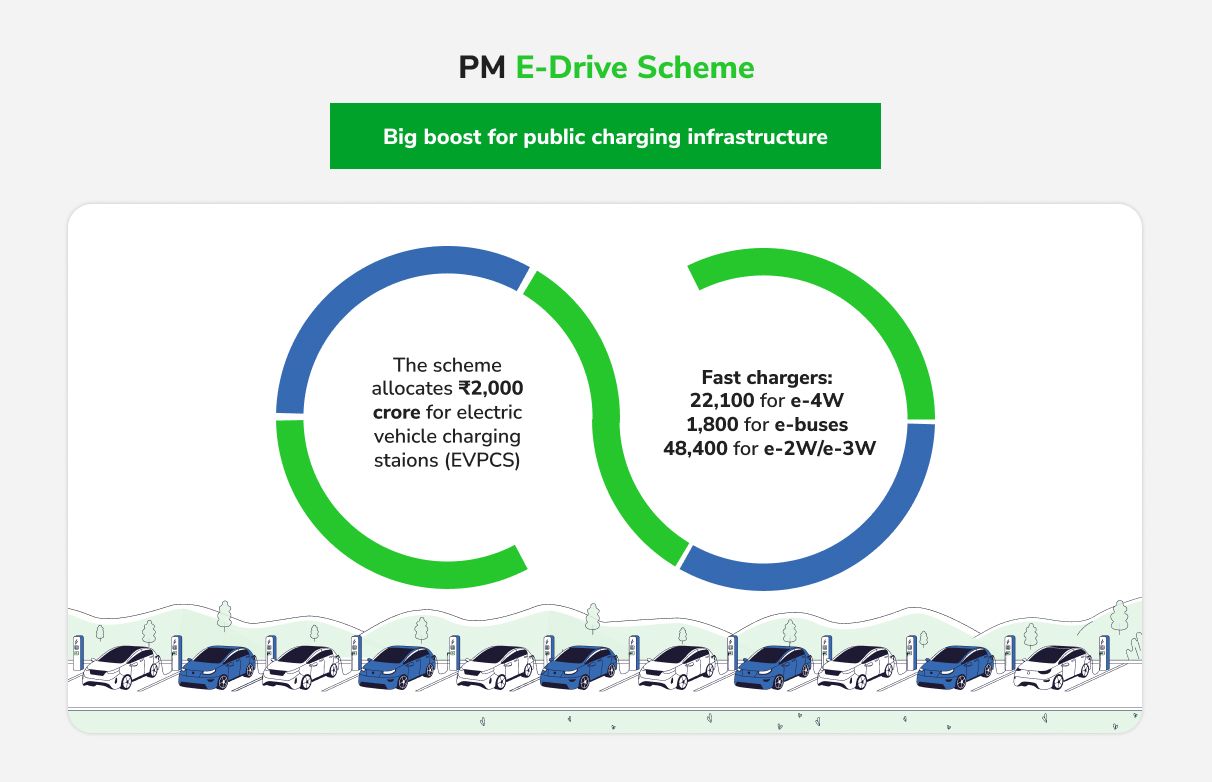
    PM Electric Drive Revolution in Innovative Vehicle Enhancement (PM E-DRIVE) is India’s flagship EV incentive program, running from October 1, 2024 to March 31, 2026, with a ₹10,900 crore outlay. The scheme has two key objectives: accelerate EV adoption through buyer subsidies and establish essential EV charging infrastructure in India. In practice, PM E-DRIVE has multiple components:

    • Demand incentives for EVs: A ₹3,679 crore is allocated for subsidies on electric two-wheelers, three-wheelers, buses, ambulances, and trucks, targeting nearly 25 lakh new EVs. Notably, privately owned e-2Ws are also eligible, unlike the earlier focus on commercial/public vehicles. E-vouchers linked to Aadhaar are used, enabling seamless incentive claims at purchase.
    • Grants for charging infrastructure: A ₹2,000 crore is earmarked to expand public EV charging stations nationwide. This funding will support installing approximately 72,000 new chargers by FY 2025-26. The plan includes around 22,100 fast chargers for cars, 1,800 charging stations for e-buses, and 48,400 chargers for e-two & three-wheelers, focused on high-demand cities and key highway corridors. For context, FAME II supported approx. 9,300 chargers in five years, while PM E-DRIVE targets over 70,000 in just two years. Chargers will be strategically placed on 50 national highway corridors and high-footfall public locations such as metro stations, airports, bus depots and fuel stations to curb range anxiety.

    Other components of PM E-DRIVE include support for electric buses, ambulances, and testing labs, but the scheme’s most transformative impact lies in its EV charging infrastructure in India push.

    In May 2025, an inter-ministerial meeting chaired by MHI decided to appoint BHEL as the nodal agency to aggregate charger demand and develop a unified “EV super app” for users. This app will allow real-time charger discovery, slot booking, digital payments, and track rollout progress,enhancing the user experience and transparency.

    Such coordination reflects a “whole-of-government” approach: “Ministries, public sector enterprises, and states are all aligned to deliver results on the ground… PM E-DRIVE will catalyse new industries, generate green jobs, and offer seamless electric mobility to every Indian,” said the Heavy Industries Minister.

    Overall, PM E-DRIVE is set to be a transformative initiative. It consolidates India’s EV momentum into a focused two-year rollout, backed by substantial funding. By making EV charging stations widely accessible, the scheme aims to eliminate one of the biggest hurdles to EV adoption.

    Union Budget 2025: Supercharging the EV Ecosystem

    The Union Budget 2025-26, delivered in February 2025, reinforced India’s commitment to electrified transport, particularly via funding and tax reforms. Finance Minister Nirmala Sitharaman almost doubled the overall automotive sector budget, from ₹4,307 crore in FY24 to ₹7,485 crore in FY25, driven largely by increased EV spending. A major highlight was the boost to charging infrastructure:

    • Higher Allocation for PM E-DRIVE: The budget allocation for the PM E-DRIVE scheme jumped by 114% to ₹4,000 crore for FY2025, specifically to accelerate the rollout of charging stations. The government is front-loading funds to ensure the targeted 72,000 chargers under PM E-DRIVE are deployed on schedule. This infusion also signals to private players. Complementing this, a dedicated PM e-Bus program was allotted ₹510 crore to help electrify public transport in cities.
    • The budget also continued the policy of offering income tax rebates on loans for EV purchases (Section 80EEB) and announced improved access to credit. Additionally, it expanded the Fund of Funds for Startups, which EV charging startups can access for capital. While these are not direct charging infrastructure subsidies, they improve the overall environment for EV adoption, innovation, and growth of the EV charging network in India.

    State EV Policies: Incentives Driving Infrastructure on the Ground

    State EV Policies_ (1).jpg
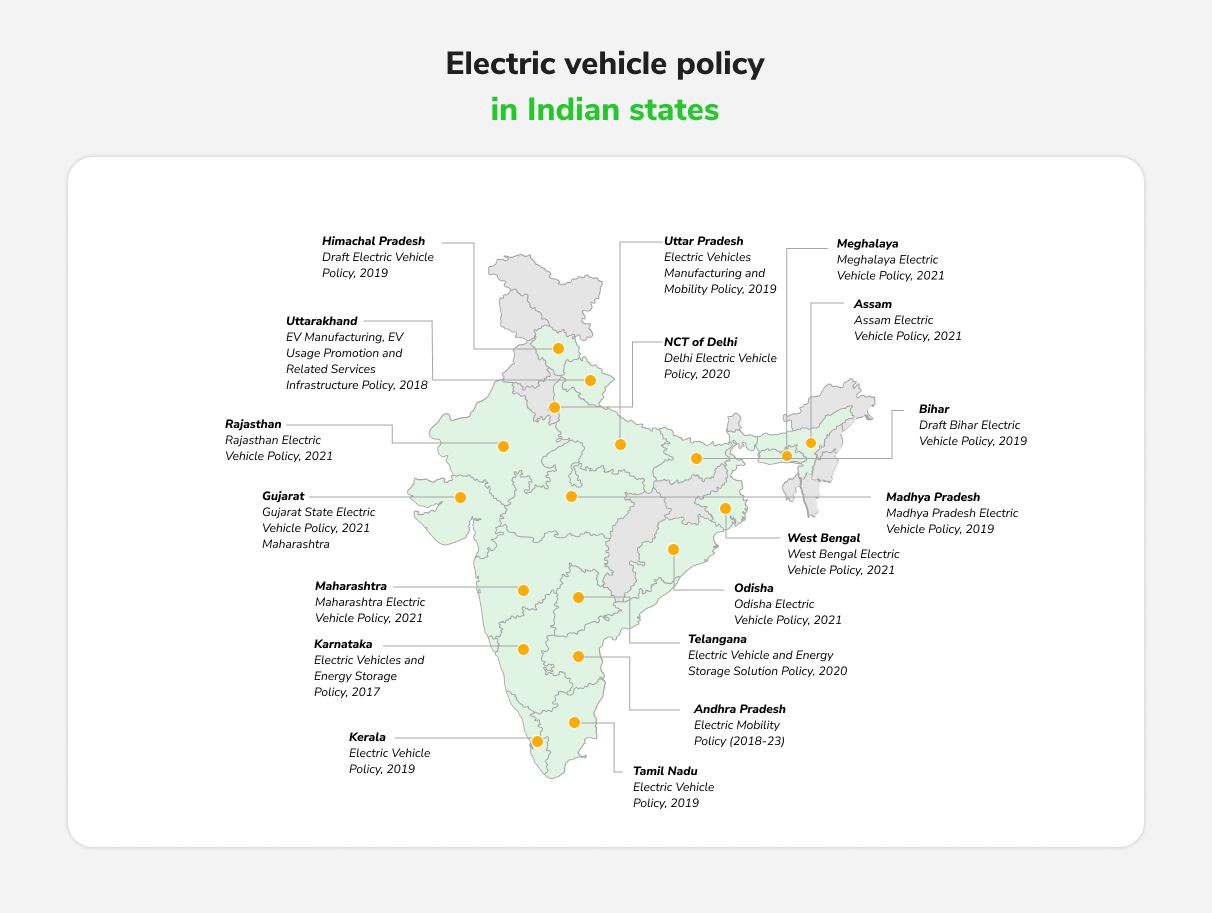
    India’s states are playing a pivotal role in India’s EV revolution. Over 25 states and Union Territories have notified dedicated EV policies, offering a mix of capital subsidies, land support, and electricity concessions.

    Capital Subsidies for Charging Stations

  • Uttar Pradesh: In June 2025, UP became the first state to subsidize upstream electrical infrastructure (like transformers and grid connections) as part of EV charging station cost. Under the amended UP EV Policy 2022, stations are eligible for a 20% subsidy on fixed capital investment, up to ₹10 lakh per station, including grid equipment. This helps CPOs meet ₹25 lakh investment threshold and makes more projects viable.
    • Maharashtra: The new Maharashtra EV Policy 2025 has introduced a Viability Gap Funding (VGF) scheme for public chargers. CPOs can get 15% of the charger cost reimbursed (up to ₹10 lakh per DC fast charger), especially along highways and in cities like Mumbai and Pune.
    • Other states such as Gujarat, Kerala, Punjab, Tamil Nadu, and several Northeastern regions offer similar capital subsidies, typically ranging from 20–25%, with caps per charger or station. Land Allotment and Infrastructure Support

    Securing suitable land remains a key challenge for harging infrastructure. States are addressing this through:

    • Land at Concessional Rates: States with EV manufacturing ambitions are developing EV parks or clusters where land is offered at subsidized rates for related infrastructure. Tamil Nadu’s 2023 EV policy gives 50% discounted land in EV supplier parks for companies setting up EV or charging equipment plants. While that mainly targets factories, it indirectly helps charging by bringing down charger hardware costs. Telangana’s updated policy (Nov 2024) similarly offers land in upcoming EV parks on long-term lease at concessional rates to attract charging station operators and battery swapping providers.
    • Public Land for Charging Stations: Several states and city authorities are identifying government-owned spaces (bus depots, parking lots, highways rest areas) to install charging stations. Delhi has been aggressive here – through its single-window portal, applicants can request installation at municipal parking lots and Delhi Transco Ltd helps provide locations and connections. Maharashtra is opening up MSRTC bus depots for private players to install fast chargers (with revenue-sharing models). Karnataka is clustering chargers at metro stations and BMTC bus depots in Bengaluru, often offering space at nominal rent. This addresses both location and footfall challenges, while the state bodies often facilitate the electrical connection as well.
    • Ease of Land Conversion & Approvals: States are simplifying the red tape for charging stations. Many have declared charging setups as a permissible activity in commercial or non-agricultural land use, avoiding lengthy land-use change processes. Some (e.g., Rajasthan and Madhya Pradesh) have single-window clearance systems to approve new charging stations within weeks, coordinating utilities and urban bodies.
    • EV Parks & Hubs: A few large states are creating integrated EV zones. Uttar Pradesh is setting up a 500-acre EV park near Kanpur, primarily for manufacturing, but with provisions for battery swapping and charging infrastructure on-site. The idea is to provide ready-made infrastructure (power supply, land, permissions) so investors can plug-and-play.

    Affordable Electricity: Tariff Concessions and Duty Waivers

    Electricity cost is the single largest ongoing expense for a charging station operator. To make EV charging profitable and accessible, states:

    • Dedicated EV Tariffs: Most states offer dedicated EV tarrifs with lower per-unit rates and reduced demand charges compared to commercial tariffs. For example, Delhi’s EV tariff is ₹4.5 per kWh (plus nominal fixed charges), which is significantly cheaper than regular commercial rates. Maharashtra too has a concessional EV tariff (around ₹5–5.5/kWh) approved by MERC, and waived demand charges for the initial years, enabling CPOs to pay only for energy consumed. Karnataka and Telangana have tariffs in the ₹5–6 range, which their policies advertise to investors as a major incentive.
    • Electricity Duty Exemption: States like Gujarat and Maharashtra have waived electricity duty for EV charging operations for a period (often 5 to 10 years). Gujarat, for instance, offers a 100% electricity duty exemption for EV charging services, effectively reducing the energy cost by approx. 15%. Odisha, Bihar, Tamil Nadu, Punjab, and several others include similar duty holidays in their EV policies. This directly lowers the cost per unit of electricity for CPOs.

    Together, these concessions keep EV charging cheaper than petrol, often ₹1–2 per km, and encourage adoption.

    Other Incentives and Mandates

    State policies also include various innovative measures to boost charging infrastructure:

    Mandating Charging Facilities: States like Andhra Pradesh, Telangana, and Haryana, require new real estate projects to include EV charging provisions

    Fuel Station mandates: Maharashtra, Kerala and Tamil Nadu mandate require petrol pumps to install at least one charging station.

    • Highway mandates: NHAI (central) is working with states to ensure charging points every 40-60 km on national highways – many states piggyback on this to also cover state highways.
    • Battery Swapping and Grid Support: Delhi, Telangana and Tamil Nadu offer incentives for battery swapping stations
    • Open Access for Renewables: Some states allow open access to solar energy for large charging parks, reducing carbon footprint.
    • Public Awareness and Outreach: Campaigns like Switch Delhi educates users about EVs and the available charging infrastructure.

    The result of all this multi-level push is evident: India’s EV charging infrastructure is growing rapidly. By Dec 2024, we saw 25,000+ public charging stations operational across the country, up from just a few hundred five years prior.

    Conclusion: A Unified Charge Toward an Electric Future

    The policy landscape in 2025 clearly shows that India is fully commited to an electric mobility revolution. With central government’s initiatives like PM E-DRIVE and state-level incentives offering capital grants, land, and low-cost power, charging infrastructure is expanding rapidly.

    For CPOs, fleet operators, and investors, this is the ideal time to enter the market.

    Of course, challenges remain, but today the direction is clear. Executing the installation of tens of thousands of charging stations in a short span will test coordination between ministries, state agencies, and private players. There is also a need for standardized guidelines and robust maintenance to ensure these stations remain functional and don’t “rust,” as some experts caution.

    Every ₹1 saved in subsidies or gained in revenue by a charging operator, every parcel of land allotted, and every reduced electricity bill is locking in “green miles” on India’s roads for decades to come. The government incentives, central and state, are not just monetary boosts; they are confidence builders, telling the ecosystem that “we are in this together.”

    As a result, India’s EV charging infrastructure is no longer a chicken-and-egg dilemma; it’s racing ahead, powering the country’s transition to sustainable transportation.

    The journey from a handful of chargers to a nationwide network in a few years is truly remarkable. And with the current policies in place, the remainder of this decade promises an electric ride, one charging station at a time, lighting up a cleaner future for all.

  • Part 1: The Future of Workplace EV Charging in India

    Part 1: The Future of Workplace EV Charging in India

    Is home charging really accessible for India’s EV owners?

    According to McKinsey’s Global Automotive Consumer Survey: India, 55% of EV owners in India have access to home charging, while the remaining 45% rely on alternatives like public, shared, or workplace EV charging India to charge their vehicles.

    However, access to public charging in India is still evolving. Today, the country has approximately 1 public charger for every 135 EVs, compared to a global average of 1 charger per 6 to 20 EVs, highlighting the need for more destination-based EV charging infrastructure.

    This charging gap opens up a clear opportunity, especially as millions of Indians return to offices post-pandemic. For most commuters, the workplace is where their vehicle sits idle for 8–10 hours a day, an ideal window for charging.

    Globally, studies show that combining home and workplace charging can cover over 90% of daily driving needs. And in India, where public charging remains limited and home charging isn’t universal, the workplace EV charging in India is emerging as the next high-impact node in the EV ecosystem.

    Yet, most Indian offices and depots are not EV-ready. While corporate fleets still account for less than 20% of EV adoption in India, demand is rising fast, driven by ESG targets, cost savings, employee expectations, and the promise of smarter, solar-integrated, grid-aware EV charging infrastructure.

      In this article, we focus on the following three questions:

    • What are the benefits of workplace EV charging in India?
    • What is the current state of workplace EV charging in India?
    • What is the future of workplace charging in India, and how will it scale by 2030?

    3 Benefits of Workplace EV Charging in India

    Providing EV charging at corporate campuses presents a win-win opportunity. For employees, they get a convenient “top-up” charging, and for employers, this amenity enhances the company’s sustainability profile and employee satisfaction.

    According to a 2022 KPMG analysis, the majority of charging for private EVs in India, particularly two- and four-wheelers, is likely to be conducted at home or at work using AC slow/medium chargers. By installing EV charging stations, companies demonstrate ESG commitment and help overcome one of the biggest perceived barriers to EV adoption in India: lack of charging infrastructure.

    Encouraging EV adoption

    Encouraging EV adoption.jpg
    A recent survey in Bengaluru found that ~25% of people commute on two-wheelers, but many hesitate to switch to electric due to charging access. Workplace charging can directly address this: IT office parking lots host approx. 500,000 two-wheelers daily in Bengaluru alone. Simply providing basic 3-pin sockets or AC charging points in these lots (even at a modest fee) would let employees charge over 6–8 hours of work, ensuring they have enough range to get home and back the next day. Such initiatives could create a massive incentive for millions of commuters to opt for EVs nationally.

    Employee benefits and retention

    Employee benefits and retention.jpg
    Free or low-cost charging is seen as a valuable perk. Companies offering workplace charging have reported improved employee satisfaction and retention. Globally, employees have indicated that workplace charging access influences their choice of employer; one survey found 82% of EV drivers consider on-site charging an important benefit. In India, forward-thinking firms like Vedanta and MakeMyTrip are subsidizing employee EV purchases and installing campus charge points as part of “green perks” packages.

    Reducing emissions and costs

    Reducing Emissions and Costs.jpg

    Workplace charging aligns with corporate sustainability goals. Every kWh delivered at work (especially if coupled with solar power) displaces fossil fuel usage in employees’ commutes. EVs also cost far less per km to run, around ₹1.2–1.5 per km versus ₹5–7 for petrol cars, translating to savings for employees. Workplace charging thus directly supports staff in cutting their fuel bills and carbon footprint.

    Current State of Workplace EV Charging

    As of 2025, India’s EV charging infrastructure has grown rapidly, supported by both government initiatives and private sector participation. Workplace charging, is gaining traction as businesses incorporate EV facilities for employees and fleet vehicles. Corporate leaders are now treating EV charging stations as an essential amenity for offices, comparable to Wi-Fi or parking security, to future-proof their facilities and align with sustainability goals.

    Key aspects of the current state include:

    Surge in charging points

    According to the Ministry of Power, India had 12,146 operational public EV charging stations as of February 2, 2024, nearly double the count from 10 months prior. Major business hubs lead in charger deployment, for example, Maharashtra and Delhi had approx. 3,079 and 1,886 public chargers respectively by early 2024. By mid-2025, the total number of public chargers is expected to be well beyond this figure (likely in the 15,000–20,000 range) as new stations come online monthly. Notably, oil marketing companies (IOCL, BPCL, HPCL) aggressively added stations at their fuel outlets – around 8,000 fast chargers were installed by these firms during 2023–24 alone, under FAME II funding support. This expanded network directly benefits workplaces located near highways or urban fuel stations, improving charging access for commuting employees.

    Private and captive charging growth

    Private and captive charging growth (1).jpg
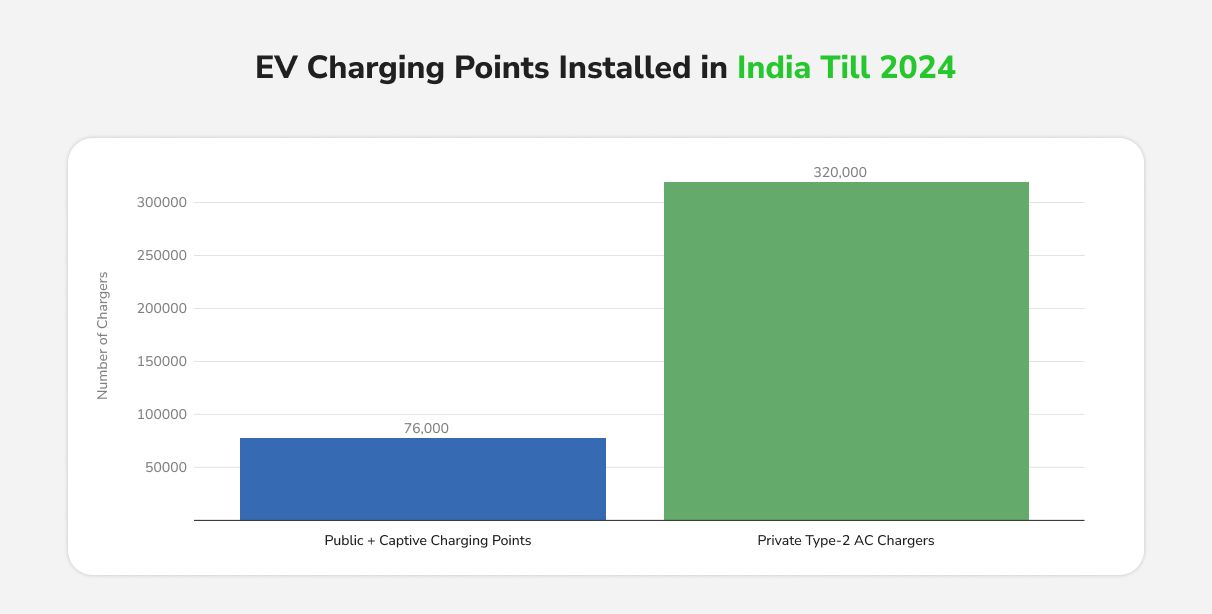
    Alongside public chargers, there’s been a boom in private (captive) charging at workplaces, apartment complexes, and fleet depots. A recent industry report noted that by 2024 India had about 76,000 charging points in total (public + captive) and over 320,000 private chargers (mostly home chargers) installed. Many large companies, especially in IT parks, logistics, and hospitality, have set up dedicated employee charging stations. These are typically AC slow/medium chargers (3.3 to 7 kW) that can top up vehicles over the workday. The majority of charging for private EV owners in India is expected to happen at home or at work using AC chargers, a trend now visible in corporate sustainability plans. For example, tech campuses in Bengaluru and Gurugram have started offering free or subsidized EV charging, paralleling practices in Silicon Valley.

    Scalability for decarbonization

    Public-private partnerships is emerging to build large charging hubs for commercial use. For instance, Flipkart partnered with a utility to set up 38 dedicated charging sites (190 fast chargers) across cities to support its delivery of EV fleet. These hubs not only serve company vehicles but can often be opened to other fleets or even the public, maximizing utilization. The opportunity is huge: India’s logistics and service sectors operate millions of vehicles, and electrifying even a fraction by 2030 will require thousands of depot charging stations.

    How India’s Charge Point Operators (CPOs) are powering the workplace charging ecosystem

    The charging infrastructure market now hosts 40+ active CPOs offering various hardware and software solutions. Many national and global players are now partnering with corporates and real estate developers to install chargers at workplaces, shopping centers, and parking lots. The private sector’s role is evident in the growing diversity of charger types, from 15A charging sockets to Type 6 and Type 7 connectors (primarily for two- and three-wheelers), Type-2 AC connectors for cars, and 60 kW CCS2 DC fast chargers for commercial fleets. The ecosystem has matured to the point where workplace charging solutions — such as load-managed smart charging for office parking garages and charger management systems (CMS)— are now offered as turnkey services by emerging energy startups.

    Government initiatives and policies

    The policy environment in 2022–2025 has significantly favored faster charging rollout:

    In 2022, the government issued revised Guidelines and Standards for EV Charging Infrastructure. These allowed individuals to use existing electrical connections at homes/offices for charging EVs, mandated that distribution companies provide connections for public chargers expeditiously, and capped tariffs for EV charging (with a special EV tariff not exceeding the average cost of supply. Such measures directly encourage workplaces to install chargers, since offices can now easily add charging points on their premises without regulatory hurdles.

    Several state EV policies (e.g., Maharashtra 2021, Karnataka 2022) include provisions for charging infrastructure in commercial buildings. Delhi’s subsidy for 30,000 private chargers was fully subscribed, boosting installations in office complexes and apartments. States like Telangana, Tamil Nadu, and Gujarat have also provided capital subsidies or tariff concessions for charging stations, spurring private investors to set up charging hubs that often cater to nearby office clusters.

    In late 2024, the government approved the PM e-Drive (Electric Drive Revolution) scheme, essentially FAME II’s successor. With an outlay of ₹10,900 crore for 2024–26, it earmarks ₹2,000 crore specifically for charging infrastructure. This injection of investment is accelerating installations in cities with high EV adoption and along key highways. We are already seeing the impact in 2025: tenders and grants for workplace charging clusters (in government office complexes and tech parks) have been rolled out under this program.

    More ease of access for users

    With more chargers around, using an EV for commuting is far more practical in 2025. Payment and access have been streamlined. Most public and workplace chargers support digital payments and interoperable RFID/mobile app access, often integrated via aggregators or the government’s One Nation One Card for EVs initiative. Tariffs for workplace charging are often subsidized by employers or offered at cost (and remember, in India charging at the workplace using an employer’s electricity is allowed on the company’s connection). This ease of access is encouraging more employees to consider electric company cars or to switch to electric two-wheelers for their daily commute. Backing this shift, several companies now offer reimbursement programs that make buying an EV not just sustainable, but financially rewarding.

    Outlook 2025–2030: Forecasts and Future Trajectory

    The next decade will be transformative for EVs in India, and workplace charging infrastructure is expected to grow exponentially to keep up with rising demand. Key forecasts and data-backed estimates include:

    EV adoption rates

    Government targets and industry projections indicate that EVs could form 30% of new private car sales, 70% of commercial vehicle sales, 40% of buses, and 80% of two- and three-wheeler sales by 2030. In absolute numbers, one analysis projects around 50 million EVs on Indian roads by 2030, up from only ~2 million in 2023. This surge will be driven largely by two/three-wheelers and commercial fleets, segments that heavily rely on workplace or depot charging.

    Charger deployment needs

    To support these EVs, India will need a massive build-out of charging infrastructure. Estimates vary, but a 2024 report by Forvis/Mazars suggests about 1.3 million charging stations will be required by 2030 (roughly a 1:40 charger-to-EV ratio). This implies installing approx. 400,000 chargers per year through 2030. For context, as of early 2024, India had only approx. 16,000 public charging stations. A significant share of the new chargers will be semi-public (at workplaces, malls, fleet depots, etc.) rather than purely public ones. Workplaces are expected to become a major venue for EV charging, second only to home charging, as EV adoption expands.

    Workplace charger demand & utilization

    As more employees drive EVs, the demand for office charging points will rise. Today, the availability is limited; only about half of EV drivers in one 2025 survey had access to workplace charging, but employee interest is extremely high. In the US, 98% of surveyed commuters without workplace charging said they want it available, and Indian employees echo similar sentiments anecdotally. We can expect utilization of workplace chargers to start modestly perhaps a few uses per charger per day when EV penetration is low) and climb steadily through 2030. Global data shows that when offered, many EV owners plug in at work 1–3 times per week, mostly to replenish the daily commute. One US Department of Energy program found that employees at companies with charging were six times more likely to drive an EV than the average worker.

    Typical charger utilization

    A single Level 2 charger can often fully charge 2–3 cars during an 8-hour workday if drivers rotate, but in practice, cars often remain plugged in for the entire workday. This means that current utilization (charging time vs. connected time) is relatively low. However, as EV numbers grow, we can expect smarter usage policies to increase throughput. By 2030, it’s plausible that workplace chargers will operate near capacity during daylight hours, especially in large campuses. Fleet depot chargers will also see intensive use. For example, ride-hailing and delivery fleets might cycle vehicles such that each charger is used for multiple sessions per day. Overall, industry planners anticipate average charger utilization rates rising from <15% in early years to 40%+ by the late 2020s for public/commercial chargers, as EV adoption reaches critical mass. High utilization is key to making the economics of charging stations viable.

    EV charging cost trends

    The cost of EV charging equipment and installation is expected to gradually decrease, making workplace chargers more affordable. Today, a basic 3.3–7 kW AC charger unit in India costs on the order of ₹10,000–₹100,000 (plus installation), while a 60 kW DC fast charger costs over ₹5 lakh. These costs have already fallen from a few years ago, thanks to local manufacturing and economies of scale.

    By 2030, continued innovation and volume production could further reduce hardware costs per charger by 20–30%. Additionally, battery improvements might allow smaller chargers to deliver more service, improving cost-effectiveness. On the electricity side, tariffs may evolve with more time-of-use pricing, potentially lowering off-peak charging costs. Overall, the total cost of providing workplace charging (per vehicle served) is expected to trend downwards, improving the business case for employers.

    Energy demand and grid impact

    If tens of millions of EVs charge at homes and workplaces, what does it mean for energy demand? According to a 2019 Brookings India study, even under a scenario where all vehicle sales shift to electric, EV electricity demand would remain under 100 TWh by 2030, but still make up between 1.3% and 4.8% of India’s total electricity use that year. Daytime/work charging is actually advantageous for the grid if it aligns with solar generation. India’s policy think tanks note that unmanaged evening charging (everyone charging after 6pm) would stress the grid, but shifting more charging to daytime (at workplaces during solar peak hours) can reduce loads and cut emissions. Thus, forecasts to 2030 increasingly favor “solar-friendly” charging patterns, with workplaces playing a crucial role in absorbing midday solar surplus by charging cars while the sun shines. By 2030, we may also see vehicle-to-grid pilots where workplace EVs can discharge power back to the grid or building during peaks (this remains experimental but could become part of beyond-2030 forecasts for office campuses).

    Policy trends and government roadmap

    Policy will continue to be a key driver. We can expect:

    Continued incentives

    The upcoming years might see an extension or evolution of subsidy schemes. With FAME II concluded, the PM e-Drive scheme (2024–26) provides fresh capital for chargers. If the EV sales trajectory remains steep, policymakers could extend such incentives beyond 2026. We might also see state-level mandates, for instance, requiring office complexes above a certain size to install EV chargers (some cities globally have done this). In India, several state governments already require new commercial buildings to allocate 20–25% parking for EVs with charging facilities; enforcement of these rules will tighten by 2030.

    In short, through 2030 and beyond, workplace charging infrastructure in India will expand from a niche offering to a mainstream feature of corporate campuses and logistics hubs. We will likely go from only a few thousand workplace chargers today to tens of thousands (if not more) by 2030. This growth will mirror and support the rapid rise in EV ownership, helping India stay on track to meet its electrification and climate goals.

    In the next part of this series, we’ll explore what India, as an evolving market, can learn from other countries about building effective workplace EV charging networks. We’ll also break down the business models and ROI structures that are working globally. And finally, we’ll highlight where the real investment opportunities lie for Indian enterprises, utilities, and infrastructure players.

  • Why Blaze DC Is the Right Choice for EV Charging Hosts

    Why Blaze DC Is the Right Choice for EV Charging Hosts

    Historically, many businesses and residential complexes in India hesitated to host EV chargers due to perceived high costs and unclear benefits. But as EV demands surge and public charging remains scarce, a new reality is setting in: businesses that offer on-site charging stand to attract a growing wave of EV customers and gain a competitive edge over those that don’t.

    International trends echo this. Major retail brands like Starbucks and Walmart have invested heavily in EV charging, expecting it to increase customer dwell time and same-store sales. In the US, a comprehensive study across 800+ counties found that retailers located near public chargers saw a 4% increase in monthly visits and a 5% rise in spending on average. In other words, EV drivers actively seek out and patronize charger-equipped locations. Offering fast charging is no longer just a green gesture; it’s becoming a proven way to boost foot traffic, customer loyalty, and revenue.

    Blaze DC was built for exactly this opportunity. It’s a fast, intelligent charging solution tailored to businesses, property owners, and any EV charging hosts looking to turn the charging gap into a growth avenue.

    In this blog, we explore 5 reasons why Blaze DC is the right choice for EV charging hosts, helping you draw in EV customers, create new revenue streams, and deliver a seamless charging experience that sets your location apart.

    5 Ways Blaze DC is the Profitable Solution for EV Charging Hosts

    1. Increase footfall and customer dwell time

    Installing Blaze DC can transform your location into a magnet for the growing EV customer base. With convenient charging available on-site, EV drivers are more likely to choose your business over others, even going out of their way for a top-up in a safe, comfortable environment. Early-adopting retailers have already seen the impact: businesses within approx. 150 m of a charging station enjoy higher visit counts and spending from customers who charge while they shop.

    The logic is simple: if patrons can plug in their scooter or rickshaw and then grab a meal or do some shopping, they’ll linger longer and likely purchase more. This increased dwell time directly boosts sales.

    In fact, a US survey found EV drivers are willing to pay a premium for public charging convenience, and they overwhelmingly prefer venues that offer amenities during charging stops. By hosting Blaze DC fast chargers, you’re offering an experience that draws people in and keeps them coming back.

    2. Optimize space & serve more EVs with fast charging

    In many businesses, parking space comes at a premium. Blaze DC’s compact, wall-mountable design allows it to fit neatly onto a wall or a single parking spot, delivering fast charging without disrupting your layout or operations.

    Despite the small size, Blaze DC packs a punch: its DC fast charging capability drastically reduces charge times, so each parking spot with a charger can serve many more vehicles in a day compared to a slow charger.

    In fact, fast chargers service roughly 3× more vehicles per connector than typical AC units, according to a study done on 27,800 charging stations in Germany.

    For an EV host, this means you can accommodate more charging sessions without needing many dedicated bays. Customers get a meaningful charge in just 15 to 30 minutes, freeing the spot for the next EV drive; no one is stuck waiting hours.

    And faster turnaround keeps your parking area flowing smoothly, even as traffic grows. Blaze DC comes in 3 variants of 3 kW, 6 kW, and 12 kW you can choose from according to your use case, balancing speed and grid load to fit your space and capacity. Bottom line: Blaze DC lets you offer efficient charging, maximize utilization of each charger and parking spots.

    3. Tap into a high-margin revenue stream

    EV charging can be a lucrative new income source for host businesses. Public fast charging typically carries a hefty convenience fee. In India, DC fast charging rates hover around ₹18–₹22 per kWh, which is 2 to 3× higher than residential electricity rates. EV owners willingly pay this for a quick top-up, even though charging at home is much cheaper, because time is money on the road. This price difference translates into solid profits for the charger operator.

    One analysis found drivers are happy to pay ₹250–₹330 per hour for DC charging, despite it costing only about ₹60 in electricity for that time at home—a markup that goes into the host’s pocket. Even at modest utilization, a single Blaze DC can generate significant revenue. Industry data from early deployments in India shows that a busy public charger can earn ₹10–14 lakh per year from charging fees.

    With typical fast-charge margins of around 30–40% after electricity costs, that means ₹3–5 lakh in annual gross profit per charger. Moreover, government initiatives like the PM E-DRIVE scheme now offer subsidies (up to 80% of infrastructure costs) for installing public fast chargers, dramatically lowering your upfront investment.

    In short, Blaze DC doesn’t just pay for itself; it quickly becomes a profit center for your location, helping offset declining revenues in other areas and future-proofing your business model.

    4. Safety and smart reliability; built for worry-free operation

    When you provide EV charging to customers, you need it to work flawlessly every time; a malfunctioning charger could mean lost trust and business. Blaze DC is engineered with enterprise-grade safety and intelligence to ensure every charge is both safe and smooth. Each unit comes with a multi-layer protection system that operates autonomously in real time. This includes safeguards against:

    • Short-circuits
    • Over-voltage
    • Under-voltage
    • Earth faults
    • Reverse polarity
    • Current leakage

    Along with an emergency stop button for immediate cutoff. These protections are always-on and require no manual intervention, so even if a customer is charging unsupervised, you can be confident there’s no risk to them, their vehicle, or your premises.

    On the reliability front, Blaze DC’s built-in smart features minimize downtime. The charger is natively connected to the cloud via the Bolt.Earth CMS, enables live status monitoring, instant fault diagnostics, and predictive maintenance alerts.

    If an issue does arise, many fixes can be done remotely or with simple component swaps, thanks to its modular design (critical parts are field-replaceable in minutes). For a host operator, this means 99%+ uptime without needing on-site technical expertise.

    By choosing Blaze DC, you’re providing a safe, dependable service to your customers, backed by intelligent systems that keep it running smoothly in the background.

    5. Universal compatibility & future-proof flexibility

    One of the biggest headaches for charging hosts is dealing with multiple vehicle brands and charging standards. Nobody wants a charger that’s limited to one make or stuck with an outdated connector.

    Blaze DC eliminates that worry. It’s India’s first universally compatible DC fast charger for 2- and 3-wheelers and supports both the major connector standards, Type 6 (Bharat Charge Alliance’s DC standard) and Type 7 (the new LECCS fast-charge standard approved by the BIS), in a single unit.
    In practice, this covers over 90% of fast-chargeable EV models on Indian roads. Whether your customer drives an Ather or Ola e-scooter, a Hero MotoCorp, a Mahindra e-rickshaw, or any other popular model, Blaze DC can charge it seamlessly.

    As the market evolves toward these common standards, your infrastructure will remain compatible with upcoming vehicles, keeping you future-proof.

    The charger’s over-the-air update capability also ensures it stays current with the latest protocols and features. And with its robust design (IP54 weather protection, industrial-grade components), Blaze DC is built to last in India’s conditions, from high-traffic urban storefronts to outdoor parking lots. Choosing Blaze DC is a long-term investment in charging flexibility, ensuring that your site can serve the widest range of EV customers both now and in the years to come.

    Final Thoughts

    In a landscape where EV adoption is outpacing infrastructure, forward-thinking businesses have a golden chance to stand out by becoming EV charging hosts. Blaze DC makes that transition not only feasible but also highly rewarding. It enables you to offer a premium fast-charging experience that delights customers by letting them see their vehicle gain tens of kilometers of range over a quick cup of coffee or charge up while running errands without missing a beat. By doing so, you’re signaling that your business values convenience, innovation, and sustainability, which in turn builds goodwill and customer loyalty.

    At the same time, Blaze DC addresses the practical needs behind the scenes: keeping your operations smooth and profitable. From reducing parking bottlenecks with quick-charge turnover to generating new income with each charging session to minimizing maintenance headaches through smart monitoring, it’s a solution designed from the ground up for commercial viability.

    If you’re looking to deploy Blaze DC at your retail outlet, office complex, hotel, or any other site, our team at Bolt.Earth is here to help make it happen. You can purchase Blaze DC fast chargers directly through the Bolt.Earth website, or reach out to us for a tailored consultation and free site assessment.

    Email: [email protected]

    Phone: +91 80456 88455

  • Introducing Blaze DC: India’s First-Ever Universally Compatible Fast Charger for 2- and 3-Wheelers

    Introducing Blaze DC: India’s First-Ever Universally Compatible Fast Charger for 2- and 3-Wheelers

    Six years after deploying our first charger, we’ve now launched Blaze DC — a fast-charging solution shaped by everything we’ve learned from operating India’s largest EV charging network, with 1 lakh+ chargers across 2,000+ cities.

    It combines our latest advancements in hardware, software, and grid integration to deliver what we consider the ideal, universal fast charger for India’s two- and three-wheeler EVs.

    Refined through real-world insights and proudly built in India, Blaze DC is the most accessible and future-ready charging experience yet.

    Why India Needs a Fast Charger for 2- and 3-Wheelers


    India’s EV revolution is led by two- and three-wheelers. Together, they account for over 90% of all electric vehicles sold in the country. Two-wheelers alone made up 59% of EV sales in 2024, with three-wheelers close behind at 35%.

    But while adoption has surged, infrastructure hasn’t kept pace. Four-wheelers enjoy access to a growing DC fast-charging network, but for 2- and 3-wheelers, it’s still virtually nonexistent. It’s fragmented — slow sockets at home, brand-specific setups, or improvised, often unsafe, public workarounds.

    Governments are beginning to take notice. In cities like Delhi, local authorities have flagged safety and reliability concerns, particularly around unauthorized e-rickshaw charging hubs, and are calling for dedicated fast-charging stations.

    Industry projections show the two-wheeler fast-charging station market is expected to grow at over 30% CAGR, reaching nearly USD 1.85 billion by 2032.

    Blaze DC is our answer to this imbalance, a fast-charging solution engineered for India’s 2- and 3-wheeler segment.

    A Fast Charger Built for India’s 2Ws and 3Ws: Fast, Compatible, and Future-Ready

    While most fast-charging options for two- and three-wheelers in India today are either modified car chargers or locked behind OEM-specific networks, Blaze DC is engineered to meet the real-world demands of India’s most-used EVs. The result? It delivers 1% charge per minute, up to 3.5x faster than conventional setups, and is optimized for both the urban stop-and-go user and the long-distance fleet rider.

    Blaze DC supports both the BIS-approved Type 7 connector and the Type 6 connector endorsed by the Bharat Charge Alliance (BCA). Type 6, also formally recognized under the international IEC 62196-6 (Dash-6) standard, is rapidly becoming the preferred interface for fast-charging light electric vehicles in India.

    By supporting both standards, Blaze DC is nationally compliant and compatible with popular models from Ather, Ola, Hero MotoCorp, Matter Motors, Simple Energy, and more.

      Blaze DC’s connector architecture offers multiple cascading benefits:

    • Compatibility: Supports 90%+ of fast-charging enabled 2Ws and 3Ws in India
    • Scalability: Easy to deploy across residential, commercial, and fleet locations
    • Future-readiness: Designed to work with any future Type 6 and Type 7 EV models.

    Speed wasn’t the only priority. Blaze DC was designed to fit the everyday realities of India’s EV ecosystem, fast when the shift demands it, reliable when the route gets unpredictable.

    Echoing this, Raghav Bharadwaj, CEO of Bolt.Earth says, “Blaze DC is substantially faster than any two-wheeler charger in the country. The 12kW variant delivers up to 100 km of range in just 15 minutes. It cuts down charging time, on average, for 2-wheelers from 5 to 6 hours to 1 hour. Most riders who start around 10 am typically pause by noon to grab lunch and recharge, making that 30-minute window the perfect moment to power up. That’s the future we’re building: charging that fits into your day, not the other way around.”

    For urban commuters and delivery partners, charging anxiety remains one of the biggest barriers to adoption. Long queues, slow chargers, and unpredictable uptime all contribute to uncertainty. Blaze DC eliminates that with fast, dependable, and repeatable performance, helping users break free from downtime and experience seamless rides.

    4 Blaze DC Variants Built for Every EV Charging Use Case


    Blaze DC comes in four variants: 3kW (Single & Dual Gun), 6kW, and 12kW, each tailored to match India’s diverse power availability and EV use cases.

    Blaze DC 3kW Single Gun DC Fast Charger

    The 3kW Blaze DC is designed specifically for Indian homes and RWAs, where most properties operate on a single-phase, 230V connection, typically rated for up to 7.5kW or 40A. This unit draws less than half of that, making it safe, efficient, and plug-and-play for most residential settings.

    • No rewiring
    • No panel upgrades
    • No extra utility approvals

    For a typical 16A circuit, often used for air conditioners, water heaters, or microwave ovens, the 3kW variant operates well within limits. It upgrades users from slow wall sockets to a fully integrated fast-charging experience, up to 3x faster and far safer.

    It’s ideal for:

    • Apartment complexes
    • Gated communities
    • Small businesses
    • Homeowners with 2W EVs

    Power Input: 16A Single-phase, 220V AC ±10%
    Connector: Type 6 or Type 7 connector
    Output: 3kW DC | Single Gun
    Range Delivered: Up to 40 km in 15 minutes

    Need Blaze DC 3kW Single Gun? Click here to grab yours now!

    Blaze DC 3kW Dual Gun DC Fast Charger

    This variant is equipped with both Type 6 and Type 7 connectors, making Blaze DC the first DC fast charger in India to support both standards in a single unit. The dual-gun design improves access without overloading single-phase limits and is great for semi-public locations.

    It’s ideal for:

    • Small retail locations
    • Shared RWA/community chargers
    • Commercial two-wheeler charging

    Power Input: 16A Single-phase, 220V AC ±10%
    Connectors: Type 6 and Type 7 connectors
    Output: 3kW DC (1 gun active at a time)
    Range Delivered: Up to 40 km in 15 minutes

    Need Blaze DC 3kW Dual Gun? Click here to grab yours now!

    Blaze DC 6kW Single Gun DC Fast Charger

    The 6kW Blaze DC is best suited for high-performance two- and three-wheeler operators looking for a bit more speed without switching to three-phase power. It delivers double the output of the 3kW variant, while still working with a 32A single-phase connection common in many retail outlets and commercial complexes.

    It’s ideal for:

    • Light fleet hubs
    • Standalone EV charging kiosks
    • High-footfall RWA setups
    • Shared-use residential deployments

    Power Input: 32A Single-phase, 220V ±10%
    Connector: Type 6 or Type 7 connectors
    Output: 6kW DC | Single Gun
    Range Delivered: Up to 80 km in 15 minutes

    Need Blaze DC 6kW Single Gun? Click here to grab yours now!

    Blaze DC 12kW Single Gun DC Fast Charger

    This is the workhorse for public charging corridors and fleet-scale applications. Built for scale, the 12kW Blaze DC is India’s fastest DC charger for two- and three-wheelers, designed specifically for high-footfall environments.

    It’s ideal for:

    • Fleet depots
    • Highway charging stations
    • Commercial hubs and logistics parks
    • Public infrastructure rollouts

    Power Input: 16A Three-phase, 400V AC ±10%
    Connectors: Type 6 or Type 7 connector
    Output: 12kW DC
    Range Delivered: Up to 120 km in 15 minutes

    Need Blaze DC 12kW Single Gun? Click here to grab yours now!

    What Makes Blaze DC the Smartest Charger on the Market

    Blaze DC is the first fast charger built specifically for India’s 2- and 3-wheeler EVs that integrates connected software, real-time safety features, and a modular design—all in one unit. Its smart system enables seamless communication between the charger, the vehicle, and the user, with remote monitoring and over-the-air updates ensuring it stays reliable, secure, and future-ready.

    Every Blaze DC charger is:

    • 4G-enabled and cloud-connected
    • Paired with the Bolt.Earth app for real-time session control, secure payments, and live battery insights
    • Compatible with Bolt.Earth Charger Management System (CMS) for centralized monitoring, remote diagnostics, and predictive maintenance

    This software-driven foundation allows Blaze DC to evolve, with firmware updates that unlock compatibility with new EV models, connector protocols, and charging behaviors.

    Safety, smartness & reliability: Engineered into every unit

    Blaze DC is engineered with a full-stack protection system that activates automatically, with no manual input. Designed for India’s grid unpredictability and urban deployment density, these protections create a charging experience that’s reliable, safe, and hassle-free.

    Built-in protections include:

    • Short Circuit Protection
    • Input Over Voltage & Under Voltage
    • Earth Detection
    • Output Reverse Polarity
    • Output Short Circuit
    • Emergency Push Button
    • Current Leakage Detection

    Fault events are flagged instantly and can be viewed and tracked through the Bolt.Earth CMS gives operators total transparency.

    Modular by Design

    To minimize downtime and simplify servicing, Blaze DC features a modular hardware architecture. All core components, including power modules, communication boards, and controllers, are designed as Field Replaceable Units (FRUs).

      They can be:

    • Swapped on-site
    • Replaced without special tools
    • Serviced without waiting for factory intervention

    This reduces the average service time from days to minutes, keeping chargers live, revenue flowing, and user trust intact.

    Get additional visibility via Bolt.Earth CMS

    For operators and network managers, all safety events and charger health data can be viewed and monitored through the Bolt.Earth Charger Management System (CMS).

    From the CMS dashboard, you can:

    • Check live health status across locations
    • View triggered protection events and fault history
    • Run remote diagnostics and pre-emptive maintenance checks

    It’s an added layer of intelligence, giving you full visibility into charger performance, even before users notice an issue.

    Ready to Experience It?

    Blaze DC chargers are live and available on the Bolt.Earth EV Charging App. Download the app today on Android or iOS to locate a Blaze DC charger near you!

    If you’re looking to deploy Blaze DC at your home, commercial site, or fleet hub, you can purchase directly from Bolt.Earth or get in touch with our team in case you have any questions.

    Email: [email protected]

    Phone: +91 80456 88455

  • Exploring the UK’s Dynamic EV Market Landscape

    Exploring the UK’s Dynamic EV Market Landscape

    In 2019, the UK set a historic precedent: the government officially committed to achieving net zero greenhouse gas emissions by 2050. Despite some delays, the UK’s transport sector stands out positively in carbon emission reduction. In 2022, nearly one out of every five cars sold was fully electric, surpassing the government’s goals.
    Nevertheless, the UK’s ranking in the EV Country Readiness Index has dropped, from 4th place in 2021 to 5th in 2023, raising concerns about the country’s electric vehicle (EV) market.

    This article will provide insight into the UK’s EV situation by addressing the following questions:

    • What is the current state of the UK’s EV market; who are the major players, and what are the government’s goals?
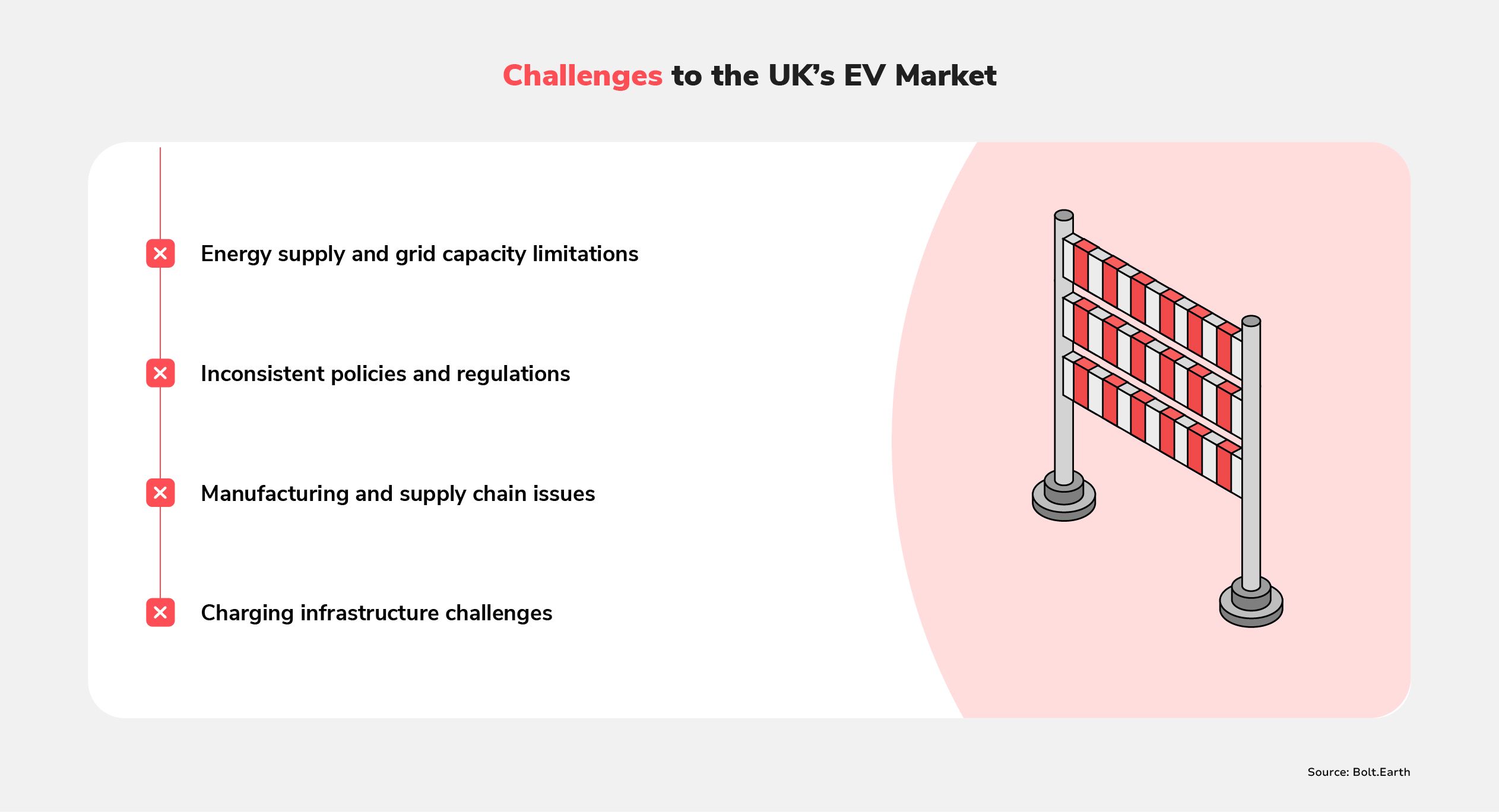
    • What challenges does the UK’s EV market face?
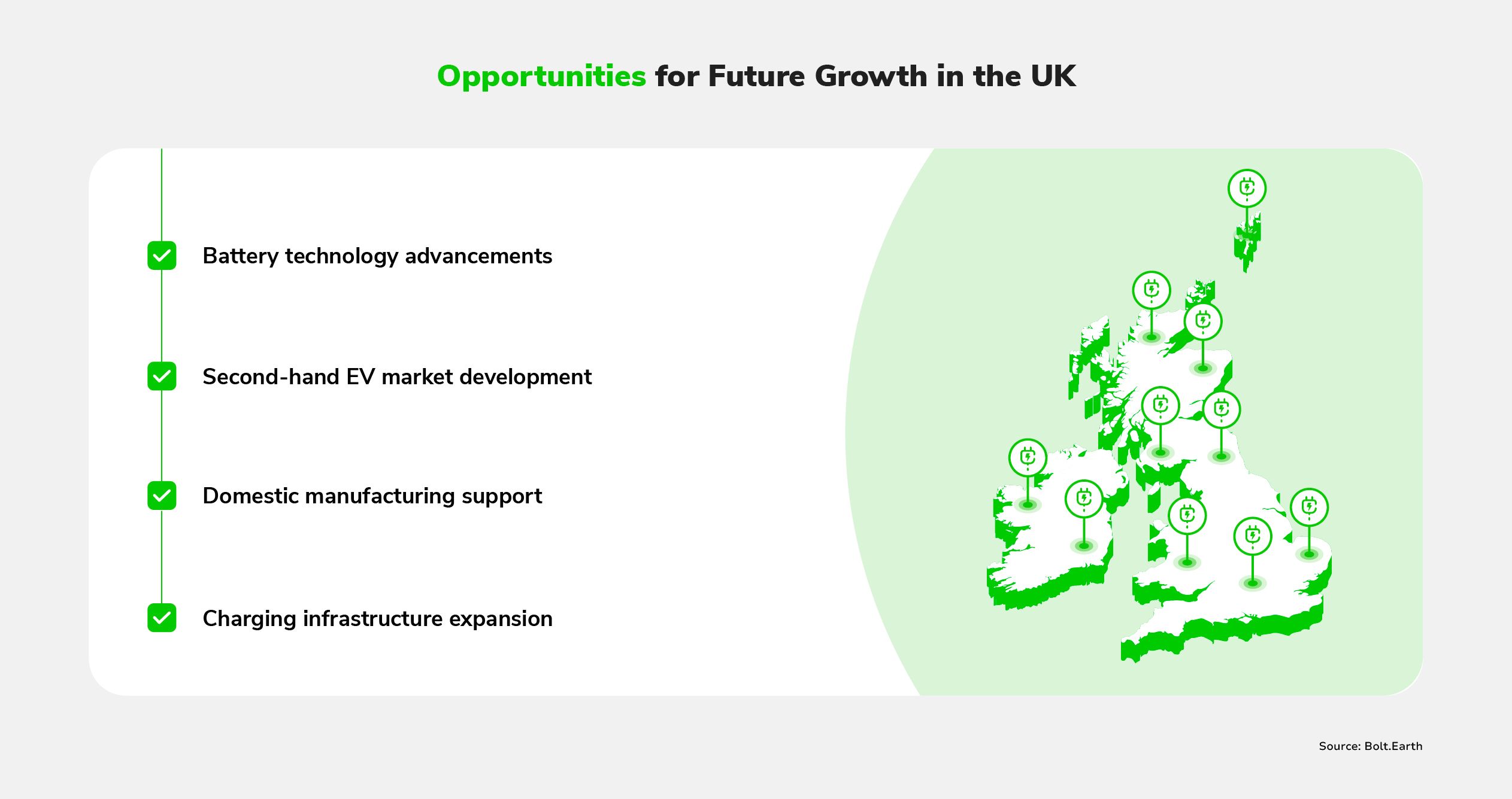
    • How can the UK progress in the international EV industry in the upcoming years?

    The UK’s Current EV Market

    The UK’s EV market has seen rapid growth, registering over 260k new electric cars in 2022, a significant increase from 15k in 2018.

    According to the Society of Motor Manufacturers and Traders (SMMT), zero-emission vehicles accounted for an impressive 37.3% of new car registrations in September 2023. Growth is evident across battery electric vehicles (BEVs), plug-in hybrid electric vehicles (PHEVs), and hybrid electric vehicles (HEVs) alike.

    Meanwhile, fleet-driven growth increased by 40.8% in September 2023, reaching a 52.5% market share. This indicates a market adjustment following limited supply in 2022, which constrained deliveries to business and fleet customers. Private consumer demand rose by a less dramatic 5.8%, reaching 122,944 units.

    The increase in ultra-low emission vehicles began with plug-in hybrid electric vehicles from 2014. Specific BEV growth surged from early 2019, outstripping PHEVs from Q4 2020 onward. As of November 2023, BEVs remain in the lead, taking up 16.4% of the automotive market. PHEVs are also continuing to grow, but lag behind, at a 6.8% market share.

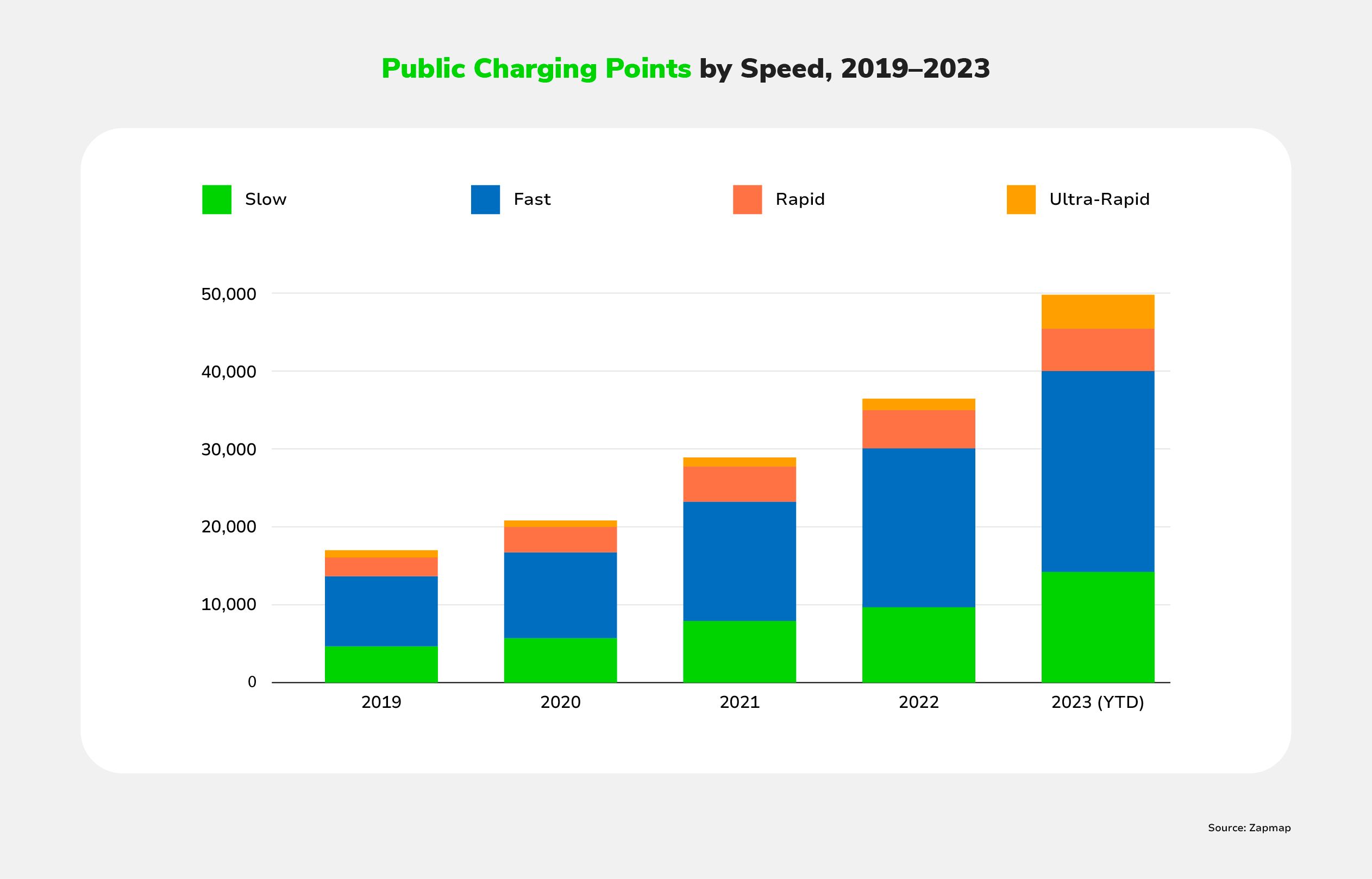
    The UK’s charging infrastructure is starting to catch up with the rising EV adoption rates. As of September 2023, the UK boasts 49,882 public electric vehicle charging points across 29,709 locations, marking a 43% growth since September 2022. Home and workplace charging installations bring the country’s total up to approximately 680k.

    Currently, rapid and ultra-rapid chargers make up around 20% of public charging devices; there are 9,209 rapid and ultra-rapid charging devices spread across 4,809 locations, with a growth rate of 68% YoY.
    A bar chart showing the UK's public EV charging infrastructure from 2019 to 2023, broken down by charger speed

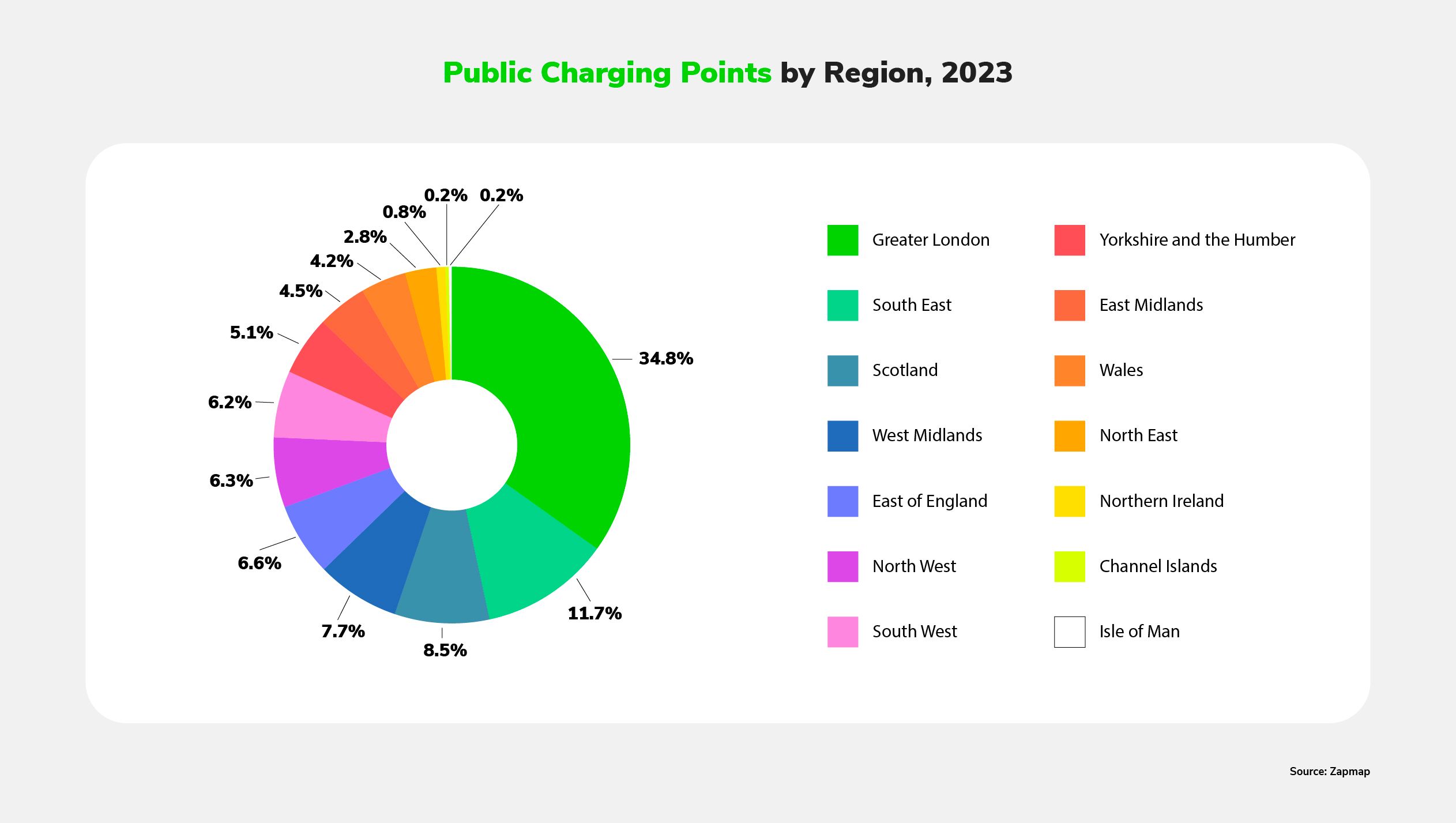
    Greater London tops the list of charging points in 2023, with an estimated 17,380, accounting for an impressive 34.8% of the entire UK’s public charging infrastructure. Southeast England and Scotland follow, with 5,812 (11.7%) and 4,245 (8.5%), respectively.
    A pie chart showing the geographical distribution of public charging points in the UK

    Demand for affordable zero and low-emission cars is growing, as evidenced by rising second-hand sales figures; from March to June of 2023, second-hand EV sales surged by over 80%, reaching more than 30.5k units. Despite setting a record for the sector, however, these EV sales still constitute just 1.7% of the total second-hand market.

    Enhancing the second-hand market is crucial for broadening the accessibility of electric vehicles, which currently remain more expensive than ICE models.

    The UK’s electric 2-wheeler market is also growing, driven by increasingly affordable prices and rising traffic congestion. 2-wheelers up to 125cc currently dominate due to fuel and cost efficiency, and manufacturers are focusing their research and development efforts on premium high-capacity bikes to further amplify market growth. The strong leisure market, especially for adventure bikes, also contributes to market expansion. Anticipated growth in registered motorcycles over the next five years will further drive the UK’s two-wheeler market.
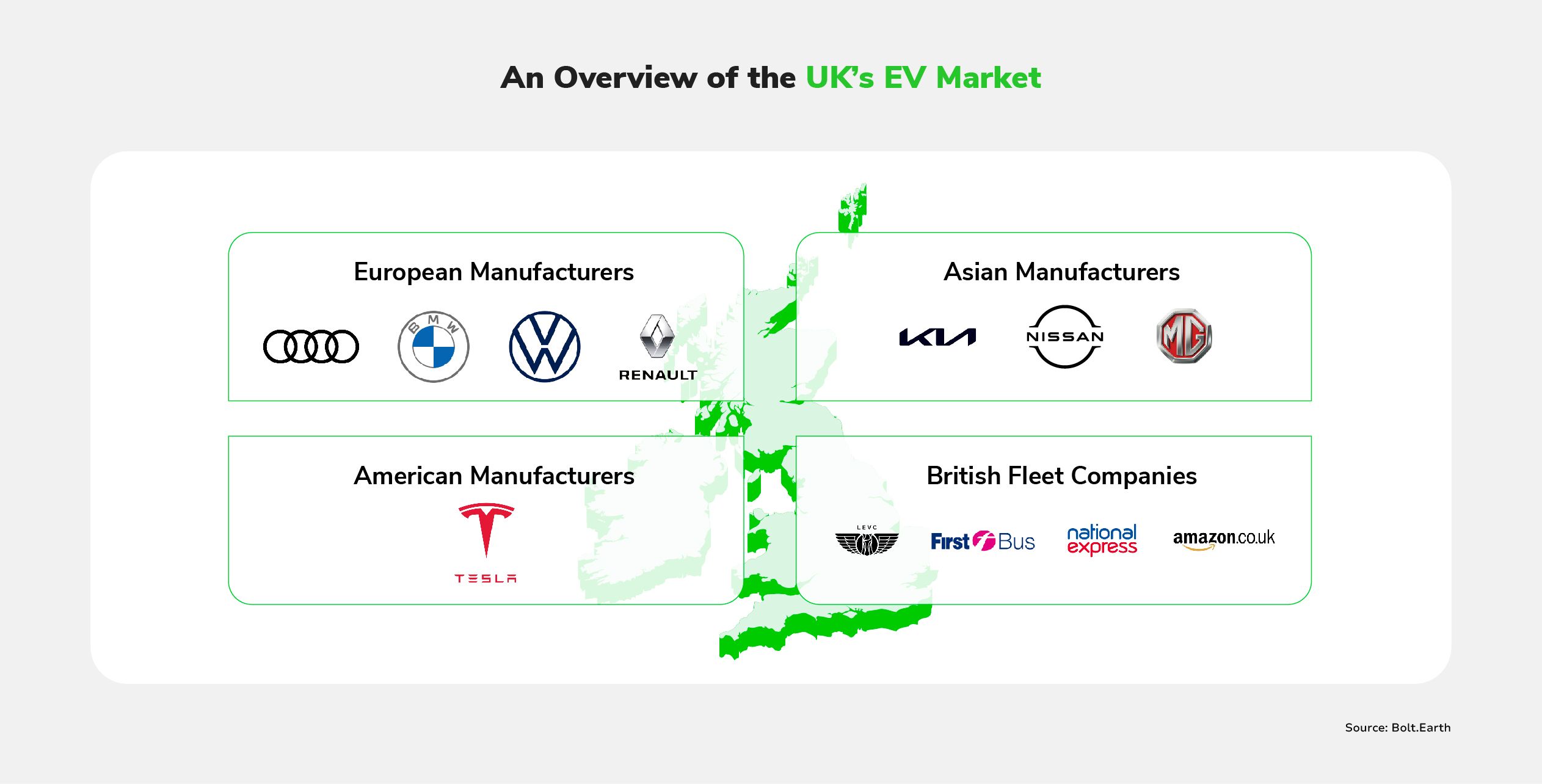
    A graphic listing important players in the British EV market, superimposed on an outline of the UK

    Major 4W Market Players

    Overall, the UK’s EV market is dominated by five foreign brands: Audi, BMW, Renault, Tesla, and Volkswagen.

    In 2022, the Kia e-Niro and Nissan Leaf were the 3rd and 5th best-selling EV models in the UK. 2023 has seen the arrival of a new Asian brand: China’s MG. During the first seven months of 2023, the MG4 was the UK’s #2 best-selling EV, beaten only by Tesla’s Model Y.

    Tesla

    Tesla’s Model Y and Model 3 were the UK’s best-selling EV models in 2022. The Model Y, a family SUV with a 319-mile range, is priced between £52k and £68k (USD 65,047 – 85,057), accelerating 0 – 60 mph in 3.5 seconds. The Model 3, priced between £48,490 and £61,490 (USD 60,653 – 76,914), charges from 10 to 80% in 23 minutes on a 200kW charger, making it a popular and affordable choice in the UK.

    Despite lacking a Gigafactory in the UK, Tesla offers another innovative approach: electricity generating. They recently applied for a license to generate electricity with the UK’s Gas and Electricity Markets Authority in Great Britain, showcasing their commitment to sustainability.

    German Legacy Brands

    BMW and Audi, legacy manufacturers of luxury cars, have recently grabbed the British EV market’s attention with the BMW i4 and Audi Q4 e-tron models.

    Audi has announced an ambitious goal: achieving full EV production by 2029. All existing production facilities will be retooled, new plants will be built where additional capacity is needed, and the range of models will grow.

    Volkswagen is planning a similar transition, but is targeting the mid-end market.

    Kia

    Many buyers view Korean brand Kia as comparable to Volkswagen. They provide similar range — around 260 miles — and safety features, at a near-identical price.

    However, Kia’s longer warranty and faster charging capability offer a better user experience, which is helping Kia make progress in the British market.

    MG

    China’s share of the European electric car market has more than doubled in less than two years. This is largely due to MG’s success.

    China’s dominance is further accentuated by its lead in battery production, leaving the European industry dependent on a geopolitical rival until it establishes its own “gigafactories.”

    In the case of MG, which is owned by SAIC, successful localization efforts include establishing a design studio in London and crafting cars that resonate with the preferences of the UK market, exemplified by the Cyberster series.

    Thanks to these efforts, in addition to competitive pricing (£26,995 to £32,495), the MG4 appears poised for a promising future in the British market.

    Major EV Fleets

    The UK has been making strong efforts to electrify its fleet and business vehicle sectors.

    Government Fleets

    In January 2023, the British government announced that it had successfully achieved its 2022 target: ultra-low emission vehicles now comprise 25.5% of government fleets.

    A notable instance is the integration of 3-wheeled electric motorbikes, the Yamaha Tricity 300, into the British police force. This initiative is endorsed by the Department for Transport and Innovate UK. The electric police bike incorporates a venturi duct traversing the center of the motorcycle, aiming to markedly minimize drag and improve efficiency.

    Taxis

    As of Q4 2021, there were 5,440 electric taxis registered in the UK, 3,621 of which were in London.

    London Electric Vehicle Company (LEVC), a prominent player in London’s taxi market, has been promoting the TX range-extended electric black cab since 2018. With over 6,000 vehicles now in operation, the LEVC TX comprises more than 40% of all black cabs in London. The LEVC TX, equipped with a 110-kilowatt electric motor, offers an impressive 78 miles of pure electric range and a flexible total range of 333 miles on the WLTP test cycle, driving in full-electric mode at all times.

    LEVC is contributing significantly to London’s transition to a cleaner, greener EV black cab fleet, positively impacting air quality.

    Buses

    Buses are responsible for 2.2% of the UK’s transport-related emissions. As of 2023, the Department for Transport has issued £320mn to obtain 4,000 zero-emission buses by 2025. The Transport Secretary has pledged £129 million to back local authorities in introducing zero-emission buses.

    Major operators like First Bus and National Express aim for zero-emission fleets by 2030 and 2035, respectively. With sufficient funding, it’s expected that over two-thirds of new bus purchases in England by 2025 will be zero-emission, aligning with the Confederation of Passenger Transport’s goal for full adoption by the same year.

    Freight

    In 2021, heavy goods vehicles (HGVs) contributed 19% to the UK’s domestic transport emissions. While electric HGVs have a higher upfront cost and an average shorter range of 220 km, their lifetime expenses are lower, including fuel and maintenance savings.

    Forward-thinking operators are adopting electric HGVs for a greener fleet. For example, Amazon UK has incorporated five heavy-duty electric trucks from DAF Trucks, capable of carrying up to 37 tons.

    Meanwhile, DHL Supply Chain has pioneered the use of four 40-tonne Volvo FM fully-electric HGVs in the UK. Featuring a substantial 540kWh battery, these zero-emissions trucks have a range of up to 180 miles and have received positive early feedback from DHL drivers, especially regarding acceleration and hill performance.

    Government Incentives & National EV Targets

    As far back as 2008, the UK had already started to explore green transportation. However, after many initiatives and campaigns, the results were not as expected.

    Until 2019, the Labor Party said it would aim to ban the sale of new non-electrified cars by 2030. Although the deadline shifted with each Prime Minister, the strict policy significantly boosted the UK’s market overall.

    EV Master Plan

    Shortly after announcing its goal of phasing out ICE vehicles by 2030, the British government issued the Ten Point Plan for a Green Industrial Revolution.

    To align with the 2030 goal, this plan suggested several funding schemes to support supply chain and charging infrastructure. The plan’s expected impact includes boosting the employment rate, unlocking private investments, and mitigating carbon emissions. In 2021, the government followed up with a more detailed transport decarbonization plan.

    Recently, like its neighbor Germany, the UK realized the importance of implementing charging infrastructure to sustain the EV ecosystem. As a result, in 2022, they published an electric vehicle infrastructure strategy to support EV adoption. Under this strategy, the UK will have an estimated minimum of 300k public charging points by 2030. However, this figure is highly uncertain.

    After the Plug-in Car Grant (PiCG) purchase incentive was dropped in 2022, the government shifted focus to EV infrastructure and to other vehicles.

    EV Supply-Side Incentives

    Grants for Charging Infrastructure

    The Ten Point Plan proposed issuing £1.3bn to accelerate charging infrastructure, and £582mn in extended grants. Major grants for charging points include the EV chargepoint grant and EV infrastructure grant. In addition, the Local Electric Vehicle Infrastructure (LEVI) funding program is specifically designed for residents without access to off-street parking. Meanwhile, the long-awaited Rapid Charging Fund has committed £950 million to install rapid chargers at key motorway service areas.

    Research and Development Funding

    The British government and private sector have continuously provided R&D funding to the EV industry. For example, in 2020, the government announced £12mn in funding for “groundbreaking research” into zero-emissions transport, including EV charging.
    As of January 2023, 17 projects aim to advance EV battery technologies in the UK. These are funded with £27.6mn from UK Research and Innovation (UKRI) through Innovate UK to bolster the UK’s competitiveness across the battery value chain.
    Furthermore, £89mn in funding has been granted to 20 pioneering projects in net-zero technology, solidifying the UK’s global leadership in zero-emission vehicle technology.

    Incentives for Manufacturers

    According to the Ten Point Plan, a £2.8bn support package was planned to boost EV manufacturing in the West Midlands, Wales and the North.

    EV Demand-Side Incentives

    Plug-In Car and Van Grants

    The plug-in car grant was dropped in June 2022, leaving Britain as the only major European market with no consumer EV incentives. Grants for vans remain in effect, deducting 35% of the purchase price for small vans up to £2,500 and large vans up to £5,000. EV grants are also available for wheelchair-accessible vehicles, motorcycles, mopeds, trucks, and taxis.

    Congestion Charge and Ultra Low Emission Zone (ULEZ) Benefits

    EV drivers are not subject to current city congestion charges or low emission zone charges, such as London’s Congestion Charge or ULEZ.

    Zero- or Reduced-Rate Benefit-in-Kind Taxation

    Although the direct purchase incentive for EVs has been canceled, there are still various tax advantages%20came%20into%20fruition,hybrids%20until%20around%202018%2C%20too.). EVs are exempt from road tax, including the “premium car” tax for those with a list price over £40k. Fleet operators and company car users benefit from a low Benefit-in-Kind (BIK) rate of 2% for EVs, frozen until 2025, when it will rise.

    Challenges to the UK’s Electric Vehicle Market

    The UK’s EV market faces several similar challenges to other countries’, as well as some unique issues.

    A graphic listing challenges to the British EV market

    Energy Supply and Grid Capacity Limitations

    In 2022, the UKs electricity demand reached a record low of 320.7 TWh due to the increased utility prices. Supporting electric vehicles would require an estimated 100 TWh in energy usage by 2030. This is not predicted to be a major problem, however, since almost 40% of electricity is expected to come from renewable resources by 2030.

    A more serious challenge involves grid stability at a street level, and domestic infrastructure. There are around 400k substations in the UK, each serving approximately 1,500 homes and businesses. This creates a serious risk of electricity overload from using typical 7 kW EV chargers, since substations have power output limits.

    Domestic wiring variations in the UK, such as TT, TNS, and TNCS, further complicate EV charging point installations; compatibility concerns with simultaneous household appliance usage must be addressed.

    Inconsistent Policies and Regulations

    The reduction in Plug-in Car Grant incentives led to an immediate decline in private EV sales in the UK, revealing the market’s dependence on policy support. Despite arguments that grants can kickstart ongoing EV demand, the cancellation raises concerns.

    The Prime Minister’s plan to delay the deadline for consumer EV purchases until 2035 conflicts with the unchanged mandate for manufacturers: over 20% of each manufacturer’s new cars in 2024 must be zero-emission, or they face fines.

    A lack of details and clarity causes further uncertainty for manufacturers, hindering investment and industry development. Furthermore, since the mandate now takes effect next year, manufacturers are already scrambling to adapt to the policy change.

    Overall, abrupt policy changes create ongoing chaos and challenges for the automotive sector; inconsistent regulations, implemented with insufficient prior notification, are hindering the industry’s development.

    Manufacturing and Supply Chain Issues

    This is the challenge faced by many traditional automotive giants worldwide, like Germany, Japan and South Korea.

    With half of its cars exported to the EU, the UK’s focus on limiting petrol and diesel sales faces a crucial shift, yet only 9.5% of 2022 car production comprises BEVs. This necessitates strategic moves to align with evolving global EV trends and secure export revenue. However, transforming the ICE supply chain into an EV-centric one requires substantial investment, new suppliers, and talent, all of which are difficult to find.

    Furthermore, post-Brexit, the UK’s EV supply chain is struggling to meet the rules of origin criteria outlined in the UK-EU Trade and Cooperation Agreement (TCA). To qualify for zero tariffs, EVs must meet specified content percentages originating from the UK or EU, starting with 40% by December 31, 2023. Brexit-induced trade barriers may impact material, component, and EV costs due to reduced market access.

    Charging Infrastructure Challenges

    EV adoption faces hurdles in the UK, with 70% of stakeholders highlighting on-street charging inadequacy as a key concern. A third of households lack driveways, creating a strong need for robust public charging infrastructure.

    Unclear public-private network relationships and requirements and a costly and time-consuming planning permit system also hinder EV infrastructure establishment. Furthermore, the UK is facing a critical shortage of skilled EV infrastructure technicians, with only 6% currently possessing the necessary skills, and a projected deficit of up to 35k by 2030.

    Opportunities for Future Growth in the UK

    A graphic listing opportunities for future growth in the British EV market

    Battery Technology Advancements

    As mentioned above, the British government is committed to providing financial and regulatory support to enable mass-scale EV battery production. Notably, Williams Advanced Engineering and Fortescue Metals Group are partnering to develop a bespoke battery system for a 240-tonne electric mining haul truck. The innovative battery electric powertrain, featuring regeneration capabilities, will be integrated into the prototype. The collaboration also involves creating a fast-charging unit, facilitating the broader adoption of a battery-electric haulage fleet. Meanwhile, Moixa’s
    solar battery integrates hardware and GridShare software for renewable energy management. It optimizes EV battery charging in real-time, considering factors like driver behavior, energy costs, and weather forecasts.

    Second-Hand EV Market Development

    Although the upfront cost of EV is not consumers’ top concern, it still needs to be addressed. With used cars representing 82% of all cars sold in the UK in 2021, it is critical to optimize the second-hand market as a catalyst for a nationwide adoption of EVs. To do this, the government could incentivize buyers with a new battery or financial refund, easing worries about battery health. Standardizing battery life and quality with a certification could further enhance consumer confidence. Finally, public awareness campaigns could dispel concerns about purchasing used EVs and educate consumers about charging costs and locations, enabling a smoother transition to electric vehicles.

    Domestic Manufacturing Support

    Britain’s new relationship to the EU has important implications for automakers, specifically for the whole value chain. As of 2023, the UK has already developed a foundational EV supply chain to produce almost every component of EVs.

    An SMMT report established plans for future direction anchor vehicle production in the UK via three strategies:

    1. Boost Government Support for EV Manufacturing

    To benefit from tariff-free trade, the UK needs investment in domestic minerals refining, battery manufacturing, and electric drive units. A competitive incentive package is crucial to attract global investors and position the UK as a top destination for green technology investment.

    2. Simplify Administrative Processes

    It is better for the UK to streamline regulatory frameworks for projects like battery production and renewable energy facilities. Faster access to funding and market reforms, such as decoupling electricity and renewable energy prices from gas, are essential for attracting investments.

    3. Forge Global Partnerships

    The UK can secure minerals processing capacity by expanding trade agreements and partnerships with resource-rich countries. Priorities include expanding free trade agreements, establishing partnerships, encouraging British investors in sustainable mining, and creating favorable conditions for remanufacturers.

    Charging Infrastructure Expansion

    Like Europe, the UK is actively working to expand its charging infrastructure. It has identified several areas for improvement.

    Home Charging

    Promoting residential EV charging is prudent, given unpredictable private-public charging proportions. Residents can charge their cars overnight, or establish a DER for extra income.

    The British public is open to home EV charging, as shown by a 2023 survey; nearly half of homeowners are willing to pave over their front gardens to accommodate charging devices, and 70% of EV owners have already modified homes for charging. The demand for home charging is expected to continue rising.

    Charger Technology Improvements

    According to British charger company Zap-Map, the latest ultra-rapid charging devices already enable some EVs to add more than 100 miles in as little as 10 minutes. To address the public charging network’s inadequacies, the UK could spread out more ultra-rapid chargers to low dense areas.
    Innovative companies such as Swarco, which provide expert-level 24/7 in-house customer support to optimize the user experience, could further support this transition.

    Grid Stability Optimization

    Since grid stability is the main concern when it comes to EV charging, the UK has proposed introducing the G99.pdf) grid connection standard to revolutionize the way power is generated, transmitted, and consumed.

    Accelerating Towards a Bright EV Future

    The UK’s electric vehicle market stands at the edge of a transformative era. With government commitment, strategic investments, and innovative solutions addressing challenges, the road ahead looks promising. The UK is poised for a future in which residential charging becomes ubiquitous, cutting-edge battery technologies redefine possibilities, and a robust domestic supply chain solidifies the nation’s position in the global EV arena. Substantial challenges exist, but they are stepping stones to a cleaner, sustainable tomorrow. The UK’s EV journey is not just about reducing emissions; it also promises to steer the nation towards a dynamic and electrifying future.

    FAQ

    What are the key factors shaping the growth of the UK’s EV market?

    The growth of the UK’s EV market is driven by government commitments to achieving net-zero emissions, rising consumer demand, advancements in technology, and supportive policies and incentives.

    How do advancements in battery technology affect the UK’s EV landscape?

    Cutting-edge battery technologies, including those developed by British companies like Williams Advanced Engineering and Moixa, are a major contributor to EV innovation in the UK, enhancing range, efficiency, and overall performance.

    What incentives exist for businesses to invest in EV manufacturing in the UK?

    Businesses receive substantial support, including a £2.8bn package, to boost EV manufacturing in regions like the West Midlands, Wales, and the North. Green finance initiatives and export support further incentivize investment.

    What role does charging infrastructure play in boosting EV adoption in the UK?

    Charging infrastructure is crucial for EV adoption in the UK. The government is investing in expanding charging points, and encouraging home charging. Challenges like on-street charging inadequacy and an overcomplicated planning permit system still need addressing.

    What is the timeline for the UK’s ban on new petrol and diesel car sales?

    The UK aims to ban the sale of new petrol and diesel cars by 2030. Hybrid vehicles will be permitted until 2035. As of September 2023, the Prime Minister was considering pushing the deadline back by 5 years, but no further details or plans have emerged.

    How are consumer preferences evolving in response to the UK’s changing EV landscape?

    Increased sales of second-hand EVs, growing demand for affordable zero-emission cars, and the popularity of EVs in various market segments all demonstrate a positive shift in consumers’ mindset toward electric vehicles.

    Resources

    SMMT: Society of Motor Manufacturers and Traders

    Explore updated data about the British EV market here.

    House of Commons: Electric vehicles and infrastructure

    Find more details about the UK’s EV industry and infrastructure here.

    Zap-Map: EV charging statistics 2023

    View a map of the UK’s EV infrastructure here.

    UK Gov: The ten point plan for a green industrial revolution

    Read the British government’s plan for the EV market here.

    UK Gov: UK electric vehicle infrastructure strategy

    Discover the British government’s strategy for EV infrastructure here.

  • Revolutionizing Commercial Mobility With OS in Electric Trucks & Vehicles

    Revolutionizing Commercial Mobility With OS in Electric Trucks & Vehicles

    Growing concerns over carbon emissions have led to a call for change in the commercial vehicle industry. Currently, commercial vehicles — most notably, commercial trucks with traditional internal combustion engines — are responsible for 80% of vehicular emissions. This emission level is unsustainable and poses a significant obstacle to countries reaching for Net Zero carbon commitments.

    The push for commercial electric vehicles (EVs) is driven largely by automotive technology advancements, with a particular focus on operating systems (OS) that are responsible for a smooth and seamless connection between EV components and performance.

    This article answers three key questions about the pivotal role of OS in transforming the commercial EV landscape:

    • What challenges impede the development of OS in commercial vehicles, and what opportunities lie in their implementation?
    • Which key OS features are best suited for electric commercial trucks and vehicles?
    • How can OS revolutionize commercial mobility for EVs?

    Challenges Impeding OS in Commercial Vehicles

    Despite the increasing adoption of commercial EVs, several challenges need to be addressed for widespread acceptance. Alongside general challenges like limited infrastructure and high costs, OS-related obstacles including software incompatibilities, cybersecurity issues, and the impact of over-the-air (OTA) updates in vehicle operations can be viewed as an inconvenience and dampen adoption efforts across the commercial industry.

    These challenges are even more profound in electric 3-wheelers due to their design. Because of this, their OS must support advanced safety features, support load management, and offer routing capabilities all while ensuring their stability when transporting heavy cargo.

     infographic listing the challenges impeding hindering OS development in commercial EVs

    Battery Technology Limitations

    Commercial vehicles are expected to operate efficiently over long distances, and sometimes, in demanding weather conditions. Existing battery technology offers only a limited range, meaning frequent stops are needed to charge commercial EVs. Also, the fear of running out of power during transit, especially along routes with limited charging infrastructure, can discourage commercial players from adopting EVs in their fleets.

    With these limitations, OS in commercial EVs must accurately estimate and communicate effective energy management. Battery management, space constraints, performance optimization, software updates, energy-efficient features, and user experience enhancements can also stand in the way of successfully implementing OS in commercial vehicles.

    To address this concern, researchers are exploring solid-state batteries with higher energy density that can extend the driving range of commercial EVs. Similarly, fast charging solutions and energy optimization systems are emerging to reduce charging times.

    Charging Infrastructure Constraints

    In 2022, the world had a mere 2.7 million charging stations, with Europe having just 375,000 stations despite EVs accounting for 20% of all its new-car sales. This shortfall can be particularly impactful for commercial EVs that need to cover long distances.

    Moreover, not all existing stations have fast charging capabilities. This can result in longer charging and waiting times, both of which can affect delivery schedules. Lastly, available public chargers may not be compatible with specific EV models, contributing to range anxiety concerns. The high cost of EV infrastructure development, coupled with trade-offs between range and payload capacity, can slow down OS development and adoption, particularly in the commercial industry.

    Improving the availability of interoperable EV charging infrastructure is key to overcoming these complications. Fast charging technologies are being developed to shorten the charging time and improve the efficiency of EV charging infrastructure. This, in turn, can shorten driver downtime and increase the Return on Investment (ROI) for charging point owners. Standardizations across EV charging points can also remove barriers to EV charging. Government incentives, private-public collaborations, and peer-to-peer sharing of charging points are filling this infrastructure gap for now.

    Motor Control and Power Delivery

    Managing power delivery, especially in 3-wheeler EVs, presents a unique challenge. These EVs require precise torque distribution to ensure optimal performance. The OS must allocate power to the wheels effectively to balance stability with acceleration, particularly during sudden turns. Also, the OS must control energy recovery during braking and convert it into stored power to extend the EV’s range.

    Bumps, potholes, and uneven terrain can suddenly affect vehicle stability. Given the variable road conditions, particularly for last-mile delivery 3-wheeler EVs, the OS must make real-time adjustments to ensure a smooth ride. OS in commercial vehicles must adjust power delivery to varying driving styles and driver preferences.

    Researchers are exploring torque vectoring algorithms that allow the vehicle to adjust the torque in each wheel to improve its traction and stability.

    While these challenges continue to exist, innovative solutions are being developed to refine the efficiency and adaptability of OS in commercial vehicles.

    Innovative Solutions for OS in Commercial Vehicles

    Over the years, EV OS has evolved significantly to optimize performance and enhance efficiency. Advancements in artificial intelligence (AI), machine learning (ML) technology, Internet of Things (IoT), and battery management systems have been instrumental in making commercial EVs a more viable option. Here’s a look at some of these technologies.

    Infographic listing solutions for OS in commercial EVs

    AI and Machine Learning Integration

    The integration of AI and machine learning into EV OS is driving energy efficiency and predictive maintenance, leading to more reliable operations. These algorithms can analyze data from sensors in real time to make immediate adjustments in driving and power distribution. They can also predict traffic conditions and help with route planning for the efficient use of available energy. Above all, these technologies continuously monitor the health of vehicle components to spot issues before they become critical. This allows for scheduled maintenance, eventually lowering operating costs and avoiding delays.

    Some examples of AI-based OS include:

    • Tesla’s Autopilot uses AI to provide features like adaptive cruise control, lane centering, and self-parking.
    • Waymo’s Self-Driving System provides an OS for autonomous driving, although it’s not available for commercial vehicles yet.
    • NIO’s NOMI leverages an AI assistant that manages vehicle functions and enhances navigation for a personalized driving experience.

    IoT Applications in OS

    Internet of Things (IoT) sensors collect large amounts of data from various vehicle components like temperature, battery health, and performance metrics. It analyzes this information to provide insights into the vehicle’s condition and efficiency. It also enables the remote monitoring of commercial EVs to help fleet managers optimize vehicle usage and plan maintenance. Other information like driver behavior, energy consumption, and route efficiency help fleet managers to plan routes. Lastly, it can enhance the safety of EVs in adverse driving conditions.

    Many companies are leveraging IoT to improve their operations, including:

    • UPS employs IoT to monitor the condition of batteries and other components to extend battery life, reduce maintenance costs, and increase overall reliability.
    • Geotab utilizes IoT connectivity to provide real-time data on vehicle location, speed, and diagnostics for fleet management. In turn, this allows companies to optimize routes and improve driver safety.
    • FedEx uses IoT in its commercial EVs for route optimization and energy management to reduce fuel consumption and emissions.

    Advancements in Battery Management Systems (BMS)

    Battery management systems (BMS) have evolved to offer comprehensive battery monitoring while providing real-time data on cell voltage, temperature, and health. In turn, this provides precise control and optimization of the battery’s performance. Advanced algorithms manage the charge and discharge, leading to the efficient use of the battery. Furthermore, the exact estimation of the battery’s State of Charge (SoC) helps with range prediction and optimal power management.

    The concept of swappable battery technology is also gaining popularity as it supports battery replacements. Though this technology is in the early stages, it holds the potential to minimize vehicle downtime and range anxiety concerns.

    Collectively, these innovations and technologies are shaping the development of OS conducive to powering commercial EVs and are influential in advancing the EV industry.

    The Current Landscape of Commercial EVs

    In 2022, 101,499 commercial electric trucks were sold, and these sales are projected to increase to 1,067,985 trucks by 2030, signaling a compound annual growth rate of 34.2%. This growth can be attributed to a combination of factors, including government policies and regulations on emissions, as well as technological advancements in batteries and EV OS. By 2030, it is estimated that EV commercial trucks will account for 27% of the total truck market while e-buses will make up 82% of commercial transportation. This substantial expansion will largely happen in the Asia-Pacific region powered by orders from China, India, and Japan. Canada and the United States are also expected to see robust growth, followed by Europe.

    Graph showcasing the increasing demand for commercial electric trucks by 2030

    The major players in commercial EVs, including BYD, Mercedes Benz, Volvo, Ford, and Rivian, are catering to diverse needs across numerous industries — the food and beverages industry, state services like the United States Postal Service (USPS), and e-commerce companies like Amazon and Walmart.

    Almost every major automaker in the world is investing heavily in innovative technologies that can improve the driving range of commercial EVs. Also, collaborations and partnerships pave the way for addressing the unique challenges of commercial EVs. With increasing demand for commercial EVs, OS in commercial vehicles will continue to play a bigger role in driving these vehicles.

    The Significance of OS in Commercial EVs

    Software-defined vehicles lie at the center of EV evolution, and commercial vehicles are no exception. Here, the OS is responsible for managing all aspects of the EV’s functionality. When an EV powers up, the OS takes charge of critical functions, integrating hardware, software, and data to ensure that every aspect of the vehicle is working as it should.

    The OS also plays a continuous role in monitoring the battery to maintain sufficient power levels. It controls the distribution of power from the battery to the wheels, enabling the vehicle to move. Furthermore, it oversees specialized functions like regenerative braking, a process that captures energy during deceleration and uses it to charge the battery for an extended driving range.

    In all, the OS is the driving force behind today’s commercial trucks and vehicles. Due to this overarching role, industry experts agree that developing and maintaining OS in commercial vehicles is necessary for evolving commercial transport. Consequently, several companies have taken the lead on this front.

    The Case for OS in Commercial EVs

    Some companies are ahead of the curve in implementing successful commercial EVs powered by sophisticated OS. One such company is Bollinger Motors, an American company that manufactures B4 and B5 commercial electric trucks. These vehicles are designed from the ground up, offering driver safety and fleet efficiency functionalities. They can also be custom-configured to meet the specific needs of their clients. Compatible with level 2 and level 3 chargers, they require approximately nine hours for level 2 and one and a half hours for level 3 to charge. These operations are supported by a patent-pending E-chassis.

    Another example is Tesla Semi, the class 8 semi-truck built by Tesla and powered by its OS. This fully-electric truck can accelerate from 0 to 60 miles per hour within 20 seconds to help drivers maintain the highway speed levels. It also comes with advanced motor and brake controls to improve safety. Its design, including the centered driver seat, ensures that drivers have comprehensive visibility on the roads. As for fleet operators, Tesla claims that they can save $200,000 in fuel costs within just the first three years of ownership.

    XOS Trucks is another notable company building electric trucks and their vehicles run on the proprietary Xosphere platform. They operate medium and heavy-duty trucks that can be customized for any use case including last-mile deliveries. Plus, its OTA updates make the upgrade process a breeze. It’s hard to find this battery modularity in similar trucks like Tesla or Bollinger Motors.

    This industry progress points to an electrified future, powered by robust operating system optimization.

    Impact of OS on the Future of Commercial EVs

    Advanced OS holds the potential to drive improvements in the cost-effectiveness and performance of commercial EVs. Through optimized power management, improved route planning, and predictive maintenance capabilities, these operating systems reduce operational costs and increase environmental sustainability. As a result, more businesses are likely to embrace EVs for their commercial operations.

    Bolt.Earth OS is a compelling example of an advanced OS that can reshape the commercial EV landscape. This innovative OS offers a seamless combination of AI, IoT, and data analytics to provide real-time insights into vehicles’ performance, energy consumption, and predictive maintenance. By enhancing efficiency and curtailing operational costs, Bolt.Earth OS can revolutionize commercial mobility.

    To know more about how to revolutionize commercial mobility with OS, read the FAQ and Resources below!

    FAQ

    How do operating systems impact the performance of electric trucks and commercial vehicles?

    Operating systems optimize power distribution and ensure that all components communicate and operate efficiently. They also ensure efficient energy utilization and extend battery life. Plus, they support OTA updates and protect data and systems from cyberattacks.

    What are the benefits of integrating AI and IoT in operating systems for EVs?

    AI optimizes energy usage, enhances predictive maintenance, and provides real-time insights into vehicle performance. IoT, on the other hand, enables remote monitoring, precise diagnostics, and safety enhancements. Together, AI and IoT make EVs more competitive, sustainable, and eco-friendly.

    Will optimized operating systems lead to the widespread adoption of electric commercial vehicles?

    An optimized EV OS can enhance efficiency, reduce operational costs, and improve overall reliability. They provide real-time insights for informed decision-making. When coupled with government incentives and stricter emissions regulations, operating systems are an obvious catalyst for commercial EV adoption.

    Are there any regulations promoting the use of electric trucks in the transportation industry?

    Governments worldwide are implementing policies, subsidies, and incentives to encourage the adoption of electric commercial vehicles. These regulations include tax incentives, emissions reduction targets, and stricter emissions standards. They aim to reduce greenhouse gas emissions, improve air quality, and transition to a more sustainable and eco-friendly transportation sector.

    How do 3-wheeler EVs differ from traditional electric commercial vehicles in terms of operating systems?

    3-wheeler EVs differ from traditional electric commercial vehicles in terms of operating systems due to their unique design and functionality. Operating systems for 3-wheelers require specialized algorithms for more efficient power management and real-time adjustments to varying road conditions. These systems optimize energy utilization, torque distribution, and braking, providing a different set of challenges and opportunities compared to larger commercial EVs.

    Resources

    IEA: Trends in electric heavy-duty vehicles

    Discover the major trends in commercial vehicles here.

    Diva: Modern Electrical/Electronic Infrastructure for Commercial Trucks

    Explore innovative insights here.

    Mecalux: Electric trucks and their impact on logistics

    Learn about the impact of electric Trucks on the future of logistics here.

    Driivz: Beyond Basics: What Growth-Oriented Providers Should Look for In EV Charging Management Software

    Know what to look for while choosing EV software here.

    McKinsey: The Economics of Fleet Electrification

    Read the economics of electrification here.

  • Exploring South Korea’s EV Success

    Exploring South Korea’s EV Success

    In Asia’s booming electric vehicle (EV) market, South Korea is demonstrating a much greater commitment to a cleaner environment than many other nearby countries.

    South Korea initially invested in hydrogen-powered EVs, much like Japan. However, it made a swift transition to pure EVs, thanks to determined policy support, advanced technology and innovation, a robust supply chain, and an export-oriented industry strategy. Since then, South Korea has emerged as a booming economy in the EV industry.

    This article will explore the factors behind South Korea’s leadership in the Asian electric vehicle market. In particular, it will address the following questions:

    • Who are the major players in the South Korean EV industry, and how do they shape the market?
    • How are the South Korean government and private sector promoting EV usage?
    • What are the current challenges associated with EV adoption in South Korea, and how can they be overcome?

    South Korea’s EV Market

    In South Korea, eco-friendly vehicles are usually called green cars or new energy vehicles (NEV). There are several types available, including battery electric vehicles (BEVs), hybrid electric vehicles (HEVs), plug-in hybrid electric vehicles (PHEVs), and fuel cell electric vehicles (FCEVs). FCEVs use a hydrogen-based fuel cell to power the motor, and are therefore sometimes categorized as HEVs.

    South Korea boasts a rich automotive history, particularly in the 1990s, when it became the world’s fifth largest automobile producer. When its market share declined in 2018, the government promptly responded by offering subsidies and incentives to boost the EV industry, and by investing in charging infrastructure. Leading OEMs like Kia and Hyundai began launching new EV models in 2004, and have been producing EV components domestically since 2009.

    This proactive approach resulted in significant growth in EV adoption. In 2022, the Ministry of Land, Infrastructure, and Transport (MOLIT) reported a remarkable surge in green vehicle registrations: electric vehicle registrations increased by 72.7% YoY, hydrogen vehicles by 54.3%, and hybrids by 29.6%. Total EV sales exceeded diesel vehicle sales for the first time, reaching 448,934 units. Among EV power sources, hybrids led with 274,282 units sold, followed by 164,324 BEVs, marking a 63.7% sales growth from 2021.

    A graph showing South Korea's annual EV sales from 2011 to 2020
    Nevertheless, there is still work to be done. In particular, stakeholders must find a way to meet the government’s extremely ambitious goals for the next few years.

    Meanwhile, South Korea’s adoption of electric 2-wheelers has slowed, due to limited range, inconvenient charging requirements, and extended charging times. These factors, coupled with reduced subsidies averaging ₩1.8 million (USD 1,365), down 13% from the previous year, have substantially dampened consumer demand.

    EV Charging Infrastructure Growth

    As a key initiative, in August 2016, the MOLIT, along with the Korea Electric Power Corporation (KEPCO) revealed plans to construct ₩200 billion of charging infrastructure. By November 2020, they had installed a total of 62,789 public chargers, including 9,661 rapid and 53,128 slow chargers. In 2021, they added 3k fast-charging stations, distributed as follows:

    • 2,280 charging stations at locations such as private supermarkets
    • 290 charging stations in parking garages
    • 300 fast-charging stations at pit stops
    • 123 high-powered charging stations by the automotive industry

    As of 2021, South Korea had the world’s best ratio of EVs to charging points: 2.6 vehicles per charging point.

    Major Players in South Korea’s EV Market

    South Korea’s thriving EV landscape is partly attributed to the efforts of leading automakers. They have rapidly adopted EVs, and have leveraged the country’s strong automotive industry and existing supply chains to compete globally.

    South Korea utilizes economies of scale to achieve competitive EV production. Its well-established network of suppliers and manufacturers, in addition to a substantial pool of engineers and technicians well-versed in cutting-edge production methods, supports efficient, cost-effective manufacturing of high-quality EVs.

    A graphic listing major players in the South Korean EV market
    Global OEMs in South Korea

    In 2022, the top three players in South Korea’s domestic passenger EV market were Hyundai Motor Group, Tesla, and Kia, which is a subsidiary of Hyundai. In the context of the global market, Hyundai was the fifth largest EV seller in 2022.

    Hyundai did not enter the EV market until 2015, but has achieved immense success, with a 75% domestic market share. The company initially emphasized hydrogen vehicles, and only shifted its focus to BEVs in 2018, in response to Tesla’s success.

    Hyundai’s vertically integrated supply chain network, modular EV platform, and export-oriented focus have all proven instrumental to the company’s success. The vertical integration spans various subsidiaries, streamlining EV production from batteries to software, and enabling strategic partnerships involving the whole EV supply chain. By adopting a dedicated EV platform early on, Hyundai set itself up for successful rapid model development; it plans to launch 31 EV models by 2030.

    In addition to supplying EVs to South Korean consumers, Hyundai has a strong focus on exporting to foreign markets. In fact, South Korea’s EV exports rose by 112.2% between 2019 and 2022, led by Hyundai and Kia.
    A bar chart showing South Korea's 2022 EV sales, broken down by model

    South Korea’s EV Component Manufacturers

    EVs contain many parts, including a speed reducer, a thermal management system, batteries, motors, inverters, and tires. As mentioned above, due to South Korea’s strong value chain, the country has many prominent suppliers of these components.

    Three major battery cell companies, LG Energy Solution, Samsung SDI and SK On, recently announced their plan to work with the government to jointly invest ₩20 trillion (USD 15.1bn) through 2030 to develop advanced battery technologies, including solid-state batteries.

    Hyundai Mobis, LG Electronics, and S&T Motiv produce motors, and are all core suppliers of Hyundai Motor Co., Ltd.

    Hanon Systems is the main contributor to the heating system segment, while Hwaseung R&A produces important components like air conditioner hoses and coolant hoses.

    Major EV Fleets

    South Korea’s government recognizes the importance of commercial vehicles and fleets in terms of EV industry development. In 2020, the country introduced 94,430 EVs and hydrogen cars, including 11k two-wheeled EVs, 7,500 electric delivery trucks and 650 electric buses.

    Electric Taxis

    Between January and November of 2022, the number of newly registered electric taxis surged to 15,038 units — roughly triple the previous year’s figure. These taxis have rapidly gained ground against their ICE counterparts, primarily thanks to their higher fuel efficiency and lower maintenance costs. Green taxis’ market share is expected to grow to 40% in the future.

    Car-Sharing Services

    South Korea’s car-sharing pioneer, SoCar, plans to transition its entire fleet to electric vehicles by 2030. In collaboration with leading charging service provider Everon, SoCar will expand the charging station network and enhance EV charging and car-sharing services. This partnership aims to leverage the two companies’ expertise and data on EV charging, including charging times and battery capacity.

    Car Rental Companies

    Local rental companies are rapidly adopting EVs; in fact, projections indicate that rental companies could account for 8% of green vehicle sales by 2025. This trend is particularly pronounced in large cities, where long-term lease packages for EVs are gaining popularity, driving the adoption of new energy vehicles.

    Postal Services

    Postal and logistics companies globally are piloting EV programs to explore their environmental benefits. Public procurement of EVs, exemplified by Korea Post’s plan to introduce 10k EVs by 2020, demonstrates these programs’ effectiveness, and, in turn, encourages wider adoption. Replacing conventional vehicles with EVs offers operational and non-market advantages, such as replacing gasoline-fueled delivery motorcycles with compact EVs in Korea Post’s fleet.

    Government Incentives & National EV Targets

    South Korea’s electric vehicle policy is overseen by three ministries: the Ministry of Trade, Industry and Energy (MOTIE) for vehicle and auto parts technology development; the Ministry of Environment (ME) for EV promotion and infrastructure; and the MOLIT for safety certifications.

    The South Korean government strongly supports the EV industry, with incentives like tax breaks, financial aid and R&D spending. These measures encourage investment and drive sector growth to achieve the government’s ambitious goals for EV adoption.

    EV Master Plan

    South Korea’s government has been continuously updating its EV policies since 2011. Currently, there are two main sources of guidance for EV goals: the 4th Master Plan for Eco-Friendly Cars, and the Korean New Deal.

    MOTIE and ME unveiled the 4th Master Plan in February of 2021. It aims to support 2.83mn eco-friendly cars by 2025, and 7.85mn by 2030.

    The Korean New Deal sets another ambitious goal: 1.3mn electric and 200k fuel cell vehicles by 2025. It also involves increasing renewable energy usage and expanding the smart grid.

    South Korea also has some additional EV-related goals:

    • Charging infrastructure goal: have 50% more chargers than EVs, including ultra-rapid chargers that take only 20 minutes to provide enough charge for a 300 km range.
    • Export plan: achieve a 12% share of the worldwide NEV market by 2030, in the interests of becoming a global automotive industry leader.
    • Commercial EV target: launch 20k hydrogen-powered buses and 10k hydrogen-powered trucks by 2030.

    To support all of these ambitious goals, the government has revised the incentive scheme every two years.

    EV Supply-Side Incentives

    Research and Development Support

    South Korea offers substantial R&D tax incentives, and is even allocating 70% of its yearly R&D budget to fund 40 projects in 11 key industrial areas, such as secondary batteries and future mobility. This includes investments of around $4.7bn from 2023 to 2027, with a long-term target of $10.2bn by 2030.

    Tax Incentives for Manufacturers

    The government offers tax credits for companies in key tech sectors, including EV-related ones. Large firms currently receive tax credits of up to 15% tax credit, while small- and medium-sized enterprises receive up to 25%. An additional 10% credit is available for 2023, based on increased average investments over the past three years.

    Sales Quota

    The South Korean government has implemented a sales quota whereby EVs must comprise at least 15% of each car manufacturer’s sales. The aim is to eventually make 20% of all South Korean-produced cars EVs, and then transition to all-EV production in the public sector.

    Export Support

    The government is using tax incentives to encourage car manufacturers to invest up to ₩95 trillion (USD 66.03bn) in EVs by 2026, in the interest of stimulating the production of EVs for export. The government is further supporting this goal by providing ₩7 trillion won (USD 5.3bn) in loans and guarantees to battery and material firms in North America.

    Investment Incentives

    The Foreign Investment Promotion Act aims to attract foreign investment primarily through tax support, cash grants, and industrial site support.

    Collaborations and Partnerships

    In response to various challenges, South Korea has adopted a trans-regional R&D strategy. This approach aims to reduce regional inequalities within the country and foster collaborative innovation in areas such as EV technology.

    EV Demand-Side Incentives

    Subsidies and Grants

    In 2023, South Korea will revise its EV subsidy policy to favor domestic producers based on performance, infrastructure, battery density, and price. This will particularly benefit Hyundai and Kia. Subsidies range from ₩2.5mn to ₩6.8mn (USD 1,867 – 5,078), excluding vehicles over ₩85mn (USD 63,481). Makers who have installed at least 100 chargers over the last three years get extra incentives, as do makers who have implemented vehicle-to-load (V2L) technology.

    Tax Benefits

    In 2019, South Korea’s government announced plans to extend tax breaks for purchases of electric vehicles. These tax breaks were originally set to expire, but were extended to incentivize more people to buy EVs.

    Discounted Parking and Tolls

    EV users in South Korea enjoy incentives including a 50% discount on public parking facility fees and highway tolls. Notably, hybrid vehicles no longer qualify for these discounts; only compact cars and fully electric vehicles are eligible.

    Residential Charging Support

    In keeping with the revised Environment-Friendly Automobile Act, new apartment complexes must install EV chargers in 5% of their parking spaces, while existing apartment complexes need chargers in 2% of theirs.

    Key Challenges in South Korea’s EV Market

    To generate ongoing momentum and keep making sustainable progress, South Korea will need a combination of proactive investments and supporting regulations. South Korea is certainly on the right track, but must still overcome a few challenges.

    Government Subsidy Dependence

    South Korea successfully achieved early EV adoption by heavily relying on government support. The downside of this strategy is that the market has been shaped by government policies rather than by consumer demand. In fact, according to a recent survey, price concerns persist despite biennial incentive revisions, significantly impacting purchase decisions. As South Korea’s EV industry advances, balancing government support with consumer demand will become increasingly important.

    Charging Infrastructure Issues

    The survey also indicated that charging infrastructure poses a significant challenge for prospective EV users in South Korea, particularly because multi-family housing with limited parking facilities is so common there. Unfortunately, economic issues discourage the establishment of new charging infrastructure. The government has capped charging fees, but does not directly subsidize the high initial costs of building a charging station, meaning that both public and private charging facilities have struggled to stay afloat. The government offers subsidies aimed at encouraging private investment in charger infrastructure, but this has led to market distortions, with companies prioritizing subsidies over charger optimization and demand considerations.
    A table showing results from a survey about South Korean consumers' EV-related concerns

    Talent Shortages and Organizational Inefficiencies

    The IMD World Competitiveness Ranking evaluates a nation’s capacity to foster a business-friendly environment. Between 2020 and 2023, South Korea’s ranking dropped from 20th to 28th out of 64. This decline has raised concerns about South Korean companies’ ability to sustain growth and contribute to their citizens’ well-being. Despite strong technological foundations, the country ranks low in workforce productivity growth and management practices.

    The service sector, including many small- and medium-sized enterprises, under-utilizes technology, and inadvertently hinders productivity by imposing excessive working hours and rigid hierarchical structures. Promotions are based on seniority rather than skill, compounding the problem. Senior leaders lack international exposure and skills, depriving them of hands-on knowledge about how to manage modern organizations. As a result of all these issues, even though South Korea’s government is encouraging EV-related research and development, the relevant companies may not be able to live up to their full potential.
    A graphic listing challenges in South Korea's EV market

    Opportunities for Future Growth

    South Korea has stepped into a prominent role in the global EV industry, even though its domestic market lags behind considerably. Looking ahead, the country has plenty of growth opportunities, both global and domestic.

    Collaborative R&D Initiatives

    South Korea actively engages in collaborative EV research and development with strong support from the EV value chain. Stakeholders including automakers, battery manufacturers, and technology companies have already formed R&D partnerships.

    To promote international researchers’ participation, the government is increasing the international R&D budget by 29.3%, focusing on outstanding joint projects led by overseas institutions. This shift responds to global tech challenges and intensifying competition. Ssangyong Motor’s partnership with BYD and Renault Korea’s planned collaboration with Geely reflect a growing trend of international cooperation within the EV industry. Such partnerships leverage strengths and resources from different countries to advance EV development and adoption. The collaboration also benefits the labor market, which will in turn boost the industry. Kia’s groundbreaking EV plant in South Korea offers employment opportunities, with a 31% increase in staff. This strategic move aims to secure a skilled workforce, providing stability amid the global trend of job reductions in the electric vehicle industry.

    Charging Infrastructure Investment

    The South Korean government has already stressed the need to significantly expand the number of charging stations. For example, upcoming laws require new buildings to be equipped with EV chargers.

    Seoul, South Korea’s capital city, will replace 400k ICE vehicles with EVs by 2026. They plan to install 220k chargers to ensure that residents can access them within a five-minute walk from anywhere in the city. To meet this goal, the city has come up with innovative solutions such as street lamp chargers: 50kW fast chargers resembling street lamps, which can fully charge an electric vehicle in just one hour.

    Meanwhile, back in 2013, the city of Gumi introduced two electric buses which utilize dynamic wireless charging technology. The buses receive electricity at 20 kHz and 100 kW, with an 85% maximum efficiency rate, by drawing power from cables under the road’s surface. The innovative charging method offers a solution to long charging times and bulky batteries. If other cities go on to implement this wireless charging technology, South Korea could significantly boost its EV adoption rates.

    Export-Oriented Manufacturing

    South Korea relies heavily on exports to grow its EV industry, and is therefore sensitive to global conditions. As a result, various geopolitical developments could benefit South Korean companies, especially in the US market. For example, the US Inflation Reduction Act signals commitment to boost EV adoption and production, giving Korean firms a competitive edge in the US and North American markets.

    Moreover, South Korea actively participates in international negotiations and agreements related to minerals and EVs. These include free trade agreements, negotiations with Indonesia, and discussions about leveraging Argentina’s lithium resources to produce lithium-ion batteries.

    To support its export strategy, South Korea plans to implement smart manufacturing practices, improve productivity, and reduce costs. This initiative will provide training for 40k workers, benefiting employment rates.

    A graphic listing future opportunities for South Korea's EV market

    South Korea’s Electric Future

    South Korea has emerged as a leader in the EV industry, propelled by strong policy support, advanced technology, and an export-oriented strategy. Major players like Hyundai, Kia, and Tesla have contributed to exponential growth in EV adoption, with green vehicle registrations surging significantly. The government’s ambitious goals include supporting millions of eco-friendly vehicles by 2030, and expanding charging infrastructure. Substantial incentives for manufacturers and demand-side subsidies for domestic EV producers further propel the nation’s EV industry. However, challenges such as government subsidy dependence and charging infrastructure economics must be addressed. Nevertheless, South Korea’s commitment to collaborative R&D initiatives and international partnerships, along with its export-oriented manufacturing approach, promises a bright future for the nation’s EV industry and economic development.

    FAQ

    Why is the South Korean EV market gaining attention?

    The South Korean EV market is gaining attention due to its rapid growth and its commitment to green transformation. Factors such as determined policy support, advanced technology, a robust supply chain, and an export-oriented industry strategy have propelled South Korea to a leadership position in the Asian electric vehicle market.

    How are government policies influencing EV growth in South Korea?

    Government policies in South Korea are playing a pivotal role in driving EV growth. These policies include tax breaks, financial aid, R&D spending, and subsidies for both manufacturers and consumers. They encourage investment, production, and adoption of electric vehicles, in line with the government’s ambitious goals.

    What opportunities exist for investors in the South Korean EV market?

    Investors in the South Korean EV market can capitalize on opportunities in various sectors, including EV manufacturing, battery technology, and charging infrastructure development. The government’s strong support and incentives for EV-related projects make South Korea attractive to investors with an interest in sustainable transportation.

    Who are the major players in South Korea’s electric vehicle sector?

    Major players in South Korea’s electric vehicle sector include Hyundai, Kia, and Tesla, with Hyundai leading the domestic market. These companies have rapidly adopted EV technology and are leveraging their strong automotive industry and supply chains to compete globally.

    What key factors are driving South Korea’s shift towards sustainable transportation?

    South Korea’s shift towards sustainable transportation is driven by factors such as government policies promoting eco-friendly vehicles, investments in charging infrastructure, and the rapid growth of EV adoption. Consumers are increasingly considering electric vehicles, due to governmental incentives and rising environmental awareness.

    What are the projections for EV market growth in the coming years?

    Projections for South Korea’s EV market growth are positive, with the government targeting support for millions of eco-friendly cars by 2030. The country aims to substantially boost EV production and exports, with ambitious goals for increasing market share and expanding charging infrastructure.

    Resources

    Journal of Technology Management & Innovation: Industrial Policy and the Development of the Electric Vehicles Industry: The Case of Korea

    Read about the current state of South Korea’s EV industry here.

    IOP Conference Series: Study on Electrical Vehicle Policy in South Korea as a Lesson Learning for Indonesia

    Learn about South Korea’s EV policies here.

    Storm4: Why South Korea Is Dominating The EV Sector In Asia

    Discover South Korea’s prominent role in the Asian EV market here.

    Invest Korea: The Rapidly Developing Electric Vehicle Industry in Korea

    Understand South Korea’s EV export landscape here.

    EVVAP: Electric Vehicle in South Korea

    Explore South Korea’s history of EV development here.

  • EV Technology in 2023: Current Trends and Future Prospects

    EV Technology in 2023: Current Trends and Future Prospects

    Growing climate change concerns, coupled with technological advancements in the automotive industry, have fueled the growth of electric vehicles (EVs). In the first half of 2023, there was a 40% increase in global EV sales compared to the previous year. By 2030, EVs will constitute 35 to 40% of all new car sales. However, this mass adoption depends on innovations in charging infrastructure, smart grids, and battery technology.

    To provide a realistic perspective on the EV trends in India, this article answers three key questions:

    • What are the top technology trends shaping the EV industry in 2023?
    • How are current challenges impeding the progress of EV technology?
    • Why are proposed solutions vital to overcoming these challenges?

    Today’s EV Technology

    EVs present an eco-friendly and cost-effective alternative to traditional vehicles, offering a solution to reduce congestion and pollution in Indian cities. These modern vehicles come equipped with high-tech features, further enhancing the driving experience and contributing to a sustainable urban environment. Consequently, the Indian government is supporting EV adoption, and the private sector is building innovative EVs to suit India’s roads and traffic conditions.

    Battery technology innovations play a key role in the EV market. Advancements in lithium batteries have reduced EV battery costs by 90% since 2008, making EVs more affordable, providing more mileage, and reducing range anxiety. Advancements in EV chargers and smart grids further boost consumer interest. Favorable government policies, greater EV benefits, and rising consumer demand have all spurred the global EV market.

    In India, Tata Motors is in the lead, with an 86% market share from its Tigor and Nexon EV models. Other popular models include MG Motor’s MG ZS EV at 9% and Hyundai’s Kona at 1.6%. In the two-wheeler EV sector, Ola Electric leads a 27.2% market share, followed by TVS Motor at 19.3% and Ather Energy at 14.6%. Mahindra & Mahindra dominates the three-wheeler EV market, followed by Piaggio Vehicles.

    Moving on to the global EV market, Tesla leads with a market share of 20% in Q2 of 2023. BYD Auto follows with a market share of 15% and Volkswagen with 7%. The remaining 58% of the market share is highly fragmented among many local and international companies.

    A pie chart showing global EV market leaders

    When it comes to EV two-wheelers, the top players are AIMA Technology, Ather Energy, Hero Electric, Jiangsu Xinri, and Yadea Group Holdings.

    A quick comparison between the Indian and global markets shows that in India, there’s room for more players and models. This also signifies more opportunities for global players who can enter this lucrative market for a share in the EV pie.

    Why Discuss EV Breakthroughs Now?

    2023 is a pivotal year for EVs, marked by an influx of new models and increased demand and awareness. By discussing EV shifts in India now, stakeholders have a chance to actively shape the future of mobility. Furthermore, these advancements are backed by potentially time-sensitive regulatory policies that create a conducive environment to improve battery technology and integrate renewable energy sources; this is an ideal moment to boost EV adoption, create economic opportunities, and provide environmental benefits.

    Key Technology Trends Shaping Electric Vehicles in 2023

    A lot is happening under the hood, from smart systems to power-packed batteries. Here are some key technology trends shaping EVs in 2023.

    A graphic listing nine key trends in EV technology in 2023

    AI-Powered Vehicle Health Checks

    AI systems are revolutionizing EV safety and performance by gathering sensor data and analyzing anomalies. In particular, these systems gauge EV and battery health, so that owners and fleet operators can take proactive actions to avoid costly repairs. A good example is the vehicle intelligence system developed by Delhi-based Vecmocon Technologies and funded by the Indian Department of Science and Technology; it features keyless entry, predictive maintenance, remote diagnostics, fleet management, and user-adaptive algorithms to ensure a reliable and safe EV driving experience.

    Advanced Driver Assistance Systems (ADAS)

    ADAS refers to a collection of technology-driven features, consisting of sensors and controllers, that enhance driving safety and comfort by monitoring the external environment for the presence of other vehicles and pedestrians. This information is used to provide real-time suggestions, including emergency braking and parking assistance. ADAS can also detect driver drowsiness to improve safety.

    Improved Connectivity Features

    The shift to software-defined vehicles (SDVs) emphasizes seamless connectivity for a smooth driving experience. Vehicle-to-everything (V2X) technology enables software controllers to send and receive information — including remote diagnostics, location-based services, current charge level monitoring, and over-the-air software updates — to internal and external components.
    An infographic depicting vehicle-to-everything (V2X) technology

    Charging Infrastructure Development

    Currently, the charging market in India is highly fragmented, with four different charging standards: Bharat AC-001, Bharat DC-001, CHAdeMO, and CCS. The existing infrastructure is located in cities, although public-private partnerships are working to build many stations across highways. Efforts to address incompatibilities in charging standards include Bolt.Earth’s universal chargers. Furthermore, the emergence of fast charging technology is reducing charging time, leading to optimized usage of existing facilities and greater return on investment (ROI) for infrastructure developers.

    Smart Grids

    Smart grids enhance EV charging efficiency and improve load balancing, ensuring a smooth charging experience for users. Innovations like bi-directional charging and vehicle-to-grid (V2G) technology allow EVs to function as energy repositories that can return unused energy to the grid, making them a more sustainable option.

    Advancements in Battery Technology

    The demand for high-performance EVs with longer mileage is fueling innovation in battery technology. Solid-state batteries, which use solid electrolytes over liquid or gel, promise efficiency, durability, and higher energy density that has higher energy storage. Similarly, lithium-sulfur batteries offer greater energy storage at reduced costs. Sodium-ion (Na-ion) batteries, which are cost-effective but less-than-ideal for long distances, are currently being explored for e-scooters. Additionally, advancements in battery recycling technologies are helping extend battery lifespans and reducing operational costs.

    Sustainable Material Disposal

    The growing awareness of environmental damage and the efforts going into solid waste management will extend to EVs. It’s estimated that 100 million EV batteries retire in the next decade, creating opportunities in battery recycling.

    Research and development grants from the EU’s European Battery Alliance and the United States’ National Science Foundation Phase II are driving the battery recycle trend. Stringent decarbonization targets are also pushing EV automakers to consider using recycled batteries, as it can have four times less carbon footprint than new ones.

    Energy Efficiency and Regenerative Braking

    EV makers are looking to optimize energy usage and efficiency, as it can directly address problems like range anxiety. The regenerative braking trend contributes to energy efficiency as it captures the kinetic energy released during braking. When the vehicle decelerates or comes to a standstill, a certain amount of kinetic energy is released, and this is captured and reused for running the EV. While this trend is in the nascent stages, it is expected to pick steam in 2023 and beyond.

    Hydrogen Fuel Cell Vehicles (FCVs)

    The push to make EVs more environment-friendly is fueled by renewable energy usage. Along with solar, wind, and hydro, there has been a growing interest in hydrogen fuel cells. As the name suggests, hydrogen is the fuel, and the emission is only water and warm air. Though FCEVs are in the early stages now, a lot of research is happening in this field. Countries like India are even looking to commercialize these hydrogen fuel cells in the coming years.

    These exciting trends chart a path to a greener and smarter future. However, to realize their full potential, stakeholders must tackle some important challenges.

    Obstacles to Enhancing EV Technology

    The road to enhanced EV technology is complicated by several technical, regulatory, and economic factors. The EV industry must address these before it can truly harness the power of emerging technologies.

    A graphic listing obstacles to enhancing EV technology

    Safety Concerns With ADAS

    ADAS’ safety features may not always be reliable; low light, weak network signal areas, and inclement weather conditions can lead to false alarms, or cause ADAS to miss serious issues. Furthermore, since ADAS relies heavily on GPS systems, outdated data can reduce efficacy, or even provide inaccurate information.

    Integration of Connectivity Features

    Relying on EV software for connectivity creates a need for compatible protocols and hardware to ensure seamless communication. Nevertheless, the current landscape is fragmented; there are multiple communication protocols, which can prevent software components from effectively exchanging information. Furthermore, EV users must search for charging locations that have hardware compatible with their specific vehicles. Lastly, concerns about data security and privacy affect connectivity among EV components. These issues impact remote diagnostics and smart navigation, reducing user experience and increasing maintenance costs.

    Limitations in Battery Technology

    Although there have been remarkable developments in battery technology in the last few years, it still lags behind fossil fuels in energy density. Furthermore, insufficient charging stations and prolonged charging times continue to restrict EVs’ usability.

    Although these challenges are substantial, the EV industry is already taking steps to overcome them.

    Resolving Current Challenges in EV Technology

    In order to keep making progress, the EV industry must resolve challenges involving safety, range, and battery technology. Industry stakeholders are working together to address these issues with research, investments, and regulatory support.

    A graphic listing solutions that can address major challenges in today's EV technology

    Robust Testing and Safety Standards for Autonomous Driving

    Rigorous testing is required to ensure a safe driving experience, especially for ADAS. Automakers and technology companies must integrate real-world trials with virtual simulations and data analysis to identify shortcomings, enhancing user trust in ADAS-equipped EVs.

    Enhanced Connectivity Protocols and Cybersecurity Measures

    Cybersecurity is essential to all communication and connectivity protocols. Automakers must consider using upgraded protocols, encrypted communication channels, and proven authentication mechanisms to ensure confidentiality among car components, EVs, and smart grids. Secure connectivity is required to prevent cyberattacks and safeguard sensitive user data.

    Innovations in Battery Technology

    Battery technology, which is undergoing ongoing research, is central to EVs. Developing solid-state and lithium-sulfur batteries can increase EV mileage, and advancing fast-charging technologies reduces charging time. For example, the Swiss-based technology company Morand has developed a fast charger that can charge EVs to 80% in 72 seconds, although it is only suited to small-range cars.

    These solutions pave the way for a future where autonomous driving, seamless connectivity, and cutting-edge batteries work together to boost EV users’ driving experience.

    Imagining the Future of Transportation

    Emerging trends in battery technology and ADAS are not just drivers of innovation; rather, they can reshape the future of the EV industry by creating user-friendly features, improved range, and faster charging solutions, making EVs more attractive to a wider customer base. By championing EV adoption, stakeholders can make strides towards improving air quality and reducing carbon emissions.

    If harnessed correctly, technology trends can pave the way for a greener, cleaner, and more electrified future.

    Embrace the Electrifying Future: Drive the Change Today!

    In 2023, technological trends such as AI-powered health checks, seamless connectivity, smart grids, improved charging infrastructure, and powerful batteries are driving the EV industry. Keeping up with these trends isn’t just a choice; it’s a roadmap for a cleaner future. Let’s embrace the electric shift and drive the change toward a greener tomorrow!

    To learn more about EV trends in India, please see the FAQ and Resources sections below.

    FAQ

    How is the global adoption of electric vehicles progressing?

    The global adoption of EVs is steadily advancing. Sales and registrations of EVs have been on the rise, driven by factors like government incentives, environmental awareness, and technological advancements. EV sales reached a near-record high of 1.26 million in June 2023. This growth is attributed to improved battery technology, expanded charging infrastructure, and increased consumer interest in sustainable transportation.

    Who are the major players in India’s electric vehicle market?

    The Indian EV market’s major players are Tata Motors, Ola Electric, and Mahindra & Mahindra. These companies have strategically positioned themselves to capitalize on India’s growing demand for EVs. With innovative product offerings, competitive pricing, and collaborations with local stakeholders, these players have emerged as influential contributors to the expansion of India’s EV market.

    What role does autonomous driving play in the future of electric vehicles?

    Autonomous driving plays an important role in shaping the future of electric mobility. It integrates artificial intelligence and advanced sensors to enhance safety, reduce traffic congestion, and optimize energy efficiency. As self-driving technology advances, it could enable shared autonomous EVs, reducing urban pollution.

    How is the charging infrastructure developing to support the expanding electric vehicle market?

    The charging infrastructure is rapidly evolving to accommodate the growing number of EVs. Governments, private companies, and communities are driving the installation of charging stations, especially in urban centers and along highways. This expansion is fueled by increased EV adoption, government incentives, and environmental concerns, all contributing to a more accessible and convenient charging network.

    What sustainability initiatives are being taken in the electric vehicle industry?

    Many sustainability initiatives are happening in the EV industry. Manufacturers prioritize eco-friendly materials, including polymers or composites of carbon fibers, for EV production, integrate renewable energy in charging stations, and create battery recycling programs. Together, all these initiatives are contributing to a greener EV ecosystem.

    Resources

    LinkedIn: Top 5 Electric Vehicle Technology Trends for 2023

    Get detailed insights on some cutting-edge trends in EV technology.

    EV Magazine: Trends in electric vehicles: what can we expect in 2023?

    Discover predictions for the EV industry’s immediate future.

    InteractOne: The Tech & Trends Shaping Automotive in 2023

    Learn about some key technological advancements and trends.

    United States Department of Energy: Electric Vehicle Charging Infrastructure Trends from the Alternative Fueling Station Locator

    Find out how EV charging infrastructure trends are shaping the industry.

    International Council on Clean Transportation: Annual Update on the Global Transition to Electric Vehicles

    Gain an understanding of the global EV market.

  • How Operating Systems Influence Two-Wheeler EVs’ Advanced Driver Assistance Systems

    How Operating Systems Influence Two-Wheeler EVs’ Advanced Driver Assistance Systems

    India’s rapidly increasing middle class is increasingly relying on vehicles as a means of economic empowerment and a sign of upward mobility. However, the surge in ownership correlates with the rise in accidents. In 2021, there were 4,12,432 road accidents leading to 1,53,972 fatalities, while 2022 saw a record high 1,68,000 road accident deaths – this is about one death every three minutes. Two-wheelers are at the highest risk, accounting for a staggering 45.1% of the total accident-related deaths.

    Technological advancements have recently caught the attention of automakers looking to improve road safety, especially for two-wheelers. Advanced Driver Assistance Systems (ADAS) is at the forefront of these innovations, which can reduce the number of accidents by addressing potential accident causes, including speeding, traffic light violations, objects on the road, lane departure, and drunk driving.

    To better understand ADAS’s critical role and its underlying operating system (OS) can play in enhancing the safety and efficiency of two-wheelers, this article will answer three key questions:

    • How do operating systems influence ADAS in 2-wheeler electric vehicles?
    • What are the current challenges in implementing operating systems for two-wheeler ADAS?
    • What solutions and potential impact do enhanced operating systems have for the future of safety and efficiency in two-wheeler electric vehicles’ ADAS?

    Analyzing the Existing Landscape of ADAS Technologies and OS

    ADAS comprises electrical and electronic components that collect external and internal data to analyze and provide real-time driving insights, enhancing safety and driver experience. By 2035, the two-wheeler ADAS market is projected to reach USD 3.34 billion, marking a 6.3% annual growth. The Asia-Pacific region is expected to lead with a 7.3% growth rate between 2026 and 2035.

    A bar chart showing the 2W ADAS market growth

    Two-wheeler ADAS encompasses diverse technologies, including collision alerts, adaptive cruise control, parking features, camera-based vehicle sensors, human-machine interface, and blind-spot detection. An efficient OS synergizes these technologies, ensuring seamless interaction between sensors, electric control units (ECUs), gear assistors, and brakes.

    Leading players in India’s two-wheeler ADAS market include Spark Minda, Brakes India, BMW, Continental, Ducati, Garmin, Honda, Bosch, TVS Motor, Suzuki, and Yamaha. A key determinant of their market position is their OS’s power and efficiency.

    Significance of OS in Advancing 2-Wheeler EVs’ ADAS

    A two-wheeler ADAS OS seamlessly manages all hardware components and software programs, providing suggestions to drivers based on dynamic environmental factors without latency.

    Standards and protocols have been established for the OS, and these determine how the OS works and supports communication between components. Currently, the Automotive Open System Architecture (AUTOSAR) and the Connected Vehicle System Systems Alliance (COVESA) are well-known standards for four-wheelers, undergoing modifications to cater to two-wheelers.

    While two-wheeler ADAS in India is still nascent, upcoming innovations such as Minda’s AI-enabled Collision Avoidance Technology (CAT) and Continental’s low-cost radar (expected in 2024) show promise. However, to adapt to the growing two-wheeler adoption and curb accidents, policymakers, researchers, and manufacturers must collaboratively innovate, prioritizing safety features.

    Yet, developing a dedicated OS for 2-wheeler ADAS is full of challenges.

    Addressing the Challenges in OS for ADAS

    Two-wheeler ADAS implementation grapples with issues due to the vehicles’ small size, maneuverability in tight spaces, and the need for real-time responsiveness. Selecting the right sensors and an OS capable of seamlessly collating information and compatibility with hardware and software components is a difficult task.

    A list of challenges in 2W ADAS OS

    Hardware Limitations

    Embedding essential ADAS components, including braking systems, sensors, radars, and ECUs in the limited size of two-wheelers, without compromising affordability and efficiency, is challenging. Moreover, these systems must function without depleting electric vehicle (EV) batteries. Potential solutions include compact hardware, power management strategies, and improved battery technology.

    Real-Time Responsiveness

    Two-wheelers require ADAS to react quickly due to their maneuverability in tight spaces. Indian road congestion and the lack of clearly marked lanes compound this challenge. Optimized algorithms and high-speed data processing allow an OS to process surrounding information and issue commands quickly.

    Integration Complexities

    Currently, only a few ADAS technologies are in the pipeline for two-wheelers. Integrating multiple technologies, such as collision alerts, adaptive cruise control, and lane departure warning requires exceptional communication and coordination among hardware and software components. A modular approach, backed by standardized protocols, can reduce this integration complexity.

    The road to implementing two-wheeler ADAS is intricate, but innovation and standardization can tackle these challenges.

    ADAS OS Solutions

    Addressing the challenges highlighted earlier requires a concerted effort from all stakeholders that can lead to improvements in OS, seamless communication, and a modular approach that leverages technological advancements. Such a modular approach provides greater flexibility to change components based on user preferences and to add technological advancements.

    A list of solutions for 2W ADAS OS challenges

    Specialized OS

    While many companies are looking to use existing ADAS OS such as AUTOSAR and COVESA, which were designed for four-wheelers, it’s imperative to develop dedicated systems for two-wheelers. For instance, Continental is pioneering a two-wheeler ADAS system and planning to bring its safety products to Indian original equipment manufacturers (OEMs).

    Collaboration and Standardization

    Establishing standards and implementation requires a collaborative approach among stakeholders. Policymakers must create protocols for seamless communication, while two-wheeler manufacturers need to create power-efficient and compact hardware components. Automotive software developers should leverage emerging technologies to build a specialized OS that integrates ADAS. One such standard is the Motorcycle Safety Integrity Level (MSIL) in ISO 26262, which creates guidelines that align with the unique developmental processes and safety requirements of two-wheelers.

    Advances in Artificial Intelligence and Machine Learning

    Artificial intelligence (AI) and machine learning (ML) are redefining the automotive industry, having the potential to enhance the efficiency of 2-wheeler ADAS OS. These technologies continuously learn from data and can adapt to changing road conditions. Nagpur implemented an AI-driven ADAS to detect road hazards, including possible collisions, reducing road accidents.

    These solutions underscore the immense potential of developing and customizing a state-of-the-art OS for two-wheeler ADAS.

    Future Benefits of ADAS-Specific OS

    Indian road conditions present distinctive challenges for two-wheeler riders. Developing an OS to power a unique ADAS will aid automakers in improving road safety, vehicle efficiency, and user driving experience. Such an OS-powered ADAS can have a far-reaching impact on smart cities, sustainable mobility, and the evolution of transportation systems.

    ADAS OS unlock a future of benefits for everyone involved

    Enhanced Safety and Reduced Accidents

    Two-wheelers are 30 times more prone to accidents than cars, and riders suffer from higher fatality and disability rates. Installing crash-avoidance systems, such as anti-lock brakes that are automatically triggered when there’s a possibility of a crash and warnings about fixed road objects and lane departure reduce collisions on national highways. Such ADAS requires a dedicated OS that can quickly collect surrounding data, predict a collision, and activate hardware components, curbing accident rates.

    Increased Efficiency and Energy Savings

    With the ongoing research in the two-wheeler segment, ADAS components must remain lightweight to avoid compromising EV efficiency. The integration of hardware components requires a dedicated OS that can offer fast communication, anticipate potential collisions, and adaptive cruise control. These developments can positively impact India’s environment, as two-wheelers account for 70% of all vehicles, and shifting to EVs with ADAS can reduce emissions, improve air quality, enhance cost-savings, and increase safety.

    Evolution of Self-Reliant Vehicles

    As cars incorporate advanced technologies, the demand for similar features in two-wheelers increases. This can even pave the way for autonomous bikes with self-balancing capabilities. Furthermore, ADAS can cater to skilled and novice riders, democratizing the advantages of technological innovations and reshaping urban mobility.

    ADAS and its underlying operating systems have the potential to redefine mobility, setting new standards in safety and efficiency.

    Unlocking the Future of Safety and Efficiency with ADAS

    ADAS provides heightened levels of safety for two-wheelers, alleviating road safety concerns in India. Despite existing challenges – from hardware component constraints to real-time responsiveness – these can be addressed with a tailored OS. Central to this transformation is the collaboration among stakeholders and fostering innovation in building ADAS-specific OS. The road ahead for two-wheeler ADAS is filled with potential, and each stride towards a better OS is a step closer to a safer, greener, and more efficient transportation future.

    For more information about the influence of operating systems in two-wheeler EV’s ADAS, please see the FAQ and Resources below!

    FAQ

    How do operating systems support two-wheeler EVs’ ADAS?

    Operating systems in two-wheeler EVs’ ADAS manage and control advanced features such as collision avoidance and adaptive cruise control. They coordinate information from sensors and cameras to make quick decisions for safer rides. Currently, there are no dedicated ADAS operating systems for two-wheelers, though there are many promising developments.

    How can enhanced operating systems improve two-wheeler EV safety?

    Enhanced operating systems in two-wheeler EVs improve safety by processing data from sensors and cameras faster. They enable features such as automatic braking and collision warning. These systems analyze road conditions and rider behavior, acting accordingly to avoid accidents. Faster responses and accurate predictions enhance rider protection as well.

    What collaborative efforts are being made to standardize ADAS operating systems for two-wheelers?

    Collaborative efforts are underway to standardize ADAS operating systems for two-wheelers. Industry leaders, manufacturers, and technology providers are working together to establish common platforms. Standards, including AUTOSAR and COVESA, are a good starting point to ensure compatibility and easy updates across different brands. Additionally, safety standards like ISO 26262, ISO 17409, ISO 12405, ISO 18243, and ISO 15118 ensure the reliability of two-wheeler ADAS.

    How do operating systems contribute to the evolution of sustainable mobility in two-wheeler EVs?

    Operating systems play a vital role in the evolution of sustainable mobility in two-wheeler EVs. They optimize energy usage, enhance battery management, and support regenerative braking. Also, they efficiently control power distribution and extend EVs’ range and overall lifespan, contributing to environmental benefits like reduced emissions and resource conservation.

    Are there specific operating systems specifically designed for two-wheeler ADAS?

    Currently, there are no specific operating systems available for two-wheeler ADAS. Leading companies such as Bosch modify AUTOSAR for two-wheelers, while others like Spark Minda and Continental want to implement specific ADAS features only through their existing operating systems. One company that’s offering a wide range of operating systems is Bolt.Earth, and its products can be customized for all EVs.

    What are the potential benefits of integrating advanced operating systems into two-wheeler EV ADAS?

    Integrating advanced operating systems with two-wheeler EVs’ ADAS offers significant benefits. It enhances real-time data processing for quicker responses to potential dangers on the road. This improves collision avoidance, adaptive cruise control, and overall rider safety. Additionally, seamless integration allows for regular software updates, ensuring that safety features remain up-to-date and effective over time.

    Resources

    National Highway Traffic Safety Administration: Advanced Rider Assistance Systems for Powered Two-Wheelers

    Understand how ADAS works for two-wheeler EVs.

    Hindawi: An Improved Deep Learning-Based Technique for Driver Detection and Driver Assistance in Electric Vehicles with Better Performance

    Discover how ADAS helps improve safety for EVs.

    Hitachi: Electric Drive and Control for Two-wheeled Vehicles to Protect Environment and Enhance Safety and Comfort

    Explore insights about ADAS for two-wheelers.

    The Motorcycle Industry of Europe: An In-depth Study on Detection of Two-wheelers by Advanced Driver Assistance Systems

    Learn how ADAS can benefit two-wheelers.

    The Federation of European Motorcyclists’ Association: CMC: ‘Motorcycles Must Be Included In Driver Assistance Systems’

    Know more about the ADAS expectations of motorcyclists.