Category: EV Charging Infrastructure

  • How Poor Cable Selection Causes EV Charging Fires

    How Poor Cable Selection Causes EV Charging Fires

    Electric vehicles are booming in India, but so are reports of charging fires and short circuits. Recent incidents include an electric scooter that exploded while charging in Agra (September 2025) after a short circuit in its wiring, and multiple fires in Gujarat, from buses at depots to scooters in apartment parking lots.

    This blog examines EV charging fire risks in India through three critical areas:

    • Why charging fires are often cable failures, not battery faults
    • How poor cable selection, installation, and accessories create overheating and fire risk
    • What standards, certifications, and best practices are essential for safe EV charging

    Why Do EV Charging Fires Often Start in Cables and Wiring?

    Analysts note that as India’s public chargers have grown fivefold, safety concerns have risen. Fires in Gujarat (2024) included a BRTS bus charging fire and a tragic battery explosion in Surat. These cases highlight that charging fires are often electrical problems, frequently in the cables and wiring rather than mysterious battery malfunctions.

    Cables carry high current from the grid to chargers and into the vehicle batteries. AC charging cables handle 230–415V at up to 32A, while DC fast-charging cables carry hundreds of volts at well over 100A, making EV charging cable safety a critical concern.

    If cables are undersized or poor quality, they overheat. Just as a narrow hose cannot carry the flow of a firehose, thin cables heat under heavy current. Cheap, uncertified cables often use thinner copper or even aluminum conductors with flimsy insulation, making them unsafe for continuous EV charging. Aluminum cables, in particular, heat more and carry less current, making them unsuitable for continuous heavy loads. By contrast, high-quality copper cables offer far lower resistance and heat generation.

    Cable thicknessmust match current. For example, home EV chargers (Level 2, 3.3–7.2kW) draw 15–32A. Industry guides recommend at least 4 sqmm copper cable for a 16 A charger and 6 to 10 sqmm for a 32A charger.

    Table showing recommended copper cable sizes for home EV charging based on amp load.

    Why Undersized EV Charging Cables Are Dangerous

    Too-thin wires heat up under load, risking melted insulation and fire. Voltage drop in long or thin cables slows charging and increases heat. Correctly sized, single-core copper cables avoid excess heat buildup. Experts emphasize dedicated circuit with proper gauge copper cable, MCBs and RCDs as mandatory for safe charging.

    India’s climate magnifies risks. High ambient heat and humidity strain charging systems. Hot summer temperatures and direct sunlight can raise cable and charger temperatures well beyond the normal operating range. Cables under constant sun or in unventilated basements lose insulation quality faster. Voltage spikes or brownouts can cause arcing, further heating.

    Human factors also play a role. Improper installation is another hazard. Loose screw terminals, poor crimps, or exposed conductors create high-resistance hot spots that can quickly ignite. Even good cables fail if poorly connected. DIY setups, tapping chargers into lighting circuits, or using extension cords are recipes for overload and overheating, directly impacting EV charging installation safety.

    Low-cost accessories worsen the risks. Many generic charging cables and adapters lack surge protection, earth continuity, or thermal sensors. Experts advise using certified chargers with proper earthing, RCDs, and surge protection instead of improvised wiring.

    Close-up of a damaged electrical terminal block showing overheating, corrosion, loose connections, incorrect wire gauge, and physical cable damage which are the common causes of EV charging fire risks.

    Common EV Charging Installation Mistakes That Causes Fires

    In apartments, Resident Welfare Associations (RWAs) often rush installations without upgrading building infrastructure. If multiple EVs draw high current without DISCOM-approved load increases, old wiring and meters overload. DIY electricians may use aluminum feeders, skip RCCBs, or fail to ground chargers. One case involved upgrading from 10 sqmm to 16 sqmm loops after a fire scare, which could have been avoided with proper design from the start.

    Even professional installations can fail if not inspected. For example, burnt connectors, mismatched ferrules, or exposed wires have caused fires. Experts recommend electrical inspections before adding chargers, dedicated circuits with 30 mA RCDs, and proper conduit routing. Public EV charging stations and Public charging operators (CPOs) face stricter requirements: temperature monitoring, fire, and regular maintenance. Inspections catch frayed cables or loose lugs before they cause fires. In humid depots, cleaning contracts and testing protective devices is vital.

    EV Charging Safety Standards: The Role of BIS, AIS, and Certification

    Infographic showing Bureau of Indian Standards (BIS) certification benefits for EV charging infrastructure, highlighting quality assurance, legal compliance, reduced risk, market access, brand reputation, and competitive advantage.

    India mandates Bureau of Indian Standards (BIS) EVSE standards (IS 17017 series), harmonized with IEC norms. These cover cable fire resistance to connector safety, IP55/IP65 enclosures, RCDs, and surge arrestors. Certified cables are flame-retardant (FR-LSH rated), tested for heat endurance, insulation stability, and durability, and carry ISI marks. Compliance reduces risks of insulation breakdown and overheating.

    ARAI/ICAT certification (AIS-138) adds tests for temperature, water/dust ingress, and shock. In sum, buying only BIS/ARAI-certified chargers and cables is non-negotiable. Uncertified equipment may save costs but can fail catastrophically.

    Choosing Safe Cables: Tips for EV Owners and Installers

    Here are key tips to avoid the cable trap:

    • Always use copper, correctly gauged cable: For a 15–16 A charger (~3.3 kW), use ≥4 sqmm copper; for a 30–32 A charger (~7.2 kW), use ≥6 sqmm. If the cable run is long (over 10–20 m), bump up a size (e.g., 10 sqmm) to prevent voltage drop. Crucially, the cable must be the right typesingle-core, flame-retardant insulation (FR or FR-LSH), not a generic multitask wire.
    • Inspect and replace damaged cables: Look for fraying, cracks, burn marks, or loose pins. Even small cuts in the sheath can expose conductors and spark. In apartment or depot settings, managers should schedule formal inspections of all chargers and wiring every few months.
    • Install dedicated protection: Put the EV charger on its own MCB or circuit breaker (typically 32 A for home chargers) and a 30 mA RCCB. This isolates the charger from other loads. Never plug an EV charger into a multi-socket extension cord or a general outlet. Use conduits or cable trays to shield the cable from physical damage.
    • Ensure proper grounding and surge arrestors: Good earthing (ground connection) is vital. All charge points should have an earth rod or building ground with a low-resistance path. Install surge protectors to divert spikes (from lightning or grid surges) away from the charger and cable.
    • Watch the environment: Charge in shaded, ventilated areas whenever possible. Avoid placing chargers (and their cables) under direct sun or next to heat sources. In humid or dusty sites, keep cables off the ground and out of puddles. Never charge near flammable gas cylinders or solvents, a worst-case fire could spread quickly in such clutter.
    • Use certified products: Buy cables and chargers that explicitly carry ISI/BIS or ARAI marks. If a vendor can’t show compliance, walk away. Even if an uncertified cord looks robust, it may be made of sub-par copper alloy or poor PVC. For peace of mind, stick with reputable brands or OEM-supplied cables; many EV makers now bundle ISI-rated cords with their cars.
    • Schedule maintenance and monitoring: Fleet operators and CPOs implement a routine checklist. Include thermal imaging or temperature sensors on cable runs if possible. Many modern chargers can auto-shutdown at high temperature. If using multiple chargers in one parking, stagger charging times to avoid tripping the main feeder. Document any wiring changes and keep a log for insurance audits.
    • Confirm certifications: Ensure that the installation and equipment have all required approvals. For home users, ensure the electrician tests the earth and obtains any needed electrical clearance. CPOs should register their hardware under BIS’s Compulsory Registration Scheme (CRS) and display the certificate. Consider getting an inspection by a licensed electrical safety auditor, especially for large or public charging setups.

    Checklist: How to Avoid Cable-Related Fire Risks

    • Use copper cables (not aluminum) for adequate cross-section for your charger’s current.
    • Check for ISI/BIS certification marks.
    • Have a qualified electrician install the cable on a dedicated circuit with its own MCB and RCCB. Follow conduit and grounding requirements.
    • Inspect regularly for signs of wear (cuts, melting, discoloration) and tight connections.
    • Avoid cheap adapters or uncertified plugs. Use only chargers and cables designed for EV use.
    • Keep cables clear of heat and moisture; provide ventilation around chargers. Install weatherproof enclosures.
    • Ensure your building’s electrical panel can handle the added load. Apply for a DISCOM load enhancement if needed.
    • Install surge protection as per standards to protect against grid spikes.
    • Train staff and tenants on EV safety rules and that it’s a shared responsibility.
    • Keep all test reports (BIS, ARAI, CEIG) updated. Inform your insurer about the charging setup to keep coverage valid.

    By adhering to these guidelines, EV owners and operators can ensure that hot wires stay cool. In India’s climate and busy buildings, neglecting cable quality invites disaster. But with proper cable selection, installation, and upkeep, all backed by official standards, EV charging can be both green and safe. Stakeholders from RWAs to CPOs and electricians must stay vigilant: the cables that power our EV revolution should never become the spark that ends it.

    Blog Banner

    Frequently Asked Questions

    Are most EV charging fires caused by battery failures?

    Not always. While battery defects do occur, many EV charging fires are caused by electrical faults, especially overheating cables, loose connections, or short circuits in wiring used during charging.

    Is aluminum cable safe for EV charging?

    No. Aluminum cables heat up faster and carry less current safely than copper. Making them unsuitable for continuous EV charging and increasing the risk of fire.

    What are the most common installation mistakes that lead to charging fires?

    The most common installation mistakes include loose terminals, improper crimping, lack of RCCBs, inadequate earthing, exposed wiring, using extension cords, and tapping chargers into circuits not designed for high loads.

  • EV Charging for Quick Commerce Fleets in India: Scaling Sustainable Delivery 

    EV Charging for Quick Commerce Fleets in India: Scaling Sustainable Delivery 

    A recent Reuters report noted that quick commerce now accounts for two-thirds of all e-grocery orders, with market size projected to rise from USD 3.65 billion to over USD 6 billion by 2025–2026, up fivefold since 2022.

    The sector already serves roughly 20 million customers annually across 400+ cities. Tech-enabled ‘dark stores’ and micro-fulfillment centers, small neighborhood warehouses, underpin this model, enabling orders to be picked and dispatched at lightning speed.

    As Q-commerce has boomed, it has become a critical part of the broader e-retail ecosystem. It not only drives consumer expectations around instant delivery but also employs large gig fleets of delivery partners, often hundreds per dark store.

    In Gurgaon, Blinkit reports that 80% of its last-mile fleet is already electric, while Instamart (Swiggy) aims for a 100% EV fleet by 2030, as highlighted in Outlook Business. This surge in vehicles and deliveries highlights the challenge of sustainable last-mile logistics, setting the stage for electrification.

    Why Electrify Quick Commerce Fleets? 

    Electrification of delivery fleets, especially two- and three-wheelers, offers multiple benefits that align with India’s needs and policies.

    First and foremost is pollution and climate impact. Road transport is a major source of urban air pollution and carbon emissions. Commercial delivery vehicles typically travel 5–6 times more (daily) than a personal vehicle, multiplying their carbon footprint, as noted by Entrepreneur India. Transitioning to EVs can drastically cut tailpipe emissions (and noise) in congested city centers. Faster, scaled EV adoption is essential if India is to meet its carbon goals and clean air targets.

    Cost efficiency is another driver. EVs cost more upfront but have far lower operating costs. Fleet operators report running electric two-wheelers at just ₹1.5–2 per km versus about ₹4 per km for petrol vehicles. Electricity is more stable than fuel prices and can be offset with solar. Factoring in lower maintenance and energy costs, EVs can save 40–60% per kilometer compared to ICE vehicles, as highlighted by Maritime Gateway. Under commercial high-usage models, payback periods can be as short as two years.

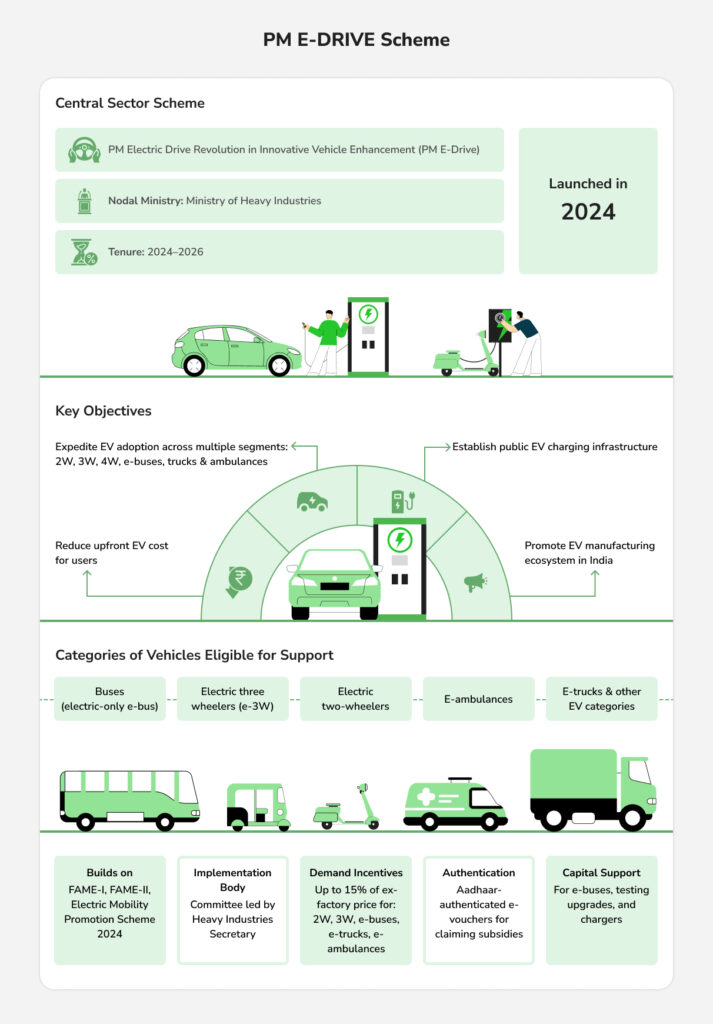
    Policy mandates and incentives also push quick commerce fleets toward EVs. India has set ambitious EV targets (net-zero by 2070) and offers subsidies under the PM E-Drive scheme (₹10,900 crore in 2024) specifically targeting EV adoption in commercial fleets and charging infrastructure. States like Delhi have even mandated 100% electrification of delivery fleets by 2025. Companies such as Flipkart and Zomato pledged to have fully electric fleets by 2030. In short, electrification aligns with growing sustainability demands from regulators, brands, and customers alike.

    Unique Charging Demands of  Quick  Commerce

    Quick commerce delivery imposes special requirements on EV charging. Orders must go out almost instantly, with vehicles often running 15–20 hours per day, as highlighted by EV Reporter. This leaves little downtime for charging. Unlike taxis or commute vehicles that recharge overnight, quick commerce riders need fast charging or battery swaps between rushes.This is where EV charging for quick commerce fleets becomes critical, requiring high-speed, high-availability systems tailored for continuous operations.

    Key demands include:

    Speed and turnaround: A delivery scooter may only have 20–30 minutes for recharge during a lull. Fast charging (20 minutes for approximately 50 km range) or quick battery swaps are essential. Traditional 4–6 hour full recharges are not feasible in this model. 

    Density: At a busy dark store, dozens of vehicles may need to charge during peak hours. Charging hubs must serve many EVs daily without queues. For example, EMO Energy estimates that a single 6kW fast charger can serve approximately 15–20 two-wheelers per day, matching the quick commerce pace. 

    Peak-demand management: Lunch or dinner surges dozens of deliveries at once. Charging facilities must scale for these bursts without overloading substations. Some companies are already incorporating on-demand energy management. AI-driven systems like EMO’s NEXO, as introduced by EMO Energy, balance solar and grid power across chargers. There’s also emphasis on integrating charging with logistics; for instance, some fleets charge EVs on the spot while riders pick up orders,reflecting real-world EV charging for last mile logistics.

    Infrastructure Challenges 

    Building this infrastructure in dense Indian cities faces hurdles:

    • Urban micro-hubs and space: Q-commerce thrives on local micro-hubs like dark stores, but they are small, and fitting chargers or swap bays is difficult. Traditional swap stations need 30–40% more space than equivalent fast-charging hubs, as highlighted by EV Reporter. Moreover, many leases don’t accommodate large charging equipment. Some companies are choosing warehouse locations with EV infrastructure in mind, but overall, real estate for chargers remains scarce around EV charging for dark stores. 
    • Grid reliability and load management: India’s electric grid can be unreliable, and many neighborhoods lack spare capacity. Charging dozens of vehicles simultaneously can strain local transformers. This raises concerns over brownouts or equipment failure. Fleets often add battery storage to buffer peaks. Future systems may use vehicle-to-grid (V2G) strategies or time-of-use tariffs to shift load, but inconsistent grid quality remains a concern. 
    • Lack of standardization: Two- and three-wheeler EVs lack a universal charging standard in India. This means swap stations and chargers must stock multiple battery types or adapters, often requiring approximately 1.5 batteries per vehicle to avoid shortages, as noted by EV Reporter. Fast chargers are simpler (many E2Ws use standard 230V AC plugs with Bharat-standard connectors), but their 3–6 kW output limits charging speed. Industry groups are working on unified standards like Bharat DC001 for E2Ws, but widespread adoption is pending.  
    • Regulatory and utility barriers: Incentives largely target public car chargers; only a few incentives directly address private fleet charging or battery-as-a-service (BaaS) models. Additionally, utilities and local governments must streamline approvals for high-power electrical installations, which are currently slow. 

    These challenges mean that quick commerce companies and infrastructure providers must creatively adapt traditional charging models to fit the new context of EV fleet charging infrastructure

    Adapting Last-Mile Logistics 

    Traditional delivery models are being retooled for EVs and fast logistics. Major quick commerce firms and e-commerce companies have rolled out EV programs and new infrastructure models: 

    • Fleet electrification plans:  Flipkart (including BigBasket) has pledged 100% EVs in last-mile delivery by 2030. Blinkit alone had approximately 50,000 EV delivery partners by March 2025 and aims for 100% EV deliveries by 2030. Amazon India fielded over 10,000 EVs across 500+ cities by 2024. These large players are investing in EV-capable two- and three-wheelers (e.g., Ampere, Hero, and Ather models) and, in some cases, even long-range electric trucks for heavier loads. 
    • Charging deployment: Flipkart has installed chargers at approximately 2,900 last-mile hubs nationwide. Swiggy and Blinkit are outfitting high-volume dark stores with chargers or partnering with EMO and Kazam. In many cases, quick commerce platforms subsidize charging for their rider networks, offering “pay-per-use” charging or leasing models, bundling energy in gig worker payouts, as highlighted by Outlook Business.
    • Battery leasing & BaaS: Riders lease EVs and batteries through providers like Yulu, Zypp, and Chartered Bikes, including insurance and maintenance. Platforms incentivize riders by offering more favorable pay rates for EV usage or by partnering with BaaS (Battery-as-a-Service) firms, which handle the charging/swapping logistics. 
    • Micro-hub design: Some Q-commerce companies are co-locating EV charging with product storage. New dark-store designs include dedicated charging bays. Zepto’s hubs in Gurugram reportedly have multiple swap/charge stations.  BigBasket has collaborated with Kazam and Zypp to electrify its fleet, with Flipkart setting up charging infrastructure at chosen hubs. 

    Charging Models: Traditional vs. Quick Commerce 

    To illustrate the differences, consider how a typical charging model compares to one tailored for quick commerce (especially two-wheelers): 

    This comparison shows why quick commerce operations favor on-site fast charging and swapping models. By co-locating chargers at order hubs, companies minimize downtime and maximize delivery capacity. 

    Blog Banner

    Frequently Asked Questions

    Why is quick commerce uniquely suited for fleet electrification?

    Quick commerce fleets operate on predictable, high-frequency routes with short travel distances, ideal conditions for electric two- and three-wheelers. High daily usage accelerates cost savings from lower fuel and maintenance expenses, making EVs economically attractive. 

    Why don’t traditional EV charging models work for Q-commerce fleets?

    Traditional charging assumes long idle periods, such as overnight home charging. Q-commerce vehicles operate almost continuously, leaving little downtime. Fleets need fast, high-throughput charging or battery swapping at hubs, not slow, distributed charging. 

    What charging speed is required for quick-commerce delivery vehicles?

    Most quick commerce fleets need either fast charging that adds ~40–50 km of range in 20–30 minutes, or battery swapping that takes 2–5 minutes. Anything slower reduces delivery capacity and rider productivity.

  • The Psychology of EV Charging: What EV Drivers Want at a Charging Station 

    The Psychology of EV Charging: What EV Drivers Want at a Charging Station 

    Electric vehicle drivers have clear, data-backed expectations for the charging experience. They want chargers that reliably work when needed, charge fast, and are convenient. Studies show EV owners often still worry about running out of battery, even though only about 8% have ever actually run out of charge, and 64% have never come close. This range anxiety makes trust in the EV charging network critical. 

    Pie chart showing percentage of EV owners running out of charge.

    A recent analysis found drivers expect functioning fast chargers, accessible stations, and safe, clean facilities to be top priorities. In short, EV drivers want charging stations to feel as dependable and hassle-free as traditional gas stations, if not better

    This blog examines the psychology behind EV charging decisions and what drivers truly expect from a charging station, focusing on three core dimensions: 

    • Trust in the network, driven by reliability and coverage 
    • Perceived convenience, shaped by charging speed and location 
    • Comfort and confidence, influenced by amenities, safety, and ease of use

    Reliability and Coverage: Trust in the Network

    Above all, drivers need charging stations to be reliable and available. Many EV owners complain that stations are too few, difficult to use, or simply broken.

    In India, the concern is even more pronounced; as McKinsey & Company highlights, over 75% of EV users feel that the charging network is still “not yet well set up.”

    This concern is becoming even more critical as adoption accelerates. According to TOI, in India, EV sales have surged to a record 24.5 lakh units in FY26, highlighting the rapidly growing demand for accessible and dependable charging infrastructure.

    Speed and Efficiency: Every Minute Counts

    Time is a major psychological factor in EV adoption. EV drivers strongly associate charging speed with convenience, making it a critical decision driver. According to insights from McKinsey & Company on EV consumer behavior in India, charging speed is the single most important factor for many users, with 49% of Indian drivers ranking it as their top criterion when selecting a charger.

    Additionally, research highlighted by Next10 shows that every additional minute of wait time reduces a charger’s likelihood of being used by 6%. This sensitivity to time also translates into willingness to pay; drivers are ready to spend more for faster charging, with estimates suggesting around $1 extra per 100 miles of range and a 10–20% premium for quicker service.

    In practice, this means EV charging station need plenty of high-power DC fast chargers, 24/7 uptime, and payment models that reward faster fills. Simply put, fast charging with minimal wait is not a nice-to-have; it’s a must-have in today’s EV world. 

    Location & Convenience: Charging Where Drivers Frequent Most

    EV drivers prefer charging stations in locations that fit their daily life and travel routes. Multiple surveys show that drivers overwhelmingly favor chargers at amenity-rich destinations. For DC fast charging, 74% of drivers want chargers at highway rest stops, 71% at shopping malls, 65% in parking garages, and 59% at restaurants. These are places where people naturally spend time while their car fuels up.  

    EV drivers prefer charging stations in locations that fit their daily life and travel routes.

    Co-locating chargers with grocery stores, cafes, or malls dramatically boosts usage. One study from Next10 found charging events rose 2.7–5.2× near dining and grocery outlets. Workplace charging is also highly valued: roughly a quarter of EV drivers use workplace chargers daily, and another quarter weekly. In essence, drivers want chargers where they already are, at home, at work, or on frequent travel routes. 

    Amenities & Comfort 

    Since EV charging takes longer than refueling a conventional vehicle, drivers increasingly expect stations to offer added comfort and convenience. Charging stops are no longer just functional; they’re becoming experience-driven pit stops. Insights from Green Car Reports highlight that EV owners actively look for gas-station-style amenities such as air pumps, vacuums, restrooms, and clear charging information when choosing where to charge.

    This expectation extends beyond basics. According to research referenced by Next10, EV drivers are 37% more likely to choose a charging station that offers amenities like restrooms or convenience stores. Many users also prefer locations with cafes, Wi-Fi, or comfortable seating; turning charging time into an opportunity to relax or stay productive.

    In practice, this signals a shift in how charging infrastructure should be designed. The most successful EV charging hubs go beyond utility, integrating food outlets, coffee shops, retail spaces, and clean rest areas. As industry experts suggest, aligning charging infrastructure design with the amenities EV drivers value is key to improving utilization, satisfaction, and overall adoption.

    Safety, Simplicity and Trust

    Beyond speed and convenience, drivers care about safety, cleanliness, and ease of use. Charging in a safe, well-lit area is important.

    Graph showing key decision making factors when choosing an EV charging point.

    Stations should feel secure and welcoming. User experience matters too: drivers expect simple interfaces and clear pricing. Insights from Green Car Reports highlight that drivers expect clear signage for pricing and charging speed, along with simple, familiar payment methods; similar to traditional fuel stations.

    Research published on ScienceDirect further reinforces that ease of use, reliable functionality, and transparent systems are among the top expectations influencing user satisfaction. In practice, this means the entire journey—from discovering a charger on an app to initiating payment and checking real-time availability—must be seamless and intuitive.

    Additionally, perspectives shared by Driivz emphasize that drivers want greater control over their charging experience, including quick, one-click visibility into charger status. When chargers are frequently out of service or interfaces are difficult to navigate, user confidence drops rapidly, impacting both usage and brand perception across public EV charging stations.

    Ultimately, a reliable and frictionless user experience is not just a differentiator—it is essential for scaling EV adoption and ensuring consistent utilization of charging infrastructure.

    Final Thoughts 

    Putting it all together, the data paints a clear picture. EV drivers want charging stations that: 

    • Always work: Reliable, well-maintained chargers with minimal downtime. 
    • Charge quickly: High-power fast chargers so drivers spend less time waiting. 
    • Are conveniently located: co-located with destinations like rest stops, malls, and workplaces, where drivers can shop or relax. 
    • Offer amenities and comfort: facilities such as restrooms, food, Wi-Fi and even gas station perks like air pumps and vacuums to make charging breaks pleasant. 
    • Feel safe and transparent: well-lit, secure locations with clear pricing and easy payment apps.

    Frequently Asked Questions

    Why do EV drivers still experience range anxiety despite better batteries?

    Range anxiety is largely psychological rather than technical. Even though most EV drivers rarely run out of charge, uncertainty around charger availability and reliability creates stress, making trust in the charging network more important than battery size alone.

    What is the single most important factor for EV drivers at a charging station?

    Reliability. Drivers consistently say they want chargers that work every time. Broken or inaccessible chargers erode trust faster than slow charging speeds or higher prices.

    Are EV drivers willing to pay more for faster charging?

    Yes, studies show drivers are willing to pay a premium, often 10–20% more, for faster charging if it reduces waiting time and uncertainty. 

  • What Is the Real Bottleneck in Scaling India’s EV Charging Network?

    What Is the Real Bottleneck in Scaling India’s EV Charging Network?

    EV charging network in India has expanded rapidly over the last few years. Policy intent is strong, funding has been announced, and charger installations are steadily increasing across public, residential, and fleet segments. On paper, the ecosystem appears to be moving in the right direction. Yet, as explored in the first part of this series, “Current State of EV Charging in India”, growth in charger count has not translated into consistent availability, reliability, or commercial viability on the ground. The challenge is no longer whether chargers are being installed but how to scale them effectively. 

    In this second part, we explore:  

    • Core bottlenecks in charger deployment: regulatory and permitting friction, grid and distribution constraints, weak commercial viability, and fragmented technical standards 
    • Why these issues persist despite supportive policies: misaligned incentives, uneven state adoption, limited grid visibility, and low utilization at many sites 
    • Structural fixes to enable growth: from single-window clearances and grid-ready planning to better commercial models, standardized user experience, and integrated land-use planning 

    What Are the Core EV Charging Bottlenecks Slowing Charger Deployment? 

    Below are the fundamental, structural constraints that policymakers and industry cite as slowing charger deployment, commonly referred to as EV charging bottlenecks in India, beyond mere “lack of funding”.

    Regulatory & Permitting Friction 

    While the 2024 MoP guidelines made EV charging a de-licensed activity, approvals still require navigating multiple agencies. A charging station may need a city building permit, a fire safety NOC, and separate clearance from the local DISCOM.  

    DISCOMs themselves have no standardized process. Some states mandate a fresh service connection and costly transformer upgrades; others allow sub-metering on an existing line. Tariff policy is improving, with most states now capping EV charger supply at the Average Cost of Supply (ACoS), but rates and rules vary widely.  

    Chronological list of guidelines and amendments issued by the Indian Ministry of Power regarding EV charging infrastructure.

    Providers offering open-access power for fast chargers may face a 15–25% surcharge on top of grid prices. Institutional incentives are also misaligned: PM E-DRIVE subsidies focus on equipment cost, not ongoing operational viability. In practice, heavy reliance on private players for network rollout has “not yielded expected results”, as one analyst notes, with installations remaining low where state support and demand signals are weak.

    Grid & Distribution Constraints

    The Indian grid was built for heavy industry and households, not sudden surges of mobile load. A key bottleneck is uncertainty around capacity. Distribution companies often lack EV-specific load forecasts or dedicated feeders. Without clear guidance, they default to cautious policies, such as rejecting large connection applications pending complete load studies. ORF (Observer Research Foundation) notes “limited visibility into grid infrastructure upgrade requirements” leaves CPOs unsure of costs and timelines. Upgrading a substation or line for fast chargers can be prohibitively time-consuming.  
     
    On the system side, planning bodies like CEA and State load dispatch centers have only recently begun factoring EV growth into long-term forecasts. As a result, new chargers sometimes trip transformers or raise evening peak demand unexpectedly. In regions with already stressed grids (e.g., Delhi or parts of Maharashtra), DISCOMs are reluctant to permit more high-kW chargers without guaranteed compensation. The solution requires treating EVs as a new load category, with published processes for wiring up depots and public hubs, alongside smart charging policies (time-of-day tariffs, V2G) to smooth demand spikes across the EV charging network.

    Commercial Viability 

    Many charging businesses are losing money. Utilization rates are typically well below 25%, and the high upfront cost (₹2-3 lakh per fast charger plus civil works) often never pays off. Investors report lengthy payback periods (5-7+ years) unless cross-subsidized by real estate owners or the government.  
     
    The PM E-DRIVE scheme’s ₹2,000 crore grant pool is intended to ease this, offering up to 100% subsidy on chargers at government sites and 80% on highways. Yet disbursment has been slow: as of late 2025, no scheme funds had been released for public chargers. Moreover, even subsidized sites need foot traffic. Analysts (and industry voices) emphasize that low utilization, not technology, is the pinch point. Poor site selection, such as charging kiosks on low-demand sidewalks, has been a common criticism. Until charging can become a reliable revenue stream, large investors and banks will remain cautious. 

    Technical & User Experience Issues 

    India’s charging ecosystem is fragmented. Different CPOs use different apps and connectors, and there is no unified platform for finding or booking chargers. A 2025 study notes drivers may need roughly 17–20 apps. Payment is another pain point: many drivers, especially chauffeured or elderly, still want cash/UPI at the station, but most chargers accept only card or app payments.  
     
    Reliability is also problematic. A February 2024 report found 12,100 of 25,000 public chargers non-functional (almost 50%), with 38% of users citing poor uptime as a top cause of range anxiety. Frequent hardware failures (overheated breakers, cable damage) and patchy maintenance erode trust. Moreover, India lacks full interoperability: not all fast-chargers support all standards (e.g., CCS vs. GB/T vs. Bharat DC). While new rules mandate interoperability and calibration, legacy sites often remain in a single protocol. Addressing these technical gaps – through mandatory uptime SLAs, a nationwide charging portal, and stronger standards enforcement – is as critical as adding new plugs. 

    Fostering Growth: Structural Fixes 

    To truly unlock charging scale, the system needs multi-pronged fixes: 

    Streamline Permits & Tariffs 

    States must push a “single-window” clearance for chargers. For example, appointing a State Nodal Agency,  as suggested in the MoP 2024 guidelines, should mean a one-stop shop for site permissions and power allocation. Cross-subsidy surcharges or open-access fees for EV load (currently up to 20%) should be waived or reduced.  

    Regulators should enforce the ACoS cap on charger supply tariffs across all states and establish uniform EV tariff categories for homes and businesses. Accelerated metering, such as pre-approved meter kits for EVs, can ease home charging. Policy must also incentivize equity in charger location: tying subsidies to utilization or mandating minimum uptime can prevent funds from being wasted on idle sites. 

    Grid Capacity Planning

    Smart EV charging station is an intelligent way to power up your electric vehicle

    DISCOMs and CEA must integrate EV forecasts into planning now. Utilities should publish expected timelines for substation upgrades in fast-charging corridors, giving CPOs clarity.  Mandatory EV load forecasting will signal where new transformers or feeders are needed. Regulators could require time-of-day tariffs to encourage night/weekend use and defray peak stress. Smart-charging and vehicle-to-grid (V2G) pilots should be fast-tracked, with fleet vehicles providing grid services.  Renewable energy integration, such as solar carports at stations, can reduce grid draw and improve station economics. 

    Improve Commercial Models

    Charging stations should capture multiple revenue streams.

    Charging stations should capture multiple revenue streams. Retail tie-ups (e.g., malls hosting chargers) and “energy plus amenities” (charging integrated with food/café services) can increase footfall. Standardized roaming frameworks,  similar to mobile networks, would let EV drivers use any network with one ID, raising usage. Financial support could shift to performance-based grants: subsidizing chargers only once minimum uptime or customer-use thresholds are met. Private fleets (taxis, delivery companies) should be encouraged to co-invest in public charging through demand aggregation schemes. 

    Standardize User Experience 

    The government’s digital portal for EV chargers and apps like “GoElectric” should be ramped up so all stations are listed,  bookable, and interoperable. Mandating a common payment interface (e.g., QR code payments at all chargers) will remove friction for users. Enforcing robust maintenance contracts,  perhaps by licensing CPOs, will improve reliability;  broken chargers are as bad as no chargers. Central bodies like CEA and BEE should continue issuing safety and interoperability standards (for plugs, meters, and cables) and ensure adoption. 

    Land Use and Urban Planning

    City planners should embed charging in zoning rules. States should adopt the MoHUA’s EV-ready bylaws (20% of new parking wired for EVs) uniformly, as Delhi and Maharashtra have. Public land and metro parking areas can be allocated to charging operators on concession, and streetlight/pole charging trials can be expanded in dense areas. Highway agencies must enforce the plan for chargers every 25–50 km; putting EV charging status on NHAI highway maps would help drivers and investors alike.  Chargers must be treated as vital infrastructure, on par with fuel stations or telecom towers. 

    Final Thoughts 

    India’s EV charging network has grown impressively on paper, but the last mile” problems remain. As Tata.ev’s 2025 report notes, rapid charger deployments have improved coverage, yet “reliability issues continue to undermine user confidence”.  

    Unless the real bottlenecks, such as multi-agency delays, grid readiness, commercial viability, and technical glitches, are addressed, confidence will falter. For CPOs, investors,  and policymakers, the path forward is clear: focus less on headline targets and more on enabling every link of the charging ecosystem. Only by fixing the structural kinks and dispelling myths that subsidies alone will suffice can India’s charging infrastructure truly power its EV ambitions. 

    Blog Banner

    Frequently Asked Questions

    1. Why hasn’t government funding solved the charging problem? 

    Government funding hasn’t solved the charging problem because funding targets installation, not utilization or uptime. Most subsidy schemes pay for charger hardware, do not reward station performance, and do not penalize low utilization or downtime. As a result, chargers get installed where subsidies are easy, not where demand is strong. The real bottleneck today is commercial viability, not CAPEX availability.

    Why is charger utilization so low despite rising EV sales?

    Charger utilization is low despite rising EV sales because chargers are often built ahead of demand, not aligned to it. 

    Key reasons are 

    • Poor site selection (low footfall areas) 
    • Fragmented apps and payment systems 
    • Reliability issues (non-functional chargers) 
    • Lack of roaming across networks 

    More EVs do not automatically mean more charging sessions; accessibility and trust matter more than charger count. 

    Why are DISCOMs hesitant to approve fast chargers? ok be released?

    DISCOMs are hesitant to approve fast chargers because fast chargers create unpredictable, high-power loads. 

    From a DISCOM’s perspective: 

    • EV load forecasts are weak or absent 
    • A single fast charger can stress transformers 
    • Peak charging coincides with evening peak demand 

    Without clear compensation mechanisms or grid upgrade plans, DISCOMs default to risk avoidance, slowing approvals. 

  • The Current State of EV Charging in India [2026]: Public, Home, and Fleet Networks

    The Current State of EV Charging in India [2026]: Public, Home, and Fleet Networks

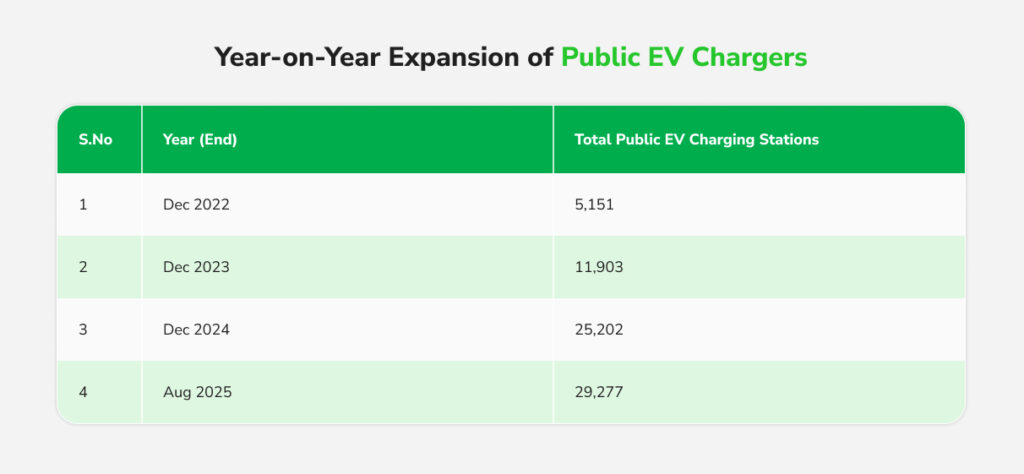
    India experienced a record-breaking year in 2025, with total EV registrations reaching 2.3 million units, up from 1.95 million in 2024. EVs now account for 8% of all new vehicle registrations in the country.  Public chargers rose from approximately 5,000 in 2022 to around 25,000–26,000 by early 2025, yet this still meant one charger per 235 EVs (far above global norms).  By late 2025, India counted about 39,500 chargers (8,414 fast chargers), highlighting gaps in EV charging infrastructure in India.  
     
    The gap between EVs and charging points is widening as adoption soars, undermining consumer confidence.  In this article, we explore:  

    • Public charging networks: deployment patterns, utilization  challenges, land and grid constraints, and the commercial viability of fast-charging sites 
    • Residential charging: the role of home and community charging, RWA-level challenges, wiring upgrades, and uneven adoption of national guidelines 
    • Fleet charging: depot and highway charging for buses, autos, and commercial fleets, and how policy and grid readiness shape scalability 

    Public Charging (Open Network)

    Public chargers have expanded rapidly, roughly a five-fold increase from FY22 to FY25, thanks to government push and private investment.

    Public chargers have expanded rapidly, roughly a five-fold increase from FY22 to FY25, thanks to government push and private investment.  Growth, however, has been uneven, with leading states such as Karnataka, Maharashtra, and Delhi clustering most chargers, leaving others underserved across the broader EV charging ecosystem India.  
     
    Private operators report very low utilization: on average, under 25% across all stations. Many fast-charger sites remain nearly empty outside peak hours, making business models unviable.  Observer Research Foundation’s (ORF) 2025 study highlights execution gaps: project delays, stalled approvals, and opaque grid interconnections plague new sites.  
     
    For example, developers often face repeated permit delays from DISCOMs or local bodies and sometimes outright rejection of grid connection requests. Land acquisition is another challenge, with charging operators struggling to get long-term rights on highway waystations. Even with subsidies, high capital and grid-upgrade costs remain. ITDP India notes that “land identification” and “high power connection costs” (including transformer upgrades) deter many Charge Point Operators. 

    Some state governments are attempting fixes. Delhi, for instance, offers concessional land rates and has a low EV-specific tariff to spur stations. Several states have created EV policy committees to smooth approvals.  Yet misperceptions linger; many assume chargers can be deployed quickly when, in reality, a new fast charger often requires a 300 kW+ service upgrade, a multi-month process involving utility studies, transformer replacement, and new cabling.  Without integrated planning from the Central Electricity Authority (CEA) and DISCOMs, operators remain uncertain about upgrade costs and timelines for each EV charging station. 

    Residential Charging: Home and Housing Complexes 

    Surveys show only about 55% of Indian EV owners currently have home chargers.

    Home charging is the most convenient mode for India’s millions of two- and three-wheelers.  The 2024 Ministry of Power (MoP) guidelines allow homeowners to use existing meters or install a separate EV-dedicated meter and tariff. This means apartment owners can install a 3 kW–15 kW charger at home and pay regular residential rates, with distribution companies obliged to sanction any needed load increase. RWAs (Resident Welfare Associations) are permitted to set up “community charging” in parking lots, complementing Public EV charging stations in dense urban areas. However, the reality is messier. 

    Many RWAs and electricians remain confused over wiring costs, sub-metering for visitors, or applicable safety standards. Reports note that despite central guidelines, several state governments have yet to adopt these guidelines.  

    In practice, some housing societies flatly refuse EV chargers for safety or cost fears. Upgrading an old apartment’s electrical panel can cost ₹10,000–₹50,000 per slot, often shared among all residents, prompting objections from non-EV owners. Unsurprisingly, IEEFA found gated communities delaying or banning chargers “for fear of additional financial burden”

    Although up to 80% of EV charging could occur at home (as in mature markets), India lags. Surveys show only about 55% of Indian EV owners currently have home chargers.  Cities are beginning to mandate wiring: Delhi’s EV policy (2020) requires 20% of parking in new buildings to be EV-ready, Maharashtra’s code mandates one charger per five parking spots in new projects, and Uttar Pradesh requires “at least one charger” for large residences. These rules help long-term, but enforcement is uneven. Many states lack EV-ready building codes, and existing complexes struggle to retrofit. The result: home charging, critical for EV transition, remains stuck in coordination limbo. Without clear RWA guidelines, financial incentives, or mandated infrastructure in old complexes, India cannot rely on private homes alone to bridge the gap. 

    Fleet Charging: E-Buses, Autos and Delivery Fleets 

    Fleets often manage charging “in-house” at depots or offices, sidestepping public network gaps. For example, e-buses rely on large DC chargers at bus depots; under PM E-DRIVE’s first phase, 10,900 e-buses were allocated to five cities (with operators bidding in late 2025). The 2024 guidelines allow bus depots to apply for high-power connections or open-access supply (with a 20% surcharge). In many cases, utilities expedite these, seeing the public interest. However, issues remain: some states lack clear policies for depot charging, and depots sometimes struggle to meet the required 240 kW minimum charger capacity for buses

    Two- and three-wheeler fleets (delivery, auto rickshaws) mainly use swappable batteries or slow chargers.  Bottlenecks here are often operational, not infrastructural: e-rickshaw unions or fleets avoid costly parking fees, preferring back alleys or roadside vendors for cheap overnight charging. Few formal public chargers cater to autos, so drivers rely on informal arrangements. For trucks and ride-hailing cars, range anxiety is still a concern on intercity routes. Highway charging networks are in the pilot stage: NHAI and state agencies have invited bids to build wayside amenities (including charging) on major corridors, but the rollout of 25–50 km is only beginning across the national EV charging network

    In sum, fleets drive electrification but also expose gaps. While they can deploy captive chargers (e.g., at depots or warehouses), large-scale fleet growth will eventually stress the common grid. Without robust public or semi-public charging infrastructure, fleet operators face higher costs (owning and maintaining hardware) and risk bottlenecks on longer routes.  Scaling fleet charging requires expansion both at depots and along highways to keep up with commercial EV adoption. 

    Final Thoughts 

    India’s EV adoption is moving faster than its charging infrastructure. While vehicle sales and policy intent are strong, execution challenges persist across public, residential, and fleet use cases. 

    Public networks struggle with low utilization and grid constraints, home charging remains caught in coordination and cost disputes, and fleet charging, though often managed privately, will increasingly strain common infrastructure as electrification scales. Across all three, the issue is not demand but planning, approvals, and grid readiness. 

    For India’s EV transition to sustain momentum, charging must be treated as essential infrastructure, planned, integrated with the grid, and supported by clear, enforceable standards. The success of the next phase will depend less on new incentives and more on whether charging can quietly and reliably keep up with the EVs already on the road. 

    Frequently Asked Questions

    Why does India still have EV charging problems despite thousands of new chargers?

    India still has EV charging problems despite thousands of new cchargers becausethe number of chargers does not equal availability or usability. While India has added tens of thousands of chargers, many suffer from:

    • Low uptime 
    • Poor site selection 
    • Grid constraints 
    • Low utilization 

    Charging infrastructure needs planning, power readiness, and demand alignment, not just installations. The bottleneck today is execution, not intent.

    Why are fast chargers so difficult to deploy in Indian cities?

    Fast chargers are difficult to deploy in Indian cities because fast chargers are power-hungry assets. A single DC fast charger can require: 

    • 300 kW+ sanctioned load 
    • Transformer upgrades 
    • New cabling and switchgear 
    • Months of utility approvals 

    Indian city grids were not designed for sudden, mobile high-load demand, making deployment slow, expensive, and uncertain. 

    Why is home charging adoption still low in India? 

    Home charging adoption is still low in India because, despite clear central guidelines, home charging faces: 

    • RWA resistance 
    • Cost disputes among residents 
    • Confusion around wiring and metering 
    • Lack of enforcement of EV-ready building rules 

    Only about 55% of EV owners have reliable home charging today, even though it’s the most efficient solution. 

  • Solar-Powered EV Charging in India’s Tier-2/3 Cities: Opportunities and Challenges 

    Solar-Powered EV Charging in India’s Tier-2/3 Cities: Opportunities and Challenges 

    As of FY2025, Tier-2 and Tier-3 towns each accounted for over 10% of India’s EV market. Two-wheelers dominate: about 58% of EVs in Tier-2 and 71% in Tier-3 are electric scooters and motorcycles. Electric auto-rickshaws (3-wheelers) make up the next largest share, approximately 30% in Tier 2 and 22% in Tier 3. These trends reflect booming mobility demand in India, where rural and small-city Indians are adopting EVs to save on fuel costs.

    Public charging infrastructure, however, lags behind.  Nationwide, there were only about 25,200 public chargers by mid-2025, heavily clustered in a few states.  Tier-2/3 states have far fewer stations.  

    Decentralized solar-powered EV charging in India has emerged as a promising solution. Thanks to India’s abundant sunshine, even small solar arrays can meaningfully power EVs.  WWF reports that roughly two-thirds of India’s land (>1.89 million km²) receives more than 5 kWh/m²/day on average.  A 5kW PV system typically yields 20–25 kWh per day, enough to add 60–80 km of range to a scooter, sufficient for most rural commutes.  A modest rooftop PV setup (4kW) requires only 300–350 sq ft of area and costs ₹3–4 lakh (pre-subsidy). Larger ground arrays (10–50 kW) cost about ₹45–50 thousand per kW installed. Battery storage adds to the cost (around $100/kWh, or ₹9k/kWh), though prices are falling. 

    This blog covers three core themes: 

    • Where and how solar-powered charging models are already working 
    • Whether the economics make sense (a close look at capital costs, operating savings, subsidies, and payback periods) 
    • The challenges to scaling solar charging and practical solutions  

    Why Solar EV Charging Makes Sense for India’s Small Cities and Towns 

    Solar charging can take several forms in Tier-2/3 contexts: 

    • Standalone PV charging stations: Off-grid “solar pumps” for EVs, typically with a PV array, inverter, and chargers (plus optional battery). These can be sited anywhere sunny—on open land, village squares, or petrol pumps. For example, Jabalpur (Madhya Pradesh) launched nine standalone solar e-rickshaw charging stations serving approx. 400 vehicles. Each station has approx. 50kW of PV and can charge up to four e-rickshaw batteries in 7–8 hours. The result: Drivers’ charging costs dropped to approx. ₹30 per charge (vs. ₹40–50 on the grid). 
    • Solar microgrids: Solar microgrids combine PV (often ground-mounted) with storage and multiple fast chargers. For example, in 2024, BluSmart, in collaboration with the Haryana Renewable Energy Development Agency (HAREDA) built  a  1.2 MW solar EV microgrid in Gurugram, powering 150 fast chargers and serving ~2,000 EVs per day. Tata Power and Indian Oil Corporation have also announced plans for similar solar-charging farms. Such microgrids can serve highway corridors or entire towns by acting as renewable power stations. 
    • Community solar hubs: Small solar chargers can sit at local businesses, panchayat halls, or schools. Entrepreneurs are already experimenting with rooftop solar feeding wall-plug chargers.  These decentralized models cost 80–90% less than urban DC stations and fit village power limits. Over time, a “sun-to-scooter” ecosystem may emerge, where microgrids and rooftop PV become the backbone of rural mobility. 

    This is a prime example of renewable energy EV charging being adapted to local contexts. Crucially, India’s solar resource can support these ambitions. Even partial deployment can significantly offset grid use. For instance, a 10kW solar array generates approx. 40–50 kWh/day, enough to charge an electric scooter (~100 Wh/km) for ~400km of travel daily. 

    Economics and Financing 

    A key question is cost and return on investment. Compared to metros, Tier-2/3 chargers tend to be lower-power (3–15 kW AC rather than 150+ kW DC) because vehicles are lighter and distances shorter. Indicative costs (excluding installation): 

    • EV chargers: A 15kW AC charger costs ₹3.5–4 lakh. A 60kW DC fast charger runs ₹3–7 lakh. Installation (cabling, transformer, site work) add more. 
    • Battery storage: Battery packs remain expensive and cost approx. $108/kWh (about ₹9,000/kWh). Thus, 100 kWh of storage is approx. ₹9–10 lakh.  

    However, solar charging also saves money. Once installed, solar power is free fuel. Grid power in rural areas may cost ₹7–8 per kWh, whereas solar can cut effective electricity costs to near zero. For EV owners, this translates into very low per-km cost: approx. ₹0.15–0.20/km for electric two-wheelers vs ₹2–2.5 for petrol. Savings accumulate quickly; one analysis estimated annual operating savings of ₹25,000–30,000 per vehicle

    Government incentives improve economics further. The PM E-Drive earmarks ₹2,000 crore for 22,100 chargers by 2026. The Ministry of New and Renewable Energy (MNRE) has set aside $120 million under the National Solar Mission for solar EV charging by 2027 with draft guidelines offering up to 50% capital subsidy
     
    States like Uttar Pradesh, Gujarat and Rajasthan waive land conversion fees and grant additional incentives for EV infrastructure. The Bureau of Energy Efficiency’s new “Green Charging” initiative (2024) mandates that 25% of new public chargers by 2026 source at least half their power from renewables. Public–private collaborations are also reflecting this push: Adani Green Energy and ChargeZone have announced 1,000 solar-powered chargers along the Delhi–Mumbai Expressway. 

    A rough cost breakdown for a small solar charging station might look like: 

    • PV panels and inverter (10 kW): approx. ₹4.5–5 lakh. 
    • Charger (15 kW): approx. ₹4 lakh. 
    • Mounting, wires, installation: ₹1–2 lakh. 
    • Battery (100 kWh): approx. ₹9 lakh. 

    So, a 10 kW PV + 15 kW charger + moderate storage could total approx. ₹15–20 lakh. With government support (50% subsidy on the charger or PV, cheap loans), this cost drops significantly. A 10 kW PV system generates approx. 12,000–15,000 kWh/year, saving ₹90,000–1.2 lakh annually. At this rate, a 3–5 year payback is plausible

    This makes solar charging one of the most attractive EV charging solutions for businesses operating in smaller towns, where cost savings and subsidies can accelerate adoption.

    Challenges and Solutions

    Despite the potential, several hurdles remain. 

    • Intermittency and storage cost: Solar generates only during the day. Without batteries or a grid tie, charging stations would only work daytime. Adding enough battery storage for night charging drives up cost (₹9k/kWh). Second-life EV batteries (as in Bengaluru’s RE2EV) help but still add complexity. In most Tier-2/3 contexts, a hybrid approach (solar by day, grid or battery at night) is needed. 
    • Maintenance and reliability: Solar panels need periodic cleaning and inspection. Battery banks and chargers require technical upkeep, which may be scarce in small towns. Local technician training is important. Moreover, panels and inverters must withstand local weather (dust, heat). 
    • Awareness and trust: Rural customers and local officials may be unaware of solar-EV options. Outreach and visible pilots (like Jabalpur’s hub) can build confidence.  
    • Upfront capital and business models: Even with subsidies, building solar stations requires upfront capital. Private operators worry about low initial demand in small towns. Innovative models (grants, concessional loans and CSR funding) can mitigate this. Peer-to-peer approaches (e.g. local entrepreneurs sharing risk in PPPs) are promising. 
    • Proposed solutions: Analysts suggest combining approaches. For example, power-sector regulators and DISCOMs should co-plan with EV-charging companies to use solar and demand management..  
    • Public–private partnerships (PPP) can mobilize investment: start-ups building village chargers could partner with utilities or panchayats. In fact, some EV infrastructure firms are already piloting solar micro-grids for rural e-rickshaw fleets. Also, technical workarounds like swapping (batteries replaced rather than charged) reduce grid dependence and are well-suited to off-grid solar. 

    Role of Policy and Partnerships 

    Beyond technology, governance will shape outcomes. Central schemes (FAME-II, E-Drive) are creating the funding framework, but many incentives target metros and highways. Policymakers must explicitly include Tier-2/3 solar charging in state EV policies. For instance, land-use norms could allow solar on common property (temple/market rooftops). DISCOMs should view solar chargers as allies and fast-track approvals. 

    Local governments can designate charging sites at bus stands, schools or mandi complexes. Microfinance or rural banks can support entrepreneurs to install chargers. Training institutes (like the new EV and Solar skill centers) should include solar-EV tech in curricula, so technicians are available locally. 

    Public–private collaborations are already underway. Major oil companies (IOC, HPCL) are rolling out EV chargers at their rural outlets, with plans to integrate solar. Tata Power has committed to equipping many of its new chargers with solar capacity. Startup–NGO partnerships (e.g. GIZ-BESCOM) developed the RE2EV solar hub in Bengaluru highlight the potential. 

    Case Studies: Learning from Pilots

    Several real-world examples illustrate the potential: 

    • Bengaluru, Karnataka (2025): The RE2EV hub at Kempegowda Airport pairs 45 kW of rooftop solar with a 100 kWh second-life battery. It runs nine fast chargers (capable of 18 simultaneous charges) almost round-the-clock, reducing grid pressure. This project shows a model for other Tier-2 cities (e.g., Mysuru, Vijayawada). 
    • Delhi–Mumbai Expressway (upcoming): Leveraging a BEE mandate, Adani Green Energy and ChargeZone plan 1,000 solar-powered chargers along the highway. The first of these combines a solar canopy with EV stalls, providing clean, fast-charging at intervals.

    Highways are often Tier-2/3 linkages, and this shows how EV charging infrastructure in Tier-2 cities can evolve when solar is integrated into planning. 

    Future Outlook 

    Solar EV charging can offer multiple long-term benefits for smaller cities and rural areas. By integrating into village power systems, these setups can double as mini-grids. For example, an EV charging station with battery storage could also supply nighttime lighting or pump irrigation after business hours. This leverages idle solar energy and improves local electrification. It also adds resilience: during power cuts, solar chargers with storage could keep critical loads or emergency vehicles running. 

    Energy-wise, solar EV infrastructure moves India toward a virtuous cycle. Vehicles become not just transport but distributed storage (via V2G in the future), and rooftop solar investments will gain additional revenue streams through vehicle charging.  

    Environmentally, widespread solar charging reduces tailpipe and coal-power emissions. Socially, it democratizes clean mobility: villagers gain low-cost charging, making EVs more accessible. Early studies note that rural commuters (10–25 km/day) fit EV range perfectly and that using solar cuts their daily energy costs to just a few rupees.  

    If even 10–20% of small-town charging goes solar, it could save hundreds of GWh annually and avoid millions of tons of CO₂. As one analysis notes, an EV-powered village economy (with solar at its core) can thrive “even with weak grid connections”

    In sum, solar-powered EV charging in India is viable and valuable but requires thoughtful execution. Key steps include targeting the right technology (smaller chargers, smart storage), securing affordable financing (leveraging new subsidies), and forging strong partnerships (utility–private–community).  

    With 5–7 kWh/m²/day of sun and falling hardware costs, the technical foundation is solid. By building on the successful pilots and addressing the challenges above, India can spark an electric mobility revolution not only in its cities but across Indiadelivering clean, affordable transport and energy to all.

    Frequently Asked Questions

    Is solar-powered EV charging actually viable in small towns and rural India?

    Yes, solar-powered EV charging is actually viable in small towns and rural India, especially for two- and three-wheelers, which dominate Tier-2/3 EV adoption. Most rural and small-town EV users travel 10–40 km/day, use low-power chargers (3–15 kW), and charge during daytime or overnight. India’s solar resource (5–7 kWh/m²/day in most regions) is well-suited to these needs. Even a 5–10kW solar system can support daily scooter or e-rickshaw charging economically. 

    Is solar EV charging cheaper than grid charging in Tier-2 and Tier-3 cities?

    Over the long term, yes, solar EV charging could be cheaper than grid charging in Tier-2 and Tier-3 cities. While upfront costs are higher, solar charging offers: 

    • Near-zero fuel cost after installation 
    • Protection from rising grid tariffs 
    • Lower per-km cost for EV users 

    For two-wheelers, charging via solar can bring energy costs down to ₹0.15–0.20/km, compared to ₹2–2.5/km for petrol. Over time, this makes solar charging the lowest-cost option in small towns.

    What types of EVs benefit most from solar charging in small towns?

    Solar EV charging works best for: 

    • Electric scooters and motorcycles (2Ws) 
    • Electric auto-rickshaws (3Ws) 
    • Small delivery fleets 
    • E-buses at depots (with storage or grid backup) 

    Heavy long-haul trucks and ultra-fast chargers are less suitable for off-grid solar today due to high power requirements. 

  • OCPP 2.0.1 Explained: Why It Matters for Indian CPOs 

    OCPP 2.0.1 Explained: Why It Matters for Indian CPOs 

    Open Charge Point Protocol (OCPP) is the industry-standard language for communication between EV chargers and central management systems. It ensures chargers from any vendor can connect with any backend, avoiding proprietary lock-in.  OCPP 1.6, introduced around 2015, became widely used for basic interoperability. OCPP 2.0.1 explained here, was finalized in 2020 and is the latest stable version, adding advanced features. In short, OCPP makes charging networks open and scalable, a crucial factor as India rapidly builds out its EV infrastructure. 

    Evolution of OCPP: From 1.6 to 2.0.1 

    OCPP 1.6 laid the foundation with basic transaction control and fixed charging profiles. But the EV landscape has grown more complex. OCPP 2.0 and its revision 2.0.1 introduce a richer device model (hierarchical EVSE/connector structure) and dynamic smart-charging capabilities. For example, OCPP 2.0.1 allows real-time charging profiles that adjust to grid constraints, time-of-day rates, or renewable supply, unlike 1.6’s static profiles. It also consolidates many messages for efficiency and adds features like WebSocket compression for high-traffic sites. In short, 2.0.1 was built for large-scale, modern networks and is not backward-compatible with 1.6.

    Key Features of OCPP 2.0.1 

    Key Features of OCPP 2.0.1

    OCPP 2.0.1 brings major new capabilities over 1.6, including: 

    • Dynamic Smart Charging: Real-time, grid-aware charging profiles allow operators to push updated power limits or schedules based on electricity prices, local grid signals, or vehicle needs.  OCPP 2.0.1 also supports integration with ISO 15118 for bidirectional Vehicle‑to‑Grid (V2G) charging, enabling EVs to supply energy back to the grid. 
    • Native Plug-and-Charge (PnC): OCPP 2.0.1 is the first version with built-in support for ISO 15118’s Plug & Charge, a certificate-based, app-free charging flow. This means a driver can simply plug in and charge without RFID cards or apps, with payment and authentication handled automatically. By contrast, OCPP 1.6 requires custom workarounds to achieve this. 
    • Advanced Diagnostics & Maintenance: The Device Model exposes detailed component and sensor data to the backend. Operators can retrieve full charger logs and status (errors, connector health, etc.) remotely, enabling proactive fault detection and resolution. Secure remote firmware updates and automatic logging improve uptime and reduce maintenance costs. For example, OCPP 2.0.1 lets CPOs perform secure remote firmware updates and deep diagnostics on chargers. Features like signed firmware pushes and automatic logging help ensure stations stay current and healthy. 
    • Optimized Transactions and Payments: OCPP 2.0.1 supports unified transaction events and standard payment flows, allowing contactless card, app-based, and Plug & Charge options. This flexibility encourages multiple payment providers and fair competition, aligning well with India’s UPI-based ecosystem. 
    • Future-Proofed for V2G and Renewables:  By aligning closely with ISO 15118-20, 2.0.1 prepares stations for upcoming use cases like fast, bidirectional V2G services. Recent studies show ISO 15118-20 enables chargers to reverse power flow and negotiate grid services, features that OCPP 2.0.1 can natively carry.  

    In short, OCPP 2.0.1 is the global baseline for “smart” charging. As one analysis notes, making 2.0.1 (and eventually 2.1) the norm brings richer device control, improved security, and better diagnostics to all networks. That means CPOs can mix and match hardware and software easily, plug in future services, and avoid vendor lock-in.  In practice, OCPP 2.0.1 ensures that any charger (of any brand) can join the network.  CPOs gain the ability to use a variety of vendors from hardware and backend providers without being locked in, improving interoperability and uptime. 

    Why OCPP 2.0.1 Matters for Indian CPOs (2025–26) 

    India’s EV rollout now demands exactly what OCPP 2.0.1 offers. The Ministry of Power’s 2024 charging guidelines and state policies emphasize open communication protocols (OCPP and OCPI) and interoperability. Public chargers are effectively treated as unlicensed, and CPOs are expected to use open standards to enable seamless roaming and reliability. For example, the MoP mandates that all new public chargers support OCPP/OCPI and UPI-based payments.

    This makes integration with an OCPI EV charging network critical, as it allows roaming across multiple operators and boosts utilization rates.

    Chinese or proprietary systems risk becoming stranded assets. Using OCPP 2.0.1 ensures chargers can be added to a nationwide database and roaming hub, enabling “one app, one account” roaming.  National databases like BEE’s EV portal encourage open APIs and standards, with guidelines advising CPOs to adopt protocols such as UEI, OCPP, OCPI, and OpenADR for grid and roaming integration.  

    In practice, this allows Distribution Companies (DISCOMs) to send real-time demand response signals (via OpenADR/OCPP) and enables CPOs to share usage data with state nodal agencies.  

    Reliability and cybersecurity are also pressing concerns. OCPP 2.0.1’s advanced diagnostics and secure firmware updates help keep stations running and protected against hacks.  Regulators such as CERT-In, BIS, and MoP are pushing the ecosystem to adopt secure protocols.  New installations are increasingly expected to use OCPP with security profiles enabled, and guidelines encourage implementation of secure communication standards like OCPP 2.0.1 and ISO 15118. In other words, CPOs using the old 1.6 only, or skipping certificate checks, risk non-compliance. 

    Domestic charger makers and CPOs are already moving to meet these standards. For instance, a recent Indian R&D grant highlighted that Electrowaves Electronics has developed DC chargers fully compliant with OCPP 1.6J and OCPP 2.0.1. This reflects a broader trend: Indian OEMs and startups know that future government contracts and utility tie-ups will require 2.0.1 support. State EV policies often specify that new public DC chargers must be “OCPP 1.6/2.0.1 ready” with secure OTA updates.  Similarly, national schemes like PM E-Drive or highway charging grants favor suppliers whose equipment is standards-compliant. 

    Benefits of OCPP 2.0.1 for Indian CPOs 

    • Cross-network roaming and payments: Pairing OCPP with OCPI (the roaming protocol) makes stations visible to all operators, strengthening EV charging interoperability. One common example: UPI and RFID-based authorizations flow smoothly because OCPP 2.0.1 carries the transaction data and certificate checks needed for plug-and-charge or third-party billing
    • Remote diagnostics & maintenance: Early alerts and logs reduce downtime by enabling proactive maintenance, keeping stations available on Indian roads. 
    • Futureproofing: OCPP 2.0.1-readiness ensures stations can be upgraded with new firmware or ISO 15118 modules without changing the protocol.  

    Final Thoughts

    Integration with power utilities and OEM ecosystems will only deepen. Indian guidelines encourage EV charging to act like grid-interactive assets. Modern CMS platforms are expected to integrate OCPP with OpenADR and AI-based scheduling. For example, the TekMindz analysis notes that India’s CMS roadmaps emphasize OCPP 2.0.1 support along with grid-aware demand response features to align with MoP/BIS guidance.

    Partnering with an EV charging solutions company can help CPOs deploy compliant hardware and software faster, while adopting an EV charging management system ensures smooth operations, billing, and monitoring. Together, these steps strengthen EV charging interoperability and make networks future-ready.

    In sum, adopting OCPP 2.0.1 enables CPOs to unlock roaming revenue, ensure uptime, and meet regulators’ mandates, keeping India’s EV charging networks open, reliable, and future-ready.  

    Frequently Asked Questions

    Is OCPP mandatory for EV chargers in India? 

    Yes, for public charging, open communication protocols are effectively mandatory. 

    India’s Ministry of Power guidelines require public chargers to support: 

    • OCPP (1.6J or 2.0.1) for charger–backend communication 
    • OCPI (or equivalent) for roaming and interoperability 
    • UPI-based digital payments 

    While private chargers are not strictly mandated, any CPO seeking incentives, grid integration, or roaming access must use OCPP.

    Is OCPP 2.0.1 compulsory, or is OCPP 1.6 still acceptable?

    Today, both are accepted, but OCPP 2.0.1 is strongly preferred and future-facing

    • OCPP 1.6J: accepted for legacy and basic networks 
    • OCPP 2.0.1: expected for new public deployments, utility-integrated sites, and future tenders 

    Many state policies and tenders now specify “OCPP 1.6 / 2.0.1 ready”, signaling a transition period, not long-term parity. 

    What real problems does OCPP 2.0.1 solve that 1.6 cannot?

    OCPP 2.0.1 directly addresses issues that plague Indian charging networks today: 

    • Poor uptime due to blind diagnostics 
    • Security vulnerabilities in legacy deployments 
    • Manual firmware updates 
    • Static charging schedules 
    • Vendor lock-in
    • Limited payment and roaming flexibility

    In short, 1.6 “connects” chargers; 2.0.1 “operates” networks

  • Unified Bharat e-Charge (UBC) Explained: India’s EV Charging Interoperability Framework 

    Unified Bharat e-Charge (UBC) Explained: India’s EV Charging Interoperability Framework 

    Electric mobility in India is set for explosive growth, but the charging infrastructure remains fragmented. Multiple networks operate in silos, each with its own app, credentials, and payment schemes. This fragmentation creates discovery friction and payment hassles for EV users: drivers often juggle multiple apps to find nearby chargers, reserve slots, or start sessions, and they face different billing processes depending on the network.  
     
    The Unified Bharat e-Charge (UBC) initiative addresses this by defining an open, national interoperability protocol for EV charging. In essence, UBC ensures that every charger, every operator, and every app speak the same language, helping unify public EV charging networks across India.  
     
    In this blog, we explore: 

    1. What Unified Bharat e-Charge (UBC) is and how it solves India’s fragmented EV charging ecosystem 
    1. How UBC’s Beckn-based architecture works in practice   
    1. Why UBC is strategically critical for India’s EV scale-up 

    The UBC Architecture: How it Works 

    UBC’s technical foundation is the open Beckn Protocol, which enables interoperability across diverse platforms. The key actors include: 

    • Beckn Platform Providers (BPPs): These are the seller-side platforms, primarily the CPOs or e-Mobility Service Providers (eMSPs) that manage charging stations. A BPP “sells” charging as a service. It receives requests from BAPs and manages the fulfillment (starting, metering, and ending charging sessions). 
    • Beckn Gateway (BG) / Registry: A lightweight registry that keeps track of all registered BAPs and BPPs in the network. When a user app wants to find a charger, it sends a search query to the BG. The BG’s job is simply to broadcast that query to all relevant BPPs (or to those that fit search criteria, like location or connector type). The gateway is not in the path for the actual charging session; it only facilitates discovery
    • Catalog & Discovery Services (CDS): UBC’s technical spec mentions a Catalog Discovery Service, which essentially aggregates or curates standardized metadata about chargers (location, connector types, rates, etc.), ensuring consistent search results. 
    • National Bulk Switching Layer (NBSL): In the UBC design, an NBSL is envisioned as a centralized coordination point for onboarding, certification, and compliance, ensuring trust and scalability. Think of it as the national switchboard that ties the decentralized network together. 

    This architecture allows any BAP to discover any BPP. For example, if Google Maps (as a BAP) searches for chargers in Delhi, the Beckn Gateway broadcasts the request to all registered CPOs (BPPs). Each EV charging provider responds directly to Google Maps with its relevant station data, ensuring seamless discovery. No intermediate hub keeps the conversation going; after the gateway broadcast, the session is purely peer-to-peer between the user’s app and the CPO’s backend. This ensures scalability and avoids a single point of failure. 

    The Role of the Beckn Protocol 

    Beckn provides the “common language” for interoperability. It defines message flows such as discover, select, init, confirm, status, start, and stop, covering a complete life cycle of a charging session.  

    For EV charging, the key Beckn flows are: 

    • Discovery: The user’s app (BAP) searches for chargers with specific attributes. E.g., “Find me chargers at location X with these attributes”. The gateway distributes this request, and each BPP (CPO) replies if it has matching stations. 
       
    • Select & Confirm: Once the user picks a specific charger or slot, the BAP sends a select/init message to the chosen BPP. The BPP reserves the slot or unit of energy and confirms the BAP. 
       
    • Fulfillment (/start and /stop): When the user plugs in or otherwise initiates charging, the BAP sends a /start message to the CPO, which triggers the charger. When done, a /stop message ends the session. The CPO meters the energy dispensed. 
       
    • Billing & Payment (/on_status): After the session, meter readings and costs are shared, and payments are made directly to the operator, typically via UPI. 

    By using Beckn, UBC effectively digitizes the charging session, guaranteeing transparency and consistency. This strengthens the reliability of EV charging network in India, making it easier for users to access services without juggling multiple apps.  

    Beckn’s design means new services or add-ons (like battery swapping, idle battery trading, renewable energy credits, etc.) can be represented by extending the data model without breaking core compatibility. 

    One big advantage of Beckn over typical payment protocols is it encodes business logic, not just money movement, enabling time-of-use tariffs, discounts, and refunds. It also separates authorization from settlement, ensuring flexibility and transparency. 

    Compatibility with OCPI and Global Standards 

    UBC and Beckn are designed to complement existing EV protocols. In particular, the popular European roaming standard OCPI EV charging network is widely used for bilateral CPO partnerships. But OCPI assumes fixed relationships: two networks must sign agreements for roaming. This doesn’t scale well in India’s fragmented market. In contrast, UBC’s “universal” approach removes the need for bilateral contracts. 

    That said, UBC does not preclude using OCPI under the hood. For example, an EV charging provider’s internal system might use OCPP (Open Charge Point Protocol) to talk to its chargers and OCPI for settlement. UBC sits above these layers: it can translate a user’s request into whatever the CPO needs. Indeed, industry stakeholders envision UBC (Beckn) APIs coexisting with standards like OCPP and OCPI. The UBC Technical Spec even mentions configuring “Beckn ONIX for EV” alongside Type 6 connector standards. In practice, this means that if an EV charging provider already shares data via OCPI, it could map that data into the Beckn messages, making it available on the open UBC network. 

    In summary, UBC leverages Beckn as its open transaction protocol while staying compatible with global EV standards. It brings the advantages of Beckn’s network model (decentralized, discoverable, multi-vendor) without ripping out existing protocols. As one comparison notes, UEI/UBC has the “potential to simplify communication between CPOs, DISCOMs, and end consumers” by acting like a “universal translator”, whereas OCPI EV charging network requires bilateral bookkeeping and can lock out new entrants. 

    Real-World Usage Scenarios 

    Walk-In Charging (Instant Sessions) 

    Imagine a commuter in Bengaluru needs a quick charge. She opens her preferred UBC-enabled app (say, Google Maps or an OEM app) and searches for nearby chargers. The app sends a Beckn “search” query. The UBC gateway broadcasts it to all charging operators, and each matching CPO responds with its station details and real-time availability. Within seconds, she sees a consolidated list: locations, connector types, current rates, and uptime. She picks a convenient charger. 

    Next, she taps “Start Charging” on the app. Under the hood, the app issues a Beckn /start request to that CPO’s backend. The charging process begins (the driver plugs in, and the charger verifies the request). Once finished, she taps “Stop”. The app sends a Beckn /stop, the charger ends the session, and sends meter readings. The CPO then sends a status report via Beckn, including kWh consumed and total cost. The driver sees the final bill and pays, for example, by UPI to the CPO’s account, all through the same app. 

    Crucially, no separate app-switching or RFID card is needed. The entire session, from discovery to payment, is handled by one interface. This walk-in use case is fully supported by UBC. As DST’s recent guidelines illustrate, the flow is straightforward: the user queries, receives responses, selects a charging point, and the UBC network “facilitates direct communication” for start/stop commands. After charging, the operator’s UPI ID is provided, and the user pays directly, avoiding extra fees. 

    In practice, the experience is much like using an all-in-one travel app to book parking and pay for it, but for EV charging. Users don’t have to register with each network: their account with the BAP suffices. Because UBC knows your profile, it can even show user-specific tariff plans (e.g., fleet discounts) if applicable. Overall, walk-in charging across public EV charging networks becomes seamless like tapping a button. 

    Reservation and Slot Booking 

    For many drivers, especially in dense urban areas, being able to reserve a charger or a time slot in advance is important. UBC supports this too. A BAP can query not only for “available now” but also for future availability. For example, a user could choose to charge in 30 minutes or next hour. The app would send a Beckn /select and /confirm message specifying the desired time and energy amount. The CPO’s system would then lock that slot and confirm back. 

    This reservation flow is especially useful for highway or fleet charging. The Government’s PM E-Drive scheme explicitly envisions real-time slot booking in its unified EV app. UBC’s protocol enables exactly that: on the same network, a user app can hold space at a charger. If the user doesn’t show up, the CPO can release the reservation automatically. If the user arrives early, they may check availability and get charged instantly. 

    Whether walk-in or reserved, the charging session uses the same basic Beckn messages. The difference is only in timing. The powerful feature is that both modes run on one network and app. The unified app the government is building (as per PIB) will allow users to see “slot booking, charger availability, and progress” in real time. UBC makes that possible by standardizing how availability is communicated and reserved across operators. 

    Strategic Relevance for India’s EV Growth 

    India’s EV push has strong policy backing. Initiatives like the National Electric Mobility Mission Plan (NEMMP) and now the PM E-Drive are all aimed at accelerating adoption. UBC aligns with India’s EV and digital economy goals by solving a systemic bottleneck. It ensures that investments in charging infrastructure are fully leveraged, removes barriers to adoption, and supports renewable energy integration.  

    Interoperability has long been cited as a barrier in government reports; for instance, a recent DST whitepaper on EV charging explicitly endorses open networks like UEI/UBC to streamline charging across diverse operators. 

    Just as UPI unified payments, UBC aims to unify charging across EV charging providers and the wider EV charging network in India, expanding their reach and efficiency. This national-scale approach fits India’s preference for unified, government-endorsed platforms. 

    Finally, the protocol is open-source and India-led (Beckn originated in India). It avoids lock-in to foreign protocols or vendors, strengthening self-reliance under the “Make in India” initiative. As India plans to manufacture its own EV chargers and batteries, having a sovereign open standard for their software interoperability is strategically valuable. 

    Final Thoughts

    The Unified Bharat e-Charge (UBC) initiative is India’s EV journey leap. By applying the open, Beckn-based protocol to EV charging, UBC dissolves silos between chargers, operators, and apps. Users gain one-stop discovery and payment; CPOs gain market reach and efficiency, and governments accelerate clean mobility goals. Backed by data and demos, UBC is poised to power thousands of charging points (and their future innovations) without lock-in or complexity. 

    In a sense, UBC is India’s own “UPI for EV charging”. A nation-scale platform that anyone can join. As India rolls out its EV super-app and expands charging networks under PM E-Drive, UBC provides the digital backbone for a truly interoperable, user-friendly future. Looking ahead – vehicle-to-grid integration, smart grids, dynamic tariffs, and more – this unified protocol will be the enabler. The fragmentation of today’s EV charging world may be a thing of the past with UBC, ensuring a seamless EV charging network in India. 

    Frequently Asked Questions

    What problem does UBC solve in India’s EV charging ecosystem? 

    UBC solves fragmentation by making all chargers and apps interoperable through a common protocol. 

    How is UBC different from existing EV charging apps?

    UBC is not an app. It is a network-level protocol. Apps, maps, OEM dashboards, and wallets can plug into UBC to access chargers across operators. 

    Does UBC control payments or take transaction fees? 

    No. Payments happen directly between the user and the charging operator, typically via UPI, without platform fees. 

  • How to Save Money on EV Charging: Complete Guide

    How to Save Money on EV Charging: Complete Guide

    Electric vehicles have moved from early-adopter novelty to mainstream mobility in India. With more than 2.2 million EVs registered nationwide by late 2025 and nearly 30 percent of new two- and three-wheelers electrified, EV ownership is becoming a standard part of India’s transportation landscape. Yet one concern persists among existing and prospective EV users: the cost of charging. 

    Many drivers assume that charging an EV is expensive, often referencing a public EV charging station in malls or on highways.  In reality, smart charging habits can dramatically reduce monthly expenses.

    Table showing monthly and annual drive for EV range 200km  per charge

    Below are strategies EV owners in India can use to save money on EV charging, whether in metros, tier-two cities, or semi-urban clusters. 

    1. Home Charging: The Most Affordable  Option

    Residential electricity tariffs in India typically range between Rs 6 and Rs 10 per kWh, compared to Rs 14 and Rs 18 at public Level 2 chargers and Rs 22 to Rs 33 at DC fast chargers, depending on demand, location, and taxes. 

    While fast charging is essential on intercity highways or long trips, relying solely on public charging can more than double energy costs. This is partly due to the substantial capital that charging point operators must invest in grid upgrades, transformers, installation, land leasing, maintenance teams, and service software that supports uptime and billing. These operational and capital expenses contribute to higher usage prices. 

    In contrast, residential EV charging spreads the cost over standard grid rates and often occurs during off-peak hours.  Industry reports show EV owners who primarily charge at home spend between Rs 700 and Rs 1,500 monthly on electricity, compared to Rs 6,000 to Rs 9,000 on fuel for petrol cars.  A home EV charger is the foundation of affordable EV ownership.  

    2. Use Time-of-Day Tariffs

    DISCOMs in states like Maharashtra, Karnataka, Delhi, and Tamil Nadu offer discounted nighttime tariffs that reduce the per-unit rate for EV charging significantly. 

    Off-peak charging can reduce costs by 30 to 60 percent. For example, in Mumbai, overnight EV tariffs range from Rs 5.50 to Rs 7.50 per kWh, compared to daytime rates above Rs 12. 

    Smart chargers allow scheduled charging during low-tariff hours, saving Rs 12,000 to Rs 18,000 annually.  This is where smart EV charging becomes valuable.

    3. Install a Level 2 Home Charger  

    Level 2 chargers (7 to 11 kW) can fully charge most EVs overnight. 

    The upfront cost of a home EV charger ranges between Rs 35,000 and Rs 1.2 lakh, depending on charger capacity, installation needs, and smart features. Many urban households may require electrical upgrades, such as a higher-capacity distribution board or additional safety gear, which may add Rs 10,000 to Rs 40,000 to installation costs. 

    Despite the upfront expense, savings quickly add up.  For example, charging a Tata Nexon EV at home costs around Rs 150 to Rs 180 per 100 km, compared to Rs 330 to Rs 500 on a public DC charger. Over a year of regular usage (10,000 to 12,000 km), savings often exceed installation costs. 

    India also offers rebates and tax incentives that offset charges for residential users and housing societies. Several DISCOMs, including BEST (Mumbai) and BESCOM (Bengaluru), offer subsidies and simplified approvals. 

    4. Workplace and Community Charging  

    Workplace charging is expanding across technology parks and commercial real estate developments. Many companies offer low-cost or free charging as an employee benefit. With an average commute of 15 to 50 km, this covers most daily needs. 

    Industry data shows that over 29 percent of EV drivers in major Indian cities use workplace charging at least once a week. Corporate sustainability initiatives and ESG frameworks are accelerating installations, supported by incentives under state EV policies. 

    Residential societies are also adding community chargers billed through maintenance fees at lower tariffs than a public EV charging station, ideal for users without private parking. 

    5. Subscription Plans and Membership Discounts 

    Just as telecom users subscribe to data packs, EV drivers can reduce charging costs by using subscription-based charging networks. Charging networks now offer subscription packs and loyalty benefits, reducing costs by 10 to 30 percent. Some also provide discounted night-charging slots or credits for frequent users.  

    Aggregator platforms consolidate multiple networks, offering dynamic pricing and real-time demand-based discounts to optimize charging costs. 

    6. Pair EV Charging with Solar Power

    Graph showing installed renewable energy capacity.

    Rooftop solar is a powerful way to cut costs.  A typical 5 kW rooftop solar system, costing Rs 2.5 lakh to Rs 3.5 lakh after subsidies, can power most household needs plus daily EV charging. With battery storage, homeowners can charge an EV overnight using stored solar energy. 

    Solar and battery combinations generally deliver payback in 6 to 8 years, depending on usage and local tariff pricing, after which charging is nearly free. 

    7. Use Smart Charging and Load Management

    Modern chargers include features to optimize usage, avoid circuit overload, and automatically schedule charging to minimize cost.  In apartment complexes, smart EV charging distributes energy safely among multiple EVs without grid upgrades. 

    8. Take Advantage of Free and Destination Charging 

    Hotels, resorts, restaurants, co-working spaces, hospitals, and shopping malls increasingly offer free or subsidized charging. 

    Planning trips around such locations can save Rs 8,000 to Rs 15,000 annually.  

    However, stick to legitimate providers to avoid unreliable access points. 

    9. Practice Good Battery Habits 

    Battery care reduces charging frequency and long-term costs.  Experts recommend keeping the charge between 20 and 80 percent for daily usage, reserving full charges for trips.  Minimizing fast-charging cycles and preconditioning the vehicle before charging improves efficiency and extends battery life, lowering lifetime cost by 10 to 15 percent, according to energy analytics research. 

    10. Leverage Government Incentives  

    Central and state programs provide subsidies, tariff-based concessions, and simplified installation approvals for home and community chargers. 

    States like Maharashtra, Karnataka, Delhi, and Uttar Pradesh offer direct subsidies and reduced tariffs, significantly lowering upfront EV charging costs. 

    Final Thoughts 

    Saving money on EV charging is straightforward with the right strategy. For most Indian EV owners, home vs. public EV charging remains the key comparison; home charging is the most economical method, especially when combined with time-of-day tariffs and smart scheduling. Workplace and destination charging expand access, while memberships and solar power reduce long-term costs.  Battery care further improves efficiency. 

    For EV owners willing to adopt smart charging habits, saving money on EV charging is practical, measurable, and scalable. The shift to electric mobility is about financial empowerment and ownership efficiency. When powered wisely, EVs are cleaner and far more economical than petrol and diesel alternatives. 

  • India’s EV Charging Infrastructure Policy 2025: Impact on CPOs and OEMs

    India’s EV Charging Infrastructure Policy 2025: Impact on CPOs and OEMs

    By 2025, domestic EV sales reached approximately 2.5 million units, and the government targets approximately 30% of all new vehicle sales to be electric by 2030.

    To sustain this growth, the charging infrastructure has become a national priority. Installation of public EV charging stations in India expanded from 5,151 stations in Dec 2022 to 25,202 by Dec 2024, and approximately 29,300 by Aug 2025.

    However, density remains low relative to EV adoption. Policymakers have therefore updated guidelines, incentives, and regulations to build infrastructure for all segments while ensuring business viability. 
     
    In this blog, we explore: 

    1. What India’s new EV Charging Infrastructure Policy changes in practice 

    2. How these policy shifts impact the profitability, expansion strategy, and technology roadmap of Charge Point Operators (CPOs) 

    3. What EV OEMs must do to stay compliant and competitive 

    Central Government Initiatives  

    Revised MoP Charging Guidelines 

    In Sep 2024, the Ministry of Power issued fresh “Guidelines for Installation and Operation of EV Charging Infrastructure – 2024”, revising standards, safety, and siting norms. Key changes include mandating chargers at workplaces, residential complexes, bus depots, and public hubs. EV charging is now declared an “unlicensed” activity, with emphasis on EV charging network interoperability via open protocols (OCPP/OCPI) and unified roaming apps. In Jan 2025, MoP also released India’s first guidelines for battery swapping stations, detailing technical standards for interoperable swap bays. Together, these reforms aim to make charging safer, more accessible, and commercially sustainable
     

    PM E-DRIVE Scheme

    The PM-Electric Drive Revolution in Innovative Vehicle Enhancement (E-DRIVE) scheme (notified Sep 2024) allocates ₹10,900 crore for FY2024–26 to boost EV demand and infrastructure. Of this, ₹2,000 cr is earmarked for public charging stations. The government plans to deploy approximately 72,000 fast chargers across highways and urban sites by FY25–26 and co-fund depot chargers for e-buses and fleets. The scheme also supports consumer subsidies and ₹4,391 cr for 14,028 e-buses. In sum, PM E-DRIVE provides large-scale funding and a national mandate to expand commercial EV charging stations quickly. 

    Revamped Distribution Scheme (RDSS) 

    Delhi's new 420 crore multi-level EV bus depot marks a significant advancement in public transport infrastructure.

    The Revamped Distribution Sector Scheme encourages state DISCOMs to invest in EV charging. New guidelines allow DISCOMs to use RDSS funds for public charging connectivity and grid reinforcement.  

    States/DISCOMs/SERCs are urged to incentivize EV charger rollout and incorporate charging obligations in grid planning.

    Urban Mobility 

    The Ministry of Housing & Urban Affairs (MoHUA) approved the PM e-Bus Sewa scheme (2023) to electrify city bus fleets with 10,000 buses on PPP, supported by ₹20,000 cr. This will create strong demand for depots and en-route charging for urban mass transit. MoHUA and MoP (Ministry of Power) are also encouraging cities to integrate chargers in parking lots, metro stations, and street hubs. Model building bye-laws (amended 2019) require major developments to allot space for EV charging. 

    Table showing year-on-year public EV charger expansion

    Regulatory Changes Impacting CPOs and OEMs 

    Recent rule changes affect how CPOs operate and how OEMs plan networks: 

    Time-of-Day Tariffs (ToD) 

    Some states introduced ToD pricing to shift charging to daytime solar hours. Tamil Nadu pioneered ToD in 2023, cutting midday rates by ~50%. However, its latest tariff order (Jul 2025) raised rates across all periods (solar ₹6.50/kWh, peak ₹9.75) and doubled fixed charges on high-tension connections. Operators warn this 20% hike erodes earlier cost advantages. Other states (e.g., Karnataka) maintain cheaper midnight rates. Tiered tariffs reward solar-time charging but penalize low-utilization sites via high fixed fees, squeezing CPO margins. CPOs must therefore optimize charging schedules (e.g., offer discounts off-peak) and may need to invest in on-site solar or storage. 

    Land and Zoning Mandates 

    Urban building codes increasingly require EV charging readiness. Delhi’s rules (2020) were updated so major developments must reserve EV-ready parking. Maharashtra, Karnataka, and others have inserted similar clauses. These mandates give CPOs predictable demand (e.g., malls and offices must allot charging spaces) and encourage OEMs to ensure dealer showrooms are EV-ready. Land allotment schemes are also emerging for charger parks. 

    Interoperability Standards 

    The government emphasizes a standardized, interoperable network. All new public chargers must support open communication protocols (OCPP for charging backend, OCPI for roaming) and UPI-based payments. This fosters EV roaming: drivers can plug in to any network using one app or RFID. When multiple CPOs joined a common roaming platform in 2023, charger utilization jumped from <10% to over 20%. Compliance with national protocol mandates is therefore essential for CPOs, and OEMs must equip vehicles with standard connectors (Type-2/CCS2 for cars and Bharat DC-001/Type-4 for two-wheelers). 

    Other Technical Mandates 

    Safety and quality standards (CE/IS certifications, surge protection, secure payments) have been tightened. The CEA has added electrical safety requirements for EVSE. In the future, grid codes may require smart charging features (V2X-readiness, load management) to support grid stability. OEMs must coordinate vehicle-charger compatibility (e.g., ISO15118/BMS standards). 

    Implications for Charge Point Operators (CPOs) 

    CPOs stand to benefit from these policies but also face new challenges: 

    Subsidies and Funding 

    Central and state grants lower CAPEX for public and depot chargers. Unlicensed status and expedited permissions speed up rollout. Participation in schemes like PM E-DRIVE provides direct reimbursements. 

    Regulatory Costs 

    Higher DISCOM tariffs raise OPEX. Low utilization of public chargers means steep fixed charges hit profitability unless offset by subsidies or dynamic pricing. CPOs must optimize placement (high-demand locations) and consider bundled services to improve throughput.  

    Standards Compliance 

    Meeting interoperability and safety standards adds complexity. CPOs must ensure all new chargers are OCPP-compliant and join national roaming platforms. Legacy stations may need upgrades.

    Market Opportunities 

    Residential and workplace charging are now covered in MoP guidelines, opening new revenue streams.  Public-private partnerships are now more attractive with co-funding available. Highway and city charging corridors offer scale, especially for commercial EV charging stations. Retail partnerships are encouraged by state incentives. 

    Strategic Alignment 

    CPOs must align rollout plans with OEM sales and fleet electrification. As more EVs hit the roads, OEMs will demand robust charging access to reassure buyers. Savvy CPOs will partner with OEMs on service networks (e.g., providing chargers at dealerships or fleet depots). Many OEMs are already entering the CPO space or partnering with other CPOs to ensure customer access. 

    Implications for EV OEMs 

    Original Equipment Manufacturers (OEMs) likewise feel the policy effects: 

    Demand Stimulation 

    Policy support (subsidies, mandates, infrastructure funding) reduces range anxiety and total cost of ownership, boosting EV sales, which is the OEMs’ primary goal. A denser EV charging network makes it easier for consumers to choose EVs, enabling OEMs to accelerate EV model launches. 

    Technical Coordination 

    OEMs must ensure their vehicles are compatible with mandated standards (CCS2, Bharat DC-001, ISO15118).  The push for interoperability means OEMs should also prioritize OCPP & OCPI compliance in India when collaborating with CPOs, ensuring seamless integration across networks. 

    Network Partnerships 

    Many OEMs are investing in charging networks (e.g., Tata Motors with Tata Power; MG has partnered to roll out DC chargers; Hero MotoCorp’s Ather with Uber to install bike chargers). Policies encourage such tie-ups. OEMs should seek alliances with CPOs (or become CPOs themselves) to enhance brand value and customer retention. 

    Product Planning 

    OEMs will time vehicle launches with infrastructure milestones. Entry-level e-2Ws/3Ws rely on home-charging incentives, while cars follow fast-charger expansion.  

    Fleet Segment 

    OEMs supplying buses, trucks, and specialized EVs (ambulances, tractors) must coordinate with cities and operators to co-develop depot charging layouts. Government procurement under the E-DRIVE creates large opportunities. 

    Outlook and Actionable Insights 

    The 2024–25 policy wave signals that EV charging is now a national infrastructure priority. For senior decision‑makers, the imperative is twofold: execute on current incentives and prepare for the next phase. Key takeaways include: 

    • Integrate planning across stakeholders. Governments should synchronize EV sales targets with charging rollout, for example, creating dedicated EV cells in states and coordinating DISCOMs’ infrastructure plans with urban development authorities, and enforcing land-use mandates. 
    • Leverage subsidies wisely. CPOs and real estate developers should tap central and state grants now, before funds lapse, and invest in data analytics to site chargers optimally. Utilities (DISCOMs) can use RDSS funds to upgrade networks for high-demand sites and shape ToD tariffs to smooth demand curves. 
    • Adopt open standards. Both CPOs and OEMs must ensure compliance with OCPP and OCPI in India to support unified payment systems and roaming. Such interoperability will ultimately raise charger utilization (as real-world pilots have shown). 
    • Monitor evolving regulations. Tariff changes highlight the need for CPOs to engage with regulators actively. Likewise, OEMs must remain agile in adapting to local charging infrastructure rules such as new EV parking requirements. 
    • Plan for scale and future tech. With the government’s 2030 vision, OEMs and CPOs should prepare for higher EV volumes, faster chargers, and emerging models like wireless charging or integrated solar and storage at charging hubs. 

    Final Thoughts 

    India’s 2025 EV charging infrastructure policy measures have laid the groundwork for commercial EV charging stations in India. For CPOs, this means new funding streams and clearer norms, but also higher standards and competition. For OEMs, it promises greater EV uptake and responsibilities in infrastructure integration. By acting swiftly, building chargers in tandem with vehicle rollouts, engaging in partnerships, and managing regulatory risks, industry stakeholders can ensure India’s EV revolution is fully charged for the future. 

    Frequently Asked Questions

    How will higher DISCOM tariffs impact EV charging prices for end users in 2025–2026?

    Where ToD tariffs increased, CPOs may pass on 10–20% higher charging prices during peak hours. Many are shifting to time-based discounts, solar-hour deals, or subscription models to protect affordability. 

    How should OEMs prepare for interoperability mandates like OCPP, OCPI and unified payments?

    OEMs must ensure vehicles use standard connectors (Type-6/Type-7/CCS2/Type-2/Type-4) and support communication layers like ISO 15118. Backend teams must align with CPO partners using OCPP 1.6/2.0.1 and enable UPI-ready payment APIs for India-wide roaming. 

    What are the best locations for new charging stations in 2025–2030?

    Based on demand analytics across India: 

    • High-footfall urban hubs (malls, offices, tech parks) 
    • National highways with 24/7 amenities 
    • Large housing societies (supported by MoP mandates) 
    • Fleet depots (e-bus, e-cargo, ride-hail) 
    • Metro stations and transport hubs