Category: EV Charging Infrastructure

  • Part 3: EV Charging Infrastructure in India – Strategic Recommendations

    Part 3: EV Charging Infrastructure in India – Strategic Recommendations

    Read BOLT’s recommendations to Indian officials to support India’s EV charging growth.

    *This is the third part of BOLT’s three-part analysis of India’s EV charging infrastructure.*

    At BOLT, we conducted a three-part market analysis on the electric vehicle (EV) charging infrastructure in India. The first article established the current state of EV and EV charging in India. In the second, we discussed the opportunities and risks of increased EV adoption in India. From these two articles, it’s clear that EV charging infrastructure is set to grow in India.

    Now, we’ll highlight some key strategic recommendations. We also hope this helps officials to make better decisions around the EV charging infrastructure.

    Maximizing the Economic Impact of the EV Transition in India: Possible Scenarios

    India is a key market to represent the transition to electric mobility in the coming decade. More specifically, it can lead the way on how emerging economies should reach this goal.

    We can somewhat compare the EV and EV charging infrastructure worldwide to the smartphone market. Developed and emerging economies have starkly different mobility and charging needs. For instance, the share of 2-wheelers is much larger in emerging economies. This mirrors the dominance of the two largest smartphone operating systems–iOS and Android.

    In the long run, we believe the same will happen to the operating systems that power EVs and EV charging infrastructure. Clear leaders will likely emerge for the two distinct markets. Although market shares among different geographies may overlap, the difference will be clear. While some EV and Charger Operating Systems will offer an open-source, peer-to-peer charging experience, others may create a closed ecosystem of charging services,  depending on the local EV user base.

    Given the advent of EVs, we can also project a few main transitions that could happen to the mobility sector in India. Namely, we’ll list these 3 scenarios and what they could mean to the EV charging infrastructure in India:

    1. EVs on the Road Outstrip the Needed EV Charging Infrastructure

    While this scenario is unlikely, this would be the worst possible outcome. India will have to deploy an efficient EV charging infrastructure on time. Otherwise, EV charging will snowball into a costly endeavor. A big chunk of public charging infrastructure investment could also become a sunk cost. This will all slow down EV adoption even further. Ultimately, the country could miss the EV30@30 pledge it has made in this scenario.

    2. Unplanned Deployment of EV Charging Infrastructure Creates Inefficient Public Charging Networks 

    Deploying an efficient nationwide charging network needs several considerations. Additionally, infrastructure deployment requires a massive collaboration. Specifically, the government, utilities, private/ public companies, startups, and the media should all work together.

    End-users use public EV charging infrastructure far less than gas/petrol stations. The country needs a highly optimized strategy for deployments. Otherwise, some chargers on the network could get isolated. This will certainly lead to a sunk cost. Additionally, for EV charging infrastructure to be efficient, the positioning of fast and slow chargers needs to be optimal. An inefficient approach would limit EV adoption rates around hyper-localized regions.

    3. India Leads the Way for Emerging Economies

    Deploying a nationwide charging network is challenging. However, India should look at this as a necessary task. This is also an opportunity to market a successful EV business model. Other emerging economies can then use this model.

    Consumers’ EV charging needs vary vastly across different countries. This means India can’t deploy an inexpensive version of a Western business model. Rather, the country should encourage a “leading” kind of EV ecosystem. The rest of the world should want to reference India’s business model.

    Before planning a nationwide EV charging network, decision-makers have a few things to consider. Let’s take a deeper look at some of the key considerations.

    3 Factors to Consider When Planning India’s EV Charging Infrastructure

    1. Business Model: Creating an EV Charging Marketplace 

    Current Scenario

    The Centre for Climate and Energy Solutions states that charging stations can’t possibly rely on direct revenue from EV charging services. Most EV charging happens privately at home, so it isn’t financially feasible.

    To ensure mass rollouts globally, governments have favored EV charging businesses. In some cases, these businesses are exempt from regulations on utilities. In others, they operate as pure commercial service businesses.

    What does this mean? EV charging infrastructure providers give electricity to consumers. However, they aren’t tied to the regulations that utilities need to follow. As a result, this creates a lower entry barrier in the charging infrastructure market

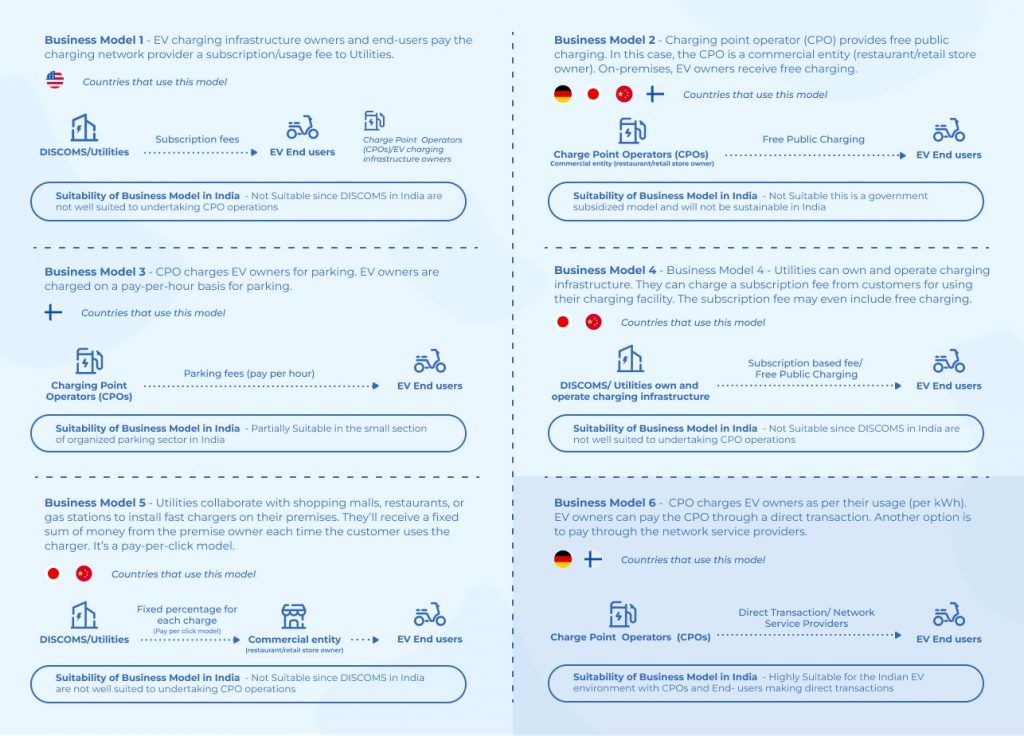
    Many new business models around charging have also started to emerge across the globe. Below, we take a look at some of the most common of these business models. We’ll also see how applicable they are to India.

    6 Business Model Examples

    Below are the 6 most common EV charging business models found across the globe.
    Graph-Option-2-1024x736.jpg

    6 different models for EV charging infrastructure.

    Slow chargers aren’t highly cost-intensive per unit. However, the volumes of slow chargers needed in India are extremely high since India has a large share of 2- and 3-wheeled EVs. Additionally, fast chargers can require a much higher initial capital cost to deploy, almost 10 to 100 times that of slow chargers. This means that making charging stations profitable would require a strategic approach. That’s especially true in emerging economies where consumers are also highly cost-conscious.

    The involved cost structures are also high. Distribution companies (DISCOMs) in India aren’t currently ready for the EV transition yet. That means the ideal solution for India is to adopt Germany and Finland’s business models. India should promote a marketplace model where CPOs and EV users make direct transactions.

    2. Quantifying Charging Needs for a City 

    Next, India will have to consider the actual execution of charger deployment. Historically speaking, EV charging infrastructure around the world is expanding outward from Tier 1 cities. Thus, to plan EV charging infrastructure deployment, a necessary step is to define and quantify the following key criteria:

    Charging Loads to the Existing Electricity Infrastructure

    As the number of EVs on the road grows, the load on the electrical grid will also increase. Planning authorities need to understand this data, then execute grid balancing operations accordingly.

    EV End-User Battery Charging Patterns and Behaviors 

    EV charging patterns will vary drastically from petrol/gas stations. Most EV users will charge their vehicles at home or at work. This means the charging behavior of users is also critical to understand. Utilities should know when they’ll face higher loads from EV charging depending on the time of day, geographical location, and so on. India needs to identify the peak EV load demands at each time of the day. Then, this will help offset any grid failures.

    Slow and Fast Chargers in Different Locations

    India specifically requires fast charging along highway routes. The country also needs a dense network of slow chargers in more populated areas. Fast chargers placed strategically within city limits will be a valuable add-on. However, this wouldn’t restrict EV adoption largely if unavailable immediately. India needs to identify the most optimized charger placement. To do this, the country should consider charger types, numbers needed, and user behavior. This will also be critical to meeting charging demand.

    The Need for EV Chargers Will Increase Soon

    City-level planning authorities need to consider the fact that the ‘ubiquity of chargers’ can solve many issues. That includes charger availability, charger malfunctions, and so on. One good metric to understand these needs is the predicted total number of chargers needed in a year. Similarly, the country will need to consider the year-on-year increase in peak EV loads. This will help predict the number of chargers needed as the EV market in India grows.

    Updates to the Electricity Grid To Handle Future Loads

    The EV market is fairly new to India. Yet, by 2030, the peak loads could be far larger than what the current electricity grid infrastructure can support. Additionally, any investment into renewable energy-based charging solutions might also warrant a similar infrastructure upgrade. Thus, the country needs city-level grid planning. Investments should also be based on EV adoption throughout the year. This will all be critical to understanding the costs involved now and in the future.

    City-level planning will aid in the efficient execution of charging infrastructure deployment. However, decision-makers need to look into some additional considerations, specifically around Indian consumer behaviors. Many aspects of the Indian EV ecosystem need to be carefully crafted around these consumer patterns. In the next section, we take a more detailed look at these behaviors. We’ll also see how they impact charging infrastructure deployment.

    3. The Indian EV Consumer

    Many Indian consumers are interested in and willing to buy EVs. Namely, their motivation is to battle climate change. Likewise, the same consumers have technological adoption concerns. As a result, they’re reluctant to transition to EVs. Below are some key considerations that help potential EV customers in India adopt this technology:

    Indian Automobile Consumers Care About Initial/Running Costs

    Indian automobile consumers are extremely conscious of the initial cost of entry. They also care about running costs. OEMs manufacturing EVs locally can gain subsidies, which can help lower the customer’s total ownership costs. On the charging side, consumers are likely to prefer slow chargers. They’re also incentivized to opt-in for any subsidies available on electricity tariffs.

    2- And 3-Wheeled EVs Are Well-suited for Indian Roads

    EVs are generally well-suited to Indian driving conditions. Within the 2- and 3-wheeled EV segments, the switch to EVs is growing. These vehicle types have smaller battery capacities and they’re suited for slow charging standards. As a result, 2- and 3-wheelers are likely to demand charging infrastructure first.

    Lacking Awareness of Consumers

    Potential EV customers in India still lack a certain level of awareness. They don’t know about range anxiety, battery life, and charging availability. Customers won’t face these issues with value-added services. They could get route planning options and real-time information on charge point locations and charging costs. However, this will require a comprehensive educational initiative across government and media to help ease the transition to new technology.

    Simple Payment Management Systems

    EV Charging also needs a simple and easy-to-use payment system integrated with a charger management system. These should also track and document all direct transactions between charging point owners and EV users. Additionally, with several EV charger plug types currently in use), charging point operators should also focus on compatibility. This will help cater to a wider variety of vehicle types.

    Now that we’ve seen the 3 factors to consider before rolling out an EV charging infrastructure in India, let’s dive into our recommendations.

    Recommendations

    After discussing these strategic considerations, we at BOLT also have some further recommendations for EV charging infrastructure. We’ve separated them into 4 categories:

    1. The Government Needs To:

    • Develop a comprehensive strategy for nationwide public EV Charging infrastructure deployment
    • Refine regulations around electricity distribution for EV charging 
    • Align private and public EV ecosystem players towards India’s unique needs arising from the higher population density and relatively smaller average distances traveled by commuters daily
    • Clarify the long-term role of state-owned utilities and DISCOMs in setting up EV charging infrastructure
    • Specify regulations around grid services and vehicle-grid integration
    • Address citizens’ concerns about range anxiety and EV charging infrastructure issues
    • Inform citizens about the environmental and cost benefits of transitioning to EVs

    2. The EV Industry and Ecosystem Needs To:

    • Address the immediate need for 2- and 3-Wheeler EVs and the consequently required charging infrastructure, with a safe and connected experience 
    • Deploy and maintain large charging point networks and cater to the demand for chargers up to 2030 and beyond (for CPOs)
    • Educate citizens about range anxiety and EV charging infrastructure issues and about the benefits of transitioning to EVs

    3. The DISCOMs Need To:

    • Develop programs with CPOs/MSPs that encourage customers to notify DISCOMs when they register a new EV or buy an automated charging point for public use
    • Offer incentives for charging systems with some automated control capabilities to gain network visibility into EV charging demands
    • Offer the right signals to the user, enabling them to choose the best charging option that includes time-of-use or location-based price signals to manage grid loads effectively
    • Educate citizens on incentives and subsidies for EVs and EV charging 

    4. The Media Needs To:

    • Highlight the right educational stories around alleviating concerns among EV users about range anxiety, charger availability, cost of ownership, and so on
    • Assist in democratizing information about the technology transition to EVs, the new charging paradigm, and the benefits of making this switch

    When the citizens are well-informed, it’ll be easy to convince them to transition to EVs. In turn, the market will also benefit from the booming EV charging infrastructure. Then, India will be at the forefront of the ongoing global transition to clean transport.

    To Summarize

    In this final part of our 3-part EV charging infrastructure series, we’ve discussed our recommendations for EV charging infrastructure deployment. We’ve also showcased the necessary factors the city supervisory body should consider in implementing the EV charging infrastructure. This third installation has also outlined BOLT’s recommendations to bolster EV charging infrastructure growth. We hope the government, industry, DISCOMs, and other related parties consider our findings. Adhering to an optimized plan will surely help India reach its EV30@30 pledge.

    In all, we’ve been able to address all the risks and summarize all the opportunities that will come from the EV transition. Our mission at BOLT is to ensure the proper growth of India’s EV charging infrastructure. To that end, we hope our market analysis has brought enough awareness to India’s EV users and governmental officials.

    FAQ

    What should the Indian government do to support the EV charging infrastructure?

    The government should inform citizens about the potential issues in the country’s EV infrastructure. It should also showcase the health and cost benefits of adopting EVs. That’ll enable citizens to head towards EVs, which also creates EV charging infrastructure opportunities.

    What are some business models in the EV charging marketplace?

    Some stores may offer free charging, and it increases attraction to their business. Other companies may also adopt a subscription fee model where the owners and end-users pay the provider a fee. In all, these business models can support a country’s EV charging infrastructure growth.

    What are some opportunities for the EV charging infrastructure?

    As India’s EV charging infrastructure grows, it’ll create many opportunities in the market. For example, data analytic businesses can emerge to assist CPOs and DISCOMs. Solar energy-powered stations can also pop up to support the EV charging infrastructure. Contact BOLT to learn more about the best EV charging infrastructure solutions.

    What are some risks in the EV sector?

    The EV charging infrastructure in India may face many risks. For example, there may be reduced revenue from the fossil fuel tax. 25% of the central government’s revenue comes from this tax. The EV charging infrastructure also lacks regulations and clarity. This makes cross-platform usage hard to achieve.

    What EV type is prominent in the Indian market as of 2022?

    2- and 3-wheeler EVs lead the Indian market in sales volumes (34% for 2-wheelers and 33% for 3-wheelers). These EVs need smaller battery capacity and can use standard AC outlets to charge. These EVs also help lower carbon emissions, so they’re better for the environment. Finally, 2 and 3-wheeler EVs have lower running costs.

    Resources

    BOLT: Part 1: EV Charging Infrastructure 

    Discover our assessment of India’s EV charging infrastructure.

    BOLT: Part 2: EV Charging Infrastructure

    Learn about the business opportunities and risks for India’s EV charging infrastructure.

    BOLT: Our Partners

    Find out who’s supporting BOLT in developing India’s EV charging infrastructure.

    BOLT: BOLT OS

    Get the best EV charging network app.

    BOLT: Guide to Install a Home EV Charger

    Learn how you can install a home EV charger from BOLT.
  • Part 2: Developing Electric Vehicle Charging Infrastructure in India–Business Opportunities and Risks

    Part 2: Developing Electric Vehicle Charging Infrastructure in India–Business Opportunities and Risks

    Recently, the Indian government has focused on following a uniform strategy for its EV charging infrastructure. They also aim to bolster EV adoption in the country. Bolt.Earth operates the world’s largest EV charging network and marketplace. We also currently occupy a 50% market share of India’s EV charging network with the chargers we deployed. As such, we want to become the default EV charging solution for EV users across India.

    The first part of this series was a market analysis of the current Indian EV charging infrastructure. This part will focus on the EV transition in India. First, we’ll show the opportunities it creates for the country’s industry and society. Then, we’ll also discuss some risks associated with this surge.

    Let’s delve into India’s 3 prime opportunities with its growing EV charging infrastructure.

    3 Opportunities for India in Deploying EV Charging Infrastructure

    1. Tier 1 and Tier 2 Indian Cities May Not Need Large Scale Public Charging Infrastructure

    According to the International Energy Agency (IEA), almost 90% of the existing EV charging points are private slow chargers. This isn’t surprising, considering EV user charging patterns. In fact, 80% of all EV charging is done at homes and workplaces. There, vehicles spend most of their time parked.

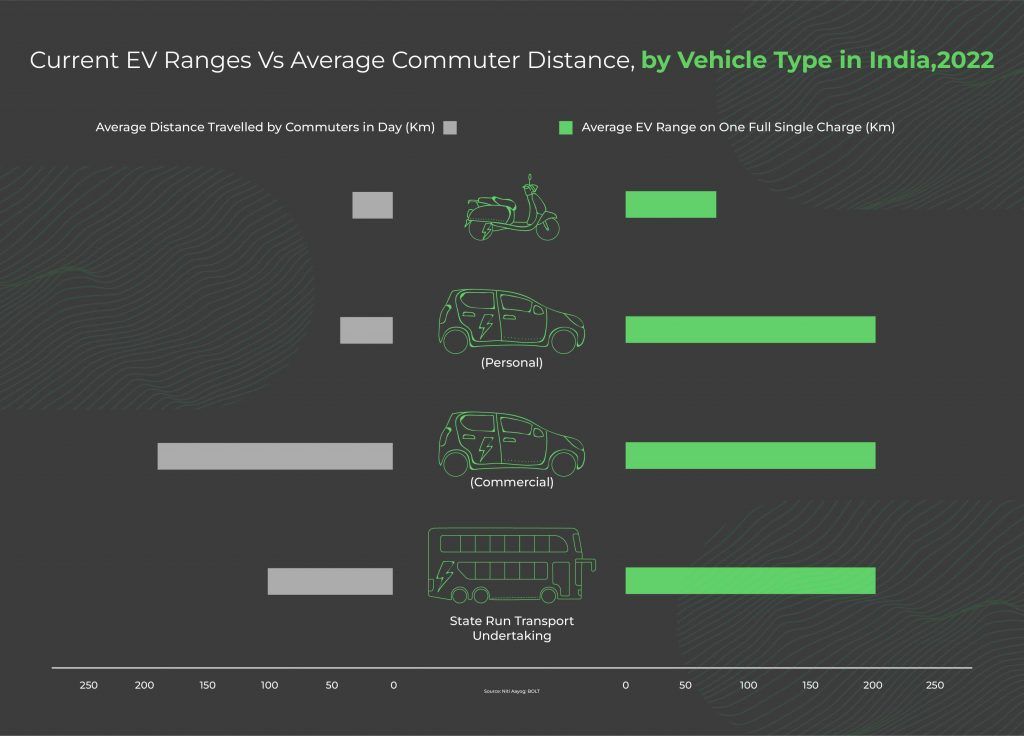
    The NITI Aayog vice-chairman also states that the current EV battery capacity is much higher than the average distance traveled in a day within the city.

    Graph-11-1024x736.jpg

    Current EV Vehicle ranges in India are comfortably larger than the average distances traveled by commuters across the board.

    This all means most EV owners won’t use public EV charging points much. That said, private and commercial EVs may need them periodically. That’s especially if they travel longer ranges. India also won’t need large government investment in EV charging infrastructure. Most EV charging stations would be privately owned. That means India only needs enough public charging sites to manage the demand for long-range EV transportation.

    unified approach to charging infrastructure needs to occur. Otherwise, the infrastructure won’t be adopted and utilized by commercial enterprises. It wouldn’t make sense to roll out EV charging for commercial vehicles by district. That’s because long-range vehicles would need nationwide coverage. Instead, a nationwide approach should expand infrastructure with a focus on motorways. Then, the infrastructure should propagate to lesser-used commercial routes.

    Key Take-Aways

    • Indian cities can become EV-ready. They simply need a few thousand strategically-placed universal EV charging stations.
    • Public EV charging infrastructure will still have low usage until EVs reach a tipping point because most EV charging happens at home.

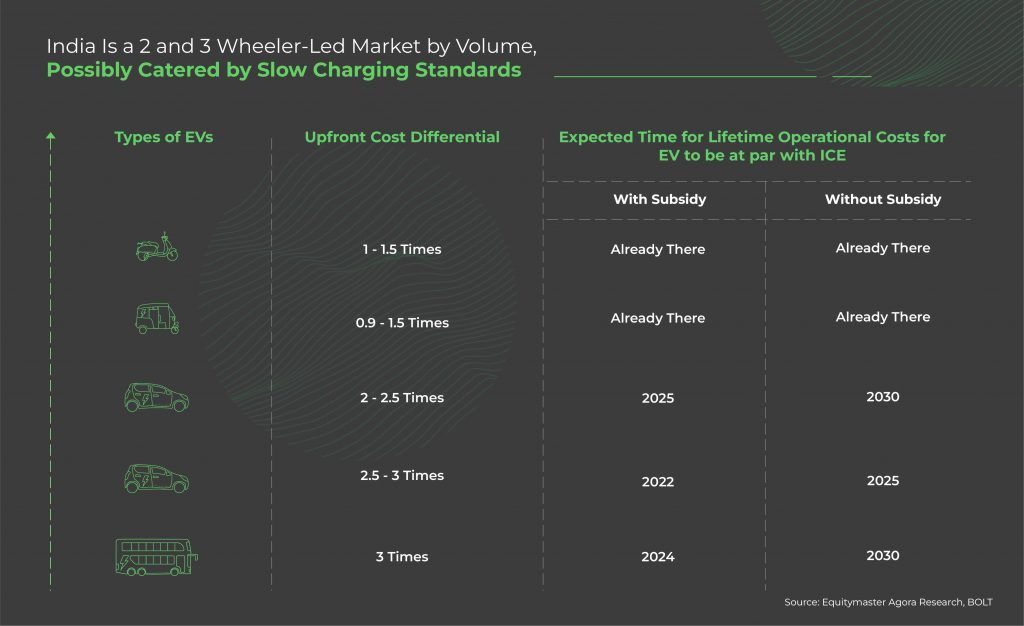
    2. India is a 2- and 3-wheeler-led market by volume, possibly catered by slow charging standards

    Graph-22-1024x626.jpg
    Two and Three-Wheelers are taking over the Indian EV market.

    >Today, the upfront initial capital costs for EVs are generally larger than Internal combustion engine-based vehicles. However, 2- and 3-wheeler EVs have already reached price parity in India.

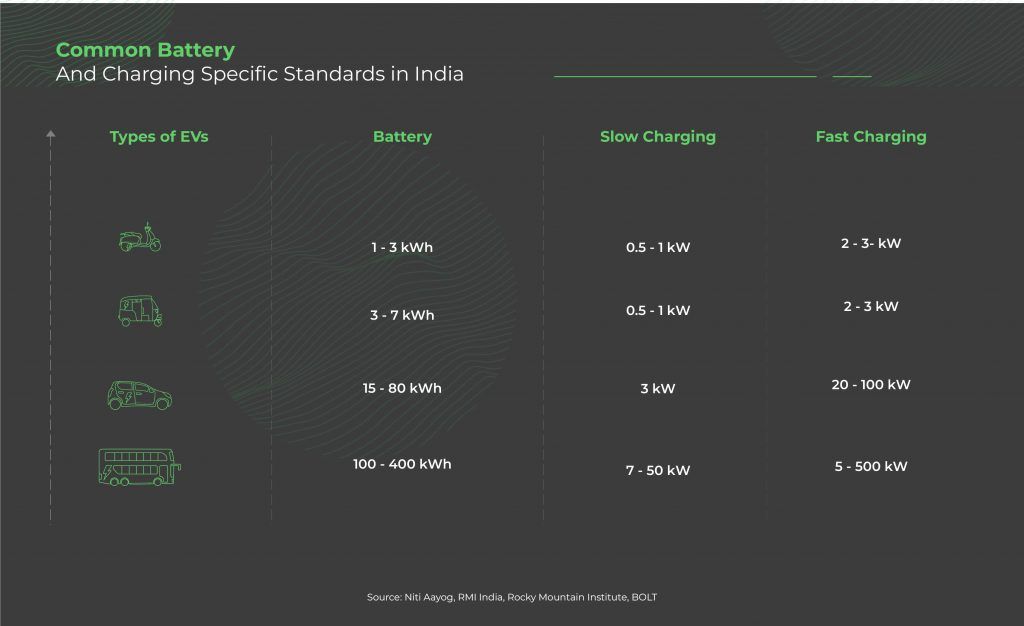
    As of July 2021, 2-wheel (2W) and 3-wheel (3W) EVs accounted for 98% of the current Indian EV sales. These segments require only smaller battery capacities. That means most EVs in this sector can use a standard AC outlet to charge.

    CPOs especially have a significant opportunity here. They could develop a holistic network of smart and connected slow charging points. This segment can also use IoT-enabled EV charging! This advancement won’t need expensive EV charging infrastructure upgrades. It also doesn’t require significant regulatory or market reforms.

    Electricity distribution companies (DISCOMs) need help with demand planning. To achieve that, we need a foundational smart charging point-based layer. It’ll then grant extreme network visibility into EV charging trends.

    Key Take-Aways

    • In India, the electrification case particularly suits the 2- and 3-wheeler segments, and it’s very robust. That means it’ll see rapid growth.
    • The first EV charging network generation can happen in India without new charging technology. It’s possible through a peer-to-peer free-market and a consumer-driven charging marketplace setup.

    3. Improved Grid Management Requires New Data and Analytics Businesses

    Graph-33-1024x728.jpg

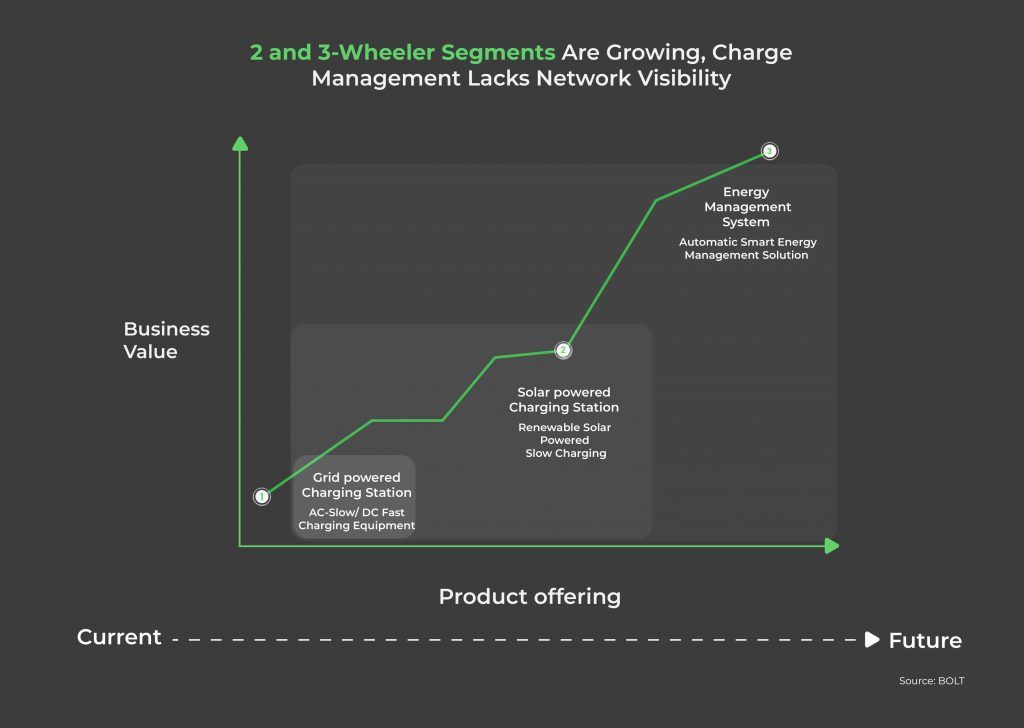
    Grid-powered stations, Solar charging stations, and energy management systems are all emerging businesses.

    Today, most EV charging infrastructure players focus on powering EV charging stations with the existing electricity infrastructure. However, we might see a shift towards renewable energy-powered charging stations soon. Eventually, the EV charging infrastructure will also move towards end-to-end energy distribution and management solutions for EV charging.

    In this eventuality, CPOs that operate large public EV charging infrastructures will want to make charging patterns more visible. They’ll also need to visualize the long-term peak demand trends.

    DISCOMs will also need to suggest the right pricing signals to EV customers. That way, they can optimize grid balancing efforts. EV charging, as a commodity, should operate on a decentralized free-market model. In turn, it’ll facilitate load management and grid balancing through pricing economics. DISCOMs will also gain visibility from CPOs. This means DISCOMs can ensure that supply-demand economics will act as checks and balances for peak load challenges in the long run.

    Key Take-Aways

    • EV charging points will evolve, moving away from simple grid-connected charging points. Instead, they’ll become smart, connected charging networks optimized for energy management.
    • A robust EV charging infrastructure market in India will provide many opportunities. For example, it’ll enable revenue augmentation for DISCOMS and distribution network upgrades. It’ll also encourage private companies and start-ups to set up a reliable charging point network.

    Since we’ve discussed the opportunities, we can now move on to see the risks. Most notably, we can count 3 risks in the EV charging infrastructure in India.

    3 Risks for India in Deploying EV Charging Infrastructure

    1. 2 and 3-Wheeler Segments Are Growing, Charge Management Lacks Network Visibility

    In this section, we’ll take a look at 3 risks that may impact the nationwide growth of EV charging infrastructure in India. As we’ve discussed above, most risks will not fall on the majority of EV users. Rather, they will impact commercial usage. For many companies, their success depends on range, reach, and fast charging. To assess the risks involved, we’ve split up EVs by vehicle type. In turn, this will reflect their use case.

    Graph-44-1024x626.jpg

    Learn the consumer trends, dominate the market.

    By 2030, India’s 2-wheeler segment electrification is expected to grow rapidly. It’ll also be a leading market segment.

    EV drivers can charge their new EVs using a standard Indian AC outlet. That means DISCOMs may not know where EV demand rises from. The lack of smart and connected IoT-based charging points will also pose a risk for DISCOMs. They’ll operate without consumer trend visibility.

    The additional electric load on the nation’s grid won’t cause any challenges. In fact, electricity shortage isn’t an issue for mass EV adoption. This is only a myth. According to BloombergNEF, electrifying all road transport will only add 25% to global electricity demand by 2050. Electricity generation in India as of March 2022 is 448.11 GW. Yet, the country uses only 180 GW at present. Assuming constant population growth and demand, India can already support a nationwide EV charging network.

    Key Take-Aways

    • Standard outlets are found anywhere in India, which can facilitate charging. Yet, a huge segment of the EV population could be adding battery charging loads. DISCOMs won’t be aware of these patterns. As a result, they may fail to implement proper demand planning.
    • The lack of a connected charging network could lead to serious grid stability issues as EV usage grows. Vehicle-Grid Integration solutions will also be a critical risk if left unresolved. For example, we can mention the EV charging management solutions that mitigate the negative impacts of uncontrolled EV charging on the power system.
    • India already generates enough electrical energy to support a nationwide EV charging network and cater for future population requirements.

    2. EV Ecosystem Management Lack Regulatory Clarity

    India’s regulations lack provisions for EVs, specifically the principles or implementation models for resource utilization. In turn, companies that want to provide grid services and vehicle grid integration are facing a major barrier to implementation.

    India also doesn’t clarify the long-term role of state-owned utilities that are working to deploy EV charging stations. This lack of clarity poses an issue.

    Key Take-Aways

    • Policymakers haven’t clearly defined the long-term role of state-owned utilities. They also didn’t address the evolution of EV charging tariffs.
    • Policy provisions are lacking for ethical user data handling and privacy.
    • Cross-platform usage is hard to achieve with the unclear strategy of registration for charging usage.

    3. Revenue for Governments from Fuel Taxes Will Likely  Reduce

    In the long run, EV adoption will replace oil products with electricity. This will impact government taxation. In turn, it may impact EV incentives. This may also elevate the road tax to compensate. In addition, the revenue from EV charging and usage may not fully offset the revenues from the fossil fuel tax. The net tax loss is also due to EVs being more energy-efficient than traditional vehicles.

    Not all crude oil is fractionally distilled or used as automotive fuel. Even though EV growth will reduce dependency on crude oil, it won’t end it. This means the Indian government will still receive revenue from taxing trade on crude oil.

    Key Take-Aways

    • The EV market is evolving rapidly, but India isn’t suffering significantly from the net tax loss just yet.
    • Net fuel tax losses might also become extremely significant as EV uptake increases.
    • Governments will anticipate taxation changes while designing mechanisms that support EV deployment.

    Final Thoughts

    The Indian EV charging infrastructure is still developing. As a result, many opportunities can arise for the Indian commercial sector. First, India’s EV market won’t need extensive charging point installations. Second, the EV charging infrastructure won’t need further development to be fully functional. Finally, this evolution will create many business opportunities for DISCOMS.  

    That said, the EV charging infrastructure deployment isn’t without risk. Regulatory clarity is one of the largest challenges faced by India at present. In addition, the Indian government may lose revenue from future fossil fuel taxes. This may make EV adoption unappealing. That said, this loss may be balanced by an increase in road tax.

    Bolt.Earth supports India’s government in implementing a nationwide infrastructure. That way, we support EV adoption. Here at BOLT, we’re keen to see how state officials implement public EV charging infrastructure. As the largest market share (50%) EV charging network supplier, our offering goes beyond charging hardware. We provide a whole charging solution. In future activities, we hope to work hand-in-hand to roll out a total charging solution. We will help private and commercial transport users get where they need to go.

    Blog CTA Banner

    FAQs

    What are the challenges to owning an EV in India?

    EV owners face many challenges. For example, you may lack mechanical service options. You may also notice a lack of standardization in connector types and parking spots. Finally, you may even worry about a lack of EV charging infrastructure for long-range travel. Here at Bolt.Earth, we aim to support the EV surge in the country.

    What are the EV benefits in India?

    EVs reduce noise pollution and carbon emissions. EV maintenance and running costs are also lower than ICE vehicle costs. Lastly, with a proper EV charging infrastructure, EVs are very convenient to charge. Contact Bolt.Earth to learn more about the best EV charging solutions in India.

    What are some business opportunities in the EV sector?

    The EV boom can pave the way for many innovative, useful businesses. For example, it can promote a battery swapping and recycling industry. We can also see a rise in EV parts manufacturing. It’s also possible to see solar EV charging mechanisms. The EV charging infrastructure is bright, and Bolt.Earth is growing these opportunities.

    Why should India use electric cars?

    To achieve Net Zero Emissions, India needs a revolution in the transportation system. One way to achieve that is through EV adoption. EVs play a very important role in reducing emissions and saving on fossil fuels. That’s why India needs to improve the EV charging infrastructure to facilitate EV adoption in the long run.

    Does India have EV charging stations?

    Yes! Currently, India has 1,640+ operational public charging points for EVs. That’s not counting the private ones installed in homes. Overall, India’s EV charging infrastructure will grow as EV adoption increases. As a result, EV users will have less range anxiety.

  • Part 1: Assessment of India’s Current Electric Vehicle (EV) Charging Infrastructure

    Part 1: Assessment of India’s Current Electric Vehicle (EV) Charging Infrastructure

    Explore the rapidly growing EV charging market in India

    Since the beginning of 2020, the electric and connected car market has drawn more than $100 billion in investment globally. Over the past two years, India has also witnessed a rapid increase in the market penetration of Electric Vehicles (EVs) and EV charging points.

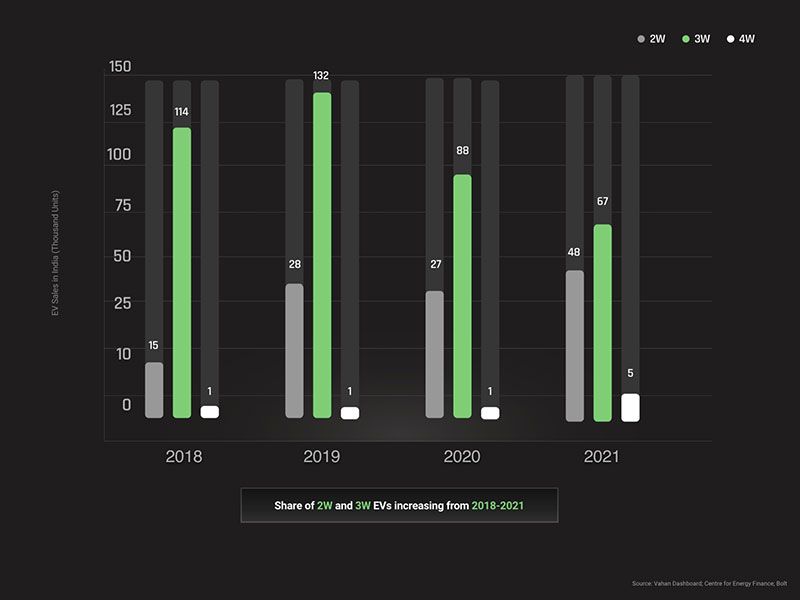
    In the past four months alone, electric charging stations in India have increased by more than two-and-half times. The Council on Energy, Environment, and Water (CEEW) claims that the Indian EV industry will be worth $206 billion by 2030 if India meets its Clean Energy Ministerial (CEM) EV30@30 pledge. The CEM is a global forum that is currently trying to get all governments to help facilitate at least 30% of all automotive sales to be EV by 2030. This pledge isn’t legally binding, but provides a useful target for governments to align with. That said, it appears to be more than achievable in India based on current infrastructural growth rates, as seen in the figure below, led by 2 Wheeler and 3 Wheeler EV sales.

    prva-slika.jpg
    EV sales in India are looking good even throughout the pandemic.

    The Indian government is currently focusing on developing a long-term strategic plan for electric vehicle adoption in India. In general, it’s planning to set up a vast array of charging points throughout India by investing in infrastructure improvements. If you didn’t know already, BOLT is already the largest EV infrastructure solution provider in India. This means we’re very excited by India’s EV adoption plans. To this end, we at BOLT decided to conduct our own market analysis and report findings here. We hope that this information will help illuminate what key requirements the Indian Government, startups, and the EV community need to consider, to set up a nationwide EV charging infrastructure.

    What To Expect in This Article

    In this article, we present what the current EV charging infrastructure looks like in India.

    In addition, we also present you with the growth potential of India’s EV transition up until 2030. Our analysis here will clarify the opportunities the EV transition presents to the Indian industrial sector and society, and we can also give strategic recommendations to the Indian government and community leaders.

    This article is the first in a three-part series where we analyze the market and specifically focus on EV charging infrastructure in India. Let’s initially take a look at BOLT and why we’re a leading authority in the EV infrastructure marketplace.

    Why Choose Bolt.Earth?

    Bolt.Earth is a venture-backed Electric Vehicle (EV) Ecosystem hardware and software business. We also operate the world’s largest peer-to-peer EV charging network and marketplace. Powered by the expansive Bolt.Earth Charging Network, we’re focused on creating a safe, smart, and connected ecosystem for EV users worldwide. In doing so, we aim to make range anxiety a thing of the past.

    Bolt.Earth’s clients and partners include EV OEMs like Hero Electric, TVS, Bosch, Okinawa, BattRE, Zypp, and Sun Mobility. We also work with infrastructure management players, like MyGate, Park+, and more. BOLT has already installed 10,000+ EV charging points worldwide, and we’re on track to deploy 100,000+ more in the next 6 months. We’re also hoping to install 250,000 charging points across India within the next year.

    >As an ecosystem player with B2B clients on the EV OEM side and B2C clients on the charging infrastructure side, Bolt.Earth is perfectly positioned to leverage a network of information nodes that represent the state of the market today.

    Read on as we give you an overview of India’s EV ecosystem in the following section.

    Blog CTA Banner

    An Overview of India’s EV Ecosystem

    In 2021, India’s EV growth was 168% up on its previous year, with 122607 EV units. Leading analysts expect this growth to continue throughout 2022 and also continue at an accelerated pace. In this section, we’ll take a look at infrastructure and future growth predictions.

    EV and EV Charging Infrastructure in India: Future Adoption Predictions

    Take a look at these: 

    3 predictions for the growth of the EV market in India:

    • The Society of Manufacturers of Electric Vehicles (SMEV) predicts India will hit the 1 million sales mark for EVs by the end of 2022 (based on current sales trends).
    • The India Energy Storage Alliance (IESA) expects the EV market to hit 6.34 million annual unit sales by 2027.
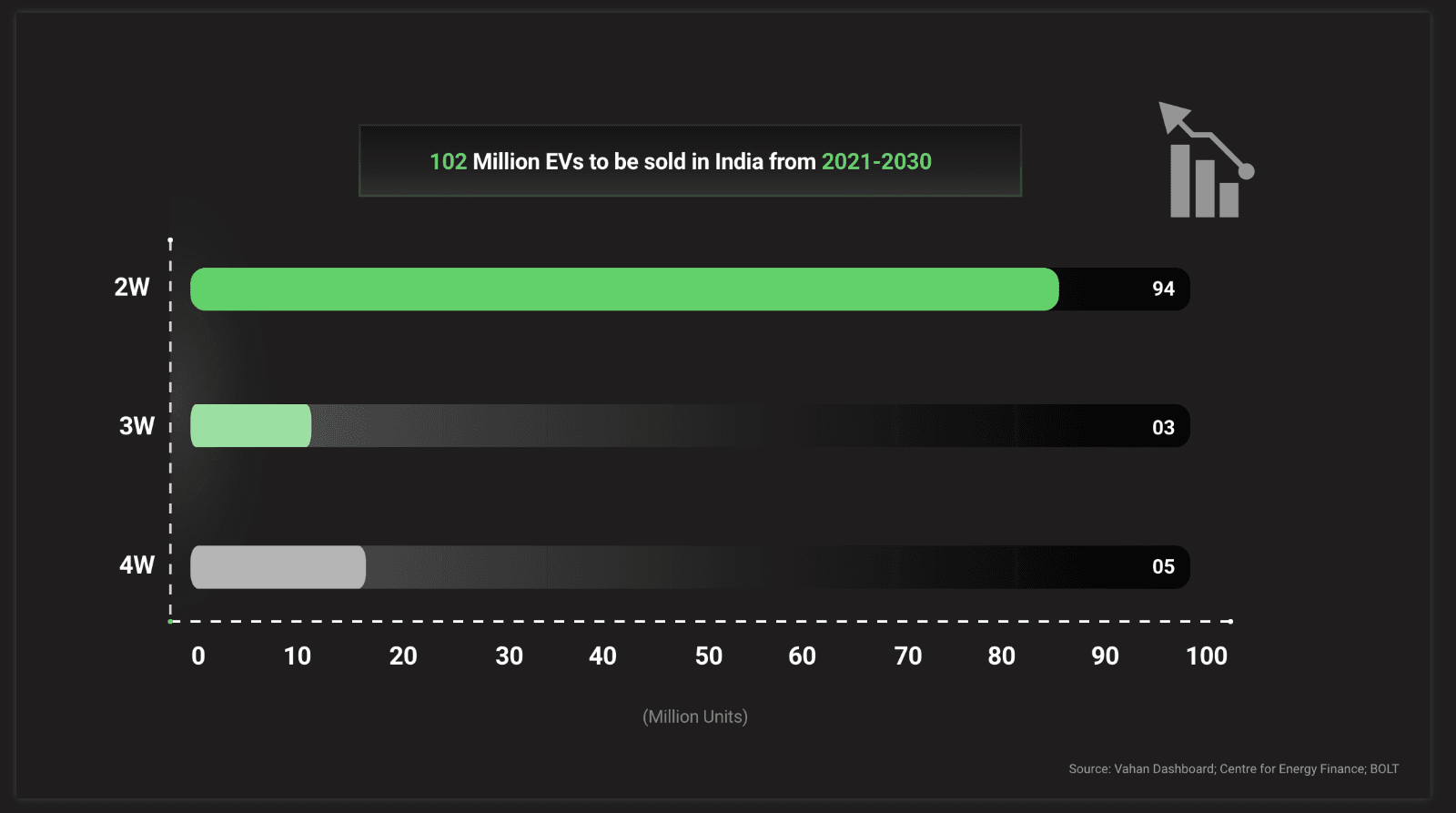
    • The Council on Energy, Environment, and Water (CEEW) and Center for Energy Finance report that the cumulative EV sales in India from 2021 to 2030 will be around 102 million units.

    2.png

    Estimated EV sales in India between 2021-2030.

    Our Assessment

    The above projections all have an underlying theme: India is seeing a strong push toward transitioning to EV-based mobility. That, in effect, will bring a host of radical changes in the way India’s citizens move around.

    Many factors are driving this growth in EV sales, indicating the Indian EV market is nearing an inflection point. EVs are expected to penetrate the different vehicle categories with varying adoption rates. Overall, the 2W EV and 3W EV markets will see rapid electrification in the near future. Rapid growth in 4W EV markets will likely begin between 2026 and 2027.

    Key Findings

    Given the new EV influx in the Indian automobile market, we’ll need an adequate EV charging infrastructure network. It isn’t hard to see how these two events are closely linked. Currently, the infrastructure may be the biggest barrier to EV transition in India.

    India’s EV Charging Infrastructure Market

    The EV charging infrastructure network in India is evolving. Several private, startups, and government entities are currently engaged in developing deployment strategies. Take a look at these examples.

    • In January 2020, the DHI approved setting up 2,636 EV charging stations across 62 cities in 24 states and union territories (UTs) of India. These include 1,633 fast-charging stations and 1,003 slow-charging stations. The Ministry of Heavy Industries (MHI) also sanctioned 241 additional charging stations in September 2020.
    • By 2030, the Bureau of Energy Efficiency (BEE) predicts that 2.26 Million charging points will be required in Delhi, 0.62 Million charging points in Lucknow, and 0.26 Million charging points in Nagpur.

    The key market players are a good mix of government-backed entities and private companies. They’re also looking to grow their installed base capacities to make several Indian cities ‘EV-Ready’ in terms of charging infrastructure deployments next year.

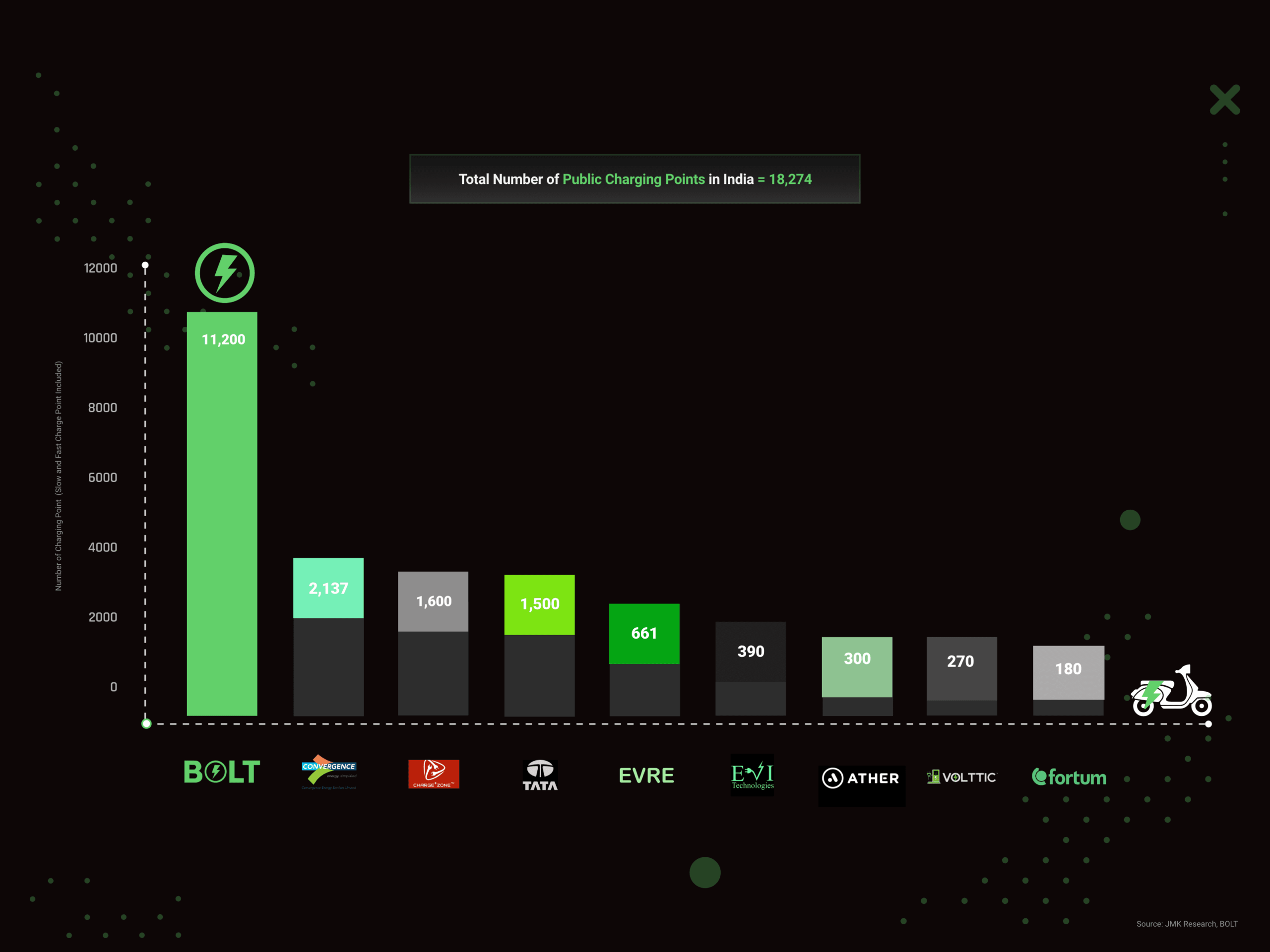
    Total number of current public charging points in India by vendor.

    Our Assessment

    Private home EV charging is also expected to dominate the market by 2030 in both numbers and capacity, given the sheer volume of 2-wheeled and 3-wheeled vehicles in India. The Private EV charging at-work segment will also need chargers. Until 2030, slow chargers will dominate the public charging infrastructure, but public fast chargers will also see a significant uptick.

    We’re already moving towards a trend of total disruption in India, which will see Charge Point Operators (CPOs) adapt to the evolving market changes. CPOs’ hesitancy to invest in new ideas and technologies or engage in major collaborations or acquisitions will also fail to capture key market positions.

    Key Finding

    The EV sector in India will expect access to an efficient charging infrastructure. CPOs need to prepare for a disruptive change in mobility. The Indian EV market is still in the development stage, but the market is heading toward making charging a commodity, just like oil or gas. In other words, the phrase: ‘electricity is the new fuel’ is gaining more merit.

    Additional Opportunities in Charging

    • Network Visibility in Charging: IoT-enabled platforms can make EV charging electricity lines smart by offering information on the infrastructure, location, availability, and real-time status.
    • Ease of use of charging infrastructure: Payment methods and charging initialization is crucial in allowing EV users to transition.
    • Data and Analytics: Geospatial data, network visibility, traffic density, and charging demand are also necessary to support a strategic deployment of a charging infrastructure across a city.
    • Smart Charging Points: Smart, connected, IoT-enabled charging points that allow for monitoring of EV charging will develop as the surviving business model grows. The idea of creating separate electricity lines for EVs in India at all locations might not be feasible, given the costs and complexity involved.
    • Alternative charging technologies: Alternative charging methods, like inductive charging, might find a market in India to solve space availability and cabling issues.

    The Value Chain of the Indian EV Ecosystem

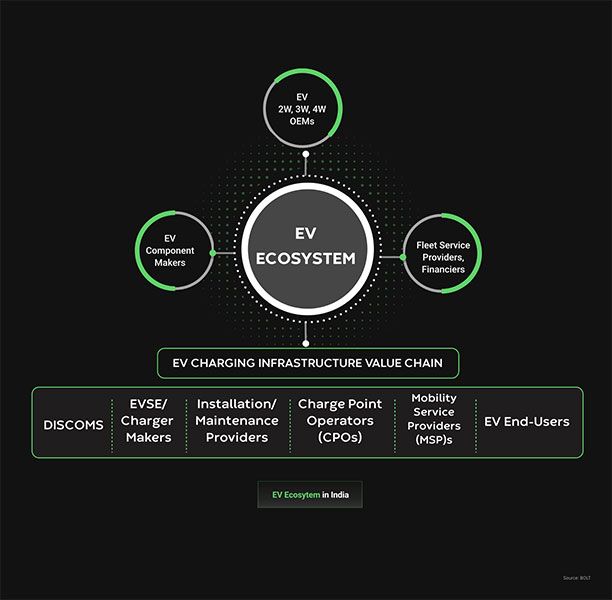
    In terms of a public EV charging infrastructure, the value chain has had a few specific roles. Let’s take a look at 6 of these:

    cetri.jpg

    EV ecosystems provide an integrated approach to EV charging.

    • Energy Suppliers and Distribution Companies (DISCOMs): Responsible for the supply of electricity at regulated tariffs for consumption by electric vehicles. DISCOMs need to understand where and when they’re facing peak demands to operate efficiently.
    • EVSE and EV Charging Point Manufacturer: The charging equipment manufacturers who design, develop, and sell their own charging points or EVSE.
    • Installation and Maintenance Providers: Responsible for the installation of chargers at locations desired by charging point real estate providers and ensuring device maintenance over time.
    • Charge Point Operators (CPOs): Responsible for setting up, managing, and operating an EV charging station network for semi-public or public use. CPOs may directly own the charging points or operate the chargers on behalf of the charging point owners.
    • Mobility Service Providers (MSPs): Responsible for helping EV users locate and provide the user interfaces to conduct transactions at EV charging points. They also enable “roaming” for EV users subscribed to one CPO, and to use another CPO’s charging networks. CPOs may also sometimes act as MSPs.
    • EV End Users and Charging Point Real Estate Providers: Include both EV and EV charging station buyers.

    The Path Forward: Future EV Charging Trends in 2022

    The future evolution of the previously mentioned points will mean that value chain integration will force some segment absorption. Ultimately, only a few players across the chain will survive in the market. Who will it be? The ones that undergo continuous upgrades in their business models. On the end-user side, charging point real-estate providers will have to cope with increased peak loads. For example, we can think of providers like shopping centers, food courts, parking spaces, and apartment complexes. In this section, we define key EV charging trends that will influence the way India adopts EV technology.

    CPO and MSP Roles

    In BOLT’s opinion, the CPOs and MSPs form the more crucial part of this value chain. We also think they’re perfectly placed to expand across the entire value chain. What’s more, these entities are currently the most active players in the market, with a huge first-mover advantage. When CPOs reach a certain critical size and scale, MSPs will have a high incentive to collaborate with them.

    Conversely, CPOs will feel as if they’re battling to expand their charging networks. Smaller players will most likely become aggregated, even at this growing stage. That way, CPOs secure the more strategically attractive charging locations for their slow/fast-charging services.

    A small number of MSPs in India currently take up a significant chunk of the market share. Still, this trend will likely change rapidly as more players emerge over the next two years.

    EV Market: Future Trajectory and Advantages

    We expect the market to follow global trends and move towards ‘plug and charge’ standards. We also see these in the U.S., Europe, and Asia, where the standard automatically identifies what type of EV you’re plugging in and bills you accordingly. In market dynamics, this gives CPOs and MSPs closely tied to EV OEMs an added advantage. That’s because they’ll be able to choose to create a closed ecosystem of EV charging customers.

    >For CPOs, the EV Ecosystem is all about scaling up – it’s a winner-takes-all market dynamic. For MSPs, the key to success will depend on how well they expand their network and diversify their operations in collaboration with the largest CPOs.

    Final Thoughts

    As the world adopts EVs more and more, it’s important to develop a proper EV charging infrastructure. That’s also the case in India, where EV adoption is increasing. To us, it’s important to analyze the current infrastructure state. Otherwise, we can’t know where it’s headed in the future. Here at BOLT, we encourage the Indian government to take action. We also encourage it to benefit from the many potential advantages of improving the infrastructure. Indian citizens and the environment alike will benefit from a robust EV charging infrastructure.

    Blog CTA Banner

    FAQs

    How big is the Indian EV charging market in 2022?

    The Council on Energy, Environment, and Water (CEEW) and Center for Energy Finance (CEF) estimate around 1 million EVs will be sold in India before the end of 2022. In addition, sales are expected to increase and total around 102 million units sold before the end of 2030.


    Who are the top 5 market shareholders for EV charging networks in India?

    Based on recent data, around 18,274 public EV charging points have been deployed in India as of June 2022. These are currently in cities like Delhi, Mumbai, Hyderabad, and Pune. The top 5 EV charging providers operating these (by market cap) are Bolt.Earth, Energy Efficiency Services Limited (EESL), Rajasthan Electronics and Instruments Limited (REIL), Tata Power, and EVI Technologies.


    Who are the critical stakeholders in the EV charging value chain who will determine the future of EV charging in India?

    Charge Point Operators who operate vast charging point networks can help determine the future of EV charging in India. Additionally, Mobility Service Providers, who provide aggregated charging services, will also be responsible for the nationwide rollout of EV charging infrastructure in India.


    What’s the difference between slow and fast charging stations?

    The main difference is the availability and usage of these stations. For starters, slow charging is usually meant for private settings. Conversely, fast charging stations might be best suited for public charging found on national highways. Secondly, fast chargers are more ideal for EVs with higher battery capacity. Finally, fast stations are more efficient per time spent charging.


    Can I set up an EV charging station in India?

    The Indian government has announced that anyone can establish EV charging stations throughout the country. That said, the station needs to comply with the Indian government’s specifications. This relative freedom presents an excellent opportunity for the EV value chain in India to establish and operate efficient EV charging stations. Contact Bolt.Earth for more information about EV charging stations.