Category: EV Ecosystem

  • How Unified Bharat e-Charge (UBC) Benefits Every Stakeholder in the EV Ecosystem 

    How Unified Bharat e-Charge (UBC) Benefits Every Stakeholder in the EV Ecosystem 

    Unified Bharat e-Charge (UBC) is designed to create value across the entire EV charging ecosystem, from everyday drivers to charging operators, OEMs, fleets, and policymakers. 

    By replacing fragmented, app-based silos with an open, interoperable network, UBC simplifies access, improves infrastructure utilization, and aligns public and private incentives. Below, we explore how each stakeholder benefits and why UBC could become a foundational layer for India’s EV growth.

    Who Benefits from Unified Bharat e-Charge (UBC)?

    EV Users 

    For drivers and fleet operators, UBC delivers a dramatically simpler and more reliable experience. Instead of juggling multiple subscriptions or apps, users gain one-touch access to any charger in the network. Imagine using the EV’s built-in navigation to find and book charging just as easily as locating a fuel station on Google Maps. 

    User benefits include: 

    • Seamless Discovery: All chargers appear on the same interface, with real-time availability. No need to remember different apps’ credentials. 
    • Guaranteed Reservation: Users can reserve slots in advance, reducing range anxiety on busy highways. 
    • Transparent Pricing: Rates are displayed across operators, enabling cost-effective or greener choices. 
    • Unified Wallets: Payments flow through familiar channels like Paytm or UPI, using existing wallets for charging credit. 
    • Data Privacy & Control: UBC shares data only on demand, giving users control over what is shared and avoiding constant location tracking. 

    In practice, this means less time spent managing apps and greater confidence that a charger will work. The EVreporter team aptly described that UBC acts as a “universal translator” in the EV ecosystem, making charging “smarter and smoother” for the consumer. By democratizing access, UBC also drives down prices and improves service quality, since operators compete fairly for every user’s business. This is particularly important for public EV charging networks, where seamless interoperability ensures users can rely on consistent service across providers.

    Charging Point Operators (CPOs) 

    CPOs, both public and private, stand to gain from UBC too.  While openness may seem counterintuitive, it actually strengthens their business.  Key benefits for CPOs include: 

    • Wider Customer Reach: Even small or new CPOs can immediately access broader user bases. A charging station that might otherwise remain buried on a niche app becomes visible on platforms like Google or Paytm.  Official guidelines note that smaller CPOs “can onboard with UEI (Unified Energy Interface) at significantly lower costs” and reach wider markets without heavy marketing spends. 
    • Higher Utilization: With all users searching the same network, stations achieve higher fill rates, accelerating the payback period. In one early deployment, thousands of chargers became available overnight once they were Beckn-enabled. 
    • Non-Disruptive Integration: Existing business models (subscription networks, local RFID passes, or proprietary apps) can continue alongside UBC. The open network simply adds a decentralized sales channel. 

    In essence, UBC opens new revenue streams for CPOs. Even operators who built their own apps can join UBC and instantly become discoverable across third-party platforms. Early adopters like Tata Power and Ionage have reported increased app downloads and session counts after integrating with the open network. This makes UBC a powerful enabler for every EV charging provider, ensuring they can compete fairly and expand visibility across the UBC EV charging network India is planning.

    Governments and Policymakers 

    For regulators and policymakers, UBC is a strategic enabler of national EV goals. India has set ambitious targets (EV30@30, Net-Zero by 2070) and rolled out schemes like FAME, NEMMP, and the PM E-Drive, all of which depend on robust charging infrastructure. UBC directly addresses one of the biggest infrastructure bottlenecks: interoperability. 

    By championing UBC, the government ensures that the taxpayer-funded chargers are utilized efficiently. A unified network means planners can aggregate usage data and spot underserved areas. Moreover, because the protocol is open and (largely) homegrown, it aligns with “Make in India” values and reduces dependency on proprietary foreign systems. 

    UBC also complements the government’s digital strategy. The PIB press release on PM E-Drive explicitly envisions a “unified digital super app” for EV users. UBC can serve as the backbone of that super app. The fact that BHEL (the nodal agency) is setting up an EV super app with features like slot booking and payments suggests UBC’s architecture could be integrated. Indeed, DST’s guidelines note that a pilot with the Central Government on UEI/UBC is already in progress. After this pilot, the APIs and registration flows will be published, indicating official endorsement. 

    Finally, UBC supports India’s climate and energy goals. Widespread EV adoption reduces oil imports and carbon emissions. The UBC network even facilitates green energy trading.  One demo showed how idle EV batteries and rooftop solar can be tapped through the same interface. By flattening transaction barriers, UBC encourages innovation like peer-to-peer energy exchange. The PM E-Drive release sums it up aptly: these infrastructure efforts will lay the groundwork for a net-zero mobility future. UBC is an integral piece of that groundwork, ensuring the EV charging network in India is smart, flexible, and inclusive. 

    OEMs and Fleet Operators 

    Automakers and fleet companies are major beneficiaries of UBC. The key benefits include: 

    Native integration: OEMs can embed Beckn-compliant functionality directly into the vehicle infotainment system, enabling drivers to access chargers without additional apps.  EVreporter  notes that a BAP “could be the app embedded in [the vehicle’s] UI”. For example, Tata or Mahindra EV owners could use their dashboards to find and pay for any charger, not just the OEM’s own network. This is a huge selling point, especially as more global brands (like Mercedes, Hyundai, etc.) enter the market with connected-car platforms. 

    Fleet Management: Fleets can uniformly provision charging across networks, leverage dynamic pricing (such as off-peak charging), and audit sessions across different CPOs seamlessly. This reduces complexity in operations and billing. 

    In short, by providing a single interoperable interface, UBC encourages OEMs and fleets to accelerate electrification, confident that drivers (and fleet schedulers) can access any available charger. It also incentivizes vehicle manufacturers to participate actively in the ecosystem, since their vehicles become native clients on the network. This interoperability ensures compatibility not only with UBC but also with global standards like the OCPI EV charging network, making Indian fleets future-ready.

    Frequently Asked Questions

    How does UBC improve the experience for EV users? 

    UBC enables EV users to discover, book, charge, and pay at any participating charger using a single app or interface, eliminating the need to install and manage multiple charging apps. 

    How do payments work for EV users under UBC? 

    Payments flow directly to operators via familiar channels like UPI or wallets without hidden fees or complex clearing systems. 

    Why is UBC good for Charging Point Operators (CPOs)? 

    UBC increases charger visibility, utilization, and revenue opportunities by making every station discoverable across multiple apps, without forcing exclusivity or expensive aggregator contracts. 

  • EV Charging Etiquette for Drivers 

    EV Charging Etiquette for Drivers 

    With more electric vehicles (EVs) on Indian roads, public EV charging stations are busier than ever. Just like sharing any shared resource, EV charging etiquette for drivers works best when everyone is considerate. Courteous behavior keeps queues moving and prevents frustration. Here are some friendly do’s and don’ts to keep in mind when you plug in.

    Don’t Block or Hog the Charger 

    Always use a charging bay only when you’re actually charging. Parking in a charger spot without charging or leaving your car plugged in long after it’s full blocks others. This is frustrating for other EV users. 

    1. Park only if charging. Drive into a spot or bay only when you intend to plug in. If your EV is already full, move it to a regular parking space. Occupying a charger when not charging is inconsiderate (and in some cities even penalized). 
    1. Set a timer or use the app. After you finish charging, unplug and vacate the spot as soon as possible. Many chargers or EV apps let you set alerts when charging is done. That way you won’t forget and unintentionally block the charger. 
    1. Avoid 100% charges on fast stations. Rapid chargers slow down after 80%, and topping up that last 20% takes a long time. If you don’t need 100% right away, it’s courteous to top up that 20%, so you don’t keep others waiting. 

    Quick tip: Return the charger cable to its port and move your car once charged. Hanging onto a fast-charger bay wastes everyone’s time. 

    Avoid ICE-ing and Idle Parking 

    EV spots are meant solely for charging. Don’t block a charger bay with a petrol or diesel car or use them as extra parking. For example, valet attendants in malls may not know EVs’ needs, so always confirm your spot is for charging and not merely parking. 

    • Look for signage: Many stations have clear markings or signs. If you see a spot labeled “EV charging station”, only EVs actively charging should occupy these bays. Some cities may even fine petrol/diesel cars caught charging spot-hogging. 
    • Ask around: If a charger is blocked, politely check with nearby drivers before assuming. Sometimes a friendly chat avoids confusion. 

    By following these simple rules, we reduce charging bay frustration and make sure every EV driver gets a turn.

    Respect the Queue and Communicate 

    Charging stations usually operate on a first-come, first-served basis. Jumping the line is a no-no. If EVs are queued up, wait your turn – no cutting ahead. This helps everyone know who’s next and avoid squabbles. 

    • Talk politely: If it’s busy, a quick smile or word with the driver ahead can clarify who’s first. Most drivers will appreciate the courtesy. 
    • Share status online: Use apps like PlugShare or EV community groups to share updates and reduce confusion. Some EV clubs in India even have WhatsApp groups where drivers announce a completed charge. By updating others that your car is “done” or “80% done”, you help the next person know it’s almost their turn. 

    Remember: treat charging slots like any shared resource. Patience and a quick chat go a long way to avoid misunderstandings. 

    Keep Charging Station Clean

    Respect the equipment and space. After you charge: 

    • Tidy up cables: Coil cables neatly or place them in holders. Never leave the connector dangling or on the ground. Cables and plugs are delicate; returning them properly prevents damage and keeps the station ready for the next user. (It’s the EV equivalent of not leaving the petrol nozzle draped across the forecourt.) 
    • Use bins for trash: Dispose of trash in bins, not on the ground. A clean charging area is more pleasant for everyone. 
    • Don’t tamper with equipment: Never press the emergency stop or pull on someone’s cable. Only interact with chargers as intended. (For example, to end your session, use the app or tap out, do not hit any red stop buttons, which can knock the charger offline. 

    By keeping chargers and parking areas clean and orderly, we respect the growing EV infrastructure and our fellow drivers. Think of it as EV station hygiene, a small courtesy with big benefits. 

    Do Not Unplug Someone Else’s Vehicle 

    Let’s be clear: never unplug someone else’s EV without permission. The charging connector is usually locked in place until the car finishes charging. Forcibly taking it out can damage both the car and station. Always wait until the person returns, or only touch a plug if the owner explicitly says it’s okay. 

    In high-demand areas, tempers can flare, but try to stay cool. Remember that EV charging is still new in India, and everyone’s learning as they go. If someone’s car is taking longer than expected (or even if a non-EV is blocking the spot), stay polite and lend them a helping hand.  

    Good charging etiquette is really common courtesy. In fact, many EV users leave notes on their dashboards or windshields indicating how much charge they need or when they expect to finish. If you see such a note, respect it and wait patiently. 

    Label Cables and Identify Equipment 

    When using portable chargers or community charging cables, it’s helpful to mark your gear, so people know it’s yours. For example, a bit of colored tape or a sticker on your home-to-public electric vehicle charging point can avoid mix-ups in residential complexes or office parking. Doing so shows thoughtfulness. It prevents someone else from accidentally taking your charger. In busy charging spots, returning connectors to their holsters or hanging them neatly makes life easier for the next driver. 

    Special Tips for Fleet Operators 

    Companies running multiple EVs (taxis, delivery vans, office cars, etc.) face unique charging challenges. Here are a few pointers if you’re managing a fleet: 

    • Schedule charging windows: Assign time slots for each vehicle so chargers aren’t all taken at once. For instance, use an app or whiteboard to book one car on the charger at a time. 
    • Mix charger types: If you have chargers at a depot, match them to vehicle needs, slower AC chargers for overnight top-ups, and a couple of DC fast chargers for quick turnarounds. Smart energy management systems can automatically avoid demand spikes. 
    • Communicate within the team: Make sure all drivers know the rules: where chargers are, how long each can use one for, and what to do when done. A shared Google Sheet or app notification can remind people to swap vehicles when charged. 
    • Keep shared areas tidy: Even for fleets, don’t trash the bay or leave cables everywhere. Professional responsibility goes hand-in-hand with public courtesy. 

    Following these practices means your vehicles stay charged without grid tantrums and sets a good example for the community. 

    Lead by Example 

    India’s EV charging network is still growing, and every user’s behavior sets the tone. By following these simple EV charging best practices, you help build a friendly charging culture. New EV drivers will follow your lead, making everyone’s life easier. 

    • Be patient: EV charging times range from a few minutes (for top-ups) to an hour or more (for empty batteries). Bring something to do, read a newspaper, or grab a snack. 
    • Educate others: If you see a newbie struggling with the charger, offer help or quick advice. A little guidance turns frustration into confidence. 
    • Share feedback: If a charger is frequently broken, or parking attendants don’t understand EV bays, let the station operator know. Many companies have helplines or app reporting. Your input can improve the system for everyone. 

    In short, treat charging stations as community parking: use them courteously, keep them clean, and respect others’ space. As one EV driver put it, “Treat others the way you want to be treated at the charger.” With everyone doing their part, India’s EV future will be charged with good vibes. 

    Frequently Asked Questions

    Is it okay to charge an EV to 100% at public fast chargers? 

    Not usually. Fast chargers slow down after 80%, so charging to 100% can block charging for others. As a courtesy, it’s better to stop around 80–85% if others are waiting. 

    Can I unplug someone else’s EV if their charging is complete?

    No. Never unplug another EV without permission. It can damage equipment or disrupt billing and charging sessions. 

    What etiquette should fleet operators follow at shared charging locations?

    Fleet operators should schedule charging slots, stagger charging times, avoid monopolizing public chargers, and ensure drivers move vehicles promptly after charging. Clear internal rules help prevent congestion and conflicts. 

  • Public vs Captive EV Charging: Definitions and Examples 

    Public vs Captive EV Charging: Definitions and Examples 

    EV charging in India broadly falls into two models: public vs captive EV charging, with a growing set of hybrid use cases in between. 

    Understanding the differences between these models is critical for policymakers, charging operators, fleet owners, real-estate developers, and everyday EV users. Each model comes with its own regulatory requirements, cost structures, operational challenges, and business logic.  

    In this blog, we explore: 

    1. The difference between public and captive EV charging  
    1. How regulations, tariffs, and operational risks differ across public and captive charging setups  
    1. Which charging model makes sense for different stakeholders 

    Public vs Captive EV Charging 

    Public EV charging stations are open to all EV users. These are typically located at highways, petrol pumps, malls or transit hubs, or city parking areas. For example, public chargers might be found along a highway rest stop or on a city street for any commuter to use.  


    In contrast, captive (or private) charging refers to charging points reserved for a specific owner or group. These serve electric vehicles owned or operated by that organization or community. Typical captive EV charging infrastructure sites include a company’s bus depots, fleet yards, housing society parking lots, or office garages.  

    semi-public category also exists, such as chargers at residential complexes or schools that primarily serve a community but may allow authorized visitors. 

    Most EV owners charge at home or work (captive charging), while public stations are essential for travel or for those without private parking. 

    Regulatory and Policy Differences 

    India’s EV charging is de-licensed, meaning no special license is required to set up either public or captive stations. However, regulations differ in practice.  

    Public stations (often run by dedicated Charging Point Operators, or CPOs) must register with authorities, comply with Central Electricity Authority (CEA) safety standards, and often report data to nodal agencies.  

    Captive installations face fewer challenges. A 2022 policy explicitly allows EV owners to use their existing home or office power connections for charging, simplifying captive deployment. 

    Tariff rules differ too. Commercial EV charging stations generally purchase electricity from the grid like other consumers, but regulators cap their tariffs to encourage affordability. The Ministry of Power capped public charger supply until 2025. They also directed distribution companies to provide grid connections quickly (within 7 days in metros, 15 in other cities, and 30 in rural areas).  

    In contrast, captive chargers pay standard domestic, commercial, or industrial tariffs through existing meters, without special EV surcharges. 

    Safety and approvals apply to both: all chargers need a commissioning certificate and adherence to CEA/BIS standards. Public CPOs often must file reports or register each site. Whereas captive stations (especially small home/office ones) incur minimal paperwork. In effect, private charging faces fewer regulatory hurdles (involves fewer stakeholders and requires less regulatory compliance), whereas public charging must navigate permits, multiple clearances, and mandated data reporting (e.g., to state nodal agencies or a national database). 

    Risk Factors and Operational Challenges 

    Both charging models face unique challenges.  
     
    Grid load and reliability: Public chargers (especially DC fast chargers) can strain local networks if many are clustered. Inadequate grid planning is a concern: some reports warn of potential bottlenecks if EV charging load isn’t forecasted and managed. Captive depots can schedule charging (often at night) to avoid peak tariffs and may even add onsite batteries or solar to buffer load. However, if a captive facility’s chargers overload a transformer, it could trigger outages. 

    Uptime and maintenance: Public charging has struggled with reliability. A 2024 report found that roughly 12,100 of 25,000 public chargers (approx. 48%) were non-functional at that time, severely undermining user confidence. Frequent outages lead to range anxiety and deter EV users. Captive chargers, by contrast, usually have dedicated maintenance and backup plans.  

    Billing and payment complexity: Public users need convenient payment methods. Currently, public chargers often rely on apps or RFID cards to pay, leading to fragmentation. Users report juggling dozens of apps to find and pay at different networks. In captive settings, billing is simpler: companies or housing societies can charge residents via monthly flat fees or allocate costs internally, without complex payment systems. In fact, workplaces often subsidize charging for employees rather than billing per kWh, simplifying operations. 

    Security and vandalism: Public stations (especially in less supervised locations) can be vulnerable to vandalism or theft of cables. Many guidelines recommend CCTV and on-site staff for larger public hubs. Captive chargers on gated property have better security by default. Safety compliance applies to both, but public sites face stricter scrutiny due to liability from third-party use. 

    CAPEX and financial risk: Public operators face high CAPEX and low utilization. Early studies note many public chargers run at only approx. 5% utilization (idle 95% of the day). At such low use, stations struggle to recover costs; one analysis showed that even at approx. 15% utilization (about 7 fast-charge sessions per day), a charger only breaks even on operating costs. This makes ROI difficult without subsidies, utility incentives, or rent-sharing deals to stay viable.  

    Captive projects are funded internally (by a company or RWA) and don’t rely on user fees. Their return is measured in reduced fuel costs rather than direct revenue. Electrifying a fleet can save hundreds of crores in fuel costs (national estimates show ₹1.63 lakh crore saved by electrifying all govt. vehicles), offsetting the initial CAPEX. 

    Business Models: Monetization vs Cost Optimization 

    Public charging is a commercial service, earning revenue from energy sales, parking, or partnerships with retailers or hotels, e.g., malls. Subsidies and “free land” provisions help. Open-access networks and aggregator apps aim to maximize charger use. However, low utilization often forces reliance on subsidies or revenue-sharing deals. Some business models (franchising, COCO) have emerged, but all hinge on growing EV traffic. 

    In contrast, a captive charging setup is an internal cost center, not a profit-making venture. Companies or fleet operators install chargers to minimize their own operating costs. For high-mileage fleets (delivery vans, cabs, buses), total cost of ownership (TCO) already favors EVs.  

    Industry analyses find many EV fleet vehicles are cheaper over time than diesel equivalents due to savings on energy and maintenance. Thus, a logistics firm may invest ₹5–10 lakh per depot charger, confident that each unit of electricity (₹5–10 per kWh) displaces much pricier diesel (₹80+ per liter) and pays back in years.  

    Housing societies, likewise, charge residents a modest fee or include electricity in maintenance dues. Captive sites often schedule charging for off-peak tariffs and pair chargers with on-site solar generation to cut costs. They rarely “monetize” charging, instead they work to optimize energy use and decouple the fleet’s fuel expenses from oil price swings. 

    Hybrid models blur the line. For example, a workplace may open its chargers to the public during off-hours (a semi-public model), or a delivery fleet depot might charge visiting taxis at a premium. Such approaches can improve utilization and share CAPEX. 

    Infrastructure, Land Use and Investment 

    Public chargers require dedicated land. But finding suitable land is a major hurdle: in cities, land parcels are controlled by many agencies (municipal, transport authorities, etc.), complicating site selection. Even when space is identified, grid infrastructure (transformers, feeders) may need costly upgrades. The government has tried to ease this by subsidizing distribution network upgrades (e.g., via RDSS funding) and providing land at concessional rates. By contrast, captive EV charging infrastructure typically uses existing property (office or apartment parking lots) and taps into the owner’s power supply. This greatly reduces land and development costs. A housing society usually can install a charger in its basement parking with minimal additional wiring, whereas a standalone public station might need full civil work. 

    Investment size also differs. Public fast-charging hubs often bundle multiple DC chargers (150kW or higher) along with amenities (restrooms, cafes), driving CAPEX into crores. Captive sites usually install slower AC chargers (3–22 kW) sufficient for overnight charging; while each charger is cheaper, a large fleet can still entail multi-million-rupee setups. Both models are increasingly integrating batteries or solar to shave peak demand charges. For instance, some highway stations now include battery storage to manage grid load spikes, an expense borne by the public operator. Captive depots similarly adopt microgrids or V2G (vehicle-to-grid) controls to optimize cost, using state programs like the PM e-Drive scheme to offset some capital cost. 

    Choosing the Right Model: Who Uses Which?

    • Individual drivers: Those with private parking can rely on captive charging. Apartment dwellers may use society chargers (semi-public) or rely more on occasional public chargers.  
    • Fleets: Buses, delivery vans, and taxis almost always use captive depots. Transport companies install depots with multiple chargers to serve their own vehicles. Such depots may start as purely captive but can become shared hubs if usage allows. 
    • Real-estate developers and businesses: Install captive chargers for tenants or employees, sometimes adding public chargers for visitors. Many are exploring EV charging solutions for businesses that combine captive setups with public models. 
    • Urban planners and utilities: Focus on public charging in dense areas (transit stations, government parking) to meet public-access needs. Some city policies allow RWAs (resident welfare associations) to run chargers for residents (effectively captive) and even permit opening them to outsiders as public charging under certain conditions. 
    • Rural authorities: Prioritize highway and district-level public chargers, while captive charging supports public services like buses and railways, and is usually handled as an internal project by those agencies. 

    In summary, the use case dictates the model. A delivery company wants reliable, high-volume charging and will invest in captive EV charging infrastructure. A middle-income family without a garage will press for accessible public chargers nearby. A corporate campus will likely offer both: onsite charging for employees (captive) and some open slots for guests (semi-public). Government fleets (e.g., buses) are virtually always captive-charged at depots, but public bus stops may also get chargers for private vehicles to use. 

    As India’s EV charging network grows, stakeholders must balance convenience, cost, and compliance. The right mix of commercial EV charging stations and captive setups with ensure both accessibility and sustainability.

    Frequently Asked Questions

    What is the difference between public and captive EV charging? 

    Public EV charging is open to all EV users, typically at highways, malls, or fuel stations. Captive EV charging is private, reserved for a specific owner or group, such as fleet depots, offices, or housing societies. 

    Is captive EV charging legal in India?

    Yes. EV charging in India is de-licensed. Captive charging is explicitly allowed, and EV owners can use existing home or office electricity connections without needing special approvals, as long as safety standards are met. 

    Are electricity tariffs different for public and captive EV charging?

    Yes, they are. Public chargers operate under regulated tariffs, capped by the Ministry of Power to ensure affordability. Captive chargers pay standard domestic, commercial, or industrial electricity rates through existing meters. 

    Why do most EV fleets prefer captive charging? 

    Fleets prefer captive charging for reliability, predictable costs, simpler billing, and better uptime. Charging can also be scheduled during off-peak hours to reduce electricity costs and grid strain. 

  • How to Prep Your EV for Long Road Trips 

    How to Prep Your EV for Long Road Trips 

    Unlike a petrol car, you can’t rely on “we’ll find a pump on the way.” Range varies with speed, terrain, and weather; charging stations aren’t always where you expect them. But with the right strategy for EV road trip preparation you can save hours of waiting and eliminate unnecessary anxiety. 

    For instance, a 2,000 km road trip in an EV might sound ambitious, but thousands of Indian drivers are already doing it. Take Siddharth Agarwal‘s Mumbai-to-Delhi trip data from 2024, proof that long EV journeys are possible with the right planning.  

    TL;DR

    The 2026 EV Road Trip Checklist

    • Use the best app to find ev charging stations in india for real-time status.
    • Follow the 20–80% charging rule to minimize wait times at fast chargers.
    • Map chargers every 200–250 km.
    • Cruising at 90 km/h vs. 120 km/h can increase range by up to 30%.
    • Always carry a 16A extension cable and multiple charging apps.

    Understand Your Real-World Range

    Graph showing the effect of speed and temperature on EV range

    What is Range Anxiety?

    Range anxiety is the fear that an electric vehicle has insufficient energy storage to cover the distance needed to reach its destination, potentially leaving the driver stranded. Modern route planning and expanded charging networks in 2026 have significantly mitigated this.

    EV range depends on speed, terrain, climate, and load. Always leave a safety buffer; if your car’s official range is 300 km, plan legs of 250–280 km in worst-case conditions.  

    • Speed Impact: One driver extended a Nexon EV’s range from approximately 280 km at 120 km/h to 400 km by cruising at 90 km/h. Use community data (forums or apps) to adjust for your model’s true range. 
    • Conditions: High speeds, AC/heater use, and hilly terrain drain the battery much faster. For example, driving at 80 km/h may give a 200–220 km range, but at 120 km/h it can drop to approximately 160–280 km. 
    • Regenerative Braking: In mountainous regions, take advantage of downhill recharge. One Ladakh trip regained approximately 30% battery on 40% downhill stretches. Many EVs let you set high regen modes; smooth, gentle braking will recapture energy. 
    • Battery Preconditioning: When possible (if your EV supports it), preheat or cool the battery before fast charging to speed up charging in cold or hot weather. 

    What is Battery Preconditioning?

    Battery preconditioning is the process of heating or cooling the EV battery to its optimal operating temperature before charging or driving. This ensures maximum charging speeds and protects battery health in extreme Indian summers or Himalayan winters.

    Plan Your Route and Charging Stops 

    Map out every charging stop before you leave. Use EV charging apps and prioritize highways with fast chargers, and plan stops with amenities like restaurants or hotels—you can enjoy a meal while your EV charges.  

    • Identify fast-charger hubs: Choose stations with multiple DC fast chargers and recent positive reviews. Always have an alternate charger 10–15 km away and keep the battery at 20–25% when approaching a station. 
    • Apps & backup: Load all relevant charging apps and preload payments. To avoid surprises, check apps for charger status in real time, and note any backup chargers en route. 
    Using an all-in-one EV charging app can help smoothen your EV journey

    How to Plan a Road Trip with an Electric Car: A 2026 Checklist

    If you are wondering how to plan a road trip with an electric car in the current landscape, follow these four pillars of preparation:

    1. Don’t just see a charger on a map; check the “last used” timestamp in apps like Bolt.Earth, PlugShare or Tata Power EZ Charge.
    2. If traveling during monsoon or peak summer, subtract 10% from your estimated range to account for heavy AC usage or waterlogged roads.
    3. Use filters on booking platforms to find hotels with dedicated 15A/16A points or wallbox chargers.
    4. Download Google Maps for your entire route, as many highway stretches in India still have intermittent 5G/4G coverage.

    Prepare Your EV and Equipment 

    Before departing, give your EV a full check:  

    • Charge to approx. 90-100% for the first leg. 
    • Inspect tire pressures, coolant, and washer fluid.  
    • Remove unnecessary weight to improve efficiency. 
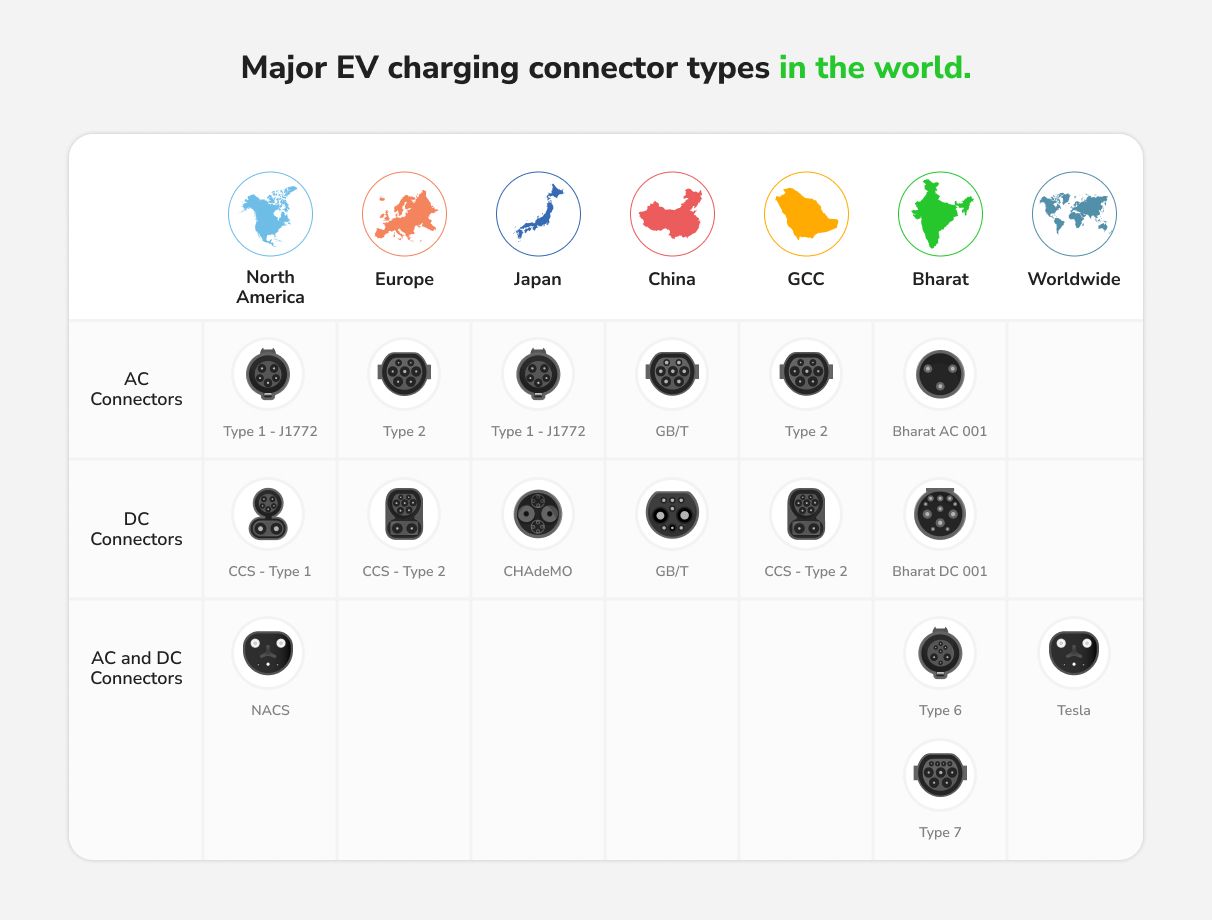
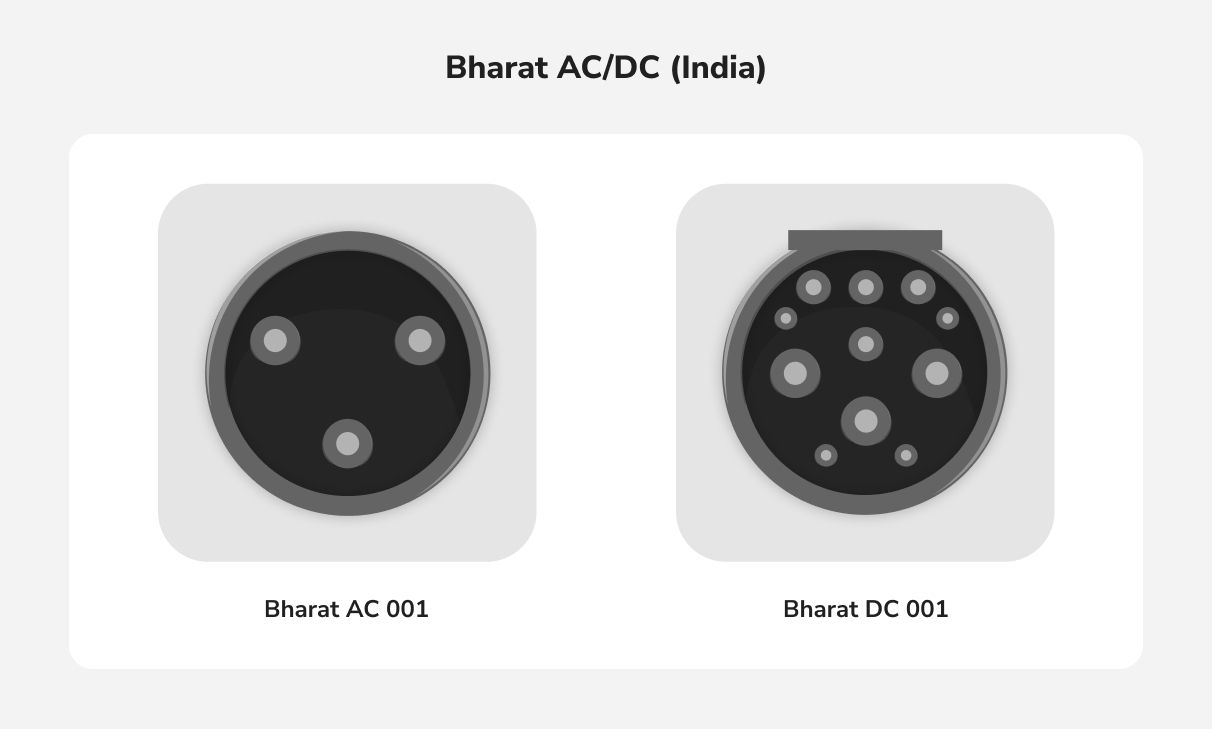
    • Carry all charging cables and adapters you might need (CCS2, Bharat AC, Type 2). Infrastructure can be fragmented, so adapters are essential. Some resorts only have 16A plugs; extension cords or grounding rod kits can help. 
    • Download offline maps for areas with poor coverage. Carry a portable charger for your phone and e-connector to work throughout the journey. 

    Drive Efficiently

    On the road, your driving style greatly affects range.  

    • Maintain steady, moderate speeds to reduce wind drag; high speeds burn battery much faster.  
    • Use cruise control where possible and avoid rapid acceleration or hard braking. Use regenerative braking settings to reclaim energy on descents. 
    • Limit climate control use: Pre-cool or pre-heat while plugged in, use seat heaters in winter, and minimize AC in summer. 
    • Activate “eco” or “range” modes, extend efficiency. 

    Charging Strategy on the Trip

    Find the right charger for your EV

    Treat charging stops as planned breaks. Fast chargers replenish quickly up to approx. 80%, after which charging slows.  

    • Follow the 20–80% rule: Instead of charging 100% each time, pull in around approx. 20% and charge up to 80% for the fastest turnaround. One EV team completed seven charges (15–30 min each) over a 2000 km trip, totaling approximately 18 hours of charging
    • Combine stops with meals/rest: Combine charging with breaks. Book EV-friendly hotels that provide chargers and confirm availability in advance. 
    • Backup outlets: Standard 16A sockets at motels or dhabas can work (at slower speeds). Carry adapters or extension cords for emergencies. 

    Comparison: AC vs. DC Fast Charging on Highways

    FeatureAC Charging (Slow)DC Fast Charging
    Common LocationHotels, Homestays, CafesHighway Hubs, Petrol Pumps
    Speed (Typical)3.3kW – 7.2kW25kW – 60kW+
    0-80% Time6–10 Hours45–90 Minutes
    Best Use CaseOvernight chargingQuick “Splash & Dash” breaks

    Final Thoughts 

    Expect the unexpected and stay flexible. Know that chargers can sometimes be offline or crowded, so always have a plan B—check for alternate stations near each stop. Keep the battery at ≥20% en route to avoid being stranded.  

    Despite the extra planning, EV road trip planning in India is rewarding: quiet drives, lower costs, and predictable breaks. For example, a 2,000 km Delhi–Ladakh EV trip costs only approximately ₹3,000 in electricity—far cheaper than petrol. Some Indian highways even waive tolls for EVs. 

    With a smart EV charging strategy, efficient driving, and backup options, your next EV trip is absolutely doable. With the growing EV charging network and highway EV charging stations in India, having access to a reliable EV charger for highway can make long journeys more practical for Indian EV owners.

    Frequently Asked Questions

    Is it safe to take an EV on a 1,000+ km road trip in India?

    Yes.

    With the 2026 expansion of charging corridors on major NH highways, long-distance EV travel is now routine. Success depends on planning stops every 200–250 km.

    Which apps are best for EV route planning in India?

    Popular choices in 2026 include Bolt.Earth, Pulse Energy, Tata Power EZ Charge, Zeon Charging, and community-led apps like PlugShare for real-time station reviews.

    How much does a long EV road trip cost?

    On average, a 2,000 km trip costs between ₹3,000 and ₹4,500 depending on the mix of home charging and commercial DC fast charging rates.

    What happens if I run out of charge on the highway?

    Most EV manufacturers and insurance providers offer RSA (Roadside Assistance) that includes towing to the nearest fast charger. Always keep your battery above 20% to avoid this.

    Does AC usage significantly reduce EV range?

    In Indian summers, constant AC usage can reduce range by 5–10%. It is more efficient to pre-cool the car while it is still plugged into a charger.

  • 8 EV Myths in India Everyone Should Stop Believing  

    8 EV Myths in India Everyone Should Stop Believing  

    Many EV charging myths still circulate in India. Below, we debunk eight common EV myths in India with facts and data, focusing on the Indian context. 

    Myth 1: Electric Vehicles Can’t Travel Far Enough (Range Anxiety) 

    Fact: Most Indian drivers travel far shorter distances than entry-level EV ranges.  

    Pie chart showing daily driving habits of individuals with electric vehicles.
    • By contrast, modern EVs easily deliver 200–400 km per charge. For example, Tata Nexon EV (30–45 kWh battery) is rated 275–489 km per full charge.  
    • In practice, typical EV owners cover only a fraction of their battery range daily. In short, range anxiety is largely unwarranted. 

    Myth 2: EVs Are Too Expensive

    Fact: While EVs often cost more upfront than petrol cars, government incentives and lower running costs change the picture.  

    Most Indian consumers express intentions to purchase electric vehicles next, signaling a growing preference for sustainable options.
    • India’s FAME-II program (approximately ₹11,500 Cr budget) has already supported over 1.6 million EVs (including 14.3 lakh two-wheelers, 1.65 lakh three-wheelers, and 22.5 thousand cars by Mar 2025).

    Myth 3: EV Batteries Wear Out Quickly or Pollute the Environment

    Fact: EV batteries are durable and increasingly recyclable.  

    Infographic showing the circular benefits of EV battery recycling, highlighting environmental and economic advantages.
    • Most modern EV batteries come with 8 to 10-year or 100,000 km warranties, and long-term data shows no evidence of premature failure. When batteries age, they often find a second life in stationary energy storage before recycling. 

    Myth 4: There Are No EV Charging Stations in India

    Fact: India’s public EV charging networks are expanding rapidly.  

    Visual representation of state-wise EV charging station numbers in India.
    • Charging points are concentrated in urban and interstate corridors, but schemes like PM-E-DRIVE have spurred massive growth in charging stations. India now averages one public charger per approx. 200 EVs (vs. the ideal ~1:20 ratio), and this is improving every year.  

    Myth 5: Charging an EV Takes Too Long (It’s Impractical!)

    Fact: Most EV drivers plug in overnight, and fast-charging technology has advanced greatly.  

    • Using a regular home socket (2–3 kW), a full charge may take 8–12 hours, but this happens while sleeping. Public DC fast chargers (30–150+ kW) can replenish an EV battery quickly.  

    Myth 6: The Electricity Grid Can’t Handle EV Adoption

    Fact: Even on India’s coal-heavy grid, EVs produce far less CO₂ per km than petrol cars.  

    • A recent IIT–ICCT (Indian Institute of Technology – International Council on Clean Transportation) study finds that Indian EVs emit up to 38% less CO₂ (life-cycle) than equivalent petrol cars. Burning a litre of petrol emits approximately 2.3 kg of CO₂, whereas an EV drawing from India’s grid (approx. 0.79 kg CO₂ per kWh) results in much lower per-km emissions.  
    • Moreover, India is rapidly decarbonizing power, with renewables now exceeding 50% of capacity. As the grid gets cleaner, EVs become even greener. Experts warn that delaying EV adoption only locks in more emissions from petrol cars
    • Even today, EVs cut transport emissions significantly in India.

    Myth 7: All EVs Charge the Same Way (and Speed)

    Fact:  EVs differ widely in fast-charging ability and connectors. 

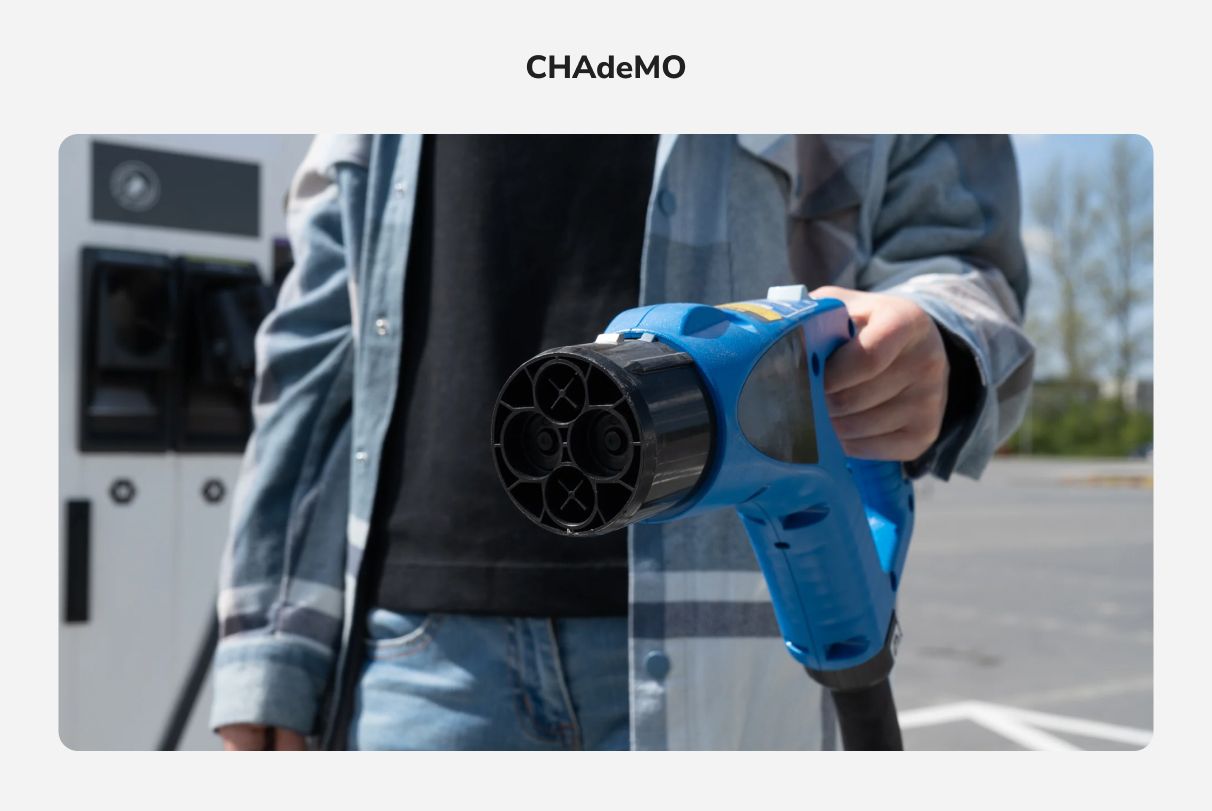
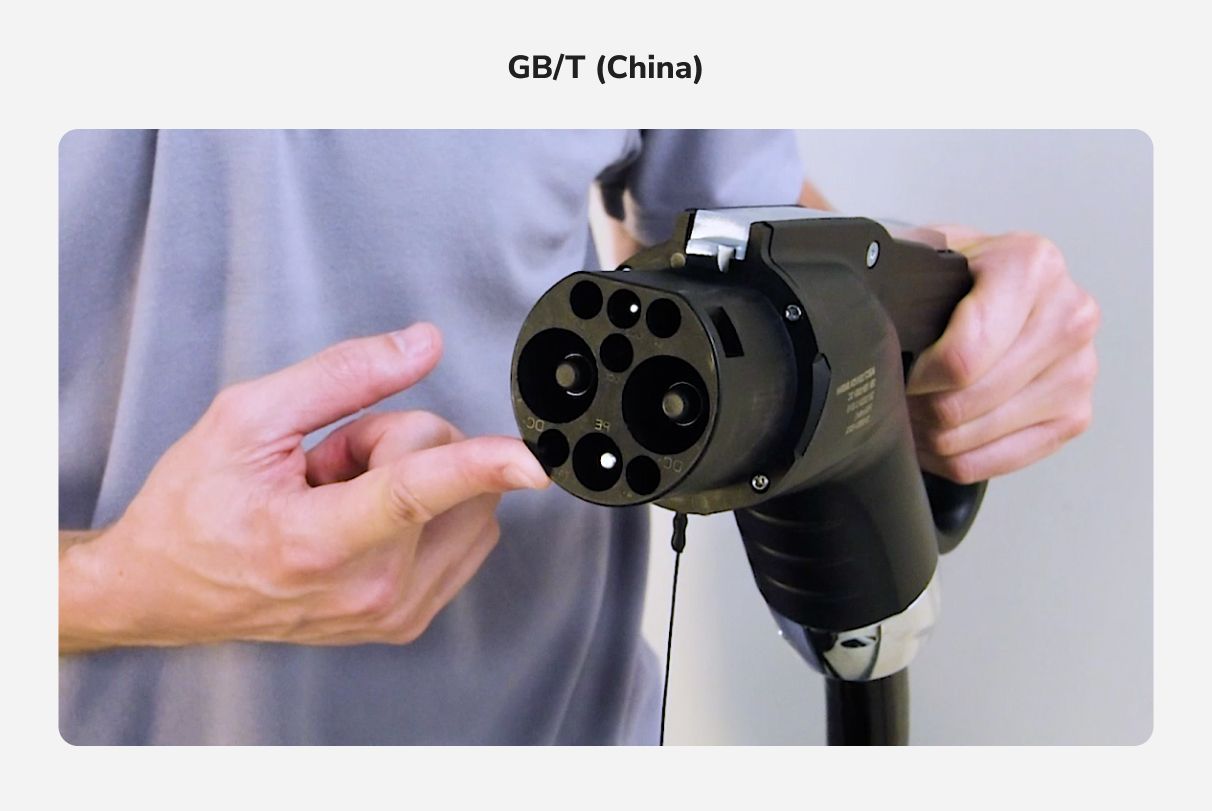
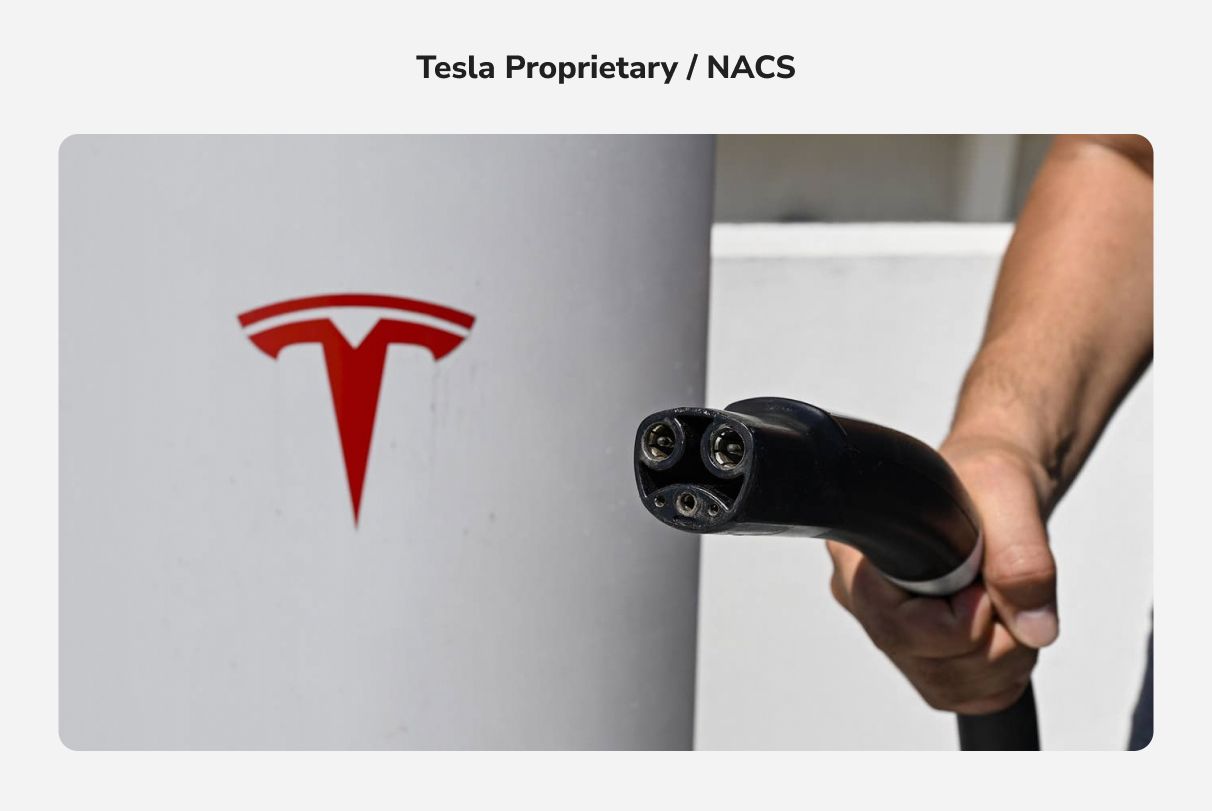
    Each EV model has unique hardware: different voltage (400V vs 800V systems), different max currents, and different connector standards (CCS, Tesla/NACS, GB/T).  

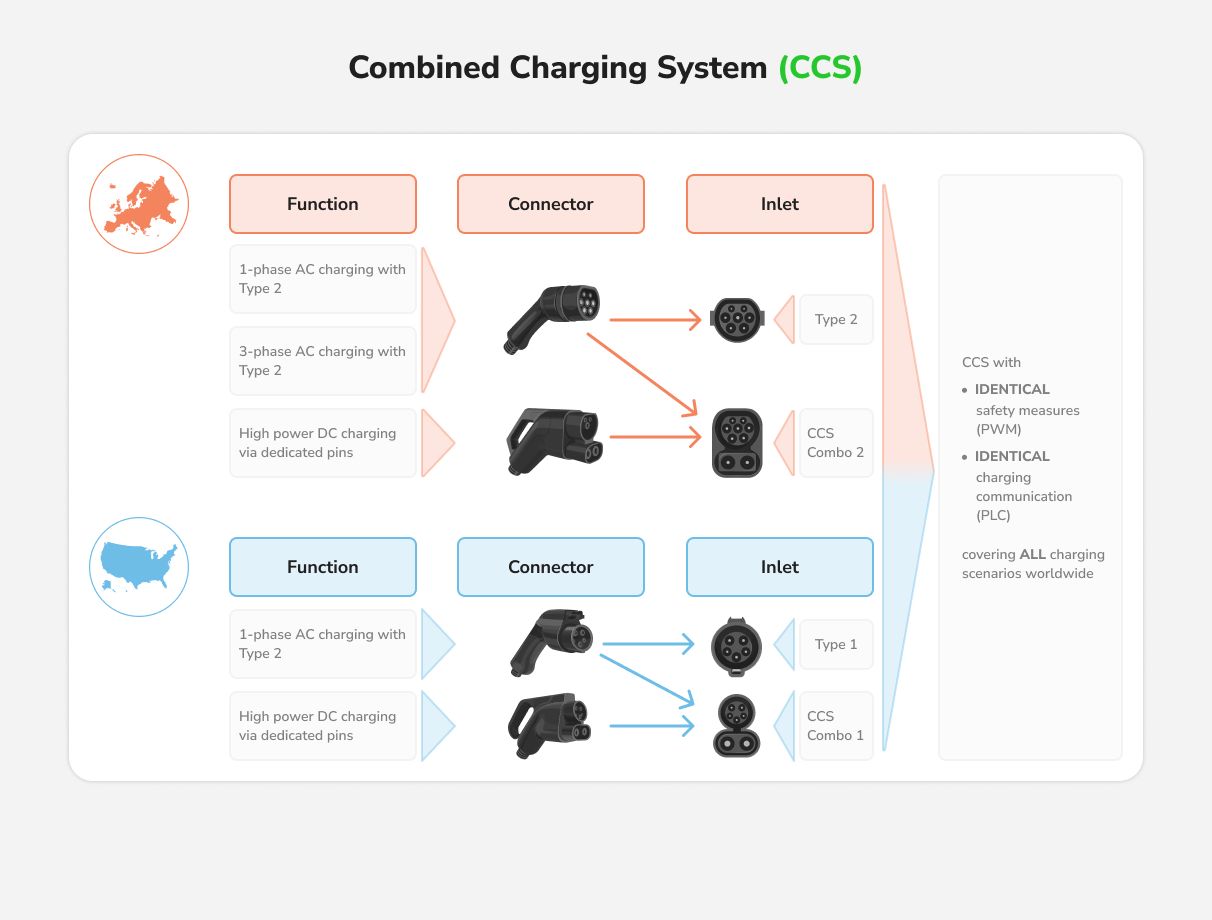
    For example, many European and North American cars now use CCS up to ~350 kW. Some plug-in hybrids can only charge on AC Level 2, not DC at all.  

    Moreover, environmental factors (battery temperature, state of charge) also influence actual power draw. This means charging speeds are not uniform.  

    However, fast charger networks have largely standardized: CCS and Tesla’s NACS (via adapters) now dominate, so most new EVs can access high-power charging at modern stations.  

    The bottom line: not every EV will hit the advertised peak kW of a charger, but each will draw the maximum it safely can. 

    Myth 8: EVs Get Damaged in Waterlogged Areas and Are Unsafe to Charge in the Rain 

    Fact: 
    Modern electric vehicles in India are designed with strong water and dust protection, making them safe to drive in rain and charge in wet conditions when used correctly. 

    This myth is common in markets like India where monsoons and waterlogging are frequent. However, EVs sold in India are built to handle such real-world conditions. 

    According to the Government of India’s e-Amrit platform by NITI Aayog, electric vehicles come with Ingress Protection (IP) ratings, typically ranging from IP65 to IP67, which protect critical components from dust and water.  

    An IP67 rating, for example, means that the battery and electrical systems can withstand temporary immersion in water (up to 1 metre for about 30 minutes) without damage.  

    In addition to physical sealing, EVs include multiple safety mechanisms: 

    • Battery isolation systems that cut off power if water ingress is detected  
    • Sealed battery packs and connectors to prevent short circuits  
    • Ground fault protection systems in chargers to stop electricity flow in case of irregularities  

    These features ensure that EVs do not conduct electricity into surrounding water and remain safe during normal rain or shallow water exposure.  

    However, it is important to distinguish between rainy conditions and extreme flooding. While EVs are safe to drive and charge in rain, charging should be avoided in deep water, damaged equipment, or submerged conditions, as with any electrical system.

    Final Thoughts 

    The shift to electric mobility in India is well underway, and the facts clearly outweigh the electric vehicle misconceptions in India. Modern EVs already deliver more range than most people need daily, the total cost of ownership rivals petrol vehicles, batteries are responsibly recycled, and EV charging infrastructure is expanding at an unprecedented pace. Fast charging and home charging make daily use seamless, and even with today’s grid mix, EVs significantly reduce emissions and environmental impact.

    With falling prices, stronger policies, rapid infrastructure growth, and rising consumer awareness, India is moving decisively toward cleaner, smarter transportation. 
     
    If we look past outdated EV myths in India and focus on data, the road ahead is greener and electric. 

  • India’s EV Charging Infrastructure Policy 2025: Impact on CPOs and OEMs

    India’s EV Charging Infrastructure Policy 2025: Impact on CPOs and OEMs

    By 2025, domestic EV sales reached approximately 2.5 million units, and the government targets approximately 30% of all new vehicle sales to be electric by 2030.

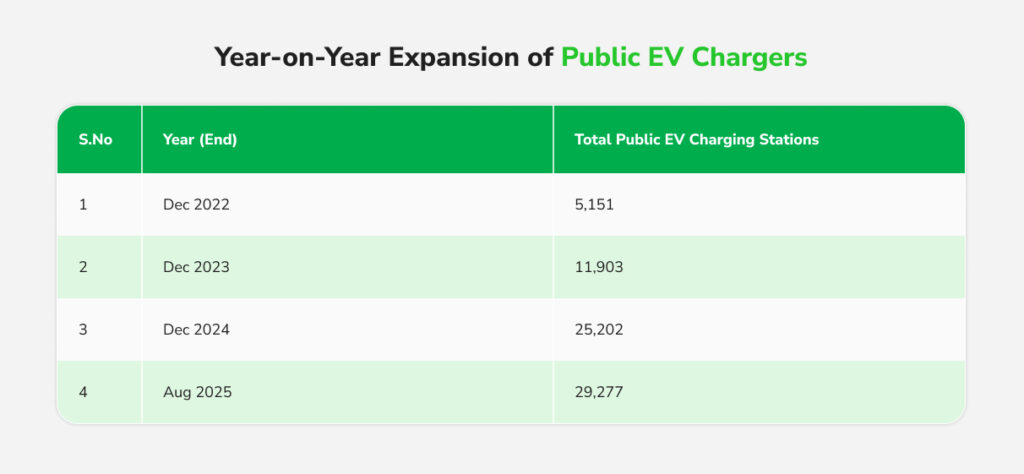
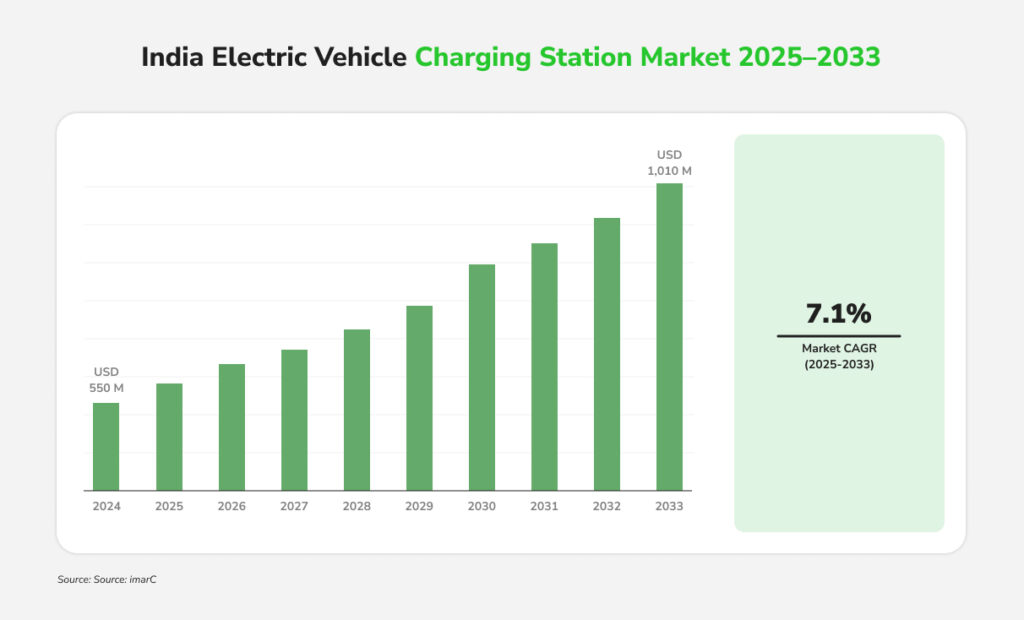
    To sustain this growth, the charging infrastructure has become a national priority. Installation of public EV charging stations in India expanded from 5,151 stations in Dec 2022 to 25,202 by Dec 2024, and approximately 29,300 by Aug 2025.

    However, density remains low relative to EV adoption. Policymakers have therefore updated guidelines, incentives, and regulations to build infrastructure for all segments while ensuring business viability. 
     
    In this blog, we explore: 

    1. What India’s new EV Charging Infrastructure Policy changes in practice 

    2. How these policy shifts impact the profitability, expansion strategy, and technology roadmap of Charge Point Operators (CPOs) 

    3. What EV OEMs must do to stay compliant and competitive 

    Central Government Initiatives  

    Revised MoP Charging Guidelines 

    In Sep 2024, the Ministry of Power issued fresh “Guidelines for Installation and Operation of EV Charging Infrastructure – 2024”, revising standards, safety, and siting norms. Key changes include mandating chargers at workplaces, residential complexes, bus depots, and public hubs. EV charging is now declared an “unlicensed” activity, with emphasis on EV charging network interoperability via open protocols (OCPP/OCPI) and unified roaming apps. In Jan 2025, MoP also released India’s first guidelines for battery swapping stations, detailing technical standards for interoperable swap bays. Together, these reforms aim to make charging safer, more accessible, and commercially sustainable
     

    PM E-DRIVE Scheme

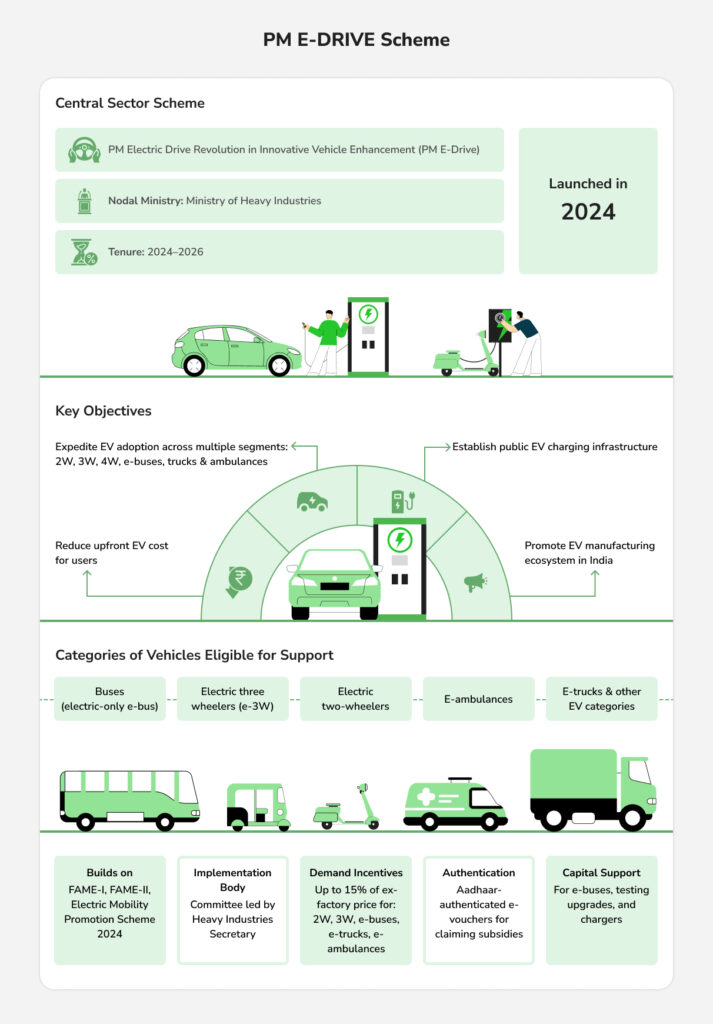
    The PM-Electric Drive Revolution in Innovative Vehicle Enhancement (E-DRIVE) scheme (notified Sep 2024) allocates ₹10,900 crore for FY2024–26 to boost EV demand and infrastructure. Of this, ₹2,000 cr is earmarked for public charging stations. The government plans to deploy approximately 72,000 fast chargers across highways and urban sites by FY25–26 and co-fund depot chargers for e-buses and fleets. The scheme also supports consumer subsidies and ₹4,391 cr for 14,028 e-buses. In sum, PM E-DRIVE provides large-scale funding and a national mandate to expand commercial EV charging stations quickly. 

    Revamped Distribution Scheme (RDSS) 

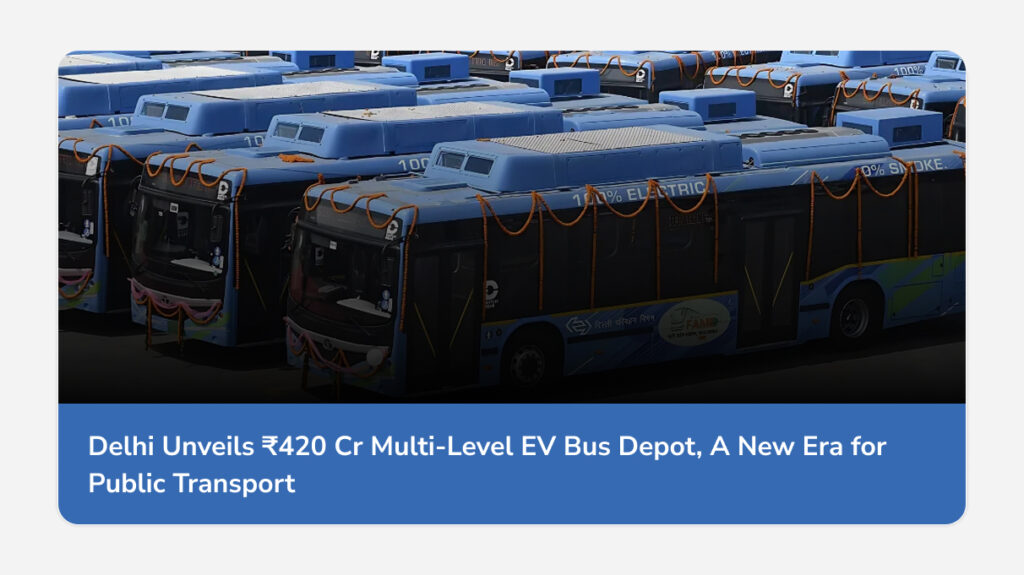
    Delhi's new 420 crore multi-level EV bus depot marks a significant advancement in public transport infrastructure.

    The Revamped Distribution Sector Scheme encourages state DISCOMs to invest in EV charging. New guidelines allow DISCOMs to use RDSS funds for public charging connectivity and grid reinforcement.  

    States/DISCOMs/SERCs are urged to incentivize EV charger rollout and incorporate charging obligations in grid planning.

    Urban Mobility 

    The Ministry of Housing & Urban Affairs (MoHUA) approved the PM e-Bus Sewa scheme (2023) to electrify city bus fleets with 10,000 buses on PPP, supported by ₹20,000 cr. This will create strong demand for depots and en-route charging for urban mass transit. MoHUA and MoP (Ministry of Power) are also encouraging cities to integrate chargers in parking lots, metro stations, and street hubs. Model building bye-laws (amended 2019) require major developments to allot space for EV charging. 

    Table showing year-on-year public EV charger expansion

    Regulatory Changes Impacting CPOs and OEMs 

    Recent rule changes affect how CPOs operate and how OEMs plan networks: 

    Time-of-Day Tariffs (ToD) 

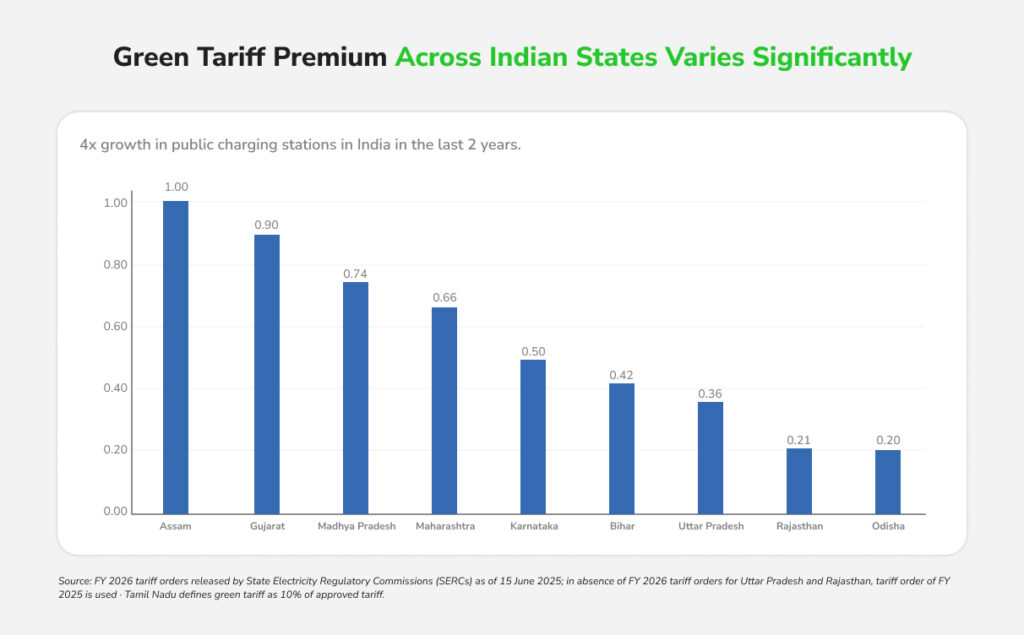
    Some states introduced ToD pricing to shift charging to daytime solar hours. Tamil Nadu pioneered ToD in 2023, cutting midday rates by ~50%. However, its latest tariff order (Jul 2025) raised rates across all periods (solar ₹6.50/kWh, peak ₹9.75) and doubled fixed charges on high-tension connections. Operators warn this 20% hike erodes earlier cost advantages. Other states (e.g., Karnataka) maintain cheaper midnight rates. Tiered tariffs reward solar-time charging but penalize low-utilization sites via high fixed fees, squeezing CPO margins. CPOs must therefore optimize charging schedules (e.g., offer discounts off-peak) and may need to invest in on-site solar or storage. 

    Land and Zoning Mandates 

    Urban building codes increasingly require EV charging readiness. Delhi’s rules (2020) were updated so major developments must reserve EV-ready parking. Maharashtra, Karnataka, and others have inserted similar clauses. These mandates give CPOs predictable demand (e.g., malls and offices must allot charging spaces) and encourage OEMs to ensure dealer showrooms are EV-ready. Land allotment schemes are also emerging for charger parks. 

    Interoperability Standards 

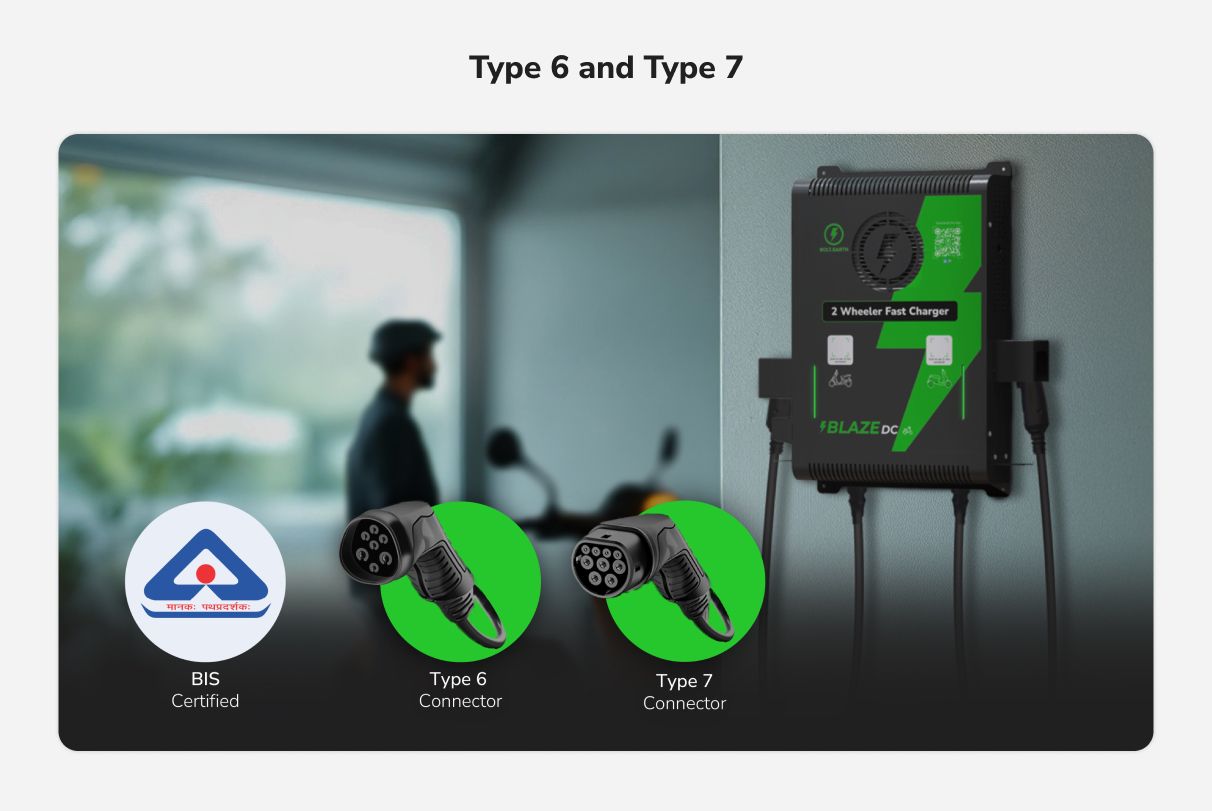
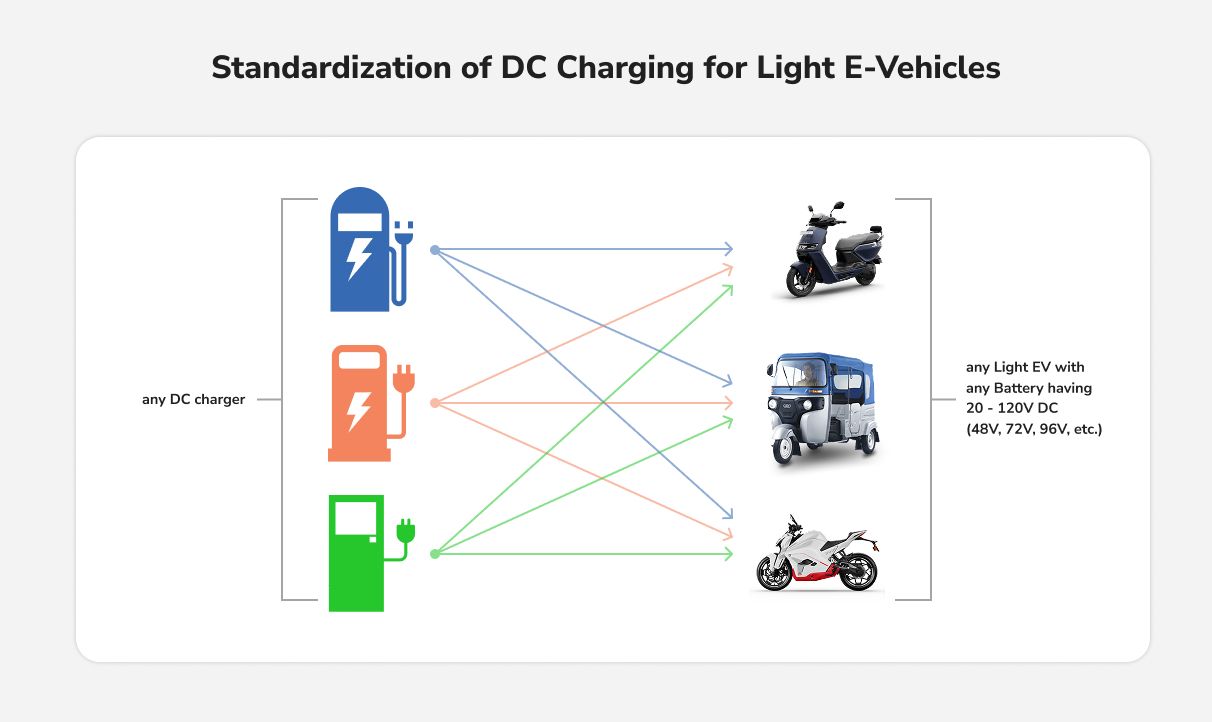
    The government emphasizes a standardized, interoperable network. All new public chargers must support open communication protocols (OCPP for charging backend, OCPI for roaming) and UPI-based payments. This fosters EV roaming: drivers can plug in to any network using one app or RFID. When multiple CPOs joined a common roaming platform in 2023, charger utilization jumped from <10% to over 20%. Compliance with national protocol mandates is therefore essential for CPOs, and OEMs must equip vehicles with standard connectors (Type-2/CCS2 for cars and Bharat DC-001/Type-4 for two-wheelers). 

    Other Technical Mandates 

    Safety and quality standards (CE/IS certifications, surge protection, secure payments) have been tightened. The CEA has added electrical safety requirements for EVSE. In the future, grid codes may require smart charging features (V2X-readiness, load management) to support grid stability. OEMs must coordinate vehicle-charger compatibility (e.g., ISO15118/BMS standards). 

    Implications for Charge Point Operators (CPOs) 

    CPOs stand to benefit from these policies but also face new challenges: 

    Subsidies and Funding 

    Central and state grants lower CAPEX for public and depot chargers. Unlicensed status and expedited permissions speed up rollout. Participation in schemes like PM E-DRIVE provides direct reimbursements. 

    Regulatory Costs 

    Higher DISCOM tariffs raise OPEX. Low utilization of public chargers means steep fixed charges hit profitability unless offset by subsidies or dynamic pricing. CPOs must optimize placement (high-demand locations) and consider bundled services to improve throughput.  

    Standards Compliance 

    Meeting interoperability and safety standards adds complexity. CPOs must ensure all new chargers are OCPP-compliant and join national roaming platforms. Legacy stations may need upgrades.

    Market Opportunities 

    Residential and workplace charging are now covered in MoP guidelines, opening new revenue streams.  Public-private partnerships are now more attractive with co-funding available. Highway and city charging corridors offer scale, especially for commercial EV charging stations. Retail partnerships are encouraged by state incentives. 

    Strategic Alignment 

    CPOs must align rollout plans with OEM sales and fleet electrification. As more EVs hit the roads, OEMs will demand robust charging access to reassure buyers. Savvy CPOs will partner with OEMs on service networks (e.g., providing chargers at dealerships or fleet depots). Many OEMs are already entering the CPO space or partnering with other CPOs to ensure customer access. 

    Implications for EV OEMs 

    Original Equipment Manufacturers (OEMs) likewise feel the policy effects: 

    Demand Stimulation 

    Policy support (subsidies, mandates, infrastructure funding) reduces range anxiety and total cost of ownership, boosting EV sales, which is the OEMs’ primary goal. A denser EV charging network makes it easier for consumers to choose EVs, enabling OEMs to accelerate EV model launches. 

    Technical Coordination 

    OEMs must ensure their vehicles are compatible with mandated standards (CCS2, Bharat DC-001, ISO15118).  The push for interoperability means OEMs should also prioritize OCPP & OCPI compliance in India when collaborating with CPOs, ensuring seamless integration across networks. 

    Network Partnerships 

    Many OEMs are investing in charging networks (e.g., Tata Motors with Tata Power; MG has partnered to roll out DC chargers; Hero MotoCorp’s Ather with Uber to install bike chargers). Policies encourage such tie-ups. OEMs should seek alliances with CPOs (or become CPOs themselves) to enhance brand value and customer retention. 

    Product Planning 

    OEMs will time vehicle launches with infrastructure milestones. Entry-level e-2Ws/3Ws rely on home-charging incentives, while cars follow fast-charger expansion.  

    Fleet Segment 

    OEMs supplying buses, trucks, and specialized EVs (ambulances, tractors) must coordinate with cities and operators to co-develop depot charging layouts. Government procurement under the E-DRIVE creates large opportunities. 

    Outlook and Actionable Insights 

    The 2024–25 policy wave signals that EV charging is now a national infrastructure priority. For senior decision‑makers, the imperative is twofold: execute on current incentives and prepare for the next phase. Key takeaways include: 

    • Integrate planning across stakeholders. Governments should synchronize EV sales targets with charging rollout, for example, creating dedicated EV cells in states and coordinating DISCOMs’ infrastructure plans with urban development authorities, and enforcing land-use mandates. 
    • Leverage subsidies wisely. CPOs and real estate developers should tap central and state grants now, before funds lapse, and invest in data analytics to site chargers optimally. Utilities (DISCOMs) can use RDSS funds to upgrade networks for high-demand sites and shape ToD tariffs to smooth demand curves. 
    • Adopt open standards. Both CPOs and OEMs must ensure compliance with OCPP and OCPI in India to support unified payment systems and roaming. Such interoperability will ultimately raise charger utilization (as real-world pilots have shown). 
    • Monitor evolving regulations. Tariff changes highlight the need for CPOs to engage with regulators actively. Likewise, OEMs must remain agile in adapting to local charging infrastructure rules such as new EV parking requirements. 
    • Plan for scale and future tech. With the government’s 2030 vision, OEMs and CPOs should prepare for higher EV volumes, faster chargers, and emerging models like wireless charging or integrated solar and storage at charging hubs. 

    Final Thoughts 

    India’s 2025 EV charging infrastructure policy measures have laid the groundwork for commercial EV charging stations in India. For CPOs, this means new funding streams and clearer norms, but also higher standards and competition. For OEMs, it promises greater EV uptake and responsibilities in infrastructure integration. By acting swiftly, building chargers in tandem with vehicle rollouts, engaging in partnerships, and managing regulatory risks, industry stakeholders can ensure India’s EV revolution is fully charged for the future. 

    Frequently Asked Questions

    How will higher DISCOM tariffs impact EV charging prices for end users in 2025–2026?

    Where ToD tariffs increased, CPOs may pass on 10–20% higher charging prices during peak hours. Many are shifting to time-based discounts, solar-hour deals, or subscription models to protect affordability. 

    How should OEMs prepare for interoperability mandates like OCPP, OCPI and unified payments?

    OEMs must ensure vehicles use standard connectors (Type-6/Type-7/CCS2/Type-2/Type-4) and support communication layers like ISO 15118. Backend teams must align with CPO partners using OCPP 1.6/2.0.1 and enable UPI-ready payment APIs for India-wide roaming. 

    What are the best locations for new charging stations in 2025–2030?

    Based on demand analytics across India: 

    • High-footfall urban hubs (malls, offices, tech parks) 
    • National highways with 24/7 amenities 
    • Large housing societies (supported by MoP mandates) 
    • Fleet depots (e-bus, e-cargo, ride-hail) 
    • Metro stations and transport hubs 

  • Sodium-Ion vs. Lithium-Ion Batteries: Which Is Better for Electric Vehicles?

    Sodium-Ion vs. Lithium-Ion Batteries: Which Is Better for Electric Vehicles?

    The Race for EV Battery Materials 

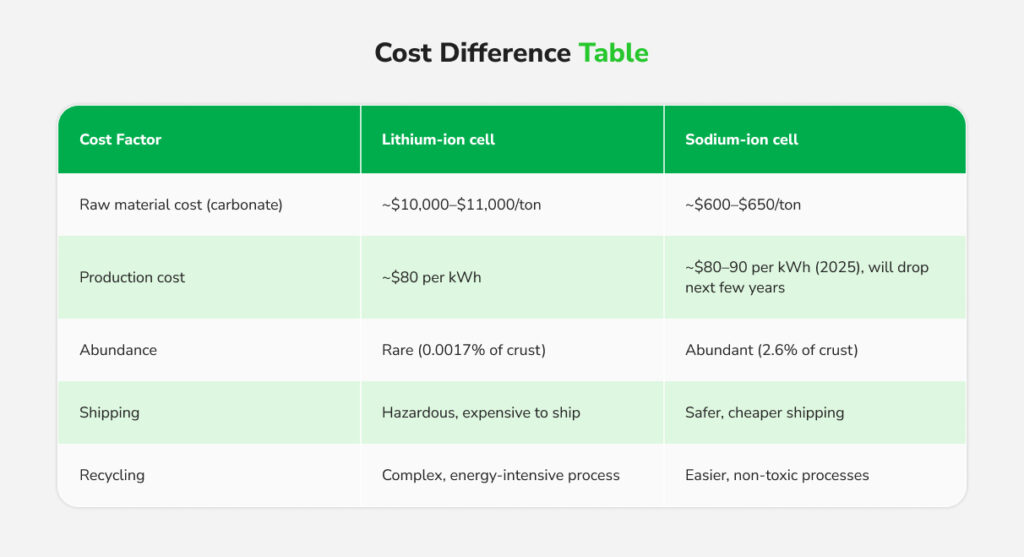
    Electric vehicles (EVs) today rely heavily on lithium-ion batteries, but this dependence comes with challenges. Lithium resources are geographically concentrated; China dominates 79% of global lithium-ion battery production and 61% of lithium refining capacity. Countries like Argentina hold around 21% of global lithium deposits, creating supply risks. Demand surges have driven lithium prices up over 700% since 2021, inflating battery costs. These supply chain constraints and price volatility have automakers and tech companies exploring alternative chemistries for EV battery technology.  

    One promising candidate is the sodium-ion battery, which uses sodium, an element far more abundant and widely available than lithium. In fact, sodium is thousands of times more plentiful in the Earth’s crust than lithium — approximately 20ppm, whereas sodium is tens of thousands of ppm. This abundance makes sodium cheaper and easier to source, without the geopolitical bottlenecks associated with lithium.  

    This blog explores three key dimensions shaping the future of EV energy storage: 

    • Growing challenges of lithium-ion batteries and why the industry is seeking alternatives. 
    • Rise of sodium-ion technology and how it compares to lithium-ion in performance, cost, safety, and sustainability. 
    • Recent developments, market trends, and the future outlook for sodium-ion batteries in the EV industry.

    How Sodium-Ion and Lithium-Ion Batteries Work 

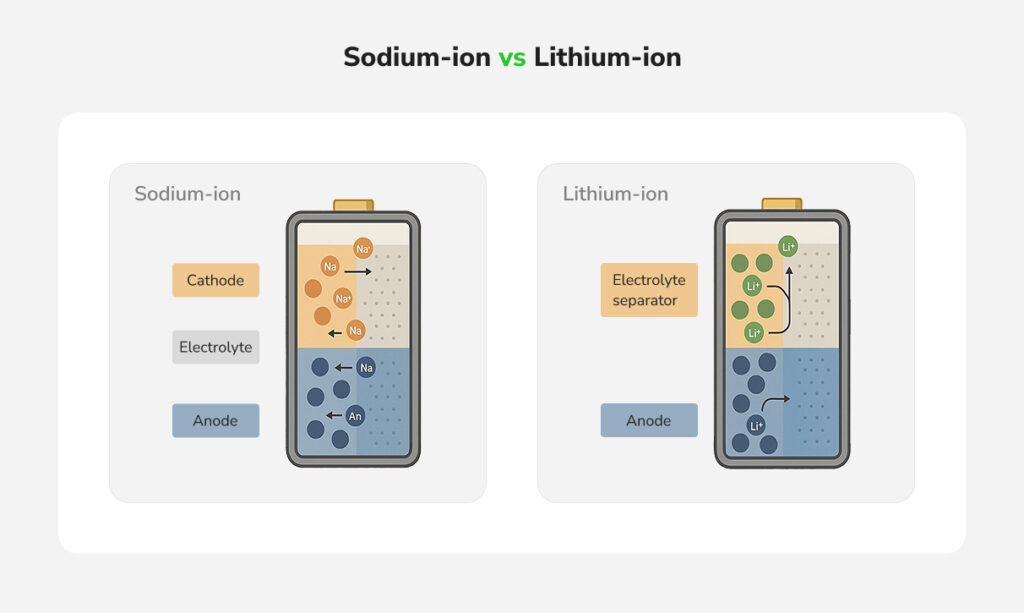
    At a basic level, both sodium-ion (Na-ion) and lithium-ion (Li-ion) batteries shuttle ions between a cathode (positive side) and anode (negative side) through a liquid (or sometimes solid) electrolyte. The key difference lies in the charge carrier: sodium ions (Na+ ) versus lithium ions (Li+ ). This seemingly small change leads to notable differences in materials and performance. 

    Sodium-Ion vs. Lithium-Ion: Key Differences 

    Both battery types aim to deliver high energy storage and power, but there are critical differences in their material abundance, performance, and suitability for electric vehicles. Below, we compare several key aspects: 

    Resource Abundance & Cost 

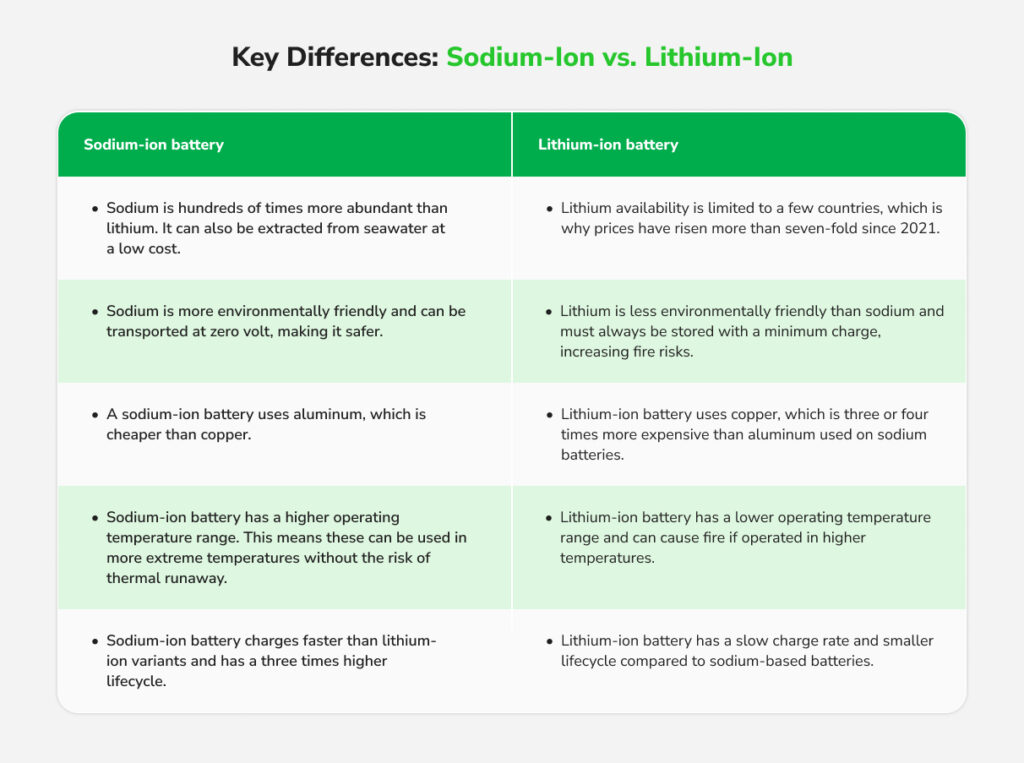
    Sodium is extremely abundant and inexpensive. It can even be sourced from seawater, and it doesn’t require intensive mining.  
     
    In contrast, lithium is limited to specific regions and has seen skyrocketing costs due to scarcity. Sodium-ion cells also use lower-cost materials; they avoid expensive cobalt and use aluminum in place of copper, further reducing material costs. Overall, sodium-ion technology offers cost advantages, especially if lithium prices remain high, making it central to EV battery cost comparison.

    Energy Density (EV Range) 

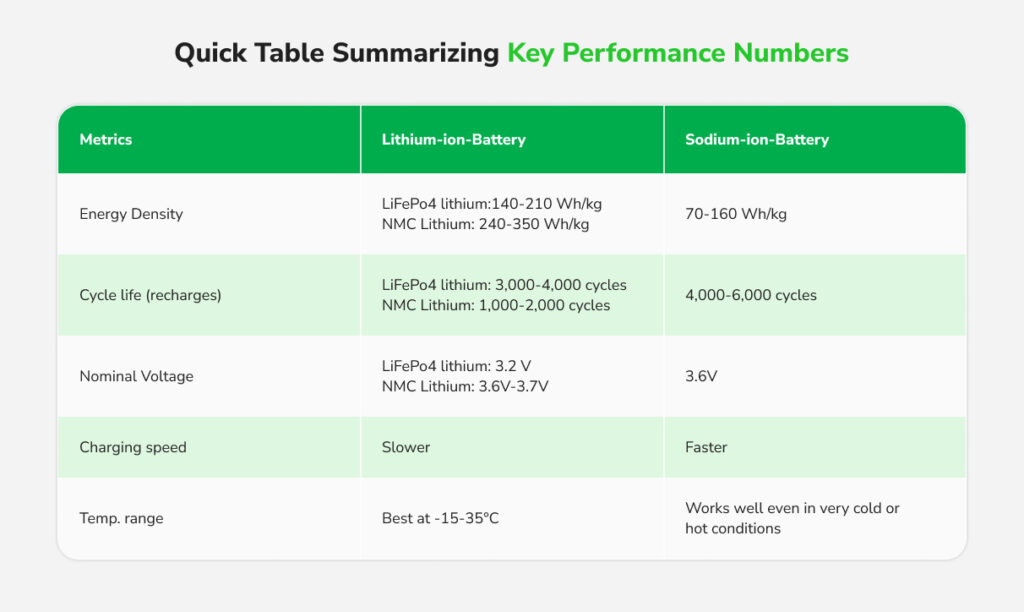
    Lithium-ion batteries lead in energy density, a crucial factor for EV range. Current lithium EV batteries (e.g., NMC or LFP) deliver around 150–250 Wh/kg of energy density, enabling long driving ranges.  
     
    Sodium-ion batteries currently achieve roughly 100–160 Wh/kg. For example the first sodium-powered compact car in China (JAC’s Hua Xianzi) carries a 25 kWh sodium battery pack for about 250 km of range —suitable for city commuting but below typical lithium EV ranges. Researchers are optimistic that with further innovation, sodium-ion cells could exceed 200 Wh/kg in coming years, but for now lithium’s superior energy density makes it better for long-range performance. 

    Charging Speed and Cycle Life 

    Interestingly, sodium-ion batteries can charge faster and potentially last longer in certain designs. Sodium ions are larger, but the chemistry avoids lithium’s tendency for dendrite formation at high charge rates. Early tests show sodium cells comfortably handle fast charging; one prototype by HiNa Battery charges fully in about 20 minutes. Some sodium batteries have shown 4,500 charge-discharge cycles with 83% capacity retention, and next-generation designs (like CATL’s “Naxtra” sodium battery) aim for up to 10,000 cycles.  
     
    By comparison, lithium-ion cycle life varies by chemistry: high-nickel types might last a few thousand cycles, while lithium iron phosphate packs can exceed 5,000–7,000 cycles under good conditions. Some commercial LFP batteries approach 8,000+ cycles before significant degradation. In short, both technologies can achieve long lifespans, but sodium-ion is proving it can match or even surpass lithium in cycle longevity, a big plus for fleet EVs or grid storage that value long-term durability. 

    Safety and Thermal Performance 

    Sodium-ion batteries are safer and more stable in extreme conditions. They tolerate full discharge and high temperatures, reducing fire risk. A sodium-ion cell retains approx. 88% of its capacity even at -20°C, while lithium NMC cells drop to only approx. 20–50% at subzero temperatures. Sodium cells also perform well up to approx. 70°C without severe degradation.  
     
    Lithium-ion batteries require careful thermal management and can’t be fully drained without damage. Their flammable electrolytes pose that fire risks. Sodium-ion electrolytes and materials tend to be less reactive, improving safety margins. For drivers, pairing safer chemistries with dependable infrastructure, such as an electric car charger in India, reinforces confidence in both battery performance and charging safety. Overall, sodium-ion technology offers a more forgiving thermal and safety profile, which is attractive for automakers and aligns with sustainable electric vehicle charging solutions. 

    Environmental Impact 

    From a sustainability perspective, sodium-ion batteries have an edge in environmental friendliness. Sodium extraction and processing generally have a smaller environmental footprint than lithium mining. Lithium extraction is water-intensive and can pollute soil and water. Cobalt and nickel mining for lithium batteries also add social and ecological costs.  

    Sodium can be obtained more sustainably and doesn’t involve rare metals. Using aluminum instead of copper and avoiding lithium reduces the carbon footprint. In summary, sodium-ion batteries align well with sustainability goals, provided their overall efficiency and longevity continues to improve. Coupled with a robust EV charging network, these advances can accelerate the transition to a cleaner mobility globally.

    Recent Developments and Industry Adoption

    Thanks to the above advantages, sodium-ion batteries are gaining traction in the battery industry, including in EV applications. Major players like CATL, BYD, and Reliance Industries are investing heavily. Reliance’s 2022 acquisition of UK-based Faradion marked a key milestone in commercializing sodium-ion chemistry. 

    In China, CATL introduced its first sodium-ion battery in 2021, followed by JAC and HiNa Battery’s launch of the world’s first sodium-powered EV in 2023. BYD and CATL have since established large-scale sodium-ion factories, targeting up to 30 GWh annual capacity by 2025. CATL’s “Naxtra” batteries promise 175 Wh/kg energy density at costs below $20/kWh, potentially cutting EV battery prices by 30–50%

    Early adoption focuses on entry-level EVs, two-wheelers, and energy storage. European projects by BASF and Mercedes-Benz are exploring sodium-ion systems for energy independence. Although China currently leads production and is expected to control around 95% of sodium-ion output by 2030, the technology is moving swiftly toward commercial reality worldwide. 

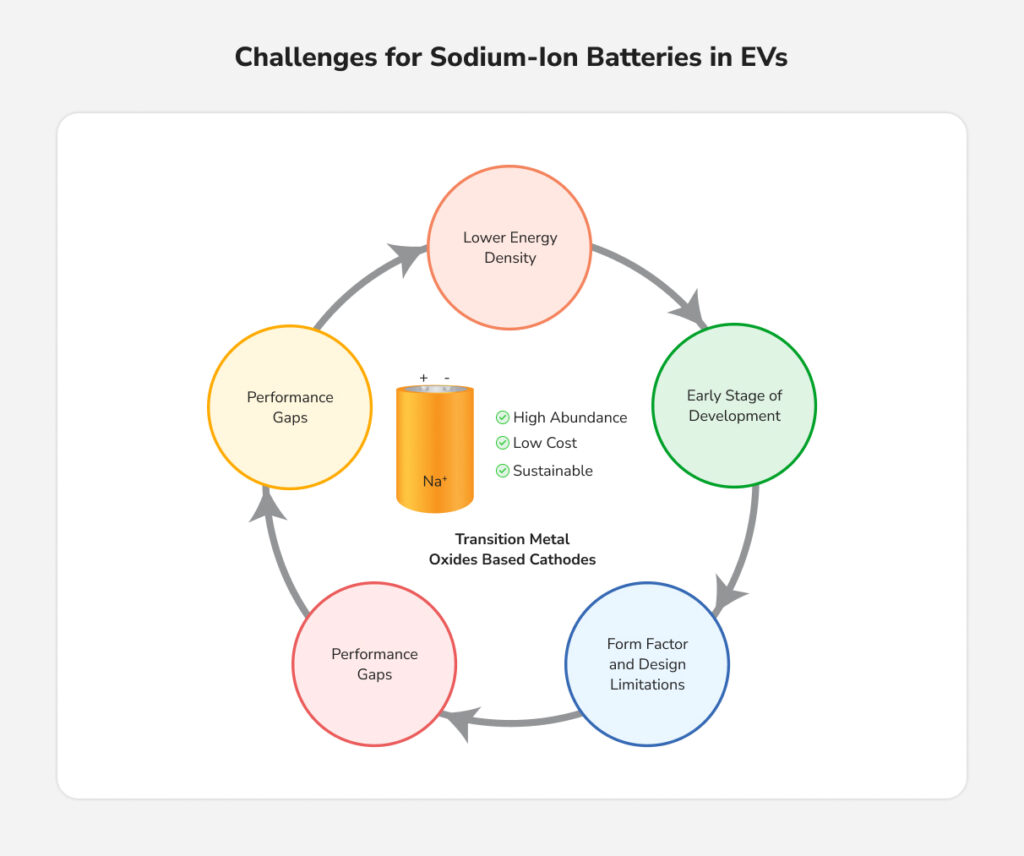
    Challenges for Sodium-Ion Batteries in EVs

    Despite their promise, sodium-ion batteries face several challenges before they can replace lithium-ion in mainstream EVs

    • Lower Energy Density: Sodium-ion cells store less energy per weight/volume than lithium cells. This is a critical drawback for EVs, where weight and space directly influence vehicle range. Until sodium batteries close the density gap (through improved electrode materials or cell design), they will likely be limited to shorter-range vehicles or require larger battery packs to match lithium EV range. 
    • Early Stage of Development: Lithium-ion technology has benefited from decades of R&D and massive manufacturing scale. Sodium-ion tech is still nascent. Only a few companies produce them at scale, and processes are not yet fully optimized. This means current sodium-ion batteries are relatively expensive to produce, ironically, despite cheap materials, mainly due to low volumes and nascent supply chains. Additionally, the supply chain for specific sodium battery materials isn’t well established yet.  
    • Form Factor and Design Limitations: Today’s sodium-ion cells have mostly been developed in pouch or prismatic formats. Some reports indicate they cannot yet be made in as many form factors (cylindrical cells, button cells, etc.) or as compactly as lithium cells. EV makers have fine-tuned battery pack architectures around lithium cell formats; switching to sodium may require redesign. However, this is likely a temporary issue, as R&D will adapt sodium chemistries to various cell formats in the future. 
    • Performance Gaps: While sodium-ion batteries show strong potential, some performance areas still lag in power density and room temperature efficiency, though this is improving with advanced electrolytes. And while lab tests demonstrate impressive cycle life (over 5,000 charge cycles), real-world validation is still limited. By contrast, lithium-ion batteries, especially LFP types, already deliver thousands of proven, reliable cycles in commercial EVs. 
    • Manufacturing and Investment Challenges: Transitioning to a new chemistry isn’t simple—it requires retooling factories, training, and ensuring the new batteries meet automotive standards. As the International Energy Agency notes, new battery technologies face an uphill climb against incumbent lithium-ion. Sodium-ion cells are viable, but scaling to the multi-gigawatt-hour factories will take time and investment.  

    Outlook: Complement or Replacement? 

    In the near term, sodium-ion batteries will complement rather than replace lithium-ion. Their cost, safety, and sustainability advantages make them ideal for urban EVs, electric two-wheelers, and large-scale grid energy storage — segments where weight is less critical.  

    If sodium-ion cells achieve approx. 200+ Wh/kg energy density and maintain their other benefits, they could begin to challenge lithium-ion even in mainstream passenger EVs. The cost reduction potential is a big motivator, especially in markets where electric vehicle charging solutions and infrastructure are rapidly expanding; some estimates suggest sodium-based packs might cut EV battery costs by 30-50%, potentially slicing thousands of dollars off an EV’s price. This would be transformative for mass EV adoption, especially in price-sensitive markets. Automakers like BYD and Ford are closely watching sodium battery progress, and some have hinted at integrating sodium cells in future entry-level models if performance improves. 

    However, it’s important to keep a perspective. Lithium-ion batteries have a huge head start and an enormous ecosystem behind them. They will remain the go-to for most EVs in the next few years. Sodium-ion batteries are best seen as an emerging alternative that will find its place alongside lithium. A recent analysis by EV industry experts noted that sodium batteries are “already viable for short-range EVs, two-wheelers, and stationary storage”, but for longer-range cars, lithium will continue to dominate unless sodium sees a breakthrough in energy density. Even the IEA commented that sodium-ion can only really compete with lithium iron phosphate on cost if lithium prices stay very high or if sodium tech makes a leap in performance

    The next few years will determine how far sodium-ion batteries can go in powering the EV revolution. The competition is on, and that’s a win-win for consumers and the planet. 

    Frequently Asked Questions

    Will sodium-ion batteries make EVs cheaper in the next few years?

    Potentially, yes. Sodium-ion cells use cheaper, abundant materials and avoid lithium, cobalt, and nickel. This could reduce EV battery pack costs by 30–50% once production scales. But mainstream affordability gains may take 3–5 years, depending on manufacturing expansion.

    How will automakers integrate sodium-ion batteries without redesigning their entire EV platforms?

    Automakers will integrate sodium-ion gradually, starting with models that don’t require major platform changes, mainly city EVs, scooters, and low-range vehicles that already rely on pouch or prismatic cell formats. Early deployments will likely involve partial or modular pack configurations that allow OEMs to test sodium packs without altering core architectures. Over the next few years, however, as sodium-ion matures, automakers will begin designing new platforms optimized specifically for sodium cells, much like they did for LFP-based EVs. This staged approach lets manufacturers adopt the technology with minimal disruption. 

    Will sodium-ion batteries meaningfully reduce pressure on public EV charging infrastructure?

    Yes, especially in urban environments. Sodium-ion batteries are well-suited for small EVs that focus on short-range, high-frequency usage patterns. Because these batteries can charge quickly and are expected to be used primarily in entry-level vehicles, more owners will rely on home or workplace charging rather than fast-charging stations. This reduces congestion at public chargers and lightens the burden on high-power infrastructure. It doesn’t replace the need for public charging, but it reshapes demand so that fast chargers are increasingly used by long-range EVs, while sodium-powered vehicles utilize slower, distributed charging solutions. 

  • EV Roaming in India: What It Means for Interoperability and User Experience

    EV Roaming in India: What It Means for Interoperability and User Experience

    With over 40 charge point operators (CPOs) running separate apps, logins, and payment systems, what should be a seamless charging experience often feels fragmented. An EV driver in Mumbai may need a different app in Delhi and yet another one on the highway. 

    EV roaming in India promises to change that. By letting drivers charge anywhere, on any network, using a single app or ID, it’s the missing piece that can make India’s charging ecosystem truly interoperable. 

    In this blog, we explore: 

    • What EV roaming is and how it works through open protocols like OCPP and OCPI. 
    • How roaming improves the EV user experience, from unified apps and payments to real-time discovery. 
    • What are the challenges of EV roaming, and how can industry and policy make “charge anywhere” a reality in India. 

    What Is EV Roaming?  

    EV roaming allows drivers to use chargers from multiple networks with a single account or app. For example, if you use Network A’s app, roaming lets you charge at a Network B or C station using the same login or RFID card. Behind the scenes, networks authenticate your account and handle billing automatically. 

    Roaming works either through direct partnerships between networks or via a central roaming hub, similar to how banks connect through a shared payment gateway. In both cases, it gives EV drivers seamless access to more chargers, shared real-time station data, and one consolidated bill or wallet. 

    Simply put, EV roaming in India makes the charging network-agnostic. Much like how your phone connects to a partner network when you’re outside your carrier’s range, roaming ensures your EV can “charge anywhere” without the hassle of multiple apps. It’s a key step toward true EV charging interoperability. 

    India’s Fragmented EV Charging Landscape and the Need for Interoperability

    An EV roaming framework should be user-centric and involve the participation of all stakeholder.

    India’s EV charging infrastructure has expanded rapidly, but in silos. Over 40 charge point operators (CPOs) run public charging networks, each with its own app, membership plan, and customer support. While competition has driven growth, it’s also created confusion. A driver might use one app in Mumbai, another in Bengaluru, and yet another on the highway. The result: too many apps, too many accounts, and a fractured user experience. 

    This fragmentation makes charging inconvenient and unpredictable. As one EV driver put it, “Why must I download 40 different apps to charge my EV?” Many users rely on third-party aggregators like PlugShare to locate chargers, only to switch apps again to start a session. Charging anxiety, wondering which app works where, has replaced range anxiety as the bigger concern. 

    For CPOs, isolation comes at a cost. A charger limited to one network can’t reach the full pool of drivers. Roaming changes that. When multiple CPOs joined an aggregation platform in 2023, some saw utilization jump from single digits to over 20% within weeks. Better usage means better revenue, stronger maintenance, and faster expansion, a virtuous cycle that benefits everyone. 

    In a country as vast as India, EV charging interoperability is the key to making EV charging seamless and reliable. 

    Public vs. Private Charging Networks 

    Public networks are open to all EV users and form the backbone of India’s charging expansion; think stations in city lots, malls, highways, and fuel stations. Roaming between these networks allows drivers to plug in anywhere, no matter who operates the charger, making intercity travel and daily commutes far simpler. Public infrastructure has grown fast, from just over 5,000 stations in 2022 to around 26,000 by mid-2024

    Private networks include home, fleet, and workplace chargers that serve specific users. India already has a vast private base; Tata Motors alone has supported over 150,000 home installations. Though not open to the public, these chargers could eventually link into roaming systems under controlled conditions, such as apartment complexes offering limited access during off-peak hours, or homeowners sharing chargers through a peer-to-peer platform. 

    In the near term, roaming efforts in India are rightly focusing on public charging first, where fragmentation is currently a pain point. Over time, even private or semi-public chargers could be integrated selectively.  
     

    The Role of Open Protocols: OCPP and OCPI 

    How do different charging networks “talk” to each other to enable EV roaming? The answer lies in communication protocols. Two key ones drive global interoperability: OCPP and OCPI

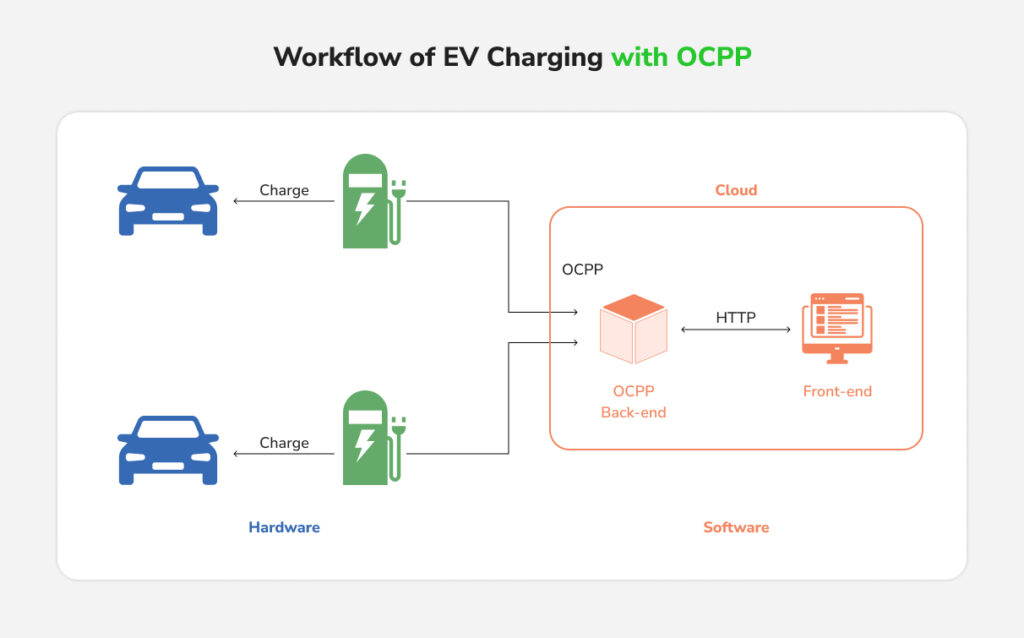
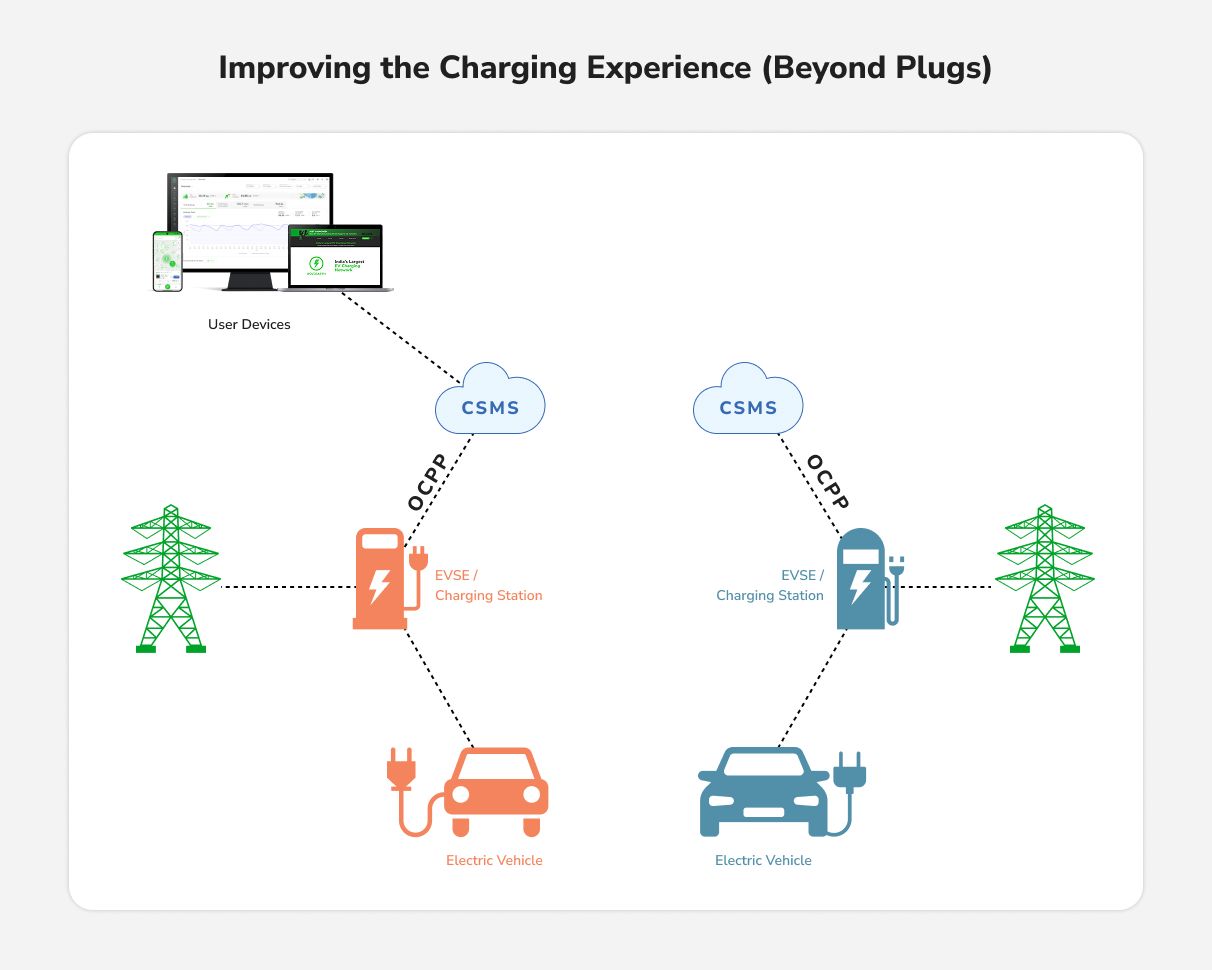
    OCPP (Open Charge Point Protocol) connects charger hardware to the network’s backend software. It ensures any EV charger can communicate with any central management system, regardless of brand or manufacturer, as long as both support OCPP. India mandates OCPP compliance for all public chargers, mirroring policies in Europe and the US.  This is the foundation of OCPP interoperability.

    Workflow of EV charging with OCPP

    OCPI (Open Charge Point Interface) connects networks to networks. It governs how different CPOs and mobility service providers exchange data, authenticate roaming users, and settle payments. 

    OCPI is open-source and peer-to-peer, enabling large-scale cooperation without centralized control. In regions like Europe and California, OCPI 2.2 has become the de facto standard for EV roaming. India’s 2023 charging guidelines also highlight the OCPI protocol alongside OCPP as essential for open, interoperable networks that support unified payments and user access. 

    Together, OCPP and OCPI bridge every link, from the charger on the ground to the roaming platform in the cloud. OCPP ensures chargers can talk to their operators; OCPI ensures operators can talk to each other. This dual-layer interoperability turns isolated charging points into a connected national ecosystem, effectively creating an OCPI EV charging network that supports unified payments and user access.

    India stands to gain immensely from adopting these open standards. Proprietary systems may promise short-term control, but they limit scale. By “speaking the same language,” every charger and every network can join a shared grid, reducing integration costs, expanding accessibility, and accelerating the country’s clean-mobility transition. 

    How EV Roaming Improves the EV User Experience  

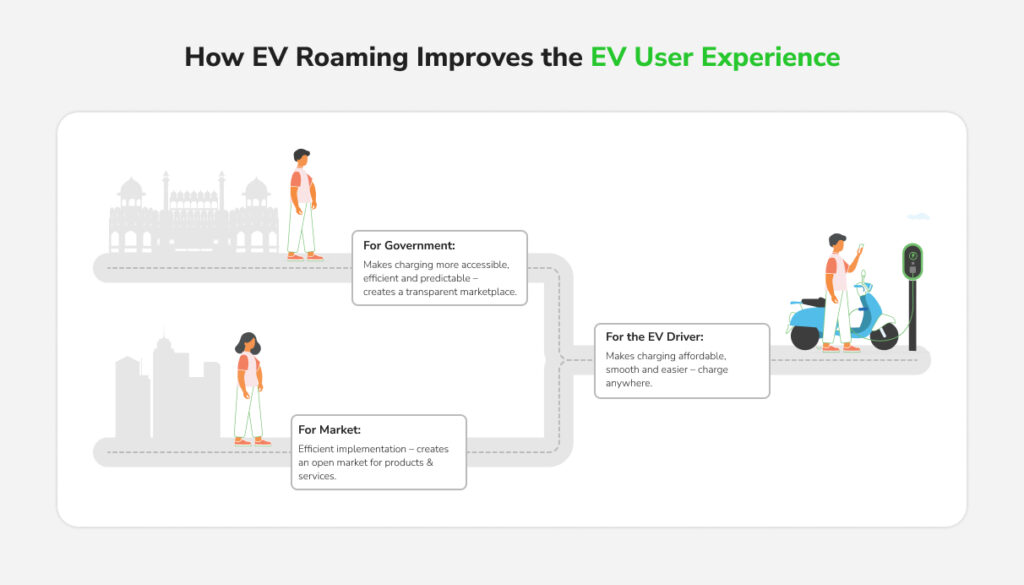
    EV roaming improves user experience

    Ultimately, roaming is about making life easier for EV owners. A seamless roaming framework can improve the user experience in severalways:  


    1. One App, One Login 

    Roaming lets EV drivers replace dozens of apps, cards, and logins with a single account. Imagine opening one app, seeing every charger in India, regardless of operator, and starting a session instantly. No more switching between networks or managing multiple passwords. This simplicity removes the intimidation barrier for new EV owners.  

    2. Unified and Frictionless Payments 

    One wallet or monthly bill covers all your sessions across networks. Whether through UPI, cards, or a single prepaid balance, every station recognizes your payment credentials. Tap your RFID, scan a QR code, and charge, no recharging multiple wallets or struggling with failed gateways. India’s digital payment infrastructure makes this especially feasible, paving the way for consistent, reliable billing nationwide. 
     

    3. Smarter Discovery and Real-Time Accuracy 

    Real-time data shows charger status and pricing, improving  route planning and making reservations smarter. Roaming  expands options and builds trust through transparency. 
     

    4. Confidence Without Range Anxiety 

    With roaming, drivers know that any compatible charger will “just work.” No need to check which app or card applies. This reliability transforms EV ownership, especially for long-distance travel. It’s why in Europe, drivers barely think about who runs a station; they simply plug in and go. That’s the level of simplicity India must aim for. 
     

    5. One Point of Support 

    Roaming also simplifies customer service. If a session fails, users can contact their home provider, who will coordinate with the network in the background. Unified support lines, like those emerging under Tata’s verified charging program, make assistance consistent and stress-free. It fosters accountability and is convenient. When all networks share a connected system, persistent issues get noticed and fixed faster. 

    Challenges for EV Roaming in India 

    While the case for EV roaming is compelling, making it the norm in India is not without challenges. Both technical and commercial hurdles need to be overcome before “roam anywhere” truly becomes standard practice. Understanding these challenges is important in charting the path forward: 

    1. Industry Cooperation and Trust 

    Interoperability requires competitors to collaborate, which is often difficult. Large CPOs fear losing customer data or control; smaller ones worry about being undercut if bigger players use roaming data to identify prime charging spots. Reports already suggest such rivalries in India. Today, roaming often depends on bilateral agreements between networks and is slow, manual, and prone to “walled garden” behavior. 
     
    A neutral clearing body could help, similar to the NPCI (National Payments Corporation of India) in payments . Policy incentives or light mandates might also be needed to bring big networks to the same table. 

    2. Clearing and Settlement Systems 

    When a user charges on another network, payments require secure systems. Europe’s Hubject serves this role, but India doesn’t yet have an equivalent. However, India’s experience with  UPI  and  FASTag proves that such interoperable, multi-party settlements are possible; the challenge is adapting that success to EV charging. 

    3. Technical Integration and Standards 

    Many chargers still lack support for open standards like OCPP 2.0 or OCPI 2.2. Smaller CPOs will need technical upgrades, vendor support, and cybersecurity reinforcement before joining roaming networks. The government has already mandated open protocols for new chargers; the next step is auditing and certifying older ones. Over time, standards like ISO 15118 (“Plug & Charge”) will make the user experience even simpler, but first, interoperability must be baked into every new deployment. 

    4. Commercial Models and Pricing 

    Roaming introduces fees, and aligning pricing is tricky. If charges are too high, users won’t adopt; too low, and CPOs lose incentive. A fair model should keep consumer tariffs consistent while letting networks share revenue transparently. Regulators may need to step in to prevent price discrimination between “home” and “roaming” users. CPOs, in turn, must shift their mindset from “owning customers” to serving the ecosystem, focusing on loyalty through experience, not exclusivity. 

    5. User Awareness and Behavior 

    Finally, it’s the human factor. Most EV drivers in India still rely on home or workplace charging and may not know roaming even exists. Likewise, on-ground staff might not recognize cross-network users. Awareness campaigns, unified apps, and clear on-screen confirmations can bridge this gap. Interoperability, after all, is as much about trust and familiarity as it’s about tech.  

    The Road Ahead for EV Roaming in India

    Looking ahead, how can these challenges be addressed to make EV roaming standard in India? A few possible pathways emerge: 

    • Policy Mandate with Phased Targets: The government could set phased interoperability targets. For example, by 2025, all new public chargers must support OCPI-based roaming; by 2026, all major networks above a certain size must be part of a roaming arrangement (either via a hub or bilateral deals) or else face penalties/lose subsidies. This would push the industry to cooperate, much like NEVI did in the US. 
       
    • National Roaming Platform or Exchange: India might establish a national EV roaming exchange, possibly operated by a neutral entity like BEE or a consortium of CPOs, where all networks plug in and swap access. This could operate on a clearinghouse model. Given India’s strength in software, an indigenous platform could be developed to handle high volumes of micropayments and data securely. The Pulse Energy initiative could scale or be a foundation for such a hub, with support to bring all players on board. 
       
    • Customer-Centric Alliances: We may see the emergence of roaming alliances led by automotive OEMs or by new-age mobility service providers. If these alliances gain popularity with EV owners, CPOs will have market incentives to join to avoid losing traffic. 
       
    • Continuous Standardization and Innovation: India should continue aligning with global standards (OCPP, OCPI, ISO 15118) while also innovating for local needs. For example, integrating UPI as a payment mechanism in OCPI flows or using Aadhaar-based authentication for a unified EV owner ID could be local enhancements. Standardizing how user identification is done (perhaps via phone number or vehicle VIN in the backend) could simplify roaming agreements too. 

    Final Thoughts

    Making EV roaming the norm in India is a journey that requires coordination between industry, government, and technology. The benefits for users and the EV sector are immense —convenience,  confidence, and higher utilization. With collaborative platforms and open standards, India can build a truly OCPI EV charging network.  

    In a few years, we should aim for an EV driver in India to be able to say, “I can charge anywhere, anytime, with one simple method, just like I can call anyone on any network or withdraw cash from any ATM.” That will be the true measure of interoperability and a key milestone in India’s e-mobility revolution.  

    Blog Banner

    Frequently Asked Questions

    How does EV roaming actually work behind the scenes?

    Roaming works through two communication layers: 

    • OCPP connects chargers to their home network. 
    • OCPI connects different networks to each other. 

    When you start a session on another network’s charger, OCPI handles authentication and billing, while OCPP manages charger operations. It’s similar to how mobile networks or ATM networks interoperate. 

    Why is EV roaming important for India right now?

    Because India has 40+ CPOs, each with its own app and payment system. This fragmentation creates inconvenience and “charging anxiety.” Roaming: 

    • Makes charging predictable 
    • Increases charger utilization 
    • Creates uniformity in payments and support 

    Helps long-distance travel become stress-free

    Is EV roaming only for public chargers? 

    Primarily yes, for now. But in the future: 

    • Apartment complexes may allow controlled public access 
    • Homeowners could offer peer-to-peer charging 

    Fleet or workplace chargers might open during off-peak hours 
    So private/semi-private chargers may join roaming networks selectively.

  • EV Charging Accessibility: Are We Designing for Everyone?

    EV Charging Accessibility: Are We Designing for Everyone?

    Electric vehicles are surging into the mainstream, but the growth of charging infrastructure hasn’t reached everyone equally. As of 2025, there are over 5 million public EV charging stations worldwide, a number that doubled since 2022. Yet this global total hides stark disparities. China alone accounts for 65% of these chargers (with 2.7 million stations), while entire regions remain underserved. India, for instance, has roughly 26,000 public chargers for its rapidly growing EV fleet, concentrated mostly in a few urban hubs. These gaps raise critical questions about whether our EV charging network is truly being designed for everyone.

    This blog explores three key questions at the heart of EV charging accessibility:

    • Are EV chargers being built where people actually need them?
    • Is charging equally easy and affordable for all drivers?
    • What will it take to make EV charging truly universal and inclusive?

    By examining infrastructure data and on-the-ground realities, from urban-rural divides to costs and policy interventions, we can assess how inclusive today’s charging ecosystem is and what changes are needed to ensure every EV driver benefits.

    Are EV Chargers Being Built Where People Actually Need Them?

    Despite the impressive growth in charger numbers, their distribution often fails to align with where drivers need them most. Globally, deployment has been heavily skewed toward a few countries and cities.

    These imbalances also appear within countries, especially between urban and rural areas. In Europe, major cities tend to be well equipped. For example, Amsterdam and other Dutch cities have dense charger networks to serve residents of apartment buildings that lack private parking.

    In such cities, there are fewer than 10 electric cars per public charging point (better than national averages), reflecting an effort to prioritize urban charging access. By contrast, rural regions lag behind.

    Norway provides a telling example: while it aggressively installed fast chargers every 50 km along highways (achieving approx. 75% highway coverage by end-2024), rural charger density off the main roads remains far thinner than in Oslo or Bergen.
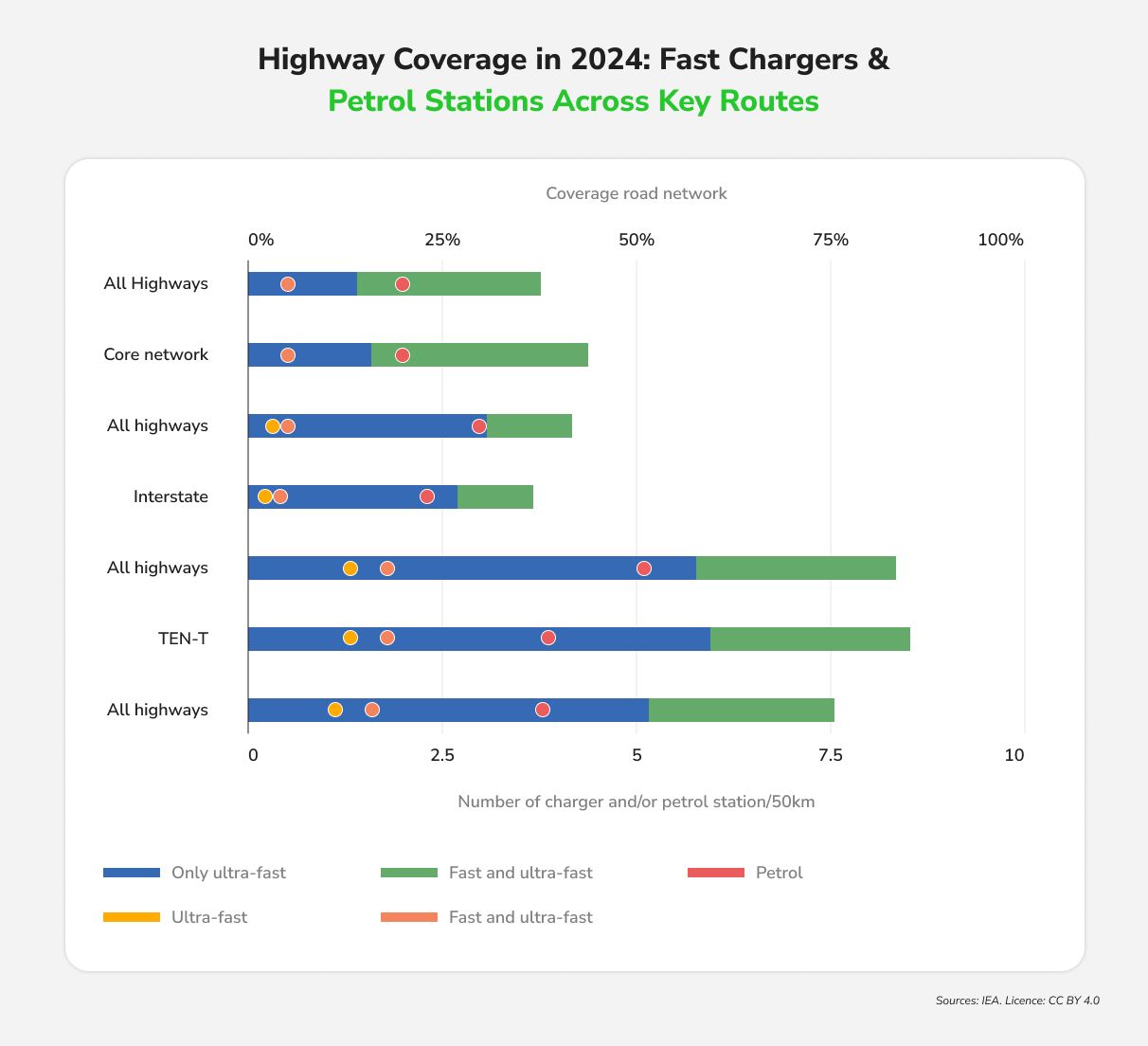
    Highway Coverage in 2024.jpg

    In the United States, a similar pattern emerges. Coastal states like California and New York host a large share of public EV charging stations, whereas the central and rural states have comparatively few. Only 35% of US interstate highways had fast chargers every 50 km in 2024 (versus 75% in Europe), with some Midwestern and Great Plains regions having coverage on just 20–30% of highways.

    A recent analysis found about 64% of Americans live within 2 miles of a public EV charger, meaning 36%, largely in less-populated and rural areas – do not. Access is clearly not uniform.
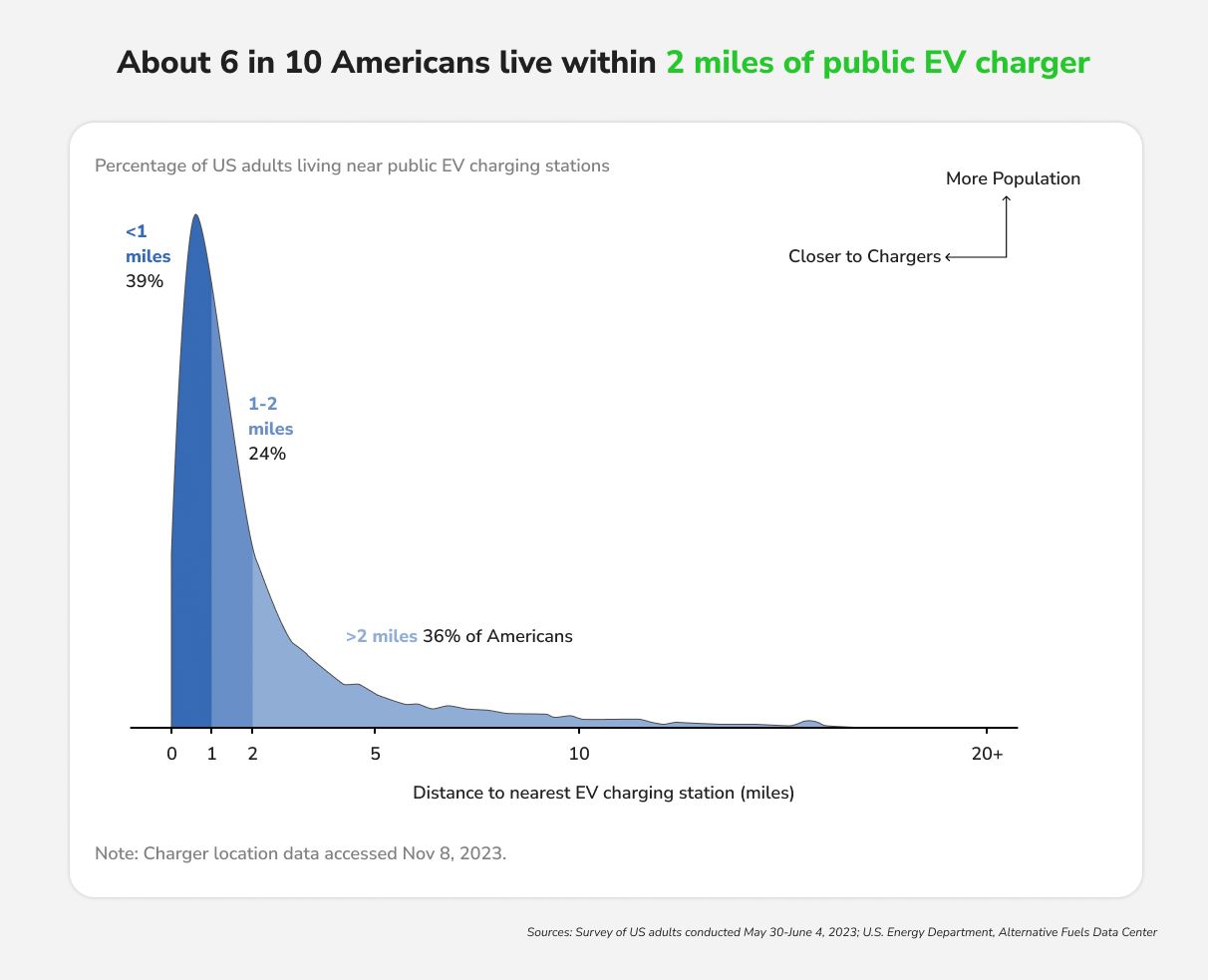
    About 6 in 10 Americans.jpg

    Where people live and park has a huge impact on charging accessibility. In suburb and rural towns where single-family homes with garages are common, most EV owners can install home chargers and rarely need public stations.

    But in dense urban areas and apartment complexes, home charging is often impossible, putting residents at the mercy of public infrastructure. In India, for example, a majority of urban dwellers live in multi-unit housing or communities without dedicated parking.

    Similarly, in South Korea, one of the world’s most densely populated countries, limited home charging access has driven the highest public charging capacity per EV in the world. Even in countries with high EV adoption like Norway or the UK, surveys show 15–30% of EV owners living in apartments lack any home charging access.

    These drivers need abundant public or shared chargers in residential areas. Some cities have started addressing this by installing curbside chargers, but many places have not

    Amsterdam is often cited as a best practice case: knowing that “residential and office buildings often have less private parking,” the city proactively built thousands of curbside and garage chargers to serve apartment dwellers and commuters. Elsewhere, EV charging for apartments is still a challenge, and apartment EV owners rely on workplace charging or public stations, which may be inconveniently located or crowded.

    Another challenge is ensuring chargers are available where drivers travel, not just where they live. Early EV infrastructure focused heavily on cities and a few highways, but long-distance routes and remote areas still have gaps.

    As of 2024, Europe’s main corridors (Trans-European Networks) were well covered, over 75% of highways had fast chargers every 50 km, thanks to both market-driven rollout and new regulations. The EU’s Alternative Fuels Infrastructure Regulation (AFIR) will soon mandate at least one 150 kW station every 60 km on major roads by 2025, locking in comprehensive coverage.

    The United States is catching up via federal programs, but rural communities and secondary highways often lack charging options, contributing to “charging deserts” that deter EV uptake beyond urban centers.

    Even where public chargers exist, they may not be truly accessible. Up to 20% of Europe’s “public” chargers are actually semi-public, for example, in hotel parking lots or gated office campuses where only certain users can enter. Limited hours, membership requirements, or physical barriers degrade effective availability of charging.

    Many drivers have pulled up to a “public” charger only to find it behind a paywall or closed after business hours. Standardization and openness are improving, but still uneven. Furthermore, chargers must be operational and user-friendly: a broken station or one requiring half a dozen smartphone apps can be as bad as none at all.

    These issues blend into the next question of ease and equity.

    Is Charging Equally Easy and Affordable for All Drivers?

    Charging an EV should be as effortless and fair as filling a gas tank, but for many drivers that’s not yet the case. Ease and cost of charging can vary dramatically based on a driver’s living situation and location.

    The most convenient and cheapest way to charge – at home overnight – is only an option for those with a private driveway or garage. Indeed, more than 80% of EV charging globally happens at home today. This creates an inherent inequality: drivers who are homeowners (often higher-income) reap the benefits of low-cost, easy overnight charging, whereas renters and apartment dwellers must seek out public chargers and often pay higher rates.

    A US study showed that homeowners are three times more likely than renters to own an EV, even after controlling for income, highlighting how critical home charging access is. In other words, the charging gap is contributing to an “EV privilege” for certain demographics.
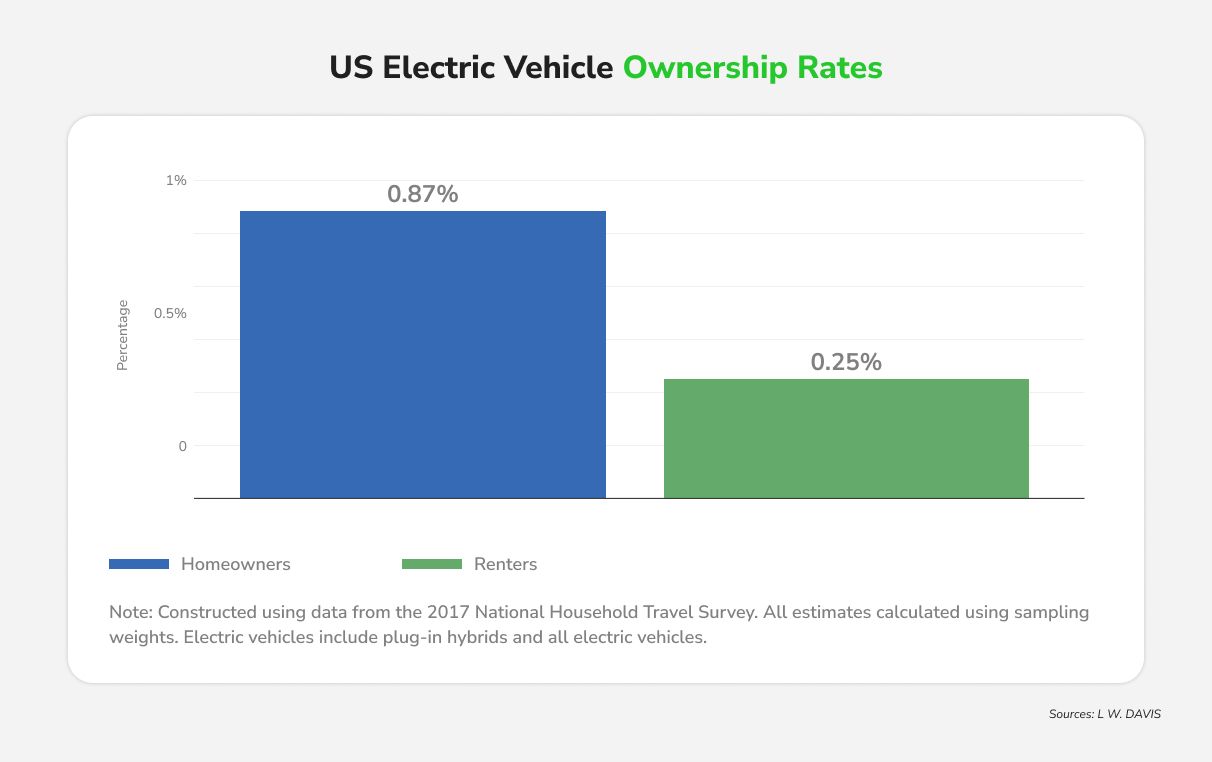
    US Electric Vehicle Ownership Rates.jpg

    Apartment residents without on-site chargers rely on public or community charging infrastructure that might be several blocks away or at busy hubs, a far cry from the ease of plugging in at one’s doorstep.

    Beyond convenience, charging costs can hit different drivers’ wallets in unequal ways. Those who charge primarily at home benefit from residential electricity tariffs that, in many countries, make driving on electricity significantly cheaper per mile than driving on gasoline.

    For instance, charging at home in Europe can cost half as much as fueling a comparable petrol car on a per-mile basis under today’s energy prices. In India, many states offer special EV tariffs or even allow home/business charging on existing connections at low rates. However, drivers who cannot charge at home frequently turn to public fast chargers, which often charge premium prices. Fast-charging on the road can erode or even eliminate the fuel-cost savings of EVs.

    A report by Car and Driver found that while home charging an efficient EV can cost as little as one-third the price of gasoline for 100 miles, using commercial DC fast chargers for that same distance can be as expensive or pricier than gasoline.

    Many US fast-charging networks price energy at $0.30–$0.50 per kWh, translating to roughly $10–$15 per “fill-up” of 100 miles – similar to what a gasoline car would cost for the same distance.

    In Europe, public charging rates of €0.60–€0.80/kWh have been reported during peak hours, approaching parity with diesel cost per km. Thus, an EV owner without home or workplace charging (often an apartment dweller or lower-income driver) might pay more per mile than a wealthier homeowner charging cheaply overnight. This is an unintended inequity in the current system.

    Charging affordability is not only about energy prices but also about upfront costs and knowledge. Setting up a home charger, if one has the option, can cost several hundred dollars (or more with electrical upgrades), which can be a barrier for moderate-income households.

    Meanwhile, many drivers are not on optimal electricity plans, they might be unaware of cheaper nighttime EV tariffs or lack access to them. Governments have begun addressing this: India’s 2022-23 charging guidelines mandated that distribution companies offer a simple, single-part tariff for public charging (capped around the average cost of power) to prevent exorbitant demand charges, and even set ceiling prices for slow and fast charging. The guidelines also provided for reduced tariffs during solar hours (20% discount) to encourage daytime charging at lower cost.

    These measures aim to keep community charging affordable and consistent. Not all regions have such controls, but they illustrate ways to avoid pricing EV fuel out of reach, a necessary step toward building a truly universal EV charging station network.

    Beyond cost, ease of use remains a sticking point, especially when roaming across different charging networks. A truly easy charging experience means plugging in and charging without hurdles, but reality can involve app downloads, membership cards, varying plug types, and unreliable station uptime.
    For community charging models and universal EV charging station access to succeed, these barriers must be addressed head-on.

    Technical incompatibilities can make charging a headache. For example, a driver of a CHAdeMO plug EV might find only CCS plugs at a station, or a Tesla Supercharger might have been (until recently) exclusive to Tesla vehicles. Payment systems are another barrier – some stations require RFID membership cards or specific apps instead of simple credit card taps, which can confuse new users.

    These technical and logistical barriers reduce overall accessibility.

    The good news is that industry trends are towards more open networks and standardized systems. Connector compatibility is improving, CCS becoming dominant in many markets, and Tesla has begun opening its network adapters. Some regions are also mandating uniform payment access. For instance, the EU now requires all fast chargers to accept ad-hoc payments (such as contactless credit cards) without a subscription.

    Still, as of 2025, the user experience remains inconsistent. A driver in California might seamlessly use a Tesla or Electrify America station with a single app, while a driver in India or Europe might need to juggle multiple apps to access different provider networks. This fragmentation disproportionately affects those who are _less tech-savvy or frequently travel off the beaten path_.

    What about drivers of commercial fleets and special use cases? Here, accessibility issues take on a different dimension. Fleet operators such as electric taxi services, delivery vans, or rideshare drivers require reliable, high-throughput charging at depots or strategic locations. In cities with limited fast charging infrastructure, an electric taxi driver might spend too much time waiting to charge, directly impacting their earnings. In this context, charging access becomes an economic equity issue.

    Heavy commercial vehicles like trucks face even greater challenges. They need ultra-high-power chargers (often 350 kW or more) and ample space to maneuver. Currently, such infrastructure is scarce outside a few pilot corridors. A small trucking firm aiming to electrify its fleet may no public megawatt-level charging along regional routes, limiting adoption to those who can afford private depot installations. While upcoming infrastructure plans aim to address this gap, the reality today is that charging is far more accessible for passenger cars in urban areas than for rural trucking companies or intercity bus operators.

    What Will It Take to Make EV Charging Truly Universal and Inclusive?

    Achieving equitable EV charging by 2030 will require smart planning, public investment, supportive policies, and inclusive design. Fortunately, governments and industry players are already taking steps. Here are five key strategies emerging globally:

    1. Strategic infrastructure deployment in underserved areas
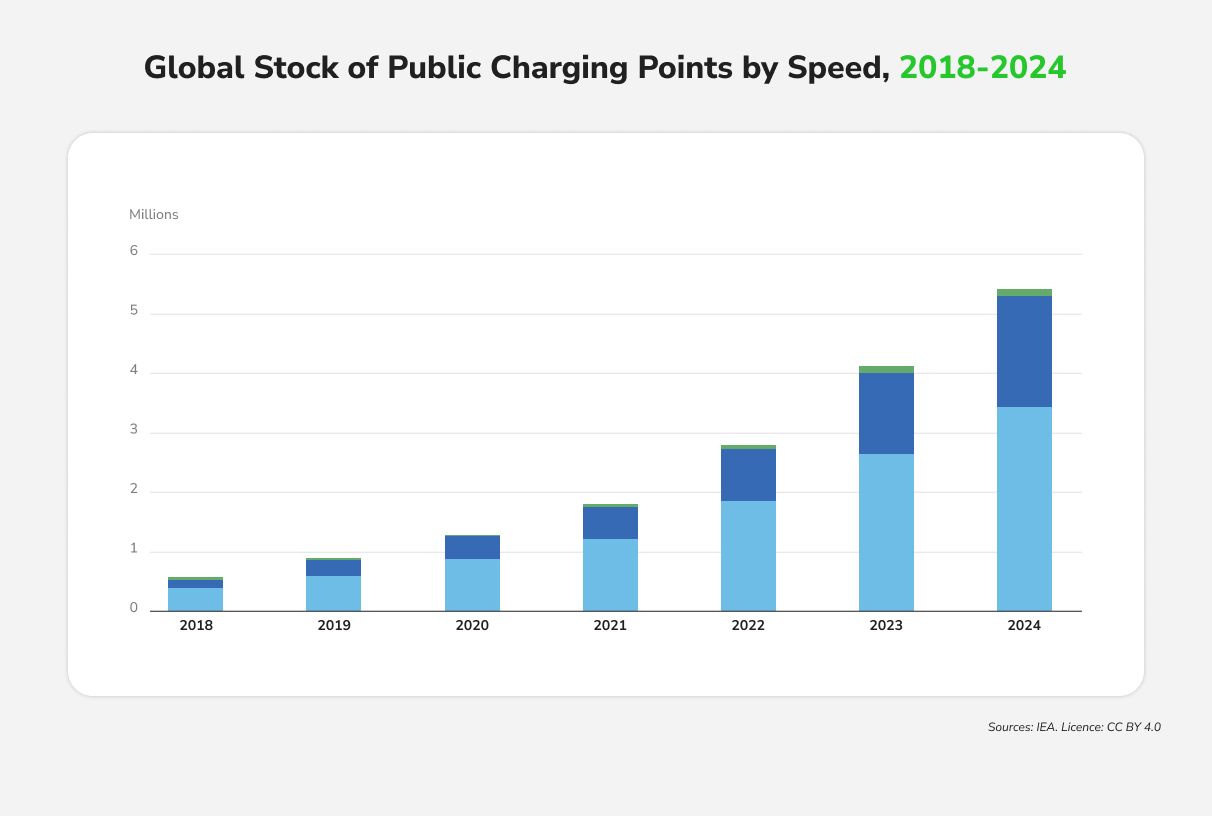
    Global Stock of Public Charging.jpg
    A truly universal network means extending chargers beyond urban centers to highways, smaller towns, and rural regions.

    • EU’s AFIR regulation: Europe’s AFIR mandates fast chargers every 60 km on major roads and sets minimum power capacity per EV, effectively pushing member states to install enough chargers proportional to their EV adoption, a mechanism to prevent some regions from falling behind in charger-to-EV ratio.
    • China’s rural push: China after achieving breakneck EV sales growth, is now turning attention to infrastructure: it has announced plans for “full coverage in cities and on highways by 2030”, along with expanded charging networks in rural areas. This includes subsidies for charging stations in smaller cities and along trucking routes, so that EV uptake isn’t constrained to coastal megacities.
    • India’s PM E-DRIVE: In India, the PM E-DRIVE scheme launched in late 2024 is funding 72,000 public charging stations by 2026 with a focus on urban centers and key transport corridors. If executed fully, this would roughly quadruple India’s public charging infrastructure in just a couple years, significantly filling the availability gap.

    2. Integrating charging into urban planning and building codes
    Blog creatives_9th.jpg
    To support apartment dwellers and those without home chargers, governments are pushing to embed charging solutions into residential and commercial infrastructure by default.

    The European Union has updated its Energy Performance of Buildings Directive to mandate “pre-cabling” for EV chargers in new buildings and major renovations. This means new apartments, offices, and shopping centers must be built EV-ready, preventing costly retrofits later and making it easier to install chargers for residents.

    Some cities like London and New York have begun adding curbside chargers on residential streets and encouraging lamp-post chargers to serve cars parked on city streets overnight.

    India’s 2024 revised guidelines explicitly call for including charging infrastructure in urban development plans and providing fast-track approvals for installing stations. They also set standards for battery swapping stations to ensure alternative charging models are available where plug-in charging is impractical. Making EV charging as routine as street parking or a gas station requires these kinds of planning measures so that chargers appear in residential complexes, malls, and workplaces as a matter of course.

    3. Keeping charging affordable and grid-friendly

    Universal charging must be accessible and sustainable. Policies to subsidize or cap the cost of charging can help lower-income drivers. Example, France and Germany have offered reduced electricity tax rates for public EV charging providers to keep prices moderate.

    India, as noted, set ceiling tariffs for public chargers and even time-of-use pricing (discounts during solar hours) to encourage cheap charging when power is plentiful.

    Utilities in states like California are experimenting with special EV charging rates that provide low-cost power at night for those who can’t get a dedicated home meter, effectively letting, say, an apartment EV owner charge at near-residential rates at public night-time chargers.

    On the technology side, smart charging and load management are being deployed to control costs and improve reliability. By shifting more charging to off-peak times, grids can handle more EVs without expensive upgrades, and drivers benefit from lower rates.

    Read more: EV Charging and Grid Stress: How Smart Chargers Can Balance the Load

    4. Expanding charging options for fleets and heavy vehicles

    To include commercial drivers and logistics operators in the EV revolution, tailored infrastructure is needed. Governments are now investing in high-power charging corridors for trucks and incentives for depot charging.

    The US Department of Energy, for example, launched a “SuperTruck Charge” initiative in 2025, funding $68 million in projects to demonstrate megawatt-scale charging sites near ports and major freight corridors. These projects will build publicly accessible truck stops with multiple MCS (Megawatt Charging System) chargers and integrate on-site solar and storage to support the grid.

    Europe’s AFIR requires dedicated heavy-duty vehicle charging stations every 120 km on core networks by 2030, with power outputs in the megawatt range to serve large trucks and buses.

    In India, where electrification of buses and three-wheelers is a priority, there are pilot programs for swappable batteries in e-buses and the installation of chargers at bus depots under the PM E-DRIVE scheme.

    By 2030, we should see dedicated “electric truck stops”, widespread depot charging support (with possibly tariff incentives for fleets), and perhaps shared charging hubs where multiple commercial operators can plug in. These developments will make electrification feasible for businesses, not just private car owners.

    5. Embracing innovation and standardization

    Interoperability is key to an inclusive charging ecosystem, meaning any EV should be able to use any public charger with ease.

    More charging networks now use open systems and roaming deals, so one app can work across many charging stations. The Tesla Supercharger network is gradually opening some stations to non-Tesla EVs in Europe and North America, thanks to standard connector adoption and policy nudges.

    Governments and organizations like the CharIN consortium are working on harmonizing standards for megawatt charging, payment systems, and data sharing. By 2030, we can expect a far more seamless user experience, where a driver doesn’t need to think about plug compatibility or whether they have the right app; the car and charger will communicate and handle authorization/payment in the background.

    This kind of simplicity is crucial for EVs to be welcoming to everyone, including those who are not tech enthusiasts. In parallel, innovations like battery swapping and mobile charging services could complement the fixed charger network to fill accessibility gaps.

    For example, rural areas with low EV density might see mobile charging vans or battery swap stations as interim solutions until demand grows for permanent stations. Renewable energy integration and energy storage at charging sites can also improve reliability and sustainability of the network, ensuring that even remote communities with weak grids can charge without blackouts.

    Final Thoughts

    EV charging has evolved from being a niche concern to becoming an essential infrastructure. However, it’s still a work in progress. To truly design for everyone, we must go beyond quantity and focus on equity, ensuring chargers are available, affordable, and easy to use for all types of users, regardless of income, geography, or vehicle type.

    By 2030, the goal globally is clear: charging should be as routine and inclusive as refueling, only cleaner; to live in a world where EV charging is no longer a privilege, but a public amenity available to everyone. If the private and public stakeholders stay the course, we’ll move from asking, “Are we designing charging for everyone?” to confidently answering “Yes”.

    Blog Banner

  • Universal EV Chargers Explained:Solving the Fragmented Charging Ecosystem

    Universal EV Chargers Explained:Solving the Fragmented Charging Ecosystem

    Electric vehicles (EVs) are becoming mainstream worldwide, yet EV owners still face the issue of a fragmented charging ecosystem. The reason? Multiple unstandardized connectors.
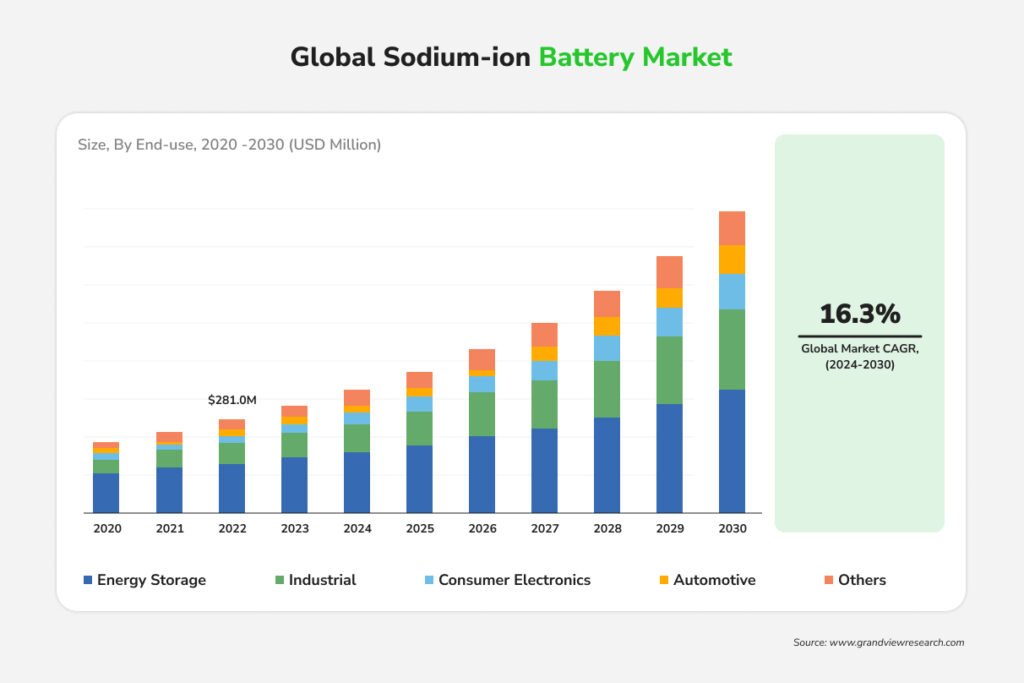
    Unlike gasoline cars that accept the same fuel nozzle, EVs lack a single “universal EV charger” that works with every EV model.

    Let’s understand this with an example: India’s EV market is dominated by two- and three-wheelers, but there are over 10 different charging connectors used across EV brands.

    Globally, EV charging solutions employ a patchwork of connector standards. From CCS and CHAdeMO to Tesla’s NACS and China’s GB/T, these connectors make EV charging interoperability a serious challenge.

    Read this blog to get answers for three key questions:

    • What are the major EV charging connector standards, and why isn’t there a universal plug?
    • How do compatibility and interoperability challenges arise from this fragmented landscape, globally and in India?
    • What efforts are underway to standardize EV charging and move toward a more universal, interoperable ecosystem?

    What Are the Major EV Charging Connector Standards, and Why Isn’t There a Universal Plug?

    EV charging standards evolved regionally, leading to a patchwork of connector types rather than one universal EV charger design.

    Different countries and vehicle segments adopted their own plugs for historical, technical, or policy reasons. This resulted in the issue that there is no “one-size-fits-all” EV connector today. Thus, it’s essential to understand the key standards in use around the world. Figure 1 illustrates this regional diversity of EV charging connectors.
    Creative 3.jpg

    Now, let’s briefly understand the major EV charger connector standards and who uses them:

    Type 1 (SAE J1772)

    Creative 1.jpg
    Type 1 charger is a five-pin AC charging plug standard in North America and Japan. It supports single-phase AC at up to approx. 19 kW. Virtually every American and Japanese EV (except Tesla) has a Type 1 inlet for Level 1 and 2 AC charging. Its limitation is single-phase only and no automatic lock. Older European and Indian cars sometimes had Type 1, but Europe moved to Type 2. Tesla provides adapters so its cars can use type 1 chargers.

    Type 2 (IEC 62196-2 “Mennekes”)

    Creative 4.jpg
    Type 2 is a seven-pin AC plug standard in Europe (and adopted in many other regions, including India, for AC charging).

    Type 2 handles single- or three-phase AC (up to 22 kW on 3-phase) and features an automatic locking latch. Since 2018, all new European public chargers use Type 2 for AC, and even Tesla in Europe switched to the Type 2 design for compatibility. Likewise, India too uses Type 2 for AC charging.

    Combined Charging System (CCS)

    Creative 2.jpg
    CCS is a “combo” connector that combines AC and DC pins into one port, allowing both slow AC and fast DC charging through the same inlet. It exists in two variants:

    • CCS1 (Type 1 combo), popular in North America (the upper half comes with Type 1 with two DC pins added below)

    CCS has become the most popular DC fast-charging standard globally for cars. The advantage is it requires only one vehicle socket for all charging, unlike older systems that need a separate port for DC. Europe mandates that every new public fast charger must include at least one CCS connector, and automakers are abandoning incompatible formats in favor of CCS.

    India has also mandated CCS2 as the standard for DC fast charging on four-wheelers, aligning with the global trend.

    CHAdeMO

    Creative 5.jpg
    CHAdeMo is a dedicated DC fast-charging connector developed in Japan (the name stands for “CHArge de MOve”). It was an early DC standard (released 2010) and can support high power (up to 400 kW in the latest specs). Japan uses CHAdeMO widely for DC charging, but globally CHAdeMO is declining. Only a couple of current car models still use CHAdeMO, and notably Nissan has switched its new EVs from CHAdeMO to CCS in North America.

    In Europe, CHAdeMO stations are dwindling as EU policy and automakers move toward CCS. In India, it is only supported by a few older Japanese models and is rarely used today.

    Notably, CHAdeMO requires a separate AC port on the car, whereas CCS unifies AC/DC into one port. The CHAdeMO consortium is now working with China on a next-gen ultra-fast connector called “ChaoJi” to support up to 900 kW, which could become a future standard in Asia.

    GB/T (China)

    Creative 6.jpg
    China chose its own national standards (Guobiao/T, “GB/T”) for EV charging. China’s GB/T AC connector looks similar to Type 2, but is wired differently (not cross-compatible), supporting up to approx. 7 kW AC single-phase. The GB/T DC connector is entirely separate and supports high power, up to approx. 237 kW in its current form, with a future 900 kW via ChaoJi.

    Having a single standard helped China build the world’s densest charging network and 60% of the global EV stock. However, GB/T is essentially unique to China, so EVs exported from China must adapt to CCS or other plugs, and foreign vehicles in China need adapters.

    Tesla Proprietary / NACS

    Creative 7.jpg
    Tesla historically used proprietary connectors. In North America, its slim connector supported both AC and DC charging (up to 250+ kW). In 2022, Tesla opened this design as NACS (North American Charging Standard), and by late 2023, major US automakers like Ford and GM announced plans to adopt NACS ports on future EVs.

    This marks a significant convergence; the US market may coalesce around NACS alongside legacy CCS1. In Europe, Tesla conforms to local standards (using Type 2 / CCS2), as required by EU regulations. In China and Japan, Tesla provides adapters or modified ports (e.g., for China’s GB/T). So while Tesla’s connector unified its own network, only recently has it begun shaping a broader industry standard, at least in North America.

    Bharat AC/DC (India)

    Creative 8.jpg
    India initially developed the Bharat EV Charger standards (AC001 and DC001) for affordable charging of light vehicles. AC001 is a 3.3 kW AC charger with three 15A sockets, aimed at two-wheelers and auto-rickshaws.

    DC001 is a modest DC fast charger up to 15 kW (72–200 V, 120A) for e-rickshaws, three-wheelers, and small cars. It uses a simple India-specific connector.

    These standards were a pragmatic early solution but limited in power. As the market matured, India pivoted to global standards like CCS2 for cars while continuing to support Bharat DC001 for smaller vehicles. Many public chargers now offer CCS2 for cars plus Bharat DC001 outlets.

    Type 6 and Type 7

    Creative 9.jpg
    India’s 2W and 3W charging ecosystem has been highly fragmented, but change is underway. In 2023, BIS introduces Type 6 and Type 7 connectors (IS17017 series) as national standards.

    Hero MotoCorp’s Vida V1 scooters have adopted the Type 7 connector so far.

    How Do Compatibility and Interoperability Challenges Arise From This Fragmented Landscape, Globally and in India?

    The patchwork of charging standards creates significant compatibility challenges for EV owners, charging providers, and manufacturers. Key problems include physical incompatibility, communication issues, and a more complex infrastructure. Here are some of the major challenges:

    Inconvenience for EV Owners

    If you drive an EV, the charger must match your vehicle’s inlet, and with multiple plug types, that’s not always the case. In the US, Tesla and CCS1 vehicles need adapters to use each other’s chargers.

    In Europe, CHAdeMO-equipped cars like Nissan Leafs struggle with CCS-only stations, forcing drivers to carry bulky adapters or hunt for the right charger. As one expert put it, “When you go up to your gas pump, you know it’s going to work with your car. But you don’t have the same experience with your charger.” This uncertainty fuels range anxiety and user frustration.

    In India, the problem is especially acute for two-wheelers: an Ola scooter (Type 6) cannot use an Ather charger (Type 7), and vice versa. Most 2W/3W OEMs still rely on proprietary plugs, leaving public fast-charging networks closed to competitors. Riders are often left stranded despite available infrastructure.

    Infrastructure Complexity and Cost

    Charging service providers (CPOs) must accommodate multiple standards, increasing hardware cost and maintenance. Many public fast-charging stations end up offering multiple cables: e.g., a US station might have CCS1, CHAdeMO, and NACS, and an Indian station might need CCS2 for cars plus separate outlets for Bharat DC001 and Type 6/7 for two-wheelers.

    Interoperability and Communication Issues

    Physical plugs are one aspect; EV charging interoperability also requires communication standards between the car and charger. Different fast-charge systems use different communication protocols. CCS uses PLC digital comms via the cable, CHAdeMO uses CAN bus, and GB/T has its own protocol. These are not inherently compatible, making it difficult for chargers to serve all vehicles without supporting multiple communication stacks.

    Creative 14.jpg

    Software and Payment Fragmentation: Proprietary networks often require specific apps or RFID cards. In India, efforts like the Unified Energy Interface (UEI) aim to enable roaming and unified payments, but until such systems mature, fragmentation remains a barrier.

    Consumer Confidence and EV Adoption

    Creative 12.jpg
    Charger incompatibility continues to slow EV adoption. Surveys show that charging logistics and reliability are top concerns for consumers considering EVs. If potential buyers hear that “you might not find a compatible charger on a trip” or encounter broken, brand-specific infrastructure, they hesitate. A fragmented ecosystem forces EV owners to plan more carefully, checking connector types and station compatibility, which adds friction to the experience.

    In India, this challenge is especially common in the two-wheeler segment. The lack of a standard connector initially forced many users to rely only on home charging. While public fast chargers existed, they were often exclusive to specific brands due to proprietary plugs and protocols. This siloed approach has hindered the development of shared, inclusive charging infrastructure.

    What Efforts Are Underway to Standardize EV Charging and Move Toward a More Universal, Interoperable Ecosystem?

    With the downsides of fragmentation now evident, global efforts are underway to standardize EV charging and improve interoperability. While a single “USB-C moment” for EVs may still be elusive, consolidation around dominant standards and supportive policy frameworks is encouraging progress.

    Consolidation Around Dominant Standards

    The industry is gradually converging on fewer connector systems.

    • In the US, a major shift in 2023 saw Tesla’s NACS gain broad support. Ford, GM, Mercedes, Honda, and others are committed to NACS ports, while networks like Electrify America and ChargePoint agreed to add NACS cables. The US is now simplifying to two systems – CCS1 and NACS, with NACS likely becoming the default.
    • China remains unified under GB/T, with the ChaoJi project aiming to merge CHAdeMO and GB/T into a single ultra-fast standard for the region. Japan continues to support. CHAdeMO domestically but export CCS-equipped models.

    Policy and Mandates for Interoperability

    Governments are pushing standards to fix charger compatibility. In Europe, CCS is mandated for all new fast chargers. India has aligned with global norms by requiring CCS2 for DC and Type 2 for AC, while CHAdeMO is permitted only for legacy use. Policies also encourage multi-standard chargers to ensure no vehicle is stranded. The PM e-drive incentives and the draft battery swapping policy emphasize interoperable solutions across brands.

    In the US, federal NEVI funding initially required CCS1 on subsidized chargers, but with NACS gaining traction, regulators are revising rules to mandate open access, likely requiring both CCS and NACS. Some states have even proposed making NACS mandatory to further reduce fragmentation.

    Standardization in India’s Light EV Segment

    India’s 2W/3W charging ecosystem has been among the most fragmented, but meaningful progress is underway. In 2023, the BIS introduced Type 6 and Type 7 connectors (IS:17017 series) as national standards.

    The Bharat Charge Alliance is backing Type 6 as the common DC fast-charge interface for scooters, bikes, and rickshaws, with Ola, Tork, and others already onboard. This would allow a vehicle from one brand to charge on another’s fast charger seamlessly.

    Meanwhile, Ather’s Type 7 combined AC/DC port is also standardized, with adoption by Hero MotoCorp’s Vida scooters proving interoperability on Ather’s public chargers. Over time, the 10+ proprietary connectors used by 2W OEMs are expected to consolidate into just these one or two, simplifying public charging deployment.

    India’s approach highlights the power of industry collaboration: competitors aligning on open standards that benefit the entire sector, much like the mobile industry’s convergence on USB charging.

    Improving the Charging Experience (Beyond Plugs)

    Plug and Charge: Achieving a “universal EV charger” goes beyond hardware; it requires a seamless user experience. A key step is ISO 15118 / Plug & Charge, which lets EVs and chargers authenticate and initiate charging automatically, without apps or cards. Supported by many new EVs and CCS/Tesla chargers, it works across connector types using cryptographic certificates.

    Creative 13.jpg

    OCPP and UEI: On the network side, Open Charge Point Protocol (OCPP) enables chargers and backends from different vendors to communicate. In India, a Unified Energy Interface (UEI) is being rolled out to let drivers locate and pay for any charger through a single interface. Together, these advances tackle the software side of EV charging interoperability, making today’s patchwork of networks feel more universal to users.

    Final Thoughts

    The world may never settle on a single EV connector, but the clutter is giving way to clarity. Within a few years, two or three standards will dominate: CCS, China’s GB/T/ChaoJi, and NACS in North America, supported by adapters and harmonized protocols. Initiatives like the Megawatt Charging System show that global cooperation is possible from the start.

    The lesson is simple: EV charging interoperability unlocks adoption. As automakers, governments, and networks align, EV charging solutions will shed their complexity and become as effortless as refueling, only cleaner, smarter, and more universal.