As India marches toward its EV30@30 goals, several public and private players can play a role in boosting EV adoption. RWAs also have a unique opportunity: by installing residential EV charging stations, they can generate a steady revenue stream while boosting the country’s EV adoption.
But installing residential EV charging points is not an easy feat for RWAs, with issues like space constraints, lack of awareness and support, high upfront costs, and installation complexity. To ease these challenges and promote the setting up of EV charging stations, many state governments are introducing a single window process for EV charger installation. In part 2 of our series on residential EV charging, we dive deep into India’s single window process. More specifically, we answer three questions:
- What challenges can the single window process for EV charging point installation address?
- How can RWAs fully benefit from the single window process?
- What can RWAs and state governments learn from other single window process implementations?
The Need for a Single Window Process In The Indian Market
Despite the government incentives, setting up residential EV charging stations remains a challenging task for RWAs. For example, the Ministry of Housing and Urban Affairs (MOHUA).pdf) has set a long list of items for RWAs to follow to be eligible to set up charging stations. These requirements range from gaining a No Objection Certificate from the local municipal body all the way to sharing collected data from EV charging stations with the appropriate State Nodal Agency (SNA).
Given these stringent requirements, the EV charging installation process becomes a hassle for RWAs, thereby hindering their charging ecosystem initiatives. To further add to the hassle, the different charging requirements for different residents makes selecting charging equipment nearly impossible. Combined, these factors suffocate RWAs efforts to help their communities turn to green mobility.
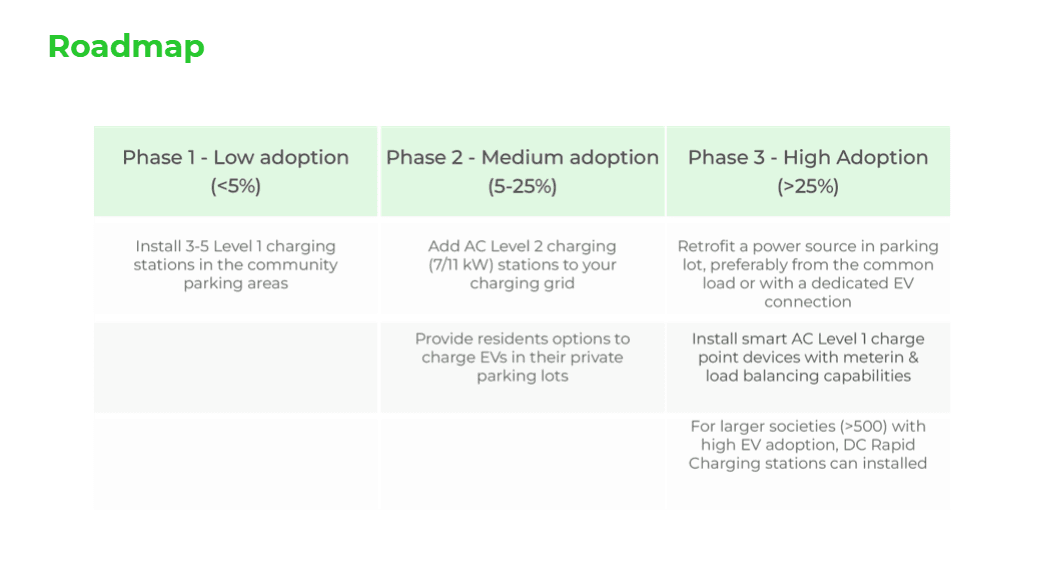
However, helping RWAs install EV chargers on their premises is an important step in achieving a full EV charging ecosystem. The table below outlines the roadmap RWAs can follow to gauge how far along they are in electrifying their society.
How the Single Window Process for EV Charger Installation Helps RWAs
The single window process for EV charger installation was set up in various states in an attempt to mitigate RWAs’ challenges. Below is a step-by-step overview of this process:
- DISCOMs enlist vendors to offer their charging equipment on the single window portal (SWP)
- One single authority handles obtaining all the permits and clearances
- The authority may provide end-to-end EV installation through its employees or chosen vendors
- RWAs can access this portal to get information on the different types of chargers, costs, vendors, etc.
- RWAs can review the available incentives and rebates on installation costs
- Office bearers simply apply and pay for the charger installation
By combining all the need-to-know information for RWAs in one single portal, the installation process is no longer a hassle. The single window process also makes EV installation more affordable, both in terms of money and time, enabling RWAs to gain more support from residents, thereby boosting EV adoption in the community.

4 Components of a Single Window Process
The single window process, with its centralized portal, standardized set of guidelines, streamlined approval process, and automatic subsidy, is expected to help RWAs install EV charging points quickly and with little effort. Below we examine how four key components in the single window process can help RWAs in India overcome installation obstacles.
1. Centralized Portal
A key component of the single window process for EV charger installation is the centralized portal that brings together different DISCOMs. In this portal, a list of trustworthy EV charging vendors vetted and approved by the state-designated authority is listed along with the cost of different chargers.
Such a credible list of vendors reduces the vetting time and effort for RWAs. It also helps ensure the chosen charging equipment will be safe and reliable. Finally, by seeing the different charger types in one place, RWAs can compare offerings to select the ones that fit their community’s needs.
2. Standardized Set of Guidelines
The single window process for EV charger installation is transparent. It also follows a standardized set of guidelines that anyone can check through the DISCOMs’ portals. These guidelines focus on safety, and ensure the EV chargers offered as well as the installation expertise of vendors meet the requirements laid down by the Bureau of Indian Standards (BIS).
Having a standard set of guidelines can help RWAs gain support from their residents, as any solution they choose will be safe for the community. In addition, these guidelines can help RWAs to better choose the types of chargers to install based on their residents’ needs.

3. Streamlined Approval Process
The single window process for EV charger installation streamlines the approval process. Once the RWA applies, the DISCOMs do a site inspection and handle all the necessary approvals and permits. RWAs simply have to apply and pay for the chargers.
By using this process, RWAs don’t have to worry about meeting the guidelines of MOHUA, the power ministry, and the local laws and regulations on their own. This, in turn, makes the installation process more efficient.
4. Subsidized Costs
Most state governments offer a subsidy for setting up EV charging stations. With a single window process, the subsidies are automatically deducted from the installation cost, and RWAs only have to pay the remaining fee. Again, this saves time and money because RWAs don’t have to pay upfront and apply for a subsidy or follow up on it. This inclusion of subsidies also helps with budgeting and planning.
Given the many benefits RWAs reap from the single window process for EV charger installation, it’s important to know how office bearers can get started with it.
How RWAs Can Use the Single Window Process In India
The single window process for EV charger installation allows RWAs to easily apply for the installation of EV chargers through a centralized portal. The five steps detailed below describe the broad process, but the exact steps may vary across states.

1. Access the Single Window Portal
The launch point of the single window process is the portals of state-authorized power distribution companies (DISCOMs). These portals have information about the application process. They also contain information about the required documents, and the price list of different chargers from approved EV charger vendors.
RWAs can follow these steps to get started:
- Visit the DISCOM’s portal to browse the list of vendors and chargers
- Decide on charger type and numbers
- Prepare the required documents in digital format
- Log in using the society’s existing customer number. To create a new customer number, the RWA should input its email ID and phone number.
2. Apply for a New EV Connection
The first part of the application is to apply for a new commercial EV connection, if required. RWAs can generally find out whether they need one through the DISCOM portal. The sample table below can help an RWA evaluate if it needs to apply for one.

RWAs can apply for a new connection with the below steps:
- Click New Connection
- Fill in the required details, like the number of charging units required
- Sign an online declaration form summarizing the entered information
- Check the details before agreeing to the terms and conditions
- Upload relevant documents, like the RWA registration certificate, address proof, the last two
- power utility bills, proof of consumer information, and other identification documents as required by the DISCOM
- Check the information for accuracy before submitting. Any errors or inconsistencies can delay the processing of the application or result in a rejection
On successful submission, an acknowledgement of the request for a new EV connection with a unique tracking number is displayed. The same information is also sent to the registered email ID and mobile number.
3. Submit and Review the Application
After applying for a new EV connection, RWAs can apply for an EV charging point installation in parallel. Based on the state’s EV policy, RWAs may have the option to pay for the installation using the CAPEX model or the Subscription model.
Below are the application steps for EV charging installation:
- Log into the single window portal
- Navigate to the the application form
- Provide the RWA consumer number, the housing society’s address, the type and number of chargers, and the cost model
From there, the online portal automatically checks details and applies any available subsidies the RWA qualifies for. The RWA will then receive the net price to pay, along with application confirmation.
If the submitted information is incorrect, the RWA receives a notification by email, or phone call. In such cases, they will have to apply again. After that, the two remaining steps are for the DISCOM to handle.
4. Monitoring the Inspection and Installation
Based on the submitted information, a vendor representative will schedule a visit to the housing community. The vendor will then assess the site and provide the detailed cost split-up for any additional electrical infrastructure required.
Once the RWA gives the go-ahead, the vendor will install the charger and present the final bill for payment. Some states require the RWA to sign an agreement with the vendor for the monthly subscription model.
It’s also a good idea for one or more RWA office bearers to be present during the inspection and installation to ensure the agreed chargers are installed, as it can be difficult to change later. Office bearers should also double-check the details on the receipt or the monthly agreement before signing.
5. Completing the Process
After the installation is complete, the vendor uploads the agreement documents or bills to the portal. The DISCOM will then provide the vendor a completion certificate and approve the subsidy. The Nodal officer will also verify the details and will initiate the subsidy to the vendor.
Though the RWAs do not receive any certificates, they may log into the DISCOM portal to check their EV charger installation. They can also follow the same process for adding more installations.
Through this single window process, RWAs only need to access the portal and provide information. The DISCOMs and vendors then take care of the process, with little to no intervention from the RWA. As a result, this reduces the workload for RWAs. But housing societies can gain more from the single window process by following some best practices.
3 Best Practices for RWAs to Implement the Single Window Process
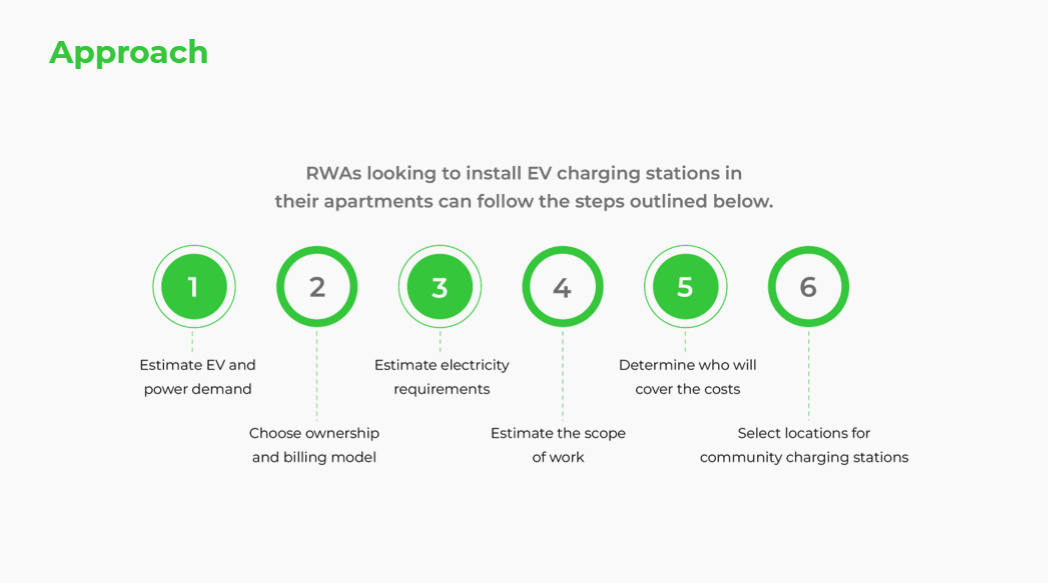
Many state governments are easing the process of EV installation in housing communities. In the first part of this series, we emphasized the approach RWAs should take when installing charging stations on their premises, as outlined in the illustration below.
However, to maximize the benefits of this process, RWAs can implement certain best practices to make the single window process more efficient and cost-effective.
1. Sign Annual Maintenance Contracts
RWAs can discuss the long-term maintenance for the installed chargers. Some vendors listed in the DISCOM portal offer annual maintenance contracts at a fixed fee that the RWAs can renew for each year. This, in turn, will help avoid expensive repairs and get technicians to attend to problems quickly.
2. Collaborate with Neighboring RWAs
An RWA with limited space can collaborate with neighboring RWAs to share EV charging points. In such cases, both RWAs can apply together through the single window portal. It’s also best for the RWAs to sign a formal agreement with the terms of use that specify the number of hours of usage for each RWA, the cost per hour, and other pertinent details. Through this collaboration, RWAs can save resources and improve the efficiency of the installation process.
3. Gauge Future EV Adoption Rates
RWAs can conduct a survey across the community to better understand how many residents are planning to buy EVs in the near future, and the type of chargers they would need. Accordingly, the RWA can select the number and type of chargers on the single window process portal. Doing so will help RWAs avoid repeating the installation process every time residents purchase new EVs.
However, the success of the single window process depends on state governments’ efforts to implement it. By analyzing how other governments have succeeded — or failed — in their efforts to implement the process, RWAs and governments can better understand how to collaborate together to ensure a successful implementation.
Case Studies: How Two Indian States Have Implemented the Single Window Process for EV Charger Installation
The case studies presented below provide a thorough understanding of the implementation of the single window processes across two different states. Through these case studies, RWAs and state governments alike can identify the factors that can lead to the success or failure of the single window process implementation.
1. Delhi
The Delhi government has launched its “EV Policy 2020”, providing a single window clearance process for installation of EV charging infrastructure. Through this plan, the Delhi government plans to install at least 30,000 charging points across the city.
To implement this single window process, the Delhi government empowered all its DISCOMs: BSES Rajdhani Power Limited (BRPL), BSES Yamuna Power Limited (BYPL), and Tata Power Delhi Distribution Limited (TPDDL). They were empaneled to shortlist EV vendors and estimate the costs for RWAs. DISCOMs then updated their websites to include the single window process and application forms.
Delhi’s single window process for EV charger installation is simple to use. RWAs can go online and complete the process or call the office, and the operator will provide detailed instructions on where to find the physical form and how to submit it. This multichannel support is handy for people with varying technical skills and backgrounds.
Because the Delhi state government has tailored this process to fit different RWAs’ needs, it has successfully installed 1,000 EV charging points since the policy was introduced.
2. Karnataka
The Karnataka government’s “Electric Vehicle and Energy Storage Policy 2017” provides a single window clearance process for setting up EV charging stations. Under this policy, Bangalore Electric Supply Company Limited (BESCOM) is responsible for setting up EV charging stations.
BESCOM follows the guidelines and regulations of the Central Electrical Authority and the safety parameters provided by the Karnataka State Electrical Inspectorate while installing EV charging points. To apply, RWAs have to reach out to BESCOM and may even have to go in person to complete the application form.
However, note that EV charging installations are being opposed by some apartment owners. The Karnataka EV policy does not have provisions to resolve these disputes, so this may delay or make it impossible to install an EV charger in the community, especially with opposition from even a few owners.
As a result, it’s crucial for state governments to ensure they are always on the same page with all RWAs, and address any concerns they may have, to guarantee the success of their single window initiatives and avoid facing Karnataka’s scenario.
Based on the above, state governments need to ensure their single window process implementation actually addresses RWAs’ needs.Looking ahead, successful single window processes across India will be key to promote further adoption of EVs.
The Future of Residential EV Infrastructure
With RWAs being a key player in the creation of a country-wide EV charging ecosystem, the government is making significant efforts to ease the installation process for EV charging stations in housing societies.
The single window process for EV charger installation can significantly simplify the approval process. As a result, it can reduce the time and costs associated with installation and facilitate private investment in EV charging infrastructure. This streamlined process can also encourage more RWAs to invest in EV charging infrastructure, leading to wider EV adoption.
However, achieving a seamless and accessible process for EV installation requires continued collaboration and innovation. Gathering information about the effectiveness of this implementation will be key to addressing any issues along the way, thereby making the process more beneficial for everyone involved.
RWAs, on the other hand, should stay informed and engaged in the process of creating a conducive environment for the growth of EV charging infrastructure. By collaborating with industry stakeholders, the government, and even other RWAs, they can ensure the EV charger installation process remains profitable for them, and safe and accessible for all residents.
For this reason, the next part of this series will discuss the importance of navigating government requirements to create a conducive regulatory environment for the growth of EV charging infrastructure.
For more information about the single window process for EV charger installation, please see the FAQ and Resources below.
FAQ
How does the single window process simplify the EV installation process?
The single window process simplifies EV installation by providing a centralized and streamlined approval process through a single portal. As soon as an RWA applies for an EV installation, a single authority or organization handles all the necessary approvals and permits. This cuts bureaucratic delays and saves time and effort for RWAs and small business owners.
What are the benefits of the single window process for EV charger installation?
The single window process for EV charger installation facilitates private investment and provides faster approvals, reduced time and costs, and increased transparency. It simplifies the approval process by consolidating multiple agencies into a single window, thereby encouraging more RWAs to invest in it. Additionally, it provides clear guidelines and reduces barriers to entry for private players, leading to competition and innovation in the market.
Who can use the single window process for EV charger installation?
The single window process for EV charger installation in India can be used by any small business owner, individual EV owners, and RWAs interested in installing EV charging infrastructure. The process aims to simplify the approval process and promote the adoption of EVs, making it accessible to a wide range of users.
How long does the approval process take under the single window process for EV charger installation?
The approval process under the single window process for EV charger installation varies from state to state, depending on the number of pending applications. In Delhi, however, the government has instructed that the installation process has to be completed within seven days of submitting a request.
What permits and approvals are required for EV installation?
Housing societies and RWAs need approvals from authorities like the State Electricity Board, local bodies like Municipal Corporations, and the Fire Department for EV installation in India. The single window process simplifies this by consolidating all approvals into a single point of contact.
What building codes or regulations to consider when installing an EV charging station?
In India, the MOHUA.pdf) lays down guidelines and regulations to consider when installing an EV charging station. When RWAs opt for the single window process for EV charger installation, all the building codes and regulations are clearly laid out. The DISCOM will also ensure the housing society is in compliance with these requirements.