Category: EV Technology and Trends

  • Why Range Anxiety Is a Myth, And What Should We Be Talking About 

    Why Range Anxiety Is a Myth, And What Should We Be Talking About 

    Despite massive improvements in battery tech and charging access, many buyers still worry about range anxiety in electric vehicles. The irony? Real-world data shows most Indians drive far less than the range even entry-level EVs offer today. 

    In this blog, we break down why range anxiety is largely outdated and what the real barriers and conversations should be in 2025, including: 

    • How actual Indian driving patterns compare with modern EV ranges 
    • Why different EV segments (2W, 3W, cars, buses) experience range differently 
    • Beyond range anxiety, what really matters to EV users in 2025 

    Range Anxiety vs. Reality: How Far Do Indians Really Drive?

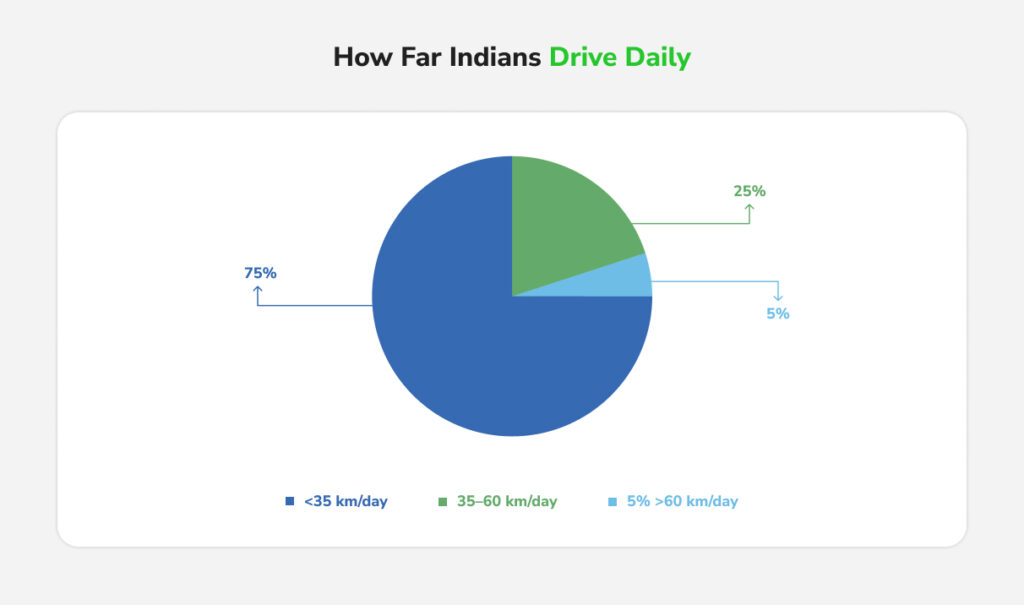
    Breakdown of How Far Indians Drive Daily

    Range anxiety assumes drivers often need more range than  EVs provide. But Indian driving patterns show the opposite. Most Indians simply don’t drive very far in a day.  

    • Modern electric cars typically deliver 200–400 km per charge, while popular two-wheelers offer 80–100 km per charge.   

    Even factoring in occasional longer trips, today’s EVs comfortably cover common use cases. As one industry expert quipped, “Nobody worries about a petrol car’s range because fuel pumps are everywhere. The same is becoming true for EVs.” 

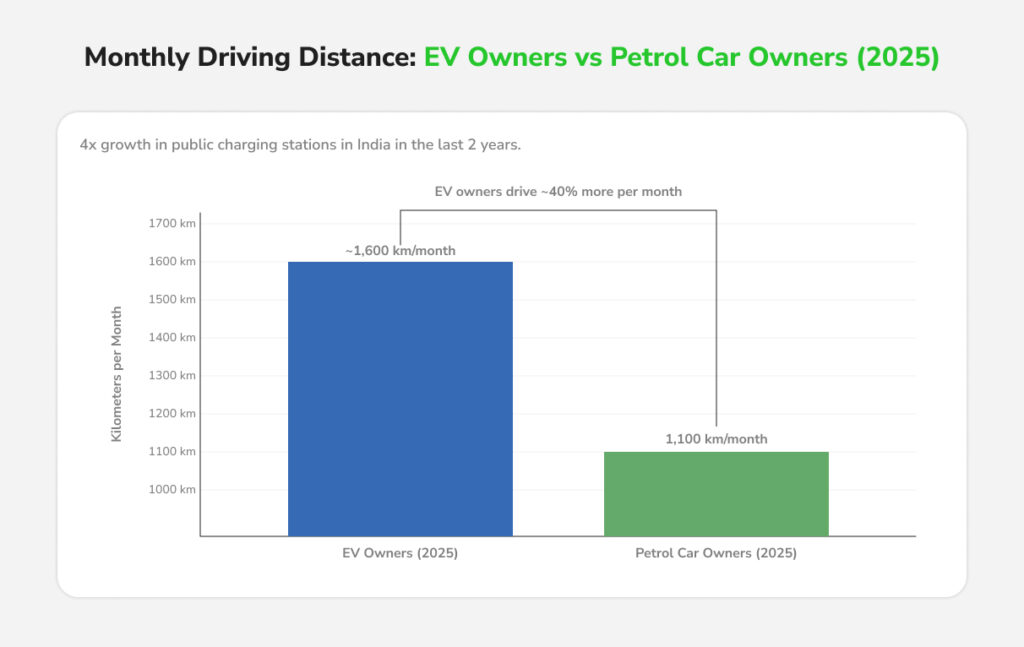
    Monthly Driving Distance: EV Owners vs Petrol Car Owners (2025)

    Data reinforces this confidence.  

    • In 2025, Indian EV owners drive about 1,600 km per month—roughly 40% more than petrol car owners. That’s about 50+ km per day of electric driving. Such confidence comes from knowing their vehicle range can handle it and that chargers are available when needed. 
    • 84% use their EV as their primary vehicle (up from 74% two years ago), and half of Tata’s EV customers have completed road trips over 500 km on major routes like Delhi–Manali or Mumbai–Goa.  

    These real-world behaviors show that range is hardly a limiting factor anymore. Long EV trips are practical and increasingly popular, and daily commuting barely scratches an EV’s battery capacity. 

    EV Range by Segment: 2W, 3W, Cars & Buses in India 

    Range anxiety means different things depending on the EV category.  

    • Electric Two-Wheelers: Scooters and bikes continue to dominate India’s EV market, with small e-scooters and e-rickshaws accounting for 94% of all EVs sold. Their typical 50–100 km range is perfectly in line with daily city travel, where most users cover well under 35–40 km a day. Models like the TVS iQube and Ola S1, offering around 100 km per charge, comfortably cover a couple of days of commuting, and overnight home charging makes range concerns negligible. As a result, range anxiety is practically nonexistent for e-2W users. 
    • Electric Three-Wheelers (E-Rickshaws & Autos): Electric rickshaws are now a familiar sight, especially in tier-2/3 cities and small towns. With a range of 80–120 km per charge, these vehicles easily handle a day’s worth of short, frequent local trips. Uttar Pradesh alone has over 4 lakh registered EVs, largely e-rickshaws, showing how deeply they’ve penetrated even rural markets. Drivers typically top up during breaks. Range anxiety is rarely a concern; drivers focus more on convenient charging points and long-term battery health. Several states, like Assam, are confident enough in this segment’s readiness that they are pushing for 100% electrification of three-wheelers in the next few years. 
    • Electric Cars (Four-Wheelers): This is the segment where range anxiety was historically the biggest talking point. Today, mainstream EVs like the Tata Nexon EV, MG ZS EV, and Hyundai Kona offer 200–300 km of real-world range, depending on the variant. For most users, 200 km covers almost a week of normal city commutes. Home charging gives car owners a full charge every morning, eliminating the need for frequent public charging. For longer highway trips, the EV charging network in India makes 400–500 km intercity journeys manageable with planned charging breaks. As a result, most EV car owners report that any initial range anxiety disappears within the first few weeks of ownership. 
    • Electric Buses: Electric buses are steadily transforming urban and intercity public transport. With typical ranges of 150–250 km per charge, they can cover an entire day’s scheduled operations. Fleet operators plan their charging strategically, usually overnight at depots and occasionally during layovers, so passengers never feel the impact. India now has nearly 10,000 electric buses on the road, thanks to programs like FAME II, which fund both buses and depot charging infrastructure. This segment demonstrates that range management is primarily a behind-the-scenes operational task rather than a user concern, enabling large-scale adoption without compromising service reliability. 

    Top EV Challenges in India 2025: Charging, Costs and Resale Value

    Charging Uptime, Accessibility & User Trust 

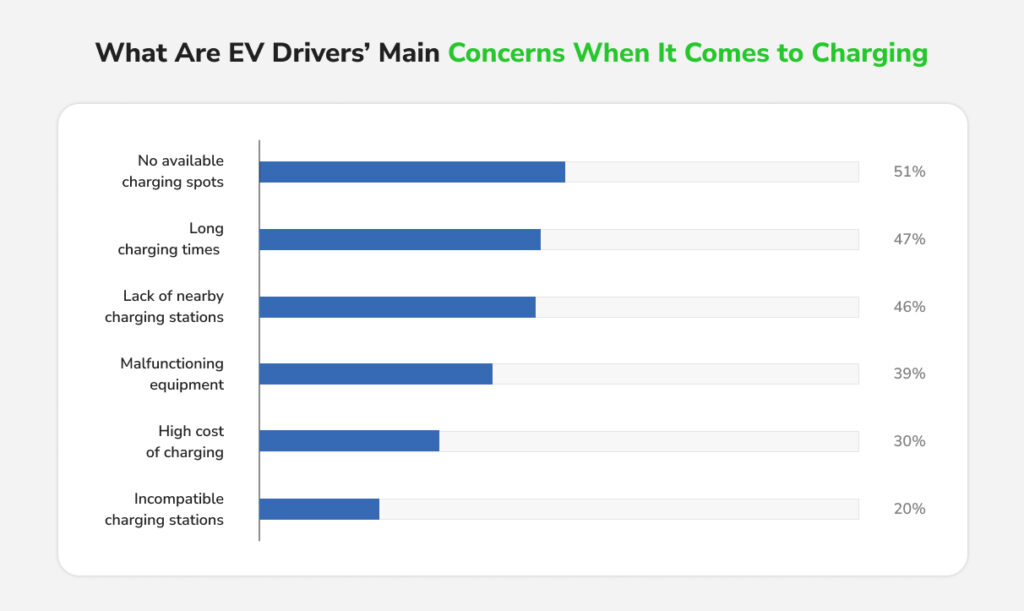
    Having chargers available is one thing; having them operational and reliable is another. Charger uptime, meaning the charger actually works when you get there, has become a critical concern. Many EV owners report arriving at a public charging station only to find stations out of service, occupied, or slower than advertised.  

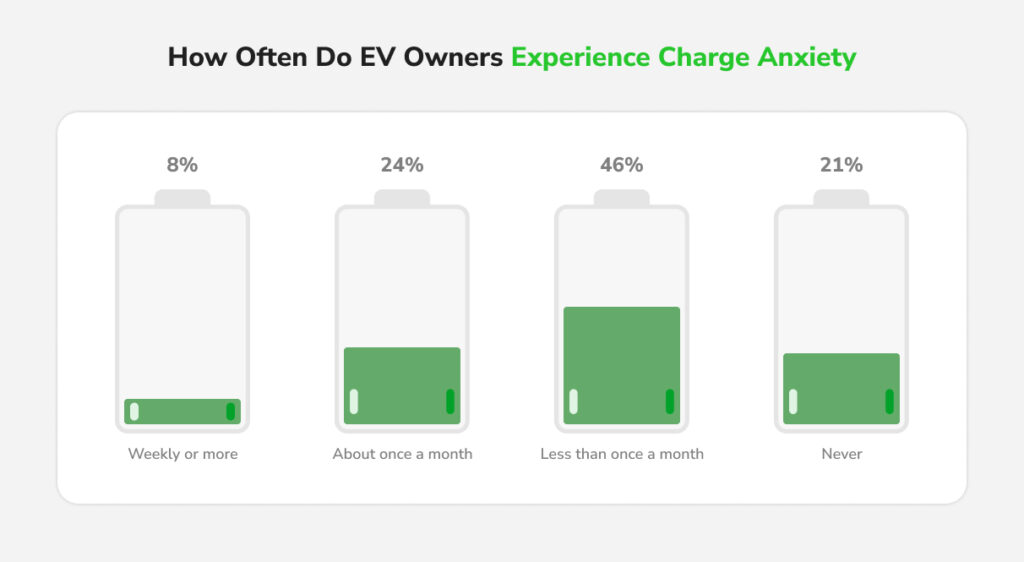
    A recent survey of EV car owners in Delhi, Mumbai, and  Bengaluru found “charging anxiety” is now a bigger concern than range anxiety, with 88% of owners citing difficulties in finding accessible, safe, working charging stations. This is despite the presence of tens of thousands of chargers on paper. This highlights the importance of reliable public EV charging networks.  

    The visibility and reliability of chargers need improvement, too.  Better signage, real-time status updates in apps, and maintenance to reduce downtime. The good news is that the industry is starting to respond. Operators are committing to higher uptimes, and the government is discussing uniform charger maintenance standards and auditing. But until that fully materializes, charger reliability remains a top-of-mind issue.  

    Fragmented User Experience

    India’s charging ecosystem is fragmented across multiple apps and providers (government-run, private startups, oil companies, and automakers). This creates a confusing EV user experience, with multiple registrations, wallets, and RFID cards required. Therefore, EV users are calling for interoperability, the ability to use any public charger with a universal access card or a common app, much like ATMs.  
     
    The government’s one-nation-one-card ambition for EV charging and emerging aggregator apps are steps forward in streamlining this. A fragmented experience is an inconvenience to users and also discourages new adopters who aren’t tech-savvy

    Resale Value Uncertainty 

    As the first generation of mainstream EVs in India ages, owners are worrying about resale value. Historically, petrol/diesel cars in India retain decent resale prices due to a well-understood used car market. However, EVs’ resale value still remains uncertain due to battery health concerns.
     
    A 5-year-old EV might still run perfectly, but prospective buyers worry about battery degradation. Since the battery is the costliest component, accounting for 30-40% of EV cost, a lack of clarity on its condition hits resale quotes. In the Park+ survey, one-third of EV owners reported a significant drop in their vehicle’s resale value, often lower than expected. Part of the issue is information asymmetry: unlike checking engine compression or mileage in an ICE car, there isn’t yet a widespread, trusted method for a used EV’s battery health certification. Having said that, the situation is improving. Some dealerships and service centers now offer battery health reports, and government agencies are exploring standard test procedures.  

    As the market matures and more second-hand EVs find new buyers, confidence in resale will grow. For now, though, concern about resale value and long-term battery life is a common refrain. The industry will need to address this through assured buyback programs, battery warranties, and transparency on battery performance over time

    High Upfront Costs & Affordability 

    EV prices in India are falling, but the upfront cost remains higher than that of petrol vehicles. Batteries still make up one-third of the manufacturing cost, the main reason for this price gap.  

    Government incentives have helped, but several of these subsidies are now tapering off. And to bridge the affordability gap, the industry is focusing on local battery production and leasing models to separate battery cost from vehicle price. Banks are also offering EV-specific loan products with lower interest rates or longer tenures. 

    Price parity remains the key milestone: until EVs are priced closer to petrol vehicles, upfront affordability will likely slow adoption more than range concerns. But the good news is that battery prices are expected to drop by nearly 50% by 2026, driving affordability. 

    Maintenance and Service Support Challenges 

    EVs are simpler machines than ICE vehicles, with fewer moving parts and generally lower routine maintenance needs. But when issues do occur—battery modules, electronics, or software glitches—the repair experience can be difficult.  

    India still lacks a widespread network of EV-skilled mechanics, and local garages often aren’t equipped to handle high-voltage systems. According to a survey, 73% of EV owners faced challenges with maintenance because local mechanics struggled to diagnose or repair. As a result, owners must depend on limited authorized service centers, leading to delays and uncertainty. 

    The ecosystem, however, is improving. OEMs and startups are investing in training programs; third-party EV repair workshops are emerging, and government initiatives like ASDC are building EV-specific skills. Over time, EV maintenance should become more routine, but in 2025, after-sales support remains a major concern for many users. 

    Final Thoughts 

    Range anxiety in electric vehicles is no longer the barrier it once was. Modern EVs already exceed the daily driving needs of most Indians, and real-world usage proves drivers trust their vehicles.  

    The real EV adoption challenges in India lie elsewhere:  

    • Reliable charging uptime  
    • Seamless EV user experience  
    • Clear resale value expectations  
    • Stronger service networks, and  
    • Affordable upfront pricing 

    Solving these issues is what will shape India’s EV adoption curve. The good part is solutions are already in motion: better charger standards, unified payment systems, battery health reporting, local manufacturing, and technician training. As these gaps close, the EV ecosystem will become more accessible, predictable, and user-friendly. 

    In short, India is moving beyond range anxiety. As adoption accelerates,  the real priority is building a reliable, seamless ecosystem, one that ensures charging uptime, affordability, and service support. That’s the key to unlocking mass adoption. 

  • EV Charging Cybersecurity in India: Threats, Risks, and Policy Landscape

    EV Charging Cybersecurity in India: Threats, Risks, and Policy Landscape

    India’s electric mobility network is growing at lightning speed, with thousands of public EV charging networks powering millions of EVs daily. As chargers become smarter and more connected, they also become prime targets for EV charging cyber threats. From data breaches to remote tampering, a single compromised EV charging station in India can disrupt networks or expose sensitive information. Securing the charging ecosystem is now as essential as maintaining grid stability or fire safety. 

    In this blog, we explore: 

    • Why cybersecurity matters for EV charging in India, and how attacks on connected chargers could compromise charging networks and infrastructure. 
    • India’s evolving policy and standards landscape and secure communication protocols.

    Why Cybersecurity Matters for EV Charging in India

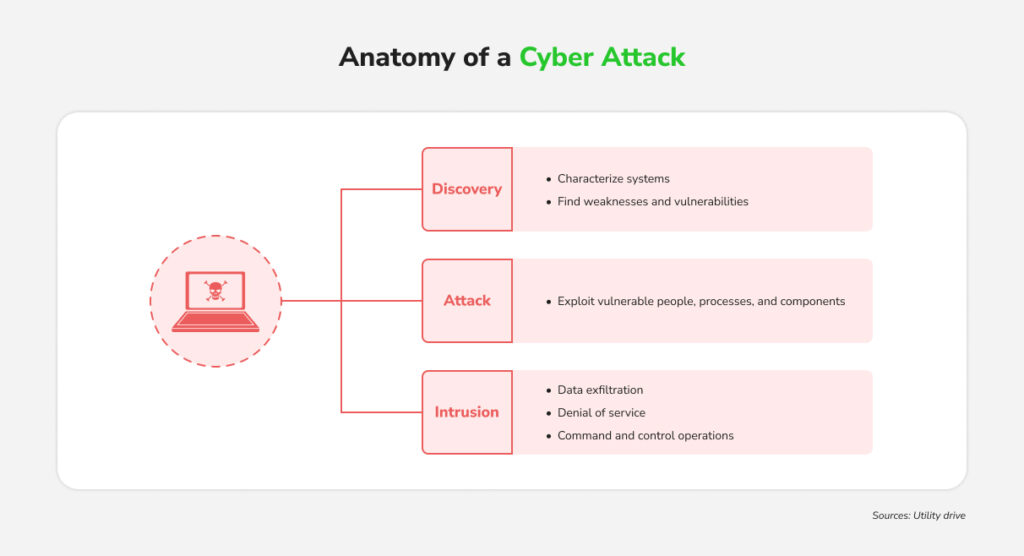
    Infographic explaining the three stages of a cyber attack, Discovery, Attack, and Intrusion, highlighting how hackers find vulnerabilities, exploit systems, and extract data.

    India’s EV ecosystem is growing fast, with nearly 2 million EVs sold in FY2024-25 and over 29,000 public charging stations operational by late 2025. The government’s PM E-Drive program aims to install 72,000+ public chargers by 2026.  
     
    Each charging point is an IoT-enabled device that connects with vehicles, payment systems, and the power grid. This connectivity brings convenience but also makes chargers enticing targets for cybercriminals. A single compromised charger could lead to stolen user data, disrupted charging services, or even grid instability. In short, cybersecurity has become as important as electrical safety in the EV charging network.

    Government and industry stakeholders recognize the stakes. In 2023, Transport Minister Nitin Gadkari cautioned Parliament that EV charging stations are “susceptible to cyberattacks and security incidents, just like any other technological application.” He noted that India’s Computer Emergency Response Team (CERT-In) has already observed vulnerabilities in charging station software/hardware and issued multiple security alerts with countermeasures. Reporting cyber incidents is now mandatory, and the government is “actively taking steps to combat the issue of hacking”, emphasizing that securing EV infrastructure is a national priority. 

    Major Cyber Risks Facing EV Charging Networks 

    What kind of cyber threats do EV charging networks face? Broadly, the risks mirror those in other IoT and critical infrastructure systems. Key threat vectors include: 

    1. Denial-of-Service (DoS) Attacks

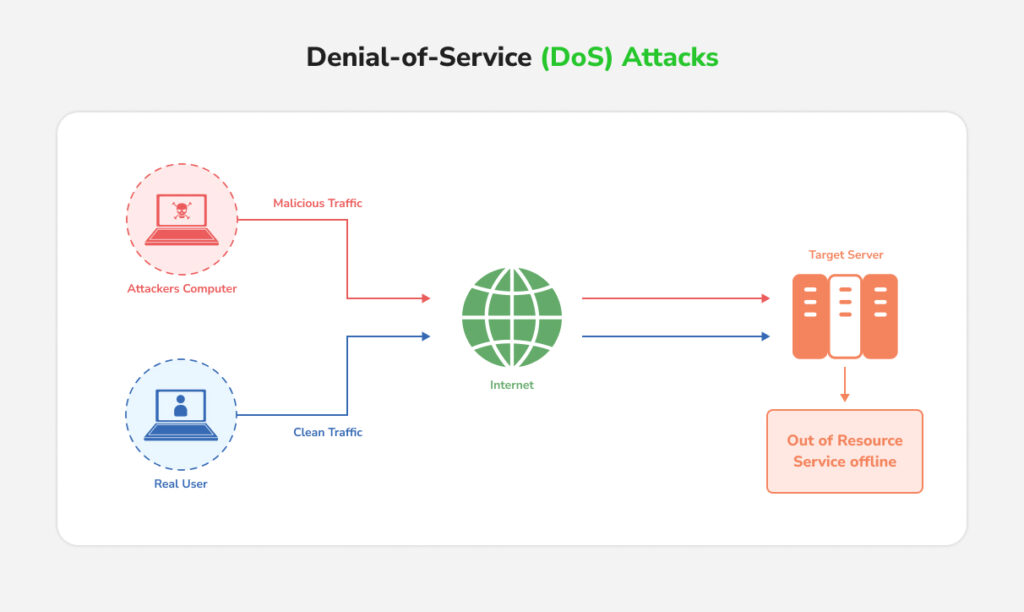
    Infographic showing how a DoS attack floods a target server with malicious traffic from an attacker, disrupting real users and taking the service offline.

    Overloading servers or communication channels to knock chargers offline. For instance, in a 2023 incident, ransomware attackers temporarily shut down a major charging network across the US and Europe. In a coordinated attack, widespread charger outages could even strain the grid by suddenly dropping or spiking demand.

    2. Man-in-the-Middle (MitM) Attacks

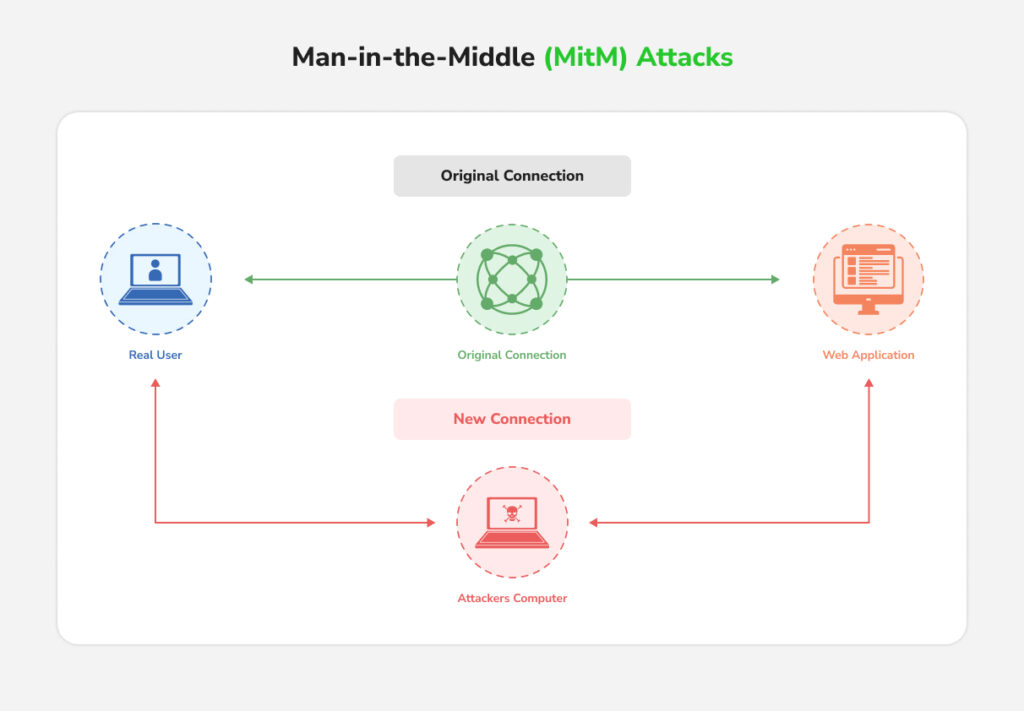
    Infographic showing a Man-in-the-Middle (MitM) attack, with an attacker’s computer intercepting and altering data between a user and a web application.

    Hackers intercept communication between EV chargers and backend systems to steal sensitive data (like payment information or user credentials) or send fraudulent commands. For instance, an attacker relaying or altering messages could manipulate charging session data, leading to incorrect billing or unauthorized free charging. 

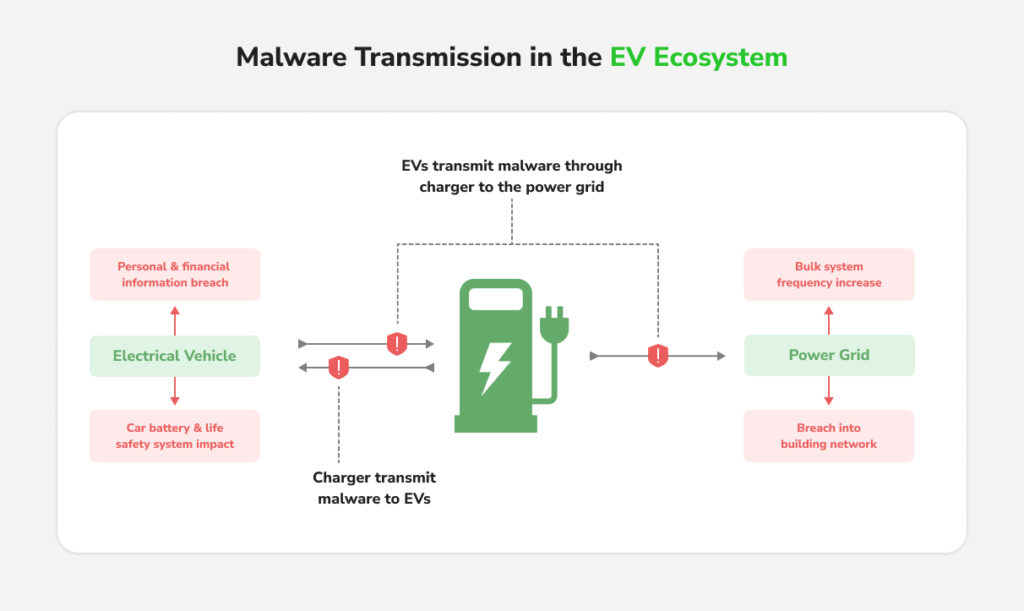
    3. Malware and Ransomware

    Infographic explaining how malware spreads in the EV ecosystem, showing infected EVs transmitting malware through chargers to the power grid, leading to data breaches and system disruptions.

    Chargers run software that can be infected just like any computer.  Ransomware can lock down operations until a ransom is paid. A notable real-world example occurred in 2023 when a charging network provider was hit with ransomware that turned off chargers across multiple countries and demanded cryptocurrency to restore service. The company recovered without paying, but the incident was a wake-up call.

    4. Data Breaches 

    Public chargers often handle user identities, credit card payments, and vehicle data. Poorly secured systems can expose user identities, payment details, or charging patterns. In one case, Shell’s charging network had a vulnerability that could have exposed millions of charging session logs, including potentially sensitive driver data, before it was patched. 

    5. Unauthorized Remote Control

    If attackers exploit software vulnerabilities in a charger or the connected vehicle, they might gain remote control of charging equipment or even the vehicle. This scenario is more complex but was demonstrated when researchers at a 2025 cybersecurity contest compromised Tesla home chargers, highlighting that even widely used EVSE systems had exploitable flaws. In extreme cases, such exploits could be used to manipulate the charging rate or harm vehicle batteries (like overcharging) or as a bridge to infiltrate the car’s internal network. 

    6. Supply Chain Backdoors

    Another risk specific to India’s context is the heavy reliance on imported charger components. About 80–85% of EV charger parts in India are sourced from abroad (mainly China), raising concerns about hidden malware or backdoors. Industry experts warn that malicious code implanted in a charger’s components could be activated later to compromise the charger or any network it connects to. 

    7. Physical Tampering

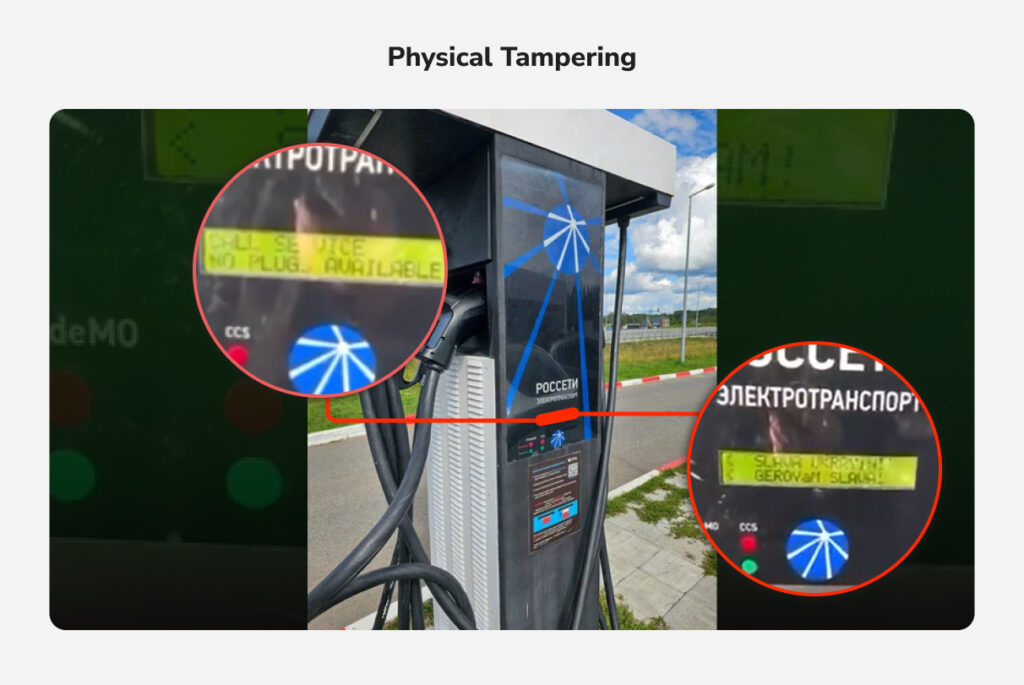
    Not all attacks are purely digital; exposed chargers can be physically tampered with. For example, installing skimmers (to steal card data) or malware devices. Proper locks, tamper alarms, and surveillance can mitigate these risks, but they remain a consideration, especially for private chargers in unguarded locations. 

    Real-world incidents highlight these threats. In 2022, EV chargers in Russia and the UK were hacked to display rogue political messages. While these were pranks, the attackers essentially took control of the stations’ interfaces remotely, a capability that could be misused for more damaging ends.

    Image showing a tampered EV charging station display with hacked text, illustrating physical tampering risks in EV chargers.

    More recently, Electrify America (a major US charging network) faced shutdowns due to operating system weaknesses, and in 2025, researchers at Pwn2Own (Tokyo) successfully breached Tesla’s Wall Connector chargers twice. Although India has not yet seen large-scale charger hacks, these examples highlight the urgent need for robust cyber protections.

    India’s Policy and Standards Landscape for EV Charging Security 

    Ensuring cybersecurity in EV infrastructure is a shared responsibility, and the Indian government has laid the groundwork through policies and standards: 

    Ministry of Power (MoP) Guidelines

    Issued in 2018 and revised in 2022 and 2024, these guidelines standardize charger deployment across India. While the MoP guidelines do not explicitly focus on cybersecurity, they enforce quality and uniformity, creating a reliable foundation on which software security can be built. Notably, under these guidelines, no license is required to operate public chargers, making it even more important that operators voluntarily adhere to best practices.

    Bureau of Indian Standards (BIS) Certifications

    The BIS has developed an entire set of standards (IS 17017 series, mirroring IEC 61851 and others) that cover performance, safety, and connector requirements for EV chargers. Adherence to these standards is now mandatory for manufacturers. Although these are largely electrical and mechanical standards, compliance ensures that chargers have proper protections against electrical surges, faults, and basic tampering. Robust hardware reduces risks of unsafe behavior during cyberattacks. BIS is also exploring standards for communication protocols and data security in automotive electronics.

    CERT-In Directives and Cyber Guidelines

    India’s CERT-In (Computer Emergency Response Team) under the IT Ministry plays a key role in cybersecurity policy, including for EV infrastructure. CERT-In continuously issues alerts and advisories about the latest cyber threats to EV charging systems and recommended countermeasures. Importantly, in 2022 the government empowered CERT-In to mandate that all cybersecurity incidents must be reported within hours and to prescribe emergency measures.  
     
    Gadkari highlighted that CERT-In has “formulated a Cyber Crisis Management Plan for critical sectors and empaneled 150 security auditors to help organizations tighten their defenses. For charging network operators, this means any breach or malware outbreak in their network must be disclosed to CERT-In, and they should follow CERT-In’s best practice guidelines. In 2024, the Ministry of Road Transport and Highways (MoRTH) explicitly acknowledged the cyber threat to EV chargers and stated that charging networks are expected to comply with CERT-In’s advisories, such as implementing encrypted communication, strong authentication, and regular security patches. While there isn’t a dedicated “EV charging cybersecurity law” yet, these directives effectively compel CPOs to adopt standard cyber hygiene or risk regulatory action. 

    Emerging EV Communication Standards

    India is encouraging secure communication standards like OCPP security and ISO 15118. Open Charge Point Protocol (OCPP) is the common language between chargers and their EV charging management systems. The latest version, OCPP 2.0.1/2.1 (released in 2025), adds substantial security features. It supports secure boot, encrypted messaging (TLS), digital certificates for charger authentication, and even secure firmware update mechanisms.  
     
    Many Indian networks today still use OCPP 1.6, but new installations are increasingly expected to use OCPP with security profiles enabled. Likewise, ISO 15118, the global standard for vehicle-to-charger communication, uses a robust PKI-based encryption and authentication system for EVs and charging points. The Bureau of Energy Efficiency (BEE) and other bodies have run pilots on ISO 15118 features in India, given its potential to make public charging both seamless and secure. Though ISO 15118 is not yet universally deployed, its secure handshake and cryptographic authentication offer a blueprint for the future of EV charging in India. We can expect upcoming guidelines to formally recommend these protocols for any smart public charging infrastructure.

    No Dedicated EV Charger Cyber Law – Yet

    It’s worth noting that as of late 2025, there is no separate cybersecurity certification or regulation specifically for EV chargers. General IT security rules apply, and power sector regulations cover grid-safety aspects. Industry executives have pointed out this gap, suggesting that specific guidelines could emerge as the network expands. In the meantime, much of the responsibility lies with charger manufacturers and operators to proactively secure their infrastructure.

    Final Thoughts 

    The cyber risks are real and evolving, from ransomware attacks and data breaches to potential grid disruptions. But so are the solutions. With proactive implementation of secure communication standards like ISO 15118 and OCPP security, adherence to CERT-In directives, and consistent alignment with BIS and MoP frameworks, India has the tools to stay ahead of emerging threats. 

    Ultimately, cybersecurity in EV charging is not a one-time compliance exercise; it’s a continuous process of vigilance, collaboration, and innovation. As stakeholders across government, utilities, OEMs, and CPOs work together, India can build a charging network that’s not just widespread and reliable but also cyber-resilient. Protecting every EV charging station in India today will ensure tomorrow’s electric highways remain open, safe, and secure for all. 

    Frequently Asked Questions

    Why can’t imported components just be “checked” for malware before use?

    Because backdoors are often embedded deep in firmware or chipsets —invisible without advanced testing. India is working toward local manufacturing and stronger supply chain audits to close this gap.

    If India doesn’t have a dedicated EV cybersecurity law yet, who enforces compliance right now?

    Currently, CERT-In acts as the de facto authority. It mandates that all cyber incidents must be reported and issues security advisories that operators are expected to follow. Enforcement is indirect, through policy pressure, public procurement standards, and utility-level compliance.

    What happens if a public charger is hacked? Who’s liable?

    Right now, liability is murky. Without a dedicated law, responsibility could fall on the CPO (Charge Point Operator) or hardware vendor, depending on the cause, whether it’s poor software maintenance or a faulty device. Future EV-specific regulation is expected to clarify this.

  • Top 5 EV Charging Innovations of 2026 Set to Solve Range Anxiety 

    Top 5 EV Charging Innovations of 2026 Set to Solve Range Anxiety 

    Below are five global innovations in EV charging poised to meaningfully impact EV charging infrastructure in India by 2026. Each innovation redefines the charging experience in terms of speed, efficiency, and cost-effectiveness, helping India leapfrog infrastructure challenges and accelerate EV adoption. 

    5. Megawatt EV Platforms: 1,000V Architecture Brings 1 MW Charging to the Masses

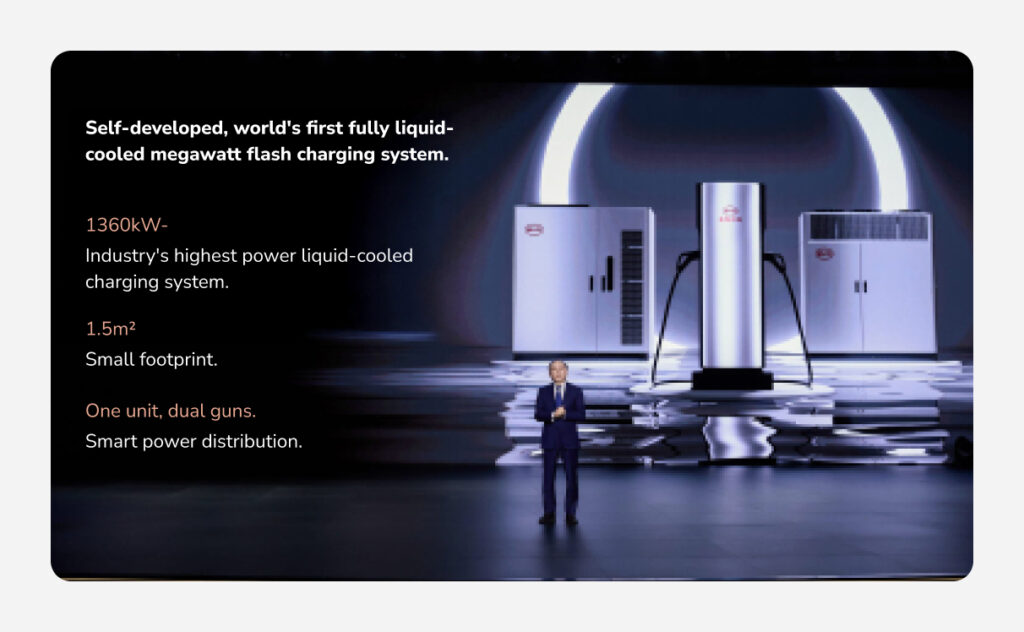
    Chinese automaker BYD has “flipped the switch” on charging times with its new Super e-Platform, unveiled in March 2025. This is the world’s first mass-produced “full-domain” 1000-volt EV architecture, delivering megawatt-level charging power. BYD demonstrated that an EV using this platform can gain approximately 400 km of range in just 5 minutes, equivalent to two kilometers of driving range per second.  

    With a 1 MW peak, using 1000 V and 1000 A, charging an EV can rival the convenience of refueling a petrol car. Importantly, BYD is rolling out this capability in mainstream models like the Han L and Tang L sedans/SUVs, democratizing ultra-fast charging for everyday drivers.  

    To support this surge, BYD plans to build 4,000 new “Flash Charging” stations across China. Each station features liquid-cooled 1 MW DC chargers, smart energy management, and often onsite solar power. These hubs can serve dozens of vehicles per hour, minimizing wait times even during peak demand. As more automakers adopt 800V+ architectures and megawatt charging standards, pit stops will shrink from hours to minutes, erasing one of the last barriers to practical electric road trips for commuters and commercial fleets alike. 

    4. Megawatt Charging: New Benchmarks for Passenger EVs

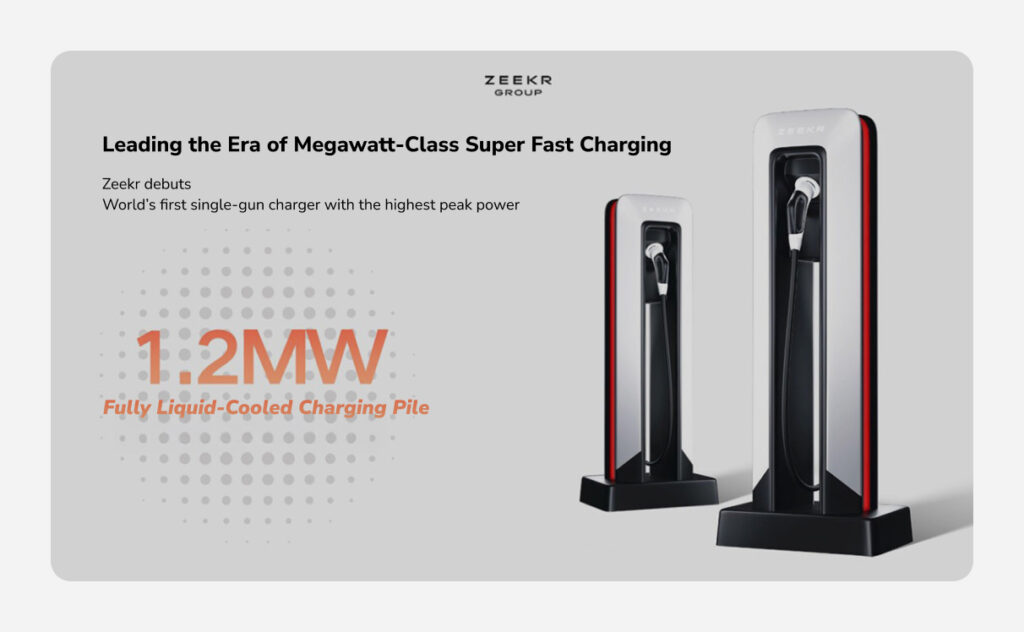
    Once reserved for heavy-duty electric trucks and buses, megawatt-class charging is now entering the passenger EV segment. Thanks to rapid advances by companies like Zeekr, BYD, and Huawei, charging speeds are reaching unprecedented levels. At 1.3 MW (roughly 1,300 kW), an EV could gain 500 km of range in about 5 minutes of charging. China is leading this ultrafast charge; premium EV brand Zeekr (part of Geely) recently unveiled a 1.2 MW fully liquid-cooled charger for passenger vehicles, the highest-powered car charger to date. It leapfrogs BYD’s 1 MW system, although current EV models need to catch up to fully utilize this capability.  
     
    Huawei has also announced a 1.5 MW charging system for electric trucks, delivering 2,400 A of current and up to 20 kWh per minute of energy transfer. All this means that in China, hundreds of 1 MW+ public charge points are already live, and thousands more are planned by 2030. These ultrafast stations use innovations like liquid-cooled cables and AI-powered load balancing to safely manage high power flow during peak hours.  
     
    Europe and the US are following suit. The EU’s new regulations support megawatt-class chargers along core highways, and companies in both regions are testing the technology for future networks.  

    The result? EV drivers will soon “fill up” as quickly as stopping at a petrol pump, making long-distance electric travel effortless and range anxiety a thing of the past. 

    3. Wireless EV Charging Will Redefine Convenience

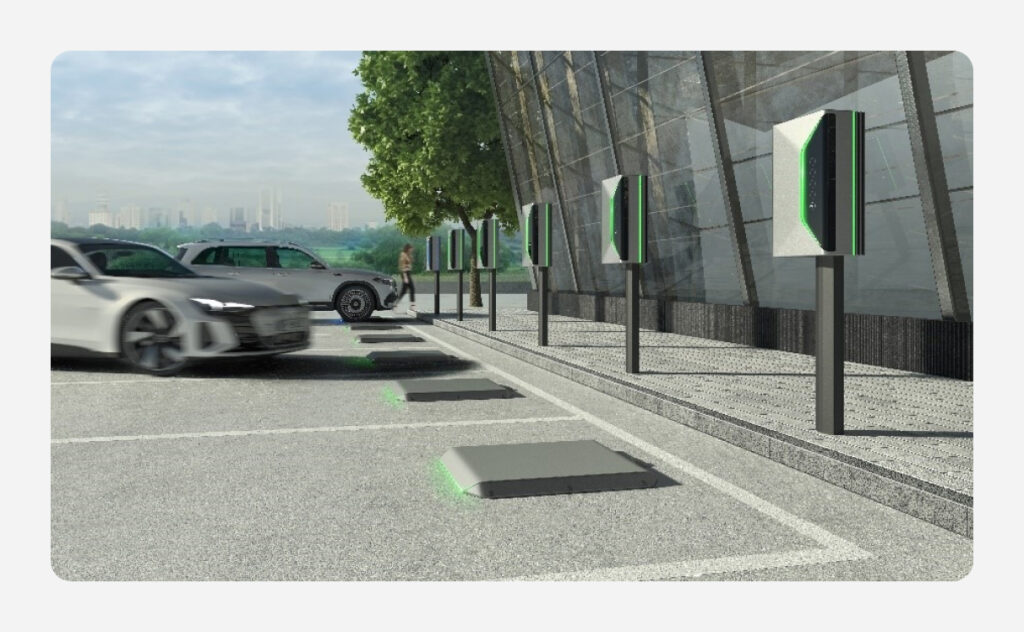
    Wireless charging uses electromagnetic induction to transfer energy without a physical cable. A charging pad embedded in the ground transmits energy to a receiver coil on the underside of the car, even with an air gap of up to 25 cm.  
     
    Massachusetts-based WiTricity is rolling out its Halo wireless charging system for real-world use. After successful demos retrofitting a Ford Mustang Mach-E and a Tesla Model 3, WiTricity is deploying Halo on E-Z-GO and ICON electric golf carts and light vehicles as part of a commercial pilot. The system delivers about 11 kW, translating to roughly 35 miles of range per hour of charging.  
     
    Major players are backing the tech. WiTricity’s investors include Mitsubishi and Siemens, and it’s partnering with South Korea’s KG Mobility (formerly SsangYong) to integrate wireless charging in future models. Another startup, HEVO from Brooklyn, is testing a 50 kW wireless charging pad on a Chrysler Pacifica minivan and developing a 300 kW version for the next leap in power.  

    Tesla has also confirmed it’s developing an inductive charging solution. As Tesla’s design chief noted, “You don’t even need to plug in… just pull into your garage, drive over a pad, and it’s charging.”  
     
    With industry standardization efforts underway, wireless charging pads could soon appear in garages, shopping centers, and taxi stands. This technology makes charging as easy as parking, rendering the entire charging process invisible and eliminating day-to-day range anxiety. 

    2. Electrified Roads: Charging Vehicles in Motion

    If wireless charging pads seem futuristic, how about roads that charge your car while driving?  
     
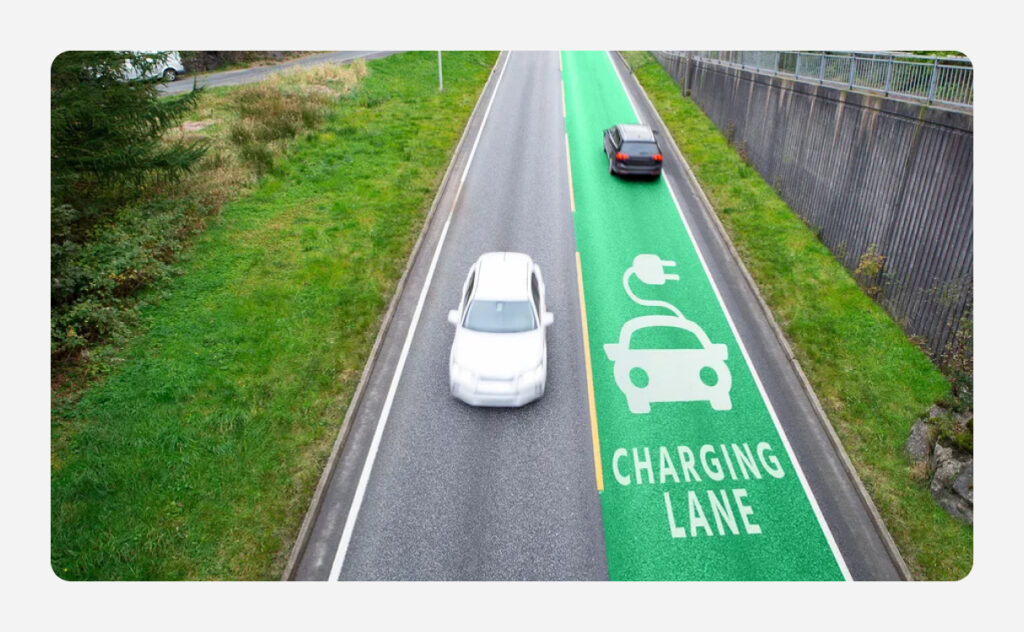
    Sweden is building the world’s first permanent electrified highway, a stretch of the E20 motorway, where EVs, especially heavy trucks and buses, will charge on the move. The system can use either embedded conductive rails or inductive coils under the asphalt to transfer power dynamically.  
     
    In one tested design, a conductive rail connects to a pickup arm under the vehicle, delivering up to 200 kW of power in real-time. That’s enough to keep a typical bus or truck moving indefinitely without exhausting its battery. Sweden’s pilot projects have validated both approaches, including a 2.5-mile inductive trial on Gotland Island. The first 21 km (13 miles) permanent e-motorway is slated to open by 2025, with plans for 3,000 km of electric roads by 2035.  
     
    Similar trials are underway in Germany, France, Israel, China, and South Korea. These innovations blend EV charging solutions into daily life, charging city buses at stoplights or EVs while cruising the highways. For commercial fleets, electrified roads mean higher uptime and smaller batteries. For everyday drives, it promises a future where finding a charging station is no longer a concern, the road itself becomes the charger.  

    1. 5-Minute Charging Batteries: Recharging 500 km Range in Minutes

    The holy grail of fast charging, adding hundreds of kilometers of range in minutes, is becoming a reality with new battery technology. CATL’s latest Shenxing ultra-fast battery, unveiled in 2025, is a second-generation lithium-iron-phosphate pack with a 12C charge rate and peak input of 1.3 MW.  It can add 520 km of range in only 5 minutes, jumping from 5% to 70-80% charge in the time it takes to stretch your legs. This beats even the impressive 400 km in 5 minutes claim of BYD’s recent 1 MW battery platform. With Shenxing, a full 800 km (approx. 500 miles) pack can recharge from 5% to 80% in just 15 minutes under optimal conditions, twice as fast as the best chargers of 2024. Crucially, these new batteries maintain high charging power even in cold weather, delivering approximately 830 kW at -10 °C. This addresses a major drawback of earlier fast-charge cells and makes ultra-fast charging viable year-round.

    Final Thoughts

    By 2026, EV charging technology will leap to new heights: 5-minute charges, 1,000 km batteries, 1+ MW chargers, cable-free charging, and even charging highways. What felt cutting-edge in 2023 will be routine. Range anxiety and downtime will fade into history, much like dial-up internet or analog cellphones.  

    India’s EV industry, already among the most dynamic globally, stands to benefit immensely. With the right investments and forward-thinking policy support, EV charging infrastructure in India can not only adopt but also lead in deploying these solutions. The road to 2026 is electrifying, and these five charging innovations are lighting the way towards the future of electric mobility, which is ultra-fast, ubiquitous, and unimaginably convenient.

    Blog Banner

    Frequently Asked Questions

    When will Indian EV drivers actually experience 5-minute charging?

    India is closer than it seems. With Tata and Mahindra adopting 800V systems and startups piloting megawatt-level chargers, metro-city corridors could see 5-minute charging stations by 2026–27. Early rollout will likely focus on highways and commercial hubs before expanding into city centers.

    Will new megawatt chargers work with existing EVs?

    Not immediately. Most current EVs use 400V systems, while megawatt chargers are designed for 800V–1000V vehicles. However, automakers are introducing bidirectional adapters and flexible charge modules, so newer EVs may not require major upgrades right away.

    Are ultrafast and wireless EV chargers environmentally friendly? 

    Yes, these technologies reduce grid stress by shortening charge times and often run on renewable energy. New LFP batteries also use fewer rare-earth metals and offer longer lifespans, making the entire ecosystem more sustainable.

  • What is Smart Parking? The Rise of EV Charging & IoT in Real Estate

    What is Smart Parking? The Rise of EV Charging & IoT in Real Estate

    India’s cities are facing a parking crunch. Smart parking has emerged as a tech-driven solution to this urban dilemma, leveraging Internet of Things (IoT) sensors and connectivity to make parking spaces more efficient. At the same time, the rise of electric vehicles (EVs) is transforming real estate, from residential complexes to commercial buildings, by increasing demand for charging infrastructure.

    This blog dives into the facts, data, and trends shaping the future of parking and mobility. Specifically, it answers three key questions:

    • What exactly is smart parking, and why is it essential in modern cities?
    • How is EV charging transforming parking in real estate projects?
    • What role does IoT play in enabling smarter, data-driven real estate and urban planning in India?

    What Exactly Is Smart Parking, and Why Is It Essential in Modern Cities?

    Imge_1.jpg

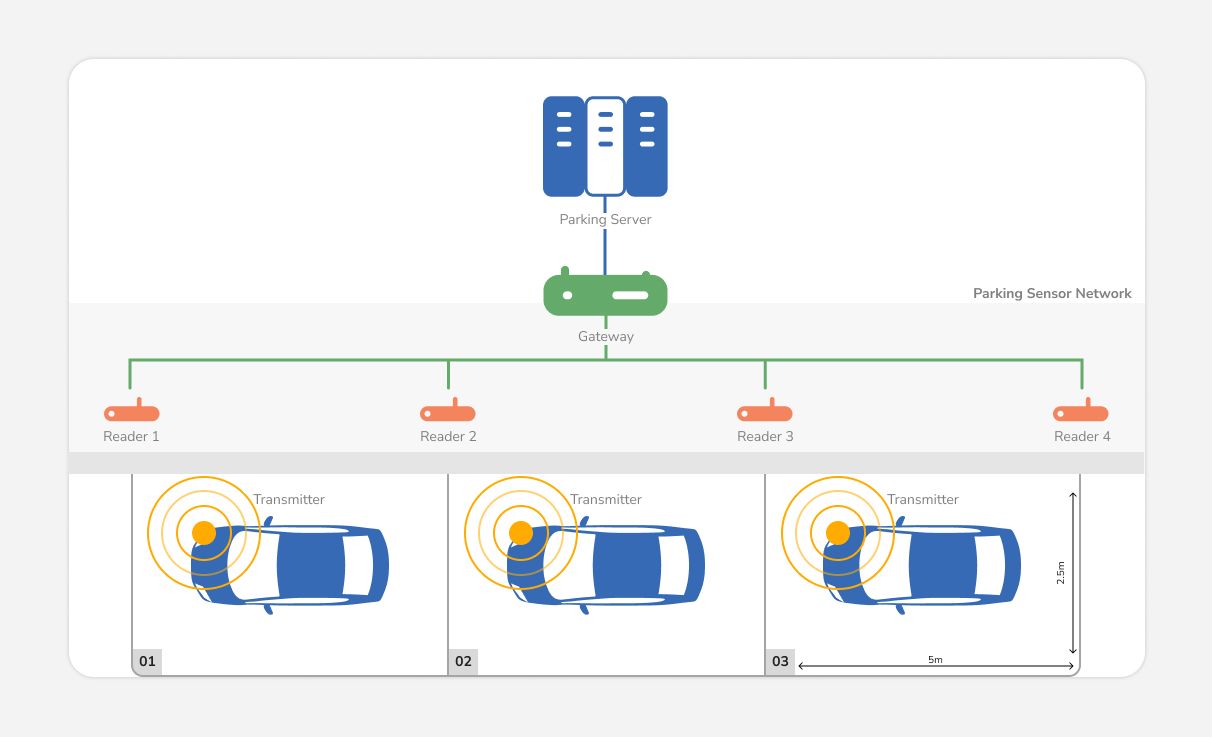
    Smart parking refers to parking systems that use sensors, cameras, and connectivity (IoT) to monitor parking space occupancy in real time and guide drivers to available spots. Drivers can check a mobile app or street display to see which spots are free or even get turn-by-turn directions to the open space in complex garages. This real-time occupancy data reduces the search time for users and reduces frustration.

    Key technologies enabling smart parking include:

    • IoT Sensors and Cameras: Ultrasonic or magnetic sensors and AI-enabled cameras detect occupancy and transmit data wirelessly.
    • Cloud Platforms: The sensor data is transmitted to cloud-based parking management platforms. This allows aggregating data across a city or building and applying analytics, which is increasingly relevant for EV charging for buildings and smart infrastructure.
    • Automated Payments: Contactless payment systems, often integrated with FASTag (the RFID toll payment sticker) to enable drive-in/drive-out payments without manual tolling. This reduces queues at exits and eliminates cash leakage. It also enables dynamic pricing models (varying rates by demand or duration) to encourage turnover and optimize charging solutions for businesses.
    • Analytics and Management Software: IoT-based parking solutions generate a wealth of data, including peak usage times and average park durations. City authorities or private operators can use this data to optimize parking policies, adjust pricing, and plan future capacity. Over time, such data-driven management leads to better land use.

    In essence, smart parking brings the power of IoT and data to an age-old urban problem. It reduces search time and enhances user experience while improving operational efficiency. It’s a win-win: drivers save time and fuel, and owners maximize utilization. This has tangible environmental benefits too; shorter parking searches mean fewer cars idling and circling, which in turn cuts fuel consumption and tailpipe emissions.

    Notably, smart parking often overlaps with smart building and smart city initiatives. For instance, India’s Smart Cities Mission has funded projects for sensor-based smart parking in multiple cities, integrating them with central command centers to better manage traffic flows and support EV charging for buildings.
    India’s Smart Building Market Forecast.jpg

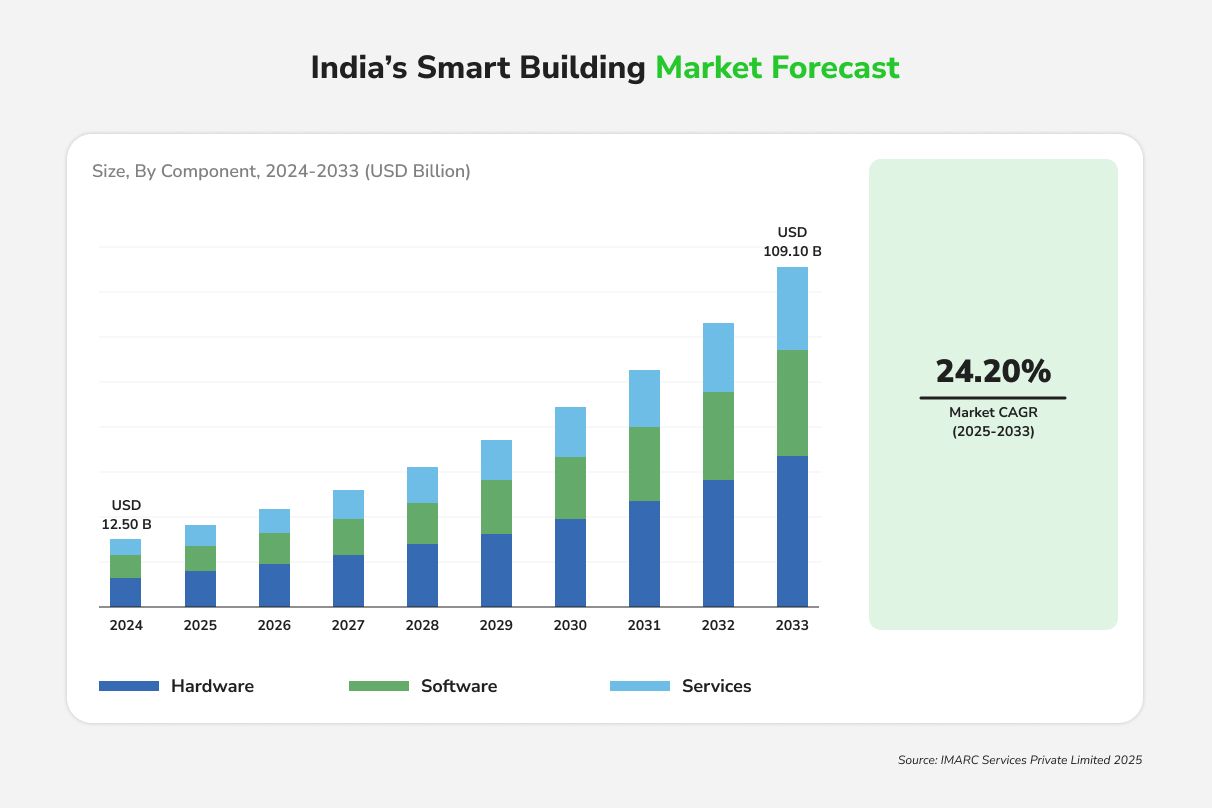
    The broader smart building market in India, including parking, was about USD 12.5 billion in 2024 and is projected to reach USD 109 billion by 2033.

    Why Smart Parking Matters in Urban India

    Urbanization and vehicle growth have led to severe parking shortages and traffic congestion. India alone has over 300 million vehicles on the road, and as cities grow vertically, traditional parking methods are becoming obsolete. Studies show that up to 30% of city traffic is caused by drivers searching for parking. This not only wastes time and fuel but also contributes significantly to pollution and economic loss. In fact, urban India loses an estimated ₹1.5 lakh crore (₹150 trillion) annually to traffic congestion, with parking-related issues accounting for nearly a third.

    Smart parking can reduce the time spent searching for parking by up to 50% and triple garage capacity through automation. Globally, the smart parking market is projected to grow from USD 5.7 billion in 2024 to USD 14.1 billion by 2033 (about 10.5% CAGR).

    Automating parking operations (through sensors, cameras, and digital payments) cuts labor costs and boosts revenue per space by optimizing utilization. Real-time data from IoT sensors provides accurate availability info, minimizing idle empty spots and helping operators adjust pricing based on demand, a model increasingly adopted in EV charging solutions for businesses. In short, smart parking promises more parking capacity with fewer resources and less chaos.

    How EV Charging Is Transforming Parking In Real Estate Projects?

    The explosion of electric vehicles globally is another major factor driving the evolution of parking infrastructure. Electric cars need charging points – and unlike a gas station that you visit only occasionally, EV owners often charge where they park (at home, work, or shopping centers). This convergence of parking and charging has huge implications for real estate developers and city planners.

    Global Sales of Electric Cars by Type (Units) (2010-2023).jpg

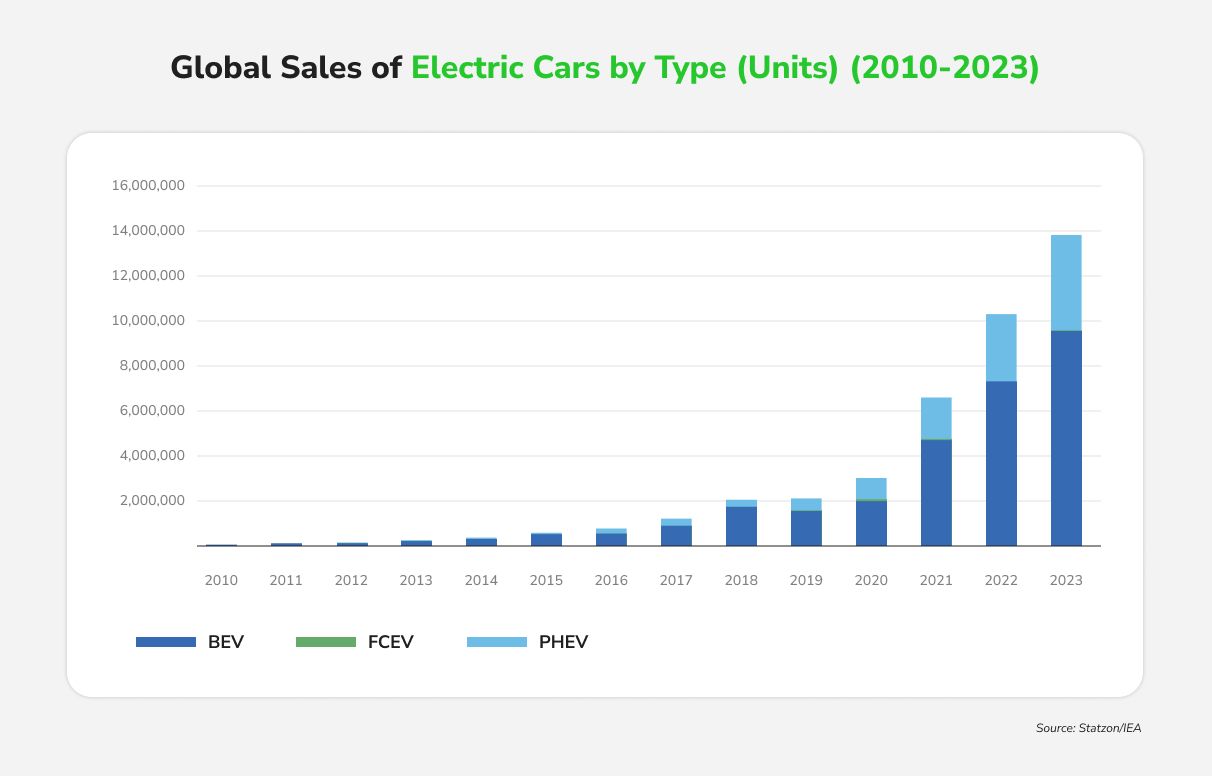
    The convergence of parking and charging is reshaping real estate. Unlike gas stations, EV owners typically charge where they park (at home, work, or shopping centers). This shift demands that parking infrastructure evolve into charging infrastructure, making it a central concern for developers and city planners focused on planning EV charging for real estate.

    In 2023, global EV sales neared 14 million, a 35% jump from 2022, bringing the global fleet to 40 million vehicles. India saw 80,000 electric cars sold in 2023, a 70% year-on-year increase. While EV penetration is still modest, the government’s 2030 targets are ambitious: 30% of private cars, 70% of commercial vehicles, 40% of buses, and 80% of two- and three-wheelers. If realized, that’s 80 million EVs on Indian roads—each needing a place to park and charge.

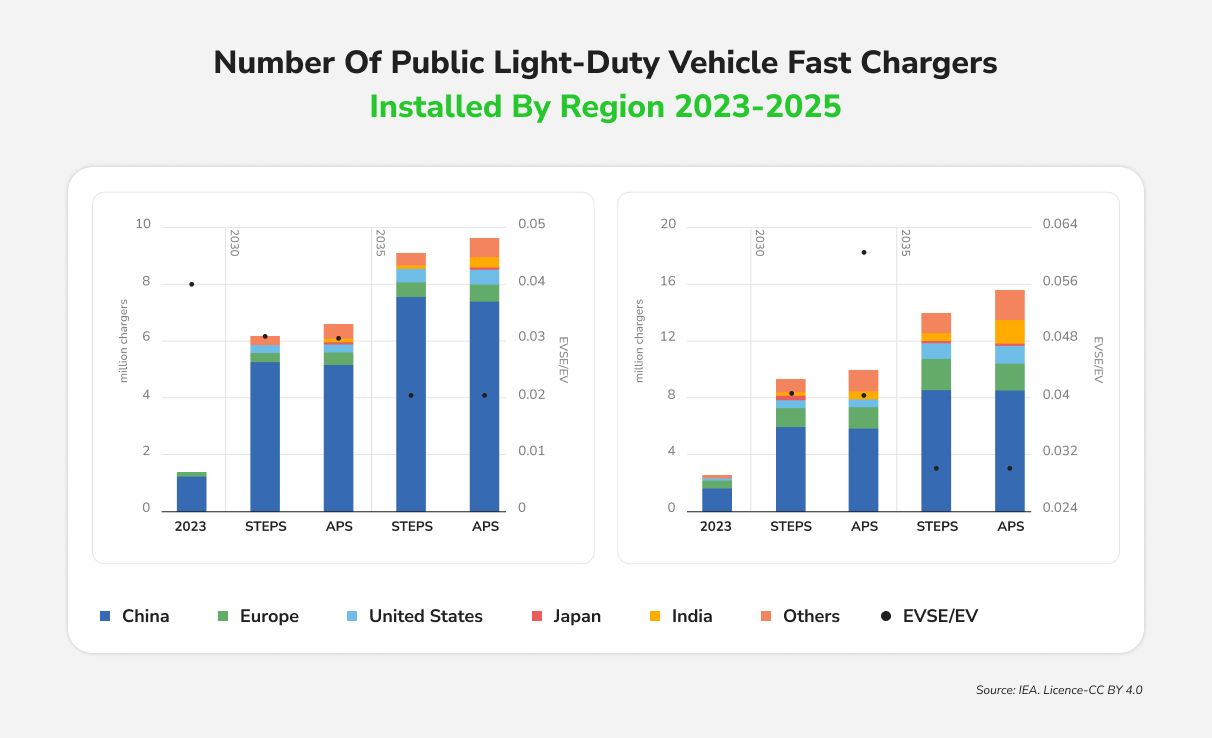
    Such growth will require an extensive EV charging network, and much of that charging infrastructure will be in parking areas. Globally, the number of public EV chargers is projected to grow fourfold from approx. 4 million in 2023 to over 15 million by 2030. A joint report by FICCI and McKinsey estimates that ₹16,000 crore (approx. $2 billion) in investments will be needed by 2030 to meet the country’s EV charging demand. These chargers are being installed in a variety of real estate contexts, from highway rest stops and shopping mall parking lots to office campuses and apartment basements.

    For real estate developers, providing EV-friendly parking is quickly shifting from a niche amenity to a mainstream requirement. Recognizing this, the Indian government and regulators have issued new guidelines:

    • Many municipal authorities are updating parking policies to include EV charging. For example, Delhi’s draft parking rules provide discounted fees for EVs in public parking lots, and cities like Bengaluru and Mumbai are exploring “EV-only” parking zones in crowded areas to encourage cleaner vehicles (as part of pollution control strategies).

    The integration of EV charging with smart parking systems is a natural next step. Since smart parking apps already manage parking spot availability, adding the status of charging stations to these platforms makes life easier for EV owners. We are seeing features like real-time EV charging slot booking through parking apps, so drivers can reserve a space that has a charger ahead of time. Additionally, advanced parking management systems now incorporate dynamic pricing for EV charging, for instance, higher rates during peak hours or incentives for vacating a charging spot once the car is topped up. This prevents charger hogging and optimizes the usage of each unit.

    Another interesting trend is the move towards sustainable parking infrastructure for EVs. Some parking lots are installing solar-powered EV charging stations (solar canopies over parking stalls with integrated chargers), reducing the draw on the grid and aligning with green building goals. This is particularly relevant in sunny parts of India; a few metro cities have piloted solar parking lots that generate renewable energy for on-site charging.

    What Role Does IoT Play in Enabling Smarter, Data-Driven Real Estate and Urban Planning in India?

    India’s Smart Parking Systems Market.jpg

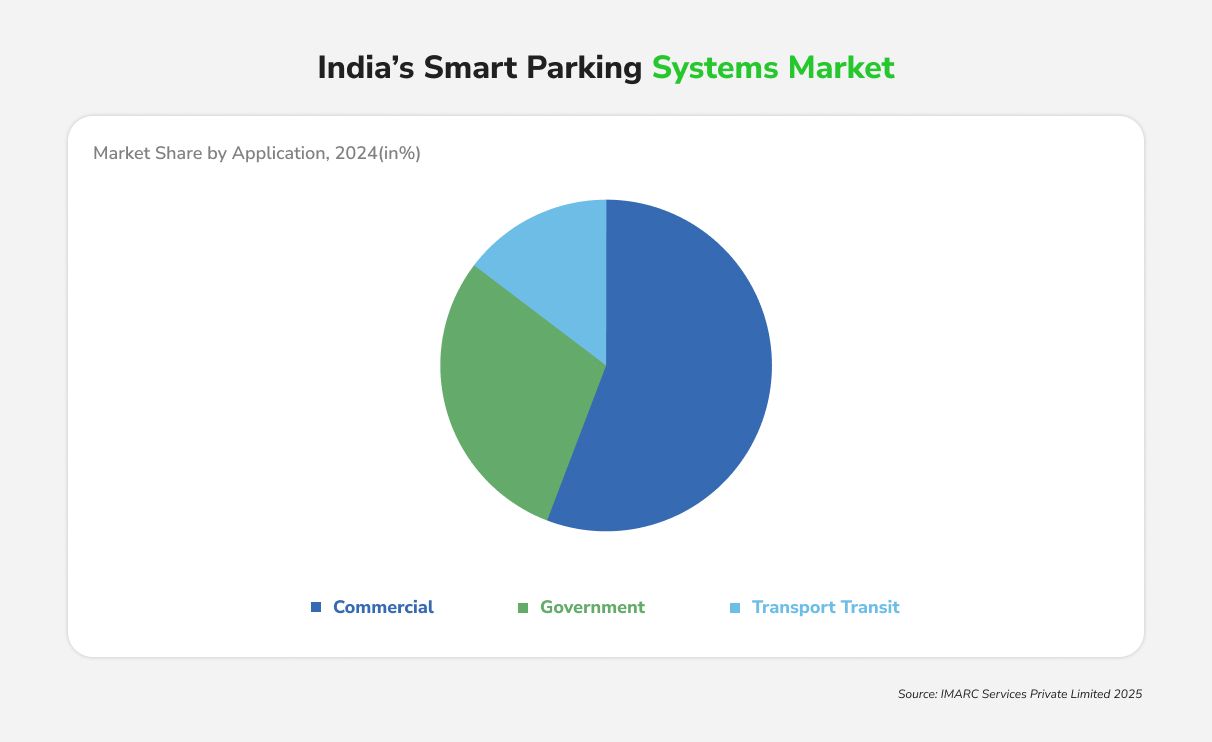
    From the perspective of real estate owners and urban planners, the confluence of IoT and EVs in parking brings several tangible benefits:

    • Enhanced User Experience and Convenience: Imagine entering a mall parking garage and your smartphone (or car’s navigation) immediately directs you to an open spot equipped with an EV charger. No circling ramps, no anxiety about whether you’ll find a plug. This level of convenience, enabled by IoT sensors and connectivity, greatly improves the visitor experience. It also builds customer loyalty; frustration-free parking can be a selling point for a shopping center or office building. Moreover, features like contactless payments and app-based reservations mean drivers can seamlessly park and pay without fumbling for cash or tokens.
    • Higher Property Value and Revenue Streams: Incorporating smart parking and EV charging can make a property more attractive. A commercial building with an IoT-driven parking system can advertise higher efficiency and guaranteed spots for tenants. On the revenue side, property managers can earn income from EV charging fees and better utilize every parking stall via dynamic pricing. A smart parking system can increase overall parking revenue by adjusting rates based on demand and preventing misuse or fraud. Essentially, technology turns parking from a cost center into a smarter profit center.
    • Better Security and Compliance: IoT in parking can bolster security through surveillance and access control. License plate recognition cameras can automatically log entries/exits and flag unauthorized vehicles. Sensors can detect if someone is parking in an EV-designated spot without an EV and alert authorities or apply fines. These measures protect resident parking in mixed-use developments and ensure that the infrastructure (like EV chargers) is used fairly. Additionally, having digital records of parking usage helps enforce time limits and prevents issues like parking ticket fraud or revenue leakage, which were common in fully manual systems. As EV charging for buildings becomes standard, these compliance tools will be essential to ensure fair access and proper usage.
    • Data-Driven Urban Planning: Over the long term, the data collected by smart parking systems is incredibly valuable for city planners and developers. Patterns of parking occupancy by time of day, by location, and even by vehicle type can inform how future garages are designed. Planners can identify underutilized lots that could be repurposed or pinpoint areas where demand far outstrips supply to justify building new multi-level parking. This data can feed into broader models of transportation and land use, helping answer questions like whether adding a metro station or bus route near a busy parking area reduces car usage. In essence, smart parking turns the parking lot into a source of insights for smarter urban development.

    India’s Trajectory vs. Global Trends

    India’s Smart Parking Systems Market Forecast.jpg
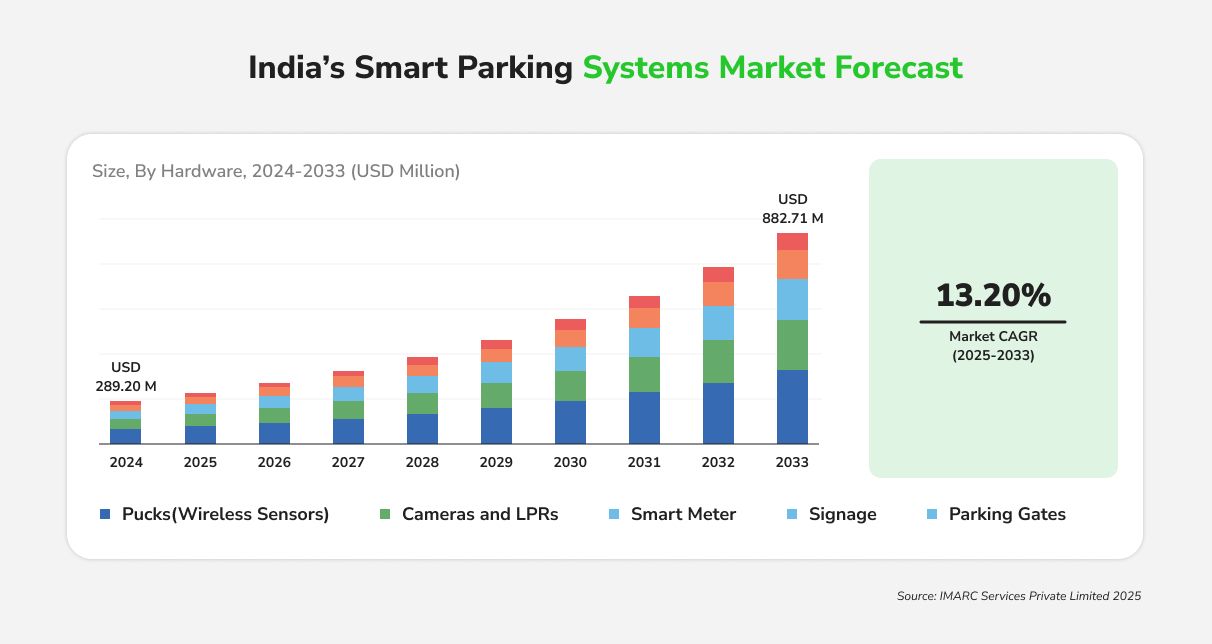
    India’s smart parking market was valued at USD 289 million in 2024 and is projected to reach USD 883 million by 2033. Government initiatives like the Smart Cities Mission have catalyzed adoption with cities like Puri (Odisha) and Davanagere (Karnataka) deploying advanced systems featuring IoT sensors, license plate recognition, and FASTag integration.

    India particularly stands out for the emphasis on two-wheelers and three-wheelers in the EV revolution. Unlike Western countries, a huge share of India’s urban commuters use scooters, bikes, and auto-rickshaws. Consequently, “smart parking” in India must cater to these vehicles as well, providing secure, organized parking and charging for electric two-wheelers. Cities are exploring dedicated two-wheeler smart parking zones with e-charging stations (for e-bikes) and anti-theft IoT locks. This broadens the definition of smart parking beyond just car garages.

    ajkgf.jpg

    Globally, countries are innovating with app-based parking payments and dynamic pricing to discourage long stays in prime spots. For example, San Francisco’s early smart parking project (SFpark) used demand-based pricing and sensors to reduce parking search time and was cited as a model for congestion reduction. China leads in public EV charging, while Europe and the US are exploring “mobility hubs” that integrate parking, charging, and shared transport.

    Future Outlook

    Looking ahead, the intersection of smart parking, EV charging, and real estate will only grow tighter. By 2030, India’s cities could be vastly different in terms of mobility. If EV adoption reaches the intended targets, tens of millions of EVs will need convenient charging.

    Most charging (up to 80%) is expected to happen at home or work, which means buildings must become the new fuel stations. We can expect every new apartment complex, office tower, and mall in India to incorporate networked EV chargers in their parking layout. In fact, only about 55% of Indian car owners today have access to home charging, so expanding to workplace and public charging is crucial. Real estate developers who provide abundant charging infrastructure stand to attract this growing EV owner demographic.

    On the technology front, IoT and AI will make parking even smarter. We might see AI-driven predictive parking, where algorithms predict parking availability at your destination by learning from historical data and current traffic and proactively reserve a spot for you. Some global cities are already testing systems that guide drivers not just to a parking lot but to a specific floor and slot based on the size of their vehicle, all optimized in real time. Autonomous vehicles could further disrupt parking; if self-driving cars become common in later decades, they might drop passengers off and then park themselves in ultra-dense robotic parking facilities. While that scenario is still on the horizon, it underscores the need to design parking infrastructure that’s adaptable.

    From a sustainability perspective, integrating renewable energy and energy management into parking will gain traction. Parking garages with solar rooftops, battery storage, and smart charging management can help balance the grid load of EVs. During the daytime, solar panels could directly power EVs in the lot; at night, the charging systems might communicate with the grid to draw power during off-peak hours. The IoT connectivity in these systems will be essential to manage such complexity, ensuring that as vehicles, buildings, and the grid all talk to each other, the outcome is optimal for everyone.

    In conclusion, smart parking represents a confluence of multiple innovation streams, urban digitalization (IoT, data analytics), the clean mobility transition (EVs), and next-gen real estate development.

    India, with its massive urban challenges and tech-savvy population, is fertile ground for these solutions. We are already seeing the early benefits: reduced congestion, better user experience, and new business models around parking. As the data and case studies build up, stakeholders from government bodies to private developers are gaining confidence in scaling up smart parking projects.

    The rise of EVs makes the case even stronger. A parking spot is no longer just a patch of concrete; it is a potential energy node where vehicles plug in and cities manage electricity demand. This will require continued collaboration between automakers, utilities, urban planners, and tech providers. The road ahead might be long, but one thing is clear: the future of parking in India and across the world is smart, connected, and electric. Embracing smart parking and IoT in real estate today is a step toward cities that are both more livable and more sustainable tomorrow.

    Blog Banner

  • Exploring the UK’s Dynamic EV Market Landscape

    Exploring the UK’s Dynamic EV Market Landscape

    In 2019, the UK set a historic precedent: the government officially committed to achieving net zero greenhouse gas emissions by 2050. Despite some delays, the UK’s transport sector stands out positively in carbon emission reduction. In 2022, nearly one out of every five cars sold was fully electric, surpassing the government’s goals.
    Nevertheless, the UK’s ranking in the EV Country Readiness Index has dropped, from 4th place in 2021 to 5th in 2023, raising concerns about the country’s electric vehicle (EV) market.

    This article will provide insight into the UK’s EV situation by addressing the following questions:

    • What is the current state of the UK’s EV market; who are the major players, and what are the government’s goals?
    • What challenges does the UK’s EV market face?
    • How can the UK progress in the international EV industry in the upcoming years?

    The UK’s Current EV Market

    The UK’s EV market has seen rapid growth, registering over 260k new electric cars in 2022, a significant increase from 15k in 2018.

    According to the Society of Motor Manufacturers and Traders (SMMT), zero-emission vehicles accounted for an impressive 37.3% of new car registrations in September 2023. Growth is evident across battery electric vehicles (BEVs), plug-in hybrid electric vehicles (PHEVs), and hybrid electric vehicles (HEVs) alike.

    Meanwhile, fleet-driven growth increased by 40.8% in September 2023, reaching a 52.5% market share. This indicates a market adjustment following limited supply in 2022, which constrained deliveries to business and fleet customers. Private consumer demand rose by a less dramatic 5.8%, reaching 122,944 units.

    The increase in ultra-low emission vehicles began with plug-in hybrid electric vehicles from 2014. Specific BEV growth surged from early 2019, outstripping PHEVs from Q4 2020 onward. As of November 2023, BEVs remain in the lead, taking up 16.4% of the automotive market. PHEVs are also continuing to grow, but lag behind, at a 6.8% market share.

    The UK’s charging infrastructure is starting to catch up with the rising EV adoption rates. As of September 2023, the UK boasts 49,882 public electric vehicle charging points across 29,709 locations, marking a 43% growth since September 2022. Home and workplace charging installations bring the country’s total up to approximately 680k.

    Currently, rapid and ultra-rapid chargers make up around 20% of public charging devices; there are 9,209 rapid and ultra-rapid charging devices spread across 4,809 locations, with a growth rate of 68% YoY.
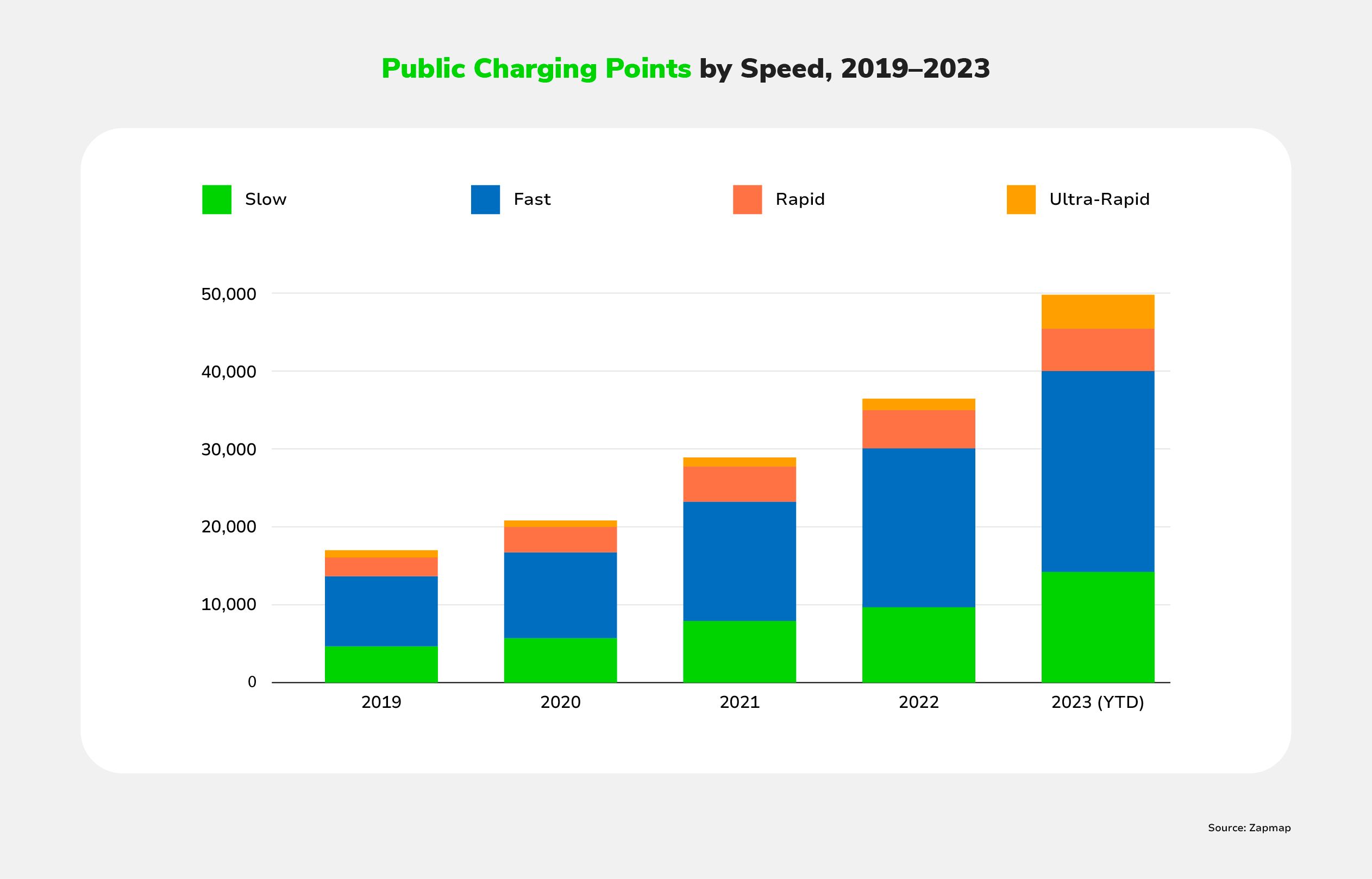
    A bar chart showing the UK's public EV charging infrastructure from 2019 to 2023, broken down by charger speed

    Greater London tops the list of charging points in 2023, with an estimated 17,380, accounting for an impressive 34.8% of the entire UK’s public charging infrastructure. Southeast England and Scotland follow, with 5,812 (11.7%) and 4,245 (8.5%), respectively.
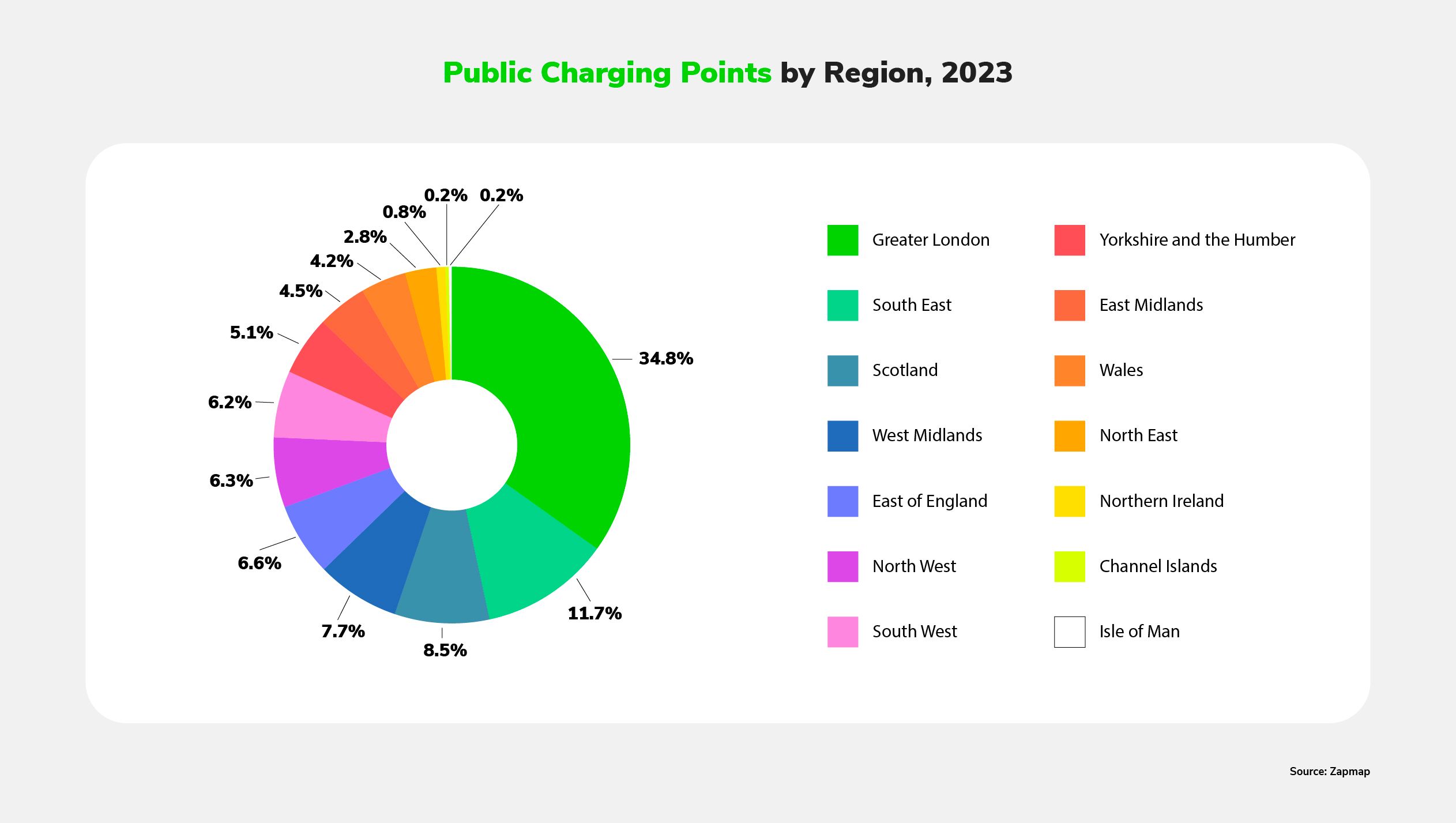
    A pie chart showing the geographical distribution of public charging points in the UK

    Demand for affordable zero and low-emission cars is growing, as evidenced by rising second-hand sales figures; from March to June of 2023, second-hand EV sales surged by over 80%, reaching more than 30.5k units. Despite setting a record for the sector, however, these EV sales still constitute just 1.7% of the total second-hand market.

    Enhancing the second-hand market is crucial for broadening the accessibility of electric vehicles, which currently remain more expensive than ICE models.

    The UK’s electric 2-wheeler market is also growing, driven by increasingly affordable prices and rising traffic congestion. 2-wheelers up to 125cc currently dominate due to fuel and cost efficiency, and manufacturers are focusing their research and development efforts on premium high-capacity bikes to further amplify market growth. The strong leisure market, especially for adventure bikes, also contributes to market expansion. Anticipated growth in registered motorcycles over the next five years will further drive the UK’s two-wheeler market.
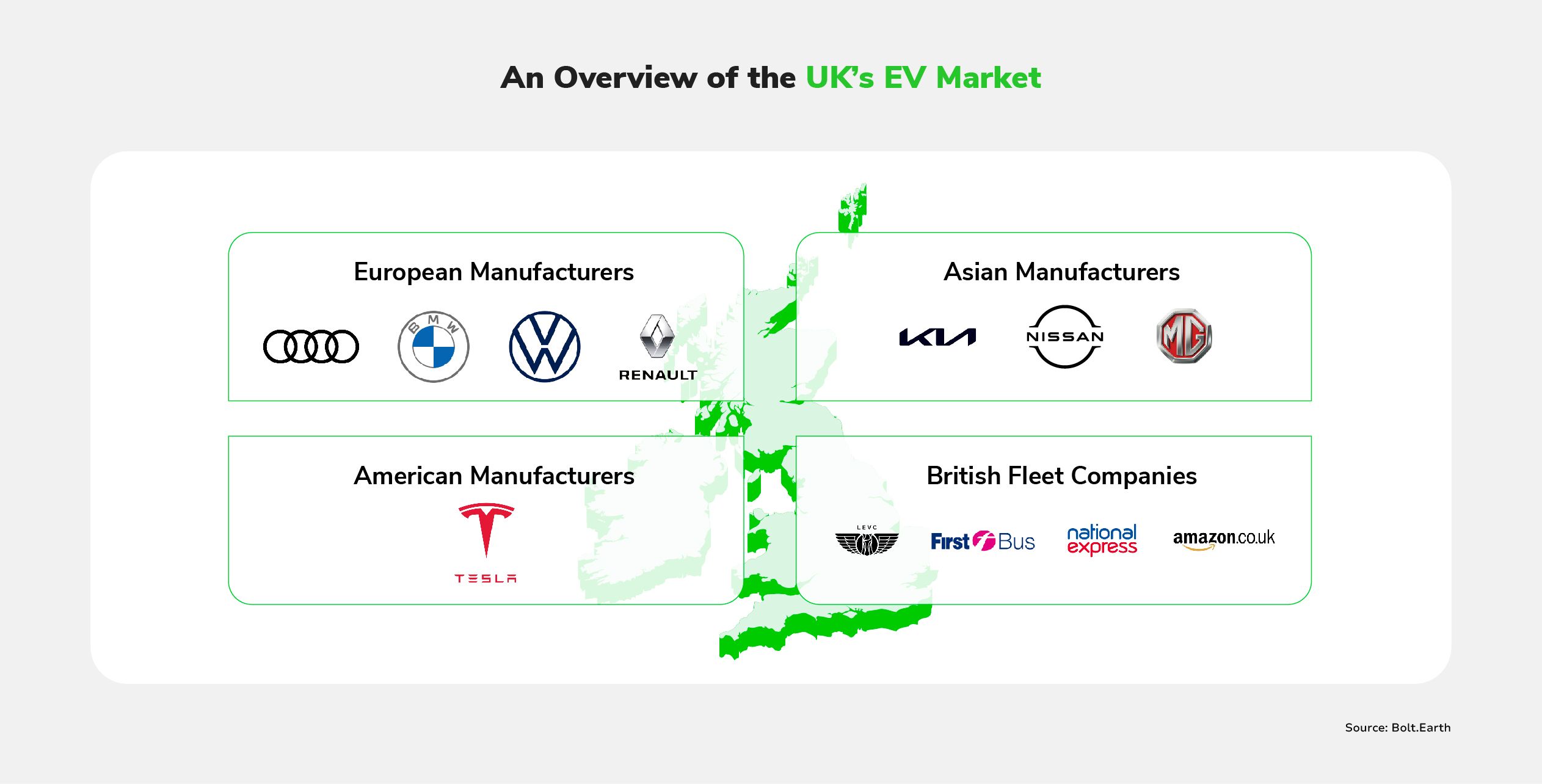
    A graphic listing important players in the British EV market, superimposed on an outline of the UK

    Major 4W Market Players

    Overall, the UK’s EV market is dominated by five foreign brands: Audi, BMW, Renault, Tesla, and Volkswagen.

    In 2022, the Kia e-Niro and Nissan Leaf were the 3rd and 5th best-selling EV models in the UK. 2023 has seen the arrival of a new Asian brand: China’s MG. During the first seven months of 2023, the MG4 was the UK’s #2 best-selling EV, beaten only by Tesla’s Model Y.

    Tesla

    Tesla’s Model Y and Model 3 were the UK’s best-selling EV models in 2022. The Model Y, a family SUV with a 319-mile range, is priced between £52k and £68k (USD 65,047 – 85,057), accelerating 0 – 60 mph in 3.5 seconds. The Model 3, priced between £48,490 and £61,490 (USD 60,653 – 76,914), charges from 10 to 80% in 23 minutes on a 200kW charger, making it a popular and affordable choice in the UK.

    Despite lacking a Gigafactory in the UK, Tesla offers another innovative approach: electricity generating. They recently applied for a license to generate electricity with the UK’s Gas and Electricity Markets Authority in Great Britain, showcasing their commitment to sustainability.

    German Legacy Brands

    BMW and Audi, legacy manufacturers of luxury cars, have recently grabbed the British EV market’s attention with the BMW i4 and Audi Q4 e-tron models.

    Audi has announced an ambitious goal: achieving full EV production by 2029. All existing production facilities will be retooled, new plants will be built where additional capacity is needed, and the range of models will grow.

    Volkswagen is planning a similar transition, but is targeting the mid-end market.

    Kia

    Many buyers view Korean brand Kia as comparable to Volkswagen. They provide similar range — around 260 miles — and safety features, at a near-identical price.

    However, Kia’s longer warranty and faster charging capability offer a better user experience, which is helping Kia make progress in the British market.

    MG

    China’s share of the European electric car market has more than doubled in less than two years. This is largely due to MG’s success.

    China’s dominance is further accentuated by its lead in battery production, leaving the European industry dependent on a geopolitical rival until it establishes its own “gigafactories.”

    In the case of MG, which is owned by SAIC, successful localization efforts include establishing a design studio in London and crafting cars that resonate with the preferences of the UK market, exemplified by the Cyberster series.

    Thanks to these efforts, in addition to competitive pricing (£26,995 to £32,495), the MG4 appears poised for a promising future in the British market.

    Major EV Fleets

    The UK has been making strong efforts to electrify its fleet and business vehicle sectors.

    Government Fleets

    In January 2023, the British government announced that it had successfully achieved its 2022 target: ultra-low emission vehicles now comprise 25.5% of government fleets.

    A notable instance is the integration of 3-wheeled electric motorbikes, the Yamaha Tricity 300, into the British police force. This initiative is endorsed by the Department for Transport and Innovate UK. The electric police bike incorporates a venturi duct traversing the center of the motorcycle, aiming to markedly minimize drag and improve efficiency.

    Taxis

    As of Q4 2021, there were 5,440 electric taxis registered in the UK, 3,621 of which were in London.

    London Electric Vehicle Company (LEVC), a prominent player in London’s taxi market, has been promoting the TX range-extended electric black cab since 2018. With over 6,000 vehicles now in operation, the LEVC TX comprises more than 40% of all black cabs in London. The LEVC TX, equipped with a 110-kilowatt electric motor, offers an impressive 78 miles of pure electric range and a flexible total range of 333 miles on the WLTP test cycle, driving in full-electric mode at all times.

    LEVC is contributing significantly to London’s transition to a cleaner, greener EV black cab fleet, positively impacting air quality.

    Buses

    Buses are responsible for 2.2% of the UK’s transport-related emissions. As of 2023, the Department for Transport has issued £320mn to obtain 4,000 zero-emission buses by 2025. The Transport Secretary has pledged £129 million to back local authorities in introducing zero-emission buses.

    Major operators like First Bus and National Express aim for zero-emission fleets by 2030 and 2035, respectively. With sufficient funding, it’s expected that over two-thirds of new bus purchases in England by 2025 will be zero-emission, aligning with the Confederation of Passenger Transport’s goal for full adoption by the same year.

    Freight

    In 2021, heavy goods vehicles (HGVs) contributed 19% to the UK’s domestic transport emissions. While electric HGVs have a higher upfront cost and an average shorter range of 220 km, their lifetime expenses are lower, including fuel and maintenance savings.

    Forward-thinking operators are adopting electric HGVs for a greener fleet. For example, Amazon UK has incorporated five heavy-duty electric trucks from DAF Trucks, capable of carrying up to 37 tons.

    Meanwhile, DHL Supply Chain has pioneered the use of four 40-tonne Volvo FM fully-electric HGVs in the UK. Featuring a substantial 540kWh battery, these zero-emissions trucks have a range of up to 180 miles and have received positive early feedback from DHL drivers, especially regarding acceleration and hill performance.

    Government Incentives & National EV Targets

    As far back as 2008, the UK had already started to explore green transportation. However, after many initiatives and campaigns, the results were not as expected.

    Until 2019, the Labor Party said it would aim to ban the sale of new non-electrified cars by 2030. Although the deadline shifted with each Prime Minister, the strict policy significantly boosted the UK’s market overall.

    EV Master Plan

    Shortly after announcing its goal of phasing out ICE vehicles by 2030, the British government issued the Ten Point Plan for a Green Industrial Revolution.

    To align with the 2030 goal, this plan suggested several funding schemes to support supply chain and charging infrastructure. The plan’s expected impact includes boosting the employment rate, unlocking private investments, and mitigating carbon emissions. In 2021, the government followed up with a more detailed transport decarbonization plan.

    Recently, like its neighbor Germany, the UK realized the importance of implementing charging infrastructure to sustain the EV ecosystem. As a result, in 2022, they published an electric vehicle infrastructure strategy to support EV adoption. Under this strategy, the UK will have an estimated minimum of 300k public charging points by 2030. However, this figure is highly uncertain.

    After the Plug-in Car Grant (PiCG) purchase incentive was dropped in 2022, the government shifted focus to EV infrastructure and to other vehicles.

    EV Supply-Side Incentives

    Grants for Charging Infrastructure

    The Ten Point Plan proposed issuing £1.3bn to accelerate charging infrastructure, and £582mn in extended grants. Major grants for charging points include the EV chargepoint grant and EV infrastructure grant. In addition, the Local Electric Vehicle Infrastructure (LEVI) funding program is specifically designed for residents without access to off-street parking. Meanwhile, the long-awaited Rapid Charging Fund has committed £950 million to install rapid chargers at key motorway service areas.

    Research and Development Funding

    The British government and private sector have continuously provided R&D funding to the EV industry. For example, in 2020, the government announced £12mn in funding for “groundbreaking research” into zero-emissions transport, including EV charging.
    As of January 2023, 17 projects aim to advance EV battery technologies in the UK. These are funded with £27.6mn from UK Research and Innovation (UKRI) through Innovate UK to bolster the UK’s competitiveness across the battery value chain.
    Furthermore, £89mn in funding has been granted to 20 pioneering projects in net-zero technology, solidifying the UK’s global leadership in zero-emission vehicle technology.

    Incentives for Manufacturers

    According to the Ten Point Plan, a £2.8bn support package was planned to boost EV manufacturing in the West Midlands, Wales and the North.

    EV Demand-Side Incentives

    Plug-In Car and Van Grants

    The plug-in car grant was dropped in June 2022, leaving Britain as the only major European market with no consumer EV incentives. Grants for vans remain in effect, deducting 35% of the purchase price for small vans up to £2,500 and large vans up to £5,000. EV grants are also available for wheelchair-accessible vehicles, motorcycles, mopeds, trucks, and taxis.

    Congestion Charge and Ultra Low Emission Zone (ULEZ) Benefits

    EV drivers are not subject to current city congestion charges or low emission zone charges, such as London’s Congestion Charge or ULEZ.

    Zero- or Reduced-Rate Benefit-in-Kind Taxation

    Although the direct purchase incentive for EVs has been canceled, there are still various tax advantages%20came%20into%20fruition,hybrids%20until%20around%202018%2C%20too.). EVs are exempt from road tax, including the “premium car” tax for those with a list price over £40k. Fleet operators and company car users benefit from a low Benefit-in-Kind (BIK) rate of 2% for EVs, frozen until 2025, when it will rise.

    Challenges to the UK’s Electric Vehicle Market

    The UK’s EV market faces several similar challenges to other countries’, as well as some unique issues.
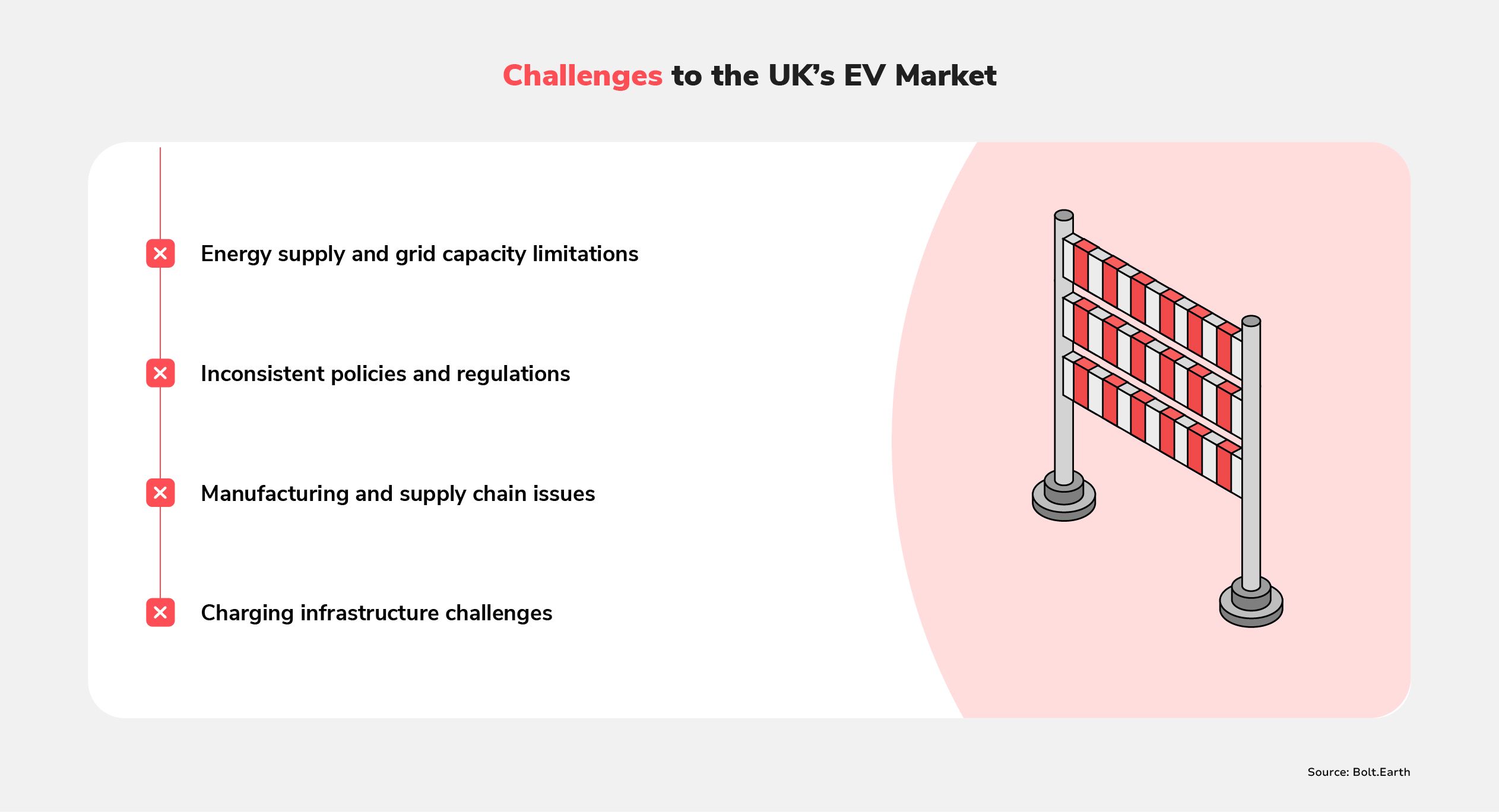
    A graphic listing challenges to the British EV market

    Energy Supply and Grid Capacity Limitations

    In 2022, the UKs electricity demand reached a record low of 320.7 TWh due to the increased utility prices. Supporting electric vehicles would require an estimated 100 TWh in energy usage by 2030. This is not predicted to be a major problem, however, since almost 40% of electricity is expected to come from renewable resources by 2030.

    A more serious challenge involves grid stability at a street level, and domestic infrastructure. There are around 400k substations in the UK, each serving approximately 1,500 homes and businesses. This creates a serious risk of electricity overload from using typical 7 kW EV chargers, since substations have power output limits.

    Domestic wiring variations in the UK, such as TT, TNS, and TNCS, further complicate EV charging point installations; compatibility concerns with simultaneous household appliance usage must be addressed.

    Inconsistent Policies and Regulations

    The reduction in Plug-in Car Grant incentives led to an immediate decline in private EV sales in the UK, revealing the market’s dependence on policy support. Despite arguments that grants can kickstart ongoing EV demand, the cancellation raises concerns.

    The Prime Minister’s plan to delay the deadline for consumer EV purchases until 2035 conflicts with the unchanged mandate for manufacturers: over 20% of each manufacturer’s new cars in 2024 must be zero-emission, or they face fines.

    A lack of details and clarity causes further uncertainty for manufacturers, hindering investment and industry development. Furthermore, since the mandate now takes effect next year, manufacturers are already scrambling to adapt to the policy change.

    Overall, abrupt policy changes create ongoing chaos and challenges for the automotive sector; inconsistent regulations, implemented with insufficient prior notification, are hindering the industry’s development.

    Manufacturing and Supply Chain Issues

    This is the challenge faced by many traditional automotive giants worldwide, like Germany, Japan and South Korea.

    With half of its cars exported to the EU, the UK’s focus on limiting petrol and diesel sales faces a crucial shift, yet only 9.5% of 2022 car production comprises BEVs. This necessitates strategic moves to align with evolving global EV trends and secure export revenue. However, transforming the ICE supply chain into an EV-centric one requires substantial investment, new suppliers, and talent, all of which are difficult to find.

    Furthermore, post-Brexit, the UK’s EV supply chain is struggling to meet the rules of origin criteria outlined in the UK-EU Trade and Cooperation Agreement (TCA). To qualify for zero tariffs, EVs must meet specified content percentages originating from the UK or EU, starting with 40% by December 31, 2023. Brexit-induced trade barriers may impact material, component, and EV costs due to reduced market access.

    Charging Infrastructure Challenges

    EV adoption faces hurdles in the UK, with 70% of stakeholders highlighting on-street charging inadequacy as a key concern. A third of households lack driveways, creating a strong need for robust public charging infrastructure.

    Unclear public-private network relationships and requirements and a costly and time-consuming planning permit system also hinder EV infrastructure establishment. Furthermore, the UK is facing a critical shortage of skilled EV infrastructure technicians, with only 6% currently possessing the necessary skills, and a projected deficit of up to 35k by 2030.

    Opportunities for Future Growth in the UK
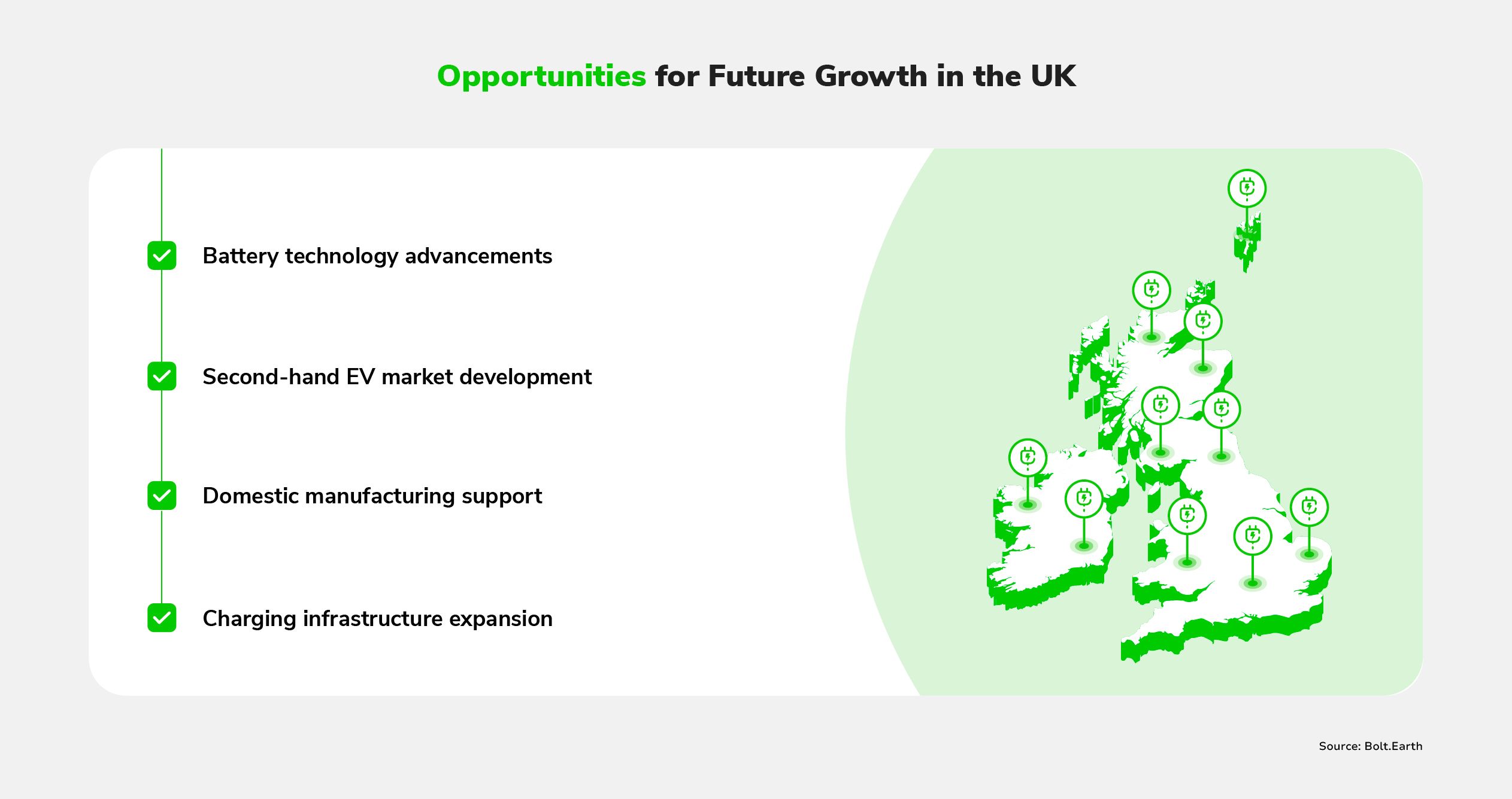
    A graphic listing opportunities for future growth in the British EV market

    Battery Technology Advancements

    As mentioned above, the British government is committed to providing financial and regulatory support to enable mass-scale EV battery production. Notably, Williams Advanced Engineering and Fortescue Metals Group are partnering to develop a bespoke battery system for a 240-tonne electric mining haul truck. The innovative battery electric powertrain, featuring regeneration capabilities, will be integrated into the prototype. The collaboration also involves creating a fast-charging unit, facilitating the broader adoption of a battery-electric haulage fleet. Meanwhile, Moixa’s
    solar battery integrates hardware and GridShare software for renewable energy management. It optimizes EV battery charging in real-time, considering factors like driver behavior, energy costs, and weather forecasts.

    Second-Hand EV Market Development

    Although the upfront cost of EV is not consumers’ top concern, it still needs to be addressed. With used cars representing 82% of all cars sold in the UK in 2021, it is critical to optimize the second-hand market as a catalyst for a nationwide adoption of EVs. To do this, the government could incentivize buyers with a new battery or financial refund, easing worries about battery health. Standardizing battery life and quality with a certification could further enhance consumer confidence. Finally, public awareness campaigns could dispel concerns about purchasing used EVs and educate consumers about charging costs and locations, enabling a smoother transition to electric vehicles.

    Domestic Manufacturing Support

    Britain’s new relationship to the EU has important implications for automakers, specifically for the whole value chain. As of 2023, the UK has already developed a foundational EV supply chain to produce almost every component of EVs.

    An SMMT report established plans for future direction anchor vehicle production in the UK via three strategies:

    1. Boost Government Support for EV Manufacturing

    To benefit from tariff-free trade, the UK needs investment in domestic minerals refining, battery manufacturing, and electric drive units. A competitive incentive package is crucial to attract global investors and position the UK as a top destination for green technology investment.

    2. Simplify Administrative Processes

    It is better for the UK to streamline regulatory frameworks for projects like battery production and renewable energy facilities. Faster access to funding and market reforms, such as decoupling electricity and renewable energy prices from gas, are essential for attracting investments.

    3. Forge Global Partnerships

    The UK can secure minerals processing capacity by expanding trade agreements and partnerships with resource-rich countries. Priorities include expanding free trade agreements, establishing partnerships, encouraging British investors in sustainable mining, and creating favorable conditions for remanufacturers.

    Charging Infrastructure Expansion

    Like Europe, the UK is actively working to expand its charging infrastructure. It has identified several areas for improvement.

    Home Charging

    Promoting residential EV charging is prudent, given unpredictable private-public charging proportions. Residents can charge their cars overnight, or establish a DER for extra income.

    The British public is open to home EV charging, as shown by a 2023 survey; nearly half of homeowners are willing to pave over their front gardens to accommodate charging devices, and 70% of EV owners have already modified homes for charging. The demand for home charging is expected to continue rising.

    Charger Technology Improvements

    According to British charger company Zap-Map, the latest ultra-rapid charging devices already enable some EVs to add more than 100 miles in as little as 10 minutes. To address the public charging network’s inadequacies, the UK could spread out more ultra-rapid chargers to low dense areas.
    Innovative companies such as Swarco, which provide expert-level 24/7 in-house customer support to optimize the user experience, could further support this transition.

    Grid Stability Optimization

    Since grid stability is the main concern when it comes to EV charging, the UK has proposed introducing the G99.pdf) grid connection standard to revolutionize the way power is generated, transmitted, and consumed.

    Accelerating Towards a Bright EV Future

    The UK’s electric vehicle market stands at the edge of a transformative era. With government commitment, strategic investments, and innovative solutions addressing challenges, the road ahead looks promising. The UK is poised for a future in which residential charging becomes ubiquitous, cutting-edge battery technologies redefine possibilities, and a robust domestic supply chain solidifies the nation’s position in the global EV arena. Substantial challenges exist, but they are stepping stones to a cleaner, sustainable tomorrow. The UK’s EV journey is not just about reducing emissions; it also promises to steer the nation towards a dynamic and electrifying future.

    FAQ

    What are the key factors shaping the growth of the UK’s EV market?

    The growth of the UK’s EV market is driven by government commitments to achieving net-zero emissions, rising consumer demand, advancements in technology, and supportive policies and incentives.

    How do advancements in battery technology affect the UK’s EV landscape?

    Cutting-edge battery technologies, including those developed by British companies like Williams Advanced Engineering and Moixa, are a major contributor to EV innovation in the UK, enhancing range, efficiency, and overall performance.

    What incentives exist for businesses to invest in EV manufacturing in the UK?

    Businesses receive substantial support, including a £2.8bn package, to boost EV manufacturing in regions like the West Midlands, Wales, and the North. Green finance initiatives and export support further incentivize investment.

    What role does charging infrastructure play in boosting EV adoption in the UK?

    Charging infrastructure is crucial for EV adoption in the UK. The government is investing in expanding charging points, and encouraging home charging. Challenges like on-street charging inadequacy and an overcomplicated planning permit system still need addressing.

    What is the timeline for the UK’s ban on new petrol and diesel car sales?

    The UK aims to ban the sale of new petrol and diesel cars by 2030. Hybrid vehicles will be permitted until 2035. As of September 2023, the Prime Minister was considering pushing the deadline back by 5 years, but no further details or plans have emerged.

    How are consumer preferences evolving in response to the UK’s changing EV landscape?

    Increased sales of second-hand EVs, growing demand for affordable zero-emission cars, and the popularity of EVs in various market segments all demonstrate a positive shift in consumers’ mindset toward electric vehicles.

    Resources

    SMMT: Society of Motor Manufacturers and Traders

    Explore updated data about the British EV market here.

    House of Commons: Electric vehicles and infrastructure

    Find more details about the UK’s EV industry and infrastructure here.

    Zap-Map: EV charging statistics 2023

    View a map of the UK’s EV infrastructure here.

    UK Gov: The ten point plan for a green industrial revolution

    Read the British government’s plan for the EV market here.

    UK Gov: UK electric vehicle infrastructure strategy

    Discover the British government’s strategy for EV infrastructure here.

  • How to Leverage The Potential of All-Solid-State Batteries for Electric Vehicles

    How to Leverage The Potential of All-Solid-State Batteries for Electric Vehicles

    Electric vehicles (EVs) are quickly becoming the sustainable alternative to gasoline-powered vehicles. However, limited range and long charging times hinder many of today’s EVs. The all-solid-state battery presents a promising solution to these issues.

    Traditional lithium-ion batteries utilize a liquid electrolyte, which can be flammable and volatile. This raises safety concerns while restricting energy density and charging speed. Conversely, all-solid-state batteries use a solid electrolyte, making them safer, and allowing for higher energy density and faster charging times. All-solid-state batteries are cheaper to produce, utilizing inexpensive materials instead of rare earth metals, setting the stage for broader EV adoption.

    To know more about all-solid-state batteries and their potential for EVs, this article answers three questions.

    • Why are all-solid-state batteries crucial for EVs and the broader energy landscape?
    • What are the challenges to commercializing all-solid-state batteries, and how can we overcome them?
    • How will all-solid-state batteries change the future of EVs and energy storage?

    Understanding All-Solid-State Batteries

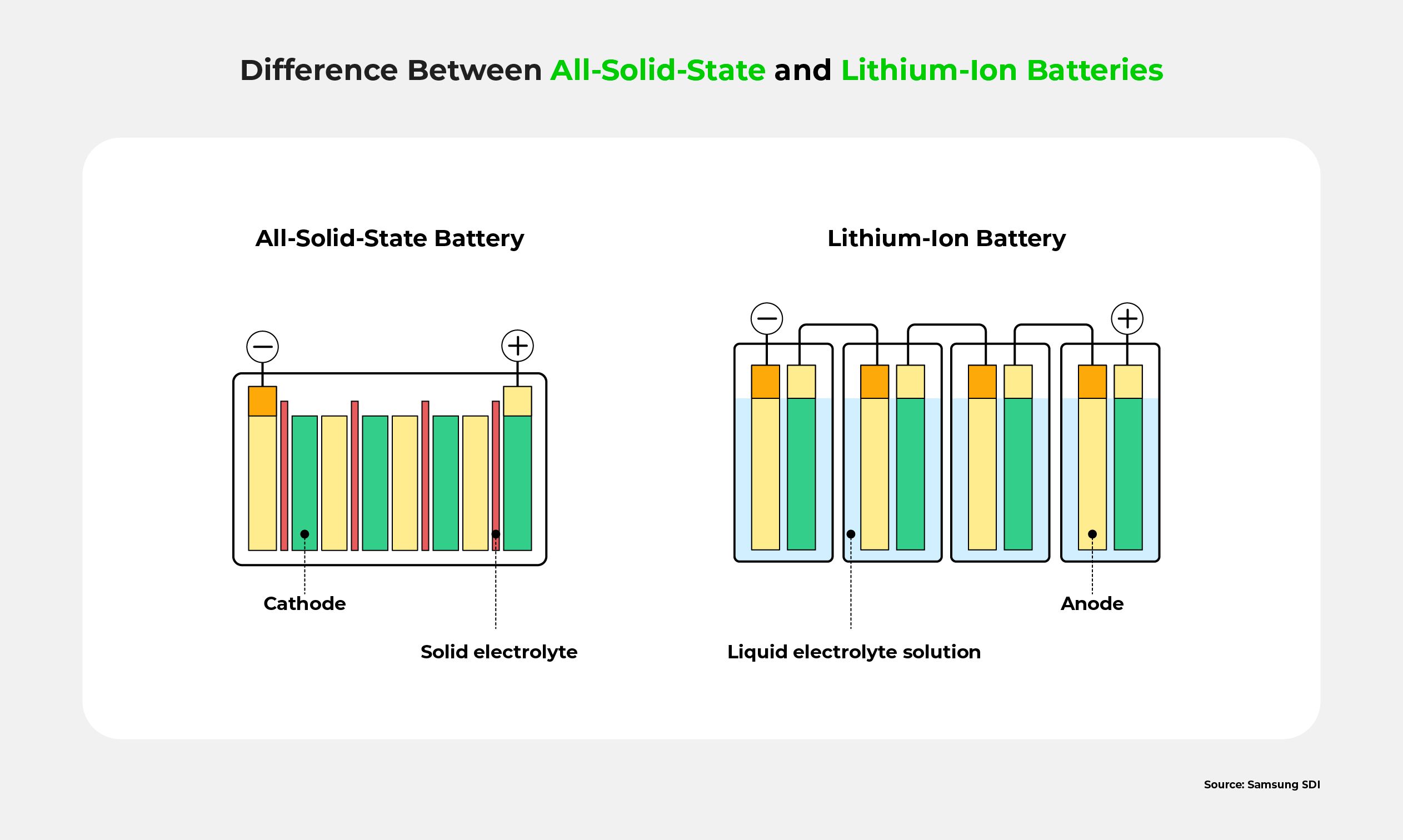
    All-solid-state batteries, as the name implies, contain only solid components. Lithium-ion batteries contain two electrodes (a cathode and an anode) separated by a liquid electrolyte. This liquid assists ion movement between electrodes, facilitating electricity generation. Solid-state batteries operate similarly but with a solid rather than liquid electrolyte.

    A diagram showing the difference between all-solid-state and lithium-ion batteries

    The shift from liquid to solid brings many benefits. Liquid electrolytes require a separator between the cathode and anode, which is redundant in a solid-state context. This compact nature means more energy and capacity, allowing EVs to travel longer distances between charges, reducing the stress of running out of power and searching for charging places.

    The lack of flammable liquids in all-solid-state batteries makes them safer and less prone to malfunction, translating to enhanced EV performance.

    All-Solid-State Batteries in Today’s EVs Landscape

    EV adoption is on a global upswing. By the end of 2023, EVs are projected to account for 18% of all cars sold worldwide. In 2022, over half of three-wheeler registrations in India were electric, and the two-wheeler sector experienced substantial growth in 2022 and 2023.

    Currently, EVs almost exclusively use lithium-ion batteries, as it’s the only available option. But, these batteries present many disadvantages:

    • Sensitive to temperature, so temperature extremes reduce efficiency or cause permanent damage
    • Difficult to recycle and often end up in landfills
    • Low energy density requires frequent charging
    • Overcharging causes battery damage
    • Average lifespan between five to eight years

    Most alarmingly, lithium-ion batteries can spontaneously combust when they enter a self-heating state called thermal runaway. These characteristics often increase EV costs and raise safety and range anxiety concerns. However, the emergence of all-solid-state batteries, with their superior safety, two to three times greater energy density, and cost-effectiveness, could revolutionize the EV landscape.

    Why Discuss All-Solid-State Batteries Now?

    The EV industry is currently navigating several challenges — heightened cost compared to traditional vehicles, safety concerns, and the limited driving range. All-solid-state batteries may be the solution.

    Recently, new developments in all-solid-state battery technology can help overcome the limitations of lithium-ion batteries. Toyota unveiled a breakthrough aiming for EVs that offer a 745-mile range with just a 10-minute charge by 2027. Chinese manufacturer Nio is gearing up to launch its solid-state battery with a 150kWh capacity, which is expected to be 40% denser than lithium-ion batteries.

    All-solid-state batteries are projected to yield environmental and economic benefits. Estimates suggest these batteries can store more energy with fewer materials, reducing an EV’s carbon footprint by 24%. Research highlights that solid ceramics in all-solid-state batteries can make them lighter, charge faster, and eventually cheaper.

     A bar chart showing the global warming potential of different batteries

    Furthermore, companies like Bolt.Earth are developing advanced operating systems designed to better monitor and manage the underlying Battery Management Systems (BMS) and extend the lifespan of batteries.

    However, fully realizing these benefits demands an understanding of inherent challenges.

    Challenges in Implementing All-Solid-State Batteries

    All-solid-state batteries offer numerous benefits, but their implementation isn’t straightforward. The technology is still emerging, with primary obstacles centered around manufacturing, material identification, and understanding conductivity.

    Manufacturing Scalability and Cost-Effectiveness

    Many engineering challenges make scalable manufacturing a distant reality. Some processes require external pressure exceeding 100 MPa for cell assembly. Moreover, several studies have used cathodes with less active loading than liquid electrolytes. Further research into the metal plating of anodes and cathodes is essential to understand their morphology and impact on energy density.

    Solid-State Electrolyte Conductivity

    Measuring the ionic conductivity of solid-state electrolytes is critical and complex. With the current technologies, conductivity is measured as bulk resistance, which can vary based on the electrolyte’s material, frequency, and temperature.
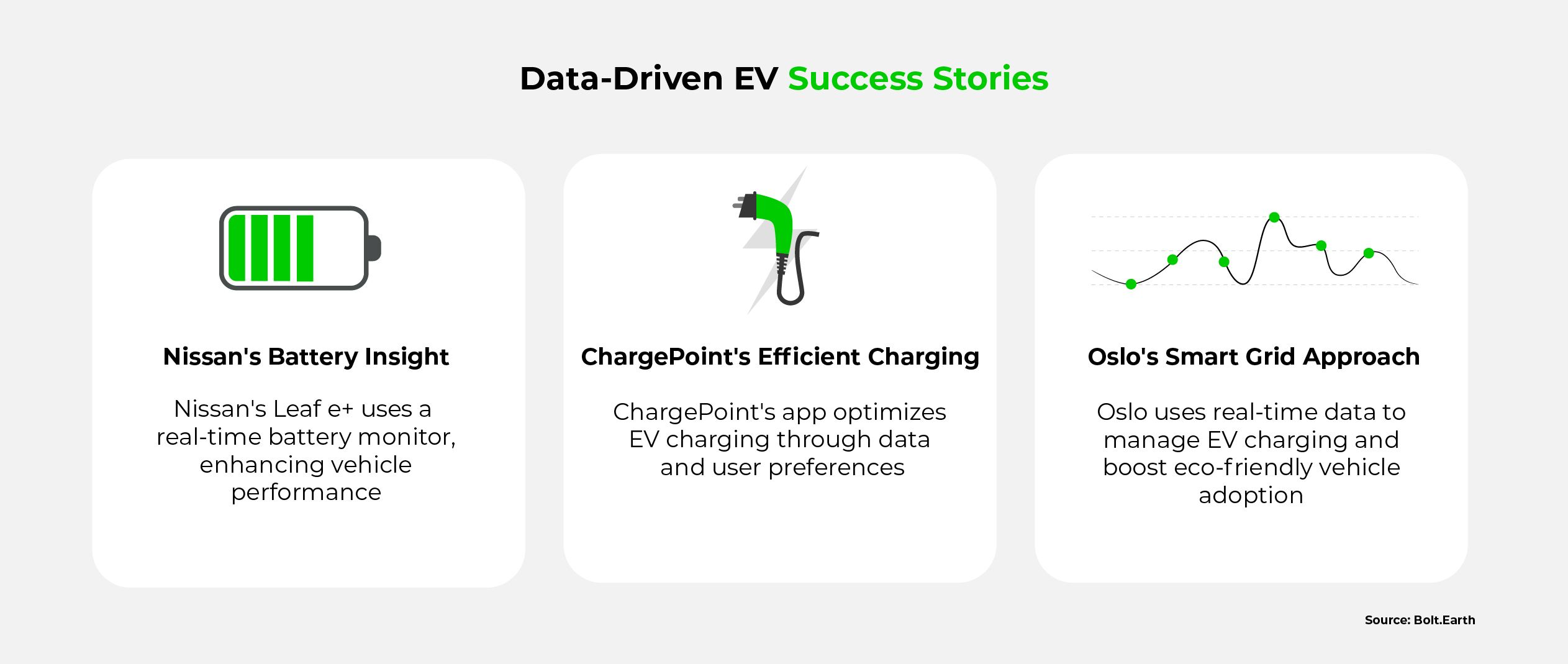
    Electrode Material Optimization

    The key component in all-solid-state batteries is the solid-state electrolyte, which can be ceramic, glass, polymer, or a mix. The choice of material brings varied electrical, electrochemical, and mechanical variations. Each material can react differently at different temperatures, making it challenging to select the most conducive material. Combining these materials with electrodes is still an obstacle and may need carbonaceous materials.

    Despite the difficulties, many companies are researching the potential of all-solid-state batteries for EVs.

    Solutions for Advancing All-Solid-State Batteries

    Researchers and companies are developing creative solutions to tackle challenges in all-solid-state battery adoption. Through collaborations, government policies, and safety certifications, the world can unlock the potential of cleaner energy storage.

    A list of solutions to help advance all-solid-state battery technology

    Collaborative Research Efforts

    In the last few years, several notable partnerships between research institutions, universities, and corporations have been underway. Some partnerships are:
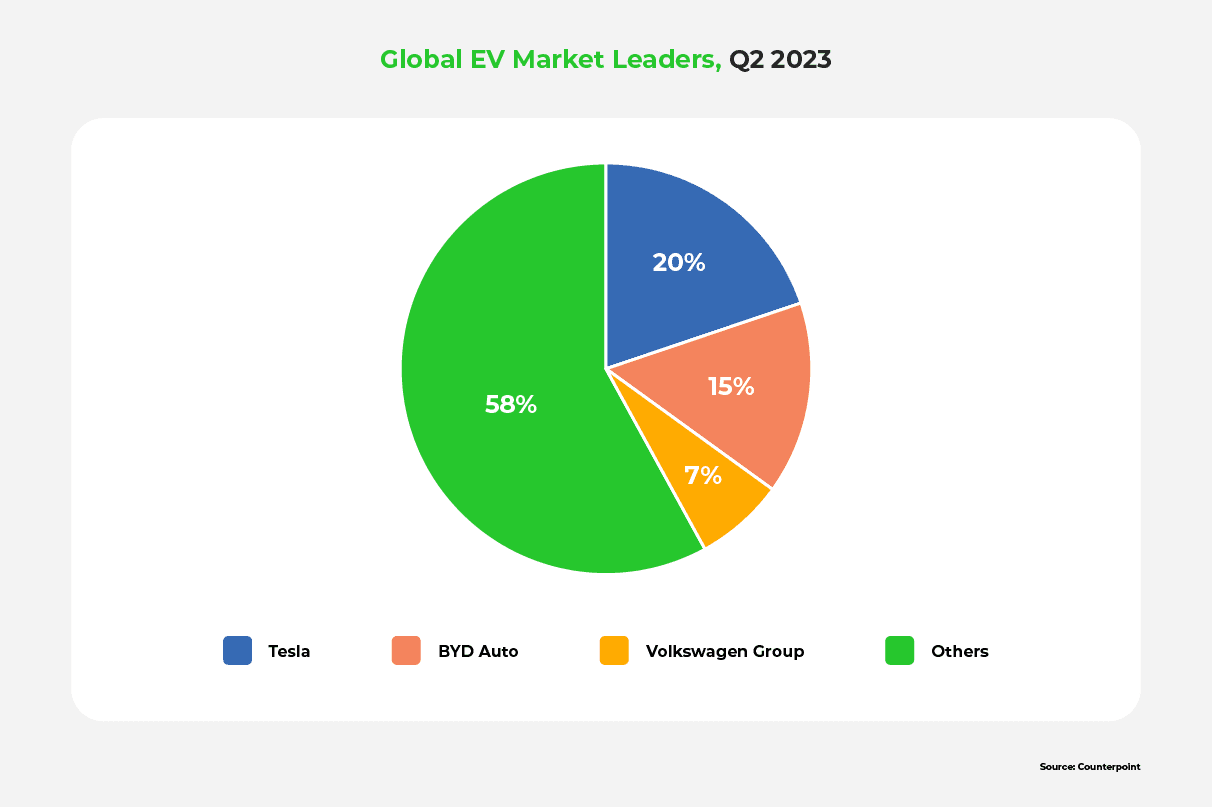
    • Tsuyo Manufacturing and IIT Delhi aim to develop cost-effective solutions using low-cost materials to improve process efficiency and reduce EV prices.
    • Indian Oil Corporation and Phinergy, an Israeli battery developer, are manufacturing lightweight metal-air batteries.
    • MIT created a new method for stabilizing electrode interfaces, aiding Toyota’s efforts to build all-state-solid batteries.
    • A study at Stanford, sponsored by Samsung, alerted manufacturers of aspects to watch out for while using ceramic in all-solid-state batteries.
    • Volkswagen and Northvolt, having acquired a cell research company called Cuberg, target a 1000Wh/liter of energy density by 2025.

    Such partnerships combine knowledge and perspectives, pushing all-solid-state battery technology forward.

    Advancements in Manufacturing Techniques

    Innovative manufacturing techniques aim to resolve challenges in making all-solid-state batteries on a large scale. Some significant advancements are:

    • Thin-film deposition over solid-state electrolytes provides control over the thickness and uniformity of the electrolyte layer and can help optimize material usage.
    • Roll-to-roll processing, where batteries are assembled on a conveyor belt, can support scalable manufacturing.
    • Using graphite anodes instead of silicon anodes can increase energy retention and density.

    Embracing these methods could create a more extensive all-solid-state battery adoption.

    Government Support and Policy Initiatives

    Government support and policy initiatives are essential to boost the research and commercialization of all-state-solid batteries. Some policy initiatives are:

    • Government funding, in the form of research grants, creates more opportunities for innovation in advancing battery technologies.
    • Tax incentives for companies investing in the production of all-solid-state batteries can encourage others to move in this direction.
    • Regulations that prioritize the use of all-state-solid batteries can increase their demand and lead to wider EV adoption.

    With a mix of financial incentives and a favorable regulatory environment, governments can accelerate the transition to sustainable transportation.

    Safety and Certification Requirements

    All-solid-state batteries are safer and more efficient when compared to lithium-ion batteries. Still, safety certifications are essential to infuse confidence in the minds of EV owners. Some difficulties in implementing these certification requirements are:

    • Depending on the material used as the electrolyte, each kind of solid-state battery can have unique characteristics that may make certification a challenge.
    • Ensuring the safety of these batteries requires comprehensive testing across various operating conditions, which may need to be more practical to implement.
    • Establishing consistent safety standards across regions is challenging, similar to defining universal traffic rules for safe driving globally.

    Despite these challenges, international organizations and governments seek to establish safety standards and certifications.

    Safety Measures

    Some rigorous safety measures that must be integrated to mitigate the risks of these advanced battery systems are:

    • All-solid-state batteries must have fire-resistant casings designed to withstand and contain thermal events.
    • All batteries must have sophisticated thermal management systems that will maintain the battery’s temperature within safe limits, preventing potential hazards.
    • A battery management system (BMS) must continuously monitor the battery’s performance and initiate shutdown when irregularities arise.

    These measures are a starting point to infuse safety as an integral part of battery manufacturing.

    Certification Standards

    Certifications are essential to ensure the safety and reliability of all-solid-state batteries, especially for EVs. Some possible standards are:

    • The UN 38.3 regulation evaluates the safety of lithium batteries and involves electrical, mechanical, thermal, and environmental testing.
    • The IEC 62660-1 standard outlines the requirements for lithium-ion batteries and addresses factors like electrical performance, thermal management, and safety features.
    • The UL 2590 standard is specifically geared for the safety and performance of EV battery packs, as it assesses factors like thermal runaway prevention, electrical insulation, and protection against external hazards.

    These certification standards can also be extended to all-solid-state batteries, acting as benchmarks for their safety and reliability.

    Advancing Electric Mobility with All-Solid-State Batteries

    All-solid-state batteries are poised to redefine electric mobility. With enhanced energy density, they promise longer driving ranges and faster charging speeds, making EVs appealing to consumers. This boost in performance and reduction in greenhouse gas emissions presents a cleaner and more sustainable transportation future.

    Ongoing research and development are crucial to fully harness the potential of all-solid-state batteries. As the technology continues to improve and gain accessibility, it will play a pivotal role in shaping the EV market, driving sustainability efforts, and accelerating the global transition to cleaner energy sources. The future is bright, with all-solid-state batteries leading the way towards a greener and more efficient world of electric mobility.

    To learn more about all-solid-state batteries, please see the FAQ and Resources below!

    FAQ

    What are all-solid-state batteries, and how do they differ from conventional lithium-ion batteries?

    All-solid-state batteries use only solid materials as electrolytes, typically ceramics or polymers, unlike the liquid electrolytes found in lithium-ion batteries. This solid-state design offers several advantages, including higher energy density, faster charging capabilities, improved safety due to reduced risk of thermal runaway, and potentially a longer lifespan.

    What advantages do all-solid-state batteries offer for electric vehicles?

    All-solid-state batteries offer several advantages for EVs. They provide higher energy density, enabling longer driving ranges. They also allow faster charging is possible due to improved ion conductivity in solid-state electrolytes. Enhanced safety is a key benefit, as these batteries are less prone to thermal runaway. Additionally, they have the potential for a longer lifespan, reducing the need for frequent battery replacements, which is particularly important in the automotive industry.

    What are the main challenges in developing and commercializing all-solid-state batteries for electric vehicles?

    Developing and commercializing all-solid-state batteries presents significant challenges. Scaling manufacturing to meet the rising demand for EVs is difficult given the many variations in solid electrolytes. Additionally, finding electrode materials that maximize energy density and cycling stability is a technical challenge that requires innovative solutions.

    How are safety concerns of all-solid-state batteries in EVs addressed?

    Safety measures are being rigorously implemented to address concerns related to all-solid-state battery usage in EVs. These measures include using fire-resistant housing to contain thermal events and reduce external fire risks. Sophisticated thermal management systems are engineered to prevent overheating, ensuring safe battery operation within optimal temperature ranges. Furthermore, intricate battery management systems (BMS) continuously monitor battery performance. In the event of anomalies or irregularities, the BMS can promptly initiate shutdown procedures, significantly enhancing overall safety and reliability.

    How do all-solid-state batteries impact the performance and range of electric vehicles?

    All-solid-state batteries have higher energy density, allowing for increased energy storage capacity resulting in longer driving ranges on a single charge. Additionally, the enhanced efficiency of these batteries can lead to improved acceleration and sustained performance over time. These factors make all-solid-state batteries a promising technology for boosting EV performance and competitiveness.

    Resources

    MDPI: Recent Advances in All-Solid-State Lithium–Oxygen Batteries: Challenges, Strategies, Future

    Discover the future of all-solid-state batteries.

    LinkedIn: Unveiling the potential of all-solid-state batteries in shaping the future of electric vehicles

    Learn how all-solid-state batteries are paving the way for a bright future for EVs.

    Wiley Online Library: Challenges, interface engineering, and processing strategies toward practical sulfide-based all-solid-state lithium batteries

    Gain an in-depth understanding of all-solid-state lithium batteries.

    Association for Computing Machinery: The Holy Grail of Electric Vehicles: Solid-State Batteries

    Explore how all-solid-state batteries can impact EVs.

    OSTI.gov: High-Efficiency, Medium-Voltage-Input, Solid-State-Transformer-Based 400-kW/1000V/400A Extreme Fast Charger for Electric Vehicles

    Stay informed of key developments in solid-state batteries for EVs.

  • How Data Insights Maximize EV Performance

    How Data Insights Maximize EV Performance

    Electric vehicle (EV) automakers are increasingly integrating software platforms and components to improve their vehicles’ efficiency and meet users’ evolving needs. With the expansion of EV charging infrastructure and growing investments, EV adoption is on the rise.

    To leverage this growing momentum, the industry aims to refine the performance and efficiency of EVs. Currently, EVs convert around 77% of electrical energy from the grid. While this is notably higher than gasoline vehicles’ 12 to 30% conversion rate, there’s potential for improvement. By innovating in battery technology and harnessing data-driven analytics, challenges such as range anxiety can be addressed, bolstering EVs as a preferred sustainable mobility option.

    To better understand the role of data insights in improving EV efficiency and sustainability, this article answers three questions:

    • How can data help make EVs better and solve EV owner problems?
    • What are the pros of using data to improve EVs? If there are cons, what are they, and how does one overcome them?
    • How have people and businesses used EV data to make things more efficient?

    Common Challenges in EV Adoption

    Despite the compelling environmental and economic benefits, EV adoption has been slower than expected due to challenges including high cost, limited range, frequent recharging needs, and lagging charging infrastructure. However, different governments’ strict laws and pollution standards have made it mandatory to decarbonize the transport sector.

    Bridging these challenges with mandatory emission standards can be filled by data-driven insights, addressing range anxiety, charging time concerns, and data deficiency.

    Range Anxiety

    Range anxiety, or the fear of depleting charge before reaching a charging station, is a common concern among EV users. Leveraging data analytics to better understand the usage patterns of a charging point, Stakeholders can make informed decisions, bolstering charging infrastructures in high-demand areas.

    Charging Time Concerns

    A significant drawback of EVs is their prolonged charging times. Level 1, or slow charging points, can take five to six hours to charge with a driving range of two to five miles per hour. Level 2 charging points charge in one to two hours with a driving range of 10 to 20 miles per hour. To alleviate long charging times, data analytics can help operators pinpoint less crowded stations, directing EV drivers to them and minimizing wait times.

    Data Deficiency

    Comprehensive insights on EV usage patterns, charging times, and power grid utilization can help policymakers understand the current state of EV charging infrastructure and its impact on EV adoption. Using this data, they can formulate policies to make EVs more sustainable. Similarly, original equipment manufacturers and fleet managers can use this EV data to better understand customer and driver preferences and improve efficiency.

    Besides addressing the above challenges, data-driven solutions can also help EV users.

    Data-Driven EV Solutions

    Data isn’t solely for policymakers and infrastructure providers – it’s also essential for EV users and fleet operators. Tapping into these insights can address several concerns.

    A list of data-driven EV solutions

    Route Planning and Range Anxiety Mitigation

    Many EV users lack clarity about their vehicle’s performance. With data analytics, they can plan better, optimizing their travel routes. Charging apps can guide users in real time, suggesting less congested charging stations or efficient routes based on battery levels, mitigating range anxiety.

    Predictive Maintenance

    Continuous data collection, especially from components like Battery Management Systems (BMS), IoT microcontrollers, and other accessories, facilitates predictive maintenance. By pre-emptively identifying issues through analyzing data to monitor the EV’s health, it can provide early warnings of potential problems, extend the lifespan of critical components, and reduce long-term ownership costs.

    User-Friendly Data Interfaces

    Clean and intuitive user interfaces are the key to making data and analytics accessible to EV users and fleet operators. App developers must design user-friendly interfaces so users can gauge their EV’s performance, charging habits, and maintenance needs. Additionally, apps offering personalized recommendations and insights enable users to make the most of data-driven insights.

    Such concerted efforts from all stakeholders can enable the industry to better utilize the data generated from EVs and charging points.

    Pros and Cons of Data-Driven EV Solutions

    A pros and cons list for data-driven EV solutions

    Pros

    Improved Efficiency

    Data-driven solutions can optimize routes, charging times, and driver behavior, leading to increased efficiency of EVs. By empowering EV users and fleet operators with actionable data insights, they can maximize vehicle potential. Over time, this can widen EV adoption by making it an environmentally and economically viable mobility choice.

    Reduced Costs

    A key advantage of harnessing EV data insights is the potential for monetary savings. Data-driven predictive maintenance can extend the lifespan of EV components like batteries, reducing upkeep and replacement costs. Optimized charging strategies can also lower electricity expenses, providing long-term financial benefits.

    Longer Battery Life

    Battery replacement costs are a deterrent to EV adoption. Given that the cost of replacement ranges from INR 15,000 to INR 20,000 per kWh (with a mid-range EV battery being 30-40 kWh) and INR 30,000 for EV two-wheelers. Leveraging data insights allows for adaptive driving habits that can prolong battery life, increasing overall vehicle value.

    Cons

    Privacy Concerns

    The process of data collection and analysis creates privacy concerns among EV users. The comprehensive data collected from EVs often include personally identifiable information (PII). Mismanagement or mishandling of this data can lead to potential data misuse. Addressing this requires rigorous data security measures at multiple levels to protect sensitive information and prevent unauthorized access, increasing trust and confidence in the data-driven approach.

    Cybersecurity Risks

    Cybersecurity is intrinsically linked to the EV ecosystem. Given the interconnected nature of EVs, with ties to the power grid, transportation networks, and smart city infrastructure, the emphasis on cybersecurity is paramount. Hence, cybersecurity needs to be embedded during manufacturing and development.

    Complex Initial Setup

    Generating EV data insights requires the installation of sensors and smart charging equipment. This can be expensive and require a high level of technical expertise. For some users, downloading and configuring the software can seem daunting. One way to alleviate this downside is to create a user-friendly setup process and offer comprehensive support resources.

    Dependence on Data Networks

    EV data insights often rely on data networks for real-time updates and recommendations. Certain features might underperform in areas with poor network coverage, potentially frustrating users. A solution to this downside is to bolster offline capabilities and integrate alternative operational methods, ensuring a seamless user experience.

    Despite these challenges, the traction for EV data insights remains robust.

    Current Market Trends and Expert Insights

    The EV market is undergoing a major transformation, largely driven by data insights. Market leaders like Tesla and Nissan are harnessing real-time data to boost battery efficiency and overall user experience. The prevalence of user-centric mobile apps continues to grow, enabling users easy access to valuable data insights. These apps provide personalized recommendations for efficient driving, route planning, and charging schedules to enhance user experience, fostering greater EV acceptance.

    Moreover, urban planners are integrating these data-driven insights into their plans. Technological advancements, including bidirectional charging and vehicle-to-grid (V2G) technology, are reshaping EV and grid interactions, leading to power distribution and usage efficiency. Additionally, artificial intelligence (AI) is improving predictive maintenance capabilities, extending the lifespan of critical components.

    These developments promise a cleaner, smarter, and greener future. More importantly, stakeholders actively leverage these data-driven insights, recognizing their transformative benefits.

    EV Success Stories

    Success stories provide valuable information into how organizations leverage data insights to improve EV performance and how these enhancements influence consumer choice and experiences.
    A pros and cons list for data-driven EV solutions

    Case Study 1: Nissan’s Battery Health Monitor

    Nissan’s battery health monitor tracks 288 lithium-ion cells within its Leaf e+ model’s 96 battery modules, offering real-time insights into battery health and performance. The Leafspy app, accessible to Leaf e+ users, provides information by connecting to the EV through a wireless dongle, allowing users to monitor battery health.

    Many Nissan owners have attested to the effectiveness of these EV data insights. One notable Leaf e+ user reported minimal degradation in the battery’s two-year lifespan despite the absence of active cooling while driving in a warm climate. These insights empower users to take control of their vehicle’s performance and maintenance, enhancing the ownership experience.

    Case Study 2: ChargePoint’s Charging Optimization Platform

    ChargePoint, a leading charging solutions provider, is revolutionizing the EV charging experience through data insights. Its app combines real-time analysis of charging station data with user preferences, guiding users to available charging spots.

    Electricity rates, grid demand, and user preferences are all factors the app considers to help EV owners charge at optimal times. Additionally, this information helps charging point operators balance grid load, ensuring stability during peak hours. Using this information, EV users can define their ideal charging times and locations to enhance their convenience while mitigating costs.

    Case Study 3: Smart Grid Integration in Oslo, Norway

    Norway’s capital, Oslo, uses real-time data to manage its EV charging networks, balance grid demand, and incentivize off-peak charging. It continuously monitors grid demand and electricity rates to encourage users to charge during off-peak hours. Its many incentives, including free public parking and reduced company car taxes, make EV ownership appealing. The growing EV adoption is helping reduce carbon emissions, creating a better living environment for residents.

    Oslo’s integration of data-driven solutions is a testament to the power of using data to increase EV adoption. Its real-time data analysis has helped harness the potential of its smart grid, benefiting the environment and residents.

    These case studies clearly show that the future is in data-driven EVs.

    The Future of Data-Driven EVs

    The future of EVs will be closely tied to the development of data-driven solutions, echoing the software-centric approach of next-generation vehicles. Breakthroughs in 5G, AI, and V2G promise a transformative phase of EVs.

    Accelerated real-time analytics, facilitated by 5G, will optimize charging, route planning, and overall EV performance. AI’s potential to quickly analyze vast datasets will provide EVs with accurate information for predictive maintenance, personalized recommendations, and energy-efficient management. Bidirectional charging and V2G technologies make EVs active participants in the energy grid, drawing and releasing excess power to help enhance grid stability.

    The future of data-driven EVs is promising, as technology can make EVs more efficient, cost-effective, and sustainable.

    Start Using EV Data Insights Today

    The journey of improving EV efficiency and performance hinges on the ability of stakeholders to embrace data-driven solutions. The associated challenges, including range anxiety, battery replacement costs, and charging time concerns, can be surmounted using data-driven insights. The case studies from Nissan’s health battery monitoring, Chargepoint’s charging optimization, and Oslo’s smart grid integration showcase the potential of data-driven insights.

    Data insights have the transformative power to optimize EV performance, reduce costs, and elevate user experience. EV users, charging point operators, policymakers, and investors can address challenges more effectively with data-driven strategies. As we look to the future, data-driven solutions are necessary in the evolution of EVs that increasingly rely on software components. By embracing these EV data insights, we can shape a cleaner, more efficient, and cost-effective sustainable transportation future.

    To learn more about maximizing your EV’s performance with data insights, please see the FAQ and Resources below!

    FAQ

    Can data insights extend EV battery life?

    Yes, data insights can extend EV battery life. By monitoring battery health and performance data, EV owners can take proactive measures to ensure optimal battery conditions. For example, Nissan’s battery health monitoring system sends alerts for maintenance, preventing early battery degradation and extending its lifespan.

    Are data-driven solutions expensive to implement in an EV?

    Data-driven solutions in EVs vary in cost but can offer substantial long-term savings. Initial implementation may include expenses for sensors, software, technicians, and infrastructure, depending on the chosen solution. However, these investments often lead to reduced maintenance and operational costs over time.

    How do data insights alleviate range anxiety for EV users?

    EV data insights provide real-time information on factors such as battery charge levels, traffic conditions, and charging station availability. Using this data, drivers can make informed decisions about planning their routes and charging stops, reducing range anxiety.

    Are data-driven solutions available for all types of electric vehicles?

    Data-driven solutions are generally available for a wide range of EVs, as they come equipped with built-in sensors and data collection software systems that enable data-driven features. However, the availability and extent of data-driven solutions can vary depending on the make and model. Additionally, retrofitting older EVs with data-driven features may be possible but could be challenging and costly.

    How do data insights impact the cost of charging an electric vehicle?

    Data insights analyze electricity rates, grid demand, and user preferences to optimize charging schedules. This helps users take advantage of lower electricity prices during off-peak hours, resulting in cost savings. Additionally, predictive maintenance enabled by data insights can extend the lifespan of the EV’s battery, further reducing long-term ownership costs.

    Resources

    Tech Briefs: Optimizing EV Performance Through the Power of Data

    Explore how engineers can harness data to optimize battery safety and performance and, ultimately, drive EV adoption.

    YoCharge: The Role Of Data Analytics In Optimizing EV Charging Management Systems

    Learn about the importance of data analytics in EV charging management systems.

    The University of Chicago Press Journals: The Market for Electric Vehicles: Indirect Network Effects and Policy Design

    Understand how EV data insights were used for policymaking.

    Australian Government: National Electric Vehicle Strategy

    Discover how the Australian government ensures EV privacy and data security through its policies.

    EV Box: Home EV Charging Data and Insights

    Learn how to benefit from home EV charging insights.

  • EV Technology in 2023: Current Trends and Future Prospects

    EV Technology in 2023: Current Trends and Future Prospects

    Growing climate change concerns, coupled with technological advancements in the automotive industry, have fueled the growth of electric vehicles (EVs). In the first half of 2023, there was a 40% increase in global EV sales compared to the previous year. By 2030, EVs will constitute 35 to 40% of all new car sales. However, this mass adoption depends on innovations in charging infrastructure, smart grids, and battery technology.

    To provide a realistic perspective on the EV trends in India, this article answers three key questions:

    • What are the top technology trends shaping the EV industry in 2023?
    • How are current challenges impeding the progress of EV technology?
    • Why are proposed solutions vital to overcoming these challenges?

    Today’s EV Technology

    EVs present an eco-friendly and cost-effective alternative to traditional vehicles, offering a solution to reduce congestion and pollution in Indian cities. These modern vehicles come equipped with high-tech features, further enhancing the driving experience and contributing to a sustainable urban environment. Consequently, the Indian government is supporting EV adoption, and the private sector is building innovative EVs to suit India’s roads and traffic conditions.

    Battery technology innovations play a key role in the EV market. Advancements in lithium batteries have reduced EV battery costs by 90% since 2008, making EVs more affordable, providing more mileage, and reducing range anxiety. Advancements in EV chargers and smart grids further boost consumer interest. Favorable government policies, greater EV benefits, and rising consumer demand have all spurred the global EV market.

    In India, Tata Motors is in the lead, with an 86% market share from its Tigor and Nexon EV models. Other popular models include MG Motor’s MG ZS EV at 9% and Hyundai’s Kona at 1.6%. In the two-wheeler EV sector, Ola Electric leads a 27.2% market share, followed by TVS Motor at 19.3% and Ather Energy at 14.6%. Mahindra & Mahindra dominates the three-wheeler EV market, followed by Piaggio Vehicles.

    Moving on to the global EV market, Tesla leads with a market share of 20% in Q2 of 2023. BYD Auto follows with a market share of 15% and Volkswagen with 7%. The remaining 58% of the market share is highly fragmented among many local and international companies.

    A pie chart showing global EV market leaders

    When it comes to EV two-wheelers, the top players are AIMA Technology, Ather Energy, Hero Electric, Jiangsu Xinri, and Yadea Group Holdings.

    A quick comparison between the Indian and global markets shows that in India, there’s room for more players and models. This also signifies more opportunities for global players who can enter this lucrative market for a share in the EV pie.

    Why Discuss EV Breakthroughs Now?

    2023 is a pivotal year for EVs, marked by an influx of new models and increased demand and awareness. By discussing EV shifts in India now, stakeholders have a chance to actively shape the future of mobility. Furthermore, these advancements are backed by potentially time-sensitive regulatory policies that create a conducive environment to improve battery technology and integrate renewable energy sources; this is an ideal moment to boost EV adoption, create economic opportunities, and provide environmental benefits.

    Key Technology Trends Shaping Electric Vehicles in 2023

    A lot is happening under the hood, from smart systems to power-packed batteries. Here are some key technology trends shaping EVs in 2023.

    A graphic listing nine key trends in EV technology in 2023

    AI-Powered Vehicle Health Checks

    AI systems are revolutionizing EV safety and performance by gathering sensor data and analyzing anomalies. In particular, these systems gauge EV and battery health, so that owners and fleet operators can take proactive actions to avoid costly repairs. A good example is the vehicle intelligence system developed by Delhi-based Vecmocon Technologies and funded by the Indian Department of Science and Technology; it features keyless entry, predictive maintenance, remote diagnostics, fleet management, and user-adaptive algorithms to ensure a reliable and safe EV driving experience.

    Advanced Driver Assistance Systems (ADAS)

    ADAS refers to a collection of technology-driven features, consisting of sensors and controllers, that enhance driving safety and comfort by monitoring the external environment for the presence of other vehicles and pedestrians. This information is used to provide real-time suggestions, including emergency braking and parking assistance. ADAS can also detect driver drowsiness to improve safety.

    Improved Connectivity Features

    The shift to software-defined vehicles (SDVs) emphasizes seamless connectivity for a smooth driving experience. Vehicle-to-everything (V2X) technology enables software controllers to send and receive information — including remote diagnostics, location-based services, current charge level monitoring, and over-the-air software updates — to internal and external components.
    An infographic depicting vehicle-to-everything (V2X) technology

    Charging Infrastructure Development

    Currently, the charging market in India is highly fragmented, with four different charging standards: Bharat AC-001, Bharat DC-001, CHAdeMO, and CCS. The existing infrastructure is located in cities, although public-private partnerships are working to build many stations across highways. Efforts to address incompatibilities in charging standards include Bolt.Earth’s universal chargers. Furthermore, the emergence of fast charging technology is reducing charging time, leading to optimized usage of existing facilities and greater return on investment (ROI) for infrastructure developers.

    Smart Grids

    Smart grids enhance EV charging efficiency and improve load balancing, ensuring a smooth charging experience for users. Innovations like bi-directional charging and vehicle-to-grid (V2G) technology allow EVs to function as energy repositories that can return unused energy to the grid, making them a more sustainable option.

    Advancements in Battery Technology

    The demand for high-performance EVs with longer mileage is fueling innovation in battery technology. Solid-state batteries, which use solid electrolytes over liquid or gel, promise efficiency, durability, and higher energy density that has higher energy storage. Similarly, lithium-sulfur batteries offer greater energy storage at reduced costs. Sodium-ion (Na-ion) batteries, which are cost-effective but less-than-ideal for long distances, are currently being explored for e-scooters. Additionally, advancements in battery recycling technologies are helping extend battery lifespans and reducing operational costs.

    Sustainable Material Disposal

    The growing awareness of environmental damage and the efforts going into solid waste management will extend to EVs. It’s estimated that 100 million EV batteries retire in the next decade, creating opportunities in battery recycling.

    Research and development grants from the EU’s European Battery Alliance and the United States’ National Science Foundation Phase II are driving the battery recycle trend. Stringent decarbonization targets are also pushing EV automakers to consider using recycled batteries, as it can have four times less carbon footprint than new ones.

    Energy Efficiency and Regenerative Braking

    EV makers are looking to optimize energy usage and efficiency, as it can directly address problems like range anxiety. The regenerative braking trend contributes to energy efficiency as it captures the kinetic energy released during braking. When the vehicle decelerates or comes to a standstill, a certain amount of kinetic energy is released, and this is captured and reused for running the EV. While this trend is in the nascent stages, it is expected to pick steam in 2023 and beyond.

    Hydrogen Fuel Cell Vehicles (FCVs)

    The push to make EVs more environment-friendly is fueled by renewable energy usage. Along with solar, wind, and hydro, there has been a growing interest in hydrogen fuel cells. As the name suggests, hydrogen is the fuel, and the emission is only water and warm air. Though FCEVs are in the early stages now, a lot of research is happening in this field. Countries like India are even looking to commercialize these hydrogen fuel cells in the coming years.

    These exciting trends chart a path to a greener and smarter future. However, to realize their full potential, stakeholders must tackle some important challenges.

    Obstacles to Enhancing EV Technology

    The road to enhanced EV technology is complicated by several technical, regulatory, and economic factors. The EV industry must address these before it can truly harness the power of emerging technologies.

    A graphic listing obstacles to enhancing EV technology

    Safety Concerns With ADAS

    ADAS’ safety features may not always be reliable; low light, weak network signal areas, and inclement weather conditions can lead to false alarms, or cause ADAS to miss serious issues. Furthermore, since ADAS relies heavily on GPS systems, outdated data can reduce efficacy, or even provide inaccurate information.

    Integration of Connectivity Features

    Relying on EV software for connectivity creates a need for compatible protocols and hardware to ensure seamless communication. Nevertheless, the current landscape is fragmented; there are multiple communication protocols, which can prevent software components from effectively exchanging information. Furthermore, EV users must search for charging locations that have hardware compatible with their specific vehicles. Lastly, concerns about data security and privacy affect connectivity among EV components. These issues impact remote diagnostics and smart navigation, reducing user experience and increasing maintenance costs.

    Limitations in Battery Technology

    Although there have been remarkable developments in battery technology in the last few years, it still lags behind fossil fuels in energy density. Furthermore, insufficient charging stations and prolonged charging times continue to restrict EVs’ usability.

    Although these challenges are substantial, the EV industry is already taking steps to overcome them.

    Resolving Current Challenges in EV Technology

    In order to keep making progress, the EV industry must resolve challenges involving safety, range, and battery technology. Industry stakeholders are working together to address these issues with research, investments, and regulatory support.

    A graphic listing solutions that can address major challenges in today's EV technology

    Robust Testing and Safety Standards for Autonomous Driving

    Rigorous testing is required to ensure a safe driving experience, especially for ADAS. Automakers and technology companies must integrate real-world trials with virtual simulations and data analysis to identify shortcomings, enhancing user trust in ADAS-equipped EVs.

    Enhanced Connectivity Protocols and Cybersecurity Measures

    Cybersecurity is essential to all communication and connectivity protocols. Automakers must consider using upgraded protocols, encrypted communication channels, and proven authentication mechanisms to ensure confidentiality among car components, EVs, and smart grids. Secure connectivity is required to prevent cyberattacks and safeguard sensitive user data.

    Innovations in Battery Technology

    Battery technology, which is undergoing ongoing research, is central to EVs. Developing solid-state and lithium-sulfur batteries can increase EV mileage, and advancing fast-charging technologies reduces charging time. For example, the Swiss-based technology company Morand has developed a fast charger that can charge EVs to 80% in 72 seconds, although it is only suited to small-range cars.

    These solutions pave the way for a future where autonomous driving, seamless connectivity, and cutting-edge batteries work together to boost EV users’ driving experience.

    Imagining the Future of Transportation

    Emerging trends in battery technology and ADAS are not just drivers of innovation; rather, they can reshape the future of the EV industry by creating user-friendly features, improved range, and faster charging solutions, making EVs more attractive to a wider customer base. By championing EV adoption, stakeholders can make strides towards improving air quality and reducing carbon emissions.

    If harnessed correctly, technology trends can pave the way for a greener, cleaner, and more electrified future.

    Embrace the Electrifying Future: Drive the Change Today!

    In 2023, technological trends such as AI-powered health checks, seamless connectivity, smart grids, improved charging infrastructure, and powerful batteries are driving the EV industry. Keeping up with these trends isn’t just a choice; it’s a roadmap for a cleaner future. Let’s embrace the electric shift and drive the change toward a greener tomorrow!

    To learn more about EV trends in India, please see the FAQ and Resources sections below.

    FAQ

    How is the global adoption of electric vehicles progressing?

    The global adoption of EVs is steadily advancing. Sales and registrations of EVs have been on the rise, driven by factors like government incentives, environmental awareness, and technological advancements. EV sales reached a near-record high of 1.26 million in June 2023. This growth is attributed to improved battery technology, expanded charging infrastructure, and increased consumer interest in sustainable transportation.

    Who are the major players in India’s electric vehicle market?

    The Indian EV market’s major players are Tata Motors, Ola Electric, and Mahindra & Mahindra. These companies have strategically positioned themselves to capitalize on India’s growing demand for EVs. With innovative product offerings, competitive pricing, and collaborations with local stakeholders, these players have emerged as influential contributors to the expansion of India’s EV market.

    What role does autonomous driving play in the future of electric vehicles?

    Autonomous driving plays an important role in shaping the future of electric mobility. It integrates artificial intelligence and advanced sensors to enhance safety, reduce traffic congestion, and optimize energy efficiency. As self-driving technology advances, it could enable shared autonomous EVs, reducing urban pollution.

    How is the charging infrastructure developing to support the expanding electric vehicle market?

    The charging infrastructure is rapidly evolving to accommodate the growing number of EVs. Governments, private companies, and communities are driving the installation of charging stations, especially in urban centers and along highways. This expansion is fueled by increased EV adoption, government incentives, and environmental concerns, all contributing to a more accessible and convenient charging network.

    What sustainability initiatives are being taken in the electric vehicle industry?

    Many sustainability initiatives are happening in the EV industry. Manufacturers prioritize eco-friendly materials, including polymers or composites of carbon fibers, for EV production, integrate renewable energy in charging stations, and create battery recycling programs. Together, all these initiatives are contributing to a greener EV ecosystem.

    Resources

    LinkedIn: Top 5 Electric Vehicle Technology Trends for 2023

    Get detailed insights on some cutting-edge trends in EV technology.

    EV Magazine: Trends in electric vehicles: what can we expect in 2023?

    Discover predictions for the EV industry’s immediate future.

    InteractOne: The Tech & Trends Shaping Automotive in 2023

    Learn about some key technological advancements and trends.

    United States Department of Energy: Electric Vehicle Charging Infrastructure Trends from the Alternative Fueling Station Locator

    Find out how EV charging infrastructure trends are shaping the industry.

    International Council on Clean Transportation: Annual Update on the Global Transition to Electric Vehicles

    Gain an understanding of the global EV market.