For fleet managers electrifying (or expanding) their EV fleets, designing the right fast charging setup is just as important as selecting the right vehicles. This blog provides a step-by-step framework and tips to help you choose a DC fast charging solution that maximizes uptime and return on investment (ROI).
1. Assess Your Fleet’s Duty Cycles and Energy Needs
Start by analyzing your fleet’s daily operations. What is the average distance per vehicle? What are the peak operating hours vs. idle periods? What are the typical range requirements and downtime windows?
For example, if delivery vans cover 120 km daily and return to the warehouse twice for loading, those loading periods might be ideal for quick charging. A van consuming 1 kWh per 5 km would need approximately 24 kWh per day. Multiply this by your fleet size to estimate total daily energy demand.
A useful rule: Segment vehicles based on charging needs. For example, vehicles with around-the-clock availability or very high daily mileage will likely require DC fast chargers, not just overnight slow charging. Identify which vehicles absolutely need fast charging to meet the schedule (e.g., those with <4-5 hours idle time in 24 hours) and which can suffice with slower charging.
2. Choose the Right Charger Power Levels
Small EVs like 2- and 3-wheelers (2–10 kWh batteries) need only 3–12 kW chargers—enough for a full charge in under an hour. Most two-wheelers can’t handle high currents.
Three-wheelers and small cargo EVs (10–20 kWh) charge efficiently at 15–30 kW, reaching full capacity in 30–60 minutes.
Fleet cars and vans (20–40 kWh) typically support 30–60 kW DC fast chargers, adding approximately 100 km of range in an hour, or up to 80% in less than one.
Larger trucks and buses (100 kWh+) need at least 60 kW, ideally 90–210 kW for faster turnarounds.
City e-buses in India typically use 120 kW chargers, while intercity buses and heavy trucks are adopting 360 kW CCS2 and upcoming megawatt charging systems. Since higher power means higher cost and grid demand, a mix works best: a few 100 kW units for large vehicles and multiple 30 kW units for routine fast charging.
Ensure compatibility with connector standards. To future-proof your setup.
3. Determine Number of Chargers and Charging Ports
For example, if 10 taxis each need a 30-minute top-up across an 8-hour shift, two 50 kW chargers could handle all 10. But if 20 delivery vans return at 7 PM and must leave by 8 PM, more chargers will be required.
As a rule of thumb, start conservatively (3:1 or 4:1) and adjust using real-world usage data, though high-utilization fleets may need ratios closer to 1:1 or 2:1. Consider dual-gun chargers that can charge two vehicles at once or split power dynamically (e.g., two 30 kW outputs from a 60 kW unit).
Plan your layout for easy cable access and charger reach. Finally, always use at least one extra charger for redundancy in your fleet charging solution.
4. Plan Infrastructure and Power Supply
Collaborate early with your electricity provider and engineers to confirm your site can handle the required load. For example, three 60 kW chargers running together require 180 kW; your connection and transformer must support this load alongside other facility needs. Use load management systems to stay within capacity. If you have four 60 kW chargers (240 kW total) but only a 180 kW connection, smart software can dynamically distribute power to avoid overload.
Consider on-site solar and battery energy storage (BESS) to reduce grid demand and costs. Storage can charge during off-peak hours or from solar, then deliver high power during peak use, easing grid pressure and providing backup during outages.
In the EV charging infrastructure in India, solar + storage systems can make daytime fast charging cleaner and cheaper.
If mission-critical uptime is essential, include backup power, such as a diesel genset or battery pack, for emergency charging. While diesel backup isn’t ideal for the long term, it ensures operational continuity when the grid fails.
5. Ensure Charger Uptime and Maintenance
Fast charging only adds value when chargers are reliable. Invest in robust, well-supported equipment with remote monitoring and strong service contracts.
Best practices include:
Preventive maintenance, regular inspections, calibration, and timely replacement of wear parts.
Keep essential spares like cables, connectors, and fuses handy to minimize downtime.
Train in-house staff or contract an on-call technician for quick fixes, and consider an O&M contract with guaranteed uptime (e.g., SLA to resolve faults within 24 hours).
Always plan for redundancy; if one charger can meet your fleet’s needs, install at least two to prevent total disruption.
As your fleet grows, distribute chargers across sites to avoid single-point failures. With proper monitoring, predictive maintenance, and real-time monitoring, 95–98% uptime is achievable. Treat chargers like critical IT infrastructure, actively managed and maintained.
6. Use Software to Optimize Charging and Costs
A centralized charging management platform can automate scheduling, prioritize vehicles, and notify drivers when charging is complete.
For larger fleets, integration with EV fleet management solutions helps align charging with vehicle deployment.
Smart scheduling also reduces electricity costs by shifting non-urgent charging to off-peak tariff hours (like 6–10 PM). Advanced systems can reallocate power from nearly full vehicles to those needing faster charging, maximizing utilization.
In India, many fleets already use these strategies; charging more vehicles simultaneously at moderate power often beats waiting for high-speed slots. Smart software ensures every kilowatt is used efficiently.
7. Analyze Costs and Track ROI
Before installation, conduct a full total cost of ownership (TCO) and EV charging ROI analysis covering equipment, installation, grid upgrades, maintenance, and electricity costs. Balance these against savings, lower fuel and vehicle maintenance costs, operational uptime gains, and any carbon credits or incentives. This helps estimate your payback period.
Many fleet charging projects in India recover costs within a few years; high-utilization public stations can even break even in under two days. For private fleets, the “return” often comes from fuel savings and improved productivity.
If ROI looks tight, adjust your plan; fewer chargers, more overnight AC charging, or smarter utilization can improve payback. Aim for 30–50% charger utilization during working hours to strike the right balance between capacity and efficiency.
Also, explore financing or leasing models, now offered by several banks and charge-point operators. Spreading costs over time through “charging-as-a-service” makes infrastructure investment easier and ROI more attractive.
8. Future-Proof and Scale Your Setup
Plan your charging setup with growth from the start. As EV adoption rises, expanding your fleet and charging needs will be inevitable. It’s far cheaper to prepare now than retrofit later.
When installing electrical infrastructure, lay conduits for future chargers and install a slightly larger transformer in case the fleet size may double in a few years.
Choose modular chargers that scale easily. Reserve space and electrical capacity upfront to avoid expensive overhauls later.
Stay informed on emerging technologies like 500 kW+ chargers and vehicle-to-grid (V2G) systems. If relevant, invest in V2G-ready chargers to unlock future revenue opportunities.
Finally, ensure all chargers support open standards like OCPP to maintain software flexibility and avoid vendor lock-in. The goal: build a system that grows and evolves seamlessly as your fleet and technology advance.
Final Thoughts
By understanding your fleet’s needs, right-sizing your charger mix, building a resilient infrastructure, and using smart management software, fleet managers like you can deploy DC fast chargers in a cost-effective way that delivers real uptime and ROI. Indian pioneers, from e-commerce giants to electric taxi startups and state transport fleets, have proven it’s possible. Their success came not just from adopting EVs but from building the charging muscle behind them.
Frequently Asked Questions
How do I decide which vehicles in my fleet actually need DC fast charging?
Not all EVs need DC fast charging. Analyze duty cycles and downtime windows. If a vehicle operates almost continuously (e.g., <4–5 hours idle per day), it needs DC charging to sustain uptime. Vehicles with predictable overnight rest can rely on slower AC charging. A good strategy is to segment your fleet by usage intensity. High-mileage or high-availability vehicles get fast chargers; the rest use slower, cheaper options.
How do I calculate how many chargers my fleet actually needs?
Estimate total energy demand (kWh/day) and overlapping idle times. A 3:1 or 4:1 vehicle-to-charger ratio works for most medium-utilization fleets, but for 24×7 operations, go closer to 1:1 or 2:1. Also, always install at least one redundant charger for continuity.
What kind of maintenance plan ensures 95%+ uptime?
Follow preventive maintenance every quarter, cable inspection, firmware updates, and part replacements (connectors, relays, fans). Keep critical spares on-site, train one technician, and use remote diagnostics for quick fault resolution. Aim for an Operation and Maintenance Service Level Agreement (O&M SLA) guaranteeing 24-hour resolution; treat chargers like IT servers, not just equipment.
India’s electric fleet revolution is gaining momentum, from nimble two-wheelers delivering groceries to electric buses running intercity routes. For fleet operators, EVs promise lower operating costs and higher productivity, provided vehicles spend more time on the road than at the charger. That’s where EV fleet charging infrastructure with DC fast chargers becomes a game-changer, enabling quick turnarounds, multi-shift operations, and seamless logistics through robust EV fleet charging infrastructure.
In this blog, we explore:
How fast charging maximizes fleet uptime and operational flexibility
Depot vs. public charging strategies, and how each model impacts cost, control, and reliability.
The ROI equation for fast charging, with real-world examples from Indian fleets.
Why Fast Charging Maximizes Fleet Uptime
Vehicle downtime directly translates to lost revenue. A delivery van stuck at a charger for hours, or a taxi offline mid-day, is time lost. DC fast charging dramatically reduces charging time, thereby maximizing vehicle availability. In the context of fleets:
1. Minimized Downtime = More Trips
DC fast chargers (typically ranging from 50 kW up to 150+ kW) can recharge a vehicle’s battery to 80% in 30-40 minutes, as compared to 6 hours on a home outlet. Simply put, a vehicle that charges faster can complete more trips per day, directly boosting productivity and strengthening any fleet charging solution.
2. Operational Flexibility
Fleets can top up batteries during short downtimes. For example, a bus charging at a terminal or a van during warehouse stops. Strategic scheduling during breaks or shift changes makes charging nearly invisible in terms of lost time.
3. Extended Service Hours
Fast charging enables multi-shift usage of EVs. For instance, a ride-hailing car can run morning and evening shifts with a quick afternoon charge. Delivery vans can do double runs, effectively doubling daily output.
Flipkart’s finding of 20% faster delivery turnaround with EVs is in part due to leveraging quick charging and quick swaps to keep bikes and vans constantly moving.
4. Reduced Range Anxiety
While private EV owners might plan their day around a full charge, fleet vehicles often push the limits of range. Knowing that a fast charger is available provides confidence to dispatch EVs on longer routes or more trips. Amazon India’s highway trials with electric trucks show that uptime is achievable even for long-haul routes with adequate fast charging.
5. High Utilization Segments
Some fleet segments operate almost continuously. Segments like intercity buses or 24×7 delivery fleets rely on fast charging to maintain schedules. Charging 15 minutes every 300 km allows electric buses to mirror diesel pit stops, proving fast charging can eliminate EV downtime disadvantages.
Depot vs. Public Charging: Choosing the Right Strategy for Fleet Charging
Fleet EVs can be charged at private depots (or hubs) controlled by the fleet operator or at commercial EV charging stations. Many fleets use a hybrid model, but optimizing the strategy is vital for cost and uptime. Let’s compare:
Depot (Private) Charging
This involves installing charging stations at fleet-owned or leased facilities, such as bus depots, delivery warehouses, taxi parking lots, etc. Depot charging can be further split into overnight slow charging and on-demand fast charging at the depot.
Advantages:
Depot charging gives fleets full control and guaranteed access. Vehicles can charge on a set schedule, say, all vans overnight, without competing for spots.
Smart charging with off-peak power and on-site renewables like rooftop solar with battery storage to cut energy costs.
Customizable infrastructure (AC chargers for overnight use and DC fast chargers for quick top-ups).
Lower electricity rates and high charger utilization.
Avoids dependence on public infrastructure, letting fleets maintain their own high-uptime systems with built-in redundancy.
Challenges:
High upfront costs for hardware and electrical upgrades.
Depot space constraints and lead time for getting permits and utility approvals for large installations.
Impractical for small fleet operators or those with distributed vehicles, e.g., gig workers who take vehicles home, may find it impractical to have their own depot for charging.
Requires planning and investment but amortizes over time.
This refers to using third-party or government-run commercial EV charging stations, available in cities and on highways. Fleet vehicles can visit these stations and pay per use (usually per kWh or per minute).
Advantages:
Public charging eliminates upfront infrastructure costs for fleets—the station operator handles setup and maintenance, while fleets simply pay per use.
Ideal for small fleets or pilot programs with limited EV numbers.
Enables en-route top-ups and emergency charging.
Pay-per-use model offers flexibility and scalability as fleets grow. It acts as an operating expense rather than a capital investment.
Most fleets adopt a depot-first approach with selective public charger use. Some even open depot chargers to the public during off-hours to generate revenue and maximize utilization.
Ultimately, the choice comes down to scale and control. Large, mission-critical fleets (buses, large e-commerce delivery operations, taxi fleets) lean towards building their own fast-charge facilities to guarantee uptime. Smaller fleets or those in early stages might lean more on public chargers until their usage justifies dedicated installations. In either case, fast charging – whether at a depot or public – is a cornerstone of fleet electrification economics. Next, let’s look at how fast charging translates into ROI for fleet operators, with some real-world data from Indian deployments.
Fast Charging and Maximizing Fleet ROI
Fuel Cost Savings
Electricity is much cheaper per kilometer than diesel or petrol. This is the fundamental source of EV cost advantage. For high-mileage fleet vehicles, the fuel savings accrue quickly, and fast charging enables more electric kilometers per day.
According to industry analysis, most EV categories in India are already TCO-positive in high-use scenarios, meaning over the vehicle’s life, they turn out cheaper than ICE vehicles when driven a lot. By allowing vehicles to stay in service longer each day, fast charging effectively increases the daily kilometers driven on electricity, thereby accelerating fuel cost payback.
For example, an electric delivery van running 150 km/day (vs. 75 km/day with slow overnight charging) doubles diesel displacement. Over a year, this translates to tens of thousands of rupees saved, offsetting charger investment.
Fast charging supports sustainability goals and brand positioning. Companies like Flipkart use their EV fleets and charging infrastructure to gain goodwill and attract eco-conscious clients. This strategic edge enhances ROI beyond direct cost savings.
Companies like Zomato, Blinkit, and Zepto leverage this for nonstop delivery. However, swapping is limited to light EVs. For cars, vans, and buses, fast charging remains the dominant solution. Standards like CCS2 and GB/T are mature, and government policy also favors fast charging for heavy vehicles.
Maintenance and Lifespan Benefits
Fast charging, when managed well, contributes to lower maintenance costs and longer vehicle life, indirectly boosting ROI. Modern EVs are built for rapid charging, with warranties covering high cycle counts. Some fast-charging hubs use battery storage to buffer the grid, reducing stress on vehicle batteries.
Longer service life means the initial purchase cost is spread over more kilometers and years, improving the overall ROI. It’s worth noting that excessive fast charging can degrade older batteries, but today’s tech and thermal management mitigate the impact. Many fleet operators factor this into the TCO model and still find fast charging worthwhile.
Final Thoughts
As technology evolves and scale drives costs down, DC fast charging will only become more accessible and even faster. Fleet managers who embrace it today will position their operations to ride the wave of electrification efficiently.
Maximizing uptime is no longer just about better scheduling; it’s about electrifying smartly. DC fast chargers unlock the true potential of electric fleets, ensuring that going green doesn’t mean slowing down. With the right charging strategy, supported by electric fleet management solutions, your EV fleet can outpace diesel vehicles in both performance and profitability.
Frequently Asked Questions
Is fast charging financially viable for small fleet operators?
Yes, fast charging is financially viable for small fleet operators, especially with shared or pay-per-use charging networks. Smaller fleets can start with public fast chargers to avoid upfront infrastructure costs. As vehicle count and mileage grow, investing in a private depot charger becomes cost-effective due to lower per-kWh rates and higher uptime. Hybrid models often offer the best ROI balance.
How do I know if my fleet needs DC fast charging?
If your vehicles run multiple shifts or over 150 km daily, fast charging helps keep them running instead of idle.
How soon does DC fast charging pay off?
For high-mileage fleets, ROI usually comes within 1.5–2 years through higher uptime and lower fuel costs.
India’s transition to electric vehicles (EVs) has gained remarkable momentum, yet EVs still comprise only a small fraction of the nation’s overall vehicle fleet. EV adoption in India rose to 6.3% by 2024, totaling over 5.5 million EVs on Indian roads in early 2025.
The Indian government has set ambitious targets for 2030, including 30% of private cars, 70% of commercial vehicles, 40% of buses, and 80% of two- and three-wheelers to be electric by 2030. Achieving these goals will require bold action across all mobility sectors. Increasingly, experts and policymakers recognize that enterprise and commercial vehicle fleets, ranging from delivery vans and ride-hailing cars to government vehicles and buses, will be the linchpin of India’s EV revolution.
This blog answers three key questions:
Why are enterprise fleets crucial for India’s EV transition?
What is the current state of fleet electrification in India, and how are companies and governments driving it?
What immediate actions should CEOs and fleet leaders take to future-proof their organizations through EV adoption?
Why Enterprise Fleets Are Crucial for India’s EV Transition
Several factors make enterprise and commercial fleets key catalysts for India’s shift to electric mobility:
Scale and Speed of Adoption
Unlike individual consumers who adopt vehicles one by one, enterprises can convert dozens or hundreds of vehicles at once. Fleet operators, from delivery companies to taxi aggregators, can deploy EVs in bulk, rapidly boosting EV numbers on the road. By 2030, commercial EVs are expected to account for approx. 70% of all EVs in India, underscoring the outsized role of fleets in the transition and the importance of scalable EV fleet solutions.
In other words, while an individual car buyer might worry about the higher upfront cost of an EV, a business calculating lifecycle costs may find an EV cheaper overall than a gasoline or diesel vehicle due to lower electricity vs. fuel costs and reduced maintenance. This economic rationale is a powerful driver; fleets can justify EV investments to their CFOs by projecting fuel cost reductions and lower total operating costs over time, strengthening the case for EV fleet solutions.
Infrastructure and Operational Control
Fleet operators benefit from controlled use cases and depots, simplifying charging solutions. For instance, e-commerce companies can install private charging stations at warehouses to recharge electric vans overnight. Public transport agencies can set up charging at bus depots, contributing to the growth of EV charging infrastructure in India.
This depot-charging model sidesteps one of the main consumer concerns, public charging availability, because fleets can ensure dedicated access.
Enterprises can also experiment with solutions like battery swapping for two- and three-wheeler fleets, minimizing downtime. By investing in their own charging infrastructure, fleets effectively expand the nation’s charging network.
Market Signaling and Ecosystem Boost
When large companies electrify their fleets, it sends a strong market signal to automakers and investors that EV demand is real. Corporate fleets committing to EVs give confidence to the ecosystem (manufacturers, charging providers, and financiers) to scale up. Moreover, fleet vehicles typically have defined turnover cycles; after a few years of service, they are resold into the second-hand market. Thus, today’s fleet EVs become tomorrow’s affordable used EVs, broadening access. Fleets, therefore, can jump-start a robust used-EV market, allowing middle-class consumers to buy pre-owned EVs at lower price points in a few years, further accelerating mass EV adoption in India.
Environmental and Social Impact
Commercial vehicles contribute disproportionately to urban pollution and carbon emissions due to their intensive use. Electrifying these yields outsized gains in emissions reduction and air quality.
Now extend that impact to the vast commercial sector, delivery trucks, ride-share cars, and company-owned buses, and the benefits to India’s energy security (cutting oil imports), climate goals, and public health (cleaner air in cities) are enormous. Fleet operators, often being large companies, are also under pressure to meet sustainability and ESG (Environmental, Social, Governance) goals. By switching to EVs, enterprises can dramatically shrink their carbon footprint and showcase climate leadership, aligning with India’s net-zero vision for 2070.
Enterprise fleets offer a fast-track pathway to scale EV adoption. They have the:
Means – capital and scale to invest in new technology
Motive – cost savings and ESG commitments
Opportunity – structured operations that can accommodate charging logistics
The Current State of Fleet Electrification in India
While private EV ownership (particularly electric cars) is in its early stages, electrification is racing ahead in certain vehicle segments and use cases, many of them enterprise-driven. Let’s examine the landscape segment by segment and through key examples:
For instance, food delivery companies and courier services are rapidly onboarding e-bikes: Zomato and Swiggy have pledged 100% electrification of their delivery fleets by 2030. These companies are already deploying thousands of electric two-wheelers in major cities, often through partnerships or incentives for their delivery partners. The cumulative effect is significant; millions of daily delivery miles are now electric, cutting fuel use and emissions.
Four-Wheeler Fleets (Cars and Vans)
Adoption of electric passenger cars by individual consumers remains modest, but enterprise momentum is building. EVs were approx. 25% of new car sales in 2022, per industry reports. Taxi and ride-hailing fleets are a prime example. Uber India announced plans to deploy 25,000 electric cars by 2025-26 as part of its “Uber Green” initiative, partnering with fleet operators and automakers.
Its domestic competitor Ola (which also launched its own EV manufacturing arm, Ola Electric) had similar bold plans to electrify its ride-share fleet.
Corporate fleets for employee transportation are also switching to EVs in tech hubs like Bengaluru and Hyderabad, supported by leasing companies offering EV fleet solutions.
Electrifying buses is a priority for cleaner public transit. Here, fleets are largely government or public-private entities, but they behave like enterprise fleets in adoption decisions. Under the FAME II scheme and PM e-Bus Sewa program, thousands of electric buses have been ordered for city fleets, reflecting the impact of evolving EV policy in India.
Converting government fleets boosts public confidence in EV and sets an example for private EV buyers and businesses.
Corporate Commitments and Coalitions
Indian businesses are joining coalitions to promote fleet electrification. The Climate Group’s EV100 initiative has attracted at least 12 Indian companies, such as Flipkart and BSES, which have committed to 100% electric fleets by 2030.
There are also public-private partnerships targeting specific segments. For example, several companies (Amazon, JSW Steel, IKEA, etc.) launched EV pilots for trucking through EV100+ to kickstart electric truck deployment in India. Such collective efforts are addressing common challenges (like lack of suitable vehicle models or financing hurdles) and sending a unified message to suppliers and policymakers that the demand for fleet EVs is robust.
Automaker and Industry Response
Automakers are tailoring products for the Indian fleet market. Tata Motors launched the XPRES-T EV, a version of its electric sedan designed for fleet use.
Partnerships like Tata Motors supplying EVs to Uber and Mahindra Electric focusing on e-3Ws for deliveries show that the automotive value chain is adapting.
Battery leasing models, fleet energy management software, and dedicated B2B sales teams are becoming central to India’s auto industry strategy.
Key Actions for Executives: Seizing the EV Fleet Opportunity Now
For a CEO or senior executive convinced by the arguments above, the logical next question is, “What should we do to get started on our EV journey?”
Here is a checklist of concrete actions and best practices to initiate today, ensuring your organization stays ahead in the EV transition:
Develop a Clear EV Fleet Vision and Policy: Articulate a top-level commitment (e.g., “50% of our delivery fleet will be electric by 2025, and 100% by 2030”). Make EV adoption part of your sustainability strategy and public ESG goals.
Conduct a Fleet Audit & Segmentation: Map out all vehicles in use and segment them by use case, mileage, and replacement timeline. Identify “low-hanging fruit” vehicles or routes that can be electrified immediately. Also note upcoming procurement cycles: if certain diesel vehicles are due for replacement in 2024–25, plan for EV options now rather than locking into another ICE for 5+ years.
Run Pilot Projects and Training: Select a city or business unit and launch a pilot with a handful of EVs. Training programs for drivers and fleet managers on EV basics (charging protocols, driving techniques to maximize range, and safety procedures) can help address any anxiety or resistance to new technology.
Engage Finance Early: Involve your CFO or finance team to explore leasing, hire-purchase, or the “EVs-as-a-service” model. Consider total cost over vehicle life, and tap into green finance or CSR budgets for pilot funding.
Plan Your Charging Infrastructure and Strategy: Conduct a site survey to install chargers. Decide whether you need fast DC chargers or slower AC chargers. Consider integrating solar energy and setting up software to monitor charging data such as sessions, costs, and energy consumption from day one.
Leverage Government Incentives and Partnerships: Track central and state incentives. Ensure timely application for subsidies on each vehicle purchase. Networking with government agencies can also present opportunities to collaborate on pilot programs (like electric bus or freight corridor pilots), which often come with support. Being visible in the public sustainability space can open doors. For instance, if a city is creating an EV task force, have your company represented.
Communicate and Celebrate Milestones: Publicize your progress through press releases and social media. It not only boosts your brand but also holds the organization accountable to keep the momentum. Internally, celebrate the first 100,000 electric kilometers driven, or the first 100 tons of CO₂ emissions avoided. This reinforces the positive feedback loop and builds pride among employees that they are part of a forward-thinking, purpose-driven organization.
Monitor, Measure, Improve: Set up a dashboard for the leadership team to track key fleet metrics such as utilization, costs, downtime, driver feedback, and emissions saved. Encourage continuous improvement and plan for scale beyond the pilot stage.
Build Ecosystem Partnerships: Partner with OEMs, charging providers, tech startups, and fellow corporations to share knowledge and resources. Join consortiums like the Climate Group’s EV100 or NITI Aayog’s stakeholder committees to facilitate peer learning and collective action.
The EV transition is a “sooner is better than later” scenario. Early movers gain cumulative benefits, while late adopters risk falling behind. With prudent planning and bold leadership, enterprise fleets can transform from carbon-intensive cost centers into efficient, innovative, and green assets for the organization.
In India, the number of public commercial EV charging stations has surged to over 26,367 by early FY25 (early 2025), dwarfing the roughly 2,600 battery swapping stations currently in operation. This sharp difference in infrastructure adoption raises a key question for fleet operators and policymakers: which model offers better long-term value? Both fast charging and battery swapping promise to minimize downtime and operational costs for electric vehicle (EV) fleets, yet their economic and practical viability differ across vehicle segments, especially when considering the right fleet charging solution.
In this blog, we address the following key questions:
What is the difference between fast charging and battery swapping?
Which model, fast charging or battery swapping, offers better ROI for different fleet types in India?
What is the infrastructure, cost, and operational implications of each approach?
What Is the Difference Between Fast Charging and Battery Swapping?
Fast charging refers to high-powered charging stations that can replenish an EV’s battery in a fraction of the time of standard home charging. Modern DC fast charging solutions operate at power levels of 50 to 24 kW (and even higher in the newest versions), enabling much quicker top-ups. For example, by 2023, some EVs were able to add over 160 km of range in just 15 minutes using the latest ultra-fast chargers.
Continued innovation, such as 800-volt battery systems and upcoming megawatt charging standards, is pushing charging times closer to gas station refueling, making it ideal for EV charging for fleets.
Battery swapping takes a different approach: instead of waiting for the battery to charge, the EV’s depleted battery is physically replaced with a fully charged one at a swap station. This typically takes only a few minutes, after which the vehicle drives off with a full “tank” of energy. The used battery is left behind to be charged off-board and later reused. Swap stations are usually automated facilities where robots handle heavy battery packs, making the process seamless for the driver. Better Place, a pioneering startup in the 2010s, could swap a car’s battery in about five minutes and built 37 swap stations across Israel. Today’s advanced swap systems (like those by NIO in China) complete the process in as little as 3 minutes without the driver even stepping out.
Both fast charging and swapping aim to minimize downtime, but their infrastructure and business models differ. Next, we compare these approaches across key dimensions: speed, convenience, infrastructure costs, battery lifecycle, operational use cases, and the specific context of India’s EV market, especially for those evaluating a scalable fleet charging solution.
ROI Across Fleet Types: Fast Charging vs. Battery Swapping
Understanding ROI for fast charging and battery swapping requires looking at how each model performs across different vehicle categories. Fleet operators in India manage a spectrum of vehicles ranging from two-wheeler delivery bikes and three-wheeler e-rickshaws to four-wheeler taxis and electric buses. Each segment has unique energy needs and duty cycles that influence which charging model makes more financial sense. Below, we compare fast charging and battery swapping side-by-side for key vehicle categories, focusing on metrics like TCO, uptime (vehicle availability), battery life, and overall operational cost.
Key Takeaways:
For two-wheelers and three-wheelers, battery swapping can offer superior ROI in high-utilization scenarios like delivery fleets or passenger rickshaws. Studies show that a ride-hailing e-scooter using swaps can achieve 15% lower TCO than one using charging, thanks to zero downtime and no battery replacement cost over the vehicle’s life.
Likewise, a typical e-rickshaw driver might increase earnings by approx. 30% with swapping due to more service hours and paying only per use of the battery. However, these benefits depend on intensive use; for private owners or low-mileage commercial use, the extra per-swap fees mean point charging can be more economical.
For four-wheelers, fast charging clearly dominates the ROI equation in India today. The lack of a universal battery format for swapping means fleets have no choice but to use fast chargers. Fortunately, they are becoming more ubiquitous and standardized with universal electric vehicle charger protocols like CCS2. Consumers have also shown a preference for the convenience of fast charging; a McKinsey survey found most Indian EV buyers are willing to pay 10 to20% more for faster charge speeds. Thus, investment in fast charging has a larger immediate user base and also avoids the interoperability pitfalls of car battery swaps.
For buses, the jury is still out. Swapping holds theoretical appeal to eliminate long charging downtimes and reduce bus acquisition costs, and the government’s push for standardized swappable bus batteries signals interest. Yet, given the enormous scale of infrastructure needed, fast charging is a more straightforward path for the foreseeable future.
In summary, fast charging infrastructure tends to yield better ROI across most vehicle categories due to its broader applicability and lower systemic costs, while battery swapping shows targeted ROI advantages in certain niches, notably 2W/3W fleet operations, but faces significant constraints scaling beyond those.
Infrastructure, cost, and operational implications
The choice between fast charging and battery swapping is not just a financial calculus but also an infrastructural and operational one. Each model demands a different kind of ecosystem, with distinct cost structures and practical considerations:
Space and location Fast charging stations require parking bays where vehicles remain plugged in for anywhere from 30 minutes up to several hours. This means higher space requirements, especially for large fleets needing many simultaneous charges. Battery swapping stations, on the other hand, can be more compact; they store charged batteries in racks and only need space for vehicles to briefly dock for a swap.
As NITI Aayog noted in its draft policy, swapping stations can mitigate urban space constraints by stacking batteries and not occupying parking spots for a long period of time. In dense cities like Bengaluru or Delhi, this space efficiency is a clear point in favor of swapping. However, swapping stations might need to be more expansion to cover a wide area of service, whereas fast chargers can be installed more flexibly.
Capital expenditure (Capex)
Fast charging infrastructure cost is driven by the charging hardware and electrical grid connection. High-power DC fast chargers (50 kW and above) are expensive and often require grid upgrades or transformers, but one charger can service many vehicles per day in sequence.
Battery swapping demands a different kind of Capex: the station mechanism (automated robotics or manual racks) plus an inventory of extra batteries. For every EV in a swapping network, operators might need 1.5 to 2 batteries available (to ensure a charged battery is ready when needed). This means a significant upfront investment in batteries themselves, essentially duplicating battery assets.
For instance, a swapping network serving 100 e-rickshaws may need approx. 150 battery packs in circulation. These spare batteries tie up capital, although they are the core “fuel” inventory for the operator’s business model. The initial expenditure to establish a wide network of swap stations is substantial, often cited as a major barrier. In contrast, installing an equivalent coverage of fast chargers could be less capital-intensive since the fleet vehicles carry their own batteries (no extra inventory needed). A Council on Energy, Environment and Water (CEEW) analysis highlighted that while swapping stations have high upfront costs, they can lower vehicle purchase prices and potentially spread battery costs over multiple users, an investment model attractive only if high utilization can be achieved (idle batteries earn nothing). Thus, fast charging may have a lower breakeven threshold in many cases, unless supported by innovative financing for swapping.
Operational complexity
Operating a fleet on fast charging is straightforward. It ensures vehicles have access to chargers and manages charging schedules to match operations. The operational challenges are mitigating queue times at charging stations and maintaining these chargers. With battery swapping, operations become more complex logistically. The swap operator must manage charging hundreds of batteries off-board, keep track of battery health, and position charged batteries at the right stations to meet demand. Interoperability issues add to the complexity. Batteries must be compatible with multiple vehicle models. Without industry-standard batteries, swap providers like Battery Smart have had to form partnerships with specific OEMs or retrofit vehicles to accept their batteries, essentially creating “walled gardens” of compatibility. This lack of universal interoperability means an e-scooter using one network’s batteries cannot simply swap at a different provider’s station. By contrast, fast-charging standards like Bharat DC-001 and CCS2 make it easy. Any electric vehicle that supports these can charge at any compatible station, no matter the brand. This interoperability of chargers greatly simplifies operations and consumer experience akin to how any petrol car can refuel at any petrol pump. In effect, fast charging benefits from being a more open ecosystem, whereas battery swapping is currently a more closed, network-specific operation in India.
Maintenance and battery lifecycle
Battery health is a crucial factor in fleet economics. Fast charging, especially high-speed DC charging, can induce stress on batteries (heat and high C-rate currents), possibly shortening their lifespan if done very frequently. Modern battery management systems and liquid cooling in vehicles are mitigating this, and many fleet managers optimize charging to occur at moderate speeds when possible and reserve ultra-fast charging only for occasional use. Battery swapping introduces a different dynamic. The batteries are actively managed by the swap operator, who can charge them in optimal conditions. However, frequent swapping itself can lead to wear and tear on connectors and the battery housing.
Moreover, batteries in a swap system cycle more times per day , meaning they accumulate charge/discharge cycles faster than a battery dedicated to one vehicle. Providers must invest in high-quality, long-cycle-life batteries to make the economics work. If poorly managed, accelerated battery degradation can eat into the ROI of a swapping model. This is why compatibility and quality control across various manufacturers’ batteries are vital. In sum, fast charging externalizes battery care to each vehicle owner (or fleet operator), whereas swapping centralizes battery maintenance with the service provider. The latter can be an advantage or a risk .
Energy costs and utilization
Fast charging draws power from the grid whenever needed, and since tariffs often change by time of day, this can significantly affect operating costs. Fleet operators can take advantage of lower tariffs during solar hours or nighttime for charging, as guided by revised tariff policies (e.g., India’s tariffs allow 0.7× cost during solar hours to encourage daytime charging).
Battery swapping stations keep charged batteries in stock by continuously recharging them. By timing this recharging during off-peak grid hours, operators can manage loads and reduce electricity costs. But swap operators also incur overhead costs for station operation and battery cooling, etc., so they typically charge a premium above the raw electricity cost. Essentially, swapping monetizes convenience and saves time. For high-utilization vehicles, paying this premium makes financial sense but for lower usage, the premium might not be worth it. Simply using a public charger or a depot charger yields better ROI.
Final Thoughts
From an infrastructure planning perspective, fast charging appears more scalable and flexible in the Indian context. Public agencies and private companies are rapidly expanding charging networks, and oil companies are installing thousands of fast chargers at fuel stations. These chargers cater to all vehicle types, effectively making them a universal solution.
By contrast, battery swapping infrastructure is growing but in a more limited scope, primarily serving e2W and e3W segments. Battery Smart’s 1,400+ swapping stations (as of late 2024) are impressive growth, yet those stations serve approx. 60,000 drivers, a fraction of India’s EV user base. To match the scale of charging infrastructure, swap networks would require enormous capital infusion.
Furthermore, each new vehicle model with a different battery size presents a challenge unless standardization is enforced. The Ministry of Power’s 2025 battery swapping guidelines and the draft policy by NITI Aayog are attempts to bring some order, proposing uniform battery pack standards, safety and performance requirements, and interoperability protocols. If these succeed, some infrastructure duplication can be avoided, improving the economics of swapping. Until then, fast charging holds an edge in simplicity. A fast EV charger installed today can serve a wide range of current and future EVs with minimal adjustments, ensuring the investment continues to generate returns as the EV market grows.
Fleet vehicles are the bloodstream of India’s urban mobility, from food delivery bikes and app-based taxis to logistics vans and quick commerce two- and three-wheelers. While exact figures vary, fleet operators account for over 50% of commercial vehicle operations in major metros like Delhi, Bengaluru, and Mumbai.
In this blog, we explore 5 key reasons why Blaze DC is the right charging solution for urban fleet operators in India. From meeting operational demands and reducing downtime to driving real business impact, we also highlight how Blaze DC helps you qualify for government incentives, making the shift to EVs more cost-effective and scalable.
Read on to discover the key features and benefits that make this fast charger a strategic enabler for fleet efficiency, uptime, and business scalability.
Platforms like Swiggy and Zomato employ over 590,000 delivery riders, most on EV two-wheelers. Both companies have announced plans to switch to a 100% electric fleet by 2030. Meanwhile, quick-commerce platforms like Zepto, Blinkit, and Instamart are driving hyper-local delivery demand, achieving $5–6 billion in annual Gross Merchandise Value (GMV) and expanding their EV fleet and dark stores aggressively.
With large sections of rickshaw and scooter fleets now electric, these vehicles collectively cover hundreds of millions of kilometers daily, and downtime even for a couple of hours can quickly cascade into lost deliveries, missed rides, and escalated costs.
And here lies the challenge.
Most current fleet operations still rely on 3kW slow chargers or 7kW mid-speed alternatives—both incompatible with high-throughput commercial models. Fleet uptime demands faster turnarounds. Charging can’t be limited to central depots. It must be distributed and made available across every urban corner.
Blaze DC was designed precisely for this.
5 reasons why Blaze DC is a game changer for fleet operator
1. Power options that match your fleet’s reality
Fleet operations aren’t built around overnight charging—they’re built around uptime. Every idle minute affects delivery volumes, trip density, and revenue per rider. Blaze DC is engineered to match this pace, with performance tiers that scale from small local fleets to enterprise-grade deployment. Each variant is designed for a different level of operational demand:
3kW (Single/Dual Gun): Adds ~40 km of range in just 15 minutes. Ideal for lightweight 2W fleets like food delivery and pharmacy riders operating on single-phase setups or for shared use in residential or retail environments.
6kW: Delivers ~80 km in 15 minutes. Built for 3W logistics fleets, B2B mobility services, and high-frequency use cases where a single 3kW gun may fall short. Works perfectly for shift-based recharging at regional hubs.
12kW: Enables ~120 km in 15 minutes. Tailored for high-volume fleets, public charging corridors, and last-mile operators needing quick turnaround. Its three-phase setup and high throughput make it ideal for highway pitstops, logistics parks, and central depots.
What sets Blaze DC apart is repeatability; it lets riders get quick top-ups throughout their route without needing to take time off duty. This means,
more deliveries per shift
Better trip-to-charge ratios
Lower cost per km compared to depot-only models
No over-reliance on a single location or power source
2. Safety, smartness & reliability: Engineered into every unit
For fleet operators, reliability is a requirement. One offline charger or an unscheduled trip to a depot can have a ripple effect across a fleet. That’s why Blaze DC is built not just for speed but for safety, uptime, and peace of mind on every route.
Blaze DC units are equipped with an advanced multi-layer protection system that ensures fail-safe performance across any urban deployment condition:
Short-Circuit Protection
Input Over-Voltage & Under-Voltage Detection
Output Reverse Polarity Protection
Current Leakage Detection
Earth Fault Monitoring
Emergency Stop Button
These protections are automated and always active, requiring no user intervention. The system continuously monitors charging parameters in real time, ensuring that every session begins and ends safely, whether it’s being used by a fleet rider, a ground staff member, or a third-party driver.
But safety is only part of the equation. Blaze DC is also smart—natively connected to the Bolt.Earth CMS, which powers:
Live charger status monitoring across all locations
Instant diagnostics and error detection
Predictive maintenance alerts that flag potential issues before they cause downtime
Remote servicing capabilities to minimize manual intervention
For large-scale operators managing 10, 100, or even 1,000+ vehicles, this means centralized visibility, zero guesswork, and significantly lower operational disruption.
3. India’s first universal fast charger for 2- and 3-wheelers
Under national policy, cities are mandated to have at least one public charger every 3 km and fast-charging stations every 25 km along major highways and arterial roads. And while India’s Charge Point Operators (CPOs) have made visible progress, installing thousands of chargers across major metro cities, most of them remain limited in scope and purpose.
Today’s fast-charging landscape is still heavily skewed toward the following:
Single-brand compatibility limits accessibility for fleet operators using mixed EV models
Consumer-focused scooter networks, not optimized for rugged, high-utilization fleet environments
Installations in premium or gated zones, leaving most roadside and Tier 2–3 routes underserved
Blaze DC closes this gap between policy ambition and real-world fleet requirements.
Compact & wall-mountable: Fits into India’s urban texture, parking lots, society gates, kirana storefronts, and fuel stations, with minimal space or civil work required.
Truly universal compatibility: Blaze DC is India’s first-ever universal DC fast charger for 2- and 3-wheelers. It supports both: Type 6 connector (BCA-endorsed, IEC 62196-6 standard) and Type 7 connector (formally BIS-approved under the Indian LECCS standard)
Compatible with 90%+ of EV models on the road: From Ather and Ola to Simple Energy, Matter, and Hero MotoCorp, Blaze DC is designed to serve mixed fleets, multi-brand deployments, and future-proof vehicle platforms
For fleet operators relying on 2- and 3-wheelers to power last-mile deliveries, logistics routes, and ride-share networks, universality isn’t a feature; it’s a necessity. With Blaze DC, you’re not tied to a single brand, platform, or protocol.
4. Eligible for 80% government subsidies
Under the Government of India’s PM E-DRIVE scheme, fleet operators, charging partners, and CPOs are now eligible for up to 80% subsidy on infrastructure costs for public fast-charging stations. That includes expenses like transformers, grid upgrades, and electrical cabling—the most capital-intensive components of any deployment. In exceptional cases, the scheme allows 100% subsidy coverage for critical power infrastructure. The only DC fast charger in India eligible under the scheme, Blaze DC’s 12 kW variant, meets all subsidy criteria. That means for every ₹1 crore invested, fleet operators and site partners can recover up to ₹80 lakh.
Why it matters for fleet operators:
Cost barrier drops: Set up a fast-charging hub with just 20% of the usual upfront CAPEX. Meaning for every ₹1 crore invested, operators can recover up to ₹80 lakhs.
Scale-ready rollouts: With reduced costs, fleet operators can deploy multiple Blaze DC units across cities—creating a network of on-route fast chargers.
Subsidy-backed certainty: As fuel prices fluctuate, this scheme creates a reliable framework to invest in dependable charging infrastructure.
5. Complementary to India’s fast-charging mandate
India’s EV policy mandates a structured mix of 3 kW, 7 kW, and high-power DC fast chargers for urban and highway networks. But in practice, most deployments have focused on slow- to mid-speed AC chargers, which don’t meet the needs of high-utilization commercial fleets.
With Blaze DC’s fast-charging variants – 3 kW to 12 kW, you get the speed and flexibility needed for real-world fleet operations while staying aligned with policy expectations.
This translates to:
A more practical deployment model for CPOs
A reliable uptime strategy for fleet operators
A direct contribution to India’s clean mobility goals—without compromise on scale or speed
In high-velocity fleet operations, downtime is expensive. That’s why Blaze DC is engineered with Field Replaceable Units (FRUs), allowing critical components to be replaced on-site, within minutes, by any certified electrician, and without specialized tools.
This includes the power module, controller, contactors, charging gun, 4G module, communication board, and SMPS.
For fleet operators, this means
Rapid fault resolution across both high-traffic and remote locations
Minimal disruption during peak hours
Lower servicing overhead with no reliance on specialized technicians
Consistent charger uptime, keeping vehicles on the move and operations running smoothly
Instead of losing hours (or days) to repair-related downtime, Blaze DC gets back online in minutes—delivering uptime that logistics and delivery fleets can count on.
Final Thoughts
In a market defined by high-utilization vehicles, tight delivery schedules, and rising electrification targets, Blaze DC meets the moment. It delivers what today’s urban fleet operators truly need: fast, distributed charging; universal compatibility; high uptime; and policy-aligned scale. Whether you manage a dozen EVs or a city-wide fleet, Blaze DC offers the performance, reliability, and flexibility your vehicle needs.
If you’re looking to deploy Blaze DC at your home, commercial site, or fleet hub, you can purchase directly from Bolt.Earth website or get in touch with our team in case you have any questions. Email: [email protected]
India’s bustling cities are undergoing a major transport transformation, with electric 3-wheeled commercial transport vehicles.
Commonly referred to as electric rickshaws or e-rickshaws, these vehicles are steadily gaining traction in India’s bustling urban landscape. Their economic and eco-friendly nature positions them as a pivotal component in India’s stride towards 2030 EV adoption targets.
In this article, we will take a deep dive into the 3-wheeler scene in India, focusing specifically on these three questions:
What is the current state of electric commercial transport vehicles and 3-wheeled commercial transport vehicles in India?
How can India resolve the challenges preventing 3-wheelers from scaling up?
Why should key players enable the transition to electric 3-wheeled commercial transport vehicles in India?
Current Status of 3-Wheeled Commercial Transport Vehicles
In India’s transportation system, 3-wheeled commercial transport vehicles, notably auto-rickshaws, hold a key place, often bridging the crucial last mile of a commute. Despite their usefulness, traditional auto-rickshaws, which run on internal combustion engines (ICE), are significant contributors to urban air pollution.
On the other hand, the introduction of electric rickshaws (e-rickshaws), which produce no tailpipe emissions and operate quietly, promises to address both mobility needs and environmental concerns.
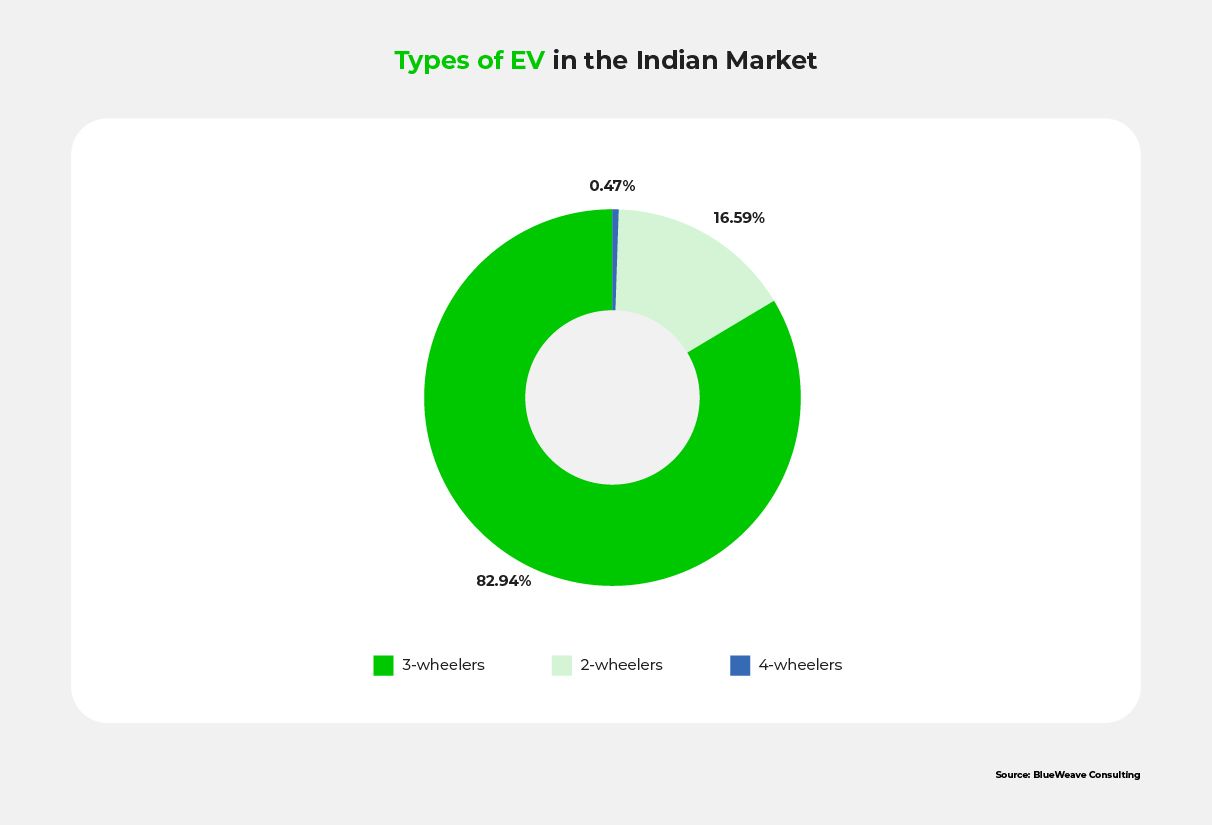
As of 2025, electric 3-wheelers account for nearly 85% of India’s EV sales, clearly showing their dominance in the EV market.
However, powering up this growing number of vehicles will require an extensive charging infrastructure. The good news is India has crossed 3,200 public EV charging stations nationwide, surpassing its earlier 2025 target of 2,600. India aims for 80% electrification of 2- and 3-wheelers by 2030.
Currently, the charging infrastructure in India extends to homes and workplaces. It also offers both fast and slow charging solutions. Although this range of options accommodates different charging needs, it may not be enough to support the country-wide shift to EVs.
Achieving a sustainable EV charging infrastructure will be key to powering the commercial 3-wheeler sector in India. However, this will require private sector investment and a comprehensive shift to renewable energy-supported EV charging. This might prove to be a challenging task for India.
Key Challenges in the Path of India’s EV Infrastructure Growth
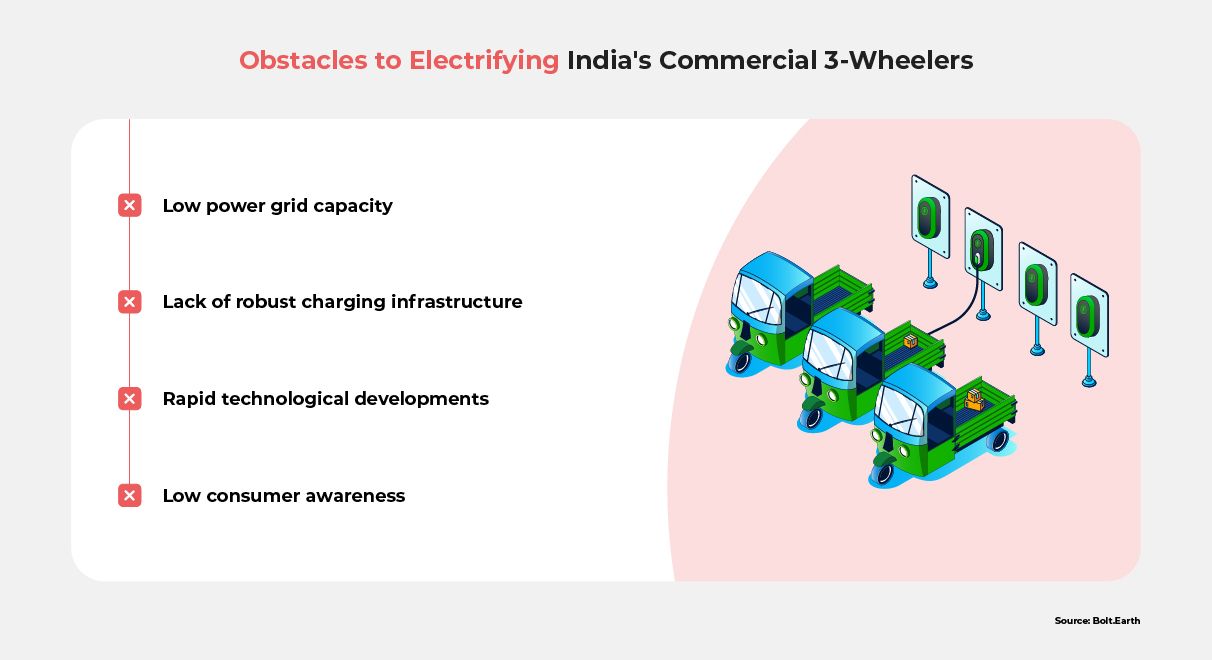
Electric 3-wheeled commercial transport vehicles are becoming increasingly popular in India, but the supporting infrastructure is still in its early stages. Unfortunately, the journey to scale up this infrastructure to power up the 3-wheeled commercial transport vehicles is fraught with challenges.
Below, we look at four key challenges that are hindering India’s EV infrastructure scale-up.
1. Power Grid Capacity
With rising EV adoption, India’s grid is already under pressure, and the anticipated surge in EVs by 2030 is expected to place significant strain on India’s power grid, potentially leading to power outages, as per a Brookings report. Moreover, uneven electricity access and fluctuating power supply across the country could further complicate the deployment of EVs.
2. Charging Infrastructure Gaps
The current EV-to-charge ratio in India is approximately 120:1, far higher than the global benchmark of 6-20:1.
The charging infrastructure in India also faces another issue: its lack of standardization, which increases costs for operators. However, significant efforts are made by the Bureau of Indian Standards (BIS) to introduce national standards.
Despite its promising future, battery swapping demands substantial upfront investment and presents several operational difficulties. It also raises legal liability concerns involving vehicle manufacturers, swap operators, and drivers in the event of accidents.
3. Technological Developments
Technological advancements are making EVs safer, more convenient, and more accessible. However, the faster the EV industry advances, the harder it becomes to keep abreast of the changes. If the country cannot keep up with the improvements, the EV sector might suffer greatly.
Below, we take a look at some of these technological developments and why India might struggle to implement them:
Solar charging for electric rickshaws. The current solar panels for e-rickshaws are made using cheap imported materials. But improving these panels for safety and comfort may make the current price skyrocket. This would drive away potential buyers, thus reducing the overall interest in new tech.
Battery capacity improvements. Electric 3-wheelers typically have a shorter range per charge. But an increase in battery capacity may add to its weight, making 3-wheelers less desirable for users.
Lithium-ion batteries. These batteries are preferred for their fast charging and superior performance. But India’s limited lithium reserves hinder local battery production, leading to increased imports and higher overall EV costs.
4. Consumer Awareness and Acceptance
Consumer perceptions greatly influence EV adoption. Despite the growing range of electric options, potential buyers often lack awareness about government incentives, the economic benefits of EVs, and advances in EV technology. This knowledge gap can affect their purchasing decisions.
An additional reason why consumers may have less interest in EVs is the lack of charging equipment and infrastructure. Although 50-90% of all EV charging happens at home, charging equipment in India may be unavailable for those without private parking amenities. Lack of charging infrastructure also raises concerns about a 3-wheeler EV’s driving range.
Low awareness of EVs, combined with range anxiety, also puts a damper on India’s overall adoption of electric 3-wheeled commercial transport vehicles.
Strategies for Boosting India’s EV Infrastructure for Commercial Transport
Addressing India’s infrastructure- and consumer-related challenges is key to scaling up the adoption of commercial 3-wheeler EVs. Policymakers and other key players will have to come together to implement innovative strategies that will pave the way for the full adoption of EVs in India.
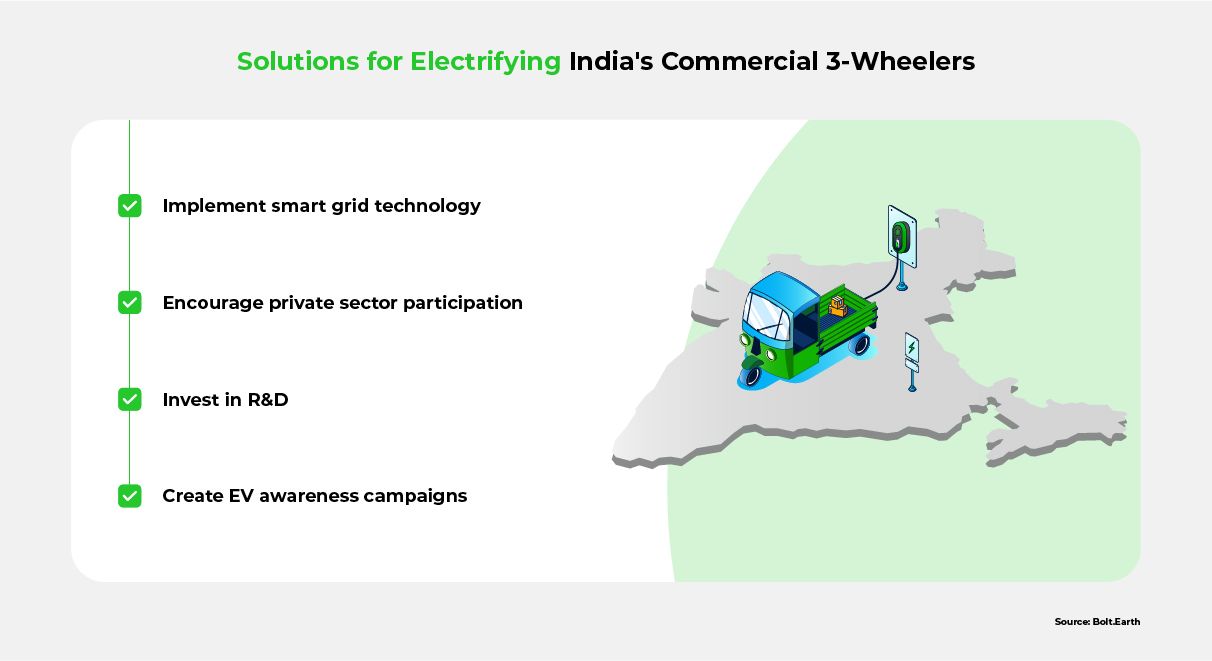
Below, we highlight four potential solutions that can help address the challenges facing EV 3-wheelers in India.
1. Harness Smart Grid Technology
A smart grid, which integrates information and communication technology, offers an upgrade over the conventional grid. It allows two-way transmission of both energy and information, bolstering security, efficiency, and responsiveness.
To implement this smart grid across the country, the Indian government should offer financial support and policy encouragement. Below are some aspects to focus on:
The three components of a smart grid. It’s crucial to invest in energy storage units, communication systems, data analysis, and management systems for the smart grid.
Integration of Decentralized Energy Resources and Renewable Energy. These two together can boost India’s energy mix and increase energy storage units.
Smart meter devices and demand response systems. These systems are key to help monitor the grid and optimize its performance.
A smart grid can help resolve India’s power management issues. It can offer more efficient and reliable electricity distribution, which means it can help the country manage the increased electricity demand from charging.
A smart grid also has diagnostic features that can help reduce power outages and improve EV drivers’ access to electricity. Implementing smart grid technology will be key to helping India support the widespread adoption of 3-wheeler EVs.
2. Promote Private Sector Investment
Investments from the private sector are pivotal in facilitating the transition towards sustainable transportation. Investment in charging infrastructure will especially be helpful to support the growing number of 3-wheeler EVs on the road. To this end, India can propose a 5-dimensional plan:
Provide tax incentives and streamlined approval processes to attract private investments
Introduce PPP models to combine government support and private expertise
Improve charging infrastructure and deploy advanced technologies
Drive demand by boosting public awareness
Encourage EV financing to provide accessible and competitive EVs
India can learn from countries like the US and China, which have greatly benefited from private sector investments. Private sector investment can help India address its infrastructure challenges. And coupled with a nationwide EV policy, charging infrastructure can make the commercial 3-wheeler EV sector a success.
3. Invest in R&D
Funding for research and development is vital to propel advancements in EV technology, leading to more efficient electric 3-wheelers. R&D can help India better understand the hurdles standing in the way of technological advancement. It can also shed light on solutions to those problems.
Below are some suggestions to help India promote investment in R&D:
Allocate a larger budget for R&D
Encourage public-private partnerships
Promote venture capital and private equity investments
Engage in international collaborations
Establish dedicated research grants
Encourage industry contributions
These measures will help attract funding, drive innovation, and accelerate advancements in electric vehicle technologies. As a result, EV technology will continue to improve and become safer, more convenient, and more accessible for all. This will greatly promote the demand for EVs, especially for electric 3-wheeler commercial transport vehicles.
4. Create EV Awareness Campaigns
Given the limited vehicle deployment and lack of exposure to charging stations, consumer awareness about EVs in India is still relatively low. Addressing this requires concerted awareness campaigns to educate consumers about EV purchasing, subsidies, performance, and charging station locations.
Propose campaigns at different political levels
Involve more participants, like private sector players and educational institutions
Leverage social media and press platforms
These campaigns are a very effective way to broadcast the benefits of EVs. For example, in 2021, India launched the “GO Electric” Campaign to raise awareness and instill confidence among EV manufacturers and consumers. The campaign included workshops, webinars, technical talks, seminars, and road shows to connect with the masses and promote the adoption of electric vehicles. Creating similar campaigns can help more people know about the benefits of EVs, making them more desirable.
The Role of Government Incentives & Public-Private Partnerships
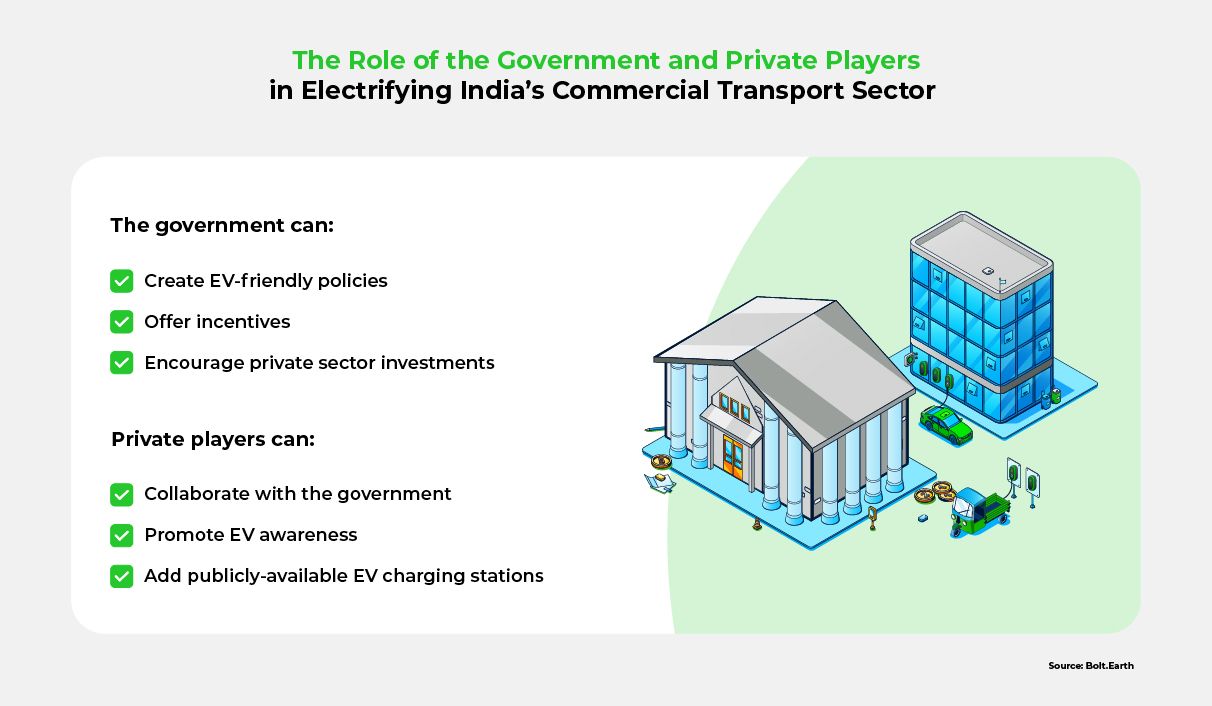
The successful deployment of electric vehicles is contingent on robust and reliable charging infrastructure. Additionally, policy frameworks that are tailored to local circumstances can greatly assist this rollout. Both government policies and public-private partnerships can be instrumental in facilitating the transition to electric 3-wheelers.
Although India has already rolled out 18 state-level policies, all focus almost exclusively on infrastructure development. While this can help address India’s needs for EV charging, it falls short of resolving the other significant obstacles in the electric 3-wheeled commercial transport vehicle ecosystem.
Below, we take a look at other countries’ examples and how they created policies to improve the state of their EV ecosystems. India can then take inspiration from these countries and create more comprehensive policies and partnerships that can fully cover the challenges it faces.
International Best Practices in Government Policies
International experience has shown that policymakers at all levels, from local to international authorities, play a crucial role in deploying public charging infrastructure for electric vehicles. Their intervention is necessary to address range anxiety and ensure sufficient coverage beyond highways and major cities.
International government policies can help address many of the primary challenges faced by India’s 3-wheeled commercial transport vehicle sector. Here are some examples:
Policies to Address Grid Issues
France declared that a portion of public EV connection costs may be assumed by the grid operator.
California’s Public Utilities Commission mandates that utilities provide “utility-side make-ready” infrastructure to support EV charging.
Policies to Address Infrastructure Challenges
Portugal established a network management body to deploy public charging infrastructure and ensure interoperability and scalability.
Korea implemented a Smart Energy Strategy to ensure open access to all charging stations with a single membership card.
Indonesia detailed requirements for EV charging stations and battery swap stations, and offered tax breaks for the deployment of charging infrastructure.
Policies to Promote Technological Advances
The Netherlands created a public-private platform to research, implement, and inform about EV policies
Policies to Raise Awareness and Acceptance of EVs
China supports local governments with financial assistance for EV equipment roll-out if they have met their EV adoption targets.
Chile created the “Mi Taxi Electrico” program to encourage public transportation to switch from ICE to EV.
Successful Public-Private Partnerships in Other Countries
In China, the government and utility companies heavily invest in EV charging infrastructure, supplemented by private investments. PPP initiatives in China merge public and social capital to drive the implementation of a nationwide EV charging infrastructure.
Policies, incentives, and programs guide this development, while automakers and energy companies enhance charging infrastructure through acquisitions and joint ventures.
In the US, a mix of federal and state programs, utility investments, private funding, and scandal settlement proceeds has facilitated the growth of the EV charging network. Despite the need for more public-private partnerships, the US is now home to 130,000+ public charging stations, minus private slow chargers.
Strategies for Effective Public-Private Partnerships in India
Despite the differences between these countries, China and the US’s success stories can be inspiring for India. Leveraging lessons from them can help India adopt an ambitious policy approach, which can include:
Integrating charging infrastructure investments into utility reforms
Optimizing charger utilization through strategic siting
Providing financing options, like low-interest loans
Implementing building codes to make for more EV-ready sites and buildings
Additionally, India should establish clear guidelines and coordinate its efforts to effectively deploy charging stations. Through public-private partnerships, India can, for example:
Encourage oil companies to establish EV chargers to diversify their portfolio, which also boosts infrastructure development
Engage non-profit organizations and utilities to promote consumer awareness about EVs, which can also increase EV adoption rates in India
These measures don’t specifically apply to the electric 3-wheeled commercial transport vehicle sector. They can, however, help India develop a more comprehensive EV charging infrastructure.
By implementing the solutions to combat logistical and consumer-related obstacles, India can pave the way for the full adoption of electric 3-wheeled commercial transport vehicles. The electrification of the transport sector will yield beneficial results for the whole country and its population.
The Impact of an Electric Transportation Sector
Transitioning to electric 3-wheeled commercial transport vehicles in India holds the promise of considerable environmental and economic benefits, aligning with the nation’s transport objectives. Here’s how this transition supports these objectives:
Environment and air quality: Unlike their traditional counterparts, e-rickshaws produce no tailpipe emissions. This means they can reduce air pollution and improve public health.
Energy efficiency: Electric vehicles are far more energy-efficient than gasoline-fueled vehicles. As a result, they offer lower operating costs for drivers and contribute to nationwide energy conservation.
Renewable energy promotion: The surge in e-rickshaw adoption will also increase the need for renewable energy sources like wind and solar power is projected to follow suit. This has the potential to accelerate the growth of India’s renewable energy infrastructure.
Economic impacts: The growing e-rickshaw market could catalyze job creation in manufacturing, services, and infrastructure sectors. In addition, lower operating costs can boost drivers’ income, stimulating economic growth and potentially alleviating poverty.
Fulfilling international commitments: The transition to e-rickshaws supports international agreements like the Paris Agreement. This will then help India meet its commitments to combat climate change.
Future Prospects for 3-Wheeler EVs in India
The wider adoption of electric 3-wheeled commercial transport vehicles can offer substantial benefits to India in terms of the environment, public health, and economy.
However, numerous challenges remain that require attention. India still suffers from a weak grid and lacks a robust charging infrastructure. The country is also unable to keep up with progress in EV technology, which also affects consumer perceptions of EVs.
That being said, India should strive to adopt a collaborative approach involving various stakeholders. This will be key to overcoming these challenges. Policies promoting EV adoption, attractive incentives, and renewable energy investments are crucial for this transition.
By fully embracing electric vehicles, India can pave the way for a cleaner, more efficient transportation system, securing a sustainable future for upcoming generations.
To learn more about electric 3-wheeled commercial transport vehicles EVs in India, please see the FAQ and Resources sections below.
Frequently Asked Questions
What is the current status of India’s EV infrastructure for 3-wheeled commercial transport vehicles?
India’s EV infrastructure for 3-wheeled commercial transport vehicles is still developing. Currently, obstacles such as a lack of charging stations, limited battery swapping facilities, and non-standardized chargers are apparent. However, efforts are in motion to overcome these hurdles, aiming to expand the EV infrastructure and pave the way for a smoother transition to electric vehicles.
How can government policies and private sector investments facilitate the electrification of 3-wheeled commercial transport vehicles in India?
Government policies and incentives can encourage private sector investment in the electrification of 3-wheeled commercial transport vehicles in India. These policies can promote manufacturing, charging infrastructure, and technological research for EVs. Public-private partnerships can further accelerate investment and cooperation, fostering an ecosystem that supports the transition to electric vehicles.
What are the benefits of transitioning to EVs in India’s transportation sector?
A move towards electric vehicles within India’s transport system holds the potential to significantly enhance air quality through reduced carbon emissions, increase energy efficiency, and promote economic expansion. In addition, the adoption of EVs can boost the demand for renewable energy sources, lead to job creation, and align India’s commitments to global climate change mitigation efforts.
How could EV adoption impact the commercial transport sector in India?
EV adoption could transform India’s commercial transport sector, leading to cleaner air and better public health due to reduced carbon emissions. Additionally, it could stimulate job growth in manufacturing, service, and infrastructure sectors and contribute to the nation’s overall energy efficiency. It can also support India in meeting its EV adoption targets.
India’s corporate fleets are rapidly electrifying, driven by government incentives, falling battery costs, and rising ESG commitments. EVs now account for over 2 million registered vehicles nationwide, with corporate adoption accelerating in logistics, ride-hailing, and delivery services.
EVs are an environmentally friendly alternative to traditional vehicles because they produce zero tailpipe emissions and have a low carbon footprint. By transitioning to EVs, corporate fleets can reduce greenhouse gas emissions, air pollution, and fossil fuel dependence, thereby contributing to a cleaner environment. EVs are also a financially beneficial option in India; government subsidies and low-cost funding options bring down capital costs, and growing awareness among consumers drives demand for EV fleets.
Fleet operators are on the cusp of creating history by shifting to EVs in their corporate fleets. This will help them gain substantial economic benefits while laying the groundwork for sustainable transportation in India.
To help companies transition to green fleets, this article answers the following questions:
Why should corporate fleets shift to EVs?
What are the potential challenges of introducing EVs into corporate fleets, and what solutions can ease the transition?
How can large corporations use fleet management software to maintain large EV fleets efficiently?
The Urgent Need for EV Adoption in Corporate Fleets
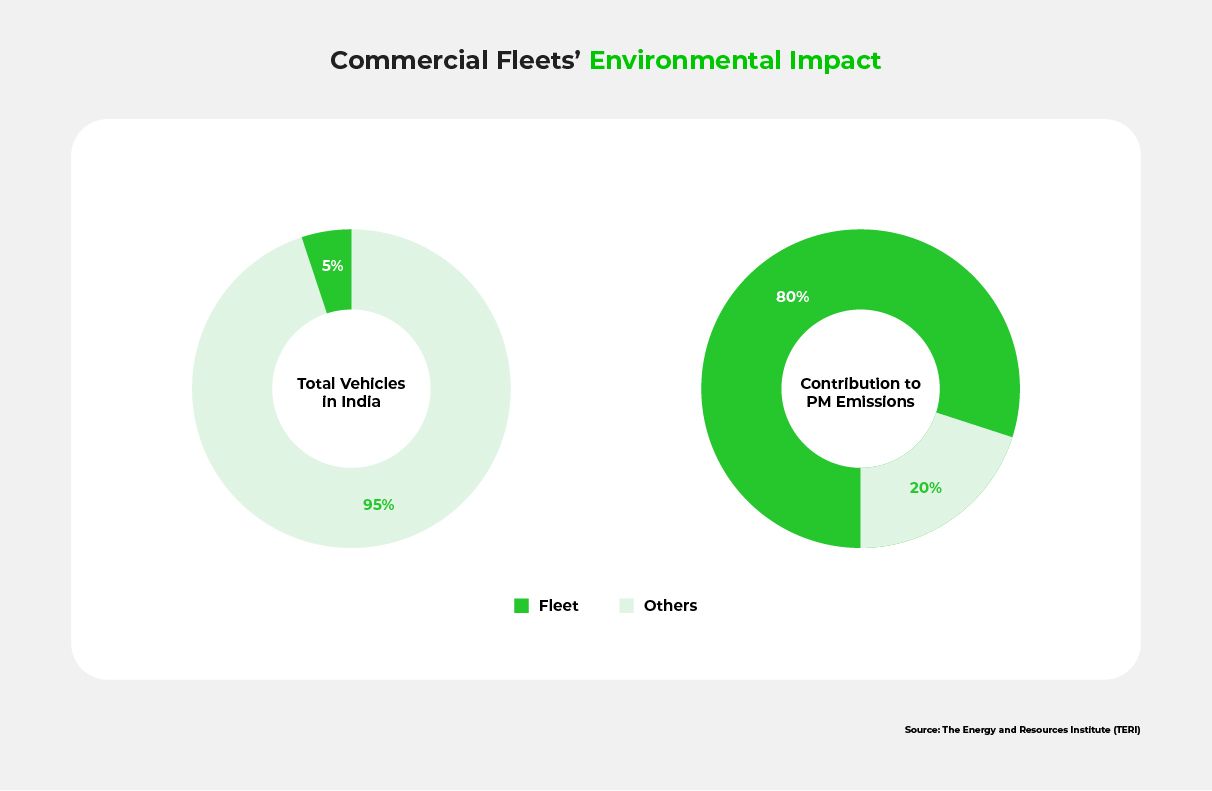
Commercial fleets, consisting of buses, trucks, and light commercial vehicles such as minivans, account for only 6% of India’s total vehicles. However, they are responsible for nearly 75% of India’s total particulate matter (PM) emissions.
Given that Indian cities are among the most polluted in the world, governmental institutions are prioritizing shifting to EVs to reduce pollution levels. For example, several state governments have committed to electrifying public buses.
Many fleet operators are also taking on the social responsibility of creating a clean environment. To this end, they are investing heavily in EVs to bring down their carbon footprint and operational costs.
BigBasket, a company that delivers groceries and kitchen goods, plans to electrify 90% of its fleet. Amazon and Flipkart are also pushing for greater electrification. BluSmart, a ride-hailing company based in Gurugram, uses only EVs in its fleet; it has over half a million customers so far, and anticipates becoming profitable by the end of 2023.
Switching to EVs comes with economic gains for corporate fleets, not just environmental benefits. For example, BluSmart estimates that its current running cost, which is INR 1.4 per kilometer, will drop below INR 1 per kilometer with the addition of 40,000 to 50,000 new EVs over the next year and a half.
This is 4 to 5 times cheaper than operating compressed natural gas (CNG) cars, and a staggering 8 to 9 times cheaper than operating petrol or diesel cars. In other words, by adopting EVs, corporate fleets can increase their profits by reducing operational costs.
That said, fleet operators face several challenges and barriers to EV adoption.
Key Challenges for Corporations in Adopting EVs
Corporate fleets face many obstacles in transitioning to EVs, including high upfront costs, inadequate infrastructure, and limited battery range. Understanding these challenges is essential to developing effective strategies to achieve a more sustainable future by accelerating and facilitating EV adoption.
High Upfront Costs
Corporations transitioning to EV fleets must start by grappling with high upfront costs. EV batteries, which contain rare earth elements and are therefore significantly more expensive than petrol and diesel vehicles’ internal combustion engines, account for about 40% of the total costs. EV adoption also requires fleet companies to invest in charging infrastructure.
These high upfront costs can create resistance from stakeholders. Fleet managers and drivers may be unwilling to make the financial commitment, and decision-makers may be skeptical that the ROI will justify the initial investment. Factors like range anxiety and discomfort with unfamiliarity can lead to further friction.
To overcome these high costs, fleet companies are using a combination of financing options. Leasing agreements enable companies to acquire EVs every month, without paying the full cost up front. Partnerships with automakers help EV fleet owners get support for charging. In addition, attracting investments from venture capitalists can cover the upfront costs without burdening the organization.
Many corporations have used these financial models to transition to EV fleets. For example, Zyngo, an EV logistics company, has raised funding from Delta Corp Holdings to increase its EV fleet. Similarly, Uber has partnered with Lithium Urban Technologies, Moove, and Everest Fleet to deploy 25,000 EVs across seven cities in India.
Lack of Charging Infrastructure
The existing charging infrastructure in India is inadequate, in terms of both coverage and capacity. India now has over 12,000 public charging stations, but rural coverage remains sparse. Charger incompatibility compounds the issue, since drivers have to find a station that supports their vehicle. As a result, EV charging stations’ unreliability and inaccessibility hamper corporate fleets’ ability to plan operations, reduce downtime, and enhance the overall efficiency of their operations.
Given that fleets must adhere to strict schedules, drivers may be hesitant to take on the additional burden of finding charging stations, especially if they have to service semi-urban and rural areas. Since EVs require frequent charging, sometimes at multiple points during the same journey, drivers’ range anxiety impedes the adoption of EVs in corporate fleets.
Strategies for Adopting EVs in Corporate Fleets in India
Addressing the challenges and boosting the adoption of EVs in corporate fleets requires a collaborative effort from governments, automakers, EV startups, fleet operators, drivers, and other stakeholders in the EV ecosystem. Every stakeholder stands to gain from the transition to EVs tomorrow, but only if they all work together today. Government incentives, collaboration among public and private entities, and innovation from startups are especially critical to the transition to green fleets.
Government Incentives
The Indian government is currently offering the following incentives:
Purchase incentives: Direct discount to the owner
Coupons: Credits on public charging stations
Interest discounts: Reduced interest rate on loans
Road tax exemption: The road tax is waived
Registration fee waiver: The one-time cost of registration is waived
Income tax benefit: GST on EVs remains at 5% (vs. 28% for ICE vehicles)
Scrapping incentives: Financial discounts are offered for deregistering old diesel and petrol vehicles
State-level perks: Many state governments, including Maharashtra, are specifically incentivizing fleet operators to shift to EVs by reducing upfront purchase costs. The incentive application process is often handled by EV dealers, so fleet operators are spared from investing additional time and effort.
Collaboration Between Public and Private Entities
Public-private partnerships help develop and expand charging infrastructure, thereby working towards alleviating range anxiety. Typically, the government encourages private companies to set up charging stations in rural areas, compensating them for revenue for a limited tenure. Such efforts can reduce range anxiety and increase acceptance among fleet managers and EV drivers.
Startups Driving Innovation in EV Fleet Solutions
Innovative startups are developing game-changing technologies and solutions to help companies integrate EVs into their corporate fleets. Much of this innovation involves battery technology and EV fleet management software. In particular, innovative fleet management software systems have improved the efficiency, reliability, and overall performance of EV fleets by enabling lower operational costs, which, in turn, can lead to wider adoption.
Leveraging Fleet Management Software for Green Fleets
EV-specific fleet management software helps streamline operations for corporate fleets.
Key features for efficient EV fleet operations include:
Route Optimization
EV software can optimize routes to reduce travel time, minimize charging stops, and enhance fleet efficiency.
Remote Scheduling for Charging
Apps can enable drivers to remotely schedule charging sessions ahead of time, so that they can skip the wait at public charging stations.
Real-Time Monitoring
Fleet managers can get real-time data on vehicle location, battery levels, health metrics, and other critical aspects. This information can help managers better plan their operations and stay apprised of their EV fleet’s performance.
Predictive Maintenance
EV software can provide recommendations on EV maintenance based on usage, mileage, and health, thereby reducing downtime and mitigating the risk of unexpected breakdowns.
Analytics
Fleet managers can use EV software’s advanced analytics to gain insights about their EVs’ performance. They can use this information to support continuous improvement by making it the basis for informed decisions about expansion and maintenance.
Communication and Decision-Making
EV fleet software can connect with other components in the company’s technology stack, charging infrastructure, and energy management systems. The resulting interconnected software ecosystem can enable seamless communication, data exchange with relevant stakeholders, and intelligent decision-making.
Energy Load Management
EV fleet software can support dynamic energy load management in the grid and enable vehicles to charge based on available power.
When fleet operators embrace EV software, they can further enhance the impact of EVs on India’s environment and economy, besides increasing their own profitability and efficiency.
The Far-Reaching Impact of EVs in Corporate Fleets in India
Incorporating EVs into corporate fleets can transform India’s transportation sector by offering economic, environmental, and public health benefits, in addition to boosting fleet operators’ profits and brand image. Fleet companies can achieve their corporate social responsibility goals of reducing their carbon footprint and creating a healthy environment for future generations. This transformation can lay the foundation for a broader shift towards sustainable transportation and can position India as one of the leaders in clean energy.
This is the moment for corporate fleet operators to embrace EVs. By doing so, they can drive positive change in the transportation sector, contribute to a greener society, and lead the way toward a sustainable and prosperous future.
Frequently Asked Questions
Why are sustainability and social responsibility important for corporations in India?
Sustainability and social responsibility enable corporations to create a positive brand image, meet stakeholder expectations, and comply with government regulations. Cost savings and government incentives also play a huge role. India’s amended Companies Act of 2013 mandates that every company put 2% of its net profits over the preceding three years towards CSR.
What are the potential benefits of adopting EVs in corporate fleets, both for corporations and for the environment?
Transitioning to EVs can reduce carbon emissions and improve the air quality in India. Corporations can also benefit from lower fuel and maintenance costs and meet governmental CSR requirements.
How can corporations integrate EVs into their corporate social responsibility initiatives?
Corporations can leverage available government incentives to bring down their high upfront costs. They can use their CSR fund to partner with public and private entities to set up charging infrastructure. Lastly, they can leverage advanced fleet software to streamline their operations.
What governmental policies and incentives promote EV adoption in India’s corporate fleets?
The national government provides many financial incentives, including waivers of road tax and registration fees, low-interest loans, and direct discounts to promote EV adoption. Additionally, many state governments provide non-financial incentives such as parking preferences, fast-tracking of registration, and free parking for EV fleets.

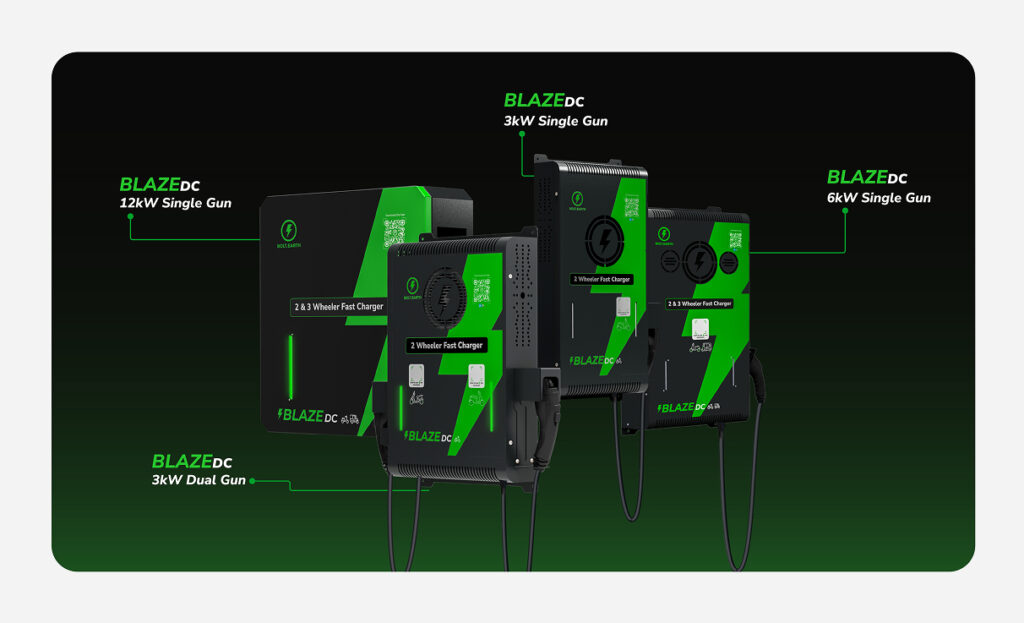
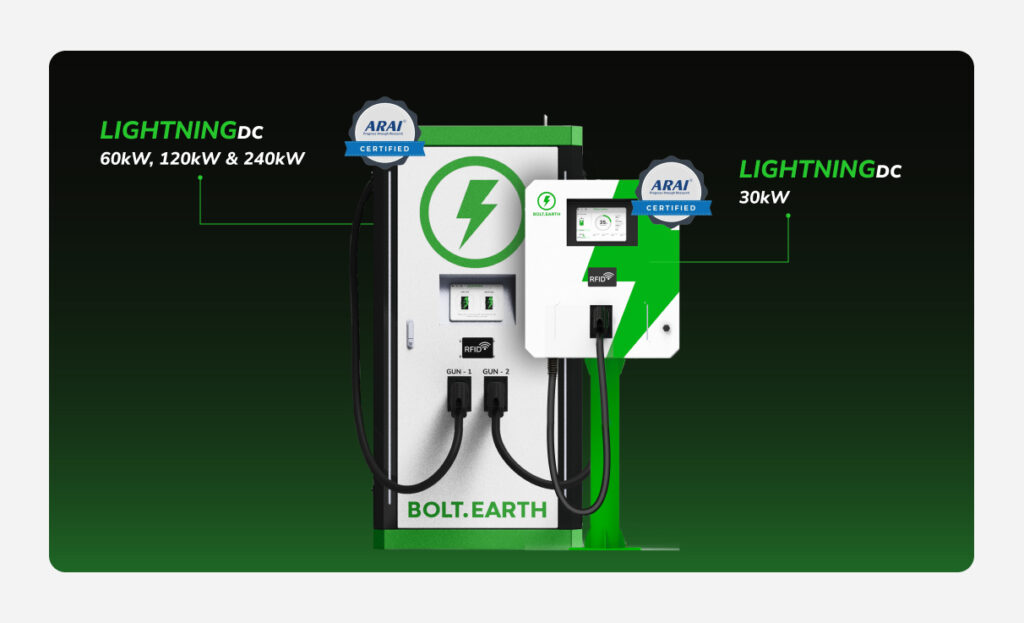

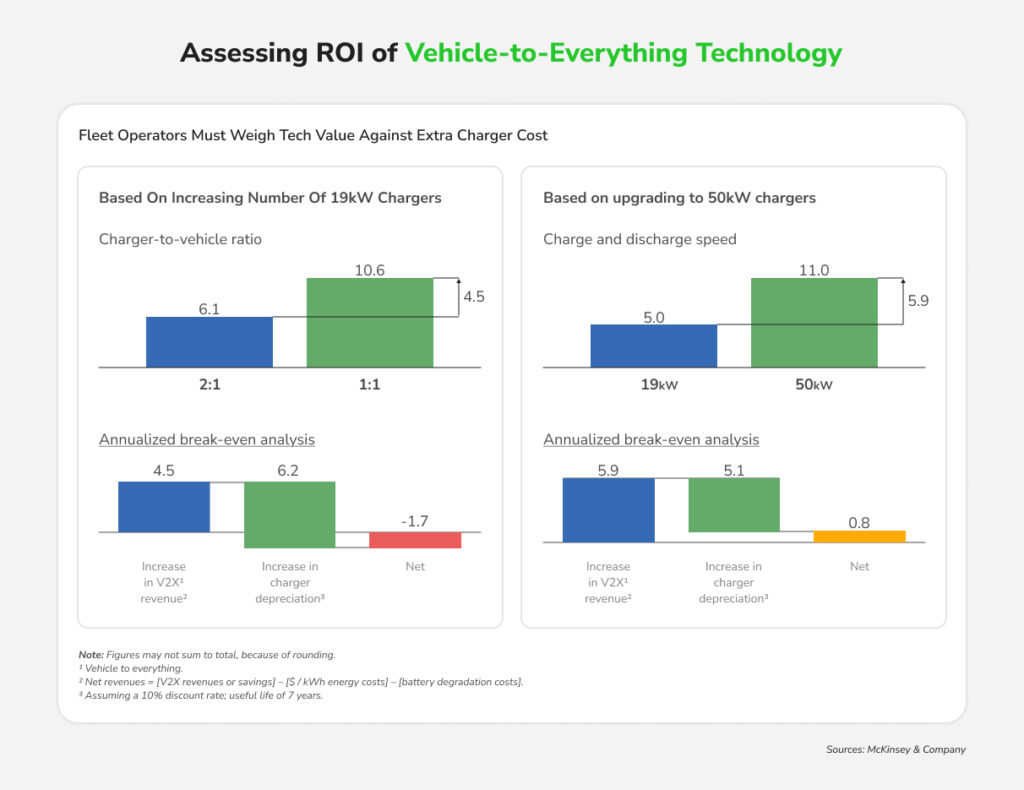
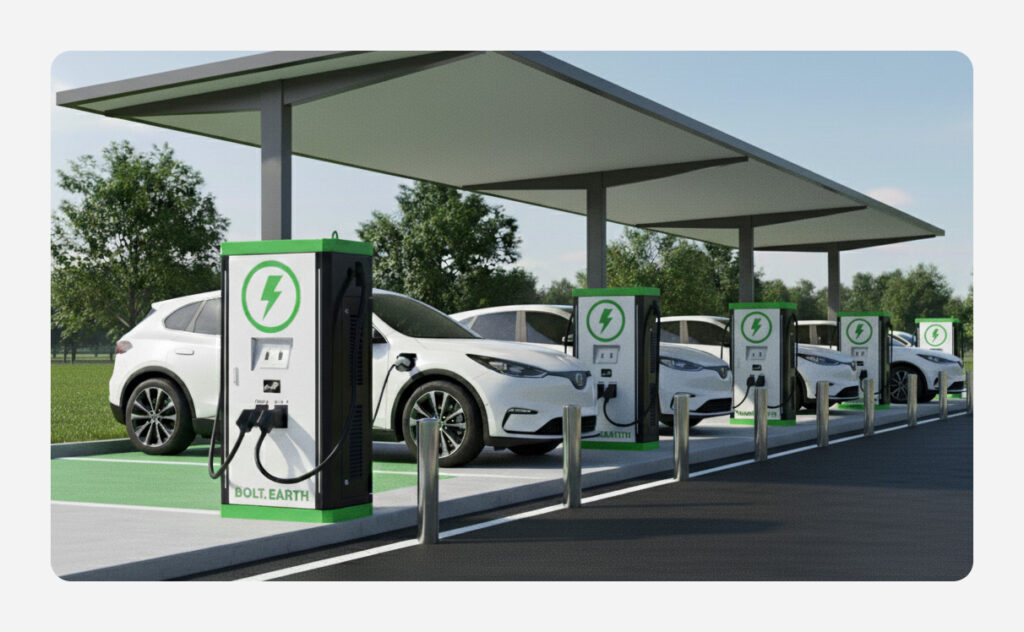


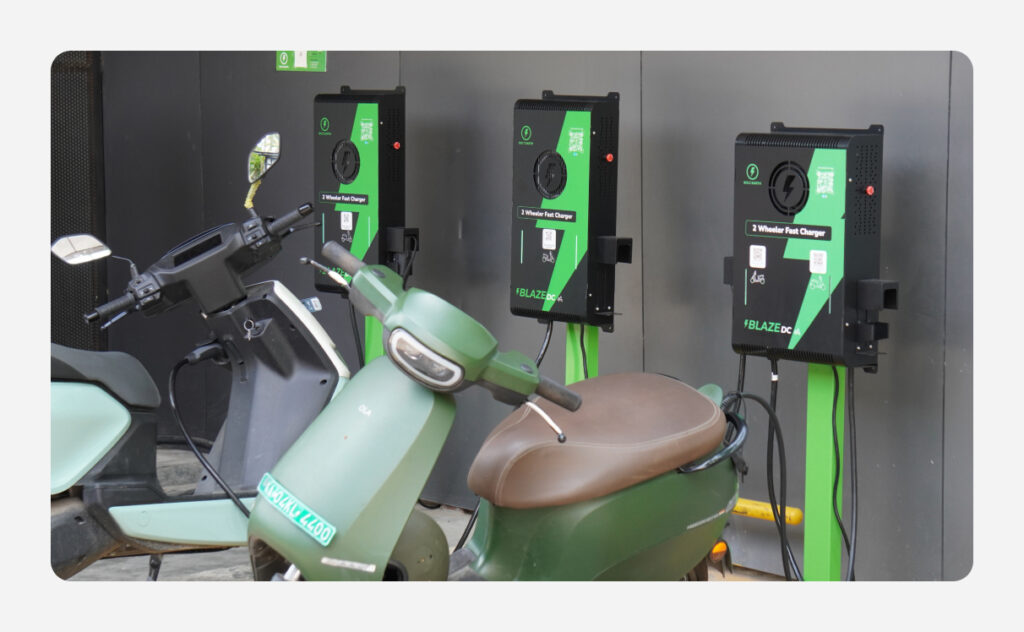
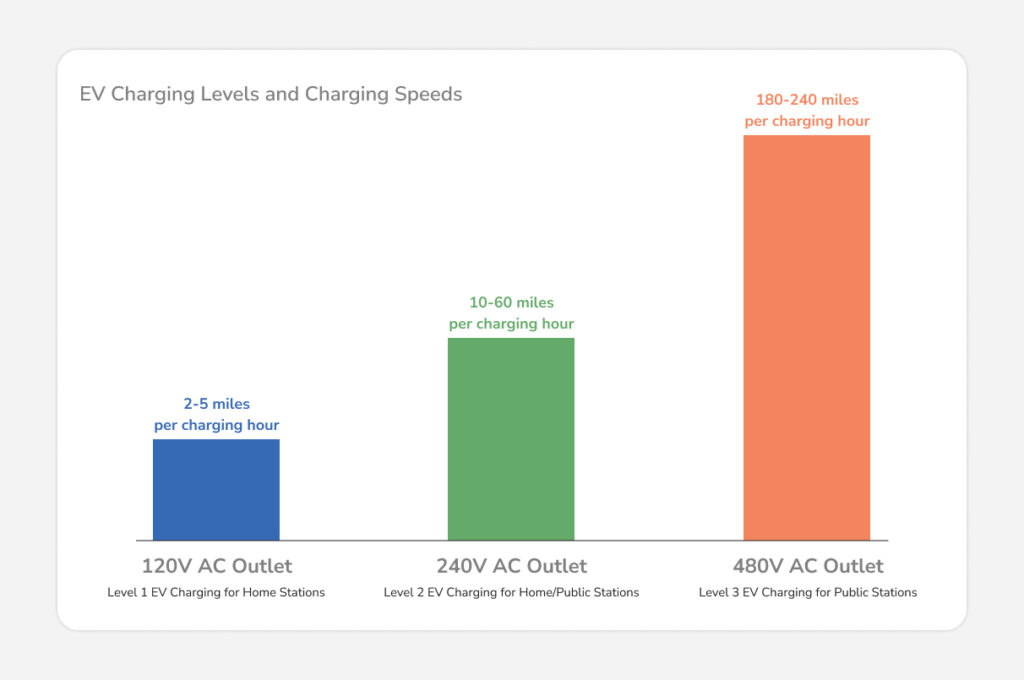
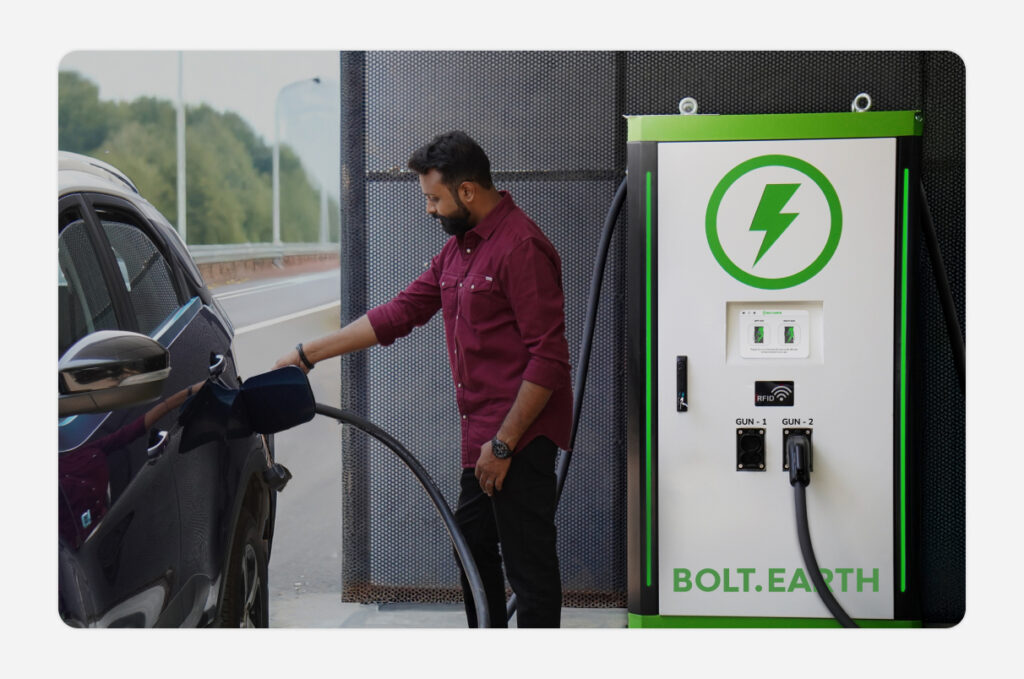
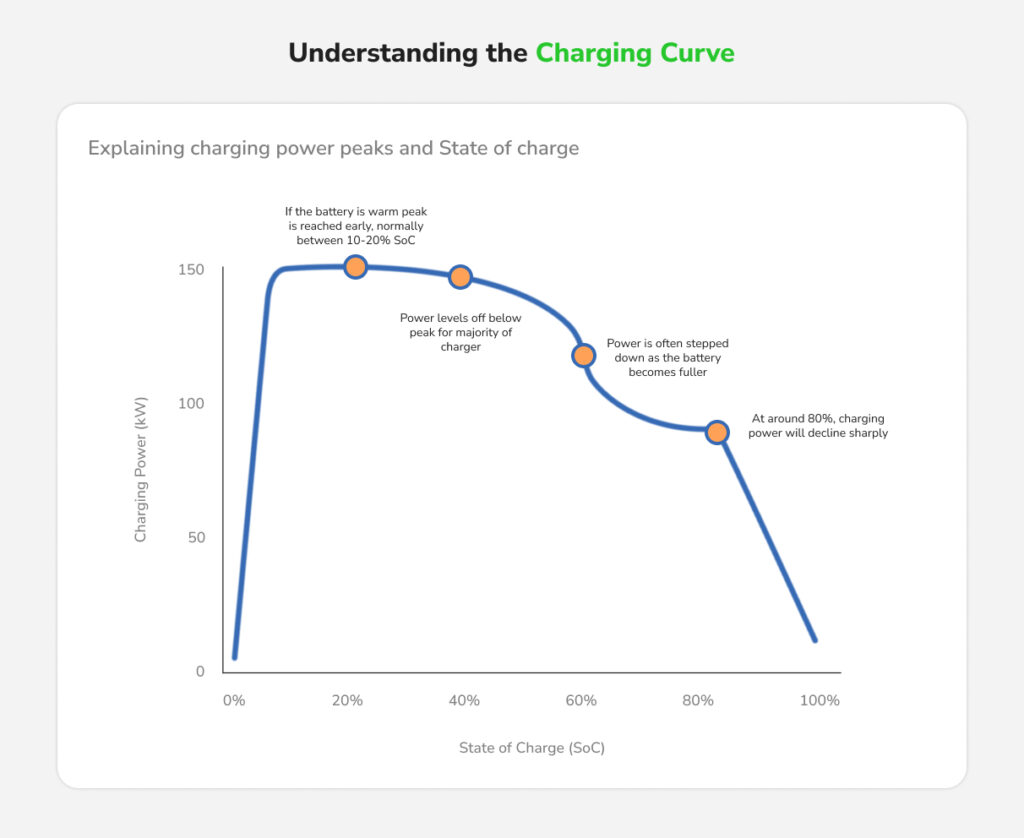
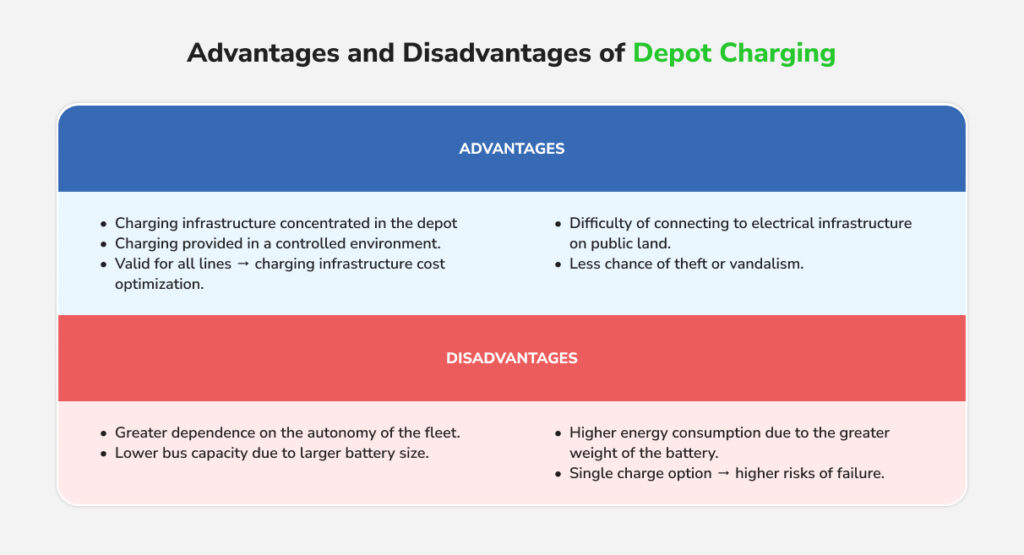
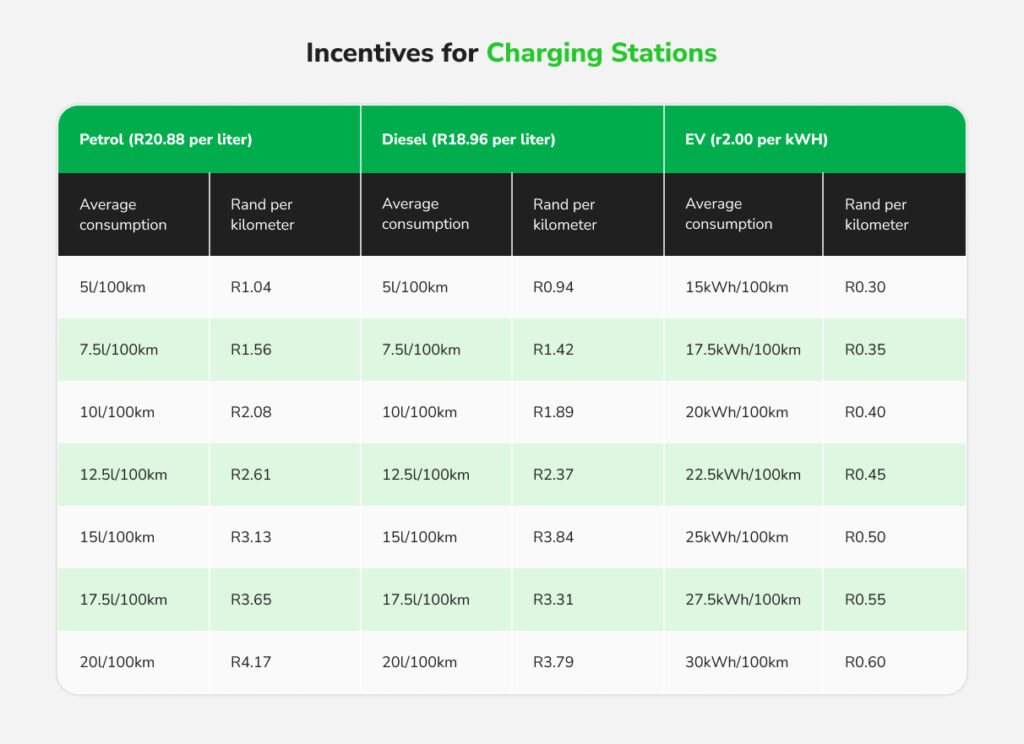
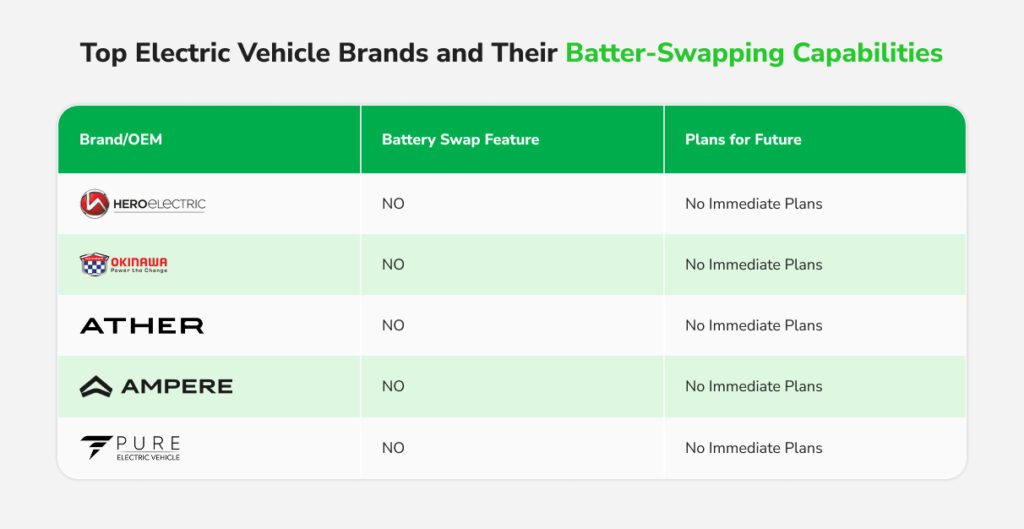

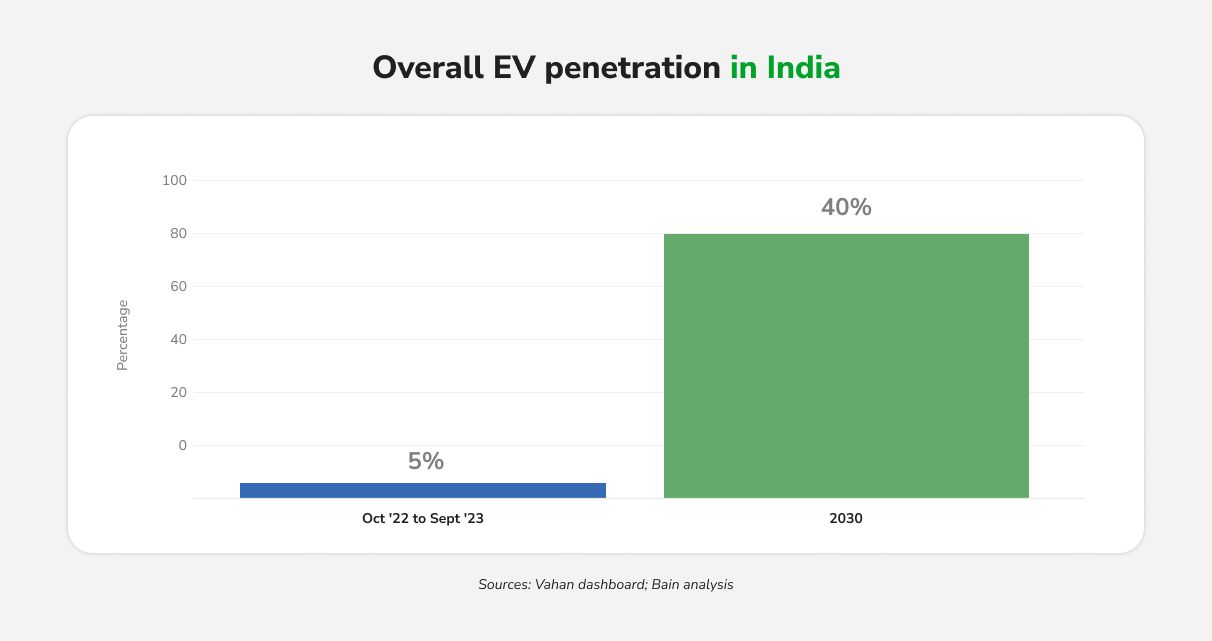
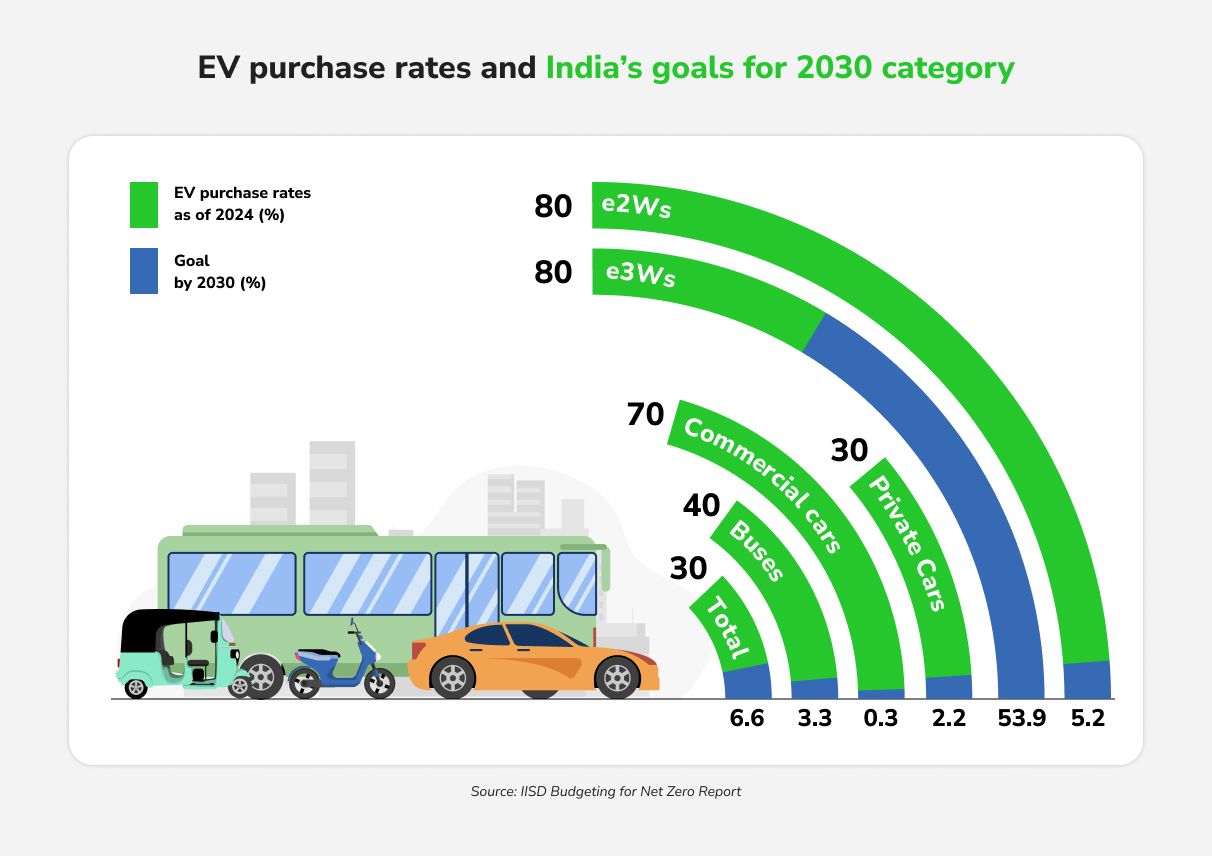
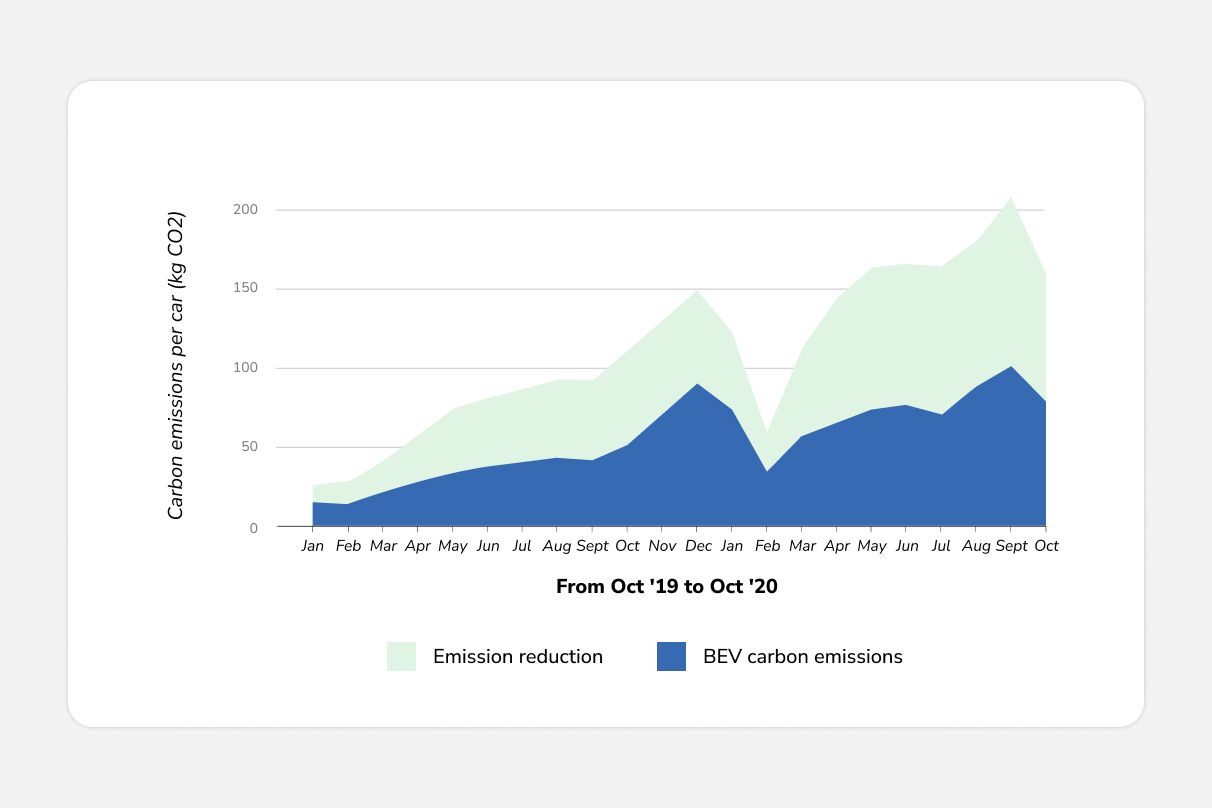
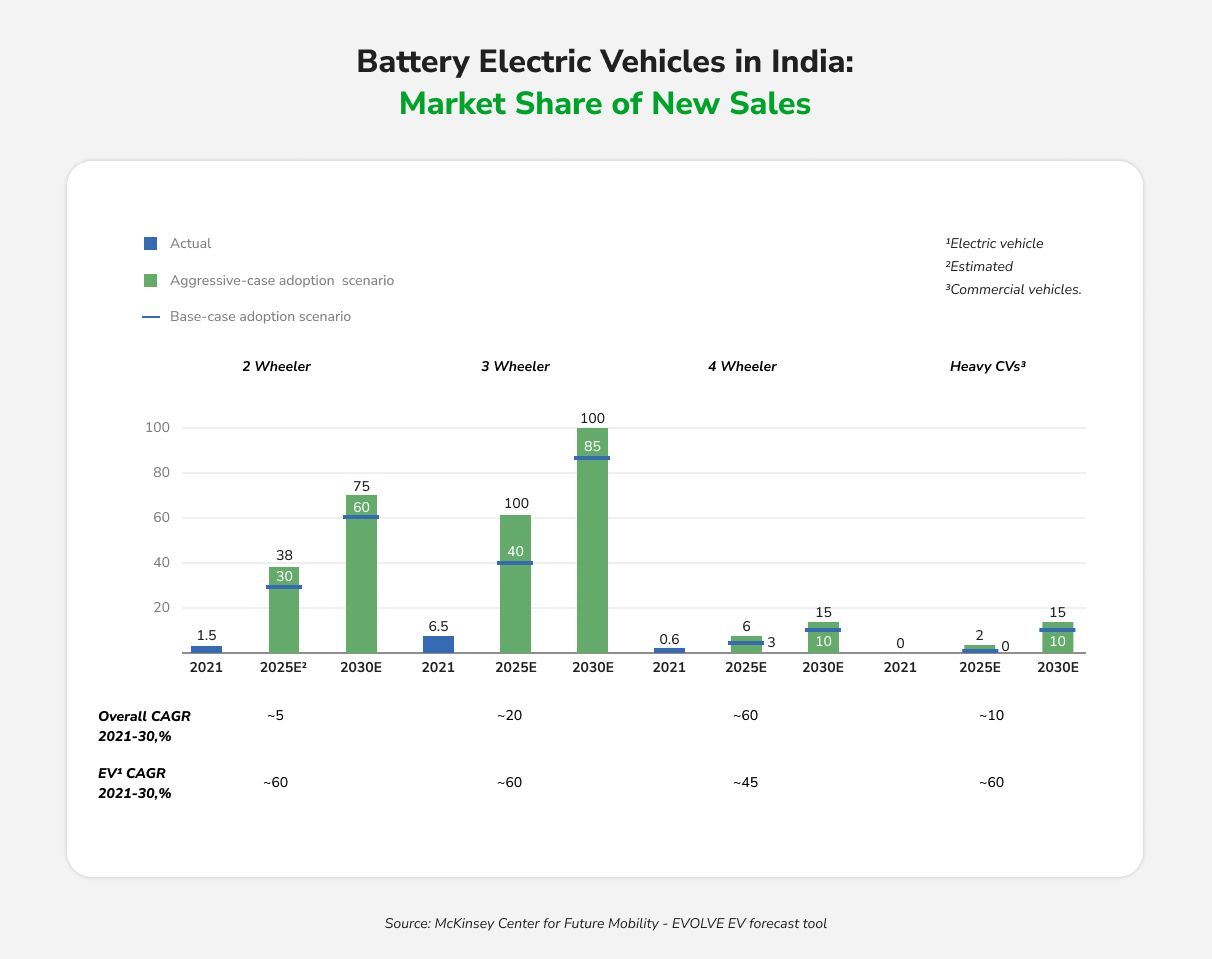
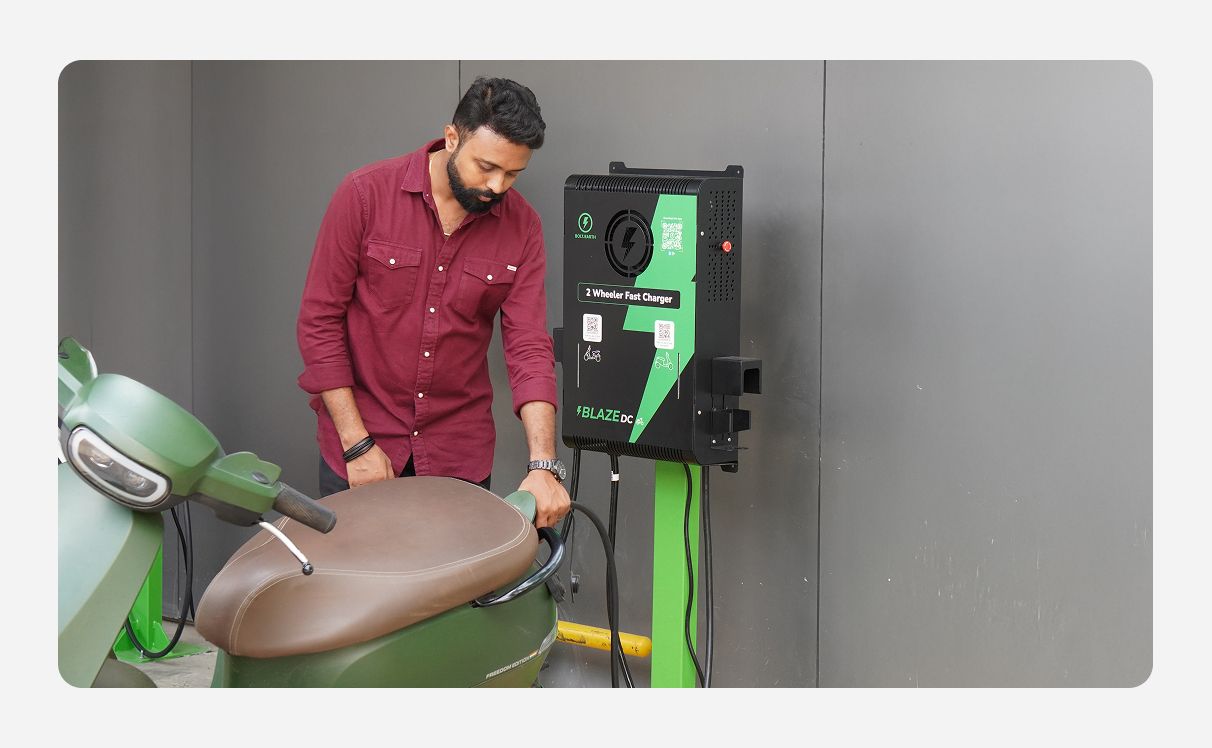
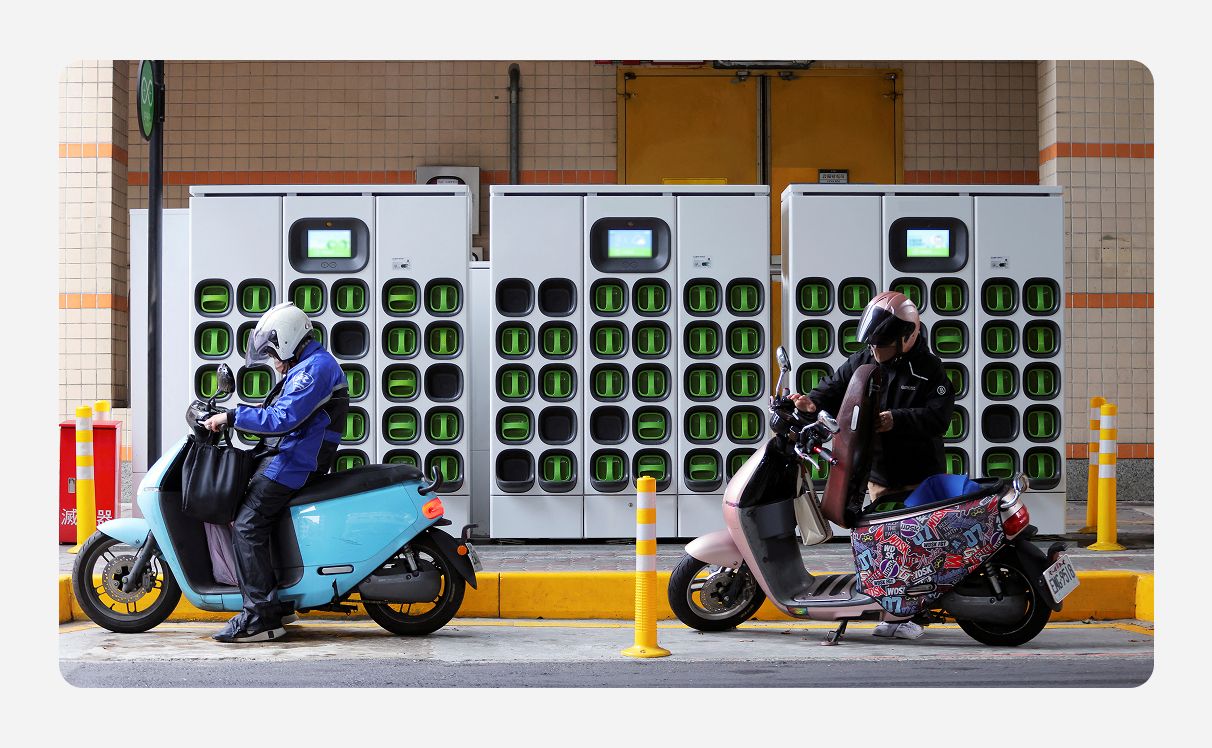
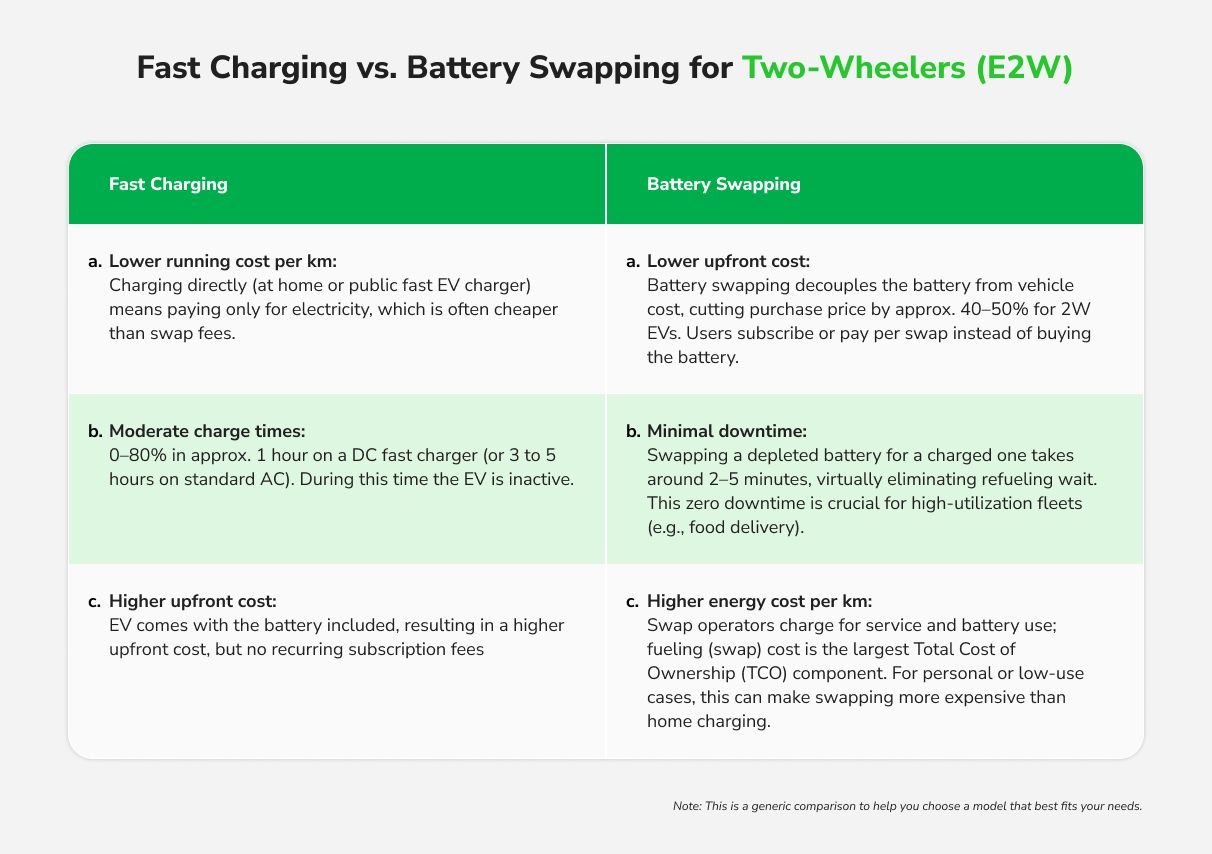
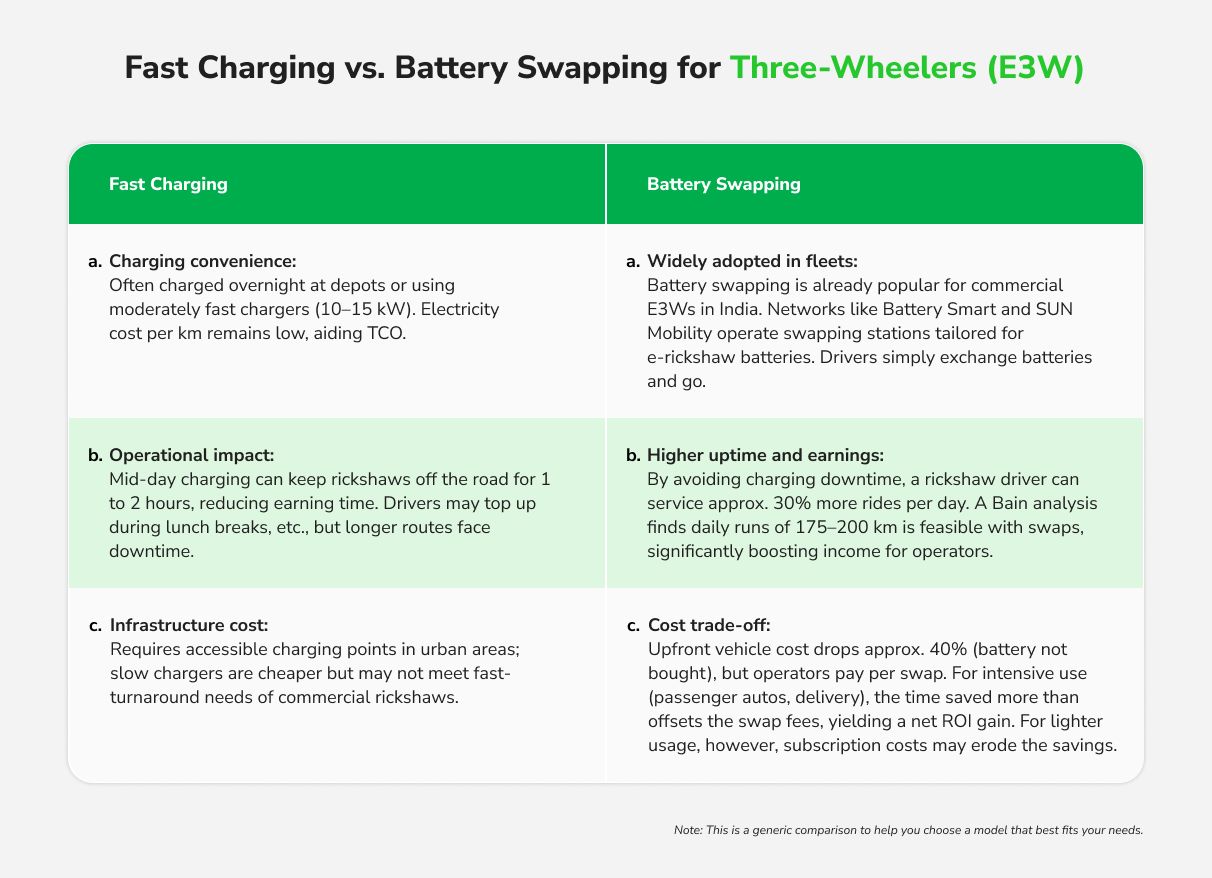
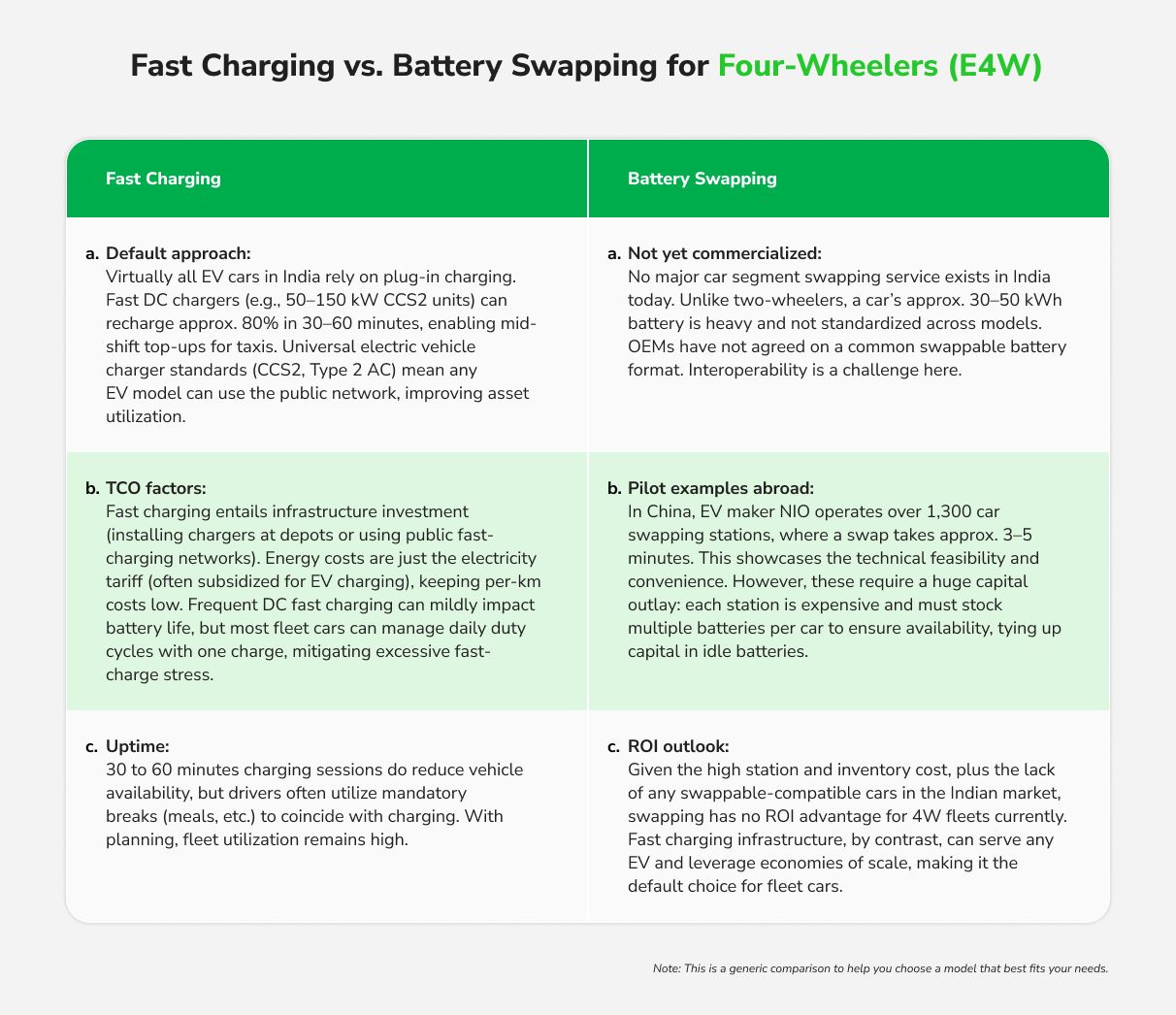
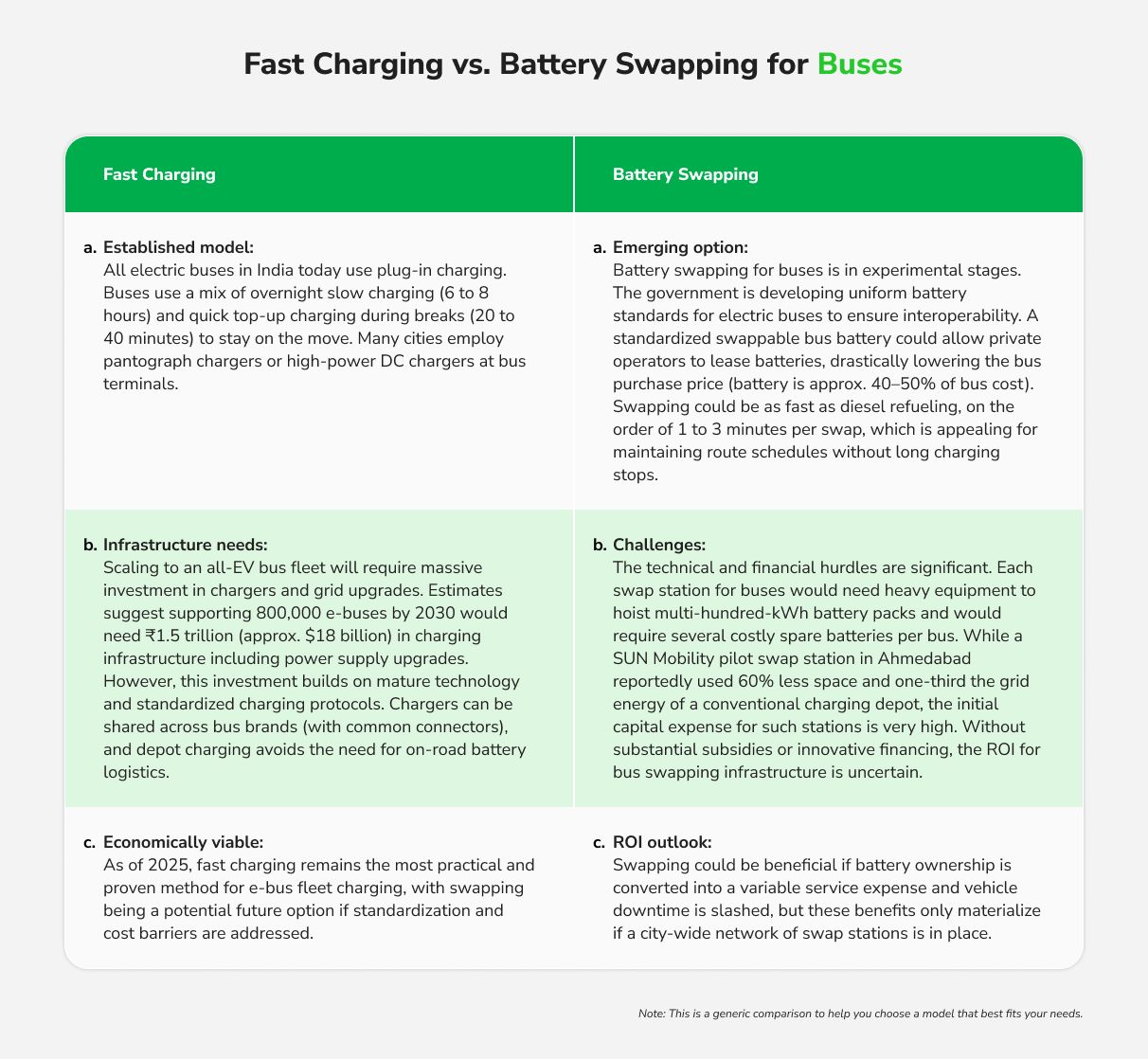


![India’s EV Revolution: Scaling 3-Wheeled Commercial Transport [2025 Update]](https://bolt-wordpress.bolt.earth/wp-content/uploads/3_wheeled_Commercial_Transport_Feature_Image_163771ee6b.jpg)