Category: EV Events and Industry Reports

  • How Unified Bharat e-Charge (UBC) Benefits Every Stakeholder in the EV Ecosystem 

    How Unified Bharat e-Charge (UBC) Benefits Every Stakeholder in the EV Ecosystem 

    Unified Bharat e-Charge (UBC) is designed to create value across the entire EV charging ecosystem, from everyday drivers to charging operators, OEMs, fleets, and policymakers. 

    By replacing fragmented, app-based silos with an open, interoperable network, UBC simplifies access, improves infrastructure utilization, and aligns public and private incentives. Below, we explore how each stakeholder benefits and why UBC could become a foundational layer for India’s EV growth.

    Who Benefits from Unified Bharat e-Charge (UBC)?

    EV Users 

    For drivers and fleet operators, UBC delivers a dramatically simpler and more reliable experience. Instead of juggling multiple subscriptions or apps, users gain one-touch access to any charger in the network. Imagine using the EV’s built-in navigation to find and book charging just as easily as locating a fuel station on Google Maps. 

    User benefits include: 

    • Seamless Discovery: All chargers appear on the same interface, with real-time availability. No need to remember different apps’ credentials. 
    • Guaranteed Reservation: Users can reserve slots in advance, reducing range anxiety on busy highways. 
    • Transparent Pricing: Rates are displayed across operators, enabling cost-effective or greener choices. 
    • Unified Wallets: Payments flow through familiar channels like Paytm or UPI, using existing wallets for charging credit. 
    • Data Privacy & Control: UBC shares data only on demand, giving users control over what is shared and avoiding constant location tracking. 

    In practice, this means less time spent managing apps and greater confidence that a charger will work. The EVreporter team aptly described that UBC acts as a “universal translator” in the EV ecosystem, making charging “smarter and smoother” for the consumer. By democratizing access, UBC also drives down prices and improves service quality, since operators compete fairly for every user’s business. This is particularly important for public EV charging networks, where seamless interoperability ensures users can rely on consistent service across providers.

    Charging Point Operators (CPOs) 

    CPOs, both public and private, stand to gain from UBC too.  While openness may seem counterintuitive, it actually strengthens their business.  Key benefits for CPOs include: 

    • Wider Customer Reach: Even small or new CPOs can immediately access broader user bases. A charging station that might otherwise remain buried on a niche app becomes visible on platforms like Google or Paytm.  Official guidelines note that smaller CPOs “can onboard with UEI (Unified Energy Interface) at significantly lower costs” and reach wider markets without heavy marketing spends. 
    • Higher Utilization: With all users searching the same network, stations achieve higher fill rates, accelerating the payback period. In one early deployment, thousands of chargers became available overnight once they were Beckn-enabled. 
    • Non-Disruptive Integration: Existing business models (subscription networks, local RFID passes, or proprietary apps) can continue alongside UBC. The open network simply adds a decentralized sales channel. 

    In essence, UBC opens new revenue streams for CPOs. Even operators who built their own apps can join UBC and instantly become discoverable across third-party platforms. Early adopters like Tata Power and Ionage have reported increased app downloads and session counts after integrating with the open network. This makes UBC a powerful enabler for every EV charging provider, ensuring they can compete fairly and expand visibility across the UBC EV charging network India is planning.

    Governments and Policymakers 

    For regulators and policymakers, UBC is a strategic enabler of national EV goals. India has set ambitious targets (EV30@30, Net-Zero by 2070) and rolled out schemes like FAME, NEMMP, and the PM E-Drive, all of which depend on robust charging infrastructure. UBC directly addresses one of the biggest infrastructure bottlenecks: interoperability. 

    By championing UBC, the government ensures that the taxpayer-funded chargers are utilized efficiently. A unified network means planners can aggregate usage data and spot underserved areas. Moreover, because the protocol is open and (largely) homegrown, it aligns with “Make in India” values and reduces dependency on proprietary foreign systems. 

    UBC also complements the government’s digital strategy. The PIB press release on PM E-Drive explicitly envisions a “unified digital super app” for EV users. UBC can serve as the backbone of that super app. The fact that BHEL (the nodal agency) is setting up an EV super app with features like slot booking and payments suggests UBC’s architecture could be integrated. Indeed, DST’s guidelines note that a pilot with the Central Government on UEI/UBC is already in progress. After this pilot, the APIs and registration flows will be published, indicating official endorsement. 

    Finally, UBC supports India’s climate and energy goals. Widespread EV adoption reduces oil imports and carbon emissions. The UBC network even facilitates green energy trading.  One demo showed how idle EV batteries and rooftop solar can be tapped through the same interface. By flattening transaction barriers, UBC encourages innovation like peer-to-peer energy exchange. The PM E-Drive release sums it up aptly: these infrastructure efforts will lay the groundwork for a net-zero mobility future. UBC is an integral piece of that groundwork, ensuring the EV charging network in India is smart, flexible, and inclusive. 

    OEMs and Fleet Operators 

    Automakers and fleet companies are major beneficiaries of UBC. The key benefits include: 

    Native integration: OEMs can embed Beckn-compliant functionality directly into the vehicle infotainment system, enabling drivers to access chargers without additional apps.  EVreporter  notes that a BAP “could be the app embedded in [the vehicle’s] UI”. For example, Tata or Mahindra EV owners could use their dashboards to find and pay for any charger, not just the OEM’s own network. This is a huge selling point, especially as more global brands (like Mercedes, Hyundai, etc.) enter the market with connected-car platforms. 

    Fleet Management: Fleets can uniformly provision charging across networks, leverage dynamic pricing (such as off-peak charging), and audit sessions across different CPOs seamlessly. This reduces complexity in operations and billing. 

    In short, by providing a single interoperable interface, UBC encourages OEMs and fleets to accelerate electrification, confident that drivers (and fleet schedulers) can access any available charger. It also incentivizes vehicle manufacturers to participate actively in the ecosystem, since their vehicles become native clients on the network. This interoperability ensures compatibility not only with UBC but also with global standards like the OCPI EV charging network, making Indian fleets future-ready.

    Frequently Asked Questions

    How does UBC improve the experience for EV users? 

    UBC enables EV users to discover, book, charge, and pay at any participating charger using a single app or interface, eliminating the need to install and manage multiple charging apps. 

    How do payments work for EV users under UBC? 

    Payments flow directly to operators via familiar channels like UPI or wallets without hidden fees or complex clearing systems. 

    Why is UBC good for Charging Point Operators (CPOs)? 

    UBC increases charger visibility, utilization, and revenue opportunities by making every station discoverable across multiple apps, without forcing exclusivity or expensive aggregator contracts. 

  • Unified Bharat e-Charge (UBC) Explained: India’s EV Charging Interoperability Framework 

    Unified Bharat e-Charge (UBC) Explained: India’s EV Charging Interoperability Framework 

    Electric mobility in India is set for explosive growth, but the charging infrastructure remains fragmented. Multiple networks operate in silos, each with its own app, credentials, and payment schemes. This fragmentation creates discovery friction and payment hassles for EV users: drivers often juggle multiple apps to find nearby chargers, reserve slots, or start sessions, and they face different billing processes depending on the network.  
     
    The Unified Bharat e-Charge (UBC) initiative addresses this by defining an open, national interoperability protocol for EV charging. In essence, UBC ensures that every charger, every operator, and every app speak the same language, helping unify public EV charging networks across India.  
     
    In this blog, we explore: 

    1. What Unified Bharat e-Charge (UBC) is and how it solves India’s fragmented EV charging ecosystem 
    1. How UBC’s Beckn-based architecture works in practice   
    1. Why UBC is strategically critical for India’s EV scale-up 

    The UBC Architecture: How it Works 

    UBC’s technical foundation is the open Beckn Protocol, which enables interoperability across diverse platforms. The key actors include: 

    • Beckn Platform Providers (BPPs): These are the seller-side platforms, primarily the CPOs or e-Mobility Service Providers (eMSPs) that manage charging stations. A BPP “sells” charging as a service. It receives requests from BAPs and manages the fulfillment (starting, metering, and ending charging sessions). 
    • Beckn Gateway (BG) / Registry: A lightweight registry that keeps track of all registered BAPs and BPPs in the network. When a user app wants to find a charger, it sends a search query to the BG. The BG’s job is simply to broadcast that query to all relevant BPPs (or to those that fit search criteria, like location or connector type). The gateway is not in the path for the actual charging session; it only facilitates discovery
    • Catalog & Discovery Services (CDS): UBC’s technical spec mentions a Catalog Discovery Service, which essentially aggregates or curates standardized metadata about chargers (location, connector types, rates, etc.), ensuring consistent search results. 
    • National Bulk Switching Layer (NBSL): In the UBC design, an NBSL is envisioned as a centralized coordination point for onboarding, certification, and compliance, ensuring trust and scalability. Think of it as the national switchboard that ties the decentralized network together. 

    This architecture allows any BAP to discover any BPP. For example, if Google Maps (as a BAP) searches for chargers in Delhi, the Beckn Gateway broadcasts the request to all registered CPOs (BPPs). Each EV charging provider responds directly to Google Maps with its relevant station data, ensuring seamless discovery. No intermediate hub keeps the conversation going; after the gateway broadcast, the session is purely peer-to-peer between the user’s app and the CPO’s backend. This ensures scalability and avoids a single point of failure. 

    The Role of the Beckn Protocol 

    Beckn provides the “common language” for interoperability. It defines message flows such as discover, select, init, confirm, status, start, and stop, covering a complete life cycle of a charging session.  

    For EV charging, the key Beckn flows are: 

    • Discovery: The user’s app (BAP) searches for chargers with specific attributes. E.g., “Find me chargers at location X with these attributes”. The gateway distributes this request, and each BPP (CPO) replies if it has matching stations. 
       
    • Select & Confirm: Once the user picks a specific charger or slot, the BAP sends a select/init message to the chosen BPP. The BPP reserves the slot or unit of energy and confirms the BAP. 
       
    • Fulfillment (/start and /stop): When the user plugs in or otherwise initiates charging, the BAP sends a /start message to the CPO, which triggers the charger. When done, a /stop message ends the session. The CPO meters the energy dispensed. 
       
    • Billing & Payment (/on_status): After the session, meter readings and costs are shared, and payments are made directly to the operator, typically via UPI. 

    By using Beckn, UBC effectively digitizes the charging session, guaranteeing transparency and consistency. This strengthens the reliability of EV charging network in India, making it easier for users to access services without juggling multiple apps.  

    Beckn’s design means new services or add-ons (like battery swapping, idle battery trading, renewable energy credits, etc.) can be represented by extending the data model without breaking core compatibility. 

    One big advantage of Beckn over typical payment protocols is it encodes business logic, not just money movement, enabling time-of-use tariffs, discounts, and refunds. It also separates authorization from settlement, ensuring flexibility and transparency. 

    Compatibility with OCPI and Global Standards 

    UBC and Beckn are designed to complement existing EV protocols. In particular, the popular European roaming standard OCPI EV charging network is widely used for bilateral CPO partnerships. But OCPI assumes fixed relationships: two networks must sign agreements for roaming. This doesn’t scale well in India’s fragmented market. In contrast, UBC’s “universal” approach removes the need for bilateral contracts. 

    That said, UBC does not preclude using OCPI under the hood. For example, an EV charging provider’s internal system might use OCPP (Open Charge Point Protocol) to talk to its chargers and OCPI for settlement. UBC sits above these layers: it can translate a user’s request into whatever the CPO needs. Indeed, industry stakeholders envision UBC (Beckn) APIs coexisting with standards like OCPP and OCPI. The UBC Technical Spec even mentions configuring “Beckn ONIX for EV” alongside Type 6 connector standards. In practice, this means that if an EV charging provider already shares data via OCPI, it could map that data into the Beckn messages, making it available on the open UBC network. 

    In summary, UBC leverages Beckn as its open transaction protocol while staying compatible with global EV standards. It brings the advantages of Beckn’s network model (decentralized, discoverable, multi-vendor) without ripping out existing protocols. As one comparison notes, UEI/UBC has the “potential to simplify communication between CPOs, DISCOMs, and end consumers” by acting like a “universal translator”, whereas OCPI EV charging network requires bilateral bookkeeping and can lock out new entrants. 

    Real-World Usage Scenarios 

    Walk-In Charging (Instant Sessions) 

    Imagine a commuter in Bengaluru needs a quick charge. She opens her preferred UBC-enabled app (say, Google Maps or an OEM app) and searches for nearby chargers. The app sends a Beckn “search” query. The UBC gateway broadcasts it to all charging operators, and each matching CPO responds with its station details and real-time availability. Within seconds, she sees a consolidated list: locations, connector types, current rates, and uptime. She picks a convenient charger. 

    Next, she taps “Start Charging” on the app. Under the hood, the app issues a Beckn /start request to that CPO’s backend. The charging process begins (the driver plugs in, and the charger verifies the request). Once finished, she taps “Stop”. The app sends a Beckn /stop, the charger ends the session, and sends meter readings. The CPO then sends a status report via Beckn, including kWh consumed and total cost. The driver sees the final bill and pays, for example, by UPI to the CPO’s account, all through the same app. 

    Crucially, no separate app-switching or RFID card is needed. The entire session, from discovery to payment, is handled by one interface. This walk-in use case is fully supported by UBC. As DST’s recent guidelines illustrate, the flow is straightforward: the user queries, receives responses, selects a charging point, and the UBC network “facilitates direct communication” for start/stop commands. After charging, the operator’s UPI ID is provided, and the user pays directly, avoiding extra fees. 

    In practice, the experience is much like using an all-in-one travel app to book parking and pay for it, but for EV charging. Users don’t have to register with each network: their account with the BAP suffices. Because UBC knows your profile, it can even show user-specific tariff plans (e.g., fleet discounts) if applicable. Overall, walk-in charging across public EV charging networks becomes seamless like tapping a button. 

    Reservation and Slot Booking 

    For many drivers, especially in dense urban areas, being able to reserve a charger or a time slot in advance is important. UBC supports this too. A BAP can query not only for “available now” but also for future availability. For example, a user could choose to charge in 30 minutes or next hour. The app would send a Beckn /select and /confirm message specifying the desired time and energy amount. The CPO’s system would then lock that slot and confirm back. 

    This reservation flow is especially useful for highway or fleet charging. The Government’s PM E-Drive scheme explicitly envisions real-time slot booking in its unified EV app. UBC’s protocol enables exactly that: on the same network, a user app can hold space at a charger. If the user doesn’t show up, the CPO can release the reservation automatically. If the user arrives early, they may check availability and get charged instantly. 

    Whether walk-in or reserved, the charging session uses the same basic Beckn messages. The difference is only in timing. The powerful feature is that both modes run on one network and app. The unified app the government is building (as per PIB) will allow users to see “slot booking, charger availability, and progress” in real time. UBC makes that possible by standardizing how availability is communicated and reserved across operators. 

    Strategic Relevance for India’s EV Growth 

    India’s EV push has strong policy backing. Initiatives like the National Electric Mobility Mission Plan (NEMMP) and now the PM E-Drive are all aimed at accelerating adoption. UBC aligns with India’s EV and digital economy goals by solving a systemic bottleneck. It ensures that investments in charging infrastructure are fully leveraged, removes barriers to adoption, and supports renewable energy integration.  

    Interoperability has long been cited as a barrier in government reports; for instance, a recent DST whitepaper on EV charging explicitly endorses open networks like UEI/UBC to streamline charging across diverse operators. 

    Just as UPI unified payments, UBC aims to unify charging across EV charging providers and the wider EV charging network in India, expanding their reach and efficiency. This national-scale approach fits India’s preference for unified, government-endorsed platforms. 

    Finally, the protocol is open-source and India-led (Beckn originated in India). It avoids lock-in to foreign protocols or vendors, strengthening self-reliance under the “Make in India” initiative. As India plans to manufacture its own EV chargers and batteries, having a sovereign open standard for their software interoperability is strategically valuable. 

    Final Thoughts

    The Unified Bharat e-Charge (UBC) initiative is India’s EV journey leap. By applying the open, Beckn-based protocol to EV charging, UBC dissolves silos between chargers, operators, and apps. Users gain one-stop discovery and payment; CPOs gain market reach and efficiency, and governments accelerate clean mobility goals. Backed by data and demos, UBC is poised to power thousands of charging points (and their future innovations) without lock-in or complexity. 

    In a sense, UBC is India’s own “UPI for EV charging”. A nation-scale platform that anyone can join. As India rolls out its EV super-app and expands charging networks under PM E-Drive, UBC provides the digital backbone for a truly interoperable, user-friendly future. Looking ahead – vehicle-to-grid integration, smart grids, dynamic tariffs, and more – this unified protocol will be the enabler. The fragmentation of today’s EV charging world may be a thing of the past with UBC, ensuring a seamless EV charging network in India. 

    Frequently Asked Questions

    What problem does UBC solve in India’s EV charging ecosystem? 

    UBC solves fragmentation by making all chargers and apps interoperable through a common protocol. 

    How is UBC different from existing EV charging apps?

    UBC is not an app. It is a network-level protocol. Apps, maps, OEM dashboards, and wallets can plug into UBC to access chargers across operators. 

    Does UBC control payments or take transaction fees? 

    No. Payments happen directly between the user and the charging operator, typically via UPI, without platform fees. 

  • EV Policies That Made Headlines in 2025 

    EV Policies That Made Headlines in 2025 

    EV sales grew 16.9% in FY2025 to approximately 1.97 million units (up from 1.75 million in FY2024), driven largely by two- and three-wheelers, which made up 91% of EV sales. Consumer interest is strong: one survey found 83% of respondents willing to buy a new-energy vehicle by 2030.  

    Graph depicting the electric vehicle market size from 2025 to 2034 in USD

    Yet, penetration remains modest (8.4% in Q1 FY26), prompting policymakers to move beyond subsidies toward more robust mandates and incentives.  
     
    Below is a review of 2025’s headline EV policies, their key provisions, and their likely impact on adoption in 2026. 

    Maharashtra’s Ambitious EV Policy 2025 

    Maharashtra’s new EV policy doubles subsidies (up to ₹2 lakh per vehicle) and mandates toll-free travel for EVs. In May 2025, the state approved a ₹1,993 crore, five-year policy (more than double its previous EV budget) aiming for a 30% EV sales share by 2030.  

    Key incentives include: 

    • Up to ₹2 lakh purchase subsidies on electric four‑wheelers used for commercial transport (covering 25,000 cars and 1,500 buses). 
    • 100% exemption from road tax and registration fees.  
    • Toll-free travel for all four-wheel EVs on major expressways (e.g., Mumbai–Pune, Samruddhi). 
    Chart explaining the Maharashtra EV policy 2025.

    Maharashtra, India’s #2 EV market (FY25 sales approx. 246,221 units, 12.5% of India’s total), is leveraging the incentives for the expansion of EV charging in India to accelerate adoption.  Passenger EVs grew 18% in FY25, and the combination of subsidies and toll savings should make the EV switch more attractive for families and businesses. 

    Karnataka’s Clean Mobility Policy 2025–30 

    In February 2025, Karnataka launched a holistic “Clean Mobility” policy to attract ₹50,000 crore in investments and create 1 lakh jobs.  

    Key highlights:   

    • Expansion of charging infrastructure: the policy targets 2,600 new charging stations via PPPs.
    • Clean Mobility Clusters in Gauribidanur, Dharwad, and Harohalli to co-locate OEMs, suppliers, R&D, and testing facilities.  
    • New subsidies for fast-charging, battery-swapping, and hydrogen-fueling stations. 
    • Expanding EV-related training programs in ITI and polytechnics.  

    With approximately 2.5 lakh registered EVs and 5,400 public chargers already, Karnataka is building a robust ecosystem for EV charging solutions and the manufacturing of clean mobility.  

    Odisha’s Draft EV Policy 2025 

    Unveiled in September 2025, Odisha’s draft EV policy aims to revive its lagging EV market. With only 9% EV penetration against a 20% target, the state now sets a bold 50% EV target for new registrations by 2030.  

    Key measures:  

    • Expanded subsidies for two-, three-, and four-wheelers,  trucks, buses, and retrofitted vehicles 
    • Mandatory fast chargers at every fuel pump on highways and major bus terminals.  
    • Viability Gap Funding for highway chargers.  

    Delhi’s Next-Gen EV Policy (Draft) 

    In mid-2025, Delhi drafted its EV Policy 2.0, building on its 2020 framework.  

    Key provisions:  

    • Strong tax breaks and new cash subsidies for electric two- and three-wheelers.  
    • Incentives for e-buses and commercial e-cars (details still to be finalized).  
    • Citywide charging and battery-swapping networks.  
    • An estimated 20,000 jobs in manufacturing and infrastructure.  

    Delhi’s draft policy focuses on mass adoption, targeting everyday riders and operators to maximize emission reductions. 

    Uttar Pradesh’s Charging Infrastructure Incentives 

    In mid-2025, Uttar Pradesh became the first Indian state to subsidize the upstream costs of charging stations

    Key changes:  

    • Lowers investment hurdles for developers, encouraging more projects. E.g., instead of ₹25 lakh of downstream investment to qualify, developers only need a ₹25 lakh project,  including upstream costs. 
    • Integration of approx. 740 electric buses and the identification of 116 “green corridors”. 

    This expansion of commercial EV charging stations is expected to reduce upfront costs and accelerate infrastructure build-out, supporting UP’s fast-growing EV market (approx. 1.27 million registered EVs).  

    National EV Manufacturing Scheme (SPMEPCI) 

    India map showing percentage share of Every Indian State in
Electronics Manufacturing Units in 2025

    In June 2025, the central government launched the Scheme to Promote Manufacturing of Electric Passenger Cars in India (SPMEPCI), targeting global OEMs to build EV plants here.  

    Key provisions:  

    • Minimum investment of ₹4,150 crore (US$486M) within three years to qualify for duty incentives.  
    • Local content requirements: 25% in three years and 50% in five years to ensure technology transfer and a domestic supply chain.  
    • Customs and excise breaks for large-scale EV manufacturing.  

    This aligns with broader government EV incentives to position India as a global auto-manufacturing hub, potentially adding hundreds of thousands of EVs annually and creating significant employment. 

    Policy Debate: NITI Aayog’s EV Vision 

    The policy landscape was also shaped by think-tank proposals. In August 2025, NITI Aayog released a report titled “Unlocking a $200 Billion EV Opportunity”, recommending a shift from subsidies to mandates.  

    It suggested national BEV targets and pilot programs to electrify 100% of buses, paratransit, and freight vehicles in five cities. A national EV policy with phased mandates requiring a growing share of new trucks and cars to be electric was called for.  NITI also stressed blended financing for e-buses/trucks and expanded fuel-efficiency norms. While not a formal law, NITI’s blueprint adds momentum to the debate: it’s a signal that India’s EV push may soon move toward regulation-driven adoption. 

    Impact on Adoption & Outlook for 2026 

    Collectively, these policies should accelerate EV adoption in India.  EV sales grew strongly in 2025: 

    • Two-wheeler registrations up 21% YoY to approx. 1.15 million 
    • Three-wheelers up 10%  

    Charging infrastructure is growing fast too, a fivefold increase since 2022 (approx. 29,000 public chargers by mid-2025). Incentives and infrastructure are reducing cost and range anxieties, driving demand for EVs. 

    Looking ahead, effective implementation could push India’s EV share beyond today’s 3–4% toward the 2030 targets.  Automakers and startups are scaling up production of new EV models, with analysts expecting electric four‑wheeler output to nearly triple.  

    In summary, 2025’s bold EV policies, from state subsidies to national mandates, are poised to electrify India’s roads in 2026 and beyond, driving cleaner transport and opening new economic frontiers. 

  • Top 10 EV Charger Manufacturers in India [2025]

    Top 10 EV Charger Manufacturers in India [2025]

    In 2024, India’s EV charging market shipped around 179,000 units, up from just a few tens of thousands in previous years, with projections estimating 1.28 million units by year’s end. It reflects the rise of a domestic manufacturing ecosystem now backed by over 50+ certified EV charger manufacturers across the country. Production isn’t limited to volume—states like Tamil Nadu have become national hubs, where global players like Delta and Eaton are building export-ready fast chargers ranging from 60 kW to 350 kW. As the global EV charging station market grows from USD 22.46 billion in 2024 to a projected USD 257.33 billion by 2032 (Fortune Business Insights), India is no longer on the sidelines. With its domestic EV charger market expected to reach USD 3.7 billion by 2030, the country is building at scale, localizing innovation, and fast emerging as a core player in the global supply chain.

    In this blog, we profile the top 10 EV charger manufacturers in India, exploring their production capabilities, product portfolios, and their roles in shaping India’s electric future.

    List of Top 10 EV Charger Manufacturers in India 2025

    1. Bolt.Earth
    1.jpg
    Company Overview
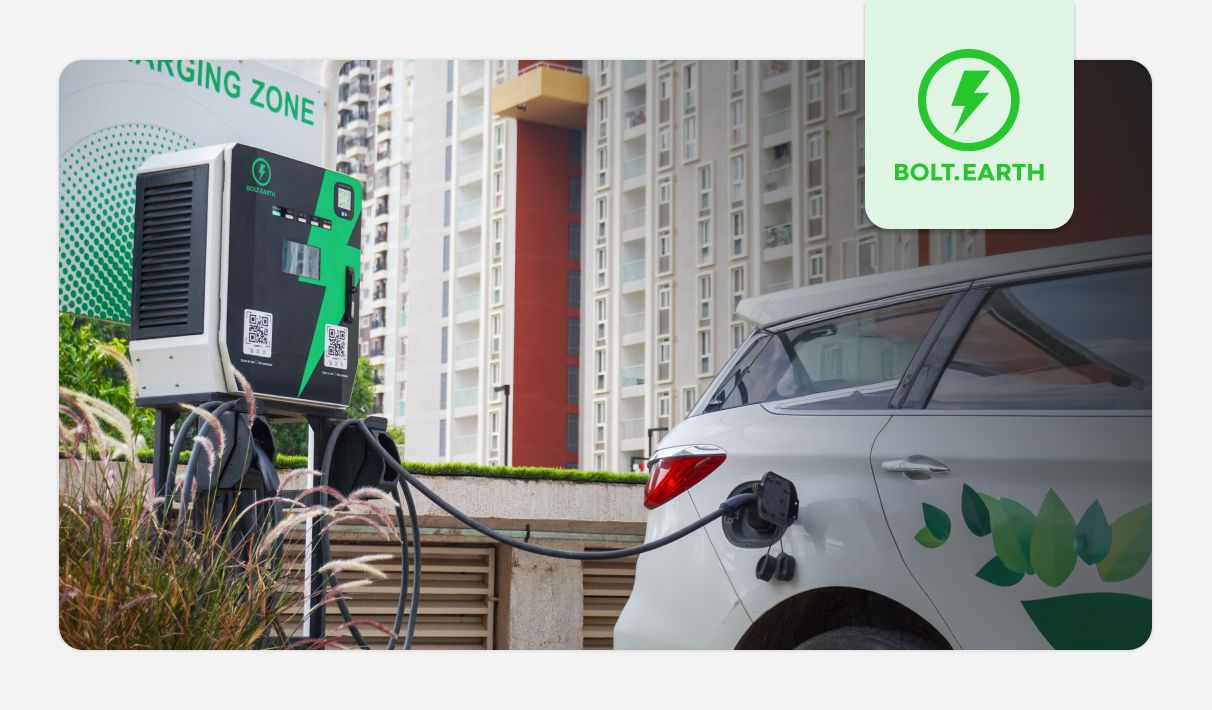
    Founded in 2017 and headquartered in Bengaluru, Bolt.Earth has grown into India’s largest EV charging network, with over 100,000+ chargers deployed across 2,000+ cities. The company caters to a broad spectrum of EV users: individual owners, residential complexes, commercial spaces, and fleet operators, with a focus on scalable, efficient, and user-centric charging solutions.

    Product Portfolio

    All Bolt.Earth hardware is designed in compliance with global standards such as CCS2, NABL, and ARAI.

    Strategic Partnerships

    Bolt.Earth has formed alliances with industry giants such as Amazon, Honeywell, Optum, Mahindra, Bajaj, Ultraviolette, TVS Motor, and Matter Motor, enabling charger deployment across dealerships, residential communities, and commercial zones.

    Flagship Innovation: Blaze DC

    In 2025, Bolt.Earth launched Blaze DC, India’s first universally compatible DC fast charger for 2- and 3-wheelers. Capable of delivering a 1% charge per minute, Blaze DC fills a long-standing gap in India’s EV infrastructure by offering brand-agnostic interoperability, rapid turnaround, and a future-ready design. It supports both the BCA-endorsed Type 6 connector and the BIS-approved Type 7 standard and is currently being rolled out nationwide.

    Manufacturing & Infrastructure

    Bolt.Earth operates multiple manufacturing and warehousing units across India. In 2024, it inaugurated a 13,000 sq. ft. Integrated Testing and Warehousing Facility in Bengaluru, built to accelerate hardware R&D and improve deployment timelines.

    Software Ecosystem

      Bolt.Earth complements its hardware with a proprietary charging software suite. This includes:

    • A user-facing mobile app, Bolt.Earth EV Charging App, for charger discovery, session tracking, and payments
    • A Charger Management System (CMS) for network operators and hosts to monitor performance, resolve faults, and analyze usage data

    This tech stack is a key differentiator, allowing Bolt.Earth to operate one of India’s few truly smart charging networks.

    Interoperability & Growth Model

    The company uses a host-sponsored model, allowing property owners and businesses to deploy and operate Bolt.Earth chargers on their premises. This reduces capital expenditure while accelerating network expansion across private and semi-public locations.

    Market Position

    According to JMK Research and the Bureau of Energy Efficiency (BEE), Bolt.Earth holds an estimated 63% share of India’s public charging infrastructure, by far the largest in the country. Its combination of scale, in-house tech, and product innovation has earned it a front-row seat in India’s clean mobility transition.

    2. Tata Power EZ Charge
    2.jpg

    Company Overview

    Tata Power EZ Charge is the EV charging division of Tata Power, one of India’s largest integrated power companies. Headquartered in Mumbai, the company has built a strong national footprint with EV charging solutions for residential users, public infrastructure, commercial fleets, and electric buses. As of 2024, Tata Power operates over 5,500 public and semi-public charging stations across 550+ cities and has installed more than 100,000 home chargers and 1,100+ bus charging points across India.

    Product Portfolio

    Tata Power EZ Charge offers a range of hardware options, including:

    • AC chargers ranging from 3 kW to 22 kW for home, workplace, and light commercial use.
    • DC fast chargers scaling up to 240 kW, ideal for highway corridors, fleet hubs, and public fast-charging stations.
    • All chargers are weatherproof, RFID-enabled, and compatible with global standards such as CCS, CHAdeMO, and GB/T.

    Strategic Partnerships

    Tata Power has formed alliances with leading OEMs such as Tata Motors, MG Motor, Jaguar Land Rover, and Zoomcar, enabling charger deployment at dealerships, residential communities, and commercial zones. The company also works with HPCL, real estate developers, and smart city projects to install chargers at key urban and highway locations.

    Manufacturing & Infrastructure

    While Tata Power doesn’t manufacture EV chargers in-house, it partners with certified vendors and integrates them into a cohesive national network. The company oversees deployment, quality control, and operations via its Network Operations Centre based in Mumbai.

    Software Ecosystem

    The Tata Power EZ Charge mobile app allows users to:

    • Locate nearby chargers
    • Track charging sessions in real time
    • Make digital payments via UPI, wallets, and cards
    • Access chargers with an RFID-enabled EZ Charge card for quick and seamless transactions

    3. Ather Energy
    3.jpg

    Company Overview

    Founded in 2013 and headquartered in Bengaluru, Ather Energy is a leading electric two-wheeler manufacturer in India and one of the earliest players to invest in dedicated EV charging infrastructure. Through its proprietary network, Ather Grid, the company has deployed over 2,700 fast-charging points across 230+ cities, focusing primarily on urban and semi-urban areas.

    What started as an ecosystem to support Ather’s own vehicles has now evolved into a more open, scalable network, especially with the company’s recent move toward interoperability through India’s upcoming LECCS standard.

    Product Portfolio

    Ather’s charging ecosystem includes both home and public fast-charging solutions:

    • Ather Dot / Ather Duo: A 700 W home charger for overnight or flexible residential use.
    • Ather Grid: A nationwide fast-charging network capable of delivering 15 km of range in 10 minutes.

    Flagship Infrastructure: Ather Grid

    Launched well ahead of its competitors, Ather Grid now spans over 2,700 active charging points, making it one of India’s largest fast-charging networks for two-wheelers. The grid is installed across cafes, malls, office campuses, and public parking spaces, offering riders convenient access in high-footfall locations.

    Software Ecosystem

    The Ather Grid mobile app is a key part of the charging experience. It allows users to:

    • Discover and navigate to nearby chargers
    • Monitor live charging sessions
    • Pay digitally using integrated UPI/wallet support
    • Access charging history and performance data

    Interoperability & Network Growth

    Ather has taken active steps to support open charging standards and interoperability. Its chargers are now being adapted to support LECCS, enabling access for non-Ather two- and three-wheelers. The company also partners with third-party networks such as Magenta ChargeGrid and ChargeMOD to extend coverage and ensure widespread compatibility.

    4. Reliance BP Mobility Ltd (Jio‑bp Pulse)
    4.jpg

    Company Overview

    Reliance BP Mobility Ltd., operating under the brand Jio-bp Pulse, is a joint venture between Reliance Industries and bp, focused on building one of India’s largest electric mobility networks. With a rapidly expanding footprint, the company currently operates over 5,000 EV charging points across 500+ locations, including highways, malls, corporate parks, airports, and fuel stations. Known for its aggressive rollout and emphasis on high-speed charging, Jio-bp Pulse is quickly becoming a key player in India’s evolving EV infrastructure landscape.

    Product Portfolio

    Jio‑bp Pulse offers a comprehensive suite of charging solutions designed for scalability and speed:

    • AC Chargers for residential and low-power commercial use
    • DC Fast Chargers ranging from 60 kW to ultra-fast 480 kW units for highway corridors, fleets, and high-traffic urban centers
    • Emerging battery-swapping infrastructure for two- and three-wheeler fleet operations

    With 95% of its deployed chargers being fast chargers, the brand is positioning itself as India’s most speed-centric EV charging network.

    Flagship Charging Infrastructure

    Jio-bp Pulse has rolled out significant high-speed charging hubs across India, including:

    • South India’s largest public EV charging station near Kempegowda International Airport, with 169 charging points.
    • Premium urban hubs like the Jio World Centre in Mumbai’s Bandra Kurla Complex.
    • Widespread installations at fuel stations, retail outlets, and food courts across highways.

    The network is known for its strong uptime, reportedly maintaining 96% availability across all stations.

    Software Ecosystem

    Jio-bp Pulse supports its hardware with a robust digital experience:

    • The Jio-bp Pulse mobile app enables users to locate nearby chargers, view real-time availability, start sessions, and pay via UPI, cards, or wallets.
    • Integrated with RFID-based access for seamless operation.
    • Select charging hubs also feature Wild Bean Café outlets for user convenience during charge cycles.

    Interoperability & Growth Model

    Jio-bp is expanding through partnerships with public and private stakeholders, including a landmark deal with the Bangalore Metropolitan Transport Corporation (BMTC) to deploy 225 charging stations across Bengaluru. The company is also piloting battery-swapping capabilities for commercial fleet segments, aiming to provide integrated energy services for urban mobility.

    5. Delta Electronics India
    5.jpg

    Company Overview

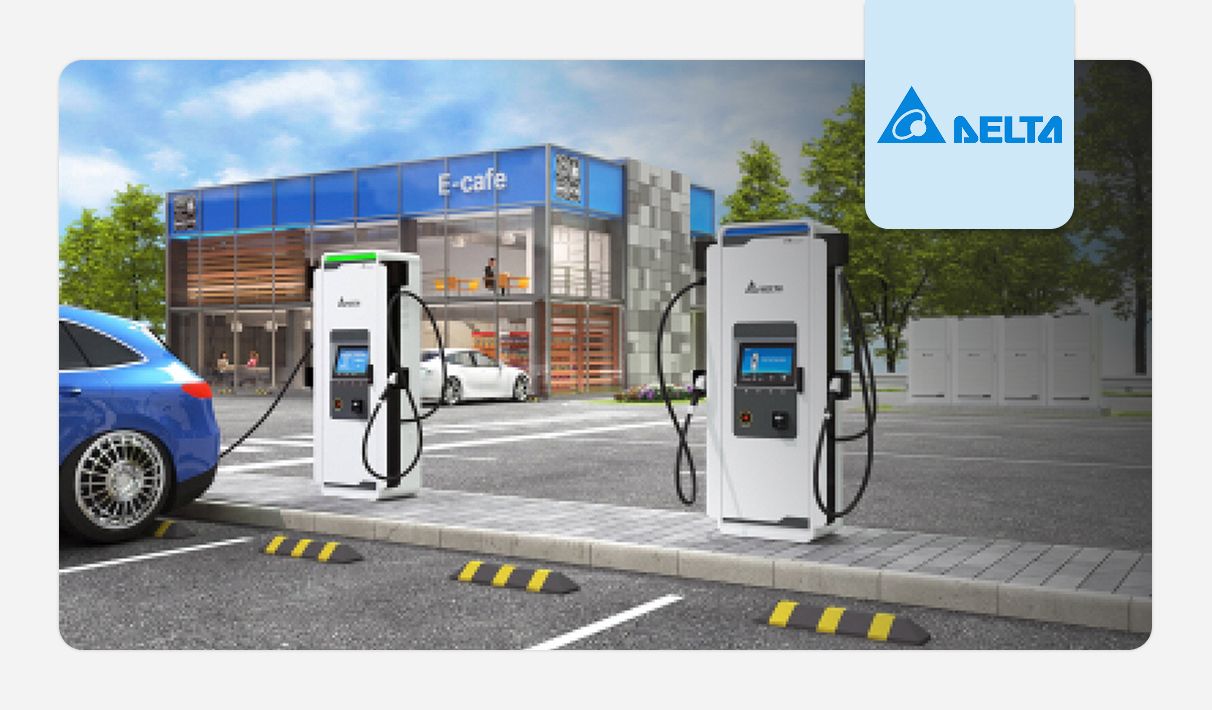
    Delta Electronics India is a subsidiary of the Taiwan-based Delta Electronics Group and a key player in India’s EV charging infrastructure space. With a strong presence in Tamil Nadu, Bengaluru, and Krishnagiri, the company has built a reputation for manufacturing high-efficiency power and energy management solutions, including a wide range of AC and DC chargers for public, commercial, and fleet applications. As of 2024, Delta has deployed over 6,000 EV chargers across India, supporting a wide range of electric mobility use cases.

    Product Portfolio

    Delta offers a full suite of EV charging solutions that cater to residential, commercial, and high-power public charging needs:

    • AC Chargers (7–22kW): Designed for homes, offices, and low-power commercial use.
    • DC Chargers (25–350kW): Including 25kW and 50kW wall-mounted units, 100 kW and 200 kW City Chargers, and the flagship Ultra-Fast Chargers (UFC 200 & UFC 350) for highway and fleet operations.
    • Energy Management Systems: DeltaGrid® EVM enables real-time monitoring, load optimization, and seamless integration with renewable energy sources and battery storage systems.

    Flagship Projects

    Delta has been involved in multiple high-impact deployments across the country:

    • Supplied 150kW DC fast chargers to Ahmedabad Municipal Transport Service (AMTS) to support its growing fleet of electric buses.
    • Partnered with BESCOM in Karnataka for the deployment of AC and DC chargers across public infrastructure and commercial sites.
    • Collaborated with ThunderPlus to develop India-made 4kW rectifier modules for onboard 2W/3W chargers, supporting domestic EV manufacturing.

    Manufacturing & Infrastructure

    Delta’s core manufacturing facility is in Krishnagiri, Tamil Nadu, where it produces chargers, rectifier modules, and other power components for domestic and export markets. The facility also supports ongoing R&D into next-gen EV chargers, including 60kW and 120kW units, which will complement its existing high-power lineup.

    Software Ecosystem

    Delta’s chargers are supported by smart backend systems and remote monitoring capabilities. The DeltaGrid® platform allows users and operators to:

    • Track real-time charger performance
    • Integrate with solar and battery systems
    • Perform diagnostics and firmware updates remotely

    This enables Delta to offer energy-smart charging solutions, especially suited for larger commercial or public deployments.

    Interoperability & Smart Infrastructure

    Delta has been a pioneer in showcasing green charging stations that combine solar PV, battery storage, and fast chargers, offering decentralized, sustainable EV infrastructure. These microgrid-enabled setups were first unveiled at Elecrama 2023, underlining Delta’s long-term vision for integrated energy mobility.

    6. Servotech EV Infra (Incharz)
    6.jpg

    Company Overview

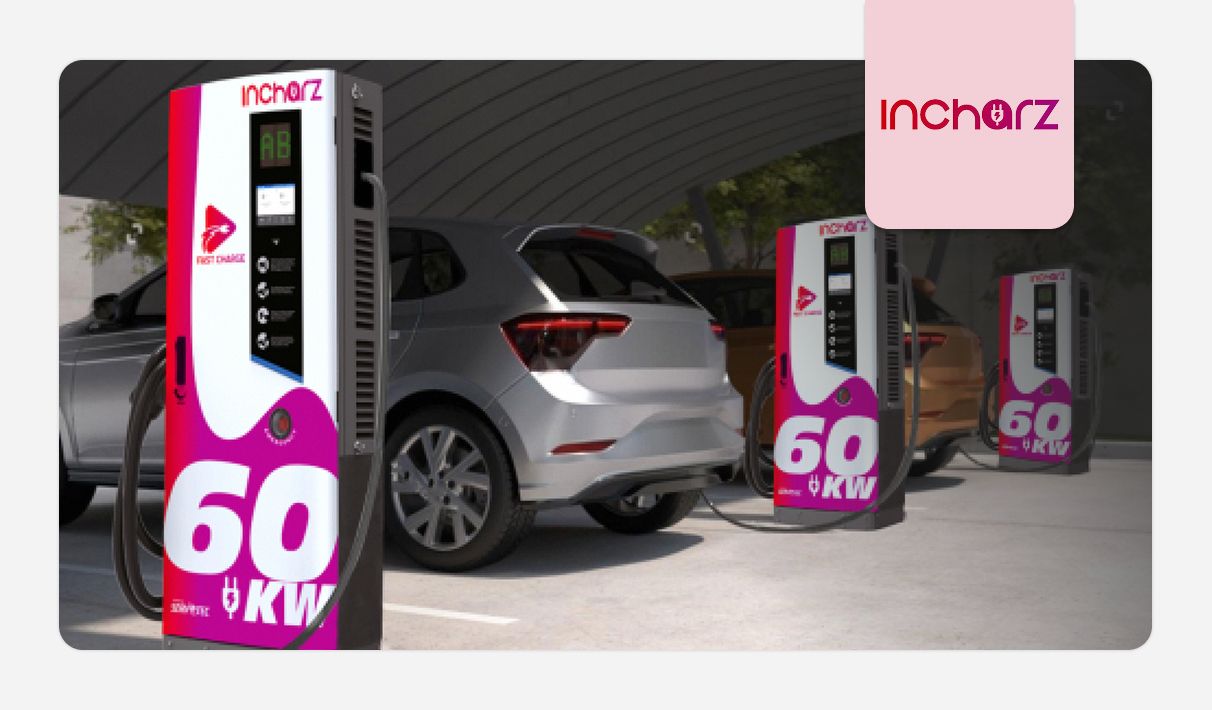
    Servotech EV Infra, operating under the brand name Incharz, is the electric mobility subsidiary of Servotech Power Systems Ltd., a Delhi-based power electronics and renewable energy company. Launched in 2023, Incharz focuses on building AC and DC charging infrastructure across India, with deployments spanning residential societies, commercial hubs, and public locations. The company aims to build a nationwide network of 5,000 EV charging stations, with a clear emphasis on quality, strategic partnerships, and fleet-based applications.

    Product Portfolio

    Incharz provides a growing range of EV chargers for 2-, 3-, and 4-wheelers.

    • AC Chargers (7–22kW): Primarily installed in residential complexes and workplaces.
    • DC Fast Chargers (25–60kW): Suitable for commercial zones, cargo hubs, and fleet depots.
    • Future-ready support for mobile charging and battery-swapping infrastructure
    • All products are NABL- and ARAI-certified and designed for Indian road and climate conditions.

    Flagship Deployments

    • 3ECO Partnership: In May 2024, Incharz signed an MoU with 3ECO, a cargo EV OEM, to install 1,000 public charging points exclusively for light commercial EVs, supporting high-volume cargo operations.
    • Prateek Group Agreement: In July 2024, the company partnered with Prateek Group to deploy AC and DC chargers at multiple residential and commercial sites across Delhi-NCR, targeting both private and visitor EV users.

    Manufacturing & Infrastructure

    Servotech operates a large-scale manufacturing facility in Sonipat, Haryana, which produces EV chargers, solar inverters, and power electronics. The company has announced plans to expand with a new EV charger production unit by 2025, with a targeted capacity of 12,000 units per year dedicated to the Incharz brand.

    Software Ecosystem

    Incharz supports its chargers with a basic yet reliable software stack, including:

    • Real-time monitoring and diagnostics through a custom CMS.
    • Remote fault detection and uptime tracking.
    • Plans to integrate battery-swapping and mobile charging workflows in the near future.

    Interoperability & Growth Model

    Incharz follows a deployment-first strategy, focusing on high-utility, high-demand zones such as logistics hubs and gated communities. While the network is still in its early stages, the company’s expansion is underpinned by a future-ready design philosophy, allowing for easy integration of evolving charging standards and technologies.

    7. ABB India
    7.jpg

    Company Overview

    ABB India is the Indian arm of ABB Group, a global leader in electrification and automation technologies. With a strong foothold in energy infrastructure, ABB has brought its global EV charging expertise to India—offering a wide portfolio of AC and DC fast chargers for residential, commercial, and fleet applications. The company has supplied chargers for public highways, commercial complexes, and mass transit fleets and is known for its focus on high-performance, scalable charging infrastructure.

    Product Portfolio

    ABB India offers a comprehensive range of EV charging products:

      • AC Wallboxes (3–22kW): Ideal for homes and small businesses
      • DC Fast Chargers:

    – Compact DC units (11–50kW) for commercial and retail spaces
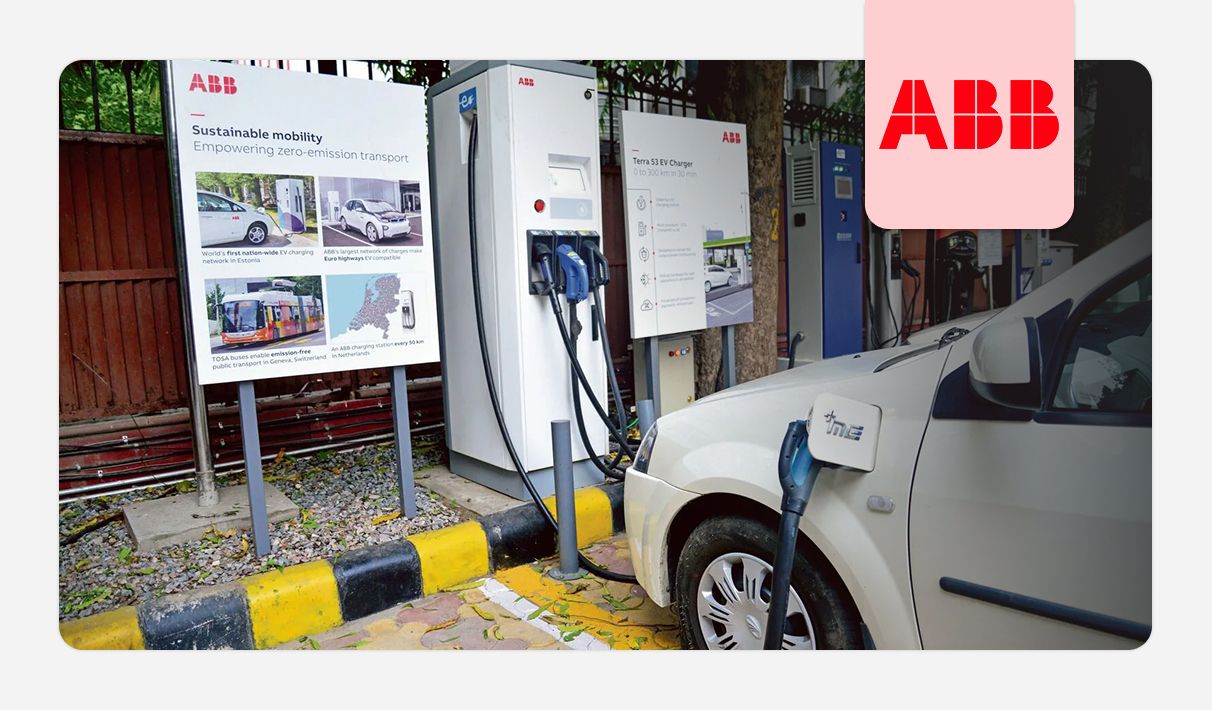
    – Terra Series ultra-fast chargers (100–360kW), suitable for highway corridors and public fast-charging stations
    – Heavy-Duty Chargers (up to 1.2 MW), tailored for buses, trucks, and fleet depots

    All ABB chargers are designed for modular scalability, cloud integration, and multi-vehicle compatibility.

    Flagship Innovation: Terra 360

    ABB’s Terra 360 is among the world’s fastest EV chargers and is available in the Indian market. It can charge up to four vehicles simultaneously, delivering up to 100 km of range in under 3 minutes. The charger features dynamic load distribution and is optimized for high-footfall, high-demand public charging environments.

    Manufacturing & Infrastructure

    ABB India produces several of its EV charging units locally, supporting India’s Make in India goals. Its chargers have been deployed at premium retail hubs, national highways, fleet depots, and OEM facilities. Globally, ABB has sold over 14,000 DC fast chargers across 80+ countries, including key deployments in India in collaboration with Audi, BHEL, and NITI Aayog.

    Software Ecosystem

    ABB’s hardware is supported by ABB Ability™, a cloud-based platform that allows:

    • Remote monitoring and diagnostics
    • Predictive maintenance
    • Real-time alerts and performance analytics
    • Integration with smart grid and energy management systems

    ABB’s 2022 acquisition of Numocity further enhances its ability to offer India-specific software features, including fleet monitoring and mobile-based payments.

    Interoperability & Growth Model

    ABB works closely with automakers, public agencies, and infrastructure providers to ensure that its chargers are OEM-agnostic, grid-compatible, and built for high-uptime usage. Its equipment is

    tailored for heavy-duty commercial EVs, long-distance travel, and high-volume public usage, making it a preferred supplier for high-throughput nodes like expressways, bus depots, and metro cities.

    8. Fortum GLIDA
    8.jpg

    Company Overview

    Fortum GLIDA (formerly known as Fortum Charge & Drive India) is the EV charging subsidiary of Fortum India, part of the Finland-based Fortum Group. The company entered the Indian EV infrastructure space in 2017 and has since built a growing network of fast-charging stations across highways, cities, and commercial spaces. With over 740+ charging points across 30+ cities and 16 states, Fortum GLIDA has positioned itself as a premium provider of fast and ultra-fast charging solutions, with a focus on seamless user experience and long-distance travel compatibility.

    Product Portfolio

    GLIDA offers a range of AC and DC chargers catering to multiple segments:

      • AC Type 2 chargers (7.4–22kW): For residential, retail, and low-traffic urban areas
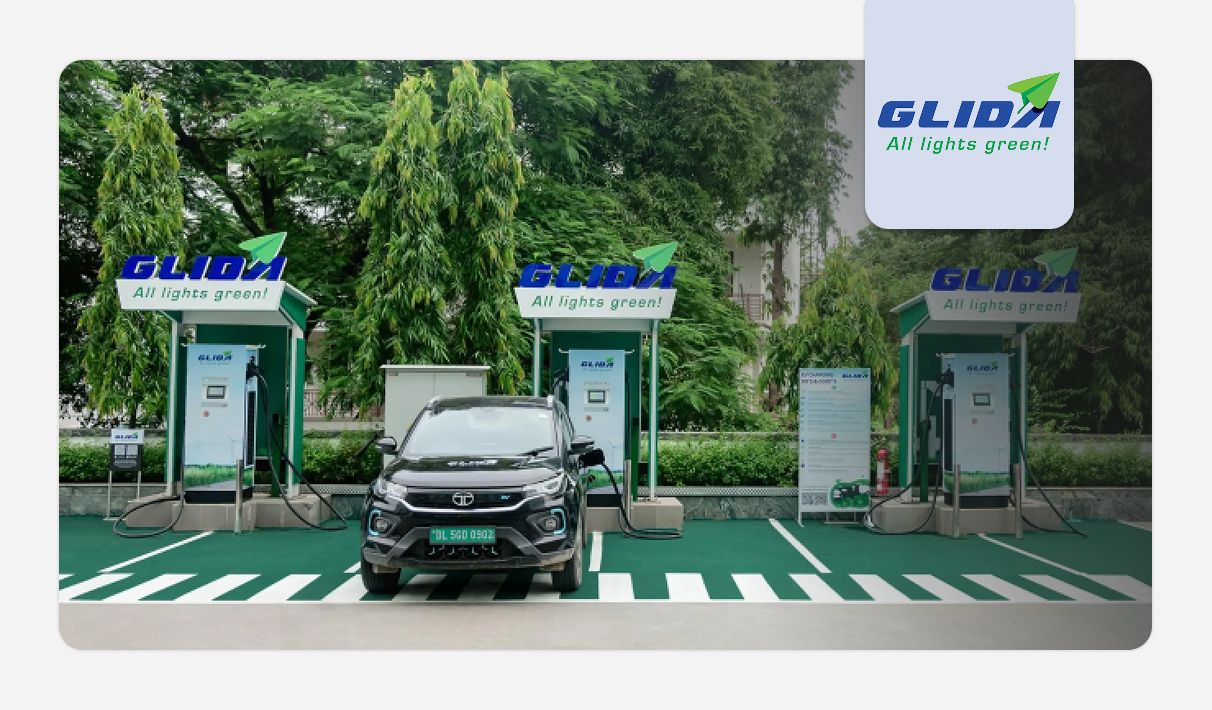
      • DC Fast Chargers (30–200kW): Designed for highway routes, fleet hubs, and high-footfall locations

    – Includes 30kW and 60kW CCS2 dual-gun models
    – 200kW ultra-fast chargers with modular satellite dispensers for high-speed multi-vehicle charging

    All chargers are designed to be operator-agnostic and compliant with Bharat EV standards.

    Flagship Infrastructure

    One of Fortum GLIDA’s standout installations is located near Hyderabad’s Shamshabad Airport, a one-acre site housing India’s first 200kW ultra-fast charger, equipped with six satellite dispensers. The company has also established over 180 charging stations nationwide, with a major presence in Hyderabad, Indore, Rajkot, and several National Highway corridors.

    Manufacturing & Infrastructure

    While Fortum imports high-power hardware through global OEM partnerships, it increasingly relies on local integration and modular design through partners like Kempower. The focus is on deploying scalable, fast-charging hubs that can handle growing demand without requiring massive physical footprints.

    Software Ecosystem

    Fortum GLIDA complements its hardware with a fully functional mobile and RFID-enabled platform:

    • The GLIDA app allows users to locate chargers, track sessions, view live availability, and pay via UPI, credit card, or wallets
    • RFID support includes both virtual and physical cards
    • Transparent pricing, session history, and usage logs are integrated into the app’s dashboard

    Interoperability & Growth Model

    GLIDA emphasizes network openness and strategic placement. It partners with hotels, malls, fuel stations, and highway operators to deploy chargers at high-dwell-time locations, enhancing convenience for users. The company’s rebranding to “GLIDA” (Swedish for “glide”) in 2023 reflects its vision of delivering a frictionless EV experience, summarized by its tagline: “All lights green.”

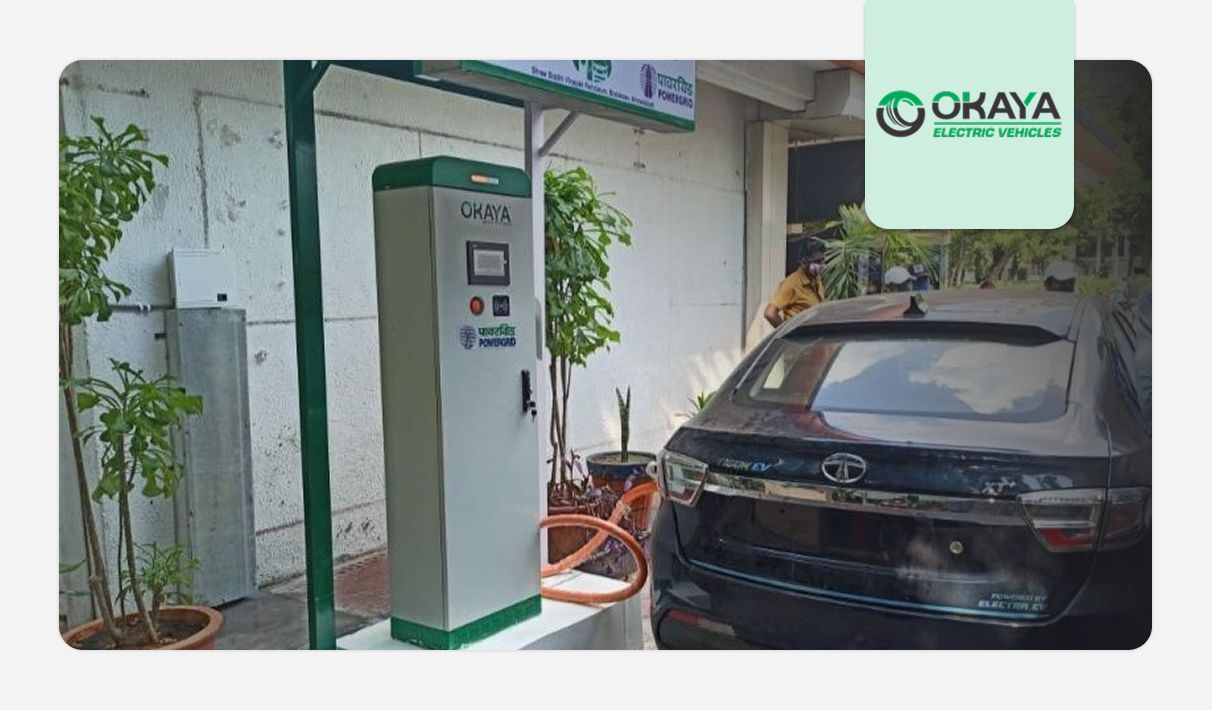
    9. Okaya EV Charging Solutions
    9.jpg

    Company Overview

    Okaya EV Charging Solutions is a division of the Okaya Power Group, headquartered in New Delhi, and one of India’s fastest-growing EV charging infrastructure providers. Officially entering the EV segment in 2020, Okaya has quickly established itself as a key player across both AC and DC charging segments. The company supports 2-, 3-, and 4-wheeler EVs, with deployments across public charging stations, fuel retail networks, and fleet depots. As of 2024, Okaya claims to hold a 40% market share in India’s EV charger manufacturing landscape.

    Product Portfolio

    Okaya manufactures and supplies a wide range of EV charging products, including:

    • AC Chargers: 3.3kW, 7.4kW, and 22kW for residential, institutional, and commercial use
    • DC Fast Chargers: 30kW, 60kW, 120kW, and 360kW models, supporting CCS2, CHAdeMO, GB/T standards
    • Battery Swapping Solutions: For two- and three-wheeler fleets in the logistics and ride-share segments
    • Chargers are multi-standard compatible, including Bharat AC001, IEC Type 2, and ARAI/iCAT-certified

    Flagship Deployments

    Okaya has secured several high-impact charging infrastructure contracts:

    • HPCL Partnership: Contracted to deploy 600 DC fast chargers (60kW and 120kW) across HPCL fuel stations nationwide
    • Indian Oil Corporation (IOCL): Collaborated to install 2,550 chargers—both AC and DC—under a ₹125 crore program
    • Shell India: Partnered to deploy a mix of 3.3kW to 360kW chargers at Shell forecourts, with initial rollouts in Bengaluru

    Manufacturing & Infrastructure

    Okaya handles end-to-end manufacturing with a large workforce and OEM-scale production capacity. Although exact factory locations are not publicly disclosed, its execution of PSU-level contracts signals a robust supply chain and high-volume deployment capabilities.

    Software Ecosystem

    Okaya chargers come with smart features and integrated safety systems:

    • User Interface: 5-inch LCD touchscreens, RFID, and QR code-based authentication
    • Connectivity: App-based monitor
    • Safety: Multi-layer protection including surge protection, over-voltage cut-off, and emergency shutdown
    • Certifications: ISO 9001, 14001, 50001; ARAI and iCAT approvals

    Interoperability & Growth Model

    Okaya’s strategy revolves around multi-standard compatibility and PSU partnerships. By integrating its chargers into existing fuel station infrastructure (HPCL, IOCL, Shell), the company ensures high visibility and consistent utilization across high-footfall public spaces. It also supports battery-swapping readiness for commercial fleets.

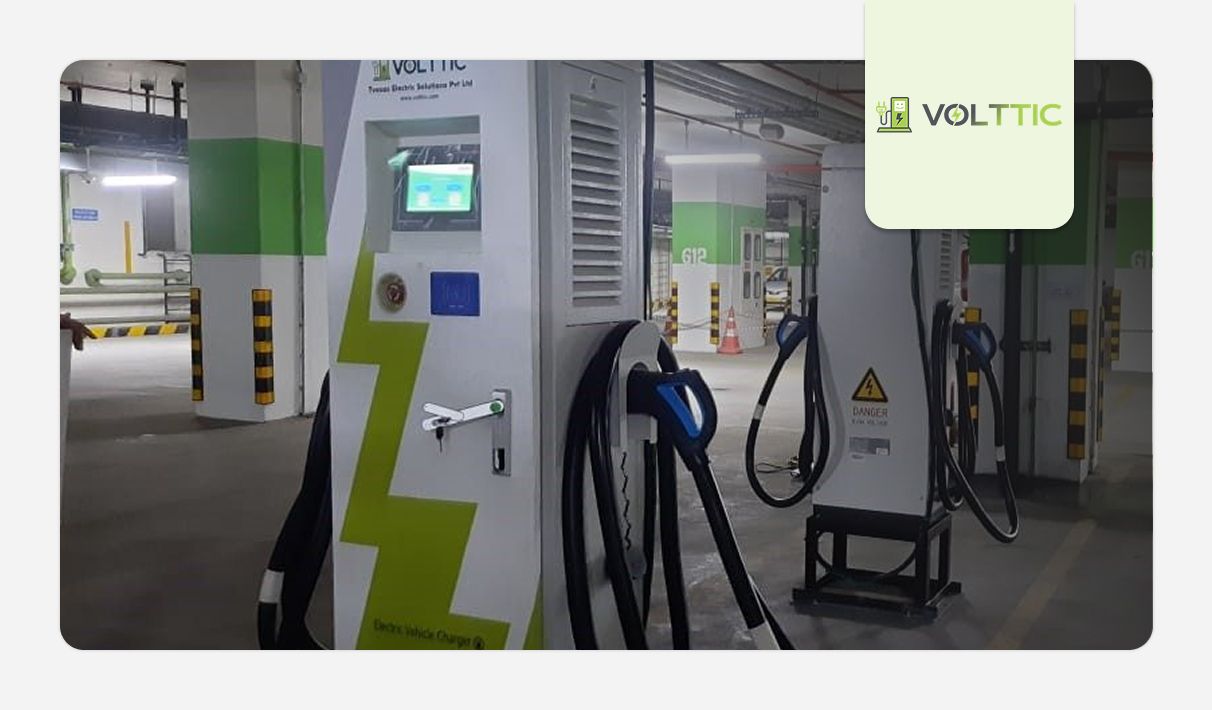
    10. Volttic EV Charging Solutions
    10.jpg

    Company Overview

    Volttic EV Charging Solutions is the charging infrastructure division of Tvesas Electric Solutions Pvt. Ltd., founded in 2017 and headquartered in Lucknow, Uttar Pradesh. The company offers end-to-end EV charging solutions with a growing presence across 20+ Indian states. With over 1,400 operational charging points, Volttic caters to residential

    societies, corporate campuses, fleet operators, commercial hubs, and highway locations, positioning itself as a turnkey provider in India’s evolving EV landscape.

    Product Portfolio

    Volttic provides a wide range of charging solutions across multiple vehicle categories:

      • AC Chargers (3.3kW – 22kW): Wall- and pole-mounted Type 2 and Bharat AC001 units for residential and commercial use
      • DC Fast Chargers (15kW – 240kW):

    – Bharat DC001 chargers for light commercial use
    – CCS2 chargers at 60kW, 120kW, and 240kW levels, including models tailored for bus and truck applications

    All chargers are OCPP-compliant and support RFID, QR code, and app-based access.

    Flagship Deployments

    • Bengaluru Campus Project: Volttic deployed 5×60kW DC fast chargers and 40 AC slow chargers at a large corporate campus, enabling up to 150 charging sessions per day.
    • Highway Installations: The company has installed 60kW CCS2 fast chargers at premium hotel chains and workplace hubs across Hyderabad and Bengaluru.
    • Fleet Infrastructure: Customized high-power charging solutions for commercial EV fleets, including electric buses and trucks.

    Manufacturing & Infrastructure

    Volttic manages the full EPC lifecycle, from site feasibility and power upgrades to charger installation, civil works, and ongoing operations. While it sources components through certified vendors, the company’s strength lies in deployment speed, maintenance SLAs, and its ability to deliver across both greenfield and brownfield sites with minimal downtime.

    Software Ecosystem

    Volttic’s backend platform includes an IoT-enabled CMS and a user-friendly mobile app that enables:

    • Real-time charger status updates and diagnostics
    • Seamless payments through QR code, RFID, or in-app options
    • Session tracking, analytics, and backend alerts for maintenance and performance issues

    This ensures smooth operations for users and hosts alike across corporate and public environments

    Interoperability & Growth Model

    Volttic follows a turnkey EPC delivery model, allowing site owners to either own the infrastructure or partner via leasing and O&M contracts. The network is vehicle-agnostic, and chargers are compatible with multiple standards, including CCS2 and Bharat protocols, making them suitable for diverse vehicle fleets and real estate environments.

    Final Thoughts

    As India accelerates toward a cleaner and smarter mobility future, electric vehicles are quickly becoming a practical and rewarding choice for individuals and businesses alike. From significantly lower running costs and minimal maintenance to government-backed incentives like purchase subsidies and registration benefits, EVs offer compelling advantages beyond just environmental impact.

    However, choosing the right charging infrastructure is just as important as selecting the vehicle itself. The manufacturers featured in this list are not only building the backbone of India’s EV ecosystem but also shaping how easy, accessible, and reliable electric mobility becomes in the years ahead.

    Want to install EV chargers at your location? Book a FREE site assessment with Bolt.Earth.
    Visit bolt.earth or contact us at [email protected] / +91 80456 88455 to get started.

  • Bolt.Earth Brings Global EV Strategies to EICMA 2023

    Bolt.Earth Brings Global EV Strategies to EICMA 2023

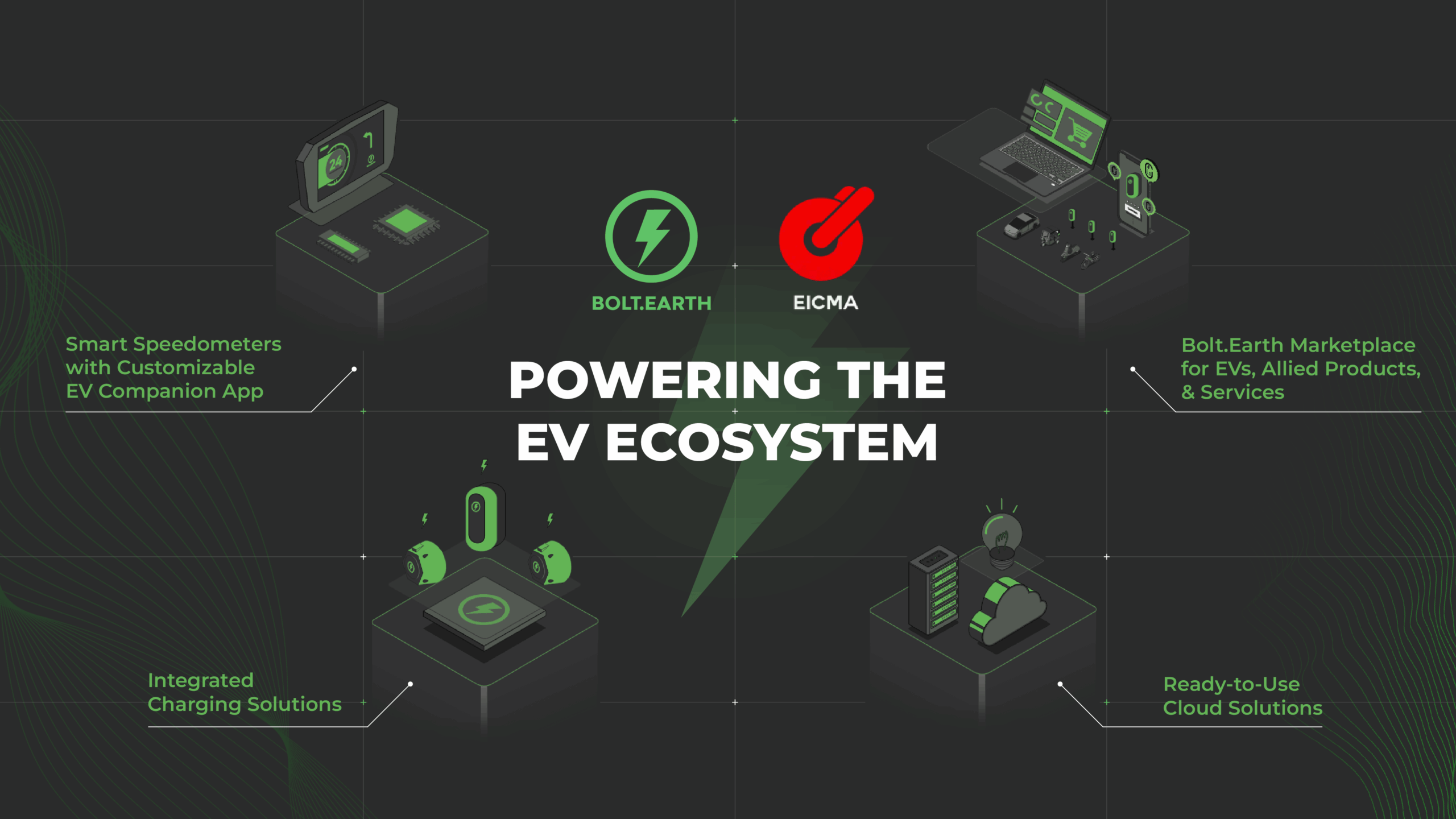
    Bolt.Earth, a leading global innovator of electric vehicle (EV) solutions, is headed for the 2-wheeler industry’s most important event of the year: the glamorous 2023 International Motorcycle and Accessories Exhibition (EICMA), in Milan, Italy! Bolt.Earth plans to showcase its groundbreaking technology by co-hosting stalls with two of its partners, preeminent electric scooter manufacturers OKLA Global and Bafang subsidiary T&D.

    The rapid growth of EV adoption has ignited demand for scalability, agility, and interoperability in tech for EVs. Bolt.Earth is working towards making it all possible via one centralized platform. The company currently partners with 8 of India’s top 10 EV-2W OEMs, has established a vast charging network with 30k+ charging points across 1100 cities, and has 150k+ active users on its app.

    Meanwhile, the startup has started making waves in international waters — with dynamic collaborations with established 2W automotive firms, in order to accelerate cleaner mobility in emerging markets.

    Bolt.Earth also provides solutions and services for EV users, fleet operators, and dealers, and empowers original equipment manufacturers (OEMs) to accelerate their go-to-market timelines. In addition to charging solutions, its comprehensive array of offerings includes integrated cloud-based software, user-friendly speedometers, allied services, and financing and leasing options to facilitate EV adoption.

    All of these offerings strategically position Bolt.Earth to address the increasing demand for an agile, scalable, interoperable, and universal EV ecosystem. By employing a strategic perspective, Bolt.Earth has successfully initiated global operations, driven by its mission to provide accessible and sustainable automotive tech solutions for EV 2-wheelers worldwide.

    To better understand Bolt.Earth’s strategy for building a sustainable auto revolution, this article will address three questions:

    • What role will Bolt.Earth play in the upcoming EICMA motorcycle show, and how will it benefit EV ecosystems in emerging markets?
    • How is Bolt.Earth strategically implementing innovative technology, including the powerful Bolt.Earth OS, to help international partners move towards software-enabled EVs?
    • Why does Bolt.Earth’s global expansion hold broad industry implications?

    Bolt.Earth at EICMA: What’s on Display

    Bolt.Earth looks forward to introducing its transformational technology to the 2-wheeler world at EICMA!

    The company takes pride in offering cutting-edge EV tech products that center on its proprietary EV operating system (OS) — the core driving force behind intelligent and well-connected software-defined vehicles (SDVs).

    In addition to its OS, Bolt.Earth provides a comprehensive range of innovative EV charging products designed with efficiency and sustainability in mind. These chargers are compatible with all EV models and promote clean energy practices. Bolt.Earth further extends its commitment to user convenience with a well-developed mobile app for finding EV charging points and charging EVs.

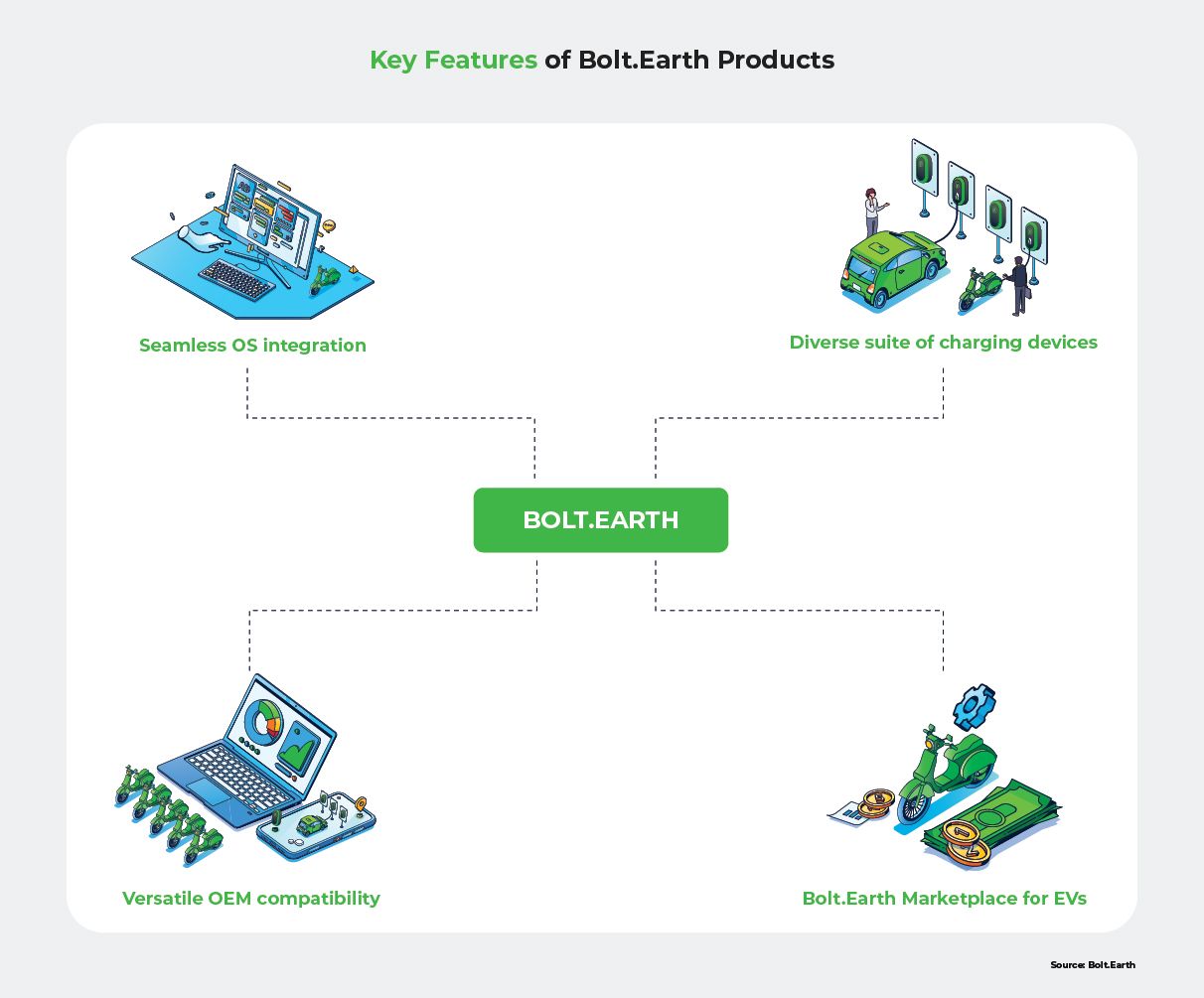
    Here’s a detailed look into the key features of Bolt.Earth’s various offerings.

    Infographic listing the key features Bolt.Earth offers

    State-of-the-Art 2-Wheeler Integrations

    Bolt.Earth OS is a comprehensive and interconnected platform technology that perfectly integrates across various EV components and devices. This provides a unified and efficient user experience. For example, embedded smart speedometer clusters monitor and control various EV components like the Battery Management System (BMS), controller, motor, and vehicle peripherals.

    By seamlessly integrating Bolt.Earth OS-powered solutions into their offerings, original equipment manufacturers (OEMs) and distributors can effortlessly tailor the EV driving and charging experience to the unique preferences of each user. Bolt.Earth OS can also help OEMs by streaming EV data to the cloud to enable a deeper understanding of customer needs, and can upgrade new features accordingly through over-the-air (OTA) updates.

    Bolt.Earth OS products’ versatile compatibility has led to many successful collaborations between Bolt.Earth and various OEMs. For example, Kyte Energy, a leading electric scooter maker in India, has leveraged Bolt.Earth’s technology to offer a comprehensive suite of EV charging features through its mobile app. Meanwhile, BattRE has incorporated Bolt.Earth’s speedometer clusters into its cutting-edge electric 2-wheelers. Such partnerships have resulted in the development of technologically advanced and user-friendly EVs, mobile apps, and EV charging stations.

    Another key advantage of Bolt.Earth OS is its ability to synchronize data, which enables users to optimize performance and ensure uninterrupted communication between different EV functionalities. This versatility extends to compatibility with any vehicle management system (VMS) and fleet management system (FMS) to optimize EV health and performance. In addition, Bolt.Earth OS is interoperable with all EV charging points and other technological components within the EV ecosystem.

    Designed with fleet operators in mind, Bolt.Earth OS also offers integrated EV charging infrastructure functionality, and FMS-optimized telemetry capabilities including real-time monitoring and continuous data collection.

    Diverse EV Charging Solutions

    Bolt.Earth offers a range of EV charging solutions, including the innovative Bolt.Earth LITE. This slow charging point caters to 2-, 3-, and 4-wheelers to ensure compatibility with all EV models, and even offers protection against power and voltage surges. Its resilience also extends to guarding against overheating and short circuits.

    Meanwhile, Bolt.Earth’s Blaze AC and Blaze DC fast-charging solutions provide flexible, efficient EV charging options to cater to every user’s needs. The Blaze chargers’ state-of-the-art features include:

    Blaze DC

    • On-the-go EV charging, enabling 50km range in just 30 minutes
    • IOT capabilities, for easy locating, scanning, and EV charging
    • In-app energy consumption monitoring
    • Ultimate customizability and adaptability; the charger can use any CAN-enabled connector, and can be scaled up to 12kW
    • IEC 61851-6 compliance, for the safest EV charging experience

    Blaze AC

    • Wireless energy metering
    • Intuitive charger status and energy display
    • IP65 water resistance
    • Included gun holder
    • Compatibility with a wide range of electric vehicles

    Bolt.Earth’s EV charging solutions are characterized by their remarkable versatility. They seamlessly adapt to different power sources, from conventional electrical grids to sustainable renewable energy systems. This compatibility supports the use of sustainable and eco-friendly EV charging practices. They are also innately compatible with offerings from all OEMs, making them a versatile and invaluable solution within the broader EV ecosystem.

    Overall, Bolt.Earth’s EV charging solutions are transforming EV ownership by enabling users to conveniently charge at any Bolt.Earth station and its partnering stations, without worrying about compatible chargers or standards. User-friendly interfaces make for a hassle-free EV charging experience, while the fast EV charging capabilities minimize wait times. Comprehensive safety measures are integrated to guarantee a secure and worry-free EV charging experience as well. Moreover, these products exhibit agility and scalability to align with emerging trends in renewable energy.

    Virtual Reality Experience

    Bolt.Earth is excited to offer EICMA attendees the opportunity to experience the practical applications of Bolt.Earth OS in immersive VR. Visitors to participating EICMA stalls can try out VR headsets to gain a firsthand understanding of Bolt.Earth OS’ user-friendly interface and advanced functionalities, making the technology accessible to everyone.

    By using the VR headsets, users can get a preview of enjoying the ultimate riding experience with Bolt.Earth, and envision their own role in a greener future. They can see how Bolt.Earth EV charging points work, and how Bolt.Earth OS clusters integrate with electric 2-wheelers. In particular, the VR experience showcases Bolt.Earth OS notifications about navigation, battery level, receiving a call, and other essential information.

    This VR experience isn’t limited to potential users; it’s a valuable resource for partners and stakeholders as well. It effectively showcases the functionalities, user interface, and advantages of Bolt.Earth’s integrated OS solutions in an immersive experience, helping OEMs gain a deeper appreciation of their technology and potential to transform the global EV industry.

    The Bigger Picture: Bolt.Earth’s Global Expansion Strategies

    Not only is Bolt.Earth poised to make an exciting splash at EICMA, it has diligently laid the groundwork for successful global progress. Bolt.Earth fully understands and is prepared to address the intricate interoperability challenges inherent in the expansion of the international EV ecosystem. Bolt.Earth’s versatile, multi-compatible offerings play a crucial role in resolving these challenges. To promote their adoption, Bolt.Earth is forging strategic partnerships with local stakeholders and industry leaders to accelerate successful market entry and expansion.

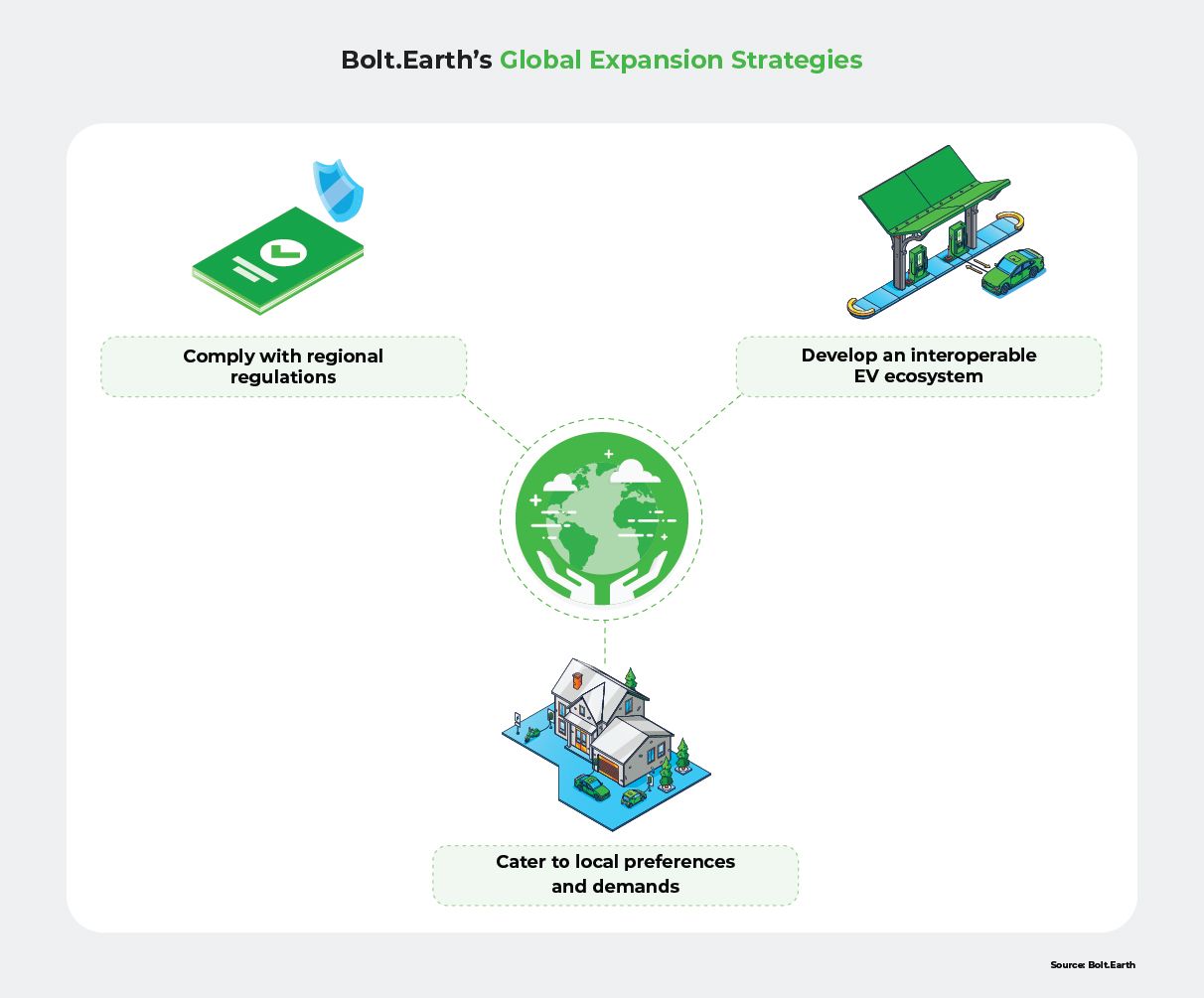
    The following key initiatives are also boosting Bolt.Earth’s global footprint.

     Infographic illustrating detailing Bolt.Earth's global expansion strategies

    Regulatory Navigation and Compliance

    Navigating international regulations can be tricky. To address this challenge, Bolt.Earth has established a dedicated team proficient in monitoring and adapting to evolving legal frameworks worldwide. This team ensures that Bolt.Earth’s products are up-to-date with the latest regulatory changes and compliance requirements.

    Moreover, Bolt.Earth proactively engages with local authorities, industry associations, and regulatory bodies to ensure compliance while providing inputs to standardize and streamline regulatory processes.

    Technological Adaptation and Innovation

    In tandem with navigating compliance, Bolt.Earth is also investing heavily in research and development to cultivate an adaptable tech ecosystem capable of integrating with various EV models and infrastructure specifications. Recently, the company raised $20 million in funding to support expanding Bolt.Earth worldwide.

    Bolt.Earth is also developing cutting-edge smart EV charging technologies, apps, and speedometer clusters that excel in both efficiency and interoperability with diverse EV models and mobility landscapes. A strong emphasis is placed on creating user-friendly interfaces that enhance owners’ and drivers’ overall EV experience. Above all, Bolt.Earth takes a need-driven approach to ensure its technology remains relevant and valuable to users globally.

    Market-Specific Customization

    A key aspect of Bolt.Earth’s global expansion strategy is its ability to customize existing products to cater to regional preferences and demands. Most notably, by providing a versatile range of OS speedometers compatible with both lower-cost and premium 2-wheelers, Bolt.Earth enables OEMs to serve every consumer segment. On the EV charging side, Bolt.Earth is working to strategically provide convenient and efficient solutions so that on-the-go EV users, residential consumers, businesses, and fleets can all transition smoothly to electric mobility.

    This dedicated focus on market-specific customization reduces entry barriers, allowing EV OEMs to swiftly enter new markets and provide convenient, accessible, and efficient electric 2-wheeler solutions to every customer.

    In all, Bolt.Earth’s multipronged approach to global expansion includes adherence to local and national regulations in different countries, investments in research and development, and a steadfast focus on market-specific customization. These collective efforts position Bolt.Earth to leave a lasting impact on the global EV market.

    Bolt.Earth’s Expanding Map

    Bolt.Earth has made progress towards establishing a robust and user-friendly EV ecosystem in promising international markets. Notably, regions like Thailand, Vietnam, and Indonesia hold significant potential for EV adoption, but face challenges such as gaps in EV charging infrastructure. Bolt.Earth’s global presence has expanded to these countries to lower barriers to EV adoption. At EICMA, Bolt.Earth looks forward to introducing its offerings to potential partners beyond the Asian shores.

    Specifically, Bolt.Earth is focusing on deploying smart EV charging technologies in international markets. These technologies optimize the EV charging network. EV owners can benefit from Bolt.Earth’s advanced EV charging features like remote EV charging management, dynamic pricing, and load balancing, all of which can make the EV charging process convenient and cost-effective.

    Bolt.Earth is also collaborating with local power grids to establish a seamless and reliable EV charging network. This integration ensures that the EV charging infrastructure functions with existing power sources to prevent grid congestion. In turn, this integration will strengthen the stability and reliability of power grids and will build confidence in the minds of EV owners. Additionally, Bolt.Earth is actively including renewable energy sources in the EV charging infrastructure. This expansion reduces the carbon footprint and contributes to a more sustainable future.

    These efforts in select international markets reflect Bolt.Earth’s vision to establish an efficient, sustainable, and user-friendly EV charging network. Throughout this process, Bolt.Earth is cultivating new opportunities for partnerships and collaborations with various stakeholders across the global EV market.

    Looking Ahead at EICMA: Global Expansion Opportunities

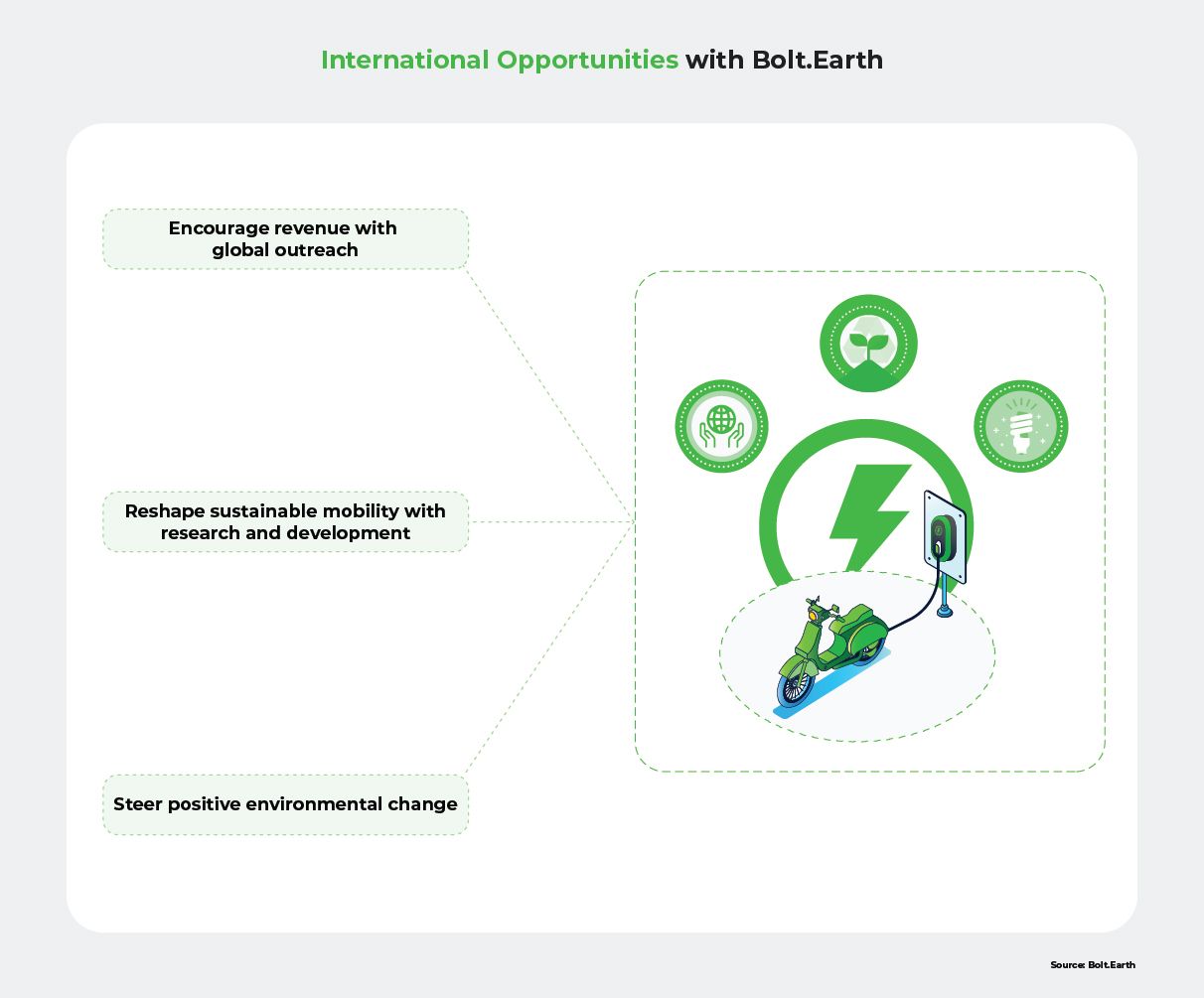
    Bolt.Earth’s global presence is creating a transformative opportunity for OEMs worldwide as the company showcases the immense potential of its well-curated tech ecosystem for EV 2-wheelers to widen adoption and increase access to sustainable EV charging infrastructure. By attending EICMA, Bolt.Earth will advance its goals by taking its place within the international 2-wheeler industry.
    Infographic showcasing Bolt.Earth's vision for global expansion opportunities

    Revenue Acceleration through Global Outreach

    International expos like EICMA provide a way to accelerate growth and revenue for both exhibitors and attendees. These events allow all stakeholders to ride the EV wave and contribute to positive change within their respective countries. OEMs, third-party app developers, and other players in the EV ecosystem can partner with Bolt.Earth to tap into a growing two-wheeler customer base.

    Spearheading Technological Advancements on the Global Stage

    With a wide range of EV charging solutions, a comprehensive app, and a universal OS, Bolt.Earth is emerging as a global player in the overall EV tech space. More specifically, its commitment to research and development and its 2W offerings are rapidly establishing it within the European 2-wheeler market. As Bolt.Earth plans to demonstrate at EICMA, such initiatives are spearheading the future of sustainable transportation solutions.

    Driving Positive Ecosystem Transformation

    As Bolt.Earth goes global with its sustainable EV charging solutions, it is bringing about substantial environmental benefits. Its presence at EICMA and other international expos helps raise awareness about 2Ws’ place within the holistic EV ecosystem. Through these efforts, Bolt.Earth is driving a positive transformation in the way the world thinks about transportation.

    In all, Bolt.Earth is contributing to a greener and more sustainable future for all through its initiatives in EV charging.

    In Conclusion

    Bolt.Earth is moving forward with one approach: to change how people perceive EVs. Through the establishment of an inclusive ecosystem, they are not merely promoting the widespread adoption of electric vehicles, but also establishing a worldwide standard for software-defined EVs. Bolt.Earth’s mission goes beyond the concept of “Make in India” — it’s about “Innovate in India and Craft for the Entire World.”

    _Join Bolt.Earth at EICMA to experience cutting-edge tech trends for EV 2-wheelers!_

    _Booth C-49 | Hall 14 & Booth I-05 | Hall 22, Rho Fiera Milano Exhibition Centre, Milan | 7th – 12th November_

    To learn more about Bolt.Earth’s international roadmap, please see the FAQ and Resources below.

    FAQ

    How will international partnerships enable Bolt.Earth to accelerate e-mobility goals on a global level?

    By forging partnerships with EV stakeholders worldwide, Bolt.Earth’s international team can not only expand the company’s presence, but also gain further insight into, and ensure alignment with, the values and needs of diverse markets. As a result, Bolt.Earth will be able to optimize its strategic offerings to most efficiently and effectively support every aspect of the emerging global EV ecosystem.

    What is the significance of Bolt.Earth’s global journey for its future growth?

    Bolt.Earth’s global journey is significant as it enables access to new markets, promotes partnerships, and positions the company as a leader in sustainable EV charging solutions. International expansion contributes to revenue diversification and accelerates the adoption of eco-friendly mobility, further solidifying Bolt.Earth’s presence in the evolving global landscape of electric transportation.

    How does Bolt.Earth inculcate innovation and adaptability in its global expansion strategies?

    Bolt.Earth boosts innovation and adaptability through investments in research and development, creating smart EV charging solutions, and establishing strategic partnerships with local stakeholders. These initiatives allow Bolt.Earth to tailor its offerings to diverse markets, promoting the adoption of sustainable transportation solutions on a global scale.

    What cross-border partnership models does Bolt.Earth explore for global expansion?

    Bolt.Earth explores joint ventures, licensing agreements, and strategic alliances for global expansion. Joint ventures involve shared ownership and management of operations, allowing for local expertise. Licensing agreements grant the use of Bolt.Earth’s technology to foreign partners. Strategic alliances entail collaboration with industry leaders and local stakeholders, leveraging their knowledge and networks.

    Resources

    Infosys: Strategic partnerships to boost EV growth

    Get to know about the importance of strategic partnership in EV growth here.

    Forbes: Five Ecosystem Actions Required To Accelerate EV Adoption

    Discover the strategies required to accelerate EV adoption here.

    Gartner: International Expansion Strategy: How to Target Specific Countries

    Learn about how to target countries with the most growth potential here.

    Velocity Global: Top 5 Global Expansion Strategies

    Explore key strategies to promote global expansion here.

    South China Morning Post: Top Chinese EV makers like BYD poised for global expansion by 2030 thanks to ‘overwhelming’ cost advantages: UBS

    Learn how EV companies are expanding globally here.