The automotive industry is undergoing a digital transformation, and cloud-based development is at the heart of this shift. As vehicles get smarter, connected, and increasingly electric, cloud platforms enable faster innovation, seamless updates, and scalable solutions.
This article delves into the transformative impact of cloud-based development in automotive software. Specifically, it answers the following questions:
- How is the automotive industry moving towards cloud-based development right now?
- What software development challenges does the automotive industry currently face, and why are traditional development environments inadequate?
- How do cloud-based development environments provide solutions, and how can they shape the future of the automotive industry?
The Current Landscape of Automotive Software Development
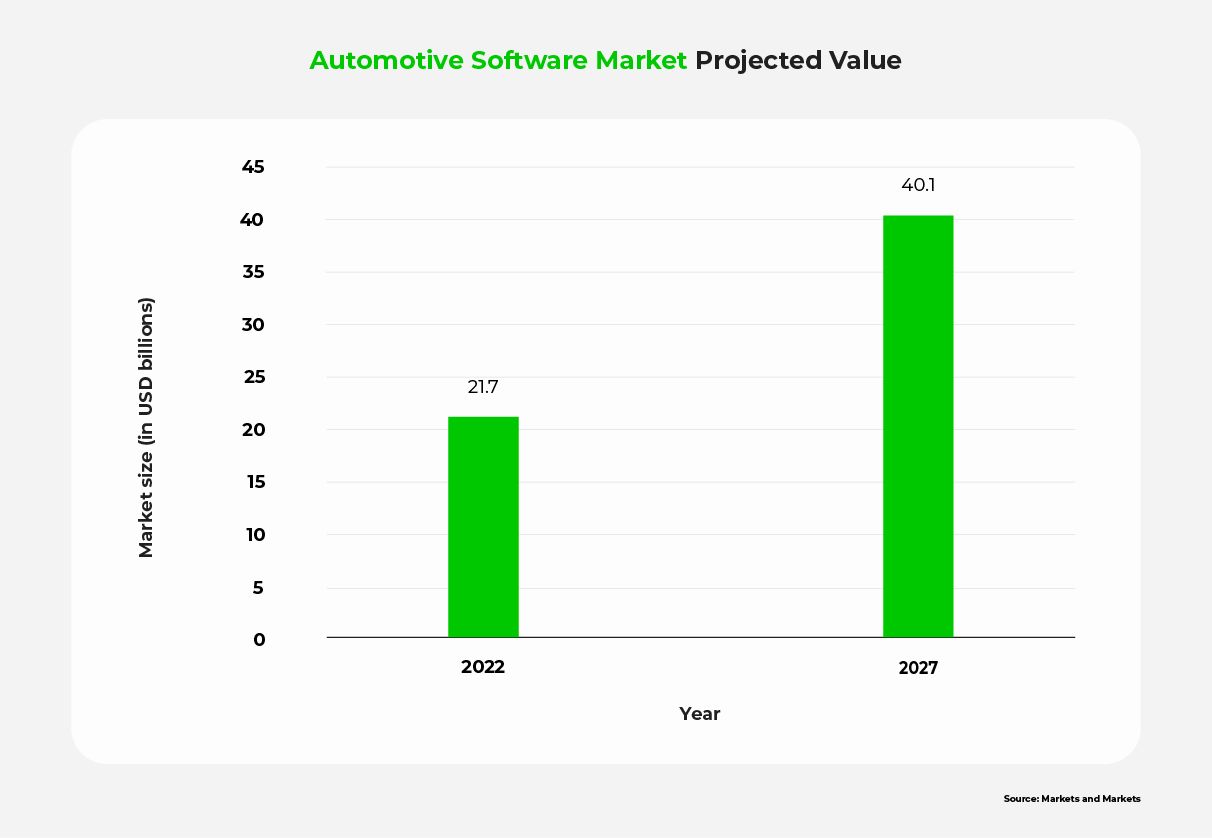
Automotive software development encompasses designing, creating, testing, and maintaining vehicle control software. In 2022, the global automotive software market reached a value of USD 21.7 billion and is projected to reach USD 40.1 billion by 2027, with a CAGR of 13.1% during this period. Factors such as adherence to fuel efficiency regulations, enhanced comfort, reduced vehicle downtime, and convenience propel the growth of the automotive software market.
- In-vehicle software: Directly impacts vehicle operations, including advanced driver-assistance system (ADAS), body controls, powertrains, infotainment, communication, remote monitoring, and vehicle-to-everything (V2X).
- Industry software: Applications that span the entire automotive value chain, including vehicle design and engineering, manufacturing execution, supply chain management, dealer management, and fleet management software and systems.
The evolution of automotive software traces back to the 1970s when cars first integrated computers. Initially, software managed basic engine functions, and advanced electronics enabled software to improve engine performance and fuel efficiency. In the 1990s and early 2000s, software began to dictate safety, climate control, infotainment, and driver assistance. Today, there is a surge in software-focused connectivity, ADAS, and electric vehicle (EV) controls.
Introducing EVs and ADAS technology has necessitated the development of new software systems and components, such as battery management systems and sensor fusion algorithms.
However, automotive software development is still a relatively nascent field continuously steered by changing functional requirements and emerging design patterns. As automotive manufacturing becomes more complex and data-driven, automakers and OEMs face new challenges. They need to develop reliable software that meets new safety regulations, connects vehicles seamlessly, and powers innovation in electric vehicles and autonomous driving. They also need to efficiently manage multiple product variants and figure out the most effective way to deploy software.
In 2021, the cloud segment led with over 60% in revenue share. The on-premise segment expects to grow at a rate of 18.6% over the forecast period.
Embracing cloud technologies offers the automotive industry benefits, including cost-efficiency, increased reliability, faster time-to-market facility, and better scalability. In contrast, the drawbacks of an on-premise system entail substantial costs involving infrastructure, maintenance, storage, power, and licenses. Scaling poses complexities and expenses due to hardware prerequisites, and data backup necessitates investments in servers, network setup, and software, coupled with ongoing maintenance. These limitations underscore the constraints of on-premise systems in cost-effectiveness, scalability, and data management.
Why Cloud-Based Development Matters in Automotive
Manufacturers need more than production expertise to thrive in today’s automotive market. Software’s growing significance aids in monitoring diverse product variables, aligning with market demands.
For internal combustion engine (ICE) vehicles, software development plays a pivotal role in elevating mobility performance and driving experiences. It refines production precision and safety features and integrates sensors, warnings, and advanced driver assistance systems (ADAS), providing drivers with proactive hazard alerts and fostering control to reduce accidents. Moreover, automotive software bolsters efficiency, curbing fuel consumption to deliver environmental advantages and cost savings. Software drives the evolution of connected vehicles, harnessing high-speed networks for real-time traffic updates and engaging infotainment services.
In addition, software is even more vital in EVs. As these vehicles lack intricate mechanical systems and traditional engines, software drives vehicle management and operation. As technology evolves, gathered data aids software developers in evaluating performance, contributing to the ongoing enhancement of future models.
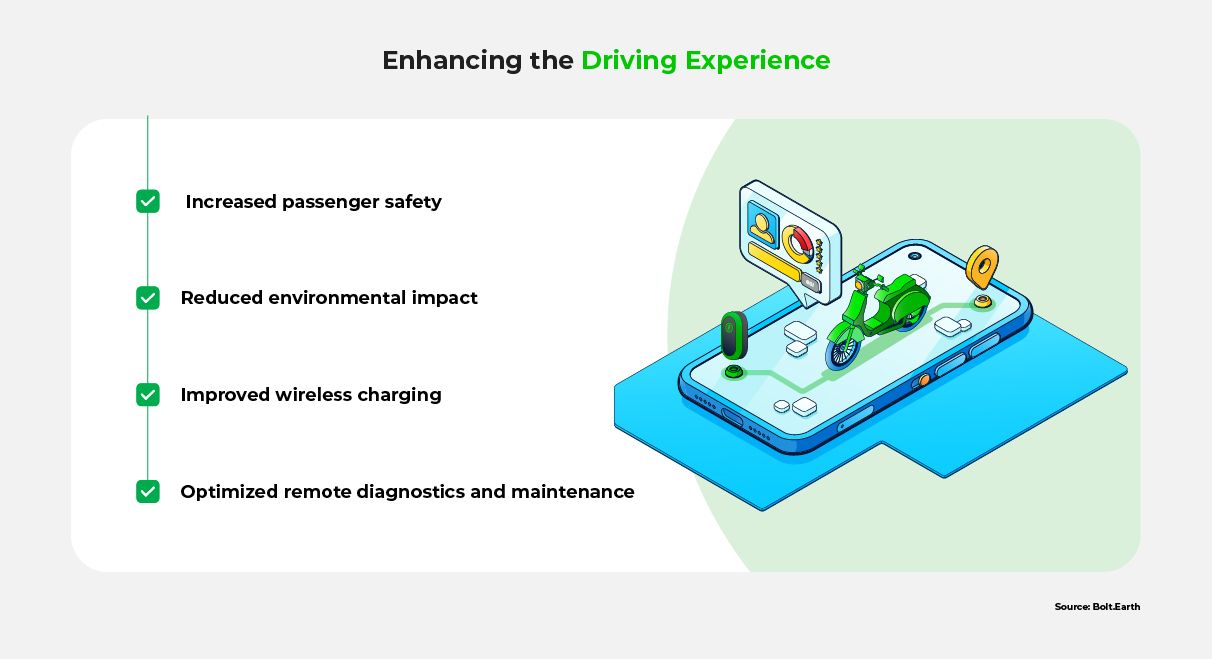
Anticipating smoother EV experiences, future software endeavors will tackle existing driver concerns and perceived drawbacks. Comparable to other tech trends, the trajectory includes expectations for connected, integrated experiences featuring smart functionalities that aim to enhance passenger safety, environmental impact, wireless charging, and remote diagnostics and maintenance procedures.
While EV charging stations are crucial for sustainability, their impact extends beyond physical infrastructure. Embracing cutting-edge software is pivotal for station owners, unlocking benefits such as optimized charging durations, remote monitoring, streamlined payments, scheduled charging, and integrations with fleet management systems. These software-driven advantages empower efficient operations and enhance user experiences, propelling the electric vehicle ecosystem forward.
Challenges in Cloud-Based Automotive Development
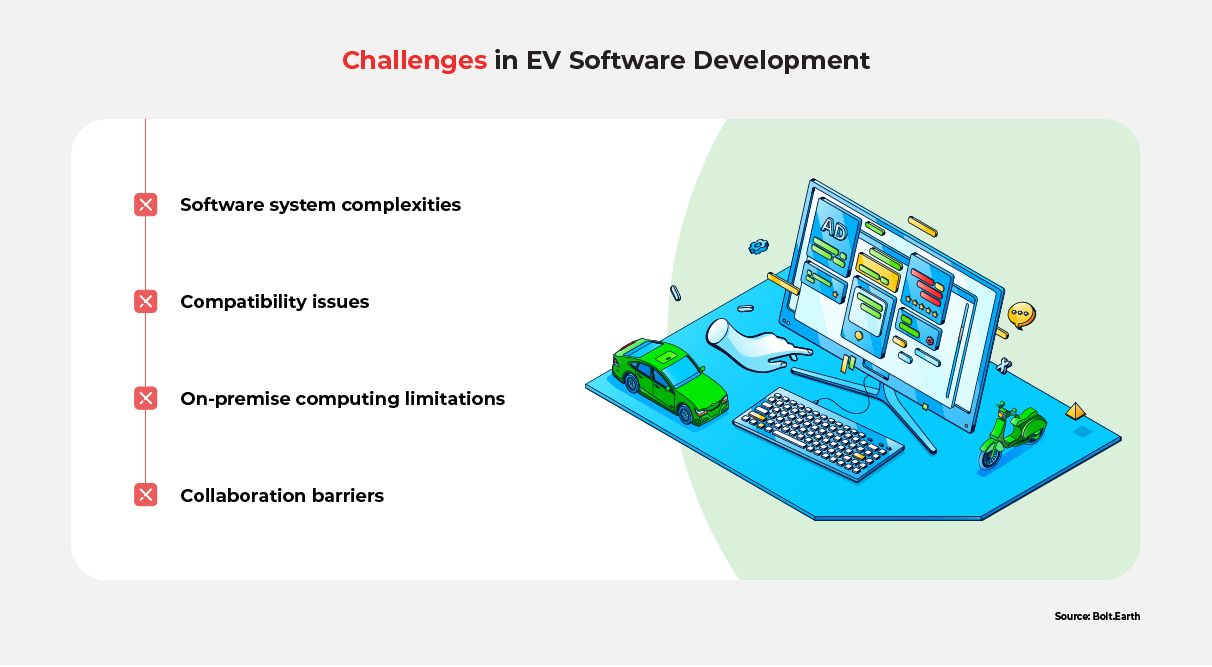
As the previous section mentioned, automotive software developers must tackle several major challenges.
Software System Complexities
EVs require sophisticated software to coordinate their intricate systems seamlessly. Developing software for these complex systems poses challenges, mainly due to the need for domain knowledge and specialized expertise. Engineers must understand how components interact within the vehicle’s ecosystem. From precise battery management for safety and performance to algorithms needed for motor control and power optimization, developers must integrate knowledge from multiple domains and adapt software as EV technology evolves.
Compatibility Issues
A significant challenge in EV software development revolves around compatibility issues on two fronts:
- Operational software compatibility: EV software architecture comprises multiple layers, each interacting with distinct hardware components. Challenges arise when creating an operating system (OS) that accommodates various hardware, ensuring seamless interactions between layers.
- Hardware compatibility: EVs rely on software systems from varying manufacturers, demanding rigorous integration efforts. The challenge involves ensuring harmony and streamlined communication between software and hardware, with extensive testing necessary for reliable performance.
On-Premise Computing Limitations
The predicted dominance of cloud-based software from 2023 to 2030 raises questions about the challenges associated with on-premise computing — the practice of hosting software applications, data storage, and computing infrastructure within an EV manufacturer’s physical premises. Several aspects of on-premise computing are currently limited. These include:
- Performance optimization: EV software optimizes complex vehicle aspects, requiring real-time data analysis and complex algorithms. On-premise computing constraints hinder efficient execution, affecting driving experience and energy efficiency.
- Real-time processing: Functions like regenerative braking need instant processing for safety. On-premise computing might struggle, risking delays and compromising EV safety and performance.
- Over-the-air (OTA) updates and cybersecurity: OTA updates enhance EV functionality. However, on-premise computing lacks the flexibility to manage updates for a diverse fleet, risking cybersecurity and update deployment challenges.
- Software updates and maintenance: Routine updates are vital for bug fixes and security. On-premise systems may struggle to coordinate updates for a dispersed fleet, leaving vehicles outdated and vulnerable.
Collaboration Barriers
In the evolving automotive sector, effective communication is paramount. Internally, streamlined communication between design, engineering, and production teams is crucial for cohesive product development and efficient processes. Externally, collaboration with suppliers, partners, and competitors can be complex, with varying B2B communication methods, potentially causing compatibility issues and data discrepancies.
Global operations add complexity, with manufacturers and stakeholders spread across regions and time zones. Aligning communication practices and overcoming cultural barriers become vital for successful collaboration.
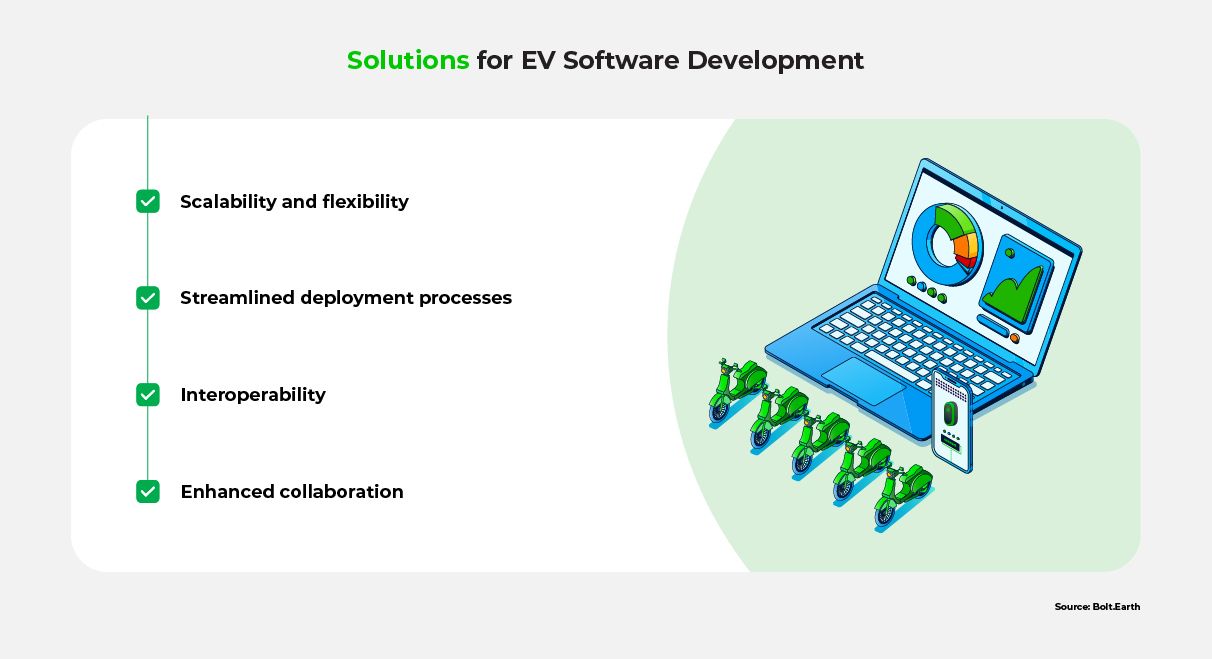
Cloud-Based Solutions for EV Software Development
EV cloud-based development uses cloud computing for design, manufacturing, testing, and operation, offering collaboration, scalability, flexibility, and cost savings. Cloud deployment dominates the automotive data monetization market, which is crucial for global automotive original equipment manufacturers (OEMs).
In this section, we’ll examine pivotal ways in which cloud-based solutions could improve automotive software going forward.
Interoperability
Centralized data management and sharing through cloud platforms streamline stakeholder communication, fostering a coordinated EV ecosystem. Cloud solutions facilitate seamless data sharing and real-time communication between charging providers, manufacturers, grid operators, and users, enhancing overall interoperability. Standardized communication protocols and APIs enable effective interaction between diverse EVs and charging stations, eliminating compatibility concerns and promoting widespread charging access. Additionally, cloud-based energy systems intelligently distribute energy demand across charging stations based on grid capacity and user preferences, preventing grid overloads and optimizing energy utilization for sustainable EV charging.
Scalability and Flexibility
Cloud-based software integration in EV software development facilitates immediate resource allocation for tasks like simulations and data analysis. Cloud tools and environments tailor EV software for real-time monitoring, maintenance, and optimization. Collaboration among dispersed developers is seamless, enhancing knowledge sharing and creativity. Cloud flexibility accelerates experimentation and refinement, expediting prototyping and performance evaluation for functions including adaptive cruise control and battery management.
Streamlined Deployment Processes
Cloud-based software can streamline the deployment processes in EVs. Here’s how cloud-based software can help:
- Remote monitoring and updates: Enables real-time EV component monitoring, diagnostics, and seamless remote software updates for fleets.
- Data analytics and predictive maintenance: Analyze EV data to predict maintenance needs, enhance performance, and prevent downtime, reducing costs.
- Simplified development and testing: Offers virtual environments for software development, testing, and validation, accelerating development cycles.
- Charging infrastructure management: Optimizes charging stations, enabling remote monitoring, energy tracking, and efficient charging control.
- Automatic updates and OTA: Handles routine maintenance and facilitates Over-the-Air updates for bug fixes, enhancements, and new EV features.
Enhanced Collaboration
Automotive manufacturers must embrace adaptable communication strategies and technologies to cater to diverse B2B approaches. Standardization initiatives and unified communication platforms aid in smoother interactions and information sharing among stakeholders with varied communication preferences.
Cloud platforms offer a centralized space for geographically dispersed teams to collaborate seamlessly. Developers can work on code, access shared resources, and synchronize tasks in real-time, bolstering efficiency and productivity.
Future Implications of Cloud-Based Automotive Software Development
For automotive software development to cater to ever-evolving consumer demands, computing must become more centralized. Cloud-native development, best known for cost reduction, time, and complexity, is increasingly relevant to automotive development.
Accelerated Software Development Cycles
In the context of automotive OEMs and tier-one suppliers, ensuring reliability and safety is vital. Therefore, many steps are required to develop software, including virtual testing, performance indicators, and quality management, accelerated by cloud computing.
Manufacturers use automated deployment and software lifecycle management tools when challenges arise from interdependent teams, causing delays and idle periods. This cloud computing automation technology makes it possible to expedite infrastructure setup, streamlines artifact sharing, and enhances collaboration, mitigating waiting times and improving software development efficiency.
Increased Collaboration and Knowledge Sharing
Software development in the automotive sector thrives on interdisciplinary collaboration, merging automotive engineering, electronics, software development, and energy systems. Cloud-based deployment boosts software quality, identifying and addressing issues early for reliable EV software.
For instance, cloud computing supports open platforms, exemplified by European companies partnering with Microsoft, fostering data-driven investments and B2B collaboration. The Data Act drives Europe’s digital aspirations, underpinned by progressive policies, tech access, and global connectivity, enhancing competitiveness in the global market.
Enhanced Industry Efficiency and Competitiveness
Cloud computing drives rapid transformation in the automotive sector, revolutionizing design, manufacturing, and customer experience. OEMs benefit from cost-effective data storage, swift tech access, and enhanced scalability, accelerating development, fostering innovation, and yielding distinct products.
Moreover, cloud technology empowers OEMs to connect global manufacturing plants, enhancing transparency, predictability, and sustainability across the digital production and value chain. Companies can swiftly address supply chain challenges, enhance quality control, optimize resource usage, and deploy best practices through advanced AI, data, and analytics tools.
As a pioneer in cloud computing software, Mercedes-Benz, working with Microsoft, aims to improve production efficiency by 20% by 2025 – a competitive advantage on the path to an all-electric future.
Advanced Technological Innovations
The world of cloud computing is constantly evolving, and the latest trends are shaping the future of this exciting field:
- Multi-cloud and hybrid cloud solutions: Empower businesses to embrace diverse services for optimal results. Advantages include increased flexibility, improved disaster recovery options, and avoiding vendor lock-in.
- Edge computing and Internet of Things (IoT): Allows swift data processing near the source and connected devices for data exchange, creating transformative potential across industries, fostering real-time decision-making, and elevating outcomes.
- Artificial intelligence and machine learning in the cloud: Enable efficient data management, informed decision-making, and personalized customer interactions. Their integration promises increased automation, data security, and individualized experiences, revolutionizing the cloud computing landscape.
- Serverless technology: Equips businesses to embrace cost-effective, scalable solutions without dedicated servers. It offers versatility, eradicating costs, and enables automatic scalability based on demand, reshaping cloud computing’s landscape.
Embracing the Future of Cloud-Based Development Environments
Cloud computing revolutionizes the automotive industry with collaborative, sustainable, and safe advancements. Using remote servers, it replaces local devices to enhance vehicle connectivity, infotainment, and safety. Cloud-based development addresses challenges, including compatibility issues, hardware limitations, and collaboration difficulties, driving efficient interdisciplinary collaboration. These advancements accelerate software cycles, boost collaboration, and enhance industry competitiveness. Trends such as multi-cloud solutions, edge computing, AI, machine learning integration, and serverless computing shape the cloud landscape, propelling the automotive sector toward innovation.

Frequently Asked Questions
What are cloud-based development environments, and how do they benefit automotive software development?
Cloud-based development environments enhance automotive software design, testing, and operation using remote servers. They promote collaboration, scalability, flexibility, and cost-efficiency, accelerating development and innovation.
What impact does utilizing cloud infrastructure have on efficiency in automotive software development?
Utilizing cloud infrastructure in automotive software development improves efficiency by offering cost-effective data storage, swift tech access, and enhanced scalability. Cloud integration accelerates development cycles, fosters innovation, and yields distinct products and services. Overall, the cloud infrastructure will have a positive influence on realizing smart digital solutions for the EV sector.
How do cloud-based development environments streamline software deployment in the automotive industry?
Cloud-based development environments simplify software deployment by enabling remote monitoring, diagnostics, and updates for EV components. They optimize charging infrastructure, manage energy demand, and facilitate automatic OTA updates, ensuring efficient and reliable EV operation.