Author: Raghav Bharadwaj

  • Delhi’s EV Policy 2026: Incentives, Infrastructure and Impact 

    Delhi’s EV Policy 2026: Incentives, Infrastructure and Impact 

    Overview of the Policy (Scope, Targets, Timeframe)

    Delhi EV policy 2026, originally notified in 2020, has been extended through March 2026-2030. The government aims to position Delhi as a leader in electric mobility. The 2020 policy set ambitious goals, such as EVs accounting for 25% of all new vehicle registrations by 2024. While timelines shifted, the extension continues the original incentives and targets. In July 2025,  officials confirmed the extension until March 31, 2026, reaffirming  Delhi’s commitment to electrification and even setting long-term stretch goals of 100% EV adoption (over a few years) in select vehicle segments.  


    TL;DR

    Delhi EV Policy 2026 Quick View

    • Scrappage: Up to ₹1 lakh incentive for scrapping old BS-IV or older cars.
    • New Mandate: Delhi released draft EV policy with new strong incentives and a registration ban on petrol two-wheelers starting April 1, 2028.
    • Subsidies: Phased tapering incentives for 2Ws (up to ₹30,000) and 3Ws (up to ₹50,000) in Year 1.
    • Tax Waivers: 100% road tax and registration fee waiver for EVs; 50% for strong hybrids (under ₹30 lakh).

    Incentives and Mandates by Vehicle Type

    Delhi’s EV Policy 2026-2030 offers phased incentives and clear mandates across vehicle types.

    Vehicle CategoryPurchase Subsidy
    (Year 1)
    Scrappage IncentiveKey Mandate
    Electric 2W₹10,000 per kWh
    (Max ₹30k)
    ₹10,000No petrol 2W registrations from April 1, 2028
    Electric 3W₹50,000 (Fixed)₹25,000Only electric 3W registrations from Jan 1, 2027
    Electric 4WTax & Reg. Fee Waiver₹1,00,000 (First 1L buyers)Government fleet 100% EV by end of 2026
    Strong Hybrids50% Tax/Reg. Fee WaiverN/ATransition tech for vehicles under ₹30 lakh

    1. Electric Two-Wheelers

    For electric two-wheelers, incentives apply to models priced up to 2.25 lakh (linked to battery capacity and will reduce over three years. Subsidies start at ₹10,000/kWh (year 1, capped at ₹30,000), tapering to 6,600/kWh (Year 2, capped at 20,000) and 3,300/kWh (Year 3, capped at 10,000).

    scrappage incentive is proposed at ₹10,000 for turning in an old petrol or CNG scooter to buy an EV. The policy mandates that no new petrol two-wheelers be registered from April 1, 2028. 

    2. Electric Three-Wheelers

    For electric three-wheelers (auto-rickshaws), the incentives are now phased at ₹50,000 in Year 1,  40,000 in Year 2, and 30,000 in Year 3.

    ₹25,000 scrappage incentive is proposed for old CNG autos. The policy mandates that only electric three-wheelers are allowed for new registrations from January 1, 2027

    3. Electric Goods Vehicles

    For N1 category electric goods vehicles up to 3.5 tonnes, the policy incentives are ₹1 lakh in year 1, ₹75,000 in year 2, and ₹50,000 in year 3. A scrappage incentive of ₹50,000 is proposed for e-goods vehicles. 

    4. Electric Four-Wheelers 

    According to the policy, all electric four-wheelers priced up to 30 lakh can enjoy 100% waiver of road tax and registration fees until March 31, 2030. A scrappage incentive of ₹1 lakh is proposed for scrapping BS-IV or older car (limited to the first 1 lakh buyers). Strong hybrid cars priced up to ₹30 lakh will get 50% reduction in road tax and registration fees, but no scrappage incentives.  

    Support for Charging Infrastructure 

    Delhi government aims to build a dense accessible charging network

    Delhi’s policy prioritizes charging accessibility, aiming for a public charging facility within 3 km of any location. The EV Charging Infrastructure in Delhi has grown rapidly, with the EV Charging Infrastructure Action Plan (2022–25) committed to tens of thousands of chargers.

    For example, one report noted  Delhi already has approximately 2,452 public charging points and 234 battery-swap stations. By early 2026, the network had expanded to 9,000 public charging stations, with a target of 30,000 in the coming years.

    To facilitate rollout, Delhi offers subsidies and amenities for charger installation, including concessional land in public parking for private charging operators, and explicitly subsidizes charger installation costs. 

    Battery-swapping stations receive additional support, including 100% reimbursement of state GST on advanced batteries. Regulations mandate EV-ready infrastructure in new buildings, requiring 20% of parking spaces to be equipped with power conduits for chargers. The government is also working to lower electricity tariffs for EV charging, ensuring affordability and widespread adoption.

    Private & Home Charging

    While public infrastructure is expanding, most users prioritize the convenience of home setups. One of the most common questions from new buyers is: can you charge an electric car at home with normal plug?

    Well, yes, you can charge most EVs using a standard 15A (Ampere) socket. However, this is “Level 1” charging and is significantly slower than a dedicated setup.

    For faster and safer “Level 2” charging, it is recommended to install a dedicated wallbox charger. Under the current policy, no special government approval is needed for private residential chargers, and DISCOMs in Delhi offer simplified “EV-only” connections with subsidized tariffs.

    To navigate the city’s charging points, apps like Statiq, EV Connect, and Bolt.Earth are considered the gold standard for real-time availability and payment integration in 2026.

    Mandates & Public Fleets Electrification 

    Delhi has used mandates and fleet procurement to drive EV demand. The policy directs the city to take the lead by greening its own fleet. All leased or hired government cars are to be converted to EVs within 12 months of the policy’s issue. The city has aggressively expanded its e-bus fleet, operating 3,535 electric buses out of 5,335 total by early 2026. Under the PM E-Drive program, Delhi is procuring 2,800 e-buses in Phase-1 (bringing the fleet to ~10,430) and has requested another 3,330 e-buses in Phase-2. The target is to reach 7,500 electric buses by the end of 2026 and 11,000 by 2028. From January 1, 2026, no new ICE vehicles will be allowed in aggregator-based operations, and existing BS-VI two-wheelers can operate only until December 31, 2026.

    Delhi’s public transport electrification is illustrated by the image below (a NUEGO electric bus that recently entered service). These e-buses, covering major routes and last-mile feeders, not only cut pollution but also set up a model for other cities. Similarly, Delhi’s auto-rickshaw sector is targeted: the government planned to phase out all CNG auto-rickshaws by 2025 in favor of e-autos (though that was deferred in the latest policy draft). Delivery and ride-hailing platforms are being urged to switch to e-2Ws and cabs, leveraging Delhi’s incentives to accelerate the transition. The overall aim is clear: public fleets, city vehicles, and even paratransit services must lead the EV transition, multiplying the impact of subsidies and demonstrating new technology on the roads. 

    Policy Impact: EV Registrations, Sales and Charging Growth 

    Delhi has emerged as one of India’s top EV markets. A government data summary for 2025 showed the city with an EV-to-ICE ratio of approximately 14%, meaning roughly 1 in 7 new vehicles registered were electric, compared to the national average of 8%. One analysis found Delhi’s EV share second only to Kerala’s in recent quarters. Since 2020, Delhi has registered over 86,000  EVs, with strong uptake in two-wheelers and three-wheelers and growing adoption of electric cars. Charging infrastructure has expanded rapidly, from a few hundred points in 2020 to approximately 9,000 by 2026. Fast-charging hubs are being set up at transit centers, parking lots, and metro stations, reducing range anxiety and supporting adoption.  
     
    In sum, the policy’s impact data suggest Delhi is outperforming older state goals: it already meets or exceeds interim targets (e.g., 10% EV share in sales, as Transport Minister Gahlot noted on the action plan launch) and is on track to meet the policy’s major aims. 

    Implementation and Governance 

    To implement the EV policy, the Transport Department of Delhi is the nodal agency. The policy mandates the creation of a dedicated EV Cell within Transport Delhi, staffed with technical experts to coordinate implementation. A State Electric Vehicle Board oversees the strategy and reviews progress. Funding comes from several sources: the city has ring-fenced its Air Ambience Fund (pollution fines and related revenues) to subsidize EVs.  
     
    New pollution-related charges (e.g., additional road tax on high-emission vehicles, congestion fees on cabs) were explicitly earmarked to refill the EV fund. Furthermore, all central FAME subsidies (for eligible vehicles) are redirected through Delhi’s scheme, and pending grants from the earlier Air Ambience Fund are being cleared by the transport department. Practically, subsidy payments have been a challenge: previous governments had accrued backlogs of incentive claims, which current authorities have promised to clear. 

    For outreach and oversight, Delhi’s EV policy calls for public awareness campaigns and periodic policy reviews. The government tracks key metrics such as EV registrations, charger installations, pollution levels, and adjusts rules accordingly. By late 2025, a high-level committee including officials and experts was finalizing the next EV policy draft based on these results. Notably, Delhi has begun preparing policy “2.0” for implementation from FY2027 onward, reflecting lessons learned. For example, strengthening subsidy disbursal, incorporating a scrappage scheme, and even opening an “open database” of charging points. 

    Challenges & Policy Adaptations 

    Despite a strong vision, Delhi’s EV push has faced hurdles. One persistent issue was implementation delays: many buyers complained that promised subsidies took months to arrive, causing confusion and frustration. The new government pledged to streamline this by issuing “purchase stickers” for vetted buyers and automating claims. Infrastructure siting also posed challenges (hence the concessional location policy), as land in Delhi is scarce.  
     
    Safety and regulatory clarity have been emerging issues: for example, Delhi’s plan to incentivize retrofitting old cars (at ₹50,000 per conversion) sparked industry debate in 2026, with automakers citing safety concerns. Policymakers note that while retrofits could help remove old polluting vehicles, the approach needs stricter standards to address those concerns. 

    Air quality requirements have also pressured timelines. Delhi’s Supreme Court-mandated bans on older vehicles (petrol >15 years, diesel >10 years) mean many owners will either scrap or convert their ICE cars. The EV policy now dovetails with these rules: for instance, scrappage incentives were introduced so that owners of banned vehicles get a bonus to switch to EVs. To address e-waste and battery recycling, Delhi has started drafting rules (and even offering battery swapping trials). Each year’s budget or policy tweak has added new elements —e.g., doubling swap station incentives and adding interest subvention for loans. These adaptations show Delhi continuously refining its framework based on feedback from industry and civil society.  

    Sodium-ion batteries are a viable alternative to lithium-ion batteries

    As Delhi scales its EV fleet, the industry is pivoting toward more stable chemistries. Sodium-ion batteries are a viable alternative to lithium-ion batteries in the Indian context for several reasons:

    1. Thermal Stability: Sodium-ion cells handle Delhi’s hot summers better, significantly reducing “thermal runaway” or fire risks.
    2. Cost-Efficiency: Sodium is derived from abundant sea salt, potentially reducing battery costs compared to lithium-ion.
    3. Sustainability: It reduces India’s reliance on imported lithium and cobalt.

    Delhi in Context: National Goals and Lessons for Others 

    Delhi’s EV penetration (14% in 2025) is among the highest nationwide, reflecting both strong policy incentives and people’s willingness to adopt new tech. The city also ranks second in public charging infrastructure after Maharashtra. Its aggressive charger-to-EV ratio target of 1:15 surpasses many state norms. Politically, Delhi’s leaders have extended and expanded the policy, signaling consensus on EVs as a solution to Delhi’s notorious air pollution. 

    However, Delhi’s fiscal constraints and land scarcity differ from those of larger states. Some states like Maharashtra and  Karnataka have more generous budgets and industrial bases, and their targets can be even more ambitious (e.g., Maharashtra’s goal of 10% EV share in new sales by 2025 and Karnataka’s plan to electrify 100% of small cargo vehicles by 2030). Nationally, the EV mission also involves central incentives (FAME, tax breaks) that Delhi complements with its own schemes.  
     
    Other cities can learn from Delhi’s integrated approach: combining purchase subsidies, charging network planning plus fleet mandates creates synergies. For instance, Delhi’s experience shows how important it is to waive road taxes and to involve local electricity regulators in tariff design. The capital’s efforts at single-window approvals and public data dashboards could be models for other cities. This makes Delhi a case study in EV Policy and Infrastructure in India, offering lessons for states with different fiscal and industrial contexts.

    Final Thoughts 

    Delhi EV policy 2026 is a comprehensive program anchored on clear targets and generous incentives. It has driven measurable growth in EV adoption and infrastructure in the last two years, and the government has demonstrated political will to refine the policy further. While challenges remain, from execution bottlenecks to new tech issues like retrofitting, Delhi’s strategy offers valuable lessons. It shows that even a dense, high-pollution city can accelerate EV uptake through decisive policy, and that continual adaptation (as seen in Delhi’s upcoming “EV Policy 2.0”) is key to staying on track. Other states and cities seeking to ramp up EVs can study Delhi EV policy infrastructure, its public charging push, and its proactive fleet electrification, while also being mindful of Delhi’s unique context (cost of living, congestion, etc.) when replicating its approach.

    Key Takeaways

    • Act Fast: Subsidies for two-wheelers are at their highest in Year 1 and will decrease annually.
    • Check Eligibility: Subsidies are generally capped at vehicles priced under ₹2.25 lakh for 2Ws and ₹30 lakh for 4Ws.
    • Hybrid Advantage: If you aren’t ready for a full EV, strong hybrids now enjoy a 50% tax waiver in Delhi.

    Blog Banner

    Frequently Asked Questions

    Which vehicle segments benefit most from Delhi’s EV incentives?

    Two-wheelers and three-wheelers benefit the most. High per-kWh subsidies, scrappage incentives, interest support, and permit flexibility make EVs significantly cheaper than ICE alternatives in these segments. Commercial fleets and last-mile delivery vehicles are also heavily targeted.

    Are EV buyers in Delhi exempt from road tax and registration fees?

    Yes. All EVs registered in Delhi receive a 100% waiver on road tax and registration fees, regardless of vehicle category. This remains one of the most impactful non-cash incentives in the policy. 

    Has Delhi’s EV policy actually increased EV adoption? 

    Yes. Delhi has one of the highest EV penetration rates in India, with EVs accounting for roughly 14% of new vehicle registrations in 2025, well above the national average. Charging infrastructure has expanded from a few hundred points in 2020 to thousands today. 

    Is it mandatory for new apartments in Delhi to have EV chargers?

    Yes. Current building bylaws require 20% of all parking spaces in new residential and commercial complexes to be “EV-ready” with power conduits and wiring already in place.

    How do I apply for the ₹1 lakh car scrappage incentive?

    To claim the ₹1 lakh bonus, you must scrap a Delhi-registered BS-IV or older car at an authorized facility. You will receive a Certificate of Deposit (CoD), which must be presented at the time of purchasing a new EV (priced under ₹30 lakh) within 6 months.

  • How to Save Money on EV Charging: Complete Guide

    How to Save Money on EV Charging: Complete Guide

    Electric vehicles have moved from early-adopter novelty to mainstream mobility in India. With more than 2.2 million EVs registered nationwide by late 2025 and nearly 30 percent of new two- and three-wheelers electrified, EV ownership is becoming a standard part of India’s transportation landscape. Yet one concern persists among existing and prospective EV users: the cost of charging. 

    Many drivers assume that charging an EV is expensive, often referencing a public EV charging station in malls or on highways.  In reality, smart charging habits can dramatically reduce monthly expenses.

    Table showing monthly and annual drive for EV range 200km  per charge

    Below are strategies EV owners in India can use to save money on EV charging, whether in metros, tier-two cities, or semi-urban clusters. 

    1. Home Charging: The Most Affordable  Option

    Residential electricity tariffs in India typically range between Rs 6 and Rs 10 per kWh, compared to Rs 14 and Rs 18 at public Level 2 chargers and Rs 22 to Rs 33 at DC fast chargers, depending on demand, location, and taxes. 

    While fast charging is essential on intercity highways or long trips, relying solely on public charging can more than double energy costs. This is partly due to the substantial capital that charging point operators must invest in grid upgrades, transformers, installation, land leasing, maintenance teams, and service software that supports uptime and billing. These operational and capital expenses contribute to higher usage prices. 

    In contrast, residential EV charging spreads the cost over standard grid rates and often occurs during off-peak hours.  Industry reports show EV owners who primarily charge at home spend between Rs 700 and Rs 1,500 monthly on electricity, compared to Rs 6,000 to Rs 9,000 on fuel for petrol cars.  A home EV charger is the foundation of affordable EV ownership.  

    2. Use Time-of-Day Tariffs

    DISCOMs in states like Maharashtra, Karnataka, Delhi, and Tamil Nadu offer discounted nighttime tariffs that reduce the per-unit rate for EV charging significantly. 

    Off-peak charging can reduce costs by 30 to 60 percent. For example, in Mumbai, overnight EV tariffs range from Rs 5.50 to Rs 7.50 per kWh, compared to daytime rates above Rs 12. 

    Smart chargers allow scheduled charging during low-tariff hours, saving Rs 12,000 to Rs 18,000 annually.  This is where smart EV charging becomes valuable.

    3. Install a Level 2 Home Charger  

    Level 2 chargers (7 to 11 kW) can fully charge most EVs overnight. 

    The upfront cost of a home EV charger ranges between Rs 35,000 and Rs 1.2 lakh, depending on charger capacity, installation needs, and smart features. Many urban households may require electrical upgrades, such as a higher-capacity distribution board or additional safety gear, which may add Rs 10,000 to Rs 40,000 to installation costs. 

    Despite the upfront expense, savings quickly add up.  For example, charging a Tata Nexon EV at home costs around Rs 150 to Rs 180 per 100 km, compared to Rs 330 to Rs 500 on a public DC charger. Over a year of regular usage (10,000 to 12,000 km), savings often exceed installation costs. 

    India also offers rebates and tax incentives that offset charges for residential users and housing societies. Several DISCOMs, including BEST (Mumbai) and BESCOM (Bengaluru), offer subsidies and simplified approvals. 

    4. Workplace and Community Charging  

    Workplace charging is expanding across technology parks and commercial real estate developments. Many companies offer low-cost or free charging as an employee benefit. With an average commute of 15 to 50 km, this covers most daily needs. 

    Industry data shows that over 29 percent of EV drivers in major Indian cities use workplace charging at least once a week. Corporate sustainability initiatives and ESG frameworks are accelerating installations, supported by incentives under state EV policies. 

    Residential societies are also adding community chargers billed through maintenance fees at lower tariffs than a public EV charging station, ideal for users without private parking. 

    5. Subscription Plans and Membership Discounts 

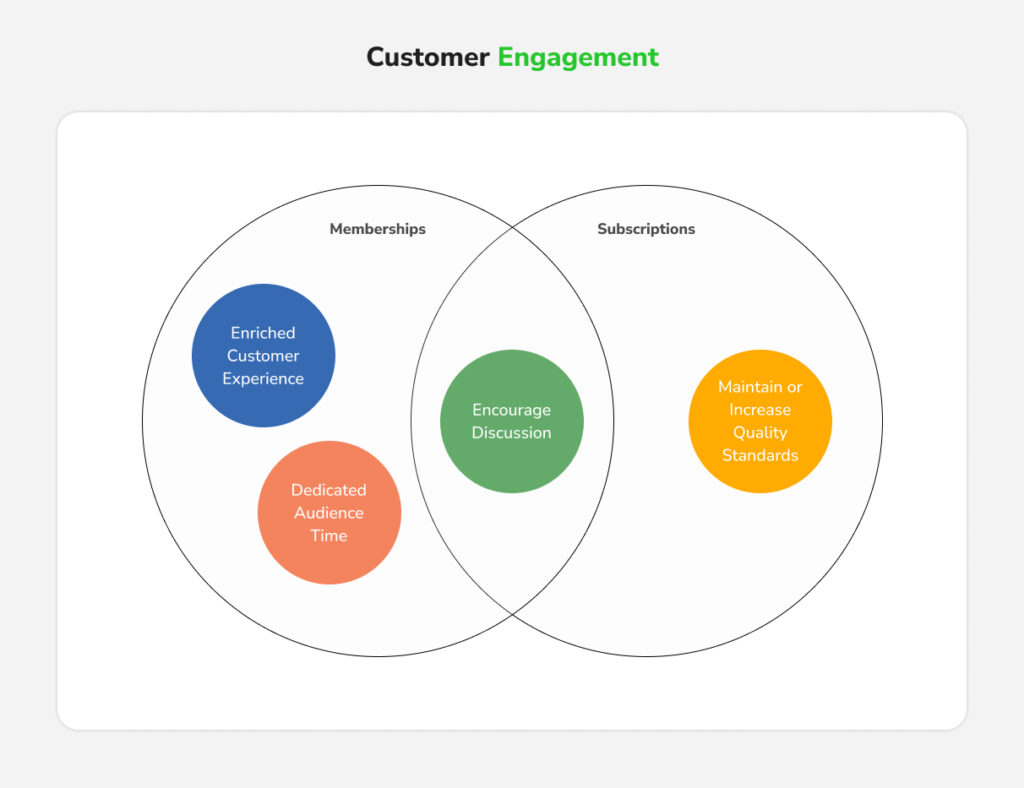
    Just as telecom users subscribe to data packs, EV drivers can reduce charging costs by using subscription-based charging networks. Charging networks now offer subscription packs and loyalty benefits, reducing costs by 10 to 30 percent. Some also provide discounted night-charging slots or credits for frequent users.  

    Aggregator platforms consolidate multiple networks, offering dynamic pricing and real-time demand-based discounts to optimize charging costs. 

    6. Pair EV Charging with Solar Power

    Graph showing installed renewable energy capacity.

    Rooftop solar is a powerful way to cut costs.  A typical 5 kW rooftop solar system, costing Rs 2.5 lakh to Rs 3.5 lakh after subsidies, can power most household needs plus daily EV charging. With battery storage, homeowners can charge an EV overnight using stored solar energy. 

    Solar and battery combinations generally deliver payback in 6 to 8 years, depending on usage and local tariff pricing, after which charging is nearly free. 

    7. Use Smart Charging and Load Management

    Modern chargers include features to optimize usage, avoid circuit overload, and automatically schedule charging to minimize cost.  In apartment complexes, smart EV charging distributes energy safely among multiple EVs without grid upgrades. 

    8. Take Advantage of Free and Destination Charging 

    Hotels, resorts, restaurants, co-working spaces, hospitals, and shopping malls increasingly offer free or subsidized charging. 

    Planning trips around such locations can save Rs 8,000 to Rs 15,000 annually.  

    However, stick to legitimate providers to avoid unreliable access points. 

    9. Practice Good Battery Habits 

    Battery care reduces charging frequency and long-term costs.  Experts recommend keeping the charge between 20 and 80 percent for daily usage, reserving full charges for trips.  Minimizing fast-charging cycles and preconditioning the vehicle before charging improves efficiency and extends battery life, lowering lifetime cost by 10 to 15 percent, according to energy analytics research. 

    10. Leverage Government Incentives  

    Central and state programs provide subsidies, tariff-based concessions, and simplified installation approvals for home and community chargers. 

    States like Maharashtra, Karnataka, Delhi, and Uttar Pradesh offer direct subsidies and reduced tariffs, significantly lowering upfront EV charging costs. 

    Final Thoughts 

    Saving money on EV charging is straightforward with the right strategy. For most Indian EV owners, home vs. public EV charging remains the key comparison; home charging is the most economical method, especially when combined with time-of-day tariffs and smart scheduling. Workplace and destination charging expand access, while memberships and solar power reduce long-term costs.  Battery care further improves efficiency. 

    For EV owners willing to adopt smart charging habits, saving money on EV charging is practical, measurable, and scalable. The shift to electric mobility is about financial empowerment and ownership efficiency. When powered wisely, EVs are cleaner and far more economical than petrol and diesel alternatives. 

  • How to Prep Your EV for Long Road Trips 

    How to Prep Your EV for Long Road Trips 

    Unlike a petrol car, you can’t rely on “we’ll find a pump on the way.” Range varies with speed, terrain, and weather; charging stations aren’t always where you expect them. But with the right strategy for EV road trip preparation you can save hours of waiting and eliminate unnecessary anxiety. 

    For instance, a 2,000 km road trip in an EV might sound ambitious, but thousands of Indian drivers are already doing it. Take Siddharth Agarwal‘s Mumbai-to-Delhi trip data from 2024, proof that long EV journeys are possible with the right planning.  

    TL;DR

    The 2026 EV Road Trip Checklist

    • Use the best app to find ev charging stations in india for real-time status.
    • Follow the 20–80% charging rule to minimize wait times at fast chargers.
    • Map chargers every 200–250 km.
    • Cruising at 90 km/h vs. 120 km/h can increase range by up to 30%.
    • Always carry a 16A extension cable and multiple charging apps.

    Understand Your Real-World Range

    Graph showing the effect of speed and temperature on EV range

    What is Range Anxiety?

    Range anxiety is the fear that an electric vehicle has insufficient energy storage to cover the distance needed to reach its destination, potentially leaving the driver stranded. Modern route planning and expanded charging networks in 2026 have significantly mitigated this.

    EV range depends on speed, terrain, climate, and load. Always leave a safety buffer; if your car’s official range is 300 km, plan legs of 250–280 km in worst-case conditions.  

    • Speed Impact: One driver extended a Nexon EV’s range from approximately 280 km at 120 km/h to 400 km by cruising at 90 km/h. Use community data (forums or apps) to adjust for your model’s true range. 
    • Conditions: High speeds, AC/heater use, and hilly terrain drain the battery much faster. For example, driving at 80 km/h may give a 200–220 km range, but at 120 km/h it can drop to approximately 160–280 km. 
    • Regenerative Braking: In mountainous regions, take advantage of downhill recharge. One Ladakh trip regained approximately 30% battery on 40% downhill stretches. Many EVs let you set high regen modes; smooth, gentle braking will recapture energy. 
    • Battery Preconditioning: When possible (if your EV supports it), preheat or cool the battery before fast charging to speed up charging in cold or hot weather. 

    What is Battery Preconditioning?

    Battery preconditioning is the process of heating or cooling the EV battery to its optimal operating temperature before charging or driving. This ensures maximum charging speeds and protects battery health in extreme Indian summers or Himalayan winters.

    Plan Your Route and Charging Stops 

    Map out every charging stop before you leave. Use EV charging apps and prioritize highways with fast chargers, and plan stops with amenities like restaurants or hotels—you can enjoy a meal while your EV charges.  

    • Identify fast-charger hubs: Choose stations with multiple DC fast chargers and recent positive reviews. Always have an alternate charger 10–15 km away and keep the battery at 20–25% when approaching a station. 
    • Apps & backup: Load all relevant charging apps and preload payments. To avoid surprises, check apps for charger status in real time, and note any backup chargers en route. 
    Using an all-in-one EV charging app can help smoothen your EV journey

    How to Plan a Road Trip with an Electric Car: A 2026 Checklist

    If you are wondering how to plan a road trip with an electric car in the current landscape, follow these four pillars of preparation:

    1. Don’t just see a charger on a map; check the “last used” timestamp in apps like Bolt.Earth, PlugShare or Tata Power EZ Charge.
    2. If traveling during monsoon or peak summer, subtract 10% from your estimated range to account for heavy AC usage or waterlogged roads.
    3. Use filters on booking platforms to find hotels with dedicated 15A/16A points or wallbox chargers.
    4. Download Google Maps for your entire route, as many highway stretches in India still have intermittent 5G/4G coverage.

    Prepare Your EV and Equipment 

    Before departing, give your EV a full check:  

    • Charge to approx. 90-100% for the first leg. 
    • Inspect tire pressures, coolant, and washer fluid.  
    • Remove unnecessary weight to improve efficiency. 
    • Carry all charging cables and adapters you might need (CCS2, Bharat AC, Type 2). Infrastructure can be fragmented, so adapters are essential. Some resorts only have 16A plugs; extension cords or grounding rod kits can help. 
    • Download offline maps for areas with poor coverage. Carry a portable charger for your phone and e-connector to work throughout the journey. 

    Drive Efficiently

    On the road, your driving style greatly affects range.  

    • Maintain steady, moderate speeds to reduce wind drag; high speeds burn battery much faster.  
    • Use cruise control where possible and avoid rapid acceleration or hard braking. Use regenerative braking settings to reclaim energy on descents. 
    • Limit climate control use: Pre-cool or pre-heat while plugged in, use seat heaters in winter, and minimize AC in summer. 
    • Activate “eco” or “range” modes, extend efficiency. 

    Charging Strategy on the Trip

    Find the right charger for your EV

    Treat charging stops as planned breaks. Fast chargers replenish quickly up to approx. 80%, after which charging slows.  

    • Follow the 20–80% rule: Instead of charging 100% each time, pull in around approx. 20% and charge up to 80% for the fastest turnaround. One EV team completed seven charges (15–30 min each) over a 2000 km trip, totaling approximately 18 hours of charging
    • Combine stops with meals/rest: Combine charging with breaks. Book EV-friendly hotels that provide chargers and confirm availability in advance. 
    • Backup outlets: Standard 16A sockets at motels or dhabas can work (at slower speeds). Carry adapters or extension cords for emergencies. 

    Comparison: AC vs. DC Fast Charging on Highways

    FeatureAC Charging (Slow)DC Fast Charging
    Common LocationHotels, Homestays, CafesHighway Hubs, Petrol Pumps
    Speed (Typical)3.3kW – 7.2kW25kW – 60kW+
    0-80% Time6–10 Hours45–90 Minutes
    Best Use CaseOvernight chargingQuick “Splash & Dash” breaks

    Final Thoughts 

    Expect the unexpected and stay flexible. Know that chargers can sometimes be offline or crowded, so always have a plan B—check for alternate stations near each stop. Keep the battery at ≥20% en route to avoid being stranded.  

    Despite the extra planning, EV road trip planning in India is rewarding: quiet drives, lower costs, and predictable breaks. For example, a 2,000 km Delhi–Ladakh EV trip costs only approximately ₹3,000 in electricity—far cheaper than petrol. Some Indian highways even waive tolls for EVs. 

    With a smart EV charging strategy, efficient driving, and backup options, your next EV trip is absolutely doable. With the growing EV charging network and highway EV charging stations in India, having access to a reliable EV charger for highway can make long journeys more practical for Indian EV owners.

    Frequently Asked Questions

    Is it safe to take an EV on a 1,000+ km road trip in India?

    Yes.

    With the 2026 expansion of charging corridors on major NH highways, long-distance EV travel is now routine. Success depends on planning stops every 200–250 km.

    Which apps are best for EV route planning in India?

    Popular choices in 2026 include Bolt.Earth, Pulse Energy, Tata Power EZ Charge, Zeon Charging, and community-led apps like PlugShare for real-time station reviews.

    How much does a long EV road trip cost?

    On average, a 2,000 km trip costs between ₹3,000 and ₹4,500 depending on the mix of home charging and commercial DC fast charging rates.

    What happens if I run out of charge on the highway?

    Most EV manufacturers and insurance providers offer RSA (Roadside Assistance) that includes towing to the nearest fast charger. Always keep your battery above 20% to avoid this.

    Does AC usage significantly reduce EV range?

    In Indian summers, constant AC usage can reduce range by 5–10%. It is more efficient to pre-cool the car while it is still plugged into a charger.

  • Top EV Launches in India: Cars, Scooters and 3-Wheelers [+Bolt.Earth Charger Compatibility]

    Top EV Launches in India: Cars, Scooters and 3-Wheelers [+Bolt.Earth Charger Compatibility]

    Society of Indian Auto Manufacturers (SIAM) data shows battery EV car sales jumped from approximately 23,000 in 2024 to over 100,000 in Jan–Oct 2025. Tata Motors led with approx. 40% market share in Oct’25 (followed by MG and Mahindra). State bus tenders and subsidies spurred electric buses (1,571 e-buses registered in Jan–May 2025), while fleets deployed thousands of electric scooters and 3-wheelers in India.  

    Major recent launches include Hyundai’s Creta EV, Tata’s Harrier EV, MG’s Windsor EV, BYD’s Sealion 7, VinFast’s made-in-India SUVs, Yamaha’s first e-scooters, and new electric 3-wheelers.  

    Below we spotlight these game-changing models by category, with specs, EV charging compatibility, sales/booking figures, and industry insights. 

    4-Wheeler EVs that changed the game  

    Mahindra’s XUV.e9S 

    • Launch: Nov 27, 2025 
    • Type: 7-seater electric SUV (India’s first mass-market 7-seater EV) 
    • Starting Price: ₹19.95 – 29.45 Lakh (ex-showroom, Mumbai)  
    • Range: ~ 500 km 
    • Variants: Six (2WD / RWD), with the top AWD variant delivering ~ 330 PS 
    • Bookings: Opened mid-Jan 2026  

    Charging: 

    • AC: Type-2 (7.2 or 11 kW home charging) 
    • Architecture: 800V platform with V2L / V2V capability 
    • Connectivity: Mahindra’s iKORE web/app ecosystem 

    Bolt.Earth Charger Compatibility: Fully compatible with Bolt.Earth Lite 3.3 kW AC charging socket, Pro 3.3 kW AC charging socket, LEVAC 3.3 kW AC charging socket, Blaze AC fast chargers (7.4 kW to 22 kW), and Lightning DC fast chargers (30 kW to 240 kW)

    Market Positioning : Mahindra sold 30,000+ EV SUVs (Mar–Oct 2025), and CEO Veejay Nakra notes that approx. 80% of XUV.e9S buyers are new to the brand, signaling strong mainstream interest. 

    Hyundai Creta Electric

    Hyundai Creta Electric specs and charger compatibility
    • Launch: Jan 18, 2025  
    • Type: Compact SUV 
      Starting Price: ₹17.99 Lakhs 
    • Range: 390 km to 473 km  

    Variants:  

    • Standard – 42.0 kWh battery, 135 PS  
    • Long-Range – 51.4 kWh battery, 171 PS 
      (On India WLTP (Worldwide Harmonized Light Vehicles Test Procedure) equivalents: approx. 420 km & approx. 510 km) 

    Charging:  

    • AC: 11 kW Type-2 
    • Smart features include scheduled charging and battery conditioning via Hyundai Bluelink

    Bolt.Earth Charger Compatibility: Fully compatible with Bolt.Earth Lite 3.3 kW AC charging socket, Pro 3.3 kW AC charging socket, LEVAC 3.3 kW AC charging socket, Blaze AC fast chargers (7.4 kW to 22 kW), and Lightning DC fast chargers (30 kW to 240 kW)

    Market Positioning: Analysts place the Creta EV head-to-head with the Tata Curvv EV and MG ZS EV in the mainstream compact-electric SUV segment. Bookings began in early 2025, and year-end sales were strong amid rising EV demand. 

    Tata Harrier EV 

    • Launch: June 3, 2025 
    • Type: 5-seater premium electric SUV (based on the ICE Harrier) 
    • Starting Price: ₹21.49 Lakh (ex-showroom) 
    • Range: 538 km – 627 km 
    • Battery: 65 kWh & 75 kWh battery options 

    Charging: 

    • DC: CCS2 up to 120 kW (20–80% in approx. 25 mins) 
    • AC: 7.2 kW (full charge in 10–11 hours

    Features: 

    • 14.5” touchscreen infotainment 
    • 360° camera 
    • 5-star ANCAP safety rating 
    • Level-2 ADAS driver-assist suite 

    Powertrain & Performance: 

    • Flagship dual-motor AWD setup 
    • Combined output: approx. 313 PS (230 kW) 
    • Torque: 504 Nm 

    Bolt.Earth Charger Compatibility: Fully compatible with Bolt.Earth Lite 3.3 kW AC charging socket, Pro 3.3 kW AC charging socket, LEVAC 3.3 kW AC charging socket, Blaze AC fast chargers (7.4 kW to 22 kW), and Lightning DC fast chargers (30 kW to 240 kW)

    Market Positioning: This is Tata’s 6th EV and its most premium electric SUV yet, aimed directly at upper-segment buyers. Bookings opened in July 2025, with strong demand expected. 

    MG Windsor EV 

    • Launch: May 6, 2025 
    • Type: Compact electric crossover (successor to the Hector EV) 
    • Starting Price: ₹14.00 – 18.39 Lakh (ex-showroom, Mumbai) 

    Powertrain & Range: 

    • Motor: 136 PS (100 kW), 200 Nm torque 
    • Battery options: 
    • 38 kWh332 km claimed range 
    • 52.9 kWh449 km claimed range 

    Charging: 

    • AC: 7.4 kW (full charge in approx. 9.5 hours) 
    • Supports Vehicle-to-Load (V2L) for powering external devices. 

    Features & Tech: 

    • MG iSMART connected car suite 
    • OTA updates 
    • Optional Battery-as-a-Service (BaaS) model, bringing effective running cost to approx. ₹3.5/km, a standout in the segment. 

    Bolt.Earth Charger Compatibility: Fully compatible with Bolt.Earth Lite 3.3 kW AC charging socket, Pro 3.3 kW AC charging socket, LEVAC 3.3 kW AC charging socket, Blaze AC fast chargers (7.4 kW to 22 kW), and Lightning DC fast chargers (30 kW to 240 kW)

    Market Positioning: A major breakout success, by Nov 2025, MG announced 50,000+ Windsor EV sales in just 400 days, making it the fastest EV in India to hit that milestone. 

    BYD Sealion 7 

    Battery & Range:

    • 82.56 kWh LiFePO₄ battery 
    • Single-motor RWD: up to 567 km 

    Performance: 

    • Single-motor: 313 PS / 380 Nm 
    • Dual-motor: 530 PS / 690 Nm 
    • Positioned to rival Tesla Model Y and the high-end MG ZS EV

    Charging: 

    • AC: Type-2, 11 kW 
    • DC: GB/T 80 kW fast charging (20–80% in approx. 45 minutes) 

    Bolt.Earth Charger Compatibility: Fully compatible with Bolt.Earth Lite 3.3 kW AC charging socket, Pro 3.3 kW AC charging socket, LEVAC 3.3 kW AC charging socket, Blaze AC fast chargers (7.4 kW to 22 kW), and Lightning DC fast chargers (30 kW to 240 kW)

    Market Positioning: A flagship BYD SUV aimed at the luxury EV segment, intensifying competition with global and premium entrants. A large battery, long range, and high performance make it a strong contender for high-end family EV buyers. 

    MG Cyberster 

    • Launch: July 25, 2025 
    • Type: 2-door high-performance electric roadster 
    • Starting Price: ₹75 lakh (ex-showroom, Mumbai) 

    Battery & Range: 

    • 77 kWh battery 

    Performance: 

    • Dual-motor AWD 
    • 510 PS, 725 Nm 
    • Top speed: 250+ km/h 

    Features: 

    • Scissor doors 
    • 4-screen digital cockpit 
    • Bose premium audio 
    • Head-up display 

    Charging: 

    • Expected AC Type-2 support 
    • Expected CCS2 DC fast charging, likely up to 150 kW 

    Bolt.Earth Charger Compatibility: Fully compatible with Bolt.Earth Lite 3.3 kW AC charging socket, Pro 3.3 kW AC charging socket, LEVAC 3.3 kW AC charging socket, Blaze AC fast chargers (7.4 kW to 22 kW), and Lightning DC fast chargers (30 kW to 240 kW)

    Market Positioning:  Analysts call the Cyberster a halo product that boosts MG’s tech brand image in India. It’s one of India’s most powerful and design-forward EVs. 

    VinFast VF6 and VinFast VF7 

    • Launch: September 6, 2025
    • Type: VF6: Compact 2-row electric SUV; VF7: Larger 3-row electric SUV 

    VinFast VF6 (Key specs)

    VinFast VF6 specs and charger compatibility
    • Battery: 59.6 kWh 
    • Range: ~ 410 km 
    • Powertrains: 
    • FWD: 130 kW / 250 Nm 
    • AWD: 150 kW / 310 Nm 
    • Interior & Tech: 13” display, ADAS suite, premium cabin design 

    VinFast VF7 (Key specs)

    Battery options: 59.6 kWh or 75.3 kWh 

    • Range: Up to 450 km 
    • Powertrains: 
    • FWD or 
    • AWD (dual motor): 260 kW output 
    • Features: High-end interiors, 13” touchscreen, ADAS, modern premium design 

    Charging 

    • DC Fast Charging: 120–150 kW (10–70% in ~25–30 minutes) 
    • AC Charging: 7 kW 
    • Dealer arrivals are expected in late 2025, with strong bookings and fleet interest. 

    Bolt.Earth Charger Compatibility: Fully compatible with Bolt.Earth Lite 3.3 kW AC charging socket, Pro 3.3 kW AC charging socket, LEVAC 3.3 kW AC charging socket, Blaze AC fast chargers (7.4 kW to 22 kW), and Lightning DC fast chargers (30 kW to 240 kW).  

    Market Positioning: VinFast VF6 and VF7 are the first made-in-India models. Additionally, VinFast previewed its upcoming VF8, VF3, and VF e34, signaling a full-scale EV portfolio for India.

    Each model supports Bolt.Earth chargers, ensuring seamless EV charging compatibility across home and public setups.

    These vehicles highlight how the EV charging network in India is maturing, with fast-charging corridors and home charging solutions making adoption easier. Having a reliable electric car charger in India ensures seamless EV charging, reduces range anxiety, and builds greater trust among EV owners. As EV charging stations in India expand, having a charging point closer is a key decision-making factor for many EV buyers.

    Top Two- and Three-Wheeler EV Launches 

    Yamaha AEROX E (Electric) 

    • Launch: Unveiled November 2025; Expected launch: Early 2026 
    • Type: Premium electric performance scooter (Yamaha’s first made-in-India electric two-wheeler) 
    • Expected price: To be announced; positioned in the premium e-scooter category 

    Battery & Range: 

    • Expected real-world range: approx. 100+ km 
    • Power delivery estimate: approx. 10 kW (industry expectation; official spec pending) 

    Performance: 

    • Sporty ride dynamics inspired by the petrol AEROX 
    • Yamaha’s signature aggressive styling and aerodynamic design 

    Charging: 

    • AC charging port 
    • Onboard charger: 7–8 kW 
    • Standard: AC Type-2 

    Bolt.Earth Charger Compatibility: Fully compatible with Bolt.Earth Lite 3.3 kW AC charging socket, Pro 3.3 kW AC charging socket, and LEVAC 3.3 kW AC charging socket. 

    Features & Market Positioning: AEROX E marks Yamaha’s serious entry into India’s EV 2W market, placing it directly in the premium performance scooter segment alongside TVS, Ather, and Bajaj. Analysts view this as a significant move by a major Japanese company, elevating competition in high-quality electric scooters. 

    Yamaha EC-06 

    • Launch: Unveiled November 2025; Expected launch: Early 2026 
    • Type: Affordable electric scooter developed by Yamaha and River Mobility (Karnataka) 
    • Expected price: To be announced; positioned in the urban commuter and mid-entry EV segment 

    Battery & Range: 

    • Expected real-world range: ~80 km 
    • Designed for short-to-medium daily city commuting 

    Performance: 

    • Lightweight, “Stylish & Cool” design language 
    • Tuned for efficient, practical urban rides rather than high performance 

    Charging: 

    • AC charging system 
    • Type-2 AC compatibility (public and home charging) 
    • Optimized for everyday top-ups on city chargers 

    Features & Tech: 

    • Yamaha’s connected telematics platform 
    • Smartphone app integration for ride stats, charge status, and remote features 
    • Built for broad mass-market appeal 

    Bolt.Earth Charger Compatibility: Fully compatible with Bolt.Earth Lite 3.3 kW AC charging socket, Pro 3.3 kW AC charging socket, and LEVAC 3.3 kW AC charging socket. 

    Market Positioning: The EC-06, alongside the premium AEROX E, marks Yamaha’s formal dual-segment EV strategy in India, targeting both premium riders and daily urban commuters. Yamaha’s investment in River Mobility reinforces long-term localization and scale in the Indian EV 2W market. 

    Dawki Velocitti and Dawki Gravitti

    • Launch: September 6, 2025 
    • Type: Electric 3-wheelers — Velocitti (Passenger) & Gravitti (Cargo) 
    • Prices: Velocitti Mini: ₹3.29 lakh (ex-showroom); Gravitti: ₹3.69 lakh (ex-showroom) 

    Dawki Velocitti (Passenger E-Auto) 

    Available in three variants: 

    Variant Battery Range 
    Mini 10.24 kWh 193 km
    Mid 11.7 kWh 250 km
    Max14.7 kWh 300 km

    Performance & Features: 

    • Top speed: 52 km/h 
    • Regenerative braking 
    • Telematics + GPS connectivity 
    • Ideal for shared mobility, city autos, and fleet operators 

    DawkiGravitti (Cargo E-3W) 

    Dawki Gravitti spec and charger compatibility
    • Battery: 10.24 kWh 
    • Range: 193 km 
    • GVW: 1,100 kg 
    • Designed for last-mile and intra-city logistics 

    Charging 

    • AC fast charging: 4–5 hours for full charge 
    • Supports typical urban depot & fleet-charging setups 

    Bolt.Earth Charger Compatibility: Fully compatible with Bolt.Earth Lite 3.3 kW AC charging socket, Pro 3.3 kW AC charging socket, and LEVAC 3.3 kW AC charging socket. 

    Market Positioning: Dawki integrates Dawki Health Telematics across all models, offering fleet tracking, health diagnostics, and trip monitoring by default. Velocitti targets passenger fleets, while Gravitti addresses commercial delivery operators. 

    Montra Super Auto

    • Launch: October 9, 2025 (updated model) 
    • Type: Premium electric passenger auto (Tata-owned Montra Electric) 
    • Price: ₹3.77 – ₹3.80 Lakh (ex-showroom, New Delhi) 

    Battery & Range: 

    • Improved real-world range: approx. 160 km per charge 
    • Delivered without increasing price, boosting value for fleet operators 

    Performance & Comfort: 

    • Updated LED headlights 
    • Tubeless tyres for durability 
    • Refined suspension for smoother city rides 
    • Built specifically for high-utilization 3W taxi owners 

    Charging: 

    • AC 240V charging (standard home & depot compatible) 
    • Smart charging features available via the Montra app (scheduling, alerts) 

    Features & Tech: 

    • Powered by the new One Montra Electric (1M) connected platform 
    • Provides: 
    • Real-time vehicle health & diagnostics 
    • Nearby charger locator 
    • Driver analytics & digital tools 
    • Smartphone app integration for fleet and individual drivers 

    Bolt.Earth Charger Compatibility: Fully compatible with Bolt.Earth Lite 3.3 kW AC charging socket, Pro 3.3 kW AC charging socket, and LEVAC 3.3 kW AC charging socket 

    Market Positioning: With better range, comfort upgrades, and advanced connectivity, the refreshed Super Auto targets India’s massive 3W passenger fleet market, offering improved reliability and digitalization. 

    Omega Seiki Swayamgati 

    Omega Seiki Swayamgati specs and charger compatibility
    • Launch: September 30, 2025 
    • Type: India’s first autonomous electric auto-rickshaw 
    • Starting Price: ₹4.00 lakh (ex-showroom) 

    Battery & Range: 

    • 10.3 kWh battery 
    • Approx. 120 km per charge 
    • Built for predictable, fixed-route shuttle operations 

    Performance & Autonomy: 

    • AI-driven autonomous system 
    • Equipped with: 
    • LiDAR sensors 
    • GPS-based navigation 
    • Obstacle detection & avoidance 
    • Phase-1 trials showcased safe autonomous operation on a 3 km route 

    Charging: 

    • AC charging (no DC fast-charging system mentioned) 
    • Suitable for depot/night charging cycles 

    Bolt.Earth Charger Compatibility: Fully compatible with Bolt.Earth Lite 3.3 kW AC charging socket, Pro 3.3 kW AC charging socket, and LEVAC 3.3 kW AC charging socket. 

    Market Positioning: 
    Swayamgati is not aimed at mass commercial deployment yet; instead, it showcases Omega Seiki Mobility’s R&D leap in autonomous 3W tech. Ideal for closed campuses, industrial parks, and fixed-shuttle environments. 

    Buying one of these EVs soon? Your EV deserves the right charger. We’ll provide end-to-end setup and support. Click on the banner below to get started.

  • 8 EV Myths in India Everyone Should Stop Believing  

    8 EV Myths in India Everyone Should Stop Believing  

    Many EV charging myths still circulate in India. Below, we debunk eight common EV myths in India with facts and data, focusing on the Indian context. 

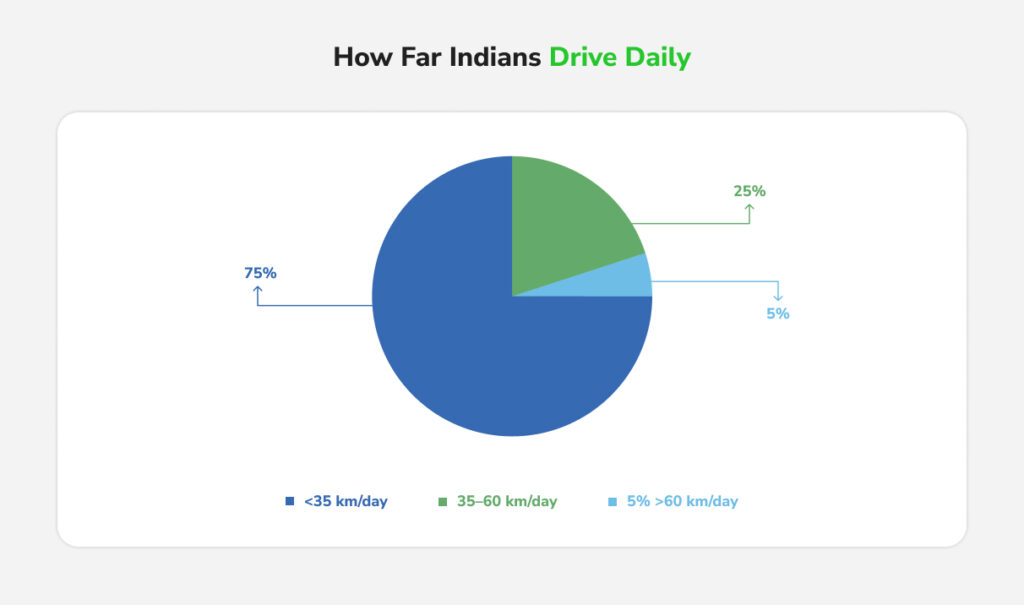
    Myth 1: Electric Vehicles Can’t Travel Far Enough (Range Anxiety) 

    Fact: Most Indian drivers travel far shorter distances than entry-level EV ranges.  

    Pie chart showing daily driving habits of individuals with electric vehicles.
    • By contrast, modern EVs easily deliver 200–400 km per charge. For example, Tata Nexon EV (30–45 kWh battery) is rated 275–489 km per full charge.  
    • In practice, typical EV owners cover only a fraction of their battery range daily. In short, range anxiety is largely unwarranted. 

    Myth 2: EVs Are Too Expensive

    Fact: While EVs often cost more upfront than petrol cars, government incentives and lower running costs change the picture.  

    Most Indian consumers express intentions to purchase electric vehicles next, signaling a growing preference for sustainable options.
    • India’s FAME-II program (approximately ₹11,500 Cr budget) has already supported over 1.6 million EVs (including 14.3 lakh two-wheelers, 1.65 lakh three-wheelers, and 22.5 thousand cars by Mar 2025).

    Myth 3: EV Batteries Wear Out Quickly or Pollute the Environment

    Fact: EV batteries are durable and increasingly recyclable.  

    Infographic showing the circular benefits of EV battery recycling, highlighting environmental and economic advantages.
    • Most modern EV batteries come with 8 to 10-year or 100,000 km warranties, and long-term data shows no evidence of premature failure. When batteries age, they often find a second life in stationary energy storage before recycling. 

    Myth 4: There Are No EV Charging Stations in India

    Fact: India’s public EV charging networks are expanding rapidly.  

    Visual representation of state-wise EV charging station numbers in India.
    • Charging points are concentrated in urban and interstate corridors, but schemes like PM-E-DRIVE have spurred massive growth in charging stations. India now averages one public charger per approx. 200 EVs (vs. the ideal ~1:20 ratio), and this is improving every year.  

    Myth 5: Charging an EV Takes Too Long (It’s Impractical!)

    Fact: Most EV drivers plug in overnight, and fast-charging technology has advanced greatly.  

    • Using a regular home socket (2–3 kW), a full charge may take 8–12 hours, but this happens while sleeping. Public DC fast chargers (30–150+ kW) can replenish an EV battery quickly.  

    Myth 6: The Electricity Grid Can’t Handle EV Adoption

    Fact: Even on India’s coal-heavy grid, EVs produce far less CO₂ per km than petrol cars.  

    • A recent IIT–ICCT (Indian Institute of Technology – International Council on Clean Transportation) study finds that Indian EVs emit up to 38% less CO₂ (life-cycle) than equivalent petrol cars. Burning a litre of petrol emits approximately 2.3 kg of CO₂, whereas an EV drawing from India’s grid (approx. 0.79 kg CO₂ per kWh) results in much lower per-km emissions.  
    • Moreover, India is rapidly decarbonizing power, with renewables now exceeding 50% of capacity. As the grid gets cleaner, EVs become even greener. Experts warn that delaying EV adoption only locks in more emissions from petrol cars
    • Even today, EVs cut transport emissions significantly in India.

    Myth 7: All EVs Charge the Same Way (and Speed)

    Fact:  EVs differ widely in fast-charging ability and connectors. 

    Each EV model has unique hardware: different voltage (400V vs 800V systems), different max currents, and different connector standards (CCS, Tesla/NACS, GB/T).  

    For example, many European and North American cars now use CCS up to ~350 kW. Some plug-in hybrids can only charge on AC Level 2, not DC at all.  

    Moreover, environmental factors (battery temperature, state of charge) also influence actual power draw. This means charging speeds are not uniform.  

    However, fast charger networks have largely standardized: CCS and Tesla’s NACS (via adapters) now dominate, so most new EVs can access high-power charging at modern stations.  

    The bottom line: not every EV will hit the advertised peak kW of a charger, but each will draw the maximum it safely can. 

    Myth 8: EVs Get Damaged in Waterlogged Areas and Are Unsafe to Charge in the Rain 

    Fact: 
    Modern electric vehicles in India are designed with strong water and dust protection, making them safe to drive in rain and charge in wet conditions when used correctly. 

    This myth is common in markets like India where monsoons and waterlogging are frequent. However, EVs sold in India are built to handle such real-world conditions. 

    According to the Government of India’s e-Amrit platform by NITI Aayog, electric vehicles come with Ingress Protection (IP) ratings, typically ranging from IP65 to IP67, which protect critical components from dust and water.  

    An IP67 rating, for example, means that the battery and electrical systems can withstand temporary immersion in water (up to 1 metre for about 30 minutes) without damage.  

    In addition to physical sealing, EVs include multiple safety mechanisms: 

    • Battery isolation systems that cut off power if water ingress is detected  
    • Sealed battery packs and connectors to prevent short circuits  
    • Ground fault protection systems in chargers to stop electricity flow in case of irregularities  

    These features ensure that EVs do not conduct electricity into surrounding water and remain safe during normal rain or shallow water exposure.  

    However, it is important to distinguish between rainy conditions and extreme flooding. While EVs are safe to drive and charge in rain, charging should be avoided in deep water, damaged equipment, or submerged conditions, as with any electrical system.

    Final Thoughts 

    The shift to electric mobility in India is well underway, and the facts clearly outweigh the electric vehicle misconceptions in India. Modern EVs already deliver more range than most people need daily, the total cost of ownership rivals petrol vehicles, batteries are responsibly recycled, and EV charging infrastructure is expanding at an unprecedented pace. Fast charging and home charging make daily use seamless, and even with today’s grid mix, EVs significantly reduce emissions and environmental impact.

    With falling prices, stronger policies, rapid infrastructure growth, and rising consumer awareness, India is moving decisively toward cleaner, smarter transportation. 
     
    If we look past outdated EV myths in India and focus on data, the road ahead is greener and electric. 

  • India’s EV Charging Infrastructure Policy 2025: Impact on CPOs and OEMs

    India’s EV Charging Infrastructure Policy 2025: Impact on CPOs and OEMs

    By 2025, domestic EV sales reached approximately 2.5 million units, and the government targets approximately 30% of all new vehicle sales to be electric by 2030.

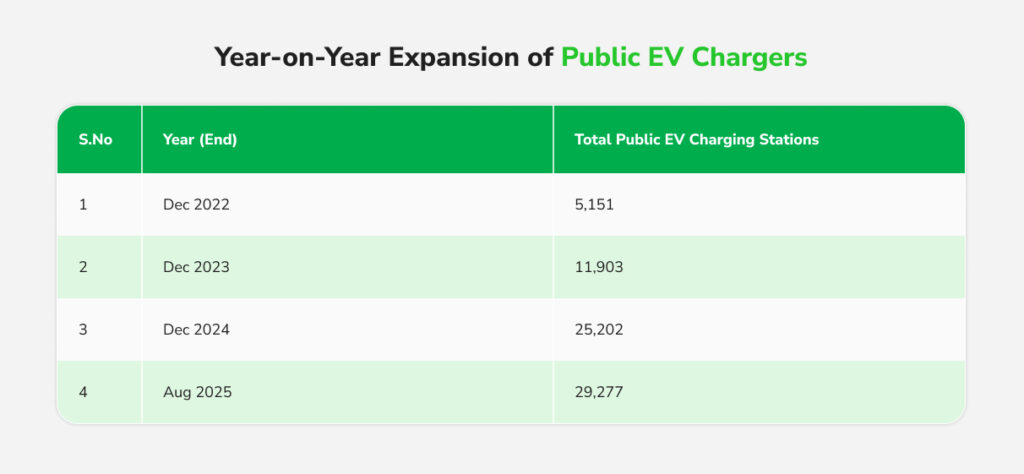
    To sustain this growth, the charging infrastructure has become a national priority. Installation of public EV charging stations in India expanded from 5,151 stations in Dec 2022 to 25,202 by Dec 2024, and approximately 29,300 by Aug 2025.

    However, density remains low relative to EV adoption. Policymakers have therefore updated guidelines, incentives, and regulations to build infrastructure for all segments while ensuring business viability. 
     
    In this blog, we explore: 

    1. What India’s new EV Charging Infrastructure Policy changes in practice 

    2. How these policy shifts impact the profitability, expansion strategy, and technology roadmap of Charge Point Operators (CPOs) 

    3. What EV OEMs must do to stay compliant and competitive 

    Central Government Initiatives  

    Revised MoP Charging Guidelines 

    In Sep 2024, the Ministry of Power issued fresh “Guidelines for Installation and Operation of EV Charging Infrastructure – 2024”, revising standards, safety, and siting norms. Key changes include mandating chargers at workplaces, residential complexes, bus depots, and public hubs. EV charging is now declared an “unlicensed” activity, with emphasis on EV charging network interoperability via open protocols (OCPP/OCPI) and unified roaming apps. In Jan 2025, MoP also released India’s first guidelines for battery swapping stations, detailing technical standards for interoperable swap bays. Together, these reforms aim to make charging safer, more accessible, and commercially sustainable
     

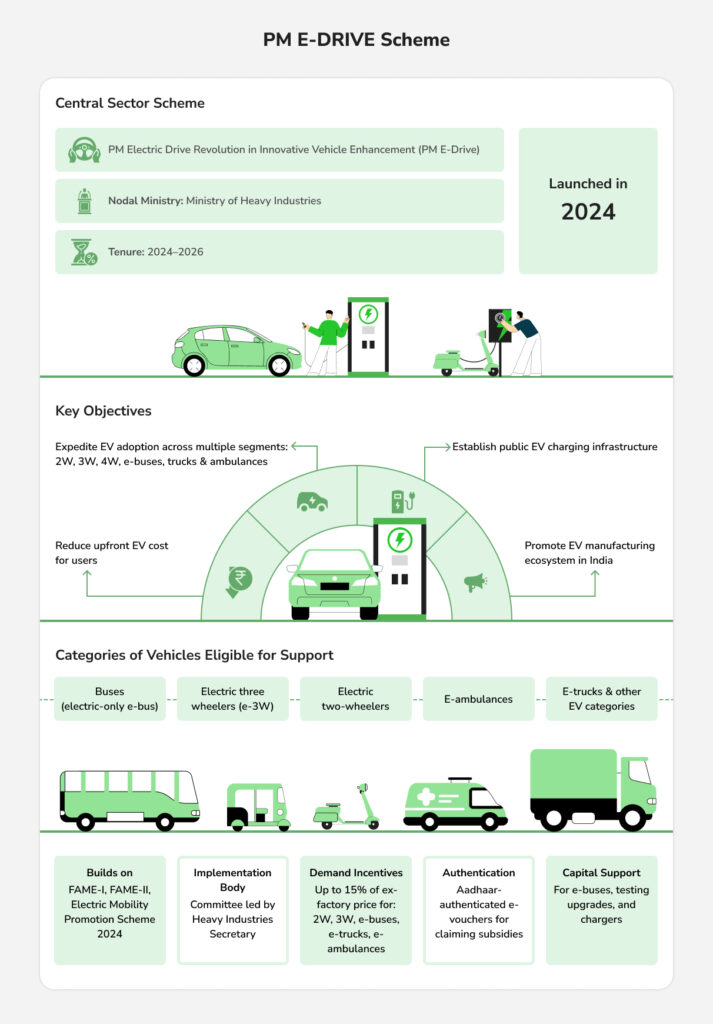
    PM E-DRIVE Scheme

    The PM-Electric Drive Revolution in Innovative Vehicle Enhancement (E-DRIVE) scheme (notified Sep 2024) allocates ₹10,900 crore for FY2024–26 to boost EV demand and infrastructure. Of this, ₹2,000 cr is earmarked for public charging stations. The government plans to deploy approximately 72,000 fast chargers across highways and urban sites by FY25–26 and co-fund depot chargers for e-buses and fleets. The scheme also supports consumer subsidies and ₹4,391 cr for 14,028 e-buses. In sum, PM E-DRIVE provides large-scale funding and a national mandate to expand commercial EV charging stations quickly. 

    Revamped Distribution Scheme (RDSS) 

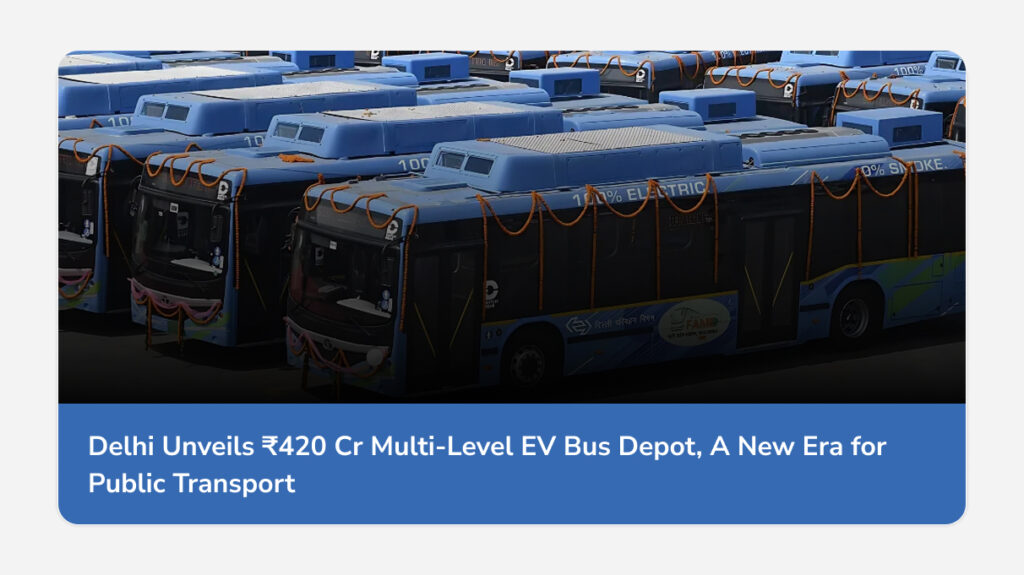
    Delhi's new 420 crore multi-level EV bus depot marks a significant advancement in public transport infrastructure.

    The Revamped Distribution Sector Scheme encourages state DISCOMs to invest in EV charging. New guidelines allow DISCOMs to use RDSS funds for public charging connectivity and grid reinforcement.  

    States/DISCOMs/SERCs are urged to incentivize EV charger rollout and incorporate charging obligations in grid planning.

    Urban Mobility 

    The Ministry of Housing & Urban Affairs (MoHUA) approved the PM e-Bus Sewa scheme (2023) to electrify city bus fleets with 10,000 buses on PPP, supported by ₹20,000 cr. This will create strong demand for depots and en-route charging for urban mass transit. MoHUA and MoP (Ministry of Power) are also encouraging cities to integrate chargers in parking lots, metro stations, and street hubs. Model building bye-laws (amended 2019) require major developments to allot space for EV charging. 

    Table showing year-on-year public EV charger expansion

    Regulatory Changes Impacting CPOs and OEMs 

    Recent rule changes affect how CPOs operate and how OEMs plan networks: 

    Time-of-Day Tariffs (ToD) 

    Some states introduced ToD pricing to shift charging to daytime solar hours. Tamil Nadu pioneered ToD in 2023, cutting midday rates by ~50%. However, its latest tariff order (Jul 2025) raised rates across all periods (solar ₹6.50/kWh, peak ₹9.75) and doubled fixed charges on high-tension connections. Operators warn this 20% hike erodes earlier cost advantages. Other states (e.g., Karnataka) maintain cheaper midnight rates. Tiered tariffs reward solar-time charging but penalize low-utilization sites via high fixed fees, squeezing CPO margins. CPOs must therefore optimize charging schedules (e.g., offer discounts off-peak) and may need to invest in on-site solar or storage. 

    Land and Zoning Mandates 

    Urban building codes increasingly require EV charging readiness. Delhi’s rules (2020) were updated so major developments must reserve EV-ready parking. Maharashtra, Karnataka, and others have inserted similar clauses. These mandates give CPOs predictable demand (e.g., malls and offices must allot charging spaces) and encourage OEMs to ensure dealer showrooms are EV-ready. Land allotment schemes are also emerging for charger parks. 

    Interoperability Standards 

    The government emphasizes a standardized, interoperable network. All new public chargers must support open communication protocols (OCPP for charging backend, OCPI for roaming) and UPI-based payments. This fosters EV roaming: drivers can plug in to any network using one app or RFID. When multiple CPOs joined a common roaming platform in 2023, charger utilization jumped from <10% to over 20%. Compliance with national protocol mandates is therefore essential for CPOs, and OEMs must equip vehicles with standard connectors (Type-2/CCS2 for cars and Bharat DC-001/Type-4 for two-wheelers). 

    Other Technical Mandates 

    Safety and quality standards (CE/IS certifications, surge protection, secure payments) have been tightened. The CEA has added electrical safety requirements for EVSE. In the future, grid codes may require smart charging features (V2X-readiness, load management) to support grid stability. OEMs must coordinate vehicle-charger compatibility (e.g., ISO15118/BMS standards). 

    Implications for Charge Point Operators (CPOs) 

    CPOs stand to benefit from these policies but also face new challenges: 

    Subsidies and Funding 

    Central and state grants lower CAPEX for public and depot chargers. Unlicensed status and expedited permissions speed up rollout. Participation in schemes like PM E-DRIVE provides direct reimbursements. 

    Regulatory Costs 

    Higher DISCOM tariffs raise OPEX. Low utilization of public chargers means steep fixed charges hit profitability unless offset by subsidies or dynamic pricing. CPOs must optimize placement (high-demand locations) and consider bundled services to improve throughput.  

    Standards Compliance 

    Meeting interoperability and safety standards adds complexity. CPOs must ensure all new chargers are OCPP-compliant and join national roaming platforms. Legacy stations may need upgrades.

    Market Opportunities 

    Residential and workplace charging are now covered in MoP guidelines, opening new revenue streams.  Public-private partnerships are now more attractive with co-funding available. Highway and city charging corridors offer scale, especially for commercial EV charging stations. Retail partnerships are encouraged by state incentives. 

    Strategic Alignment 

    CPOs must align rollout plans with OEM sales and fleet electrification. As more EVs hit the roads, OEMs will demand robust charging access to reassure buyers. Savvy CPOs will partner with OEMs on service networks (e.g., providing chargers at dealerships or fleet depots). Many OEMs are already entering the CPO space or partnering with other CPOs to ensure customer access. 

    Implications for EV OEMs 

    Original Equipment Manufacturers (OEMs) likewise feel the policy effects: 

    Demand Stimulation 

    Policy support (subsidies, mandates, infrastructure funding) reduces range anxiety and total cost of ownership, boosting EV sales, which is the OEMs’ primary goal. A denser EV charging network makes it easier for consumers to choose EVs, enabling OEMs to accelerate EV model launches. 

    Technical Coordination 

    OEMs must ensure their vehicles are compatible with mandated standards (CCS2, Bharat DC-001, ISO15118).  The push for interoperability means OEMs should also prioritize OCPP & OCPI compliance in India when collaborating with CPOs, ensuring seamless integration across networks. 

    Network Partnerships 

    Many OEMs are investing in charging networks (e.g., Tata Motors with Tata Power; MG has partnered to roll out DC chargers; Hero MotoCorp’s Ather with Uber to install bike chargers). Policies encourage such tie-ups. OEMs should seek alliances with CPOs (or become CPOs themselves) to enhance brand value and customer retention. 

    Product Planning 

    OEMs will time vehicle launches with infrastructure milestones. Entry-level e-2Ws/3Ws rely on home-charging incentives, while cars follow fast-charger expansion.  

    Fleet Segment 

    OEMs supplying buses, trucks, and specialized EVs (ambulances, tractors) must coordinate with cities and operators to co-develop depot charging layouts. Government procurement under the E-DRIVE creates large opportunities. 

    Outlook and Actionable Insights 

    The 2024–25 policy wave signals that EV charging is now a national infrastructure priority. For senior decision‑makers, the imperative is twofold: execute on current incentives and prepare for the next phase. Key takeaways include: 

    • Integrate planning across stakeholders. Governments should synchronize EV sales targets with charging rollout, for example, creating dedicated EV cells in states and coordinating DISCOMs’ infrastructure plans with urban development authorities, and enforcing land-use mandates. 
    • Leverage subsidies wisely. CPOs and real estate developers should tap central and state grants now, before funds lapse, and invest in data analytics to site chargers optimally. Utilities (DISCOMs) can use RDSS funds to upgrade networks for high-demand sites and shape ToD tariffs to smooth demand curves. 
    • Adopt open standards. Both CPOs and OEMs must ensure compliance with OCPP and OCPI in India to support unified payment systems and roaming. Such interoperability will ultimately raise charger utilization (as real-world pilots have shown). 
    • Monitor evolving regulations. Tariff changes highlight the need for CPOs to engage with regulators actively. Likewise, OEMs must remain agile in adapting to local charging infrastructure rules such as new EV parking requirements. 
    • Plan for scale and future tech. With the government’s 2030 vision, OEMs and CPOs should prepare for higher EV volumes, faster chargers, and emerging models like wireless charging or integrated solar and storage at charging hubs. 

    Final Thoughts 

    India’s 2025 EV charging infrastructure policy measures have laid the groundwork for commercial EV charging stations in India. For CPOs, this means new funding streams and clearer norms, but also higher standards and competition. For OEMs, it promises greater EV uptake and responsibilities in infrastructure integration. By acting swiftly, building chargers in tandem with vehicle rollouts, engaging in partnerships, and managing regulatory risks, industry stakeholders can ensure India’s EV revolution is fully charged for the future. 

    Frequently Asked Questions

    How will higher DISCOM tariffs impact EV charging prices for end users in 2025–2026?

    Where ToD tariffs increased, CPOs may pass on 10–20% higher charging prices during peak hours. Many are shifting to time-based discounts, solar-hour deals, or subscription models to protect affordability. 

    How should OEMs prepare for interoperability mandates like OCPP, OCPI and unified payments?

    OEMs must ensure vehicles use standard connectors (Type-6/Type-7/CCS2/Type-2/Type-4) and support communication layers like ISO 15118. Backend teams must align with CPO partners using OCPP 1.6/2.0.1 and enable UPI-ready payment APIs for India-wide roaming. 

    What are the best locations for new charging stations in 2025–2030?

    Based on demand analytics across India: 

    • High-footfall urban hubs (malls, offices, tech parks) 
    • National highways with 24/7 amenities 
    • Large housing societies (supported by MoP mandates) 
    • Fleet depots (e-bus, e-cargo, ride-hail) 
    • Metro stations and transport hubs 

  • How 5G Will Transform EV Charging in India by 2026 

    How 5G Will Transform EV Charging in India by 2026 

    India’s EV charging ecosystem is entering a critical phase between 2026 and 2030, when connectivity and intelligence will matter as much as the number of chargers. By mid-decade, 5G will be standard across most urban centers, and new chargers and vehicles will increasingly ship with native 5G modules. This shift isn’t just about faster mobile internet; it fundamentally changes how charging networks operate. 

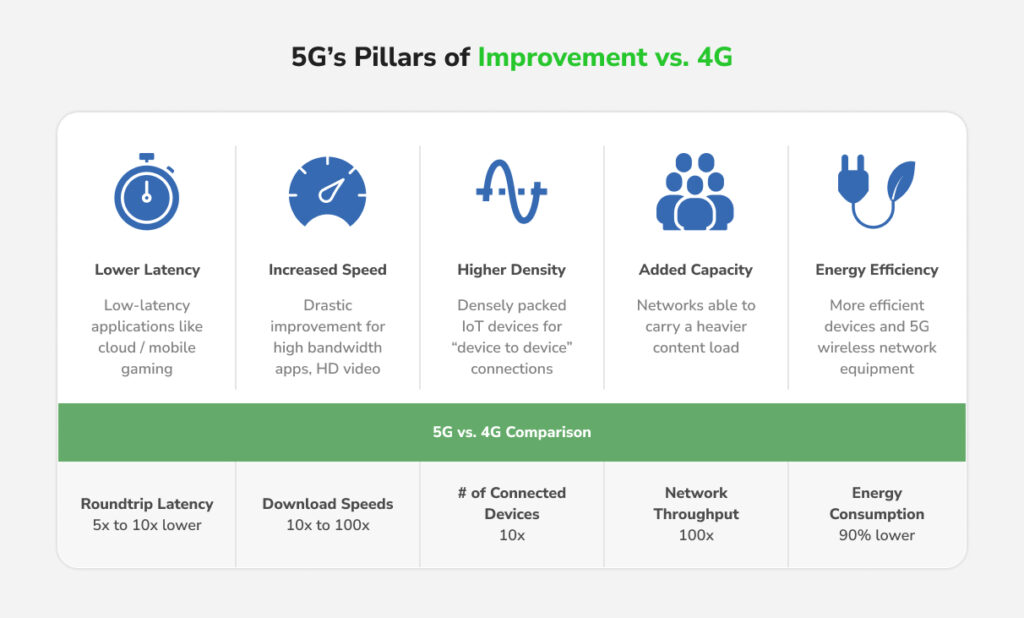
    5G’s low latency, high device capacity, and reliable real-time communication allow chargers to authenticate users instantly, push updates without downtime, and coordinate with the grid at scale. Instead of multi-second delays common on 4G, 5G enables millisecond-level data exchange, making continuous monitoring and predictive maintenance practical for thousands of chargers simultaneously. 

    In this blog, we explore: 

    • How 5G enhances the speed, reliability, and uptime of EV charging 
    • Why 5G is better suited than 4G for India’s next generation charging infrastructure 
    • What a fully 5G-enabled charging session will look like in 2026 

    How does 5G improve EV charging speed and reliability? 

    Illustration showing Third Generation Partnership Project's first phase 5G roll out.

    5G networks promise ultra-fast, ultra-reliable links that make EV charging more seamless. Unlike 4G, 5G delivers near-instantaneous data exchange with latency under 1 millisecond.  
     
    A smart EV charging station can instantly recognize your car, verify credentials, and begin power transfer with virtually no delay. Real-time connectivity also means chargers report their status continuously.  
     
    For example, 5G-enabled stations could detect a fault and reboot within milliseconds, notifying technicians immediately. Today, up to 38% of India’s public chargers are non-functional at any time. With 5G’s predictive diagnostics, uptime can rise above 99%. In short, faster and more reliable communication ensures chargers stay online and operate at peak performance. 

    Why 5G is better than 4G for EV charging infrastructure

    The advantages of 5G go beyond speed. It’s designed to support massive IoT and critical services simultaneously. For example, industry specs target 5G to handle up to 1 million devices per square kilometer with latencies as low as 1 ms, far beyond 4G’s capabilities.  
     
    Ericsson notes that 5G can handle as many as 1 million devices per square kilometer, whereas 4G struggles in crowded areas. In EV networks, this means thousands of chargers and EVs can communicate with the grid without contention. Moreover, 5G also enables network slicing, creating dedicated virtual channels. In practice, a charger could use one high-priority 5G slice for time-critical tasks like authentication and billing and another slice for routine telemetry. These slices guarantee that critical EV communication is never delayed.

    Together, multi‑Gbps bandwidth, millisecond latency, device density, and slicing make 5G-connected EV charging infrastructure far more robust and efficient than 4G.

    Will 5G reduce charging costs or wait times? 

    5G doesn’t directly cut the energy bill, but it enables smarter charging that lowers costs and queues. For instance, a big benefit of 5G connectivity is smart scheduling. Stations can continuously share live data (station load, queue length, and grid demand) and coordinate charging to off-peak hours or less-used sites.  

    A pilot in Delhi showed that shifting charging away from peak hours cuts customer bills by approx. 13%. With 5G, such savings could become routine.  

    Likewise, rapid 5G links also let apps display real-time charger availability, helping drivers avoid queues. Ultra-low latency reduces the start/stop handshake from 10-20 seconds on 4G to just 2-3 seconds. In sum, 5G-connected stations balance load and reduce energy peaks and minimize bureaucratic delays, delivering a smoother, cheaper charging experience. 

    Early 5G Charging Pilots in India and the Road to 2026 

    Several Indian trials already hint at 5G’s role in EV charging. Indus Towers (backed by Bharti, Vodafone-Idea, and Jio) has launched pilot chargers in Gurugram and Bengaluru, while BSNL plans to install EV fast chargers at 5,000 sites nationwide, effectively turning telecom sites into commercial EV charging stations. These pilots lay the groundwork: once 5G is widely rolled out (over 465,000 5G base stations exist in India as of 2024), these sites can carry EV traffic. 

    Globally, platforms like EVPassport (an EV charging platform provider) have demonstrated 5G-connected charging systems in New York, halving latency and enabling real-time power balancing. Major automakers and utilities in Europe and Asia are piloting similar ideas, with regulators pushing for networked, smart chargers. By 2026, most new fast-charging stations in key markets will use 5G or advanced IoT links. For example, the EU’s new charging rules (AFIR) effectively mandate that all public chargers be networked and V2G-ready by 2024–25. This means the majority of stations built today must already support bidirectional power and “smart” features. 5G will be the default choice for many of these.

    What a fully 5G-enabled charging session will look like in 2026? 

    Imagine pulling into a highway charging plaza in 2026:  

    • Instant connection: Your EV greets the charger over 5G in under 100ms as soon as you park.  
    • Network slicing: One slice secures payment, and another streams live telemetry to the operator (socket temperature, grid load).  
    • Dynamic pricing: As you plug in, the rates adjust in real time to encourage the use of green energy.  
    • Seamless billing: Payment completes in seconds, and charging begins almost immediately—maybe 2–3 seconds after arrival instead of 15–20 seconds today.  
    • Fail-safe measures: If a glitch occurs, the charger auto-resets the module or switches to a backup instantly. When you’re done, the session log has already synced to the cloud, giving you receipts through a real-time EV charging monitoring system.  

    In short, the whole session feels like a swift digital transaction rather than a waiting game. 

    Where 5G Fits in the Future of Charging 

    • Remote management & maintenance: Operators can monitor each charger’s health in real time and push software updates or fixes remotely. That means fewer breakdowns and faster repairs.  
    • Grid-aware scheduling: 5G-connected chargers can communicate with the grid to optimize load and reduce costs. In Europe and other regions, new smart-charging regulations already require this level of connectivity. One analyst notes that connected chargers can even be configured to only charge when energy prices are low, lowering costs for everyone. If ten EVs plug in at once, the station can intelligently divide available power among them so as not to overload the circuit.  
    • Ultra-fast authentication & payments: 5G networks will make user transactions nearly instant. Instead of waiting several seconds, authentication on 5G can be completed in milliseconds, making charging as quick as fueling at a gas pump. 

    Together, these features improve reliability and throughput. In congested urban areas, 5G-connected charging hubs will allow dozens of vehicles to charge simultaneously without glitches, powered by an advanced EV charging management system. By 2026, 5G-powered smart chargers will be as commonplace as Wi-Fi in coffee shops. 

    Final Thoughts 

    In short, 5G is the missing piece that will make EV charging truly smart and seamless. By 2026, we expect charging networks to leverage 5G for ultra-fast, reliable connectivity, enabling data-driven optimization at every level. Trials already show that 5G-connected chargers are faster and more dependable. Analysts agree that communications tech in chargers can have a considerable impact on the energy costs and overall user experience. In our view, the era of digital, data-backed EV charging is arriving, and by mid-decade, charging your car will be as straightforward as charging your phone.

    Frequently Asked Questions

    Will 5G make home EV chargers faster or smarter? 

    Mostly smarter. Home charging speed depends on AC power limits, not connectivity. But 5G can enable better remote monitoring, scheduled charging, solar integration, and predictive maintenance. 

    Do EV owners need a 5G-enabled car to benefit from 5G charging stations?

    No. Even if the vehicle doesn’t have 5G, the charger itself uses 5G for authentication, payments, grid coordination, and uptime monitoring. A 5G-equipped EV simply enables deeper diagnostics and even faster handshakes. 

    Will 5G increase data costs for charging operators?

    Not significantly. 5G IoT plans are typically priced per device at low monthly rates. Operators save more through improved uptime, fewer site visits, faster fault diagnosis, and smarter load management. 

  • Sodium-Ion vs. Lithium-Ion Batteries: Which Is Better for Electric Vehicles?

    Sodium-Ion vs. Lithium-Ion Batteries: Which Is Better for Electric Vehicles?

    The Race for EV Battery Materials 

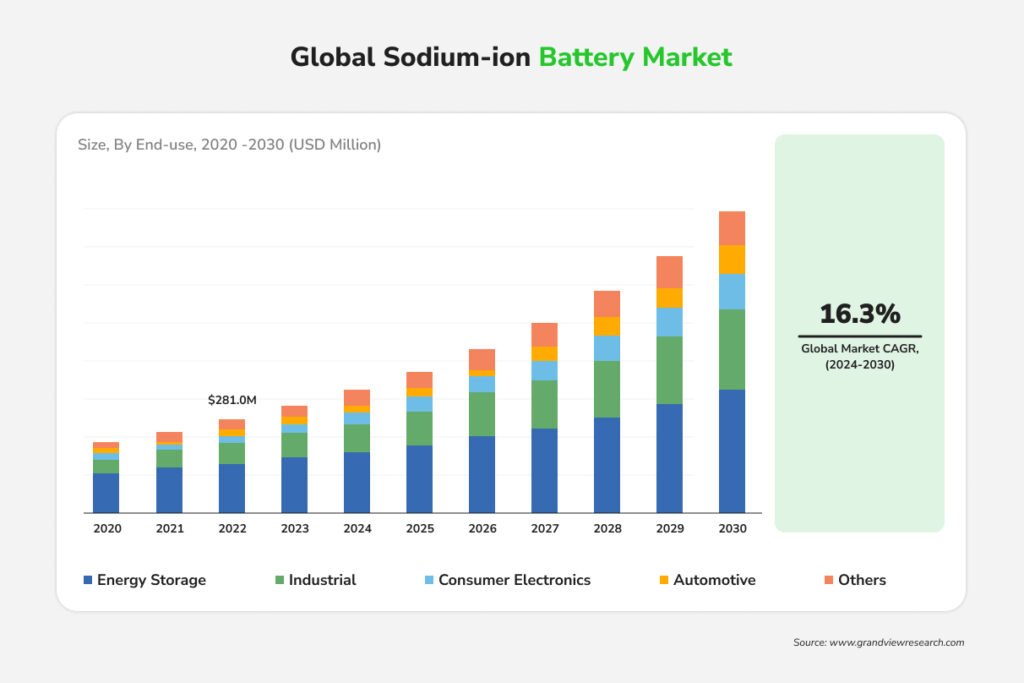
    Electric vehicles (EVs) today rely heavily on lithium-ion batteries, but this dependence comes with challenges. Lithium resources are geographically concentrated; China dominates 79% of global lithium-ion battery production and 61% of lithium refining capacity. Countries like Argentina hold around 21% of global lithium deposits, creating supply risks. Demand surges have driven lithium prices up over 700% since 2021, inflating battery costs. These supply chain constraints and price volatility have automakers and tech companies exploring alternative chemistries for EV battery technology.  

    One promising candidate is the sodium-ion battery, which uses sodium, an element far more abundant and widely available than lithium. In fact, sodium is thousands of times more plentiful in the Earth’s crust than lithium — approximately 20ppm, whereas sodium is tens of thousands of ppm. This abundance makes sodium cheaper and easier to source, without the geopolitical bottlenecks associated with lithium.  

    This blog explores three key dimensions shaping the future of EV energy storage: 

    • Growing challenges of lithium-ion batteries and why the industry is seeking alternatives. 
    • Rise of sodium-ion technology and how it compares to lithium-ion in performance, cost, safety, and sustainability. 
    • Recent developments, market trends, and the future outlook for sodium-ion batteries in the EV industry.

    How Sodium-Ion and Lithium-Ion Batteries Work 

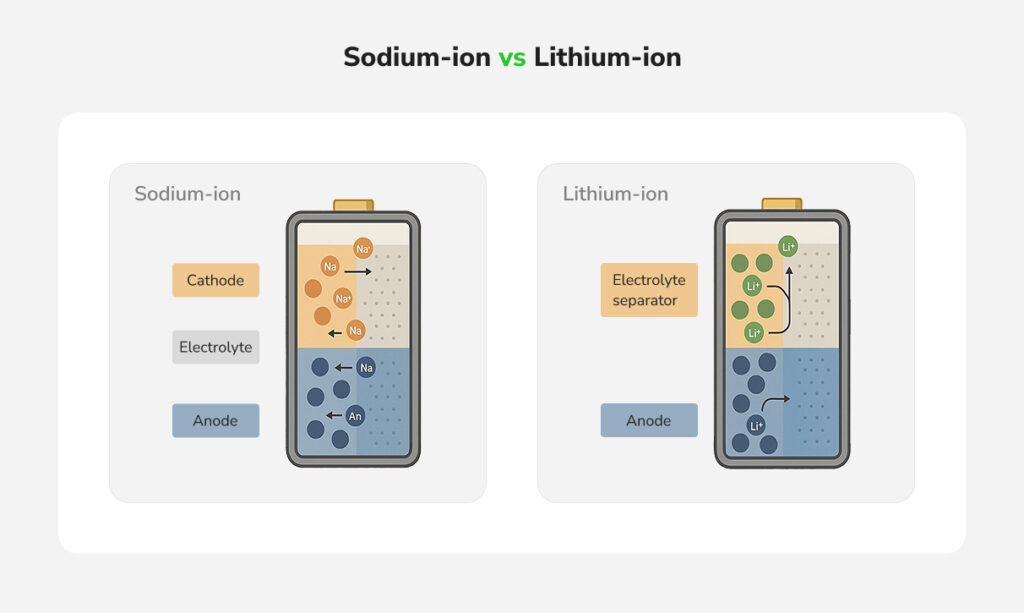
    At a basic level, both sodium-ion (Na-ion) and lithium-ion (Li-ion) batteries shuttle ions between a cathode (positive side) and anode (negative side) through a liquid (or sometimes solid) electrolyte. The key difference lies in the charge carrier: sodium ions (Na+ ) versus lithium ions (Li+ ). This seemingly small change leads to notable differences in materials and performance. 

    Sodium-Ion vs. Lithium-Ion: Key Differences 

    Both battery types aim to deliver high energy storage and power, but there are critical differences in their material abundance, performance, and suitability for electric vehicles. Below, we compare several key aspects: 

    Resource Abundance & Cost 

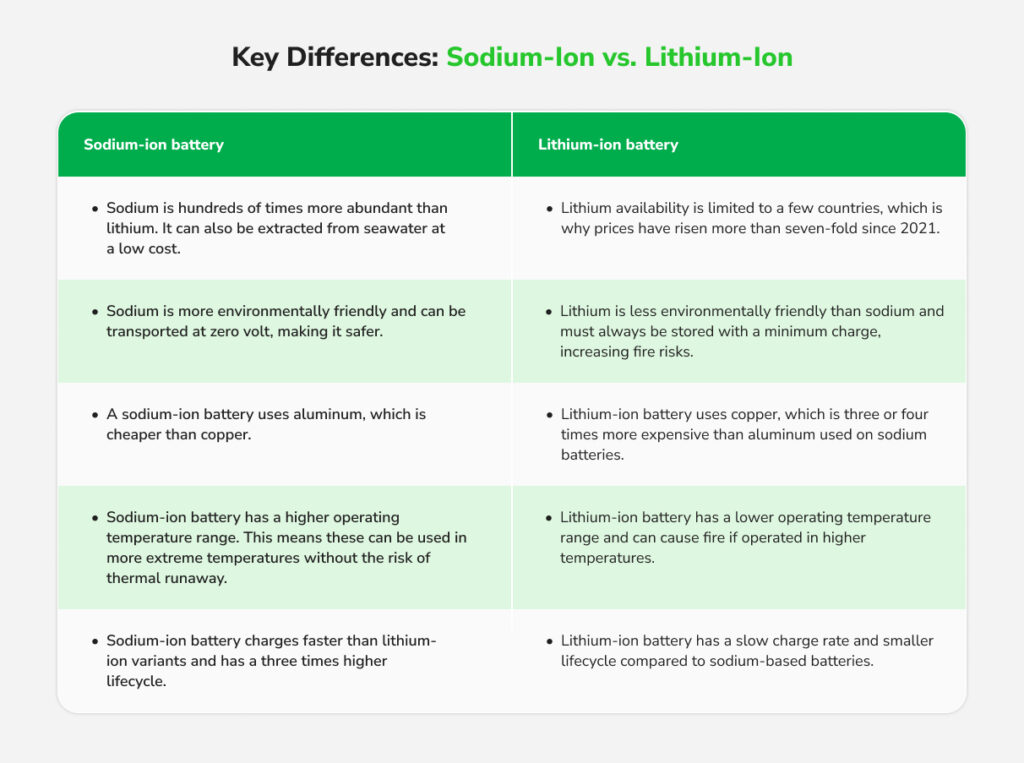
    Sodium is extremely abundant and inexpensive. It can even be sourced from seawater, and it doesn’t require intensive mining.  
     
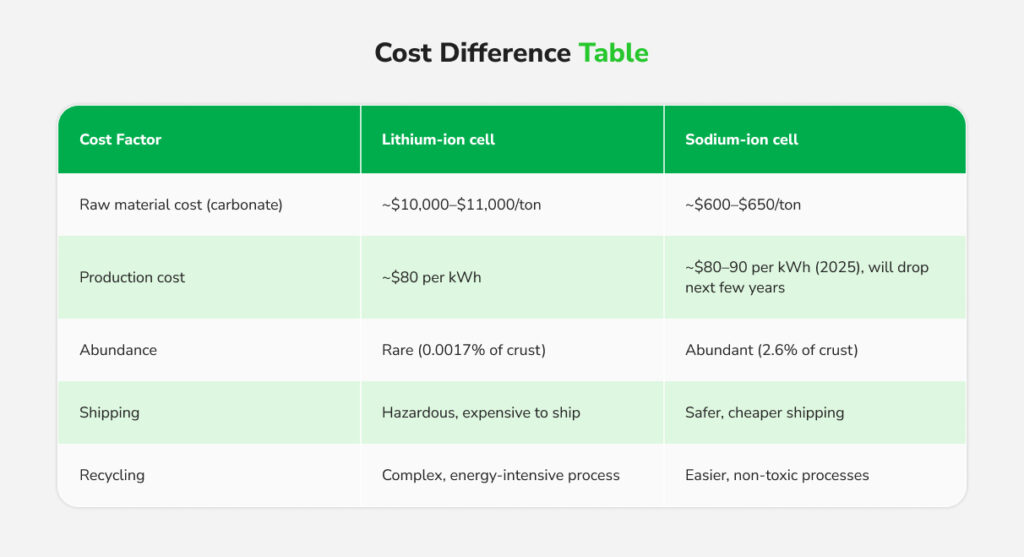
    In contrast, lithium is limited to specific regions and has seen skyrocketing costs due to scarcity. Sodium-ion cells also use lower-cost materials; they avoid expensive cobalt and use aluminum in place of copper, further reducing material costs. Overall, sodium-ion technology offers cost advantages, especially if lithium prices remain high, making it central to EV battery cost comparison.

    Energy Density (EV Range) 

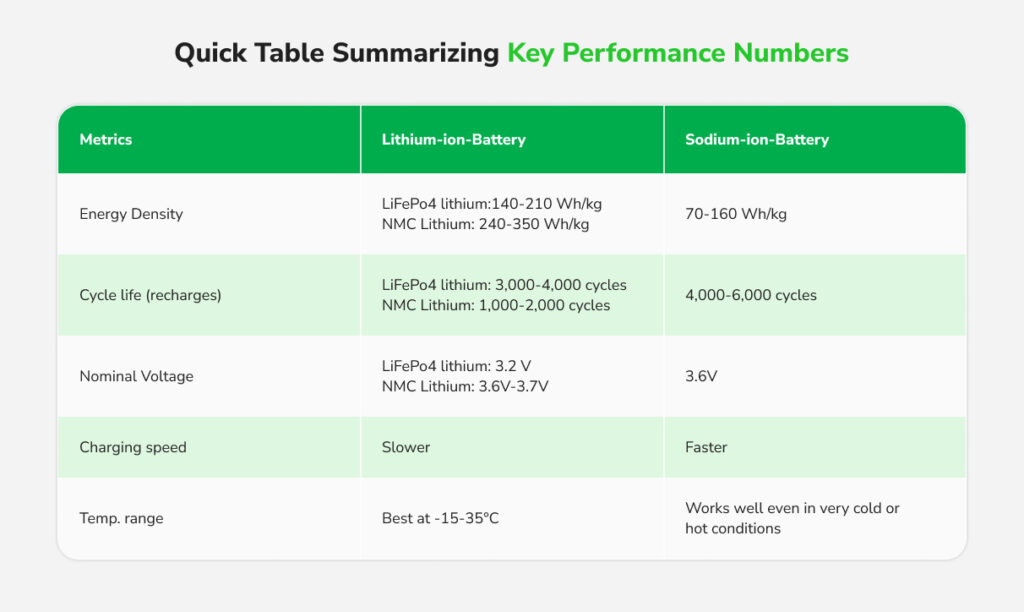
    Lithium-ion batteries lead in energy density, a crucial factor for EV range. Current lithium EV batteries (e.g., NMC or LFP) deliver around 150–250 Wh/kg of energy density, enabling long driving ranges.  
     
    Sodium-ion batteries currently achieve roughly 100–160 Wh/kg. For example the first sodium-powered compact car in China (JAC’s Hua Xianzi) carries a 25 kWh sodium battery pack for about 250 km of range —suitable for city commuting but below typical lithium EV ranges. Researchers are optimistic that with further innovation, sodium-ion cells could exceed 200 Wh/kg in coming years, but for now lithium’s superior energy density makes it better for long-range performance. 

    Charging Speed and Cycle Life 

    Interestingly, sodium-ion batteries can charge faster and potentially last longer in certain designs. Sodium ions are larger, but the chemistry avoids lithium’s tendency for dendrite formation at high charge rates. Early tests show sodium cells comfortably handle fast charging; one prototype by HiNa Battery charges fully in about 20 minutes. Some sodium batteries have shown 4,500 charge-discharge cycles with 83% capacity retention, and next-generation designs (like CATL’s “Naxtra” sodium battery) aim for up to 10,000 cycles.  
     
    By comparison, lithium-ion cycle life varies by chemistry: high-nickel types might last a few thousand cycles, while lithium iron phosphate packs can exceed 5,000–7,000 cycles under good conditions. Some commercial LFP batteries approach 8,000+ cycles before significant degradation. In short, both technologies can achieve long lifespans, but sodium-ion is proving it can match or even surpass lithium in cycle longevity, a big plus for fleet EVs or grid storage that value long-term durability. 

    Safety and Thermal Performance 

    Sodium-ion batteries are safer and more stable in extreme conditions. They tolerate full discharge and high temperatures, reducing fire risk. A sodium-ion cell retains approx. 88% of its capacity even at -20°C, while lithium NMC cells drop to only approx. 20–50% at subzero temperatures. Sodium cells also perform well up to approx. 70°C without severe degradation.  
     
    Lithium-ion batteries require careful thermal management and can’t be fully drained without damage. Their flammable electrolytes pose that fire risks. Sodium-ion electrolytes and materials tend to be less reactive, improving safety margins. For drivers, pairing safer chemistries with dependable infrastructure, such as an electric car charger in India, reinforces confidence in both battery performance and charging safety. Overall, sodium-ion technology offers a more forgiving thermal and safety profile, which is attractive for automakers and aligns with sustainable electric vehicle charging solutions. 

    Environmental Impact 

    From a sustainability perspective, sodium-ion batteries have an edge in environmental friendliness. Sodium extraction and processing generally have a smaller environmental footprint than lithium mining. Lithium extraction is water-intensive and can pollute soil and water. Cobalt and nickel mining for lithium batteries also add social and ecological costs.  

    Sodium can be obtained more sustainably and doesn’t involve rare metals. Using aluminum instead of copper and avoiding lithium reduces the carbon footprint. In summary, sodium-ion batteries align well with sustainability goals, provided their overall efficiency and longevity continues to improve. Coupled with a robust EV charging network, these advances can accelerate the transition to a cleaner mobility globally.

    Recent Developments and Industry Adoption

    Thanks to the above advantages, sodium-ion batteries are gaining traction in the battery industry, including in EV applications. Major players like CATL, BYD, and Reliance Industries are investing heavily. Reliance’s 2022 acquisition of UK-based Faradion marked a key milestone in commercializing sodium-ion chemistry. 

    In China, CATL introduced its first sodium-ion battery in 2021, followed by JAC and HiNa Battery’s launch of the world’s first sodium-powered EV in 2023. BYD and CATL have since established large-scale sodium-ion factories, targeting up to 30 GWh annual capacity by 2025. CATL’s “Naxtra” batteries promise 175 Wh/kg energy density at costs below $20/kWh, potentially cutting EV battery prices by 30–50%

    Early adoption focuses on entry-level EVs, two-wheelers, and energy storage. European projects by BASF and Mercedes-Benz are exploring sodium-ion systems for energy independence. Although China currently leads production and is expected to control around 95% of sodium-ion output by 2030, the technology is moving swiftly toward commercial reality worldwide. 

    Challenges for Sodium-Ion Batteries in EVs

    Despite their promise, sodium-ion batteries face several challenges before they can replace lithium-ion in mainstream EVs

    • Lower Energy Density: Sodium-ion cells store less energy per weight/volume than lithium cells. This is a critical drawback for EVs, where weight and space directly influence vehicle range. Until sodium batteries close the density gap (through improved electrode materials or cell design), they will likely be limited to shorter-range vehicles or require larger battery packs to match lithium EV range. 
    • Early Stage of Development: Lithium-ion technology has benefited from decades of R&D and massive manufacturing scale. Sodium-ion tech is still nascent. Only a few companies produce them at scale, and processes are not yet fully optimized. This means current sodium-ion batteries are relatively expensive to produce, ironically, despite cheap materials, mainly due to low volumes and nascent supply chains. Additionally, the supply chain for specific sodium battery materials isn’t well established yet.  
    • Form Factor and Design Limitations: Today’s sodium-ion cells have mostly been developed in pouch or prismatic formats. Some reports indicate they cannot yet be made in as many form factors (cylindrical cells, button cells, etc.) or as compactly as lithium cells. EV makers have fine-tuned battery pack architectures around lithium cell formats; switching to sodium may require redesign. However, this is likely a temporary issue, as R&D will adapt sodium chemistries to various cell formats in the future. 
    • Performance Gaps: While sodium-ion batteries show strong potential, some performance areas still lag in power density and room temperature efficiency, though this is improving with advanced electrolytes. And while lab tests demonstrate impressive cycle life (over 5,000 charge cycles), real-world validation is still limited. By contrast, lithium-ion batteries, especially LFP types, already deliver thousands of proven, reliable cycles in commercial EVs. 
    • Manufacturing and Investment Challenges: Transitioning to a new chemistry isn’t simple—it requires retooling factories, training, and ensuring the new batteries meet automotive standards. As the International Energy Agency notes, new battery technologies face an uphill climb against incumbent lithium-ion. Sodium-ion cells are viable, but scaling to the multi-gigawatt-hour factories will take time and investment.  

    Outlook: Complement or Replacement? 

    In the near term, sodium-ion batteries will complement rather than replace lithium-ion. Their cost, safety, and sustainability advantages make them ideal for urban EVs, electric two-wheelers, and large-scale grid energy storage — segments where weight is less critical.  

    If sodium-ion cells achieve approx. 200+ Wh/kg energy density and maintain their other benefits, they could begin to challenge lithium-ion even in mainstream passenger EVs. The cost reduction potential is a big motivator, especially in markets where electric vehicle charging solutions and infrastructure are rapidly expanding; some estimates suggest sodium-based packs might cut EV battery costs by 30-50%, potentially slicing thousands of dollars off an EV’s price. This would be transformative for mass EV adoption, especially in price-sensitive markets. Automakers like BYD and Ford are closely watching sodium battery progress, and some have hinted at integrating sodium cells in future entry-level models if performance improves. 

    However, it’s important to keep a perspective. Lithium-ion batteries have a huge head start and an enormous ecosystem behind them. They will remain the go-to for most EVs in the next few years. Sodium-ion batteries are best seen as an emerging alternative that will find its place alongside lithium. A recent analysis by EV industry experts noted that sodium batteries are “already viable for short-range EVs, two-wheelers, and stationary storage”, but for longer-range cars, lithium will continue to dominate unless sodium sees a breakthrough in energy density. Even the IEA commented that sodium-ion can only really compete with lithium iron phosphate on cost if lithium prices stay very high or if sodium tech makes a leap in performance

    The next few years will determine how far sodium-ion batteries can go in powering the EV revolution. The competition is on, and that’s a win-win for consumers and the planet. 

    Frequently Asked Questions

    Will sodium-ion batteries make EVs cheaper in the next few years?

    Potentially, yes. Sodium-ion cells use cheaper, abundant materials and avoid lithium, cobalt, and nickel. This could reduce EV battery pack costs by 30–50% once production scales. But mainstream affordability gains may take 3–5 years, depending on manufacturing expansion.

    How will automakers integrate sodium-ion batteries without redesigning their entire EV platforms?

    Automakers will integrate sodium-ion gradually, starting with models that don’t require major platform changes, mainly city EVs, scooters, and low-range vehicles that already rely on pouch or prismatic cell formats. Early deployments will likely involve partial or modular pack configurations that allow OEMs to test sodium packs without altering core architectures. Over the next few years, however, as sodium-ion matures, automakers will begin designing new platforms optimized specifically for sodium cells, much like they did for LFP-based EVs. This staged approach lets manufacturers adopt the technology with minimal disruption. 

    Will sodium-ion batteries meaningfully reduce pressure on public EV charging infrastructure?

    Yes, especially in urban environments. Sodium-ion batteries are well-suited for small EVs that focus on short-range, high-frequency usage patterns. Because these batteries can charge quickly and are expected to be used primarily in entry-level vehicles, more owners will rely on home or workplace charging rather than fast-charging stations. This reduces congestion at public chargers and lightens the burden on high-power infrastructure. It doesn’t replace the need for public charging, but it reshapes demand so that fast chargers are increasingly used by long-range EVs, while sodium-powered vehicles utilize slower, distributed charging solutions. 

  • How Real Estate Developers Can Monetize EV Charging in India (2026 Guide) 

    How Real Estate Developers Can Monetize EV Charging in India (2026 Guide) 

    Electric vehicles (EVs) are rapidly gaining traction in India’s mobility landscape, bringing new opportunities for real estate developers. By 2025, EV sales accounted for 7.6% of all vehicle sales in India, steadily climbing toward the government’s 30% target by 2030. This surge in EV adoption is driving demand for accessible charging infrastructure in residential complexes, commercial centers, and mixed-use developments.  

    Developers who integrate EV charging for real estate early can future-proof their properties, attract premium tenants, and command higher asset values. But monetizing EV charging is not a simple “install and forget” exercise. It requires navigating evolving policies, choosing viable business models, and balancing upfront costs with long-term returns.  

    In this blog, we explore:   

    • Direct revenue models for EV charging monetization  
    • Indirect ways EV charging enhances property value, occupancy, and ancillary revenue  

    Direct Revenue Models for EV Charging Infrastructure for Real Estate 

    Simply installing chargers is not enough. Developers need a clear business model to recover costs and generate returns. Below are the primary monetization approaches you can consider:

    1. Pay-Per-Use Charging (Direct Revenue per kWh/Session) 

    Under this classic model, EV drivers pay for the energy they consume or the time they spend charging. The property owner (or its facility management) operates the chargers and collects fees directly from users.  

    Pricing is typically set on a per kilowatt-hour basis (e.g., ₹10–₹18 per kWh, often indexed to electricity cost) or per minute in the case of DC fast chargers.  

    Revenue Potential 
    Pay-per-use offers straightforward revenue that scales with utilization. For example, if you charge ₹12/kWh and a charger dispenses 300 kWh in a month, that’s ₹3,600 revenue per charger. At high-traffic locations, the numbers can be significant.  

    Use Case 
    This model works well for commercial and mixed-use developments such as malls, cinemas, highway food plazas, and hotels. It can also be applied in residential complexes or offices as a way for residents/employees to pay only when they charge (instead of a flat fee). 

    Management Considerations 
    If a developer chooses this model, they must handle the operations. This includes payment processing, uptime maintenance, and customer service. Luckily, there are white-label software platforms and O&M (Operations and Maintenance) service providers that make these tasks easier. Many charging stations today run on management apps that handle user authentication and digital payments, so the property doesn’t need to build its own system. Still, the developer is essentially running a mini-utility service.  
     
    Tip: Partnering with established charging networks ensures visibility on EV charger maps, boosting footfall. 

    2. Subscription and Membership Models (Recurring Revenue) 

    Diagram illustrating benefits of subscription and membership models

    The subscription model offers EV charging as a service package; users pay a fixed periodic fee for access to charging. This could be structured as: 

    • Monthly flat fee for unlimited charging. 
    • Membership plans offering discounted per-kWh rates or reserved charging slots for a subscription fee. 
    • Prepaid plans where residents or employees pay a fixed amount that includes a bundle of charging hours. 

    Use case

    Subscription and membership models make a lot of sense for real estate developers: 

    • Residential Complexes: RWAs could levy an “EV charging amenity charge” of ₹500–₹1000 per month per EV-owning household. In return, those residents get unlimited charging at the society’s chargers (or a generous cap that effectively feels unlimited). This guarantees the RWA as a steady income stream to offset electricity bills and charger upkeep. It’s like adding an EV line item to maintenance dues. 
    • Offices and Campuses: An office park could offer employees a subscription (possibly paid for by the tenant company) for reserved daytime charging. E.g., employees pay ₹2000/month for the convenience of always finding a spot to plug in at work. Some employers subsidize this or include it in their green initiatives. 
    • Commercial Memberships: A retail chain or mall could have a loyalty program offering discounted charging for a yearly membership fee. Similar to how clubs offer parking privileges. 

    Revenue Potential 

    Subscriptions provide predictable recurring revenue. Even if a given subscriber charges only sparingly, you still collect the full fee, which helps cover fixed costs. It also increases charger utilization (since subscribers feel “I’ve paid for it, I should use it”), which is good for achieving ROI on the asset. In fact, one strategy is to combine subscription with usage fees. For example, offer a small monthly subscription that gives members cheaper per-kWh rates than non-members. This way, you build loyalty while earning steady recurring revenue. 

    Benefits  

    • User Stickiness: From a marketing perspective, once a resident or tenant is on a subscription, they are less likely to move out because they’ve integrated that service into their routine.  
    • Administrative Ease: Implementing subscriptions might involve some management overhead (tracking eligible vehicles, ensuring one subscriber doesn’t hog the charger 24×7, etc.). But these can be handled via simple tech such as RFID cards, app-based profiles, or a fair-use policy.  

    3. Leasing Space to Charge Point Operators (CPOs) 

    In this model, the developer leases space to a third-party charging company, who installs and runs the charging station.  

    The developer’s monetization comes from rent or revenue sharing from the operator. Essentially, your property becomes a host location —much as allowing a telecom tower or an ATM on your premises for a fee. 

    • No CapEx, Low Risk: The biggest advantage here is that the developer’s upfront investment is minimal. The CPO typically bears the cost of equipment and installation. For an existing building, this is hugely attractive; many housing societies have taken this route to avoid spending their own funds.  
    • Steady Income: The income to the developer in this model might be a fixed rental, say ₹X per month for using 5 parking spots, or 10-20% of the revenue from each charging session, or a combination. The absolute amount may be lower than what you could earn if you ran it yourself at high utilization, since the CPO keeps a cut for their services. From an ROI perspective, it turns a potentially large CapEx project into a simple real estate rental yield. For some developers, that trade-off is worth it. 
    • Expertise and Customer Base: Another benefit is that established CPOs come with their brand, app, and existing customer base. For example, if Bolt.Earth installs a charger at your mall, EV drivers using the Bolt.Earth EV Charging App will automatically see and use it, bringing in footfall. The operator ensures the station is maintained, the firmware is updated, etc. This takes technical and operational complexity off the developer’s plate. 

    Use Case

    Locations with good potential usage where a charging company is interested in expanding. This could be a busy mall, supermarket, parking garage, highway hotel, or even a large residential complex. Many petrol pump owners have adopted this model; they lend space to a CPO to install chargers at the pump, often under a revenue share. The same concept extends to commercial EV charging stations: if you have a strategic location, multiple operators might even bid to set up there. 

    4. Integrated “Energy-as-a-Service” (EaaS) Solutions 

    This is an emerging, more holistic model where EV charging is combined with on-site energy infrastructure (like solar panels, battery storage, and energy management systems) and offered as a bundled service. Essentially, a third party or the developer itself provides the entire energy and charging setup to tenants as a service, often on a subscription or fixed-fee basis. It’s called “energy-as-a-service” because the focus is on delivering energy/charging to users without users investing in equipment like UPS or EV chargers. 

    • Monetization for Developer: If the developer partners with an EaaS provider, they might structure a profit-sharing or lease arrangement. Alternatively, large real estate players might set up their own subsidiary to provide EaaS in their campuses.  

    Benefits  

    • EaaS setups often incorporate renewable energy (solar) to reduce operating costs. Solar + battery can supply daytime EV charging at near-zero marginal cost after capex. This improves the ROI while also advertising the solution as 100% green.  
    • EaaS also enables peak load management; the battery can shave off peaks, ensuring the building’s overall electricity bill is optimized even as EV charging adds load. All these technical optimizations translate to better margins for the operator. From the user perspective, it’s convenient and can be cost-stable (e.g., a fixed rate per km or per kWh that the EaaS operator guarantees, insulating them from tariff volatility). 

    This model is complex to implement. It requires expertise in energy systems and a longer-term outlook. The contracts can be like mini power purchase agreements (PPAs) or service agreements spanning 5-15 years to make the investments worthwhile.  

    For a real estate developer, venturing into energy services might be a new territory, hence partnerships with specialist companies are common. However, given trends in sustainable smart buildings, this could become mainstream for large projects. 

    Use Case  

    • Tech parks, industrial parks, large mixed-use townships, or any development where energy usage is high and there’s scope for on-site generation.  
    • Forward-looking developers who want to differentiate with a “campus energy solution” approach.  
    • For smaller residential or single buildings, EaaS might be overkill unless packaged by a vendor in a simple way. 

    These four models are not mutually exclusive. Developers often deploy a hybrid approach. For example, lease out space for a public fast charger (Model 3) to serve visitors, while offering residents a subscription for the slower chargers (Model 2). Or run pay-per-use for anyone but give an option for employees to have a monthly plan. The right mix maximizes both usage and revenue. 

    Indirect Revenue and Value Addition Through EV Charging 

    1. Enhanced Property Value and Customer Attraction 

    EV charging stations significantly improve the marketability of both commercial and residential properties. As eco-conscious lifestyles become mainstream, tenants and customers increasingly look for locations that support sustainable choices. 

    Properties equipped with EV charging for buildings often experience higher occupancy rates, faster lease cycles, and the ability to command premium rental values. In fact, studies show that commercial properties with charging amenities can see a 10–20% increase in value, making EV infrastructure a strategic investment rather than a cost center. 

    2. Increased Dwell Time and Ancillary Revenue 

    Fast charging (20–40 minutes) keeps EV drivers on-site longer, boosting overall footfall and spending. 

    Retailers and property managers can capitalize by integrating: 

    • Cafes and restaurants 
    • Convenience retail 
    • Car wash services 
    • Co-working or lounge spaces 

    This increases per-visitor revenue and creates opportunities for revenue-sharing models with partner businesses that benefit from the added foot traffic. 

    3. Advertising and Sponsorship Opportunities 

    Modern EV chargers double as premium advertising real estate. With digital screens and high visibility, they attract both local businesses and national brands seeking exposure. 

    Monetization options include: 

    • Digital ad placements 
    • Sponsored charging zones 
    • App-based promotions  

    These passive revenue streams boost overall ROI while building brand presence for the property itself. 

    4. Strengthened Reputation and Attracting Premium Demographics 

    Installing EV charging showcases a property’s commitment to innovation and sustainability. This signals tenants, customers, and corporate partners that the location is aligned with modern values, a major advantage in competitive markets. 

    EV owners also tend to fall into higher-income segments, meaning their repeated visits bring additional premium spend and loyalty. 

    5. Long-Term Strategic and Operational Benefits 

    EV charging infrastructure opens the door to several strategic advantages, including: 

    • Integration with solar power for reduced costs 
    • Alignment with ESG and net-zero mandates 
    • Preparedness for V2G (Vehicle-to-Grid) technology 
    • Attraction of corporate tenants electrifying their fleets 

    As EV adoption accelerates, properties without charging infrastructure risk falling behind. Early adopters establish staying power and long-term competitiveness. 

    By 2026, EV charging will be a defining feature of competitive real estate in India. Developers who invest early can unlock multiple revenue streams, pay-per-use, subscriptions, leasing to CPOs, or integrated energy services, while boosting property value and tenant loyalty.  

    Final Thoughts 

    Beyond direct income, EV infrastructure enhances footfall, increases dwell time, enables advertising opportunities, and strengthens a property’s sustainability credentials. 

    The winners will be developers who treat charging not as an obligation, but as a strategic asset. Those who act now will future-proof their properties and secure long-term financial advantage in India’s electrifying mobility landscape. A well-planned real estate EV charging strategy ensures developers maximize both revenue and sustainability, while achieving strong EV charging ROI in India.

    Blog Banner

    Frequently Asked Questions

    How much investment should a real estate developer budget for installing EV charging infrastructure in India?

    Costs vary widely depending on charger type, electrical upgrades, and installation complexity. A basic AC charger can cost ₹30,000–₹1 lakh, while DC fast chargers can range from ₹3 lakh to ₹15 lakh. Developers should also consider wiring, load enhancement, and civil work. Partnering with a CPO can eliminate most upfront costs. 

    Is EV charging profitable for low-traffic residential or commercial buildings?

    Profitability depends on utilization, but even low-traffic buildings benefit indirectly. Properties with EV charging often lease faster, retain tenants longer, and command higher rents. Developers can also use subscription-based models, such as monthly EV amenity charges, which ensure predictable revenue even with low usage.

    Are EV charging revenues taxable for housing societies or commercial buildings?

    Yes, but the GST and taxation category depend on whether charging is offered as a service or as part of maintenance fees.

  • Why Range Anxiety Is a Myth, And What Should We Be Talking About 

    Why Range Anxiety Is a Myth, And What Should We Be Talking About 

    Despite massive improvements in battery tech and charging access, many buyers still worry about range anxiety in electric vehicles. The irony? Real-world data shows most Indians drive far less than the range even entry-level EVs offer today. 

    In this blog, we break down why range anxiety is largely outdated and what the real barriers and conversations should be in 2025, including: 

    • How actual Indian driving patterns compare with modern EV ranges 
    • Why different EV segments (2W, 3W, cars, buses) experience range differently 
    • Beyond range anxiety, what really matters to EV users in 2025 

    Range Anxiety vs. Reality: How Far Do Indians Really Drive?

    Breakdown of How Far Indians Drive Daily

    Range anxiety assumes drivers often need more range than  EVs provide. But Indian driving patterns show the opposite. Most Indians simply don’t drive very far in a day.  

    • Modern electric cars typically deliver 200–400 km per charge, while popular two-wheelers offer 80–100 km per charge.   

    Even factoring in occasional longer trips, today’s EVs comfortably cover common use cases. As one industry expert quipped, “Nobody worries about a petrol car’s range because fuel pumps are everywhere. The same is becoming true for EVs.” 

    Monthly Driving Distance: EV Owners vs Petrol Car Owners (2025)

    Data reinforces this confidence.  

    • In 2025, Indian EV owners drive about 1,600 km per month—roughly 40% more than petrol car owners. That’s about 50+ km per day of electric driving. Such confidence comes from knowing their vehicle range can handle it and that chargers are available when needed. 
    • 84% use their EV as their primary vehicle (up from 74% two years ago), and half of Tata’s EV customers have completed road trips over 500 km on major routes like Delhi–Manali or Mumbai–Goa.  

    These real-world behaviors show that range is hardly a limiting factor anymore. Long EV trips are practical and increasingly popular, and daily commuting barely scratches an EV’s battery capacity. 

    EV Range by Segment: 2W, 3W, Cars & Buses in India 

    Range anxiety means different things depending on the EV category.  

    • Electric Two-Wheelers: Scooters and bikes continue to dominate India’s EV market, with small e-scooters and e-rickshaws accounting for 94% of all EVs sold. Their typical 50–100 km range is perfectly in line with daily city travel, where most users cover well under 35–40 km a day. Models like the TVS iQube and Ola S1, offering around 100 km per charge, comfortably cover a couple of days of commuting, and overnight home charging makes range concerns negligible. As a result, range anxiety is practically nonexistent for e-2W users. 
    • Electric Three-Wheelers (E-Rickshaws & Autos): Electric rickshaws are now a familiar sight, especially in tier-2/3 cities and small towns. With a range of 80–120 km per charge, these vehicles easily handle a day’s worth of short, frequent local trips. Uttar Pradesh alone has over 4 lakh registered EVs, largely e-rickshaws, showing how deeply they’ve penetrated even rural markets. Drivers typically top up during breaks. Range anxiety is rarely a concern; drivers focus more on convenient charging points and long-term battery health. Several states, like Assam, are confident enough in this segment’s readiness that they are pushing for 100% electrification of three-wheelers in the next few years. 
    • Electric Cars (Four-Wheelers): This is the segment where range anxiety was historically the biggest talking point. Today, mainstream EVs like the Tata Nexon EV, MG ZS EV, and Hyundai Kona offer 200–300 km of real-world range, depending on the variant. For most users, 200 km covers almost a week of normal city commutes. Home charging gives car owners a full charge every morning, eliminating the need for frequent public charging. For longer highway trips, the EV charging network in India makes 400–500 km intercity journeys manageable with planned charging breaks. As a result, most EV car owners report that any initial range anxiety disappears within the first few weeks of ownership. 
    • Electric Buses: Electric buses are steadily transforming urban and intercity public transport. With typical ranges of 150–250 km per charge, they can cover an entire day’s scheduled operations. Fleet operators plan their charging strategically, usually overnight at depots and occasionally during layovers, so passengers never feel the impact. India now has nearly 10,000 electric buses on the road, thanks to programs like FAME II, which fund both buses and depot charging infrastructure. This segment demonstrates that range management is primarily a behind-the-scenes operational task rather than a user concern, enabling large-scale adoption without compromising service reliability. 

    Top EV Challenges in India 2025: Charging, Costs and Resale Value

    Charging Uptime, Accessibility & User Trust 

    Having chargers available is one thing; having them operational and reliable is another. Charger uptime, meaning the charger actually works when you get there, has become a critical concern. Many EV owners report arriving at a public charging station only to find stations out of service, occupied, or slower than advertised.  

    A recent survey of EV car owners in Delhi, Mumbai, and  Bengaluru found “charging anxiety” is now a bigger concern than range anxiety, with 88% of owners citing difficulties in finding accessible, safe, working charging stations. This is despite the presence of tens of thousands of chargers on paper. This highlights the importance of reliable public EV charging networks.  

    The visibility and reliability of chargers need improvement, too.  Better signage, real-time status updates in apps, and maintenance to reduce downtime. The good news is that the industry is starting to respond. Operators are committing to higher uptimes, and the government is discussing uniform charger maintenance standards and auditing. But until that fully materializes, charger reliability remains a top-of-mind issue.  

    Fragmented User Experience

    India’s charging ecosystem is fragmented across multiple apps and providers (government-run, private startups, oil companies, and automakers). This creates a confusing EV user experience, with multiple registrations, wallets, and RFID cards required. Therefore, EV users are calling for interoperability, the ability to use any public charger with a universal access card or a common app, much like ATMs.  
     
    The government’s one-nation-one-card ambition for EV charging and emerging aggregator apps are steps forward in streamlining this. A fragmented experience is an inconvenience to users and also discourages new adopters who aren’t tech-savvy

    Resale Value Uncertainty 

    As the first generation of mainstream EVs in India ages, owners are worrying about resale value. Historically, petrol/diesel cars in India retain decent resale prices due to a well-understood used car market. However, EVs’ resale value still remains uncertain due to battery health concerns.
     
    A 5-year-old EV might still run perfectly, but prospective buyers worry about battery degradation. Since the battery is the costliest component, accounting for 30-40% of EV cost, a lack of clarity on its condition hits resale quotes. In the Park+ survey, one-third of EV owners reported a significant drop in their vehicle’s resale value, often lower than expected. Part of the issue is information asymmetry: unlike checking engine compression or mileage in an ICE car, there isn’t yet a widespread, trusted method for a used EV’s battery health certification. Having said that, the situation is improving. Some dealerships and service centers now offer battery health reports, and government agencies are exploring standard test procedures.  

    As the market matures and more second-hand EVs find new buyers, confidence in resale will grow. For now, though, concern about resale value and long-term battery life is a common refrain. The industry will need to address this through assured buyback programs, battery warranties, and transparency on battery performance over time

    High Upfront Costs & Affordability 

    EV prices in India are falling, but the upfront cost remains higher than that of petrol vehicles. Batteries still make up one-third of the manufacturing cost, the main reason for this price gap.  

    Government incentives have helped, but several of these subsidies are now tapering off. And to bridge the affordability gap, the industry is focusing on local battery production and leasing models to separate battery cost from vehicle price. Banks are also offering EV-specific loan products with lower interest rates or longer tenures. 

    Price parity remains the key milestone: until EVs are priced closer to petrol vehicles, upfront affordability will likely slow adoption more than range concerns. But the good news is that battery prices are expected to drop by nearly 50% by 2026, driving affordability. 

    Maintenance and Service Support Challenges 

    EVs are simpler machines than ICE vehicles, with fewer moving parts and generally lower routine maintenance needs. But when issues do occur—battery modules, electronics, or software glitches—the repair experience can be difficult.  

    India still lacks a widespread network of EV-skilled mechanics, and local garages often aren’t equipped to handle high-voltage systems. According to a survey, 73% of EV owners faced challenges with maintenance because local mechanics struggled to diagnose or repair. As a result, owners must depend on limited authorized service centers, leading to delays and uncertainty. 

    The ecosystem, however, is improving. OEMs and startups are investing in training programs; third-party EV repair workshops are emerging, and government initiatives like ASDC are building EV-specific skills. Over time, EV maintenance should become more routine, but in 2025, after-sales support remains a major concern for many users. 

    Final Thoughts 

    Range anxiety in electric vehicles is no longer the barrier it once was. Modern EVs already exceed the daily driving needs of most Indians, and real-world usage proves drivers trust their vehicles.  

    The real EV adoption challenges in India lie elsewhere:  

    • Reliable charging uptime  
    • Seamless EV user experience  
    • Clear resale value expectations  
    • Stronger service networks, and  
    • Affordable upfront pricing 

    Solving these issues is what will shape India’s EV adoption curve. The good part is solutions are already in motion: better charger standards, unified payment systems, battery health reporting, local manufacturing, and technician training. As these gaps close, the EV ecosystem will become more accessible, predictable, and user-friendly. 

    In short, India is moving beyond range anxiety. As adoption accelerates,  the real priority is building a reliable, seamless ecosystem, one that ensures charging uptime, affordability, and service support. That’s the key to unlocking mass adoption.