Author: Adith M S

  • How Unified Bharat e-Charge (UBC) Benefits Every Stakeholder in the EV Ecosystem 

    How Unified Bharat e-Charge (UBC) Benefits Every Stakeholder in the EV Ecosystem 

    Unified Bharat e-Charge (UBC) is designed to create value across the entire EV charging ecosystem, from everyday drivers to charging operators, OEMs, fleets, and policymakers. 

    By replacing fragmented, app-based silos with an open, interoperable network, UBC simplifies access, improves infrastructure utilization, and aligns public and private incentives. Below, we explore how each stakeholder benefits and why UBC could become a foundational layer for India’s EV growth.

    Who Benefits from Unified Bharat e-Charge (UBC)?

    EV Users 

    For drivers and fleet operators, UBC delivers a dramatically simpler and more reliable experience. Instead of juggling multiple subscriptions or apps, users gain one-touch access to any charger in the network. Imagine using the EV’s built-in navigation to find and book charging just as easily as locating a fuel station on Google Maps. 

    User benefits include: 

    • Seamless Discovery: All chargers appear on the same interface, with real-time availability. No need to remember different apps’ credentials. 
    • Guaranteed Reservation: Users can reserve slots in advance, reducing range anxiety on busy highways. 
    • Transparent Pricing: Rates are displayed across operators, enabling cost-effective or greener choices. 
    • Unified Wallets: Payments flow through familiar channels like Paytm or UPI, using existing wallets for charging credit. 
    • Data Privacy & Control: UBC shares data only on demand, giving users control over what is shared and avoiding constant location tracking. 

    In practice, this means less time spent managing apps and greater confidence that a charger will work. The EVreporter team aptly described that UBC acts as a “universal translator” in the EV ecosystem, making charging “smarter and smoother” for the consumer. By democratizing access, UBC also drives down prices and improves service quality, since operators compete fairly for every user’s business. This is particularly important for public EV charging networks, where seamless interoperability ensures users can rely on consistent service across providers.

    Charging Point Operators (CPOs) 

    CPOs, both public and private, stand to gain from UBC too.  While openness may seem counterintuitive, it actually strengthens their business.  Key benefits for CPOs include: 

    • Wider Customer Reach: Even small or new CPOs can immediately access broader user bases. A charging station that might otherwise remain buried on a niche app becomes visible on platforms like Google or Paytm.  Official guidelines note that smaller CPOs “can onboard with UEI (Unified Energy Interface) at significantly lower costs” and reach wider markets without heavy marketing spends. 
    • Higher Utilization: With all users searching the same network, stations achieve higher fill rates, accelerating the payback period. In one early deployment, thousands of chargers became available overnight once they were Beckn-enabled. 
    • Non-Disruptive Integration: Existing business models (subscription networks, local RFID passes, or proprietary apps) can continue alongside UBC. The open network simply adds a decentralized sales channel. 

    In essence, UBC opens new revenue streams for CPOs. Even operators who built their own apps can join UBC and instantly become discoverable across third-party platforms. Early adopters like Tata Power and Ionage have reported increased app downloads and session counts after integrating with the open network. This makes UBC a powerful enabler for every EV charging provider, ensuring they can compete fairly and expand visibility across the UBC EV charging network India is planning.

    Governments and Policymakers 

    For regulators and policymakers, UBC is a strategic enabler of national EV goals. India has set ambitious targets (EV30@30, Net-Zero by 2070) and rolled out schemes like FAME, NEMMP, and the PM E-Drive, all of which depend on robust charging infrastructure. UBC directly addresses one of the biggest infrastructure bottlenecks: interoperability. 

    By championing UBC, the government ensures that the taxpayer-funded chargers are utilized efficiently. A unified network means planners can aggregate usage data and spot underserved areas. Moreover, because the protocol is open and (largely) homegrown, it aligns with “Make in India” values and reduces dependency on proprietary foreign systems. 

    UBC also complements the government’s digital strategy. The PIB press release on PM E-Drive explicitly envisions a “unified digital super app” for EV users. UBC can serve as the backbone of that super app. The fact that BHEL (the nodal agency) is setting up an EV super app with features like slot booking and payments suggests UBC’s architecture could be integrated. Indeed, DST’s guidelines note that a pilot with the Central Government on UEI/UBC is already in progress. After this pilot, the APIs and registration flows will be published, indicating official endorsement. 

    Finally, UBC supports India’s climate and energy goals. Widespread EV adoption reduces oil imports and carbon emissions. The UBC network even facilitates green energy trading.  One demo showed how idle EV batteries and rooftop solar can be tapped through the same interface. By flattening transaction barriers, UBC encourages innovation like peer-to-peer energy exchange. The PM E-Drive release sums it up aptly: these infrastructure efforts will lay the groundwork for a net-zero mobility future. UBC is an integral piece of that groundwork, ensuring the EV charging network in India is smart, flexible, and inclusive. 

    OEMs and Fleet Operators 

    Automakers and fleet companies are major beneficiaries of UBC. The key benefits include: 

    Native integration: OEMs can embed Beckn-compliant functionality directly into the vehicle infotainment system, enabling drivers to access chargers without additional apps.  EVreporter  notes that a BAP “could be the app embedded in [the vehicle’s] UI”. For example, Tata or Mahindra EV owners could use their dashboards to find and pay for any charger, not just the OEM’s own network. This is a huge selling point, especially as more global brands (like Mercedes, Hyundai, etc.) enter the market with connected-car platforms. 

    Fleet Management: Fleets can uniformly provision charging across networks, leverage dynamic pricing (such as off-peak charging), and audit sessions across different CPOs seamlessly. This reduces complexity in operations and billing. 

    In short, by providing a single interoperable interface, UBC encourages OEMs and fleets to accelerate electrification, confident that drivers (and fleet schedulers) can access any available charger. It also incentivizes vehicle manufacturers to participate actively in the ecosystem, since their vehicles become native clients on the network. This interoperability ensures compatibility not only with UBC but also with global standards like the OCPI EV charging network, making Indian fleets future-ready.

    Frequently Asked Questions

    How does UBC improve the experience for EV users? 

    UBC enables EV users to discover, book, charge, and pay at any participating charger using a single app or interface, eliminating the need to install and manage multiple charging apps. 

    How do payments work for EV users under UBC? 

    Payments flow directly to operators via familiar channels like UPI or wallets without hidden fees or complex clearing systems. 

    Why is UBC good for Charging Point Operators (CPOs)? 

    UBC increases charger visibility, utilization, and revenue opportunities by making every station discoverable across multiple apps, without forcing exclusivity or expensive aggregator contracts. 

  • Unified Bharat e-Charge (UBC) Explained: India’s EV Charging Interoperability Framework 

    Unified Bharat e-Charge (UBC) Explained: India’s EV Charging Interoperability Framework 

    Electric mobility in India is set for explosive growth, but the charging infrastructure remains fragmented. Multiple networks operate in silos, each with its own app, credentials, and payment schemes. This fragmentation creates discovery friction and payment hassles for EV users: drivers often juggle multiple apps to find nearby chargers, reserve slots, or start sessions, and they face different billing processes depending on the network.  
     
    The Unified Bharat e-Charge (UBC) initiative addresses this by defining an open, national interoperability protocol for EV charging. In essence, UBC ensures that every charger, every operator, and every app speak the same language, helping unify public EV charging networks across India.  
     
    In this blog, we explore: 

    1. What Unified Bharat e-Charge (UBC) is and how it solves India’s fragmented EV charging ecosystem 
    1. How UBC’s Beckn-based architecture works in practice   
    1. Why UBC is strategically critical for India’s EV scale-up 

    The UBC Architecture: How it Works 

    UBC’s technical foundation is the open Beckn Protocol, which enables interoperability across diverse platforms. The key actors include: 

    • Beckn Platform Providers (BPPs): These are the seller-side platforms, primarily the CPOs or e-Mobility Service Providers (eMSPs) that manage charging stations. A BPP “sells” charging as a service. It receives requests from BAPs and manages the fulfillment (starting, metering, and ending charging sessions). 
    • Beckn Gateway (BG) / Registry: A lightweight registry that keeps track of all registered BAPs and BPPs in the network. When a user app wants to find a charger, it sends a search query to the BG. The BG’s job is simply to broadcast that query to all relevant BPPs (or to those that fit search criteria, like location or connector type). The gateway is not in the path for the actual charging session; it only facilitates discovery
    • Catalog & Discovery Services (CDS): UBC’s technical spec mentions a Catalog Discovery Service, which essentially aggregates or curates standardized metadata about chargers (location, connector types, rates, etc.), ensuring consistent search results. 
    • National Bulk Switching Layer (NBSL): In the UBC design, an NBSL is envisioned as a centralized coordination point for onboarding, certification, and compliance, ensuring trust and scalability. Think of it as the national switchboard that ties the decentralized network together. 

    This architecture allows any BAP to discover any BPP. For example, if Google Maps (as a BAP) searches for chargers in Delhi, the Beckn Gateway broadcasts the request to all registered CPOs (BPPs). Each EV charging provider responds directly to Google Maps with its relevant station data, ensuring seamless discovery. No intermediate hub keeps the conversation going; after the gateway broadcast, the session is purely peer-to-peer between the user’s app and the CPO’s backend. This ensures scalability and avoids a single point of failure. 

    The Role of the Beckn Protocol 

    Beckn provides the “common language” for interoperability. It defines message flows such as discover, select, init, confirm, status, start, and stop, covering a complete life cycle of a charging session.  

    For EV charging, the key Beckn flows are: 

    • Discovery: The user’s app (BAP) searches for chargers with specific attributes. E.g., “Find me chargers at location X with these attributes”. The gateway distributes this request, and each BPP (CPO) replies if it has matching stations. 
       
    • Select & Confirm: Once the user picks a specific charger or slot, the BAP sends a select/init message to the chosen BPP. The BPP reserves the slot or unit of energy and confirms the BAP. 
       
    • Fulfillment (/start and /stop): When the user plugs in or otherwise initiates charging, the BAP sends a /start message to the CPO, which triggers the charger. When done, a /stop message ends the session. The CPO meters the energy dispensed. 
       
    • Billing & Payment (/on_status): After the session, meter readings and costs are shared, and payments are made directly to the operator, typically via UPI. 

    By using Beckn, UBC effectively digitizes the charging session, guaranteeing transparency and consistency. This strengthens the reliability of EV charging network in India, making it easier for users to access services without juggling multiple apps.  

    Beckn’s design means new services or add-ons (like battery swapping, idle battery trading, renewable energy credits, etc.) can be represented by extending the data model without breaking core compatibility. 

    One big advantage of Beckn over typical payment protocols is it encodes business logic, not just money movement, enabling time-of-use tariffs, discounts, and refunds. It also separates authorization from settlement, ensuring flexibility and transparency. 

    Compatibility with OCPI and Global Standards 

    UBC and Beckn are designed to complement existing EV protocols. In particular, the popular European roaming standard OCPI EV charging network is widely used for bilateral CPO partnerships. But OCPI assumes fixed relationships: two networks must sign agreements for roaming. This doesn’t scale well in India’s fragmented market. In contrast, UBC’s “universal” approach removes the need for bilateral contracts. 

    That said, UBC does not preclude using OCPI under the hood. For example, an EV charging provider’s internal system might use OCPP (Open Charge Point Protocol) to talk to its chargers and OCPI for settlement. UBC sits above these layers: it can translate a user’s request into whatever the CPO needs. Indeed, industry stakeholders envision UBC (Beckn) APIs coexisting with standards like OCPP and OCPI. The UBC Technical Spec even mentions configuring “Beckn ONIX for EV” alongside Type 6 connector standards. In practice, this means that if an EV charging provider already shares data via OCPI, it could map that data into the Beckn messages, making it available on the open UBC network. 

    In summary, UBC leverages Beckn as its open transaction protocol while staying compatible with global EV standards. It brings the advantages of Beckn’s network model (decentralized, discoverable, multi-vendor) without ripping out existing protocols. As one comparison notes, UEI/UBC has the “potential to simplify communication between CPOs, DISCOMs, and end consumers” by acting like a “universal translator”, whereas OCPI EV charging network requires bilateral bookkeeping and can lock out new entrants. 

    Real-World Usage Scenarios 

    Walk-In Charging (Instant Sessions) 

    Imagine a commuter in Bengaluru needs a quick charge. She opens her preferred UBC-enabled app (say, Google Maps or an OEM app) and searches for nearby chargers. The app sends a Beckn “search” query. The UBC gateway broadcasts it to all charging operators, and each matching CPO responds with its station details and real-time availability. Within seconds, she sees a consolidated list: locations, connector types, current rates, and uptime. She picks a convenient charger. 

    Next, she taps “Start Charging” on the app. Under the hood, the app issues a Beckn /start request to that CPO’s backend. The charging process begins (the driver plugs in, and the charger verifies the request). Once finished, she taps “Stop”. The app sends a Beckn /stop, the charger ends the session, and sends meter readings. The CPO then sends a status report via Beckn, including kWh consumed and total cost. The driver sees the final bill and pays, for example, by UPI to the CPO’s account, all through the same app. 

    Crucially, no separate app-switching or RFID card is needed. The entire session, from discovery to payment, is handled by one interface. This walk-in use case is fully supported by UBC. As DST’s recent guidelines illustrate, the flow is straightforward: the user queries, receives responses, selects a charging point, and the UBC network “facilitates direct communication” for start/stop commands. After charging, the operator’s UPI ID is provided, and the user pays directly, avoiding extra fees. 

    In practice, the experience is much like using an all-in-one travel app to book parking and pay for it, but for EV charging. Users don’t have to register with each network: their account with the BAP suffices. Because UBC knows your profile, it can even show user-specific tariff plans (e.g., fleet discounts) if applicable. Overall, walk-in charging across public EV charging networks becomes seamless like tapping a button. 

    Reservation and Slot Booking 

    For many drivers, especially in dense urban areas, being able to reserve a charger or a time slot in advance is important. UBC supports this too. A BAP can query not only for “available now” but also for future availability. For example, a user could choose to charge in 30 minutes or next hour. The app would send a Beckn /select and /confirm message specifying the desired time and energy amount. The CPO’s system would then lock that slot and confirm back. 

    This reservation flow is especially useful for highway or fleet charging. The Government’s PM E-Drive scheme explicitly envisions real-time slot booking in its unified EV app. UBC’s protocol enables exactly that: on the same network, a user app can hold space at a charger. If the user doesn’t show up, the CPO can release the reservation automatically. If the user arrives early, they may check availability and get charged instantly. 

    Whether walk-in or reserved, the charging session uses the same basic Beckn messages. The difference is only in timing. The powerful feature is that both modes run on one network and app. The unified app the government is building (as per PIB) will allow users to see “slot booking, charger availability, and progress” in real time. UBC makes that possible by standardizing how availability is communicated and reserved across operators. 

    Strategic Relevance for India’s EV Growth 

    India’s EV push has strong policy backing. Initiatives like the National Electric Mobility Mission Plan (NEMMP) and now the PM E-Drive are all aimed at accelerating adoption. UBC aligns with India’s EV and digital economy goals by solving a systemic bottleneck. It ensures that investments in charging infrastructure are fully leveraged, removes barriers to adoption, and supports renewable energy integration.  

    Interoperability has long been cited as a barrier in government reports; for instance, a recent DST whitepaper on EV charging explicitly endorses open networks like UEI/UBC to streamline charging across diverse operators. 

    Just as UPI unified payments, UBC aims to unify charging across EV charging providers and the wider EV charging network in India, expanding their reach and efficiency. This national-scale approach fits India’s preference for unified, government-endorsed platforms. 

    Finally, the protocol is open-source and India-led (Beckn originated in India). It avoids lock-in to foreign protocols or vendors, strengthening self-reliance under the “Make in India” initiative. As India plans to manufacture its own EV chargers and batteries, having a sovereign open standard for their software interoperability is strategically valuable. 

    Final Thoughts

    The Unified Bharat e-Charge (UBC) initiative is India’s EV journey leap. By applying the open, Beckn-based protocol to EV charging, UBC dissolves silos between chargers, operators, and apps. Users gain one-stop discovery and payment; CPOs gain market reach and efficiency, and governments accelerate clean mobility goals. Backed by data and demos, UBC is poised to power thousands of charging points (and their future innovations) without lock-in or complexity. 

    In a sense, UBC is India’s own “UPI for EV charging”. A nation-scale platform that anyone can join. As India rolls out its EV super-app and expands charging networks under PM E-Drive, UBC provides the digital backbone for a truly interoperable, user-friendly future. Looking ahead – vehicle-to-grid integration, smart grids, dynamic tariffs, and more – this unified protocol will be the enabler. The fragmentation of today’s EV charging world may be a thing of the past with UBC, ensuring a seamless EV charging network in India. 

    Frequently Asked Questions

    What problem does UBC solve in India’s EV charging ecosystem? 

    UBC solves fragmentation by making all chargers and apps interoperable through a common protocol. 

    How is UBC different from existing EV charging apps?

    UBC is not an app. It is a network-level protocol. Apps, maps, OEM dashboards, and wallets can plug into UBC to access chargers across operators. 

    Does UBC control payments or take transaction fees? 

    No. Payments happen directly between the user and the charging operator, typically via UPI, without platform fees. 

  • Public vs Captive EV Charging: Definitions and Examples 

    Public vs Captive EV Charging: Definitions and Examples 

    EV charging in India broadly falls into two models: public vs captive EV charging, with a growing set of hybrid use cases in between. 

    Understanding the differences between these models is critical for policymakers, charging operators, fleet owners, real-estate developers, and everyday EV users. Each model comes with its own regulatory requirements, cost structures, operational challenges, and business logic.  

    In this blog, we explore: 

    1. The difference between public and captive EV charging  
    1. How regulations, tariffs, and operational risks differ across public and captive charging setups  
    1. Which charging model makes sense for different stakeholders 

    Public vs Captive EV Charging 

    Public EV charging stations are open to all EV users. These are typically located at highways, petrol pumps, malls or transit hubs, or city parking areas. For example, public chargers might be found along a highway rest stop or on a city street for any commuter to use.  


    In contrast, captive (or private) charging refers to charging points reserved for a specific owner or group. These serve electric vehicles owned or operated by that organization or community. Typical captive EV charging infrastructure sites include a company’s bus depots, fleet yards, housing society parking lots, or office garages.  

    semi-public category also exists, such as chargers at residential complexes or schools that primarily serve a community but may allow authorized visitors. 

    Most EV owners charge at home or work (captive charging), while public stations are essential for travel or for those without private parking. 

    Regulatory and Policy Differences 

    India’s EV charging is de-licensed, meaning no special license is required to set up either public or captive stations. However, regulations differ in practice.  

    Public stations (often run by dedicated Charging Point Operators, or CPOs) must register with authorities, comply with Central Electricity Authority (CEA) safety standards, and often report data to nodal agencies.  

    Captive installations face fewer challenges. A 2022 policy explicitly allows EV owners to use their existing home or office power connections for charging, simplifying captive deployment. 

    Tariff rules differ too. Commercial EV charging stations generally purchase electricity from the grid like other consumers, but regulators cap their tariffs to encourage affordability. The Ministry of Power capped public charger supply until 2025. They also directed distribution companies to provide grid connections quickly (within 7 days in metros, 15 in other cities, and 30 in rural areas).  

    In contrast, captive chargers pay standard domestic, commercial, or industrial tariffs through existing meters, without special EV surcharges. 

    Safety and approvals apply to both: all chargers need a commissioning certificate and adherence to CEA/BIS standards. Public CPOs often must file reports or register each site. Whereas captive stations (especially small home/office ones) incur minimal paperwork. In effect, private charging faces fewer regulatory hurdles (involves fewer stakeholders and requires less regulatory compliance), whereas public charging must navigate permits, multiple clearances, and mandated data reporting (e.g., to state nodal agencies or a national database). 

    Risk Factors and Operational Challenges 

    Both charging models face unique challenges.  
     
    Grid load and reliability: Public chargers (especially DC fast chargers) can strain local networks if many are clustered. Inadequate grid planning is a concern: some reports warn of potential bottlenecks if EV charging load isn’t forecasted and managed. Captive depots can schedule charging (often at night) to avoid peak tariffs and may even add onsite batteries or solar to buffer load. However, if a captive facility’s chargers overload a transformer, it could trigger outages. 

    Uptime and maintenance: Public charging has struggled with reliability. A 2024 report found that roughly 12,100 of 25,000 public chargers (approx. 48%) were non-functional at that time, severely undermining user confidence. Frequent outages lead to range anxiety and deter EV users. Captive chargers, by contrast, usually have dedicated maintenance and backup plans.  

    Billing and payment complexity: Public users need convenient payment methods. Currently, public chargers often rely on apps or RFID cards to pay, leading to fragmentation. Users report juggling dozens of apps to find and pay at different networks. In captive settings, billing is simpler: companies or housing societies can charge residents via monthly flat fees or allocate costs internally, without complex payment systems. In fact, workplaces often subsidize charging for employees rather than billing per kWh, simplifying operations. 

    Security and vandalism: Public stations (especially in less supervised locations) can be vulnerable to vandalism or theft of cables. Many guidelines recommend CCTV and on-site staff for larger public hubs. Captive chargers on gated property have better security by default. Safety compliance applies to both, but public sites face stricter scrutiny due to liability from third-party use. 

    CAPEX and financial risk: Public operators face high CAPEX and low utilization. Early studies note many public chargers run at only approx. 5% utilization (idle 95% of the day). At such low use, stations struggle to recover costs; one analysis showed that even at approx. 15% utilization (about 7 fast-charge sessions per day), a charger only breaks even on operating costs. This makes ROI difficult without subsidies, utility incentives, or rent-sharing deals to stay viable.  

    Captive projects are funded internally (by a company or RWA) and don’t rely on user fees. Their return is measured in reduced fuel costs rather than direct revenue. Electrifying a fleet can save hundreds of crores in fuel costs (national estimates show ₹1.63 lakh crore saved by electrifying all govt. vehicles), offsetting the initial CAPEX. 

    Business Models: Monetization vs Cost Optimization 

    Public charging is a commercial service, earning revenue from energy sales, parking, or partnerships with retailers or hotels, e.g., malls. Subsidies and “free land” provisions help. Open-access networks and aggregator apps aim to maximize charger use. However, low utilization often forces reliance on subsidies or revenue-sharing deals. Some business models (franchising, COCO) have emerged, but all hinge on growing EV traffic. 

    In contrast, a captive charging setup is an internal cost center, not a profit-making venture. Companies or fleet operators install chargers to minimize their own operating costs. For high-mileage fleets (delivery vans, cabs, buses), total cost of ownership (TCO) already favors EVs.  

    Industry analyses find many EV fleet vehicles are cheaper over time than diesel equivalents due to savings on energy and maintenance. Thus, a logistics firm may invest ₹5–10 lakh per depot charger, confident that each unit of electricity (₹5–10 per kWh) displaces much pricier diesel (₹80+ per liter) and pays back in years.  

    Housing societies, likewise, charge residents a modest fee or include electricity in maintenance dues. Captive sites often schedule charging for off-peak tariffs and pair chargers with on-site solar generation to cut costs. They rarely “monetize” charging, instead they work to optimize energy use and decouple the fleet’s fuel expenses from oil price swings. 

    Hybrid models blur the line. For example, a workplace may open its chargers to the public during off-hours (a semi-public model), or a delivery fleet depot might charge visiting taxis at a premium. Such approaches can improve utilization and share CAPEX. 

    Infrastructure, Land Use and Investment 

    Public chargers require dedicated land. But finding suitable land is a major hurdle: in cities, land parcels are controlled by many agencies (municipal, transport authorities, etc.), complicating site selection. Even when space is identified, grid infrastructure (transformers, feeders) may need costly upgrades. The government has tried to ease this by subsidizing distribution network upgrades (e.g., via RDSS funding) and providing land at concessional rates. By contrast, captive EV charging infrastructure typically uses existing property (office or apartment parking lots) and taps into the owner’s power supply. This greatly reduces land and development costs. A housing society usually can install a charger in its basement parking with minimal additional wiring, whereas a standalone public station might need full civil work. 

    Investment size also differs. Public fast-charging hubs often bundle multiple DC chargers (150kW or higher) along with amenities (restrooms, cafes), driving CAPEX into crores. Captive sites usually install slower AC chargers (3–22 kW) sufficient for overnight charging; while each charger is cheaper, a large fleet can still entail multi-million-rupee setups. Both models are increasingly integrating batteries or solar to shave peak demand charges. For instance, some highway stations now include battery storage to manage grid load spikes, an expense borne by the public operator. Captive depots similarly adopt microgrids or V2G (vehicle-to-grid) controls to optimize cost, using state programs like the PM e-Drive scheme to offset some capital cost. 

    Choosing the Right Model: Who Uses Which?

    • Individual drivers: Those with private parking can rely on captive charging. Apartment dwellers may use society chargers (semi-public) or rely more on occasional public chargers.  
    • Fleets: Buses, delivery vans, and taxis almost always use captive depots. Transport companies install depots with multiple chargers to serve their own vehicles. Such depots may start as purely captive but can become shared hubs if usage allows. 
    • Real-estate developers and businesses: Install captive chargers for tenants or employees, sometimes adding public chargers for visitors. Many are exploring EV charging solutions for businesses that combine captive setups with public models. 
    • Urban planners and utilities: Focus on public charging in dense areas (transit stations, government parking) to meet public-access needs. Some city policies allow RWAs (resident welfare associations) to run chargers for residents (effectively captive) and even permit opening them to outsiders as public charging under certain conditions. 
    • Rural authorities: Prioritize highway and district-level public chargers, while captive charging supports public services like buses and railways, and is usually handled as an internal project by those agencies. 

    In summary, the use case dictates the model. A delivery company wants reliable, high-volume charging and will invest in captive EV charging infrastructure. A middle-income family without a garage will press for accessible public chargers nearby. A corporate campus will likely offer both: onsite charging for employees (captive) and some open slots for guests (semi-public). Government fleets (e.g., buses) are virtually always captive-charged at depots, but public bus stops may also get chargers for private vehicles to use. 

    As India’s EV charging network grows, stakeholders must balance convenience, cost, and compliance. The right mix of commercial EV charging stations and captive setups with ensure both accessibility and sustainability.

    Frequently Asked Questions

    What is the difference between public and captive EV charging? 

    Public EV charging is open to all EV users, typically at highways, malls, or fuel stations. Captive EV charging is private, reserved for a specific owner or group, such as fleet depots, offices, or housing societies. 

    Is captive EV charging legal in India?

    Yes. EV charging in India is de-licensed. Captive charging is explicitly allowed, and EV owners can use existing home or office electricity connections without needing special approvals, as long as safety standards are met. 

    Are electricity tariffs different for public and captive EV charging?

    Yes, they are. Public chargers operate under regulated tariffs, capped by the Ministry of Power to ensure affordability. Captive chargers pay standard domestic, commercial, or industrial electricity rates through existing meters. 

    Why do most EV fleets prefer captive charging? 

    Fleets prefer captive charging for reliability, predictable costs, simpler billing, and better uptime. Charging can also be scheduled during off-peak hours to reduce electricity costs and grid strain. 

  • Maharashtra’s New Electric Vehicle Policy (2025–2030) 

    Maharashtra’s New Electric Vehicle Policy (2025–2030) 

    Maharashtra has unveiled a bold Electric Vehicle (EV) Policy 2025–2030 with a budget of ₹1,993 crore (more than double the previous allocation). The vision is to make Maharashtra “India’s leading hub for electric mobility,” driving large-scale EV adoption, charging infrastructure, and local manufacturing.

    Key targets include 30% of all new vehicle registrations to be EVs by 2030, with higher goals for specific segments (e.g., 40% of new 2- and 3-wheelers). These EV adoption targets of Maharashtra 2030 echo national ambitions of 30% EV sales by 2030 as India pursues net-zero emissions by 2070. 

    Maharashtra’s EV market is already strong. In FY2025, the state sold approximately 2.46 lakh EVs (12.5% of India’s total). It led the nation in electric two-wheeler sales (211,880 units, 18% of India’s e-2W) and e-cars (17,133 units, 16% of India’s e-cars). Domestic OEMs (Tata, Mahindra, Force, Bajaj, Kinetic, Piaggio, etc.) have strong EV manufacturing bases in Maharashtra. The new policy builds on this momentum by making EVs more affordable and convenient (through subsidies and infrastructure) and by strengthening the local EV industry and supply chain. 

    In this blog, we explore: 

    1. What does Maharashtra’s EV Policy 2025–2030 change in practice  
    1. How these policy shifts impact EV buyers, fleet operators, OEMs, and charging point operators 
    1. The key challenges and execution gaps that could slow adoption 

    Key Goals and Targets 

    The Maharashtra EV Policy 2025 sets ambitious adoption targets and environmental goals. For 2030, it envisions roughly: 

    • 40% of buses in major cities like Mumbai, Pune, Nagpur, Nashik, Sambhajinagar, and Amravati are to be electric. 
    • Charging network: Stations every 25 km on highways; at least one fast EV charger at every fuel station and MSRTC bus depot; and one charging point in every government office parking. This expansion will strengthen the EV charging network across the state.
    • Buildings: All new residential buildings must be EV-ready; new commercial buildings must reserve 50% of parking for EVs (existing to retrofit 20%). 

    Purchase Incentives for EVs 

    The policy offers direct subsidies and tax/fee waivers to lower EV costs. Key purchase incentives include: 

    • 4-wheelers (electric cars) – ₹1.5–2.0 lakh per vehicle for transport or commercial use (taxis). The subsidy is capped at approx. 25,000 cars. (Notably, unlike the previous policy, pure private e-car buyers are no longer eligible; only taxi/fleet operators get the car subsidy.) 

    All EVs registered in Maharashtra will continue to enjoy 100% exemption from road tax and registration feesPrivate EV cars and buses also pay no toll on major state highways (e.g., Mumbai–Pune Expressway, Samruddhi Mahamarg, Atal Setu).  

    In simple terms, the incentives roughly amount to approx. 10% off the factory cost of e-2Ws/e-3Ws and 15% for goods carriers and transport vehicles, subject to fixed caps (as above). For example, an e-scooter might get a ₹10k rebate, an e-auto ₹30k, and a small electric hatchback (as a taxi) up to ₹2 lakh off its price.  

    Charging Infrastructure and Partnerships 

    To tackle range anxiety, the policy mandates rapid expansion of charging networks. Key provisions include: 

    • Viability Gap Funding (VGF): The state offers up to 15% capital subsidy (VGF) for high-power public charging stations (DC fast chargers) to encourage private investment. 
    • Corridors: The Mumbai–Pune Expressway and Samruddhi Mahamarg will be developed as “sustainable mobility corridors” with dense EV charging solutions and priority infrastructure. 

    Manufacturing, Recycling, and R&D Incentives 

    The new policy supports EV and battery manufacturing clusters, recycling hubs, and R&D centers. This ensures Maharashtra remains the leader in EV innovation while supporting the EV charging station India ecosystem.  

    • Industrial incentives: The government offers “D+ category” package benefits (preferential power tariffs, subsidies, and land) to EV and battery manufacturers. This is crucial for attracting investments: Maharashtra already has big auto clusters (Pune, Mumbai region) that can convert to EV production. Under these, companies get capital subsidies (up to 15–20%), production-linked incentives, and SGST reimbursements.
    • Battery recycling & circular economy: Maharashtra will support dedicated EV battery recycling hubs in Mumbai, Pune, Nagpur, and Sambhajinagar. It directs city/municipal bodies to create battery drop-off and recycling facilities for used lithium cells. This aligns with the central government’s Battery Waste Management Rules and aims to capture valuable materials (e.g., lithium, cobalt) locally. 
    • R&D and innovation: At least three Centres of Excellence will be established (in areas like EVs, charging tech, and hydrogen fuel). A dedicated EV R&D fund of ₹15 crore will finance industry-academia projects. Focus areas include advanced batteries (solid-state, LFP, etc.), EVSE components, motor tech, V2G (vehicle-to-grid), and even green hydrogen for transport. 
    • Skills development: The State Board of Technical Education will roll out specialized EV training and certification programs. A workforce certification/reskilling framework is planned so that mechanics and engineers can support EV design, manufacturing, and charging. 

    Urban Mobility and Last-Mile Transit 

    Maharashtra’s policy explicitly targets city transit and last-mile EVs. Urban planners and fleet operators stand to benefit from: 

    • Auto-rickshaws and taxis: Electrifying last-mile auto-rickshaws (3Ws) is a priority. With a ₹30k purchase incentive, fleet aggregators (Ola, Uber, etc.) and delivery companies can convert a large share of autos to EV. The policy also sets a 50% EV mandate for aggregator fleets by 2030. In practice, this means ride-hailing and logistics firms must transition to EVs or face regulations, aligning with national discussions on fleet mandates. 
    • 2-wheelers for mobility and delivery: Electric scooters and e-bikes, used by commuters and delivery riders, benefit from the ₹10k subsidy. This lowers the cost for ubiquitous last-mile vehicles. As the EV charging network grows, the state’s own EV charging app, will help riders find chargers seamlessly. 
    • Sustainable corridors: The Mumbai–Pune Expressway and the upcoming Samruddhi Mahamarg will be “green corridors” with fast charging at intervals. This enables not just intercity bus routes but also long-haul electric trucks and vans. 

    Alignment with National EV Initiatives 

    EV adoption targets Maharashtra 2030 align with several national programs: 

    • NEMMP and emission goals: While the 2013 National Electric Mobility Mission Plan (NEMMP) had ended, its spirit of 100% electrification of public transport by 2030 lives on. Maharashtra’s 30%-by-2030 goal mirrors national aspirations. According to WRI India, New Delhi has set a target of 30% EV sales by 2030 to meet its net-zero-by-2070 pledge. Maharashtra’s policy explicitly cites climate benefits (PM2.5 and GHG reductions), showing alignment with India’s Paris Agreement commitments. 
    • State synergies: Maharashtra joins the league of progressive states (like Delhi, Karnataka, and Tamil Nadu), ramping up EV policies. For instance, Delhi’s policy offers ₹30k–₹150k incentives and a city-wide charging grid; Karnataka’s 2017 policy gave large capital subsidies for industry and chargers; Tamil Nadu’s 2023 policy targets ₹50,000 Cr investment in EV manufacturing and mandates 30% of buses be EV. Maharashtra’s approach (30% target, state and central subsidies, charging mandates) is broadly comparable, but it uniquely emphasizes recycling and R&D centers. 

    Who Benefits from the Policy 

    • Consumers and fleet operators get lower costs. Buyers of e-scooters, e-autos, and even e-cars will see a portion of the price rebated, plus they save on fuel and taxes. Fleet companies (taxis, logistics, e-commerce delivery) can cut operating expenses through toll exemptions and lower energy costs. Electric buses and cabs will cost significantly less per kilometer than diesel ones. 
    • OEMs and startups in EV and battery manufacturing benefit from a clearer demand picture and local incentives. Established automakers (Tata, Mahindra, Force, etc.) see their home state fortify demand and charging infrastructure. Startups (e.g., e-bike makers, charging tech firms) gain from subsidies and government endorsement. The D+ package and PLI scheme alignment also sweeten the deal for setting up factories in Maharashtra. 
    • Charging Point Operators (CPOs) gain guaranteed market access with subsidies for commercial EV charging stations. With mandates requiring chargers every 25 km, companies that install and operate chargers now have a defined growth path. The one-window policy reduces red tape, while technical standards (interoperable plugs) ensure consistency and reliability across the network. 
    • Urban planners and city governments will find it easier to meet pollution and traffic goals. Cleaner EV buses and autos reduce NOx/PM emissions, improving air quality. The policy’s building and parking rules are urban-planning tools to control congestion and emissions. Cities can also leverage EV data (e.g., charging demand patterns) to optimize electricity distribution. 
    • Utilities and energy sector: Electricity boards (MSEDCL, etc.) see a new source of demand. The policy’s push for off-peak charging and potential V2G (bidirectional charging) integration can help flatten load curves if managed well. (However, this is also a challenge). 

    Challenges and Gaps 

    Despite its strengths, some challenges remain: 

    • Infrastructure rollout speed: Installing chargers every 25 km is ambitious. It requires rapid land allocation, grid connections, and private investment. As transport analysts note, charging is often the bottleneck in state EV plans. Maharashtra’s one-window system should help, but skilled manpower and coordination (between transport, energy, and urban departments) are crucial for the timely rollout. 
    • Grid and energy: The policy does not detail electricity planning. Experts advise dynamic time-of-use tariffs and V2G to manage peak loads. Without such measures, mass EV charging could strain the grid. Maharashtra should monitor its demand and expand renewables for clean charging. 
    • Demand-side reach: By focusing subsidies on commercial vehicles, the policy sidelines pure private car buyers (except that they get tax breaks). This may slow consumer uptake of private EV cars. Similarly, the modest ₹10k subsidy on e-2Ws (on top of FAME-II) may not fully offset their cost for budget-conscious riders. Uptake by lower-income groups (e-rickshaw drivers, delivery riders) will depend on the total cost of ownership improvements. 
    • Implementation and monitoring: Achieving 30% EV sales requires strong governance. Maharashtra will need an EV cell or digital dashboard to track adoption, charger installations, and incentive disbursements. The policy does call for transparency and an online portal, but sustained political commitment (beyond the five-year policy) is key. 
    • Battery recycling capacity: While hubs are planned, actual recycling infrastructure in India is nascent. Ensuring batteries from thousands of EVs are safely collected and recycled will take time and partnerships with specialized firms. 

    Bolt.Earth’s analysis underscores that incentives are only part of the picture; long-term success hinges on execution. For example, even if the state sets EV quotas, it must enforce (or at least encourage) fleet electrification, similar to Delhi’s mandated 25% EVs by 2024. Maharashtra may eventually consider regulatory levers like low- or zero-emission zones in cities (as Delhi has) or local “feebate” taxes on dirty vehicles. 

    Frequently Asked Questions

    What is Maharashtra’s EV Policy 2025–2030? 

    It is a state policy backed by a ₹1,993 crore budget to accelerate EV adoption, charging infrastructure, and local EV manufacturing in Maharashtra between 2025 and 2030. 

    Which vehicles are eligible for subsidies under the new policy? 

    Subsidies apply mainly to commercial and transport vehicles, including: 

    • Electric 2-wheelers and 3-wheelers 
    • Electric taxis and commercial cars 
    • Electric buses 
    • Electric tractors and harvesters 

    Private electric cars are not eligible for purchase subsidies under this policy. 

    How does the policy support public charging operators (CPOs)?

    The policy offers: 

    • Up to 15% Viability Gap Funding (VGF) for fast chargers 
    • One-window online approvals for faster installations 
    • Guaranteed demand via highway, fuel station, and building mandates 

    This significantly improves the business case for public charging. 

  • Guide to EV Charging in Apartment Complexes: All You Need to Know

    Guide to EV Charging in Apartment Complexes: All You Need to Know

    A national survey shows 24.4% of urban households live in flats. This means millions of EV drivers in India can’t simply plug in a charger at ground-level homes; instead, they must navigate complex rules in shared buildings.

    The lack of convenient home charging in high-rise societies is already emerging as a key bottleneck to EV adoption. EV experts note that roughly 80% of EV charging happens at home (typically overnight), making accessible residential charging critical. Yet many housing societies are unprepared: some restrict charger installation due to safety or wiring concerns. As one analysis puts it, “there is little discussion” about enabling home charging in India’s gated communities.

    If you’re considering installing an electric vehicle charging station at home in India, this guide covers the costs, steps, and available government support. It answers three key questions EV owners and society managers might have:

    • What rules and permissions are needed to install an EV charger in an apartment?
    • What charging setups work best in Indian housing societies?
    • How much does it cost, and who pays?

    What Rules And Permissions Are Needed To Install An EV Charger In An Apartment?

    Bolt.Earth_EV_charging Station.jpg

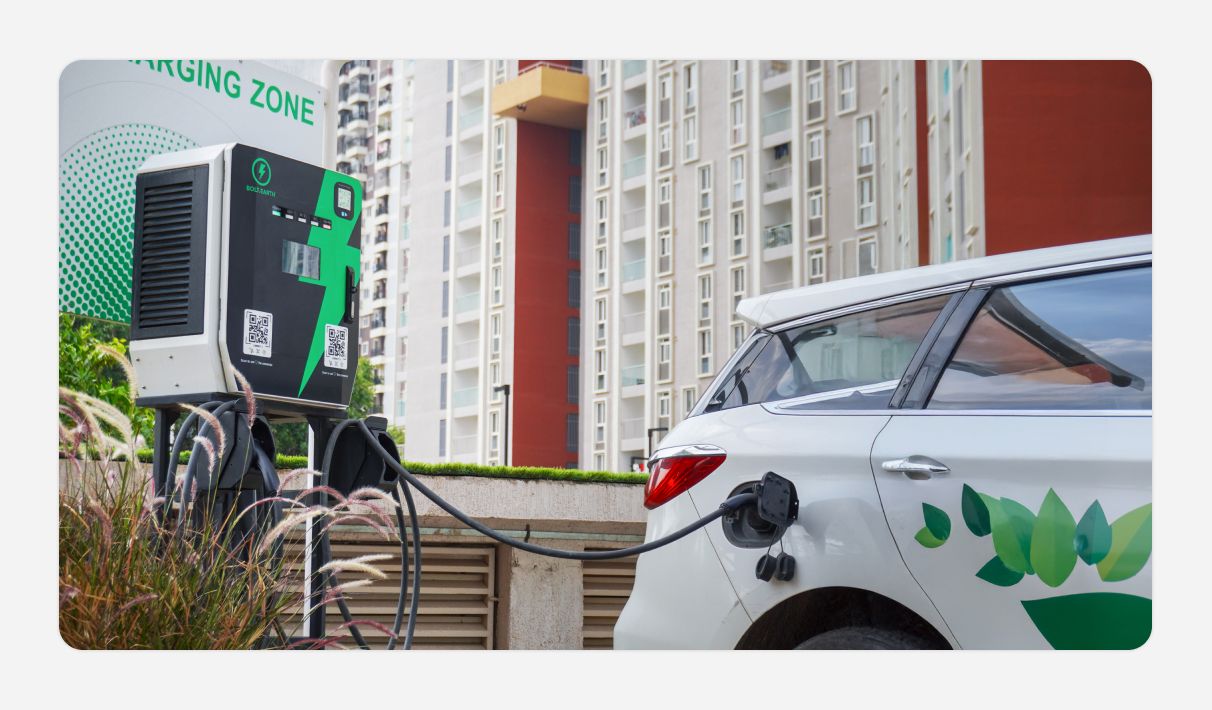
    Installing EV charger for apartment complexes involves several stakeholders: apartment owners (via the Resident Welfare Association, or RWA), the local electricity distribution company (DISCOM), and often municipal or building authorities. Fortunately, Indian government policy encourages, and in some cases mandates, EV charging for apartments in residential complexes. Key points include:

    No Special License Needed

    The Ministry of Power clarified in its EV Charging Guidelines that providing EV charging services does not require a separate electricity licence. In other words, you don’t need to become an “electricity supplier” to install a home charger; charging is treated as regular electricity use.

    Building By-Laws Require EV Provisioning

    The Ministry of Housing & Urban Affairs (MoHUA) amended the national Model Building Bye-Laws (MBBL) in 2019 to require EV-ready infrastructure in parking areas. Per these rules, 20% of parking capacity in new buildings must be reserved for EV charging infrastructure. States like Maharashtra and Karnataka have adopted similar rules: e.g., Karnataka mandates 10% EV-ready parking in new towers. This ensures future homes are “EV-ready,” but existing societies may need to retrofit wiring and parking to support residential EV charging stations.

    RWA Permission / Governing Body Approval

    In practice, any charger installation on society property needs RWA approval. Owners must pass an RWA resolution or AGM approval for dedicated charging points. RWAs can require EV owners to cover costs, but they should not arbitrarily block chargers. Some housing society bylaws have attempted to restrict EV chargers for non-technical reasons, but such restrictions conflict with government intent.

    DISCOM Coordination

    Once the RWA agrees, the DISCOM must be involved to supply power. Under the latest Ministry of Power guidelines, DISCOMs must supply electricity for EV charging through either the resident’s existing meter or a separate sub-meter, per the owner’s choice. Practically, this means:

    • Existing Meter: The EV charger draws power from the owner’s current apartment connection. The owner simply pays the extra usage on their usual bill.
    • Sanctioned Load and Panel Upgrades: Many apartment complexes have a limited power supply. If EV charging pushes the load beyond the society’s sanctioned capacity, the RWA must apply to the DISCOM for a load increase. This often involves an engineer survey and fees for extra capacity. Internal wiring (distribution panels and feeders) may also need upgrading to safely handle the new chargers.

    Step-by-Step Installation Process

    Apartment_1.jpg

    An apartment society should proceed roughly as follows:

    • Form a Committee and Survey Demand: The RWA or EV-owning residents should survey how many owners want chargers and form a small EV committee.
    • Obtain RWA Approval: Pass a general-body resolution allowing charger installation.
    • Consult DISCOM: Ask the local power utility about requirements. They may survey the site to advise on meter installation, necessary load upgrades, and any fees.
    • Apply for Connection / Load Upgrade: Request permission to connect (usually a NOC) or apply for a new connection or load enhancement. Follow the prescribed timelines (electricity rules mandate action within 30-60 days).
    • Choose Equipment and Vendor: Approve a list of BIS-certified chargers and licensed contractors.
    • Electrical Upgrades: Install or upgrade panels, wiring, and meters.
    • Commissioning: After installation, test each charger, ensure RCDs are functional, and update fire safety (e.g., fire extinguishers) and security measures (CCTV in parking).
    • Metering & Billing Setup: If using sub-meters, decide billing mechanisms: individual EV owners can pay their meter bills directly, or the RWA can collect usage fees. If relying on one master meter, the society must establish a fair cost-sharing mechanism (see next sections).

    Legal Rights

    Under the Electricity Act and Supreme Court rulings, RWAs cannot unreasonably prevent EV charger installations if they comply with safety norms. Disallowing a resident from using their allotted parking slot for EV charging is generally not permissible. Industry analysts note that “many residential communities do not allow EV chargers… despite central guidelines” and urge states to enforce citizens’ rights.

    Blog Banner

    What Charging Setups Work Best in Indian Housing Societies?

    Once permissions are cleared, society can typically choose between two models: private chargers (individual chargers at owners’ parking spots) and community chargers (shared charging stations in common areas). Some societies use a mix. The right choice depends on society’s size, parking layout, and budget.

    1. Private (Individual) Chargers

    Charger_installed_at a_host_place.jpg
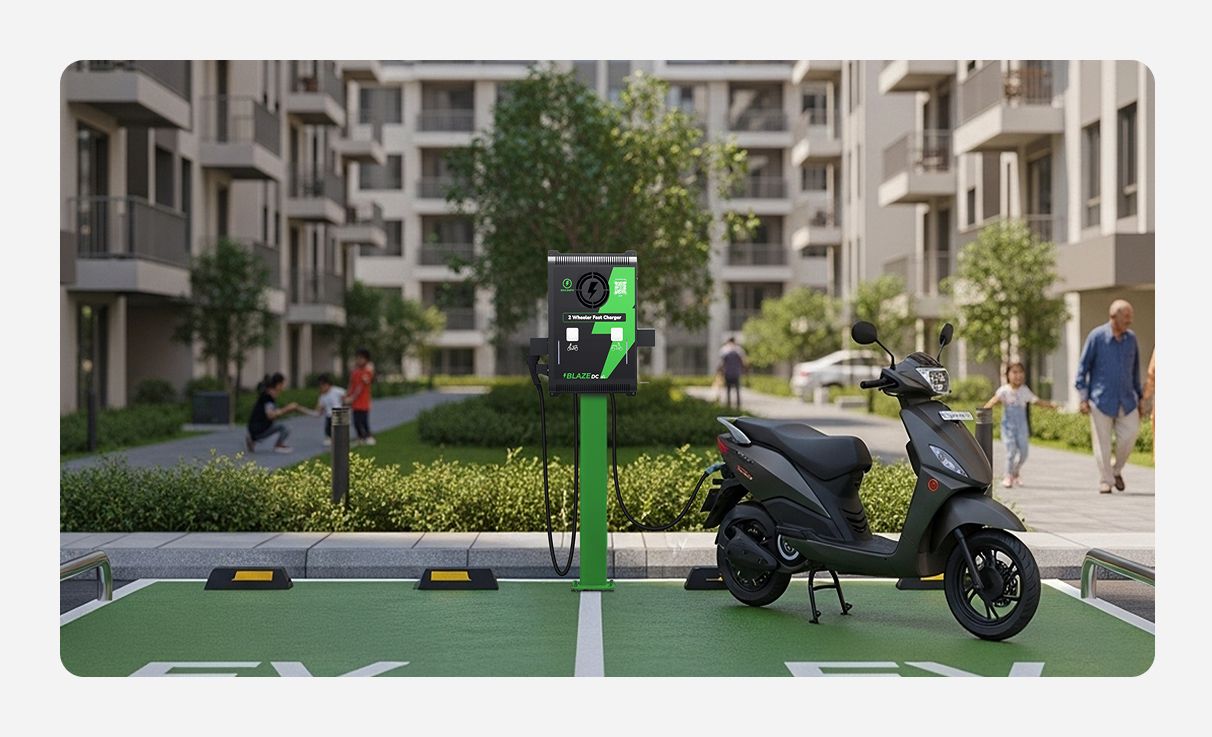
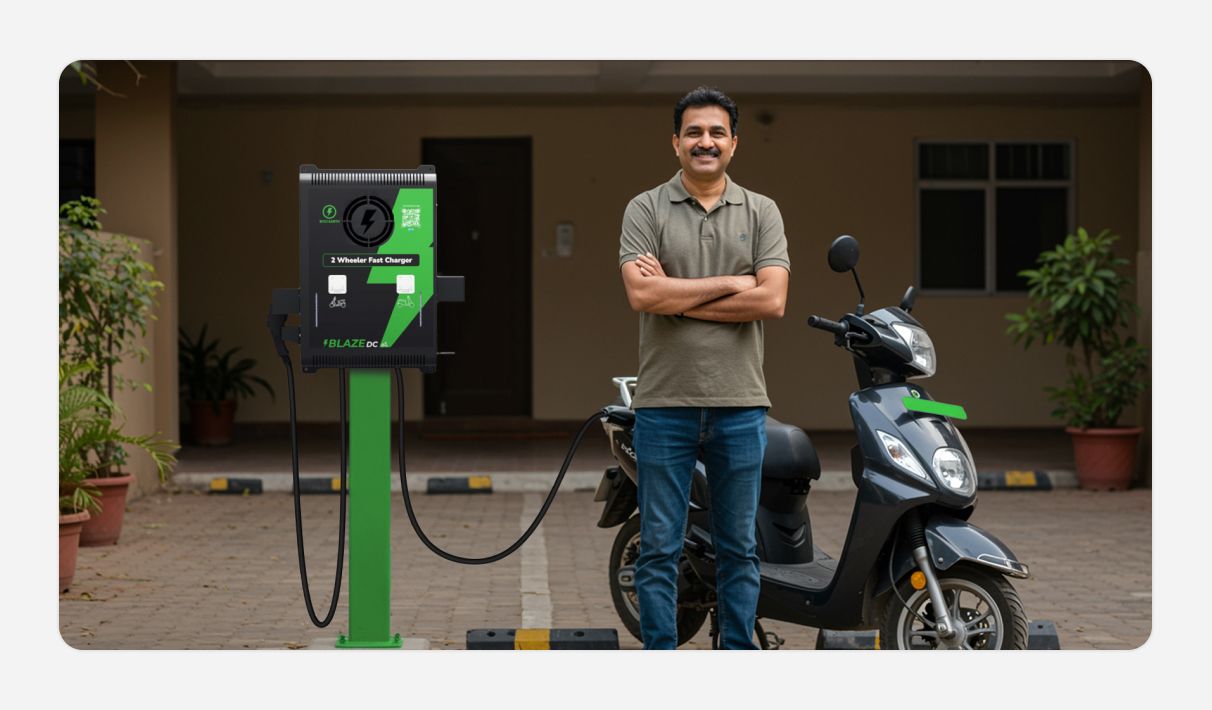
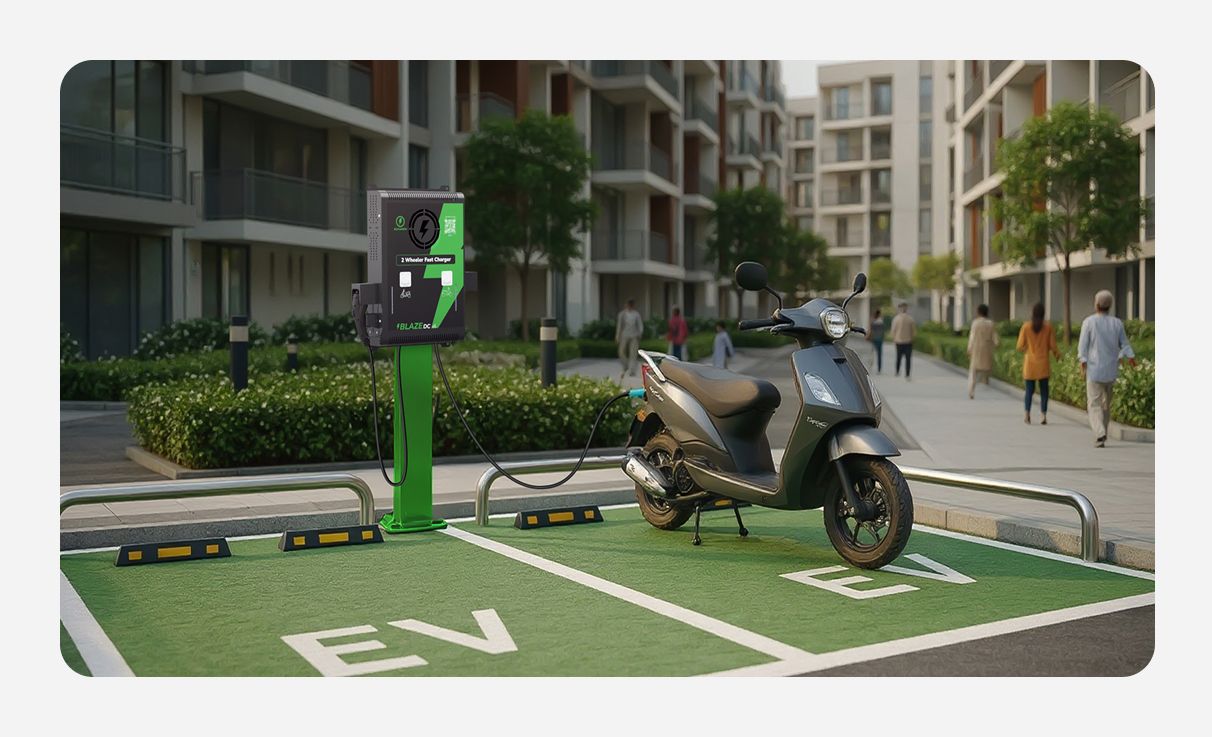
    In this model, each EV owner installs a charger at their own parking bay, usually an AC Level 2 charger (3.3–7.4 kW, 15–32A). The advantages are simplicity and owner control: each person pays for their own charger and electricity use. Installation can tie into the owner’s existing power meter (if the load permits), so billing remains straightforward. Individual chargers suit early adopters or smaller societies where each car has its own space.

      • Community (Shared) Charging Stations

    Apartment_2.jpg
    Here, RWAs install charging points in common areas. These may be slow AC chargers or DC fast chargers. Residents use them via reservation or pay-per-use. This model spreads infrastructure cost and suits societies with unassigned parking. Under new guidelines, RWAs can set community charging fees based on applicable tariffs. For instance, a Nagpur society set up a dual AC/DC station funded by the society; residents pay ₹20 per kWh plus GST when they use it.

      • Smart Charging Networks

    Some larger societies are adopting IoT-enabled chargers with dynamic load management and pre-booking features. Over time, these systems can be scaled (5–10 slots today, easily 50+ tomorrow) as EV ownership grows.

    Metering Models
    Regardless of setup, metering is crucial. There are two main approaches:

    • Individual Sub-meters: Each charger (private or shared) has its own meter. In new connections, DISCOMs often offer a dedicated EV tariff. The RWA or owner gets a separate bill for each meter. This model maximizes transparency and allows the use of EV-specific rates. Multiple submeters work well for both private and community chargers.
    • Single Master Meter: All users draw from one meter, and society divides consumption among EV owners. This requires trust and administrative effort.

    How Much Does It Cost, and Who Pays?

    A big question is “How much will this cost, and who foots the bill?” Costs come from hardware (chargers, wiring, meters) and electricity usage. Responsibility typically falls either on the individual EV owner (for private chargers) or on the RWA/owners (for community chargers), but government incentives can ease the burden.

    Charger & Installation Costs

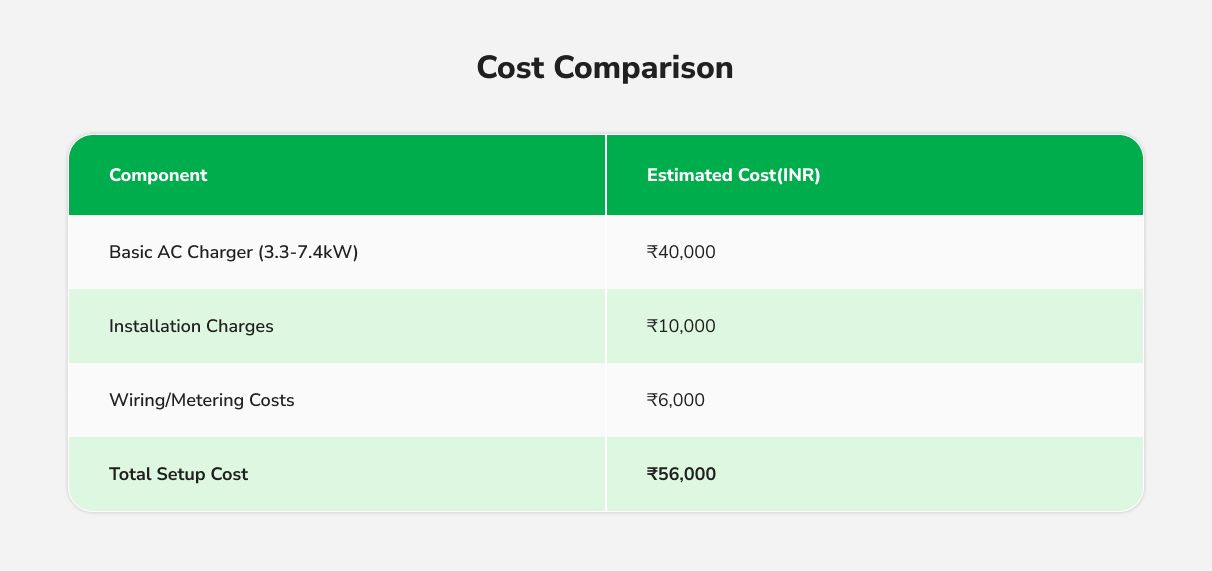
    A basic AC home charger (3.3–7.4 kW) typically costs ₹40,000–50,000. Installation and wiring add another ₹15,000–20,000. For example, an industry estimate breaks down a 7.2 kW charger as ₹40,000 (charger) + ₹10,000 (installation) + ₹6,000 (wiring/meters) = ₹56,000 total. Premium or fast chargers cost more (lakhs of rupees) but are rare in apartments.

    Existing electrical panels or transformers in older complexes may need an upgrade. A sanctioned load increase or new transformer can cost lakhs of rupees (often shared by all owners). States are beginning to subsidize this: for instance, Delhi offers up to a ₹30,000 subsidy per society to upgrade load. But without subsidy, the RWA must plan and allocate funds (sometimes from the society’s reserve fund) for such grid upgrades.

    Electricity Tariffs

    Power cost for charging is surprisingly low. If an EV consumes 7 kWh per night, that’s about 210 kWh per month. Even at ₹10/unit, that’s just ₹2,100 monthly. In practice, home charging often costs only ₹100–150 extra per month for a typical EV. EV experts stress that home charging is cheaper than public fast charging because residential tariffs are lower.

    Discoms increasingly offer dedicated EV tariffs (e.g., ₹4–5/unit) to encourage charging at home. However, one must usually use a separate meter to qualify. The IEEFA report notes that without a separate meter, “users cannot avail special discounted tariffs”. Thus, many societies opt for submetering so EV owners can pick the EV rate, a common setup for EV charging for apartments.

    Subsidies and Incentives

    Both the Central and State governments are providing incentives to lower costs:

    Central Schemes

    A BEE/EVI scheme allows RWAs to apply for subsidies on community charging, but uptake is minimal.

    State EV Policies

    Several state EV policies explicitly target residential charging:

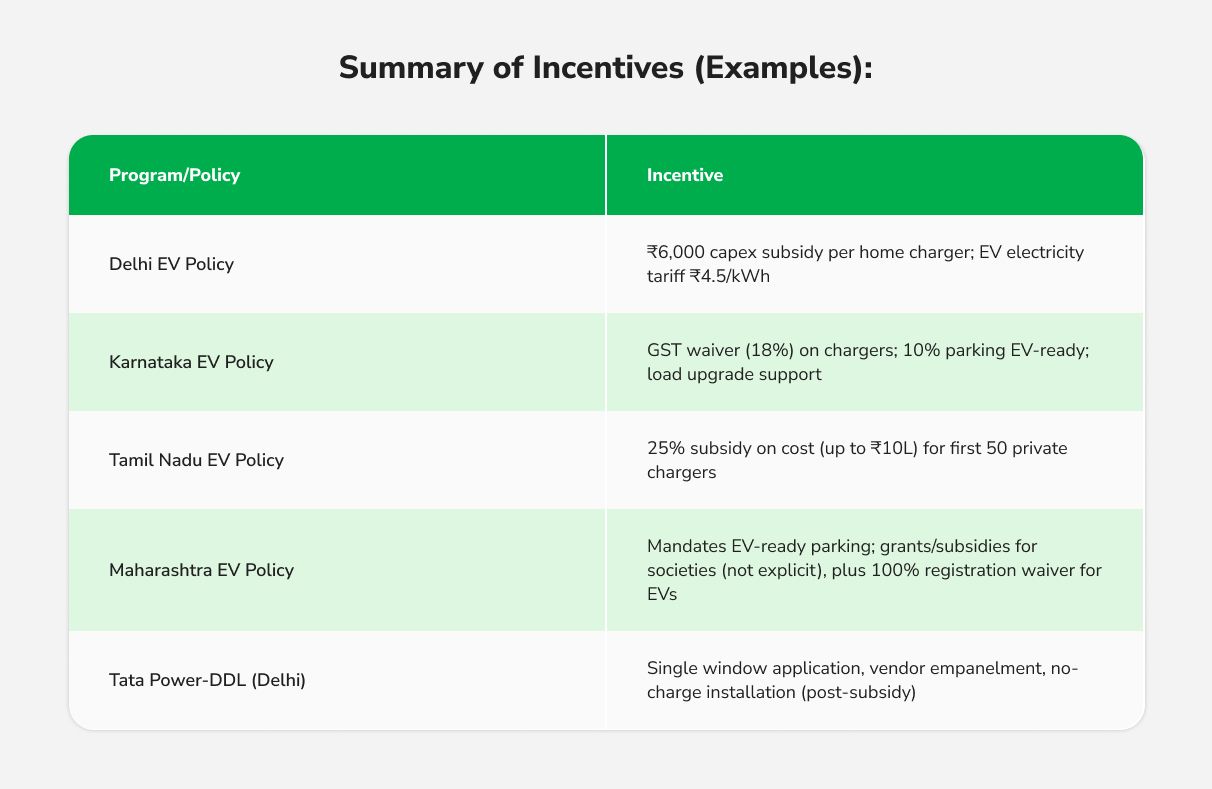
    • Delhi: Under Delhi’s Switch Delhi program, private owners get a ₹6,000 subsidy per home charger (on the charger capex). Additionally, owners can opt for a new “EV connection” from the DISCOM, with a special tariff of ₹4.50/unit. In Delhi’s scheme, the DISCOM even empanels vendors and offers a single-window online application.
    • Karnataka: Karnataka waived the 18% GST on EV chargers, meaning a 7.2 kW charger (₹42k + tax) can be bought for about ₹35,000 in practice. The state also mandates 10% EV-ready parking in buildings and allows communal chargers after a 2/3 society vote. BESCOM (Bangalore’s utility) has a mobile app for easy connections and bookings.
    • Others: Maharashtra’s EV policy 2021 offers road-tax and registration waivers for EVs and encourages developers to include charging points. The Delhi Development Authority and local municipalities in some cities have fast-tracked permissions and fee waivers for EV charger installations in apartment societies.

    DISCOM/Developer Support

    Some power utilities have their own schemes. Tata Power-DDL (Delhi) empanels vendors and promises 7-day installation service under the govt. scheme. BESCOM (Karnataka) partners with private operators, effectively subsidizing demand charges. Developers of new complexes often include base infrastructure (like conduits or panel capacity) in the building plan, as mandated by MoHUA.

    So who pays for the bill?

    • In an individual charger model, the EV owner bears the hardware cost and electricity. If using the existing meter, the cost is reflected in the owner’s normal bill. If a new meter is taken, the owner pays that bill.
    • In a community charger model, the RWA or society may invest in the charger and then recoup costs from users.
    • Grid upgrades are typically funded collectively by all owners. Since load enhancement benefits all, it’s often taken from the society’s funds or special contributions.

    Cost Comparison

    Cost Comparison.jpg

    To illustrate, consider installing a simple 7 kW AC charger at home. Total cost approx. ₹50–60k (with installation). If a Delhi subsidy of ₹6k applies, the net hardware cost is ₹44–54k. Spread over 5 years, that’s ₹750–1000/month. Added to electricity use (₹150/month), the total cost is roughly ₹900–1200/month. By contrast, a petrol SUV burns approximately ₹15,000 of fuel per month for similar use. So electric still wins hands-down on fuel savings.

    Summary of Incentives (Examples):
    Cost Comparison-1.jpg

    These incentives, together with dropping charger costs, mean EV solutions for housing societies are increasingly affordable.

    Best Practices and Case Examples

    Apartments across India are already pioneering EV charging solutions. For example, a new society near Nagpur (MIHAN) installed a mixed AC/DC station in its parking. Notably, residents report that no upfront payment was needed; the society covered installation, then billed users per kWh. They did submit a green load increase request to the DISCOM beforehand. This shows that with proper permissions, societies can make charging available at little or no cost to individual members.

    Other best practices include:

    • Pilot Testing: Start with a few chargers and gauge usage. Many RWAs encourage interested EV owners to chip in for a pilot station.
    • Load Management: Use smart controllers or time-of-day billing. Some societies offer overnight charging only when tariffs are lowest.
    • Fair Cost-Sharing: Keep non-EV owners’ concerns in mind. It often helps to create an EV reserve fund or allocate part of the RWA’s sinking fund for upgrades. Clearly communicate that an EV charger is like any amenity (like a pool or gym), and EV owners can pay for it as needed.

    Finally, it’s important to raise awareness: IEEFA recommends that state agencies run campaigns about EV charging safety and tariffs. Lack of awareness is the biggest hurdle: many societies initially do not allow EV chargers, citing “unknowns”. Education (sharing guidelines, success stories, and vendor demos) usually helps overcome hesitation.

    Conclusion

    As India’s EV population grows, residential charging will become essential. Fortunately, the regulatory framework now supports EV charging for apartments. With careful planning, involving the RWA, DISCOM, and residents, most societies can implement a mix of private and community chargers that fit their space and budget.

    The transition requires some effort (resolutions, load upgrades, wiring), but the rewards are clear: greater convenience, higher property values, and a greener neighborhood. In practical terms, a modest investment pays off in a few years through fuel savings and government subsidies.

    Whether you’re a homeowner with an EV or an RWA leader, now is the time to act. Begin the dialogue in your society, consult with power utilities, and tap into the growing market of EV solutions for housing societies. With each society that connects an EV charger, we drive India closer to a cleaner, smarter transportation future.

    Blog Banner